Feeds:
Posts
Comments

Magnificent Hampton Court

The back of Hampton Court

Gentle Reader, When I published the post about Patrick Baty’s article, The Paint Detective, Jane Austen’s World contributor, Tony Grant, did a double take. He had visited Hampton Court and taken note of the gates that Patrick’s firm had analyzed and that were subsequently repainted. Tony wrote:

Privy garden, Hampton Court

“I thought I was seeing things in your recent article, Vic, on Jane Austen’s World. Well I was. I was looking at some of the gates on the river side of Hampton Court. Hampton Court is four miles from us. Whenever friends or family come to stay. if the weather is fine, we often have a walk around Hampton Court. For those who have never seen it, it WOWS!!! them big time.

William and Mary Courtyard, Hampton Court

These pictures are when an old school friend of mine, Clive, was over with his family from Hamilton Ontario. These pictures were taken in 2005.”

To the Tudor kitchens, Hampton Court

From these images, you can see that Hampton Court is indeed a “living Tudor world.”

Cloistered area, Hampton Court

Armorial beast, Hampton Court

Wolsey's Coat of Arms

From the river walk through the railings of the fence, Hampton Court

Gilded gate, Hampton Court

Another image of the gate, Hampton Court

James Purefoy as Beau Brummel

Of course it became a fashion to exaggerate the Beau’s fastidiousness concerning his toilet. He is said to have employed at least two glovers to make his gloves — the first being entrusted exclusively with the making of the thumbs, the second with the fingers and the rest of the hand; to have made his blacking with champagne, to have had the ties of his cravats designed for him by an eminent portrait painter; to have engaged three hairdressers arrange his hair, one being entrusted with temples, one with the front, and the third his occiput [back of the head].

Quote from: Once a Week, by Eneas Sweetland Dallas, 1864,   p 242-243

The Paint Detective

Inquiring readers, Patrick Baty has written a fascinating article, The Paint Detective on the methods he uses to identify and examine early paint layers.

Paint sampling, Image, Patrick Baty

These images in his account demonstrate the methods he uses to analyze the paints. First, he takes small samples, which he sets in resin and cuts through to examine under various microscopes.

Spencer House Painted Room, Gilding. Image, Patrick Baty

He carries out pigment analysis and scans the samples under the electron microscope. These actions (and more) and documentary evidence lead him to restore the colors of rooms and houses as they once were (or close to it.)

Hampton Court, Tijoy Screen, Image Patrick Baty

Read Patrick’s other posts on this blog:

Murder on the Bride’s Side is Tracy Kiely’s second murder mystery. I thought her debut novel, Murder at Longbourn, quite charming. Although it was set in modern times, the tie ins to Jane Austen were detailed enough to be satisfying. (In the first book, Aunt Winnie was the proprietor of the Inn at Longbourn, the heroine Elizabeth Parker turned to reading Pride and Prejudice in times of stress, a cat named Lady Catherine prowled the premises, and two friends named Bridget and Colin joined a band of murder suspects for the New Year’s festivities.)

Murder on the Bride’s Side begins where Murder at Longbourn left off. Elizabeth Parker, the heroine who helped to solve the first murder, thereby saving her aunt from being falsely accused, is a fact checker for a local Virginia paper. This explains her eye for details. As the novel opens, guests are assembling to attend Bridget and Colin’s wedding in Richmond, Virginia. Elizabeth and Peter McGowan are now an item, which must have made Aunt Winnie deliriously happy, for she practically forced Peter’s company onto Elizabeth in Murder at Longbourn.

During her spare time Elizabeth reads Sense and Sensibility, which is quoted quite often at the start of this mystery. These quotes provide a tentative connection to Jane Austen, for, unlike Tracy Kiely’s first novel, the plot of this book has not been so neatly constructed around Jane’s oeuvre, and Tracy stops quoting Sense and Sensibility early on. She quotes other books as well, each one introducing a new chapter, setting up the theme.

As guests arrive for the wedding and assemble for the rehearsal dinner and reception, the reader is introduced to each murder suspect. The victim, Roni, is a suitably nasty individual whose treatment of her husband, Avery, her daughter, Megan, and the world in general is such that murdering her was quite a sensible solution.

Bridget and Colin are married and then the fun happens. As with Tracy Kiely’s first novel, the murder and its denouement are incidental to the development of the characters and their relationship to each other. Kiely’s writing style is breezy and effortless, and she has constructed a tight and entertaining mystery that leads to a satisfying conclusion. This time around the murder is not so easily solved, for she offers a side trail that a careless reader who has missed some important clues might follow.

And now we come to the tricky part of this review, for I truly enjoyed this novel. I live in Richmond, Virginia and was delighted to learn that the novel was set in my city. But the city that Tracy, a Maryland resident describes, is not one that I know. Basic mistakes were made. While going to The Tobacco Company in Shockoe Slip, Tracy has her guests park in a garage near Capitol Hill and then walk several long city blocks to the restaurant. With so many parking garages closer to this dining establishment, why would anyone want to walk through such a featureless, uninteresting part of town? The Governor’s mansion and Virginia state capitol building are not easily seen from the street and the traffic is ghastly. The cobble stone streets of East Cary Street with its trendy boutique shops, restaurants, and bars would have made a much more picturesque backdrop. Plus Tracy describes this slightly touristy, trendy-in-the-1980’s restaurant in detail, while barely mentioning the magnificent interior of the world class, historic register Jefferson Hotel several chapters later.

In this book, Tracy often arranges for people to meet “downtown”. Well, downtown Richmond is a wasteland of office buildings, banks, vacant lots, and parking garages. Major thoroughfares crisscross streets, making it hard for pedestrians to navigate towards the river, for example. The few restaurants that are making it in the financial district tend to be open only for breakfast and lunch. For entertainment and dining, Richmonders say they will meet in a specific section of town: The Fan, Cary Town, the Museum District, Church Hill, the Canal Walk, Belle Isle, Shockoe Slip, Shockoe Bottom, Libby and Grove, or the near or far West End. I am being picky, I know, but not once did I get the sense that Tracy’s characters were living and breathing in my city.

Perhaps I quibble too much, for this reviewer from The Richmond Times Dispatch was quite delighted with the book.

I give Murder on the Bride’s Side two out of three Regency fans. Will I read another Elizabeth Parker murder mystery when Tracy Kiely writes her third book? Why, yes, of course. I want to follow Peter and Elizabeth as they deepen their romance against a backdrop of murder most foul. Just not in Richmond.

More on the topic:

Watch the latest Inspector Lewis mystery, The Dead of Winter, on PBS’s Masterpiece Mystery site from September 6 until September 19. Click here for behind the scenes videos.

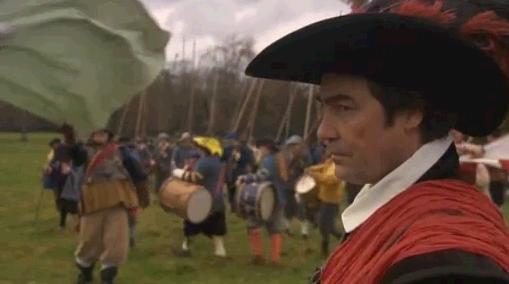
The episode opens with a shooting at a re-enactment of a battle on the grounds of Crevecoeur Hall

The curious case leads back to Crevecoeur Hall, a vast, history-rich Oxford estate, and as it happens, the setting for much of Detective Sergeant Hathaway’s (Laurence Fox) youth. Hathaway reconnects with his past – and Scarlett Mortmaigne, the daughter of the estate’s owner. But is he also consorting with a main suspect? It’s a case that threatens to expose the shortcomings and secrets of a wealthy family, cloud Hathaway’s judgment and ultimately put his relationship with Detective Inspector Lewis (Kevin Whately) in jeopardy.

Hathaway is haunted by the death of a 10 year-old girl

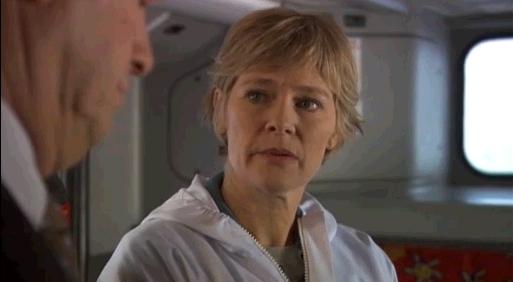
The Dead of Winter, the second episode in the third season, opens with a melancholic Hathaway testifying in court about an atrocity commited towards a ten year old girl. He cannot shake off the image of finding her body in a water cistern. Inspector Lewis is unable to communicate with his friend, and the emotional gulf between the two partners widens. As Dr. Hobson observes caustically, “boys never let anyone in.”

"Boys never let anyone in", Laura Hobson observes

When Hathaway is called to a murder at Crevecoeur Hall, the estate where he spent the first 12 years of his life as the son of the estate manager, his past life comes tumbling back. As the story unfolds, we learn more about Hathaway’s childhood, and that he had once played with the butler (Pip Carter) another child on the estate, and young Lady Scarlett (Camilla Arfwedson), for whom he still carries a tendre and who fondly calls him “James the Just.” Her engagement to a rich man does not stop her from revealing to Hathaway how very much she still is attracted to him, but for James her confession is a painful reminder of “what might have been.” James the Just can see no reason for her preferring money over love, the choice she has made.

While attracted to Hathaway, Scarlett chooses money over love

The script weaves in these threads of James’s former life with current events and the murder of a doctor who had visited Crevecoeur Hall. As James investigates thecrime, the current estate manager of Crevecoeur Hall, whose wife had run away 20 years ago, commits suicide.

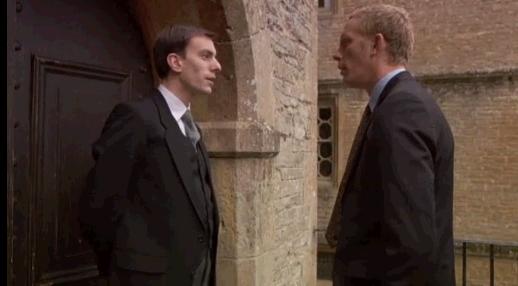
Hathaway and Paul Hopkiss, the butler and his former childhood friend

We meet an array suspects: the lord of the manor, Augustus Mortmaigne, the Marquess of Tygon (Richard Johnson); his wife, Selina Mortmaigne (Juliet Aubrey); her brother in law, Philip (Nathaniel Parker) with whom she is having an affair. Add a valuable painting that has been altered and that might hold clues, a Jesuit priest who knows more than he lets on, and a purring cat that Inspector Lewis rescues from the dead doctor’s home, and you have a fully fleshed mystery story populated with likely suspects. As both Lewis and Hathaway pursue the killer, both come at cross purposes.

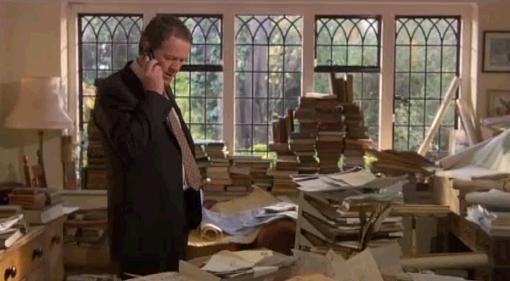
Lewis pursues his own clues in the dead Dr's office

That last statement of the quote that opens this review is a bit misleading. While Lewis becomes exasperated with Hathaway, whose surpressed longings for Scarlett have gotten in the way of his judgment, he has not come to the point of breaking off their relationship, and he makes it clear that he is content with Hathaway as a partner.

The lord of the manor and those who live on his estate have many secrets to hide

This second episode in Season 3 is better than the first – more tightly written and much darker in tone. The final scene is filled with suspense, and I did not guess the murderer until just before the major clue about corn starch was dropped. For those who have missed the episode, you can watch it online from September 6 through September 19.