Feeds:
Posts
Comments

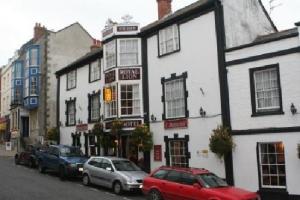
royal lion innDorset Public Inns With a Literary Connection showcases a number of inns with connections to John Cowper Powys, Thomas Hardy, Jane Austen,  Robert Louis Stevenson, and John Fowles. Constance Hill, author of Jane Austen: Her Homes and Her Friends, identifies the lodging in Persuasion as the Royal Lion Inn:

Now the inn to which they were bound we fully believe to have been the “Royal Lion,” which stands on the right-hand side about half way up the main street. The circumstances of the story all suggest it rather than the old “Three Cups,” the only other inn of importance in Miss Austen’s day. From the quaint projecting windows of the “Royal Lion” the ladies would be able to see Mr. Elliot’s “curricle coming round from the stable yard to the front door,” and could “all kindly watch” its owner as he drove up the steep hill. This would have been impossible from the windows of the “Three Cups,” which stood at the bottom of the main street and turned slightly away from it. The “Three Cups” was burnt down in 1844, but we have seen its site and have looked at an old print showing the building and its surroundings.

Update: Natalie Manifold, who runs the Jane Austen tours in Lyme Regis, wrote to say that Constance Hill’s information is wrong. The Royal Lion Inn is not the inn described in Persuasion. She has done extensive research on this topic, examining all the town’s old maps and records, and found that the front section of the hotel was a “privately owned cottage up until 1844 when it was scorched in a fire. Subsequently, it was sold and bought by the owner of the inn, which up until that point had been situated right at the back of the hotel’s car park near the river. The bay window is also Victorian as it was added when the front structure was included as part of the hotel.” Natalie concludes: “There is no way that the party would have been able to see up the hill from the hotel’s situation during the Regency period, leaving the old Three Cups as the most likely place of their stay.”

Agreeing with Natalie’s assessment are: John Fowles – the town’s most noted historian and author, Diana Shervington – relation of Austen, and Francis Turner Palgrave – Anthologist. (Thank you for the update, Natalie, which I very much appreciate.)
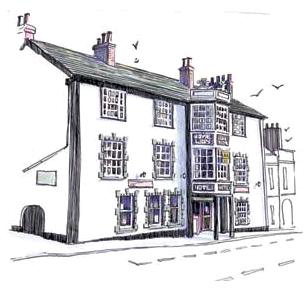
Royal Lion Inn Lyme Regis
Chances are that Jane Austen was familiar with the  Inn. In 1804 Jane Austen and her family traveled to Lyme and stayed there in the summer. The Royal Lion Inn, or the Lion as it was known, was built as a coaching inn in 1601. More information about the inn can be found in Dorset Public Inns With a Literary Connection. Over a century later, author and traveler, F. J. Harvey Darton wrote about the two inns:

Nothing could be better than the confrontation of the two chief hotels, the Royal Lion and the Three Cups. The Cups is the older house, and seems to go back to at least Stuart times in name and site. But they are both models of what a country inn of the better sort should appear to be. – The Soul of Dorset, F. J. Harvey Darton , 1922

More Links to Lyme Regis
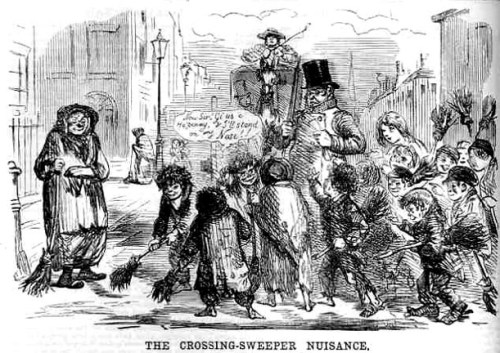
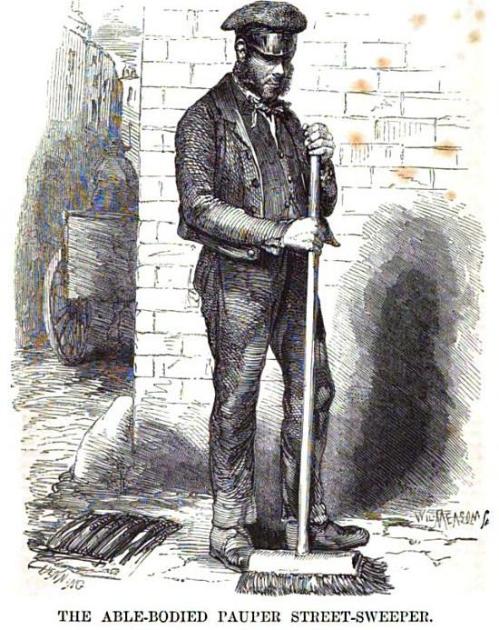
When horses drew every imaginable wagon in London, crossing sweepers were a common sight. In some areas of town they were regarded a nuisance, for often young boys would pester a pedestrian and sweep a clear path whether that person wanted their help or not. The practice of using crossing sweepers to clean the streets of horse manure, dust, and clinging mud lasted into the early 20th century. In the mid-19th century, Henry Mayhew chronicled the lives of working people in a series of volumes entitled London Labour and the London Poor. Mayhew described a system of cleaning streets, introduced by Charles Cochrane in 1843, that instituted a more orderly system than crossing sweepers, and in which former paupers were hired so that they could support themselves.

Crossing Sweepers, 1856

Crossing Sweepers, 1856

The first demonstration or display of the street orderly system took place in Regent street between the Quadrant and the Regent circus and in Oxford street between Vert street and Charles street The streets were thoroughly swept in the morning and then each man or boy provided with a hand broom and dust pan removed any dirt as soon as it was deposited The demonstration was pronounced highly successful and the system effective in the opinion of eighteen influential inhabitants of the locality who acted as a committee and who publicly and with the authority of their names testified their conviction that the most efficient means of keeping streets clean and more especially great thoroughfares was to prevent the accumulation of dirt by removing the manure within a few minutes after it has been deposited by the passing cattle the same having hitherto remained during several days. – London Labour and the London Poor, p. 259

street sweeper

The groups of orderlies not only swept the street and removed dirt in a particular area of London (500 linear yards of a busy street, 2,000 yards of a quieter section, and 9 men in a busy intersection, like Cheapside), but they also acted as “the watchman of house property shop goods, the guardian of reticule,s pocket books, purses and watch pockets, the experienced observer and detector of pickpockets … more, he is always at hand to render assistance to both equestrian and pedestrian.” The report concluded that the street-orderly system would keep the streets of London and Westminster clean in a most satisfactory way. In return, the street-orderlies would earn a wage of 12s. Although this was a lower living wage than other workmen earned, the money lifted them out of their lives of squalor.

The system did not entirely replace the crossing sweepers, many of whom were depicted in caricatures as hounding pedestrians for services rendered. Read my article on Crossing Sweepers at this link.

Mr. Knightley's Harvest Ball

Mr. Knightley's Harvest Ball

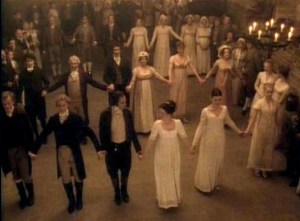
I prefer Kate Beckinsale’s Emma, written by Andrew Davies, because of the film’s depiction of ordinary life, such as farmers threshing grain before the Harvest Ball. These scenes were not written by Jane Austen, but they added authenticity to the film. When I saw this image, (Detail taken from the New York Public Library’s digital collection of the Costumes of Yorkshire, 1813-1814), I knew that the costumers and the director, Diarmuid Lawrence, had done their research. I loved the quality of the golden light that bathed the workers, lending the scene an antique, painterly feel. There are so many glorious visual moments in this film, which is well worth watching despite the script’s many variations from Jane’s plot.

Detail, Rape Threshing, 1813, The Costume of Yorkshire, New York Public Library

Detail, Rape Threshing, 1813, The Costume of Yorkshire, New York Public Library

By 1750, British agricultural practices were regarded as among the best in the world. The Industrial Revolution accelerated new practices in agriculture, in which animal power and human labor were aided by newly invented farm machinery. These inventions, as well as the new methods of food production, greatly increased the food supply.

harvest
Four-field rotation was practiced in England.  Specific crops were grown in a scientific sequence that managed the different nutrients in the soil. With this method, the continuous use of land was possible; more importantly, additional forage crops for livestock could be grown. This increase in the food supply could support livestock through the winter, which led to an improved diet year round. Even the poor could occasionally augment their bread with meat and dairy products, such as cheese.

harvest 2 (2)
While the Enclosure Acts from 1750-1831 drove many subsistence farmers off their small holdings of around 20 acres, the movement combined land into larger tracts for more efficient farming, and allowing portions of the fields to lie fallow. The traditional method of subdividing the land allowed farmers to feed their families, but their holdings were too small to follow the new method of crop rotation.  The larger holdings (which usually favored the richer land owners) applied modern methods of crop production. The unlucky farmer who lost his lands also lost the means to support his family independently. He and his family had no choice but to find work in the industrial north or in London. These burgeoning urban centers required an enormous amount of food to be brought in daily over long distances. One imagines that after Mr. Knightley set aside enough of the harvest for his own consumption, he transported the remainder to cities to be sold for profit.

harvest 3 (2)

More on the topic:

Watch Little Dorrit Online

In celebration of Little Dorrit’s remarkable seven wins at the emmys, PBS will be showing the series online for a limited time. The duration of online availability is through Sept 29, so hurry and click here to watch this well-crafted and outstanding show in its entirety. USA only. So sorry, our other country friends.

pipe09-dorrit-big

Saving Georgian Bath

After many parts of Bath disappeared overnight during a German bombing raid in World War II, efforts to restore the city began – efforts to reconstruct the major landmarks like the Assembly Rooms and The Circus, that is.  Smaller Georgian houses were scheduled for demolition.  In 1970, a horrified James Lees-Milne wrote to the Times:
Your readers may be interested to learn that we are getting on quite nicely with the demolition of the centre of Bath. This year alone we have swept away several acres between Lansdown Road and the Circus. The whole southern end of Walcot Street (including the 19th century burial ground and tombstones) has entirely gone. We are just beginning on Northgate Street and have only knocked down two or three houses in Broad Street this month. But New Bond Street’s turn is imminent. All the houses are (or were) Georgian, every one.
Lees-Milne, who joined the National Trust, “played an active part in the campaign to save Bath.” Click here to read the review of Michael Bloch’s book, James Lees-Milne, The Life: Saving what was left to a Georgian city, which goes on to describe the rest of this fascinating story.