Feeds:
Posts
Comments
Mr Darcy, Vampyre coverInquiring reader,

Great news! I have come across some letters by Elizabeth Bennet about  Mr. Darcy, Vampyre, written by Amanda Grange
, which is coming out this month. These letters, well, critiques, really, were penned long ago and describe events that seem to have transpired in a parallel universe. I was particularly struck by how freely Elizabeth shared her thoughts with her sister Jane about her adventures with an other-worldly Mr. Darcy. I will be publishing all of Elizabeth’s critiques over the next few days. Contained herein, then, is critique, part one of Mr. Darcy, Vampyre. For those to whom this matters, spoiler alert!

My dearest Jane,

I have unaccountably awoken in the 21st century and I am writing to you out of habit, though I surmise that you must be long gone, or also living in that grey netherworld of the undead fictional character into which I have landed. I’ve just discovered that Mr. Darcy and I are the hero and heroine of a spate of books that, frankly, my dear sister, make me blush from shame. Apart from their topics (imagine us as zombie fighters and being married to vampyres), I am depicted as behaving in a manner that is so unlike myself that I fear my blood shall boil from the rise in my temper.

A recent book, which has turned my Mr. Darcy into a vampyre, has me seething in particular, for, my dear Jane, you know better than anyone that I am no namby pamby missish nebbish. In this book, the author has Mr. Darcy shunning my bed. The REAL Elizabeth Darcy née Bennet, had Mr. Darcy been guilty of such a heinous offence, would not have accepted the situation without hunting him down the corridors of their cruise ship (which is what honeymoon vessels seem to be these days) and demanding an explanation of why he was unresolved in his husbandly DUTY of BEGETTING an heir immediately. Instead, this Ms Grange has me strangely accepting the situation as if I were a zombie, which I am assuredly NOT, for has not Mr. Grahame-Smith given me the warrior skills to chop off their heads?

What particularly burns me, to use 21st century parlance, is that I take pride in my conversational ability. Sparks fly when Mr. Darcy and I converse. Even when such a mundane subject as tea comes up, double entendres abound. One may be assured that Mr. Darcy and I can easily devote hours of our lives sparring verbally and taking pleasure from these seemingly uneventful encounters. But Ms Grange has us speaking in dead and flat voices, as if we were not Mr. Darcy and Elizabeth from the brilliant mind of Jane Austen, but another couple conjured up by some other author who happened to have given us similar names.

My dear Jane, I can assure you that there is only ONE Mr. Darcy and his Elizabeth. And so, I do protest strongly. Let Miss Grange choose another couple to write about. Miss Jane Austen was the first to use us and she should be the last! Oh, I am exhausted. My blood has almost reached boiling point, and I must find a cooling bath for, unfortunately, more than one reason.

Signed,

Your wedded but unbedded sister, Lizzie.

P.S. Are you experiencing a rabid bat infestation? One almost flew through my window, but I slammed it shut before it could enter. I shudder to think what might have happened had it landed on my neck. (Now why on earth did I think that?) I shall write more about this situation tomorrow, for there is so much I must share with you about my new life that my thoughts cannot be contained within a mere few sheets of vellum.

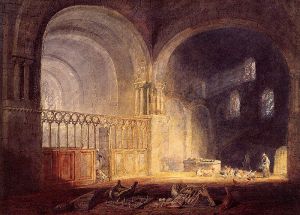
Interior of Lindisfarne Priory, 1797, Thomas Girtin

Interior of Lindisfarne Priory, 1797, Thomas Girtin

Young Thomas Girtin’s painter friend was the famous artist J.M.W. Turner. As teenagers both men had been employed to color prints with watercolor paints. While Turner lived to be over seventy-five years of age, Girtin died of consumption at 27. Turner would recall in his later years: “Had Tom Girtin lived I should have starved.” No small praise.  During his short life, Girtin gained a major reputation as a watercolor artist and played an important role in establishing English Romantic watercolor paintings as an art form. As one biographer noted, “While Girtin lived, Turner followed.”  One can only imagine how fascinated young and romantically minded Catherine Morland would have been had she seen Girtin’s painting of the priory ruins.

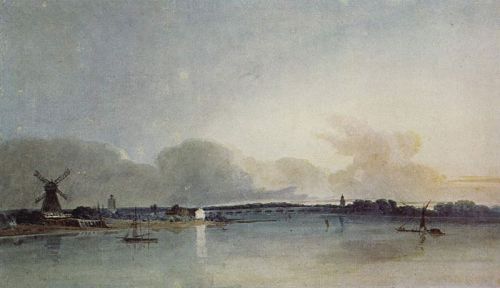
Watercolor landscape, Thomas Girtin, 1800

Watercolor landscape, Thomas Girtin, 1800

Three years before his death, Girtin had acquired important patrons who collected his works. Thankfully the young artist had been prolific and his influence was not soon forgotten. In 1842, while sketching high in the Swiss Alps, a mature Turner, reminded of a unique effect of light in darkness, penciled a brief note in the margin of his drawing: “Girtin’s White House.”

Transept of Ewenny Priory, Glamorganshire, JMW Turner, 1797

Transept of Ewenny Priory, Glamorganshire, JMW Turner, 1797

Read about Thomas Girtin in these links:

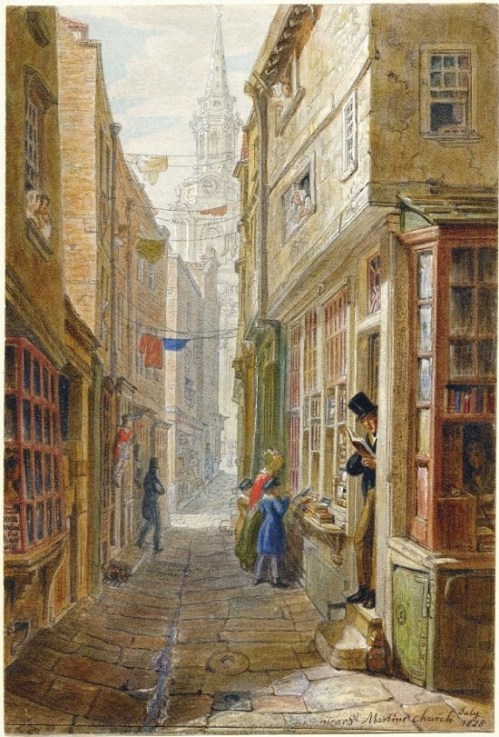
St. Martin's Church Lane, George Scharf, 1828

St. Martin's Church Lane, George Scharf, 1828

Inquiring reader:  I was visually arrested by this image of St. Martin’s Church Lane, which was painted by the German artist, George Johann Scharf (1788-1860), who lived on this street during the prime of his career. The image, painted in 1828, is a snapshot of London during George IV’s reign as king and captures the metropolis as I imagine it in those days. Born in Bavaria, George Scharf studied painting and lithography under Professor Hauber in Munich. The illustrator began traveling throughout Europe in 1810 and was caught up in the siege of Antwerp in 1814. He escaped and enlisted in the English army, where he drew maps and sketches of fortifications and troop movements. After Waterloo, Scharf moved to Paris, and in 1816 he emigrated to England and became a successful illustrator of ordinary life in England.
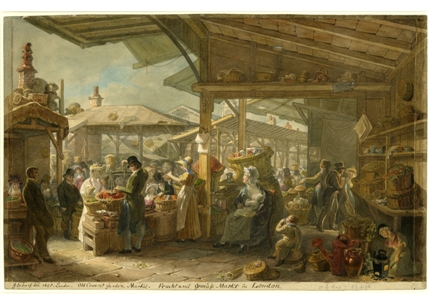
Old Covent Garden Market, 1825, George Scharf

Old Covent Garden Market, 1825, George Scharf

George Scharf has been described as the pictorial equivalent of the literary chronicler of early Victorian London, Charles Dickens. Scharf studied in Munich and became an expert in lithographic printing and miniature portrait painting. He settled in London in 1816, at a time when the capital was undergoing a dramatic expansion, and spent the rest of his life in the city. The rapidly changing face of early Victorian London is depicted in this exhibition through some 60 works. Scharf’s vivid, detailed drawings capture every aspect of ordinary life, showing people going about their daily business in fine detail – from the boots on their feet to the buttons on their coats and the hats on their heads – recorded with an immediacy that is almost photographic.
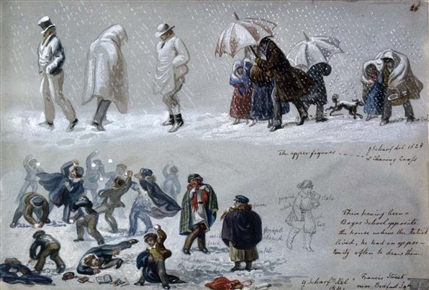
Sketches of people in snow, Scharf, 1820-30, British Museum

Sketches of people in snow, Scharf, 1820-30, British Museum

Not only do the pictures offer an interesting insight into London’s inhabitants, Scharf also precisely recreates the architectural landscape of the city. His work combines a sensitive observation of the individuals in the pictures with architectural accuracy to give a full picture of the city and its people as he saw it. In the 1820s and 1830s London experienced a huge growth in what would now be described as ‘consumer culture’ and Scharf’s pictures depict the advertising hoardings and shop signs that started to appear all around the city. They also reflect how society changed, with the introduction of gas lighting, which made the streets safer, and meant that London could start to develop a nightlife, leading to the opening of the first music halls. Private View Held By Richard Andrews, ExhibitionsNet.com
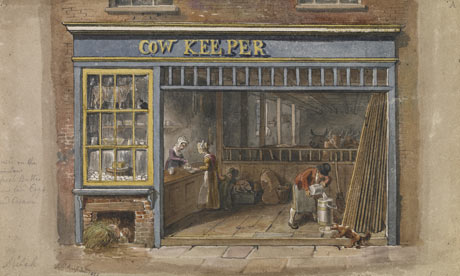
Cow Keeper's Shop, George Scharf, London 1825

Cow Keeper's Shop, George Scharf, London 1825

Once Scharf arrived in  London, he married his landlady’s sister. London was then a thriving centre for lithography – the new printing process, and Scharf was to enjoy success with mostly topographical views and genre scenes that could be transformed into prints.* These three scenes show how dairies operated in London. Cows were milked on the premises. In the Cow Keeper’s Shop, a customer is making a purchase while the man on the right pours milk into large tin pails.

Milkmaids, George Scharf

Milkmaids, George Scharf

The milk was collected twice daily and taken out into the city streets by girls, usually Welsh or Irish, who carried two heavy pails on a yoke. Their routes varied, but were usually a few miles long. The girls called out through the streets and squares for customers to purchase the fresh milk.  Their cries included, “Milk below, Maids!” and “Buy any milk?” In the scene below, a wealthier class of customer makes a purchase in Westminster Dairy. City conditions for cows were not optimal, cooped up inside as they were. A few lucky beasts would spend their day grazing in Green Park, where maids sold milk by the cup.
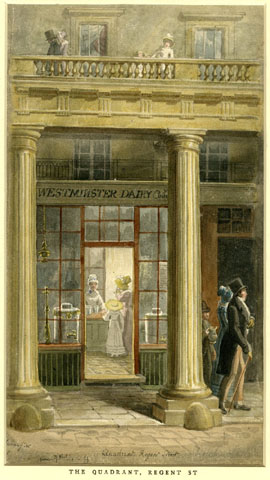
The Quadrant, Regent St., George Scharf

The Quadrant, Regent St., George Scharf

During this era, the city of London was  transformed into a modern metropolis. Massive renovations included gas lights, new canals, sewers, and water mains, creating a boon for construction. George Scharf captured these scenes of upheaval time and again, focusing on the laborer more than the surrounding buildings.
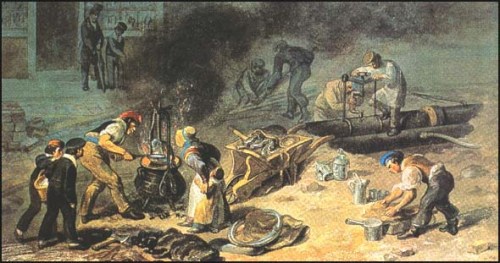
Laying a water-main in Tottenham Court Road, George Scharf, 1834

Laying a water-main in Tottenham Court Road, George Scharf, 1834

Laying the foundations of the Lycian Room, British Museum, George Scharf, 1845

Laying the foundations of the Lycian Room, British Museum, George Scharf, 1845

Placard carriers were a common sight in early 19th century London. People were hired to carry signs or wear sandwich boards and circulate in targeted areas.
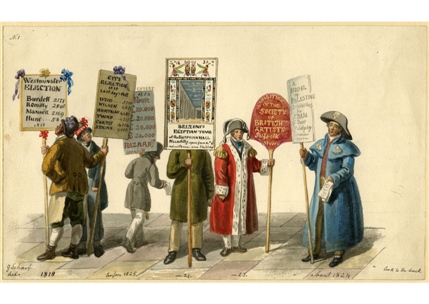
Carrying Election Advertisements, George Scharf, Scenes of London

Carrying Election Advertisements, George Scharf, Scenes of London

Shooter’s Hill, which offers splendid views, is the tallest point south of London. Situated along the Dover Road, it was notoriously dangerous at night, attracting highwaymen and robbers. In the 18th century a hotel was built for wealthy travelers on this spot, but Shooter’s Hill was also well known for a nearby gibbet and gallows. Samuel Pepys wrote in 1661: “I rode under a man that hangs at Shooters Hill and a filthy sight it was to see how the flesh is shrunk from his bones”. (British Library, Online Gallery)
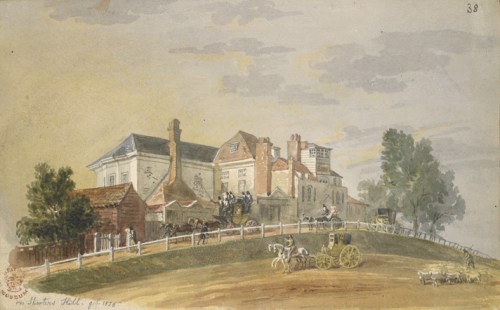
Shooter's Hill, George Scharf, 1826

Shooter's Hill, George Scharf, 1826

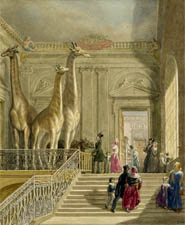
Tens of thousands of sculptures, paintings, animals, and scientific artifacts arrived from abroad during this era of exploration, war, and colonization, and were displayed in newly built museums and galleries.
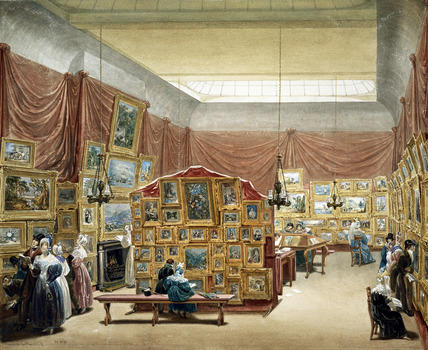
The Gallery of New Society of Painters, George Scharff, The Victoria & Albert Museum
The Gallery of New Society of Painters, George Scharff, The Victoria & Albert Museum

Visitors at Montagu House, British Museum, George Scharf

Visitors at Montagu House, British Museum, George Scharf

Like today, people purchased tickets to attend art exhibitions. Painters jockeyed for prime positions for their paintings,which were hung one on top of the other. The best wall space was reserved for the better known artists or the larger, more important works.

Glass and wood cases contained artifacts brought back by explorers or filled with collections from private individuals. Exotic animals were stuffed and displayed in halls big enough to contain them.  The plundering of important artifacts and antiquities from other cultures, such as the Elgin Marbles, was controversial even then and remains controversial to this day. While some bemoaned the pillage, others enthusiastically came to see the exhibited items.

Touring, George Scharf

Touring, George Scharf

George Scharf also created  illustrations for a number of London’s scientific institutions, such as the Zoological and Geological Societies and the Royal College of Surgeons. This work brought him into contact with leading scientists, including Robert Owen and Charles Darwin.*

Forensic Trial, George Scharf, Feb 1844, London

Forensic Trial, George Scharf, Feb 1844, London

A row with Darwin over the pricing of drawings of South American fossil bones – Darwin thought he was being ripped off – curtailed this lucrative source of income and marked a decline in Schaff’s fortunes.*
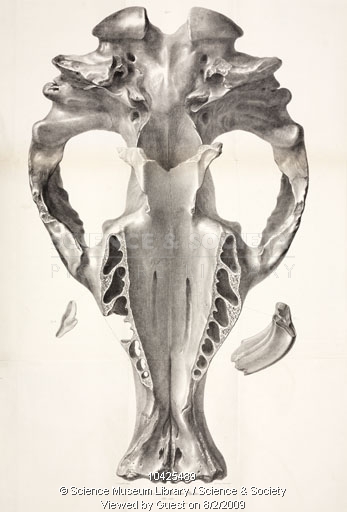
Skull of toxodon platensis, 1832-1836, George Scharf

Skull of toxodon platensis, 1832-1836, George Scharf

The artist’s last years were rather abject: living apart from his family, he was reduced to trying to sell his London drawings to the City Corporation, who turned him down. He even solicited minor German royalty for a pension in exchange for all of his work, but was again rebuffed. Following his death in 1860, his wife, Elizabeth, sold over a thousand drawings and watercolours to the British Museum. *Joe Staines, The Guardian

More about the topic:


Sir George Scharf, self portrait, watercolor, 1872

Sir George Scharf, self portrait, watercolor, 1872

A short word about Sir George Scharf, George Scharf’s son (1820-1895). Sir George was a British art critic who studied in the schools of the Royal Academy. He illustrated books related to art and antiquity, largely taught and lectured, and helped to design the Greek, Roman, and Pompeiian courts at the Cyrstal palace.  Sir George Scharf was also appointed director to the National Portrait Gallery. (1911 Encyclopedia, Sir George Scharf)
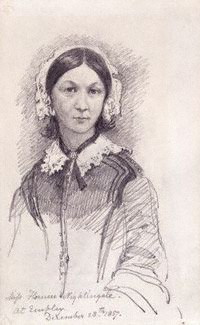
Florence Nightingale, Sir George Scharf, 1847

Florence Nightingale, Sir George Scharf, 1847

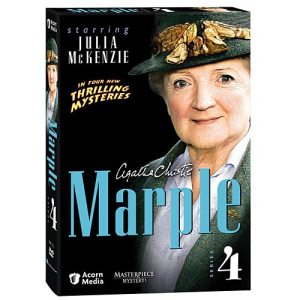
Miss MarpleYour own DVD set of Marple, Series 4 is available for shipping today! Agatha Christie’s spinster sleuth is brilliantly played by Julia McKenzie in this delightful mystery series. Julia as Miss Marple dons the traditional tweeds as if they were made for her, and the casts for all four episodes are stellar: Matthew MacFadyen, Rupert Graves, Wendy Richard, Hattie Morahan, Sylvia Simms, Anna Chancellor, Jemma Redgrave, Russell Tovey, Amanda Root, Elliot Cowan, Joan Collins, and Nigel Terry are among the suspects and victims. This set of finely produced DVDs, issued by Acorn Media, includes the following episodes:

Disc 1 A POCKET FULL OF RYE

Who poisoned wealthy businessman Rex Fortescue? Miss Marple barely has time to ponder this question before her former maid Gladys turns up strangled on the Fortescue estate, a clothes peg stuck on her nose. The murders seem to bear an uncanny resemblance to a child’s nursery rhyme. Miss Marple and Inspector Neele uncover clues from the dead man’s shadowy past that may reveal a method to the madness. Go to the PBS page to read about this episode.

Disc 2 MURDER IS EASY

Murder is easy, as long as nobody thinks it’s murder. So says elderly Miss Pinkerton to Miss Marple during a chance encounter on a train. Soon Miss Pinkerton herself dies, and Miss Marple believes that it was no accident. Her curiosity piqued, she travels to the peaceful village of Wychwood-under-Ashe to investigate. Charming her way into village life, she befriends a former policeman and discovers a shocking secret—one worth killing for.  Read the recap on Austenprose

Disc 3 THEY DO IT WITH MIRRORS

Miss Marple’s old friend Carrie-Louise has always had a soft heart for charitable causes. This time it’s juvenile criminals, lodged in a reformatory on the estate she shares with her husband. But her sister, Ruth van Rydock, is worried about her and asks Miss Marple to pay a visit. With her sharp eyes and unerring sleuthing skills, Miss Marple quickly assesses the situation—but not in time to prevent a murder. Can she save her friend from becoming the next victim? Read the synopsis and about the cast in this PBS link.

Disc 4 WHY DIDN’T THEY ASK EVANS?

A dying man’s last words turn young Bobby Attfield into an amateur detective. With the help of two assistants, beautiful socialite Frankie Derwent and family friend Jane Marple, he sets out to solve the riddle they pose. When someone tries to kill Bobby, it only strengthens his resolve. A trail of clues leads the unlikely trio to Castle Savage and its strange inhabitants, the discovery of yet another murder, and the lingering question: why didn’t they ask Evans? Read our review in this link.

No needlework, either of ancient or modern times, (says Mr. Lambert,) has ever surpassed the productions of Miss Linwood. So early as 1785, these pictures had acquired such celebrity as to attract the attention of the Royal Family, to whom they were shewn at Windsor Castle. Book of Days

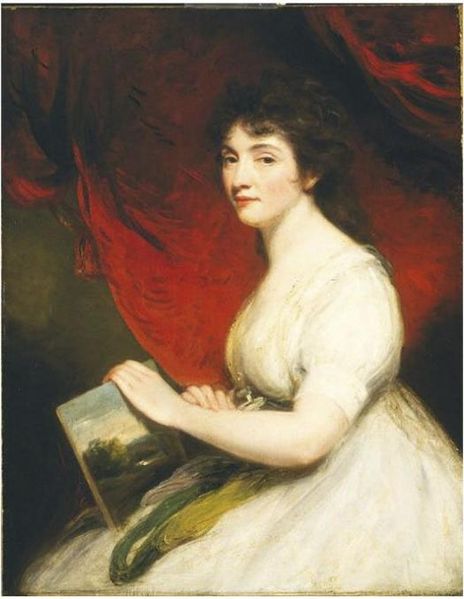
Mary Linwood by Hoppner, 1800

Mary Linwood by Hoppner, 1800. Image @Victoria & Albert Museum

Mary Linwood, Partridges after the painting by Moses Haughton, 1798

Mary Linwood, Partridges after the painting by Moses Haughton, 1798

Mary Linwood was an artist who used needlework as her material.  Born in Birmingham in 1755, Mary made her first embroidered picture when she was thirteen years old. She was mistress of a private boarding school, which her mother started, but her lasting claim to fame lay in her needlework art. For nearly seventy-five years Mary imitated popular paintings in worsted embroidery. An enterprising woman, she opened an exhibition in the Hanover Square Rooms in 1798,  which afterward traveled to Leicester Square, Edinburgh and Dublin. Four years before her death in 1845,  her works were still exhibited in London.  She embroidered her last piece when seventy-eight, although she lived to be 90 and worked as a school mistress until a year before her death.  In 1844, during her annual visit to her Exhibition in London, she caught the flu and died.

Mary worked with stitches of different lengths on a fabric made especially for her in Leicester. She had coarse linen tammy cloth prepared for her as well. Her long and short stitches looked like brush strokes, with silk for highlights, and many amateurs copiesd her on a smaller scale. A good example of her work is the almost 2 ft square portrait of Napoleon in the South Kensington Museum.

Needlework image of Napoleon

Needlework image of Napoleon

Portrait of Napoleon Bonaparte embroidered with coloured worsteds in small short and long stitches By Miss Mary Linwood In gilt frame glazed English Late 18th or early 19 th centy H 2 ft 7 in W 2 ft 2 in Bequeathed by the late Miss Ellen Markland 1438 1874 This is a remarkable specimen of embroidery involving great labour to imitate a painting – A Descriptive Catalogue of the collections of tapestry and embroidery in the South Kensington Museum, Alan Cole, 1888, p.369

Miss Linwood’s worked pictures, exhibited in Leicester square, were for many years reckoned among the sights of London, and although their pretensions to artistic merit are regarded contemptuously by the present generation, they were in one sense undoubtedly wonderful productions. The exhibition contained copies after such masters as Carlo Dolci, Guido, Ruysdael, Opie, Morland, Gainsborough, Reynolds; a list that proves how great was the scope Miss Linwood’s ambition, and how catholic  her taste. The whole collection was dispersed at Christie’s room after Miss Linwood’s death in 1845, when the pieces knocked down for sums far below those at which they had been valued a few years previously…Miss Linwood’s pictures, worked with untwisted soft crewel specially dyed in graduated shades on a ground of twilled linen, are really meritorious, nevertheless one cannot regret that their day, equally with that of the Berlin wool Landseers, is overpast and that we have at last learnt the limitations as well as the possibilities of the embroiderer’s delightful craft. – The Collector

Exhibition, Book of Days

Exhibition, Image @Book of Days

Although Mary Linwood’s needlework exhibits were popular during her lifetime, not everyone was enamored with her work. In 1919, Emily Leigh Lowes wrote these rather hateful statements about Mary in her book, Chats on Old Needlework (Embroidery),

The originator and moving spirit of this bad period was Miss Linwood, who conceived the idea of copying oil paintings in woolwork. She died in 1845. Would that she had never been born! When we think of the many years which English women have spent over those wickedly hideous Berlin-wool pictures, working their bad drawing and vilely crude colours into those awful canvases, and imagining that they were earning undying fame as notable women for all the succeeding ages, death was too good for Miss Linwood. The usual boiling oil would have been a fitter end! Miss Linwood made a great furore at the time of her invention, and held an exhibition in the rooms now occupied by Messrs. Puttick & Simpson, Leicester Square. Can we not imagine the shade of the great Sir Joshua Reynolds, whose home and studio these rooms had been, revisiting the glimpses of the moon, and while wandering up and down that famous old staircase forsaking his home for ever after one horrified glance at Miss Linwood’s invention?

Not only Miss Linwood, but Mrs. Delany and Miss Knowles made themselves famous for Berlin-wool pictures. The kindest thing to say is that the specimens which are supposed to have been worked by their own hands are considerably better than those of the half-dozen generations of their followers. During the middle and succeeding twenty years of the nineteenth century the notable housewife of every class amused herself, at the expense of her mind, by working cross-stitch pictures with crudely coloured wools (royal blue and rose-pink, magenta, emerald-green, and deep crimson were supposed to represent the actual colours of Nature), on very coarse canvas.

More on the topic: