Feeds:
Posts
Comments

Ransome's HonorRansome’s Honor by Kaye Dacus will not disappoint fans of sweet Regency romances or Christian Romance novels. We first meet Julia Witherington at the age of seventeen accompanied by her parents as they set off for a splendid evening of dancing in Portsmouth’s public assembly hall. The war with France has ended with the Treaty of Amiens. Julia’s father, an admiral, is to be introduced as Sir Edward for the first time and she expects to receive a marriage proposal from dashing Lieutenant Ransome. Sir Edward, who made his fortune in the Royal navy, has filled Julia’s marriage coffers with 30,000 pounds. Although the Lieutenant must still make his mark in the world, Julia is more than willing to share her largesse. But William, too proud to be considered a fortune hunter, changes his mind about proposing. A hurt and humiliated Julia instantly understands that Lt. Ransome had been angling after her father’s patronage and that she’d merely been a means to an end.

Flash forward twelve years and we meet Julia again in 1814. She’s turned into a beautiful, mature, and successful businesswoman who has been managing her father’s sugar plantation in Jamaica. Still unmarried, she has returned to Portsmouth following her mother’s death and become the darling of Portsmouth society. William Ransome, now a captain, is awaiting a new assignment. When Julia learns of his presence in Portsmouth, her stomach clenches at the idea of seeing him again, for she has grown to despise him. Or has she? Their re-meeting is fraught with tension on Julia’s side and it reminded me of Anne Elliot’s first unexpected meeting with Captain Wentworth in Persuasion. In fact, the first third of this novel reminded me of Jane Austen’s last novel, only in this instance it is the Captain who regrets the years apart and Julia’s ego that still smarts from his non action.

Portsmouth, Rowlandson

Portsmouth, Rowlandson

No romance novel would be worth its salt without a villain, and Ransome’s Honor offers three. Foremost in the blackguard department is Sir Drake Pembroke, who has gambled away his extensive fortune and who needs to marry an heiress as quickly as possible to keep the spectre of debtor’s prison at bay. For Georgette Heyer fans, his character reminds me of Stacey Caverleigh in Black Sheep, an equally disreputable fellow! Drake’s Mama, who happens to be Julia’s chaperone, does everything in her power to promote her son as Julia’s mate, and is even willing to use lies and subterfuge to gain the upper hand. (Attention: Plot spoiler) She enlists Julia’s aunt, Lady MacDougall, in her quest to acquire Julia’s fortune to pay of Drake’s debts. And this deception hurts Julia’s feelings most of all, for Lady MacDougall is her dead mother’s sister and Julia had trusted her to look out for her welfare.

In addition to the villains, we meet Julia’s and William’s friends, who add just the right touch of richness to this plot. Depictions of close friendships are one of the main reasons why I adore films like Bridget Jones’s Diary and Notting Hill. A hero’s or heroine’s companions can say so much about them in a manner that is more natural than mere exposition. In Ransome’s Honor, Julia and William can depend on their friends to come to support them, and they play a prominent role in bringing the novel to a satisfying conclusion.
3 regency fansI was pleasantly charmed by this book, which was written in a style that was descriptive enough to give me a sense of time and place. There are still a few loose threads that need to be addressed, such Julia’s missing brother, whose body has never been found at sea, and her concern over the inaccuracy of her father’s sugar plantation’s ledgers, but I suspect that these issues will be resolved in later books. Ransome’s Honor is the first book of the Ransome Trilogy, which is good news for Kaye Dacus fans. I give this book three out of three Regency Fans. You can order your own copy at this link.

Kaye’s website offers some lovely companion posts to her novel.

Anna, 7th Duchess of Bedford possessed the beauty and hauteur of Lady Susan

Anna, 7th Duchess of Bedford possessed the beauty and hauteur of Lady Susan

If six Jane Austen novels have left you craving for more of her fine writing, and you have not yet read Lady Susan, perhaps now is the right time to read this unusual novel. Epistolary in form, the letters between Mrs. Vernon and her mother, and Lady Susan and her friend, Mrs. Johnson, reveal a calculating woman who will use her daughter and fool around with her friend’s husband in order to get what she wants. Early on the reader learns what an unnatural and unloving a mother Lady Susan is to her daughter, Frederica. Not once does the reader feel sympathy for this anti heroine. Read my review of the novel in this link, Lady Susan, A Vicious Jewel.

Blogging Meme

bloggerGentle Readers, This meme was started by The State of Denmark. I thought this would be a good opportunity for you to learn a bit more about this blog. Other bloggers, please feel free to pick these questions up. My answers sit below the cartoon.

1.  How long have you been blogging?

2.  Why did you start blogging?

3.  What have you found to be the benefits of blogging?

4.  How many times a week do you post an entry?

5.  How many different blogs do you read on a regular basis?

6.  Do you comment on other people’s blogs?

7.  Do you keep track of how many visitors you have?  If so, are you satisfied with your numbers?

8.  Do you ever regret a post that you wrote?

9.  Do you think your audience has a true sense of who you are based on your blog?

10.  Do you blog under your real name?

11.  Are there topics that you would never blog about?

12.  What is the theme/topic of your blog?

13.  Do you have more than one blog?  If so, why?

cartoon from www.weblogcartoons.com

Cartoon by Dave Walker. Find more cartoons you can freely re-use on your blog at We Blog Cartoons.

1.  How long have you been blogging? Since August 2006

2.  Why did you start blogging? Self-Expression and interest in the topic

3.  What have you found to be the benefits of blogging? Connection with people of like minds and, as I said, self-expression and sharing of information. I was also frustrated with listserv discussions. I was tired of expressing a mere opinion on Jane Austen, her life, and novels and then having my statements nitpicked to death by peope who analyzed every word and pounced on every issue. This blog gives me a forum to discuss Jane Austen and her milieu without having to defend myself 360 degrees and 24/7. The comments left on this blog are civilized and unargumentative. I like their restful approach to discourse better.

4.  How many times a week do you post an entry? Since I manage several blogs – daily or more often.

5.  How many different blogs do you read on a regular basis? Fewer each day. I’d say less than 10. I used to read more, but I am swamped with my blogging commitments. However, I rotate blogs, so I estimate that I visit between 50-70 blogs weekly. This is not counting websites.

6.  Do you comment on other people’s blogs? Yes, frequently. Daily, actually.

7.  Do you keep track of how many visitors you have?  If so, are you satisfied with your numbers? Yes, I keep track. I’d say that I’m satisfied, but I am a bit competitive. I want more unique visitors and fewer casual hits.

8.  Do you ever regret a post that you wrote? Not frequently. When I do, I delete it. I also edit my posts after they have been published. It’s my blog. It’s not an archived newspaper or magazine article. If I see a mistake, I will fix it, even one or two years later.

9.  Do you think your audience has a true sense of who you are based on your blog? Absolutely. They understand that I love social history and the Regency Era, and that I want to share my research with others.

10.  Do you blog under your real name? No. I began blogging in the WWW dark ages. One of my blogs is outrageous and I say outrageous things on it. I do not want to jeopardize my professional position. Since an astute researcher can relate the three blogs, I have decided to maintain my anonymity as much as is possible in this transparent medium.  Aside from my name, I don’t hide certain details about my life, and often share that I have a dog, am divorced, live in Richmond, and work in professional development.

11.  Are there topics that you would never blog about? Morality. I’ll blog about politics, but I will not sit in judgment of others and impose my religion, ethics, or personal philosophy on them if I can help it. (I am human, after all, and am quite opinionated. Those qualities shine through in my twitter account.) Before opening my mouth, I think of Jane Austen and ask, What would she say?

12.  What is the theme/topic of your blog? Jane Austen, the Regency Era, Jane Austen in popular culture, popular culture, and my take on things.

13.  Do you have more than one blog?  If so, why? Yes, I oversee three blogs. I have an extensive background in marketing and I believe in targeting your audience very narrowly. Each of my blogs speaks to a specific group. Interestingly, there is very little overlap of readership among them.

Grand SophyThe Grand Sophy, the latest Georgette Heyer release by SourceBooks, is a page turner that will keep the reader guessing and wondering when and how the heroine will top her previous outrageous acts. Sir Horace Stanton-Lacy, a rich widower who has recently returned from the Continent, convinces his sister, Lady Ombersley, that his sweet, motherless daughter ought to stay with her while he returns abroad. Several weeks after their discussion, Miss Sophy Stanton-Lacy makes a grand entrance:

Lady Ombersley, meanwhile, standing as though rooted to her own doorstep, was realizing with strong indignation, that the light in which a gentleman of great height and large proportions regarded his daughter had been misleading. Sir Horace’s little Sophy stood five feet nine inches in her stockinged feet, and was built on generous lines, a long-legged, deep-bosomed creature, with a merry face, and a quantity of glossy brown ringlets under one of the most dashing hats her cousins had ever seen.

Sophy could not exactly be called a beauty, but no one who had met her could ever quite forget her. Not ten minutes after her dramatic arrival, Lady Ombersley wonders: “What kind of niece was this, who set up her stable, made her own arrangements, and called her father Sir Horace?” The entire family, nay all of London, would soon find out.

Georgette Heyer wrote about two types of heroines. The Mark II heroine, who was a biddable and quiet young girl, and the Mark I heroine whose independent habits and dominant character invariably clashed with the hero’s personality. Sophy is the quintessential Mark I Heyer heroine: a tall, bossy, outrageously rich and independent, problem-solving, smart and capable young lady who will let nothing, not even Mr. Charles Rivenhall’s censure and outrage stand in her way. Arriving at the Ombersley’s house wearing a sable stole and carrying a sable muff, she alights from a coach and four with an entourage that includes several liveried footmen, a doyenne, an Italian greyhound, a monkey named Jacko, and a parrot in a birdcage. Even as Lady Ombersley struggles to hide her dismay, Sophy’s cousins are delighted, except for Charles. Everything about Sophy sets him on edge, especially when she won’t give way to even his slightest wishes.

High Perch Phaeton

As heroes go, Charles is a bit of a prig. He cannot help himself, for his father, Lord Ombersley is an inveterate gambler. Charles unexpectedly came into an inheritance from a rich relative who had made his fortune in India and he uses his wealth to pay off his father’s debts. In doing so, Charles becomes the de facto head of the family. A sensible man, he proposes to a patronizing young lady of impeccable character, Miss Eugenia Wraxton, and leads a bland existence … until Sophy turns his well-ordered life upside down. The reader learns one thing about Charles that others don’t seem to appreciate – children, dogs, monkeys, and parrots turn instinctively to him, and although he might seem harsh on the surface, he has a soft heart and is an easy touch. However, his dictatorial ways intimidate two of his siblings, Cecilia and Hubert, to the point where Sophy feels she needs to help out. This causes Charles to gnash his teeth at her presumption. At the core of this book are the crackling scenes between Sophy and Charles, and thankfully they are numerous.

The Grand Sophy is one of Georgette Heyer’s “larger than life” books. Everything – from the characters to Sophy’s antics to the settings – is bigger and grander than in most of her other novels, and the side characters are unforgettable. Augustus Fawnhope is a beautiful but a gloriously silly poet whom Cecilia loves. Cecilia, Charles’s lovestruck sister, is a sweet Mark II heroine with backbone and pluck, who sees the error of her ways, but can do little to rectify the situation. Enter Sophy to the rescue. Sancia, Sir Horace’s Spanish fiancee, is singularly lazy and unforgettable in her ability to drop off to sleep in front of guests, but Sophy knows she can solicit her support whenever it is needed. Lord Bromford, a terminally boring hypochondriac and Mamma’s boy, woos Sophy with the tenacity of a bulldog, much to the glee of her younger cousins, who watch with awe as their older cousin deftly skirts his advances.

Charles’s fiancee, the horse-faced and prudish Eugenia Wraxton, is Sophy’s perfect foil. On the outside, Miss Wraxton is all that is proper, but on the inside she is small and mean of spirit. Sophy sees right through her and is determined to open Charles’s eyes before he is leg-shackled to her through marriage. Where Miss Wraxton merely pays lip service to being a lady, Sophy is warmhearted and generous to a fault. Her rarified social status allows her to behave outrageously with impunity, a fact that the jealous Miss Wraxton never quite realizes. Miss Wraxton constantly lectures Sophy or, worse, tattles on her, as the following scene between Sophy and Charles suggests. In it they are discussing her purchase of her high perch phaeton, to which Charles has strenuously objected:

“I have no control over your actions, cousin,” he said coldly. No doubt if it seems good to you to make a spectacle of yourself in the Park, you will do so. But you will not, if you please, take any of my sisters up beside you!”

“But it does please me,” she said. “I have already taken Cecilia for a turn round the Drive. You have very antiquated notions, have you not? I saw several excessively smart sporting carriages being driven by ladies of the highest ton!”

“I have no particular objection to a phaeton and pair,” he said, still more coldly, “though a perch model is quite unsuited to a lady. You will forgive me if I tell you that there is something more than a little fast in such a style of carriage.”

“Now, who in the world can have been spiteful enough to have put that idea into your head?” wondered Sophy.

He flushed, but did not answer.

Although this book provides us with a fun romp through Regency London, it does possess one flawed scene. The scene is pivotal and demonstrates Sophy’s fearlessness in helping Charles’s brother Hubert out of an impossible situation, but Georgette Heyer is a product of her snobbish upbringing and time. Her description of a stereotypical Jewish lender, the villainous Mr. Goldhanger, is old-fashioned and ruffles our modern sensibilities. For many readers, this scene is a deal-breaker (see comments in link). Some stop reading the book at this point, others feel that the book loses some of its lustre, and others like myself manage to move on, realizing that authors cannot help but be influenced by the age in which they live. A friend of mine observed that Huckleberry Finn is full of racial slurs, but these statements did not prevent it from becoming a classic. Having said that, Georgette’s description of the Jewish lender did give me pause, but after a few pages, I was once again absorbed by Sophy’s antics and rooting for the characters I had come to love. When I turned the last page, I could only wish them all the happiest of ever afters.

3 regency fansI give The Grand Sophy three out of three regency fans. Order the book at this link.
Read this blog’s other Georgette Heyer reviews here.

Gentle readers: The Grand Sophy will be released today. A reissue from SourceBooks, this 1950 novel was one of Georgette Heyer’s best. Look for a month-long kick off of this highly entertaining book on Jane Austen Today, Austenprose and this blog.

Also:

Regency Manners and The Grand Sophy

Read the review on Austenprose at this link.

“Invite him to dinner, Emma, and help him to the best of the fish and the chicken, but leave him to choose his own wife.” – Jane Austen, Emma

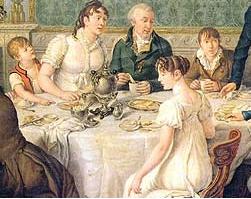
By the time breakfast was served in a regency household, the family had been up for a while. After rising, people would engage in tasks such as letter writing, practicing the piano, taking a walk or riding. In larger households, the cook and maids would busy themselves heating the stove and boiling water. In more modest establishments, such as the Austen household at Chawton, Jane would help with preparing breakfast. A simple repast of toast, rolls, cheese, tea, coffee, chocolate, or ale would be served between nine and ten. The more elaborate breakfast would not be featured until Victorian times.*

chinoiserieIndividuals would rise early, at around 6:00 in the morning. Within the next half-hour or so, people would start work. Breakfast would be taken later, at around 9:00 and afterwards. The morning’s work would finish with ‘dinner’–probably taken between 12:30 and 14:00. Work continued until late. For some, there was tea in the late afternoon, between 17:00 and 18:00. It would be common not to leave one’s work before 19:00. After the evening meal, people would go to bed at around 22:00 – Time and Work in England 1750- 1830, Hans-Joachim Voth
Nuncheon or luncheon was a midday meal served at an inn. For several centuries this meal was simply a snack. Dr. Johnson’s 1755 Dictionary defined luncheon as “as much food as one’s hand can hold.” In the Regency home, such meals had no official name and often consisted of only a cold snack and drink to provide sustenance until the evening meal.*

Morning

food

After breakfast with the children, the first job of the lady of the house would be to talk to the housekeeper. It would be important for them to communicate about the other servants, making sure they were doing their jobs properly and behaving correctly above and below stairs.

They would also discuss the evening meal. If visitors were expected, the lady would choose meals that were lavish and unusual. (They loved showing off) When these matters were dealt with the wife would then check through the household accounts. Bills for meat, candles and flour would usually be paid weekly. When the early morning activities were finished, the social whirl would begin! High society ladies would either receive calls or visit others. Tea would be drunk and snacks eaten.- The Regency Townhouse

During the medieval period dinner was eaten at midday, but this meal was slowly moved up to 3 in the afternoon, then pushed up to five. These meals became elaborate affairs of at least two or three courses, which Louis Simond, a French/American traveler to London, described in wondrous detail in his travel diary. During Jane Austen’s time tea would be served an hour or so after the meal, or from 3-6 o’clock, depending on when dinner was served. Suppers became light snacks, except in the case of a grand ball, where elaborate buffets might be served.

In 1798 Jane Austen writes of half past three being the customary dinner hour at Steventon, but by 1808 they are dining at five o’clock in Southampton. There are many mentions of the timing of dinner in the novels, but none is so explicit as in the fragment The Watsons. Tom Musgrave knows perfectly well that the unpretentious Watson family dine at three, and times his visit to embarrass them, arriving just as their servant is bringing in the tray of cutlery. Tom compounds his rudeness by boasting that he dines at eight: the latest dinner hour of any character. At Mansfield Parsonage they dine at half past four and at Northanger Abbey at five. The effect of London fashion can be seen in the difference between the half past four dinner at Longbourn and that at half past six at Netherfield. – Jane Austen in Context, Janet Todd, p. 264

  • *Jane Austen’s World, Maggie Lane

