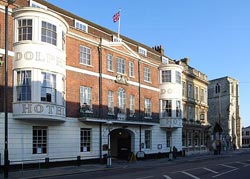
Dolphin Hotel in Southampton
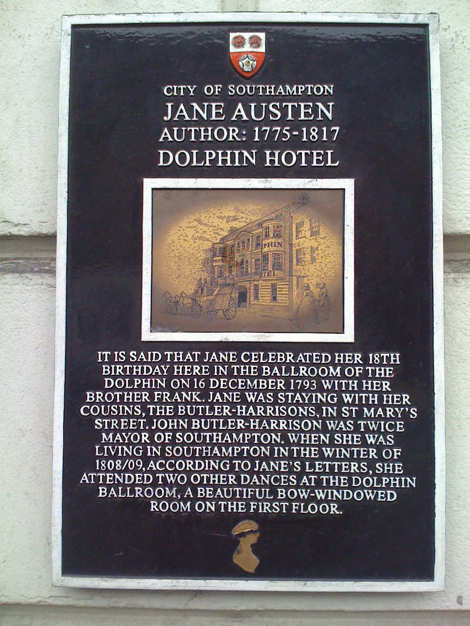
According to a recent newspaper report, The Dolphin, a 3-star hotel in Southampton, will close at the end of this month. Jane Austen danced in its ballroom between 1806 and 1809 after her father’s death and after she and her mother and sister moved from Bath. The building that houses the Dolphin was erected in 1250 and the hotel dates from 1550, a venerable history. Southampton is a medieval city. Its western walls were built in 1338 and remain one of the finest medieval town defenses in the UK.
The medieval town that Jane knew was, according to the diarist Mrs Powys, “one of the most neat and pleasant towns I ever saw … once walled round, many large stones of which are now remaining. There were four gates, only three now … one long fine street of a quarter mile in length … At the extremity a capital building was erected with two detached wings, and colonnades. The centre was an elegant tavern, with assembly, card room, etc., and at each wing hotels to accommodate the nobility and gentry. The tavern is taken down, but the wings converted into genteel houses” (Mitton 1917). – Hantsweb
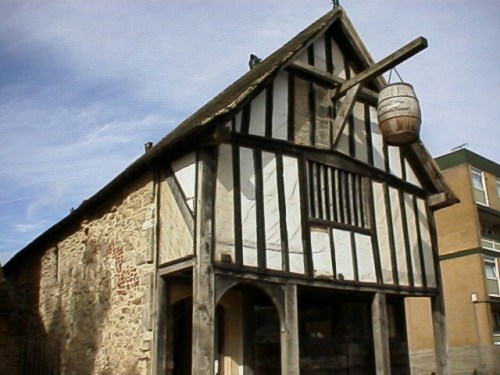
Medieval Merchant's House, Southampton
In one of her letters Jane mentioned a ball at the Assembly Rooms. These rooms, said a contemporary writer, were situated near the West Quay, and were very elegantly fitted up. “The Long Room, he says, was built in 1761, the Ball Room soon afterwards.”
Quadrille Plate from Le Bon Genre, 1805
“Our ball was rather more amusing than I expected,” Jane writes . . . . “The room was tolerably full, and there were, perhaps, thirty couple of dancers . . . . It was the same room in which we danced fifteen years ago. I thought it all over, and in spite of the shame of being so much older felt, with thankfulness, that I was quite as happy now as then . . . . you will not expect to hear that I was asked to dance, but I was – by the gentleman whom we met that Sunday with Captain D’Auvergne. We have always kept up a bowing acquaintance since, and being pleased with his black eyes, I spoke to him at the ball, which brought on me this civility; but I do not know his name, and he seems so little at home in the English language, that I believe his black eyes may be the best of him.”[1] Constance Hill, Jane Austen Southampton. – Constance Hill


Southampton Sea Walls
During the 18th century Southampton was a popular Spa town, but this development did not last long. Although assembly rooms and baths were constructed, there were not enough features in the town to maintain it as a tourist attraction. Jane and her family could visit the theatre and there was a circulating library, but Southampton was more a working seaport than a resort. Unfortunately the building that Jane Austen lived in and its surrounding area have been demolished, but one can still see the medieval walls and ancient portions of the city.* The Dolphin’s website describes the Assembly Rooms today:
Jane Austen Assembly Rooms – Jane Austen was a regular visitor to Southampton and famously attended a ball in the Assembly rooms here at the Dolphin on her 18th birthday. The main room divides into three creating: Jane Austen Assembly Room – One A large room, decorated in the Georgian style, featuring a quite stunning stone carved fireplace and one of two enormous bay windows, which are reputed to be the largest in the world, providing ample natural daylight. Jane Austen Assembly Room Two – The smallest of our meeting rooms is still a good size, with three sash windows, opening onto the royal balcony, which hangs over the high street. Jane Austen Assembly Room Three – A large room, decorated in the Georgian style, featuring a quite stunning stone carved fireplace on which one of our resident ghosts (Beau) is reputed to lean, whilst looking out of the bay window, which are reputed to be the largest in the world, providing ample natural daylight. Jane Austen Assembly Rooms Full Room – When the whole room is opened up, the symmetry of the architecture can be seen in its full glory, much as it would have been when Jane danced here. The two stone carved fireplaces, facing one another across the length of the room and the two bay windows together with the high ceilings reflect a style of architecture which has sadly passed. Jane Austen Music Room – The music room is also situated on the first floor, adjacent to Jane Austen Assembly Room One, was built slightly later than the main room in around 1780 and features a marble fireplace and five sash windows, overlooking the high street.
To mark the 200th anniversary of the year Jane took up residence in Southampton, a Jane Austen Trail was launched in July 2006. There are eight plaques each at a location associated with Jane and, available at Southampton Tourist Information Centre.
Find more on the topic in these links:
- Southampton: City of tenuous Jane Austen connections – with images of the Jane Austen trail

 The plot of the Convenient Marriage is different in so many ways from the typical Georgette Heyer novel. One is the tenderness with which the Earl of Rule treats his very young and captivating bride, and the second is that the couple has already tasted the delights of the marital bed and found the results not displeasing. The earl was all set to marry the eldest Winwood sister in an arranged marriage when her youngest sister Horatia “sacrifices” herself on the altar of sibling loyalty. Horatia’s older sister, Lizzie, is the Beauty of the family and in love with an impoverished soldier. Needless to say her family insists that she drop her soldier and marry the earl to save the family fortune. To help her sister out of her misery, Horatia sneaks off to see Rule and reasons (quite logically) that if the earl isn’t in love with her sister he might just as well marry her. The legal contract between the two families would not be altered with the switch in brides and he will still be assured that the future mother of his heir will have the appropriate pedigree. Struck by the simplicity of her argument and charmed with her slight stutter and forthrightness, the earl agrees to wed Horatia instead. Up to this point the book resembles more a 1930’s drawing room comedy than the typical historical romance novel we have come to expect from Georgette Heyer. One of her earlier books (1936) and set in the Georgian Era, the writing does not yet possess her command of the genre as she shows in later years, yet her descriptive style was already fully developed. In this instance, Heyer describes Georgian clothing with as much expertise as her knowledge of Regency garb: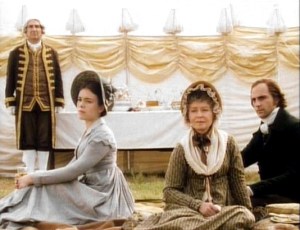











 Jane Austen's World