Feeds:
Posts
Comments

Inquiring Readers,

Joan Hassall's portrait of Jane Austen

Joan Hassall's portrait of Jane Austen

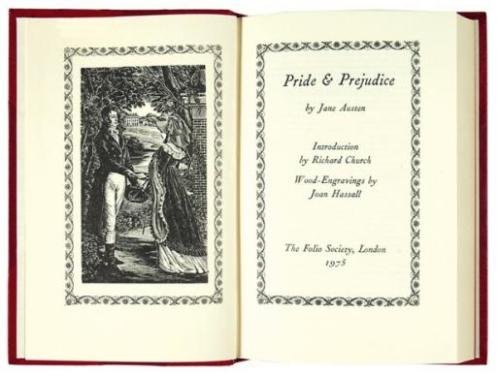
Every once in a while I contribute a small amount of information to Wikipedia, and only when I think I can add to the general pool of knowledge. When I consulted Wikipedia’s entry on Joan Hassall, the exquisitely talented wood engraver, I found it woefully lacking and added what little I knew. The best online information about her life (1906-1988) sits at this site: Joan Hassall Wood Engraver: Textualities. Between 1957 and 1962, Joan was commissioned to create wood engravings for the Folio Society editions of Jane Austen’s novels, which is her main association with the author. These editions have been frequently reprinted, but the  first folio editions of Austen’s works are now quite scarce.

Joan was known for carving detailed illustrations using an exacting medium that allowed for few mistakes. One wrong move with an engraving tool and a wood block could be ruined. She also had to plan backwards, for dark areas on the wood block printed light and light areas filled up with ink and came out as lines or shadows. Printed on paper, the image came out in reverse. The wood had to have just the right firmness and even texture. The grain could not present resistance to cutting, yet it had to be hard enough to withstand wear and permit a sharp edge to the line. Fruitwoods, such as pear or cherry were ideal candidates for this medium, whereas American oak or walnut were considered much too hard. – Technique for the Color Woodcut: Cutting
pride-and-prejudice

Joan Hassall

Joan Hassall

C. E. Brock and Hugh Thomson are better known illustrators of Jane Austen’s novels, however I find it interesting that Joan Hassell, who resembled a matronly British lady, created more forceful images than these two famous men. Brock’s and Thomson’s works are delicate and airy, while Hassall’s are stark and masculine. Her style was defined by her medium – the wood block. Hassall generally worked in black and white, scraping out thin  and thick lines with engraving tools, and adding stippled variations in between, yet she attained an astonishing amount of detail with an unerring hand. One of the reasons why I like her image of Fanny Price in Portsmouth is not only because of the robustness of the scene, but because I can practically smell the sea air. She managed to evoke waves dashing against the shore, children playing, clouds scudding by, and a stiff breeze blowing against the ribbons and short capes of the strollers. In less capable hands, this scene would have been nearly impossible to attempt in such a small area. She also moves from light to shadow effortlessly. Witness how the ships’ masts are outlined against the white cloud bank and how the legs of the little boy on the right, who stands in dark shadows, are limned by a single light line. Masterful.
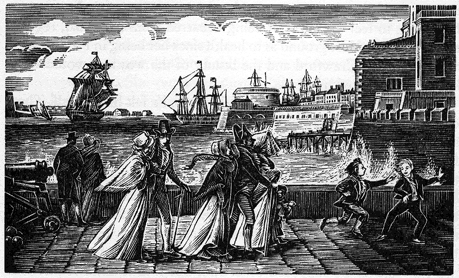
Fanny Price in Portsmouth, Mansfield Park, Folio Society, illustrated by Joan Hassall

Fanny Price in Portsmouth, Mansfield Park, Folio Society, illustrated by Joan Hassall

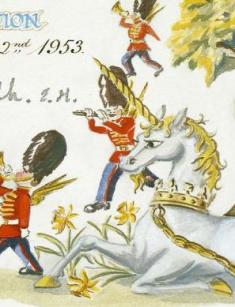
Hassall’s talents as a wood engraver did not mean that she did not possess a delicate hand, as this exquisite watercolor invitation for the Queen’s coronation in 1953 demonstrates. The queen commissioned Joan to create an invitation especially for Prince Charles, who was only five years old at the time. It is still proudly displayed in the royal collection.

royal-invitation-1953

Imagine the young Prince Charles’s delight when he saw these whimsical details:
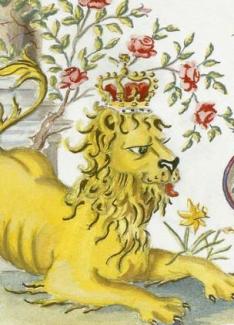
Lion detail, Prince Charles's Invitation
Lion detail, Prince Charles's Invitation

Unicorn detail, Invitation to the royal coronation
Unicorn detail, Invitation to the royal coronation

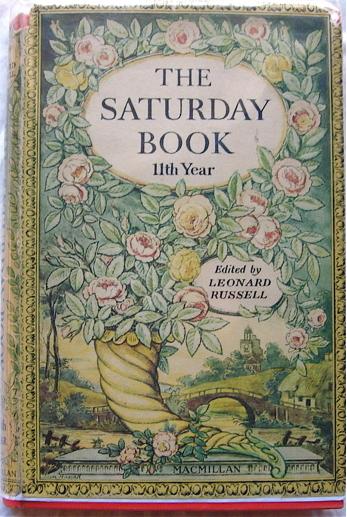
The Saturday Book, Joan Hassall dust jacket, 1951

The Saturday Book, Joan Hassall dust jacket, 1951

This 1951 dust jacket for The Saturday Book shows how expertly Joan can handle a brush as well as an engraver’s tool.

flow-gently-sweet-afton

Joan’s themes also ran to nature, and she was so well known for her natural studies that people like Flora Thompson, the author of Lark Rise to Candleford, collected her individual prints. In a 1989 JASNA article (Illustrating Jane Austen), Keiko Parker discusses Hassall’s ability to add interesting details in this wood engraving of Lady Catherine de Bourgh and Elizabeth Bennet as they take a turn in the “prettyish kind of a little wilderness on one side of your lawn.” The print demonstrates Joan’s ability to add exquisite details. You can even see the leaves between the scrollwork of the bench. One errant slip, and the back of the bench would have been ruined. Her handling of the leaves, grass, and dirt path are reminiscent of her nature studies; and she even manages to create a vista, leading one’s eye to the waiting carriage and the road that will take Lady Catherine back to her home.
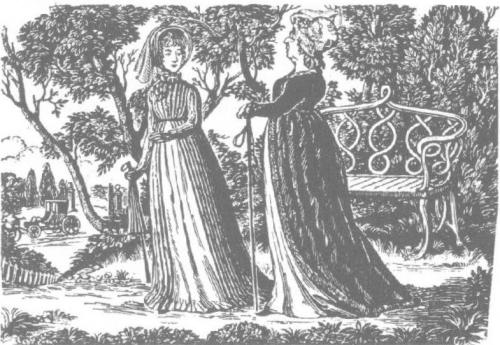
Lady Catherine de Bourgh and Elizabeth Bennet

Lady Catherine de Bourgh and Elizabeth Bennet

Hassall’s talents as a carver were recognized by her peers and she was the first woman to be elected as a master member to the Art Workers Guild (1964). In 1950 she designed an edition of Robert Burns poems and created a series of illustration that are among her most delightful small prints, especially the one of a tiny mouse rolling in the grass.
hassall-pix_460

The Old Tree, 1950

The Old Tree, 1950

Joan’s family members led lives that were as interesting and creative as hers. Her father was John Hassall, an illustrator of posters and childrens books, whose most famous work of art, a 1908 poster of The Jolly Fisherman, still promotes Skegness as a seaside resort today. Joan’s brother, Christopher Hassall, was a poet, actor, and librettist famous for his collaborations with composer Ivor Novello. Modern audiences have heard  I Can Give You the Starlight, sung by Jeremy Northam in Gosford Park. The words by Christopher and Ivor’s melody evoke “Britishness” in the 1930’s to a tee.

Learn more about Joan Hassall at these links:

Inquiring readers,

This fashion plate and accompanying description come from La Belle Assemblée Or, Bell’s Court Fashionable Magazine, August 1807, Volume III edition. The descriptions about dress are directly from the magazine. The publication featured quality engravings and advice about women’s fashions that became an essential part of the magazine, and also offered a special supplement of advertisements in the back that became a permanent record of commerce and fashion of the time. – A Magazine of Her Own, Margaret Beetham, p. 32. By the 1830’s, La Belle Assemblee, which had been such a force during the mid-18th to early 19th centuries, had merged with Lady’s Magazine before quietly dropping out of sight.

kensington-garden-dresses-1807-august

Text not available
La Belle Assemblée Or, Bell’s Court and Fashionable Magazine

We scarcely ever witnessed a period when taste and fashion were more perfectly in unison, nor any season when elegance and grace shone with such unrivalled fascination. Not only amidst the ranks of assemblies and opulence, but in those simple unobtrusive adornments appropriated to the intermediate station — in those chaste habits becoming such as move in a more domesticated sphere, have our fair country women exhibited testimonies of their advancement in taste and the graces of life.

The era is long since past when the daughters of our Isle condescended to turn copyists; and the females of a neighbouring kingdom are now happy to aid their exhausted inventions by adopting the correct graces of English style.

Frocks of coloured muslin or Italian crape with a painted border of shells in Mosaic worn over white sarsnet slip, are a new and elegant article; and French veils of coloured gauze forming at once the head dress and drapery are considered as most graceful ornaments. They are usually worn with a plain white sarsnet or muslin gown, with flowers or wreaths in front of the hair, placed towards the left side so as nearly obscure the eyebrow. La Belle Assemblée Or, Bell’s Court and Fashionable Magazine, 1807

Fronticepiece of the magazine

Fronticepiece of the magazine

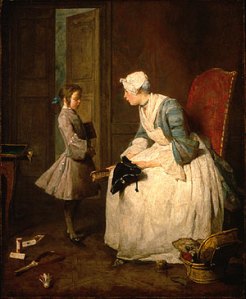
the-governess-1739-jean-simeon-chardin2“With the fortitude of a devoted novitiate, she had resolved at one-and-twenty to complete the sacrifice and retire from all the pleasures of life, of rational intercourse, equal society, peace, and hope, to penance and mortification forever” – Jane Austen about Jane Fairfax in Emma
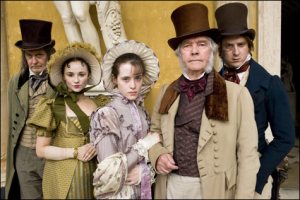
Working as a governess meant a life of limbo for the poor gentlewoman who was forced to support herself due to reduced financial cirdumstances. Jane Fairfax had every reason to fear her future employment. Governesses were a threat to both their employers and the servants of the house,  reminding their female employers of how close they were to finding themselves in a similar predicament. Because of their genteel upbringing governesses lived a life of isolation, not fitting in with the servants belowstairs, not even the housekeeper, butler, or nanny, who, while they belonged to the upper ranks of servants, came from humble origins. Governesses seldom earned enough to save for their old age, and their services were often exploited and undervalued.  Dinah Birch writes in her review of Other People’s Daughter: The Life and Times of the Governess by Ruth Brandon:

Their “predicament was earnestly debated in journals, advice books and manuals, educational treatises, newspapers, charitable commissions, lectures, reviews and memoirs. She became the object of inadequate charity, useless compassion and offensive condescension. Worse still, she had to endure the sense of having fallen from her proper place in the world, for most governesses had been brought up amid domestic comforts and cheerful expectations.”  

This passage from  The Uneasy World Between describes the governesses’ dilemma succinctly:

The governess was often perceived as being an emotional and social threat. Many gentlewomen were forced into the role by some financial catastrophe, reminding the families they worked for of a terrible possibility. Moreover, their intimacy with children often roused the mother’s hostility, and a war for the child’s love was the result. By the middle of the century, a spate of bank failures had hugely oversupplied the market with under- educated would-be governesses, some of whom were reduced to working for £20 a year, or even for nothing except bed and board. What happened to these when they grew too old to work — perhaps only at 40 — does not bear thinking about. Only very few governesses earned more than £200 a year; Sir George Stephen in 1844 only found a dozen. Charlotte Brontë, paid £20 a year in 1841, was much more typical. The social inequality flowed, however, in an unexpected way. Many governesses, more ladylike than their employers, were expected to give a sheen of social elegance to the children of the nouveaux riches. Resentment tended to flow both from the employers and from the servants’ hall. ‘I don’t like them governesses, Pinner,’ the cook in Vanity Fair says of Becky Sharp. ‘They give themselves the hairs and hupstarts of ladies, and their wages is no better than you nor me.’ The ugly situation was very clear to the more thoughtful women in this class. ‘I should be shut out from society,’ Mary Wollstonecraft wrote, ‘and be debarred the imperfect pleasures of friendship — as I should on every side be surrounded by unequals.’The one truly typical story here, perhaps, is that of a crushed and struggling woman, Nelly Weeton. We only know about her because she wrote a journal, discovered long after her death, cataloguing with great ill-humour and resentment the treatment she received at the hands of her drunken and snobbish employers, her bullying father and brother and ultimately an appalling husband. She’s not an attractive figure, full of self-pity and complaint, but her tragic story shows how much governesses at the bottom end of the market had to put up with.

The classic governess in our collective minds is Jane Eyre. She came from a relatively humble background,  but many a young governess came from a background and breeding that equalled  her employers. This definition written in 1849 in The Living Age  describes how  untenable the situation could be:

“…the real definition of a governess in the English sense is a being who is our equal in birth manners and education but our inferior in worldly wealth.  Take a lady in every meaning of the word born and bred and let her father pass through the gazette and she wants nothing more to suit our highest beau ideal of a guide and instructress to our children…There is no other class which so cruelly requires its members to be in birth mind and manners above their station in order to fit them for their station. From this peculiarity in their very qualifications for office result all the peculiar and most painful anomalies of their professional existence. The line which severs the governess from her employers is not one which will take care of itself, as in the case of a servant.

Governesses depended on the kindness of their employers. Emma’s governess, Miss Taylor, who later became Mrs. Weston, was fortunate enough to be treated like a member of the family. One surmises  that she was one of the few to make closer to the  £200 per year described above, than the average of  £20 pounds per year that most governesses earned. In real life, Agnes Porter (c. 1750-1814) was one of the lucky women to be treated with respect when she worked as a governess to the children and grandchildren of the second Earl of Ilchester. She wrote down her thoughts as an unmarried, employed gentlewoman in journals and letters that have been published. A devoted parent, Lord Ilchester took his children with him on on trips, leaving Agnes with enough  free time to entertain friends in her private apartments. She was also invited to dine  in with the family or spend an evening with them.  While Agnes’s experience was a relatively good one, she still would have preferred to be married. Becoming someone’s wife was a desirable goal, since prospects were bleak for a woman who was not “the property’ by anyone. ‘I could not forbear partially and deeply reflecting on the ills that single women are exposed to, even at the hour of death, from being the property of no one.’ ” (Information from: A Governess in the Age of Jane Austen: The Journals and Letters of Agnes Porter). 

In 1886, novelist Wilkie Collins wrote the following dialogue about the governess, Miss Westerfield,  in The Evil Genius: The Story:

Mrs. Linley returned to the subject of the governess.

“I don’t at all say what my mother says,” she resumed; “but was it not just a little indiscreet to engage Miss Westerfield without any references?”

“Unless I am utterly mistaken,” Linley replied, “you would have been quite as indiscreet, in my place. If you had seen the horrible woman who persecuted and insulted her–”

His wife interrupted him. “How did all this happen, Herbert? Who first introduced you to Miss Westerfield?”

Linley mentioned the advertisement, and described his interview with the schoolmistress. Having next acknowledged that he had received a visit from Miss Westerfield herself, he repeated all that she had been able to tell him of her father’s wasted life and melancholy end. Really interested by this time, Mrs. Linley was eager for more information. Her husband hesitated. “I would rather you heard the rest of it from Miss Westerfield,” he said, “in my absence.”

“Why in your absence?”

“Because she can speak to you more freely, when I am not present. Hear her tell her own story, and then let me know whether you think I have made a mistake. I submit to your decision beforehand, whichever way it may incline.”

The implication, of course, was that anyone with compassion would have hired Miss Westerfield. Learn more about the governess in the following links:

The Dorrits in Venice

The Dorrits in Venice

In Little Dorrit, Mr. William Dorrit followed an age old tradition when he decided to take his family on a Grand Tour of the Continent in order to educate them and expose them to the sights and monuments that influenced Western Civilization. Through Mrs. General, he introduced lessons of deportment and elocution to his children. Amy, who was the least willing to leave, made sure that the Plornishes and Maggy were well-provided for before the family departed.

Pam Ferris as Mrs. General

Pam Ferris as Mrs. General

The Grand Tour took more than a year because transportation before the advent of the railway was slow. Itineraries varied, although Paris and Rome were favorite destinations. Before the Napoleonic Wars, young gentlemen were expected to go on a 1-2 year Grand Tour with a tutor. The results were often mixed. (Click on this link to read my post on the topic.) Some heirs returned with souvenirs and their heads stuffed with knowledge, and others frittered their time away, or worse, lost their fortune at the gaming tables. Travels to the Continent ceased during the Peninsular Wars, but picked up again as soon as Napoleon was defeated. As the 19th century progressed, more and more women began to travel abroad with their families and/or chaperones. The Grand Tour began to make inroads with the rising middle class, as well as with Americans, and survives to this day in the form of a “world tour,” with (typically) recent college graduates and retirees taking several months to a year traveling.

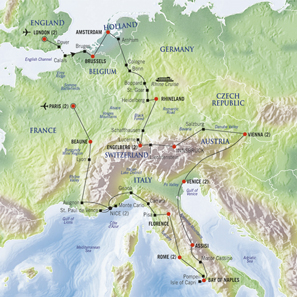
The Dorrits likely departed England from Dover and landed at Calais, the same route as today’s  Chunnel. In the early 19th century, the short voyage across the English Channel was fraught with danger. People risked seasickness or a shipwreck should a sudden storm appear. It took three days to make the journey from Dover to Paris.  Lodging would have been provided by inns along the way, hotels, friends of the family, or, as in the case of the Dorrits, a convent or monastery set up for the purpose of putting guests up for the night. It was at such a lodging that the Dorrits met Rigaud, who was traveling with the newly married Gowan and a concerned and downhearted Pet. Much to Amy’s distress, the Frenchman took an inordinate interest in her as well. As the Dorrits crossed the Swiss Alps towards Italy, Amy was seen to be the only member of the family to appreciate the natural wonders of her surroundings or to show genuine curiosity.

Map of a modern grand tour

Map of a modern grand tour

After the St. Bernard Pass, the Dorrits would have encountered Turin before journeying on to Venice.

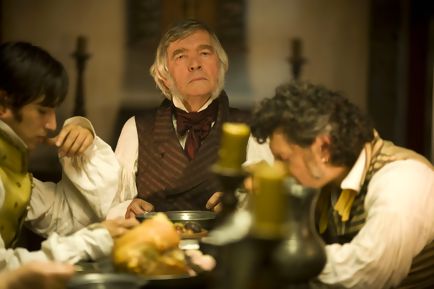
Henry Gowan, William Dorrit, and Rigaud at their lodging

Henry Gowan, William Dorrit, and Rigaud at their lodging

It was traditional for Grand Tour visitors to remain for several months in a major destination city, as the Dorrits did in Venice. Visitors did not carry a great deal of cash, for fear of robbery, but brought letters of credit that they would present at the nearest bank. Unlike other cities in Western Europe, Venice had been an independent maritime state for over a thousand years. Its wealthy merchants had created a sumptuous city that was influenced culturally and artistically by the East. Saint Mark’s Basilica is one of the most recognizable and beautiful examples of Byzantine architecture in the world. The city’s watery setting also made it unique and unforgettable. In a letter written on a grand tour in 1932, the author reveals that little had changed in Venice in over a century, or indeed through today:

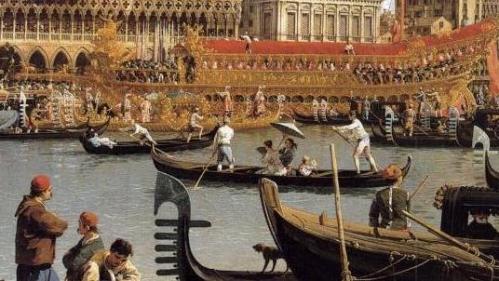
Journeying by gondola

Journeying by gondola

I suppose most people think that one cannot go anywhere in Venice except by gondola. That is not so at all. There are sidewalks and narrow streets and alleys that lead all over the city. The small canals from 15 to 40 feet wide are traversed by gondolas and sometimes small motorboats. The houses rise directly from the water’s edge in many cases. Thus along the Grand Canal the front steps lead right into the water where private or public gondolas are waiting — taxis, you know. Some of these palaces are very beautiful. Each has tall mooring posts, decorated with the family arms or gay stripesGrand Tour 1932

Mrs. Merdle and William Dorrit in Venice

Mrs. Merdle and William Dorrit in Venice

Spoiler Alert for those who have not read the book: William Dorrit was never able to escape the influence of 23 years in the Marshalsea, and on the evening of his death in Venice he imagined he was back in prison again. Of his children, only Amy remained humble and true to herself throughout the journey. Although it was evident that she deeply appreciated her beautiful surroundings, she never stopped missing England or the friends she had left behind.

Missed an episode on Masterpiece Classic? You can watch past episodes online until early May at this link.

Fanny visits the museum

Fanny visits the museum

More About the Grand Tour

My other Little Dorrit Reviews:

“Hot Cross Buns, Hot Cross Buns,
One a penny, two a penny,
Hot Cross Buns.”

– Street Cry on Good Friday in England

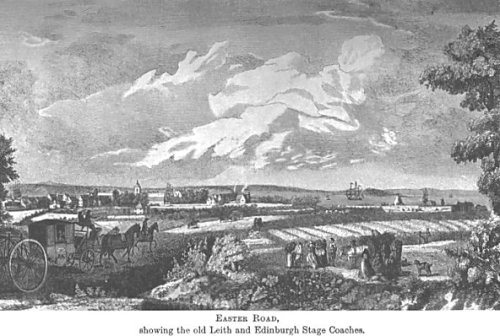
easter_road

  • Easter Fun at Chawton House this year will depend on good weather. Then again, there’s nothing like a sturdy pair of Wellies and an umbrella to deal with spring showers.
  • Here is a fun project on Belly Timber to make decorative boxes that will hold your Easter eggs or candy.

Jane Austen mentions Easter in a peripheral way. Fanny Price pines for Mansfield Park hoping to return soon to the Bertrams after her ‘exile’ to Portsmouth. However, by Easter she still has not received a summons to come ‘home.’:

Easter came particularly late this year, as Fanny had most sorrowfully considered, on first learning that she had no chance of leaving Portsmouth till after it. It came, and she had yet heard nothing of her return–nothing even of the going to London, which was to precede her return. Her aunt often expressed a wish for her, but there was no notice, no message from the uncle on whom all depended. She supposed he could not yet leave his son, but it was a cruel, a terrible delay to her. The end of April was coming on; it would soon be almost three months, instead of two, that she had been absent from them all, and that her days had been passing in a state of penance, which she loved them too well to hope they would thoroughly understand; and who could yet say when there might be leisure to think of or fetch her? – Mansfield Park, Chapter 45

Happy Easter One and All.