Feeds:
Posts
Comments

Though older and heavier than as a spoiled scoundrel in The Way We Live Now and heartthrob, Mr. Darcy, Matthew’s turn as kind-hearted Arthur Clennam in PBS Masterpiece Classic’s Little Dorrit is outstanding. No one has played the character better in my opinion.

My reviews of Little Dorrit:

One comedic touch in the otherwise unrelentingly sad and dark Litte Dorrit is Flora Finching, Arthur Clennam’s youthful love. As he walks into her father’s house,  a flickering memory of her beautiful figure comes to his mind … which is instantly displaced by the real Flora entering the room. To his horror she has become silly, old, and fat. While her youth has dimmed, her youthful air and self-image have not:

Flora, always tall, had grown to be very broad too, and short of breath; but that was not much. Flora, whom he had left a lily, had become a peony; but that was not much. Flora, who had seemed enchanting in all she said and thought, was diffuse and silly. That was much. Flora, who had been spoiled and artless long ago, was determined to be spoiled and artless now. That was a fatal blow.
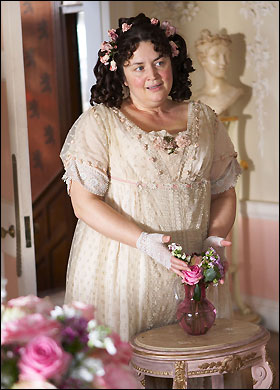
Ruth Jones as Flora Finching in Little Dorrit, 2008

Ruth Jones as Flora Finching in Little Dorrit, 2008

Maria Beadnell

Maria Beadnell

The character of Flora Finching is based on a true person in Charles Dickens’ life. In 1830, when Dickens was 18 years old he fell madly in love with Maria Beadnell, the pretty and flirtatious daughter of a highly successful banker. He courted her for three years, but her parents objected to Charles, who was a struggling young court reporter, and Maria broke off their relationship.  Dickens was heartbroken over the break up and never forgot Maria. It is said that Dora Spenlow in David Copperfield was based on his memory of her.

Dickens and Maria began to exchange letters in 1855, when she contacted him 20 years later. She was now Mrs. Henry Winter and described herself as being “toothless, fat, old and ugly.” Dickens, whose marriage was in trouble, did not believe her description. After he and Maria exchanged several passionate letters, Dickens arranged for his wife Katherine to invite Mr. and Mrs. Henry Winter to a private dinner.  He was appalled to find out that Maria had indeed altered as she said. She was in her forties, fat, and dull.* After this meeting, in which she gave him her cold, and in which he rebuffed her flirtatious attempts, his letters to her became short and formal.  Later, when she again tried to renew the relationship, he broke it off for good.
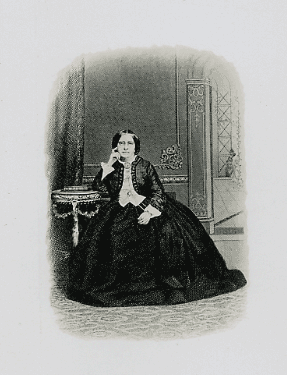
Maria Beadnell later in life

Maria Beadnell later in life

In a BBC Press Pack, actress Ruth Jones, who plays Flora, says of the character:

“She has real energy and enthusiasm and love of life – I adore that about her. But she is also very complex. She is a sad person trying to make the best of the lot she has been saddled with.

“Life has stood still for Flora while Arthur has been away. She still dresses like a little girl, but now has lines under her eyes and has put on weight.

“She is now this rather matronly woman who is still a vision in pink. But I like the fact that she is not bitter about being left behind.”

There is an affecting authenticity about the fact that Flora is unable to move on.

In later years Dickens observed about his youthful love: “We all have our Floras, mine is living, and extremely fat.” How did Charles Dickens fare in the looks department? The image on the right was made in 1858, a year after the last installment of  Little Dorrit was published.

Charles Dickens as a youth and as a man

Charles Dickens as a youth and as a man

Watch Little Dorrit on PBS’s Masterpiece Classic from now until April 26th. Click here for details.
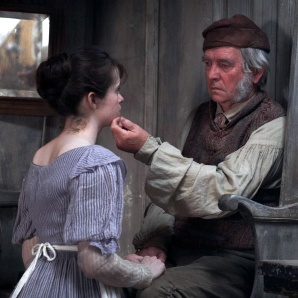
clairefoycourtenayCharles Dickens wrote Little Dorrit during the mid 19th century, but he placed the story at a time when his father was imprisoned in the Marshalsea, a debtor’s prison. PBS will be airing a 5-installment series of Little Dorrit starting tonight at 9 p.m. EST and ending April 26th. If you have missed any episodes, you can watch them online at this link.

The film is stunning; the acting is outstanding; and this story of greed, ponzi schemes, lost fortunes, insurmountable debts, and wrecked lives resonates in today’s financial climate. In the next few weeks I will be posting a series of thoughts and reviews about this film, which is set in the Regency Period. The links sit below this slide show.

Jane Austen’s World

I decided to google Jane Austen’s World to see how many items of interest popped up (besides those featured on my blog, Jane Austen’s World, and my website, also entitled Jane Austen’s World.) Here are the links listed in no particular order:

  • The Los Angeles Times features an archived post entitled the Music World of Jane Austen, which is a review of a concert performed in 2007. The link also leads to Jane Austen Audio Guide at the University of Wisconsin – Madison, which is an independent learning course offered by Professor Emily Auerbach. The costs are quite reasonable!
  • jane-austen-regency-world-coverThe March/April 2009 issue of Jane Austen Regency World Magazine is now available. Topics in this issue include: Is This the Real Mrs. Bennet?, Chawton House Bicentenery, Amazing Wilberforce, For the Love of Jane: A survey of Janeites, Death in the Press: Obituaries in the Regency World, and a new series of insights about Jane by Maggie Lane. Bimonthly Bits of Ivory, a review of Jane Austen Regency World Magazine by Carrie Bebris for JASNA News sits on the Republic of Pemberley website.
  • Shedding Light on Jane Austen’s World is a 1998 review of Claire Tomalin’s book, Jane Austen: A life. One needs a trial prescription to HighBeam to read it, but what I found interesting was this link to the Center for Distance and Independent Study from the University of Missouri, which offers English Studies online, including those that will round out your knowledge of Jane Austen and the world she lived in. Two of the courses are named Studies in English (The Rise of Gothic Literature) and Major Authors 1789 – 1890 (Jane Austen Then and Now) with a preview of the course.

jane-austens-world-illustration

  • The World of Jane Austen describes a two-day walking tour in the Hampshire countryside. It is a little pricey at £230 per person, but this tour would give you a sense of what walking from place to place was like during Jane’s time. I intend to share this information with the Janeites on the James, my book group. We are all dying to see Jane Austen’s world now that we’ve been talking about it for nearly four years.
  • Last week the Smithsonian featured The Regency World of Jane Austen. Drat, I missed it. I shall have to keep a closer tab on their educational features, since the Institution is only a two-hour drive from my house. Did anyone from the Mid-Atlantic JASNA attend the day-long workshop? If you did, how was it?
  • Last but certainly not least, Jane Odiwe recently published a post entitled: What Was Happening in Jane Austen’s World in 1795? The last few winters that Jane experienced in her life were colder than normal, which inspired Jane Odiwe to paint one of her lovely watercolours of Jane walking in the snow with her sister Cassandra.
Fanny Knight

Fanny Knight

In the last two years of her life, Jane Austen wrote five letters to her niece Fanny Knight that combined true affection, detached analysis, and rare good sense.*  Austen scholar Janet Todd characterized Jane’s role as an “agony aunt” who dispensed sympathetic advice to a motherless teenager with lines that are now famous: “Single women have a dreadful propensity for being poor — which is one very strong argument in favor of matrimony. ” In 1814,  shortly after her first edition of Mansfield Park sold out,  Jane wrote a letter of caution to her niece Fanny Knight about marriage and affairs of the heart:

And now, my dear Fanny, having written so much on one side of the question, I shall turn round and entreat you not to commit yourself farther, and not to think of accepting him unless you really do like him. Anything is to be preferred or endured rather than marrying without affection; and if his deficiencies of manner, &c. &c., strike you more than all his good qualities, if you continue to think strongly of them, give him up at once…

It turns out that Fanny was never enamored enough to marry the young man. Fanny’s daughter Louisa wrote years later:

these five letters are peculiarly interesting, not only because in every line they are vividly characteristic of the writer, but because they differ from all the preceding letters in that they are written, not to an elder sister, but to a niece who constantly sought her advice and sympathy, and whom she addressed, of course, in a different manner, and from a different standpoint. The other and, naturally, to me a consideration even more important, is that, according to my humble judgment, these letters, whilst they illustrate the character of my great-aunt, cannot, when explained, do otherwise than reflect credit upon that of my beloved mother; whilst they prove the great and affectionate intimacy which existed between her and her aunt, and incidentally demonstrate the truth of a remark in one of Cassandra’s letters that there were many points of similitude in the characters of the two.

Jane’s own words to Fanny co-oberate their closeness:

“You are inimitable, irresistible. You are the delight of my life. Such letters, such entertaining letters, as you have lately sent! such a description of your queer little heart! such a lovely display of what imagination does. You are worth your weight in gold, or even in the new silver coinage.”

While Jane died young, Fanny lived to a great age. We know of Fanny’s infamous letter about her aunt written to her younger sister Marianne in 1869, over 50 years after Jane’s death, which did not exhibit the same degree of exuberant affection as Jane’s letters showed towards her niece. But Fanny’s words were written when she was an old woman who was influenced by Victorian sensibilities. In reality, the relationship between  Jane and her niece was both loving and complex, for Fanny recalled on numerous occasions her many walks with her Aunt Jane and very interesting conversations and delicious mornings.*

Learn more about their relationship in the following resources: