
Over 200 outdoor pleasure gardens and tea gardens proliferated in London from the 16th to the early 19th centuries. Primarily frequented by working class people who lived in the city, they were located in the pleasanter parts of London’s suburbs. In days of yore, the countryside was only a walk (or short carriage drive or ferry ride) away from the city center. Tea and pleasure gardens afforded the populace a respite from the sights, smells, and congestion of city life. In his essay on Tea Gardens, William Boulton writes:
“It was the citizens of such a town, sober merchants and shopkeepers, apprentices, sempstresses, and artisans who worked continuously, but leisurely and without much stress, during the week and spread themselves over an area of many square miles on Sundays, who formed the chief patrons of the al fresco entertainment. The lawyers and military men who filled the chief of the few recognised professions of the last century, supplied their quota of course, and the aristocracy came to most of the alfresco entertainments at one time or another, but merely as incidental visitors.”
Even the humblest tea gardens situated in inns and taverns vied for customers by offering special attractions like cake and ale, a bowling green, play tables, or a pond. Larger more luxurious gardens, such as Vauxhall or Ranelagh, offered a myriad of entertainments in the form of musicales, fireworks, illuminated groves, balloon rides, and theatricals. Considered the forerunners of today’s amusement parks, pleasure gardens provided extensive walks, private arbors, supper boxes, rotundas, and Chinese pavilions. Regardless of their size, the competition among these open air recreational gardens was fierce. Open only for a short season, the proprietors had to earn enough income to keep their establishments open and make a decent living.
The London Pleasure Gardens of the Eighteenth Century By Warwick Wroth, … assisted by Arthur Edgar Wroth With sixty-two illustrations By Warwick William Wroth, Arthur Edgar Wroth
Various strata of social classes commingled in these public spaces, although the upper classes tended to visit less frequently. When they did honor an establishment with their presence, they could create a stir.
“In 1733, in the month of May, it occurred to the Princesses Caroline and Amelia to attend [Islington Spa] regularly and take its waters. These royal ladies were duly saluted with twenty-one guns, and all London flocked to the gardens to see a real princess.” – London’s Tea Gardens, An Essay by William B. Boulton
Profits shot up sky high for the owner after these royal visits, making the Islington Spa a commercial success. The White Conduit House, situated just 2-3 miles north of Marlyebone Gardens, was another popular garden destination. In 1753, the proprietor, Mr. Bartholomew, ran the following enterprising advertisement:
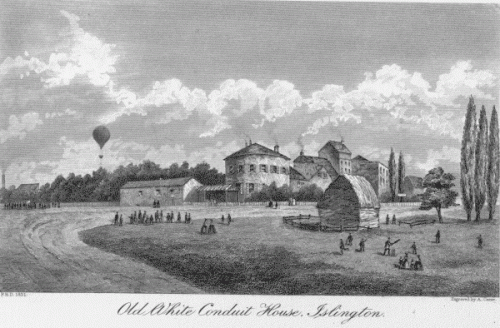
For the better accommodation of ladies and gentlemen, I have completed a long walk, with a handsome circular fish-pond, a number of shady pleasant arbours, inclosed with a fence seven feet high to prevent being the least incommoded from people in the fields; hot loaves and butter every day, milk directly from the cows, coffee, tea, and all manner of liquors in the greatest perfection; also a handsome long room, from whence is the most copious prospects and airy situation of any now in vogue. I humbly hope the continuance of my friends’ favours, as I make it my chief study to have the best accommodations, and am, ladies and gentlemen, your obliged humble servant, Robert Bartholomew. Note. My cows eat no grains, neither any adulteration in milk or cream.
The White Conduit House, also known as the “Minor Vauxhall”, began to offer balloon ascents, fireworks, and evening concerts. But its popularity gradually waned and the establishment offered its last entertainments in 1849.
Food and entertainments depended on the time of day. In Bagninne Wells, for example, morning visitors tended to be invalids who would drink the mineral waters and partake of an early breakfast.
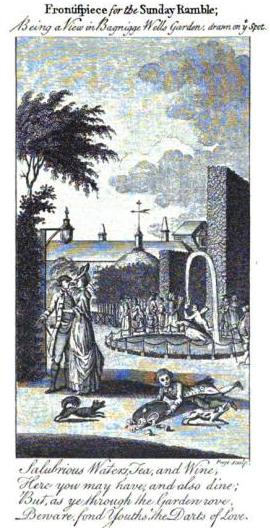
Bagnigge Wells
As the day wore on the invalids withdrew and the place was prepared for another class of customers. The citizens, their wives and daughters, came for their afternoon outing; the long room if the weather threatened, and the arbours if the sun shone, were filled with sober parties of shopkeepers or with boys and their sweet hearts, drinking tea and eating the bread and butter and the buns baked on the ground for which the place was famous. Negus was another of the products of Bagnigge held in much favour, and there were cider and ale for the more jovial spirits who smoked under the shade of the Fleet willows and watched the games of skittles and Dutch pins which were played in the eastern part of the gardens during the long summer evenings.
In the afternoon tea was served, as well as stronger drinks, like negus. Visitors could relax, drink syllabub, eat cake, and listen to the music of Handel. Or an amorous couple could sit and flirt in a private arbor. At night the pleasure gardens glittered with illuminated walks and fireworks. These public venues weren’t all pleasure. Pickpockets, “frail women”, sharpers, and other less desirable visitors would mingle among the crowds, adding a hint of danger and seaminess.
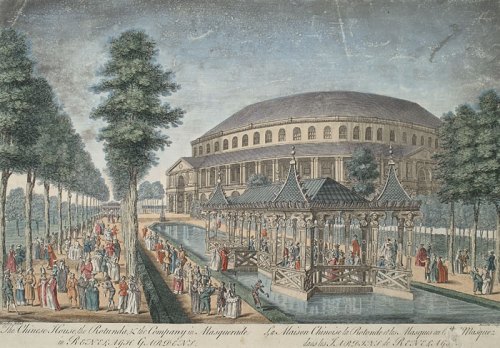
Rotunda at Ranelagh Gardens, 1754
Towards the end of 1810, Bagnigge Wells was increasingly frequented by the lower classes, or as one late 19th century writer termed, “Cockney Crowds.” By 1813 the gardens were put up for auction. Vauxhall lasted until 1857. Ranelagh’s famed rotunda closed in 1803 and was demolished in 1805. Today the site provides part of the grounds of Chelsea Hospital where the Annual Chelsea Flower Show is held.
Definition of
A Tea Garden: A tea garden was a place to drink tea and stroll around lawns, ponds and view statues. These smaller versions of pleasure gardens flourished in the late 18th century. Examples were Cuper’s Gardens and the area that became the Caledonian Cattle Market in London, England.en.wikipedia.org/wiki/Tea_garden
A Pleasure Garden is usually a garden that is opened to the public for recreation. They are differentiated from other public gardens by containing entertainments in addition to the planting; for example, concert halls or bandstands, rides, zoos or menageries.
Learn more about Pleasure Gardens at these sites
- 18th Century Pleasure Gardens
- London Pleasure Gardens of the 18th Century, Warwick William Wroth, 1896 Google Book
- Parks and Pleasure Gardens of Regency London, JASA
- Pleasure Gardens of Old London
- Pleasure Gardens
- Jane Austen Gardens
- Vauxhall Gardens
- The Vauxhall Pleasure Gardens: Detailed History
- Season Ticket to Vauxhall Pleasure Garden, British Museum
- Vauxhall Gardens, The Literary Encyclopedia
- Complete Charles Dickens Short Story: Vauxhall Gardens By Day
- London’s Tea Gardens, An Essay by William B. Boulton

 The abstract of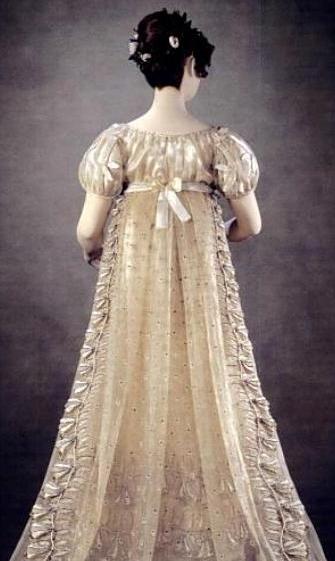
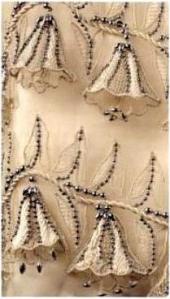 When I saw Princess Charlotte’s bellflower court dress (1814-16) at the Museum of London I remember being transfixed and standing in front of the glass case for a half hour. I could not get over the exquisite details and embroidery of this gossamer thin gown, and wondered at the hours it took to create it, the number of seamstresses that must have toiled over it, and its cost. It was so beautiful that I mistook it for a wedding dress. The train, which showed slight damage where some of the embroidered bells were missing, is similar to the one on Princess Charlotte’s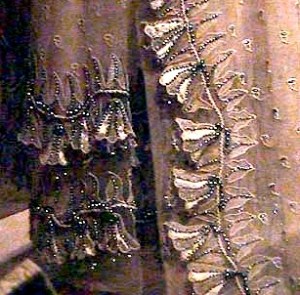
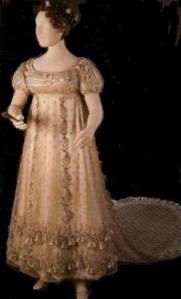 Front of gown, Museum of London







 Jane Austen's World