Feeds:
Posts
Comments
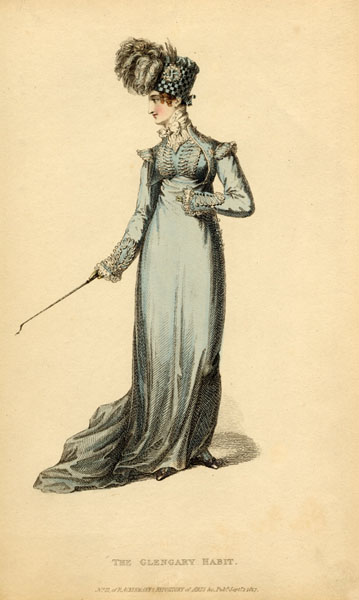
Glengarry riding habit, 1817

Glengarry riding habit, 1817, Ackermann

During the first two decades of the nineteenth century, riding habits echoed the high-waisted empire styles that prevailed and the fashion trends that were currently in vogue. The light blue Glengarry riding habit of 1817 (at right) is typical of the fashion of the day. The military-inspired dress was trimmed with lace, braids (image at bottom of post), and frogs. The hat was made of cork, a sensible light weight material, which was visually overpowered by the plumes of feathers that arched over the wearer’s face. Unlike later riding habits, regency riding costumes came in a variety of colors:

It must be remembered that riding dress fashions had not yet fixed on dark colors. Every tint of bright color was used, even figured materials. . . Cloth was of course the general material, but velvet was also used and even silk.  There seemed to be no limit to the equipments and trimmings of habits. Where undersleeves were worn in full dress, they appear on the habits. If fichus were the mode, fichus were worn on horseback, while artificial flowers decked riding hats, as well as long feathers. Necklaces even appear, and frequently chatelaines with watches and various trinkets. I have seen several old French and English fashion plates in which the rider carried a carefully spread fan. If ruffs were worn in full dress, ruffs appeared on horseback. If embroidery was worn, the habit was embroidered.  Two Centuries of Costume in America, MDCXX-MDCCCXX By Alice Morse Earle
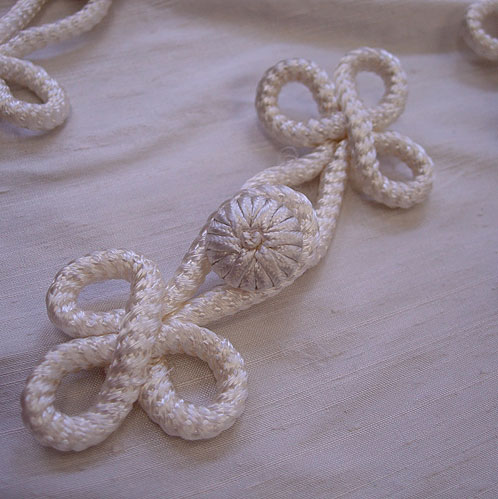
Frog fastening
Frog fastening

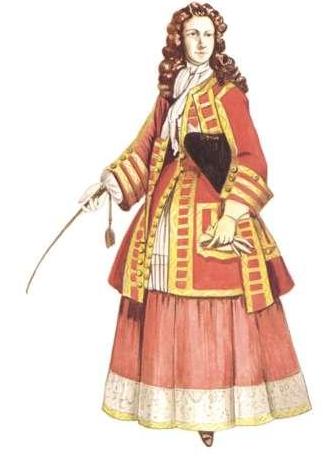
Lady in riding habit, 1720

Lady in riding habit, 1720

Braiding and frog fastenings of the era were heavily influenced by the return of English troops from Egypt. Frogs had been used in the East since ancient times, and added a dashing, even exotic touch.

The masculine influence in riding habits began near the end of the 17th Century when ladies adopted masculine coats and waistcoats for riding and hunting. The tailored tops were paired with feminine petticoats, as in this illustration. Horse riding had always been an important and fashionable sport for the upper classes, but these masculine-inspired riding habits were condemned from the start by critics who argued that the bold outfits belied a woman’s innate modesty. Some women began to wear them in the most unexpected places.

Samuel Pepys wrote famously in his diary on June 11, 1666:

Walking in the galleries at White Hall, I find the Ladies of Honour dressed in their riding garbs, with coats and doublets with deep skirts, just, for all the world, like mine; and buttoned their doublets up to the breast, with periwigs under their hats; so that, only for a long petticoat dragging under their men’s coats, nobody could take them for women in any point whatever; which was an odde sight, and a sight did not please me.

It took a long time for these outfits to become generally accepted. Almost eighty years after Samuel Pepys wrote his remarks, Samuel Richardson reminded women in his Familiar Letters on Important Occasions (1741) that:

as sure as any thing intrepid, free, and in a prudent degree bold, becomes a man: so whatever is soft, tender, and modest, renders your sex amiable. In this one instance we do not prefer our own likeness; and the less you resemble us, the more you are sure to charm: For a masculine woman is a character as little creditable as becoming. (Women of Quality, Ingrid H. Tague, 2002, p 52.)

Not all men of the era became chagrined at the thought of a woman in mannish attire. In 1670, Cardinal Dubois, a Frenchman, wrote in his Mémoires:

Mme de Fontanges – let us follow our young beauty as she goes hunting with her prince. That day she was wearing an expensively embroidered riding habit and a hat covered with the most beautiful plumes procurable. She looked so elegant in this costume none other could have suited her better. Nicole-Cargill-Kipar’s Late 17th Century Clothing History
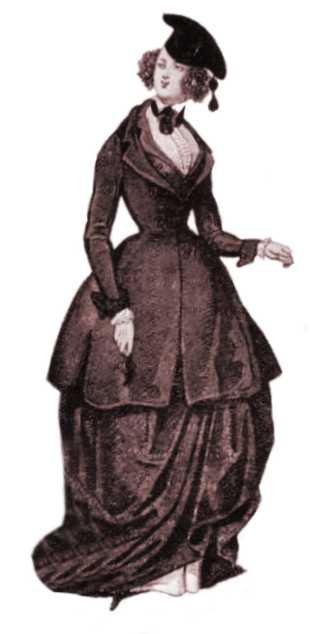
Riding costume, 1841

Riding costume, 1841

Despite their doubtful propriety, ladies continued to wear riding outfits, and as the 18th century progressed these costumes began to be more accepted.  With the changing fashion, the silhouette became more frilly and femininized and began to take on a higher waistline. In fashion plates the riding costume would be accessorized with a riding crop to distinguish the outfit from carriage costumes, which were made with similar sturdy, long-wearing cloth. By the end of the nineteenth century riding costumes had come full circle and taken on a more somber, tailored, and masculine look. Ladies’s riding habits began to be fashioned by men’s tailors as well as dressmakers.  In a New York Times article from June 1901, the author wrote: “the lady on horseback is as much of a man, down to the saddle, as circumstances permit.”

This description of the Glengarry Riding Habit (top image) was written in Ackermann’s Repository, September, 1817. A dressmaker named Miss M’Donald was responsible for its creation.

It is composed of the finest pale blue cloth, and richly ornamented with frogs and braiding to correspond. The front, which is braided on each side, fastens under the body of the habit, which slopes down on each side in a very novel style, and in such a manner as to define the figure to considerable advantage. The epaulettes and jacket are braided to correspond with the front., as is also the bottom of the sleeve, which is braided nearly half-way up the arm. The habit shirt is composed of cambric, with a high standing collar, trimmed with lace. The cravat is of soft muslin, richly worked at the ends and tied in a full bow, and there are narrow lace ruffles at the wrists. The headdress takes the form of the Glengary cap, composed of blue satin, and trimmed with plaited ribbon of various shades of blue, and a superb plume of feathers. Blue kid gloves are worn and half-boots. Sources: Riding Habits, Candice Hern, and Nineteenth-Century Costume and Fashion, Herbert Norris and Oswald Curtis.

Images of Riding Habits in the Regency Era:

History of Riding Habits

More links:

Image of 1841 riding habit from Redingote Fashion History.
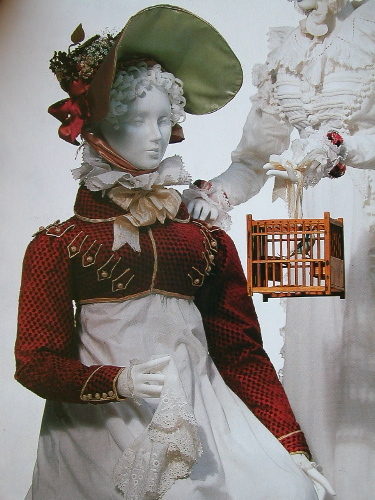
Military influence in the Spencer jacket, with braided piping, 1815

Military influence in the Spencer jacket, with braided piping, 1815. Image: Kyoto Costume Institute.
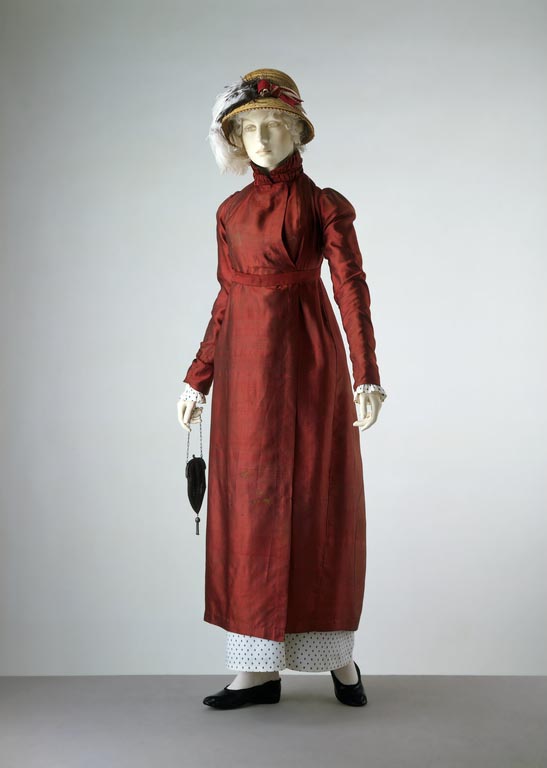
1809 Silk Pelisse, Victoria and Albert Museum

1809 Silk Pelisse, Victoria and Albert Museum

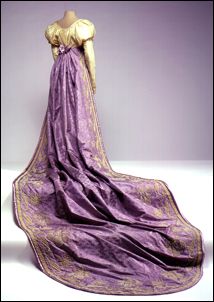
1801 Court Dress with Train, Centraal Museum

1801 Court Dress with Train, Centraal Museum

Nineteenth Century Fashions: A Compendium offers a breathtaking series of thumbnails of 19th Century fashions from museum collections and websites around the world.  The images are not original. In fact, a score of them have already been discussed on this site, such as the images from the Kyoto Costume Institute. Click on the link, then click on the years that interest you. Enjoy!

Inquiring reader: I featured this post on Jane Austen Today on November 3, but I loved the history of the back story so much that I wanted to publish the post here also. For another nearly forgotten Pride and Prejudice performance, click on Celia Johnson: The Forgotten Elizabeth Bennet.

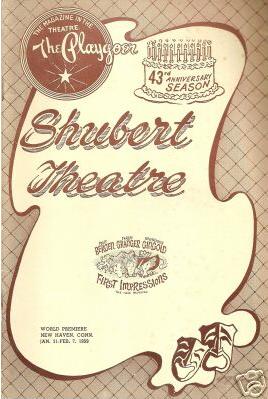
Seen on the blogosphere is this quote from Theater Mania about the 1958-1959 season:

One of the season’s short-lived shows was First Impressions, a musical version of Jane Austen’s Pride & Prejudice, in which Polly Bergen took over the lead role of Elizabeth Bennett three weeks before opening. “I replaced Gisele MacKenzie and had to learn the score very fast,” she told me. “Farley Granger [who played Mr. Darcy] and Hermione Gingold [who played Mrs. Bennett] were not singers, so I carried the vocal load of the show. It was a vicious dog-eat-dog atmosphere.”

The action took place in the early 19th Century, causing one critic to snipe that “Polly Bergen is about as period as Mickey Mantle.” She had the critique framed and hung above her desk. “I learn more from bad reviews than good ones. Everything was rushed; the last thing I gave any thought to was that it took place in 1813! It was a horrific experience, and I thought that was what Broadway was. But it’s really the medium I love.”

“As Darcy, Hollywood’s Farley Granger is the stuff telephone poles are made of.”


Here’s more about Polly Bergen in an interview that Jane Austen would have appreciated for its satiric humor:

Polly Bergen. First Impressions. NYC (Photo: Polly Bergen, Stuart Hodes)
At the first full cast rehearsal, when Polly Bergen Polly Bergen and Stuart Hodescame in I recognized her perfume.
“Aah, Vent Vert!
She stopped. “How come you know?”
“It’s my favorite. I bought some in Paris.”
I’d bought a bottle in Paris but had first sniffed it on Air France which had a full bottle in every john. I decided not to share that detail with Bergen.
The next day when Bergen arrived she approached, leaned close, and said, “Okay, what’s this?”
I had no idea. “Chanel Number 5.”
“No.”
I took another sniff. “I got it! Pissoir d’amour.
She gave me a faint smile. “You’re quite an expert.”— Stuart Hodes

One may purchase the cast album on Amazon.com today for around a whopping $90. The following is an Al Hirschfeld cartoon of Polly Bergen in 1958.

Shubert Theatre Playbill of First Impressions

Shubert Theatre Playbill for First Impressions

The 18th Century Sedan Chair

The 18th Century Sedan Chair; Image from Georgian Index

After the fire of London, in 1666, the streets were impassable, and so people of quality went on their business or pleasure in sedan chairs.They became in time such a nuisance as to obstruct the highways. – The History of Dress, The New York Times, 1884,

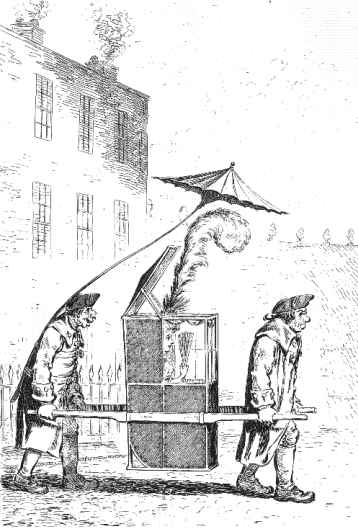
Modern young miss transported with her feather headress intact

Young Georgian miss transported across town with her headdress feathers intact. Click on image for larger view.

Sedan chairs were a major mode of transportation through London’s narrow streets and along Bath’s steep lanes throughout the 17th and 18th centuries and early part of the 19th century. Strong chair carriers could transport passengers down winding passageways much faster than a carriage, which had to make frequent stops in congested traffic. The chair was named after the town of Sedan in France where it was first used. By 1634, they had been introduced to London as vehicles for hire, and their popularity quickly spread to France and Scotland, as well as the rest of Europe.

These portable covered chairs, used in one form or another in other cultures since ancient times, sported side windows and a hinged door at the front. Sedan carriers inserted long wood poles into metal brackets on either side of the chair. The poles were long and springy and provided a slightly bouncy ride. They were arranged in such a manner that the chair would remain in a horizontal position as the carriers climbed up steps or steep slopes. Passenger entered and exited between the poles if they remained in place.

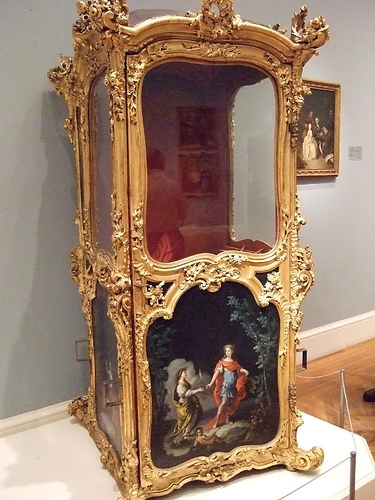
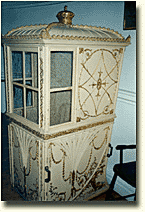
Early 18th c. gilt and wood Sedan chair; painted panels attributed to Charles Antoine Coypel

Early 18th c. gilt and wood Sedan chair; painted panels attributed to Charles Antoine Coypel

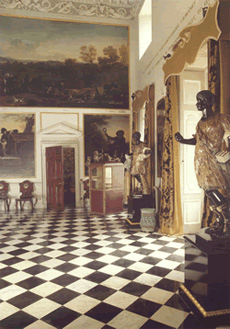
Sedan chair, 1760, made for the Countess of Spencer

Sedan chair in entrance hall of Althorpe House, made for the Countess of Spencer in 1760.

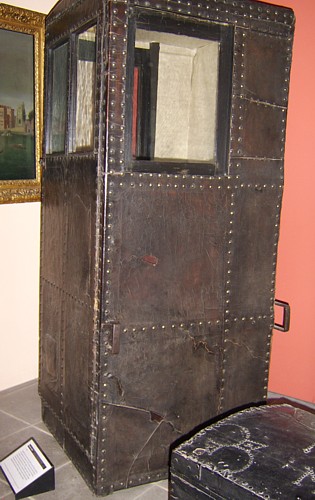
Chairs for the wealthy were richly carved and decorated, and stood inside the entrance hall to be used at the owner’s convenience. Footmen would summon hired carriers, who would take patrons to their destination. For the more ornate Sedan chairs, painters would create beautiful scenes on panels mounted on the sides, and many were extravagantly upholstered in silk on the inside. The less affluent hired plainer, leather covered chairs. (See 1700 image.)

Plain leather covered sedan chair, 1700. Notice the metal brackets.

Plain leather covered sedan chair, 1700. Notice the metal brackets.

Sedan chair in the Pump Room

Sedan chair in the Pump Room

Sedan chair houses were available throughout the city of Bath, as shown in the image lower down in this post, although they were also kept in hallways by those who owned them. A rather plain Sedan chair was on display underneath the stairs in the hall of No. 1 Royal Crescent when I visited Bath. One feature that made the chair so popular in Bath – a city in which invalids were transported for healing sessions to the hot mineral baths – is that the vehicle was narrow enough to be carried up the stairs and taken into the bedchamber. Once an invalid entered the chair, he or she would stay inside, unexposed to outside air. The chairs could be carried inside to the baths or to the Pump Room, as you can see in this illustration by Rowlandson, who shows a man on crutches emerging from a Sedan chair.

Rowlandson, Comforts of Bath, Pump Room

Rowlandson, Comforts of Bath, Pump Room

Because these portable chairs could be carried inside buildings, people could be transported around the city without being identified. This made it easier for people who were evading the law to go about their business, or for public personages to carry on trysts. Links-boys would light the road at night, and they waited until they were needed again to light the way back. As the painting below shows, accidents did happen!

Rowlandson, Sedan chair breaking down

Rowlandson, Sedan chair breaking down

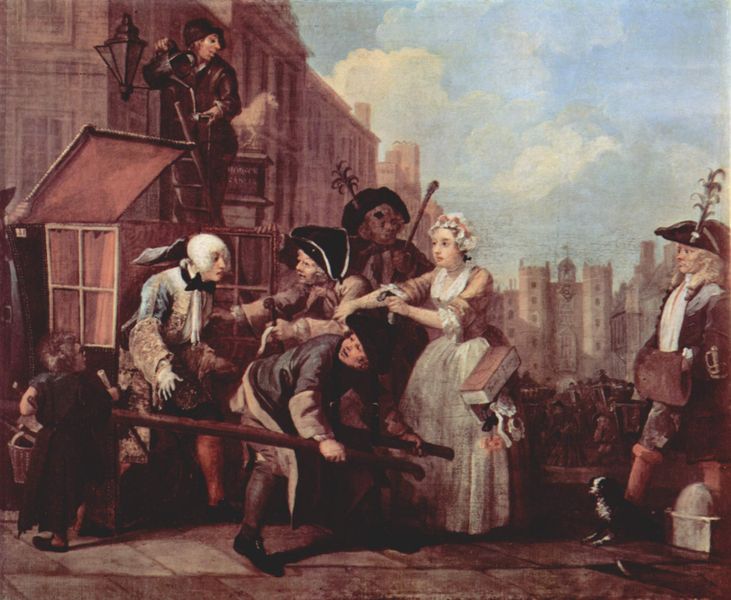
“At Bath, Tunbridge Wells, and other fashionable places, chairmen plied in the streets as cabs and hansoms now do. Occasionally they were used by spendthrifts, who were anxious to avoid the tipstaves, as they could enter them in their own houses and be deposited in that of a friend. However, it does not appear that the Sedan chair was always a safe refuge against arrest for debt, as in one of Hogarth’s prints the tipstaves are seen to be laying hold of one they were in search of, just as he was about to descend from his supposed place of security. One of the best caricatures of the day represented an Irishman being carried through the streets in a Sedan chair by two burly men, with his feet touching the ground, some wag having taken out the bottom of the Sedan, and the chairmen, aware of the practical joke, selecting the dirtiest part of the road.” NY Times, 1875, Old Coaches and Sedan Chairs

A Rake's Progress, Hogarth, Sedan Chair

A Rake’s Progress, Hogarth, Sedan Chair

As previously stated, Sedan chairs for hire were common in London. Chairmen wore a uniform, were licensed to carry passengers, and had to display a number, like today’s taxi drivers. Three hundred chair permits were issued in London and Westminster in the early 1700’s. A similar system was later used in Scotland, where a fare system was established in 1738. A trip within a city cost six pence and a day’s rental was four shillings. It cost £1 1 shilling to hire a sedan chair for a week. The chairs were available around the clock, but after midnight the chairmen would be paid double the fare.

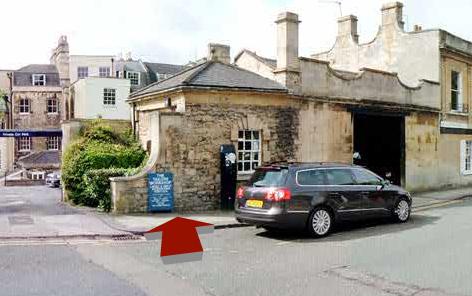
Sedan chair house in Barh, Queen's Parade Place

Sedan chair house in Bath, Queen’s Parade Place

Sedan chair houses, or stations, were common in cities were they were used. Only two examples of these houses remain today in Bath:

“Continue along Gay Street and turn first left into Queen’s Parade Place. On either side of an opening are the only examples of sedan chair houses in Britain. Here chairmen would rest before carrying passengers to their destinations. They were notoriously rude and unscrupulous often locking their passengers in the chair until they had paid the exorbitant fare! Beau Nash licensed them and set reasonable fares. Their demise came when a local man invented the “Bath chair,” a 3 wheeled vehicle.”  From eu-journal, 011

1840, wheeled Bath chairs outside of the Pump Room

1840, Wheeled Bath chairs outside of the Pump Room

The Sedan chair fell gradually into disuse. Horace Walpole bemoaned their waning popularity as early as 1774, and by the mid-19th century three-wheeled Bath chairs had taken their place.

“The chairmen were fine, robust men; they had little regard for foot passengers, and considered the pavement their own exclusive property. It was rather an amusing sight to witness how the men trotted off, when a chair was required, racing to be first for hire. After a time Sedan chairs got out of fashion, except at Bath, Cheltenham, and Leamington, where they wer in favor for many years after they ceased to exist in the metropolis. – Old Coaches and Sedan Chairs, NY Times, october 17, 1875

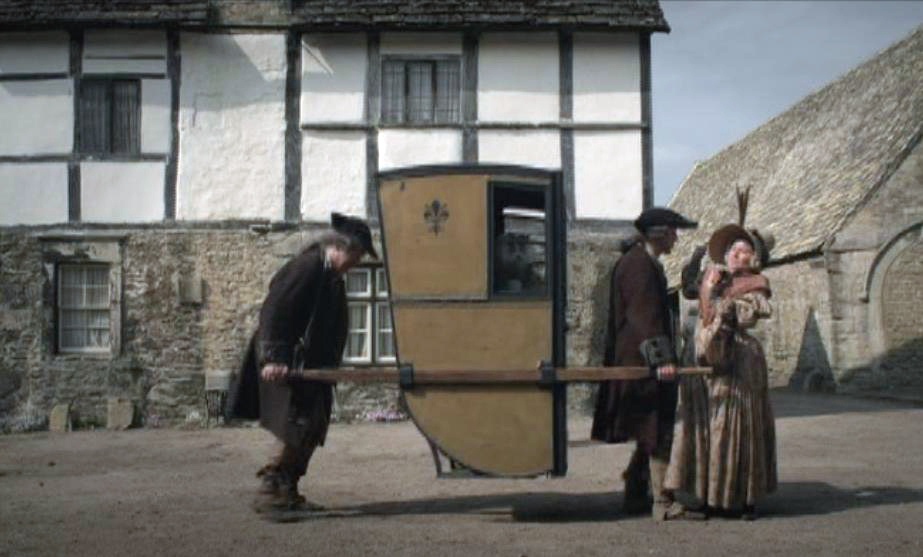
Chairmen huffing and puffing in Cranford

Chairmen huffing and puffing in Cranford

While the Sedan chair had gone out of fashion by the mid-19th Century, it played a crucial part in the recent mini-series, Cranford. One of the funniest and most memorable scenes in the movie showed two chairmen trying to keep apace with Miss Pole, a spinster, and Mrs. Forrester, whose cat had ingested lace, as they ran into the village seeking help. The men huffed and puffed as they carried their heavy load with Mrs. Jamieson inside, and staggered into Cranford.

More information on Sedan chairs:

UPDATE: Marie Antoinette’s Gossip Guide has published a sedan chair post that links to mine!

Robert Adam's Design for a Sedan Chair for Queen Charlotte, 1775. Click for a larger image.

Robert Adam Neoclassical Design for a Sedan Chair for Queen Charlotte, 1775. Click on image for a larger view.

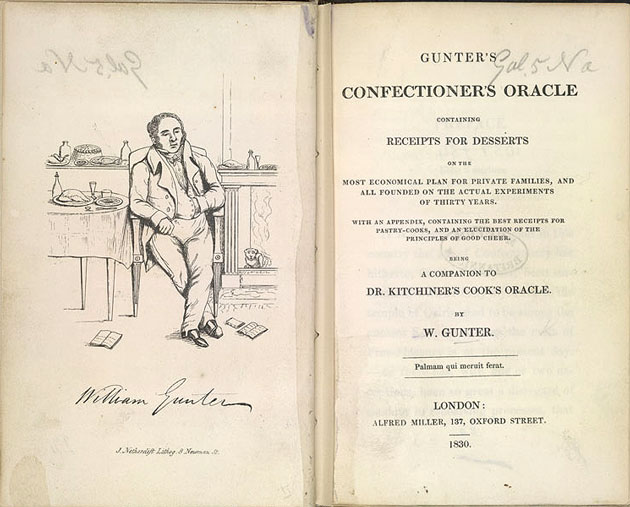
Gunter's Confectioner's Oracle, 1830

Gunter

The very interesting blog, Regency Reader, which features historical romance novels, authors, and series, also publishes interesting posts about the Regency World. Titled Hot Spots, the site includes information about:

  • Jackson’s: Famous pugilist and title champion, 1795
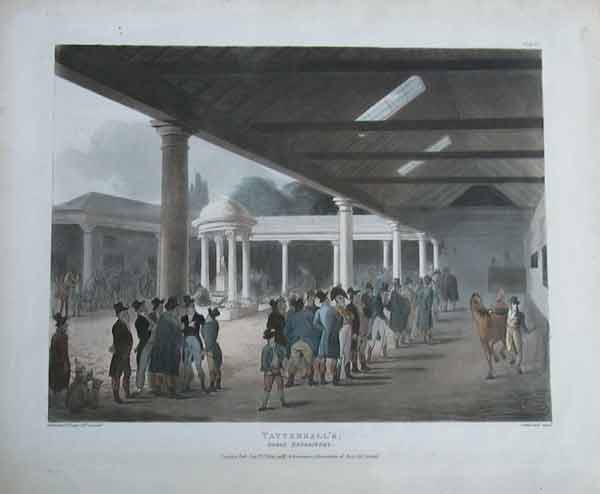
Tattersall's

Tattersall

Additional Links: