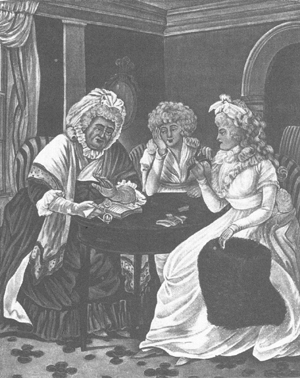
 As many of you are aware, my Jane Austen Today blogging partner Laurel Ann and I have been running a Mrs. Elton Sez advice column. The estimable Diana Birchall, author of Mrs. Elton in America, writes as our guest columnist. While our column is written tongue in cheek (though I must admit, Diana’s advice as Mrs. Elton makes sense in a loopy sort of way), the tradition of including advice columns in women’s publications has enjoyed a long and proud history. In A Magazine of Her Own? Domesticity and Desire in the Woman’s Magazine, 1800-1914, author Maragaret Beetham traces the early advice column.
The Lady’s Museum’s immediate model, once again, was the Lady’s Magazine. here ‘The matron’ – also called “Mrs. Grey’ – claimed to be:
duly qualified to make my monthly appearance in the Lady’s Magazine while I am able to hold pen, being in my grand climacteric and having been deeply engaged in numberless scenes variegated and opposite, serious and comic, cheerful and afflicting. (LMV 1774:33)
The Old Woman, too offered to advise readers from the vantage point of her age and experience. Unlike the later agony aunt, however, her tone was bracing rather than sympathetic. (The Early Ladies’ Journals, p 22-23)
The Lady’s Monthly Museum was one of the leading periodicals for women from 1798-1828. Female columnists, later known as agony aunts, answered anonymous letters that posed questions about personal problems and gave advice according to the latest etiquette books or society’s strictures. Indeed, they offered advice of the most discreet sort:
… whilst a Letter of Advice to a Lady on the point of marriage in November 1770 counsels that: ”Prudence and virtue will certainly secure esteem but unfortunately, esteem alone will not make a happy marriage, passion must also be kept alive …” – the emphasis post 1825 is on modesty and virtue – perhaps even on companionship and governing household – but certainly not passion. – Women Advising Women
Agony columns, which were located on the second page inside a newspaper, contained advertisements for missing relatives and friends. An opinion about such advertisements is described in this colorful passage from The Handy-book of Literary Curiosities:
A large number of the advertisements relate to prodigal sons and truant husbands. Now, you and I have never run away and hid from our families; probably no one in our set of acquaintances ever has. Yet the fact remains that there is a certain percentage of the human race to whom the temptation to run away is irresistible. By a more or less happy dispensation they seem to be blessed with relatives of exceptional clemency, who, instead of leaving them alone like Bopeep’s sheep ,implore them through the Times and other papers to come home to a steaming banquet of veal. They frequently wind up by promising the fugitive that everything will be arranged to his satisfaction, which surely ought to prove a tempting bait, for to have everything arranged to one’s satisfaction is a condition rarely realized. Handy-book of Literary Curiosities By William Shepard Walsh, 1909
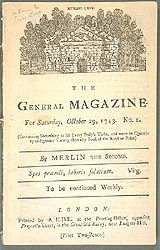
The General Magazine, 1743
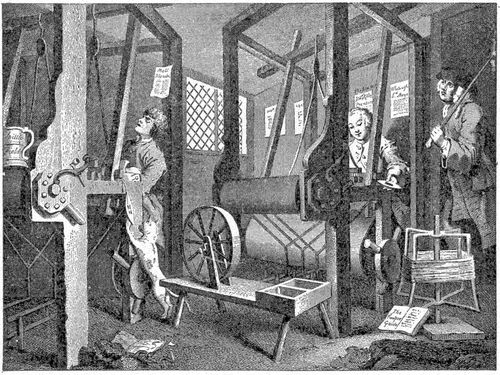
While the topics discussed in advice columns are largely thought to be about women’s issues, they have been popular in men’s periodicals as well (Think of the advice sections in Esquire or Playboy). The Athenian Mercury, a publication printed towards the end of the 17th century and that targeted “ordinary” people from the middle and lower classes, featured the first agony column in history. In many ways, early modern people’s problems do not seem significantly different from ours. Take the behavior of a knot of apprentices. Replace ‘a knot of apprentices’ with ‘a group of soldiers’, ‘a team of lacrosse players’, or ‘high school friends’, and you might still get a similar answer today:
Complaints in the Athenian Mercury about a ‘Knot of Apprentices’ misbehaving with a ‘Servant Maid, of no good Reputation’ were frequent. The Athenian Society warned apprentices that such behavior risked ‘scandal and danger‘ to their reputations. The termination of an indenture could be ruinous to a young man’s prospects, and such conduct threatened his ‘Fame, Estate, Body, and ’tis to be fear’d Soul and all’. (March, 1692)
This fascinating exchange was published in the Athenian Mercury in Nov, 1695:
Quest: A young Man being an apprentice, and having served about half his time, hath a very fair opportunity to marry much to his advantage; would you advise such an one to take opportunity by the Fore top, or to let her go and say he cannot marry because he is an Apprentice? Gentlemen, Pray favour me with a speedy Answer.
Answ: Fair and Gently, Lad; marriage is no foot ball play . . . few men till some years above twenty know either how to govern themselves, choose a wife, or set a true value upon Money. Not one marriage in five hundred, made before twenty five, or thereabouts, proves happy ….
It seems, in that age of apprenticeship and indenture, that the average age for men to marry was 27. For a woman it was 25 or 26, impossibly so, I thought, until I remembered that an indentured servant signed up for three to seven years. Perhaps only the children of the rich could afford to marry early.
Public displays of affection were not encouraged, as noted by this descriptive answer:
“Tis Silly enough in both [men and women]. . . ’tis indecent, to be alwayes slabbering, like a couple of Horses nabbing one another. . . [but it] seems worst in a Man because there ’tis most unnatural, and looks like a Woman with a Beard, so very monstrous that all the Street points at him. . . . (November, 1691)
Over three hundred years later, my dear departed (and very conservative) mother-in-law would have heartily agreed with that comment. Advice columns are still prolifically printed and widely read. While Dear Abby and Ann Landers supplied daily wisdom for our parents, modern readers can click on Dear Mrs. Web, which sits online.
Additional Links:
Image: Women and Education in 18th Century Virginia, Colonial Williamsburg
 Cathleen Myers wrote this fascinating insight about A Lady of Distinction on the PEERS website. A Lady is the author of The Mirror of Graces, my favorite source for regency etiquette.










 Jane Austen's World