The General between his cocoa and his newspaper, had luckily no leisure for noticing her… Jane Austen, Northanger Abbey
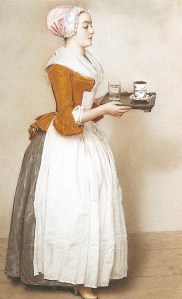
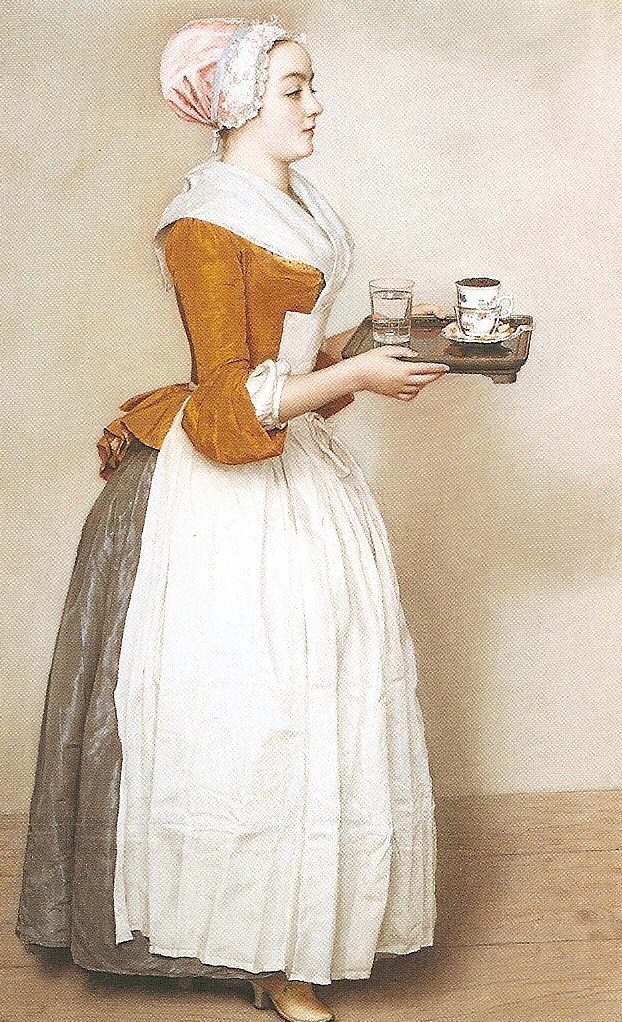
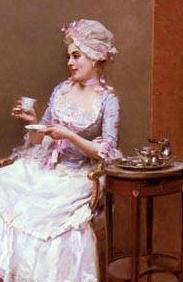
Detail, Chocolate Maid, Jean-Etienne Liotard, 1744-45
When sixteenth-century explorers brought cocoa beans from Mexico to Seville in 1585, little did they realize how much their exotic taste would appeal to European palates. Or perhaps they did. At that time hot chocolate was flavored with a mix of peppers and spices.
The first recipe for a chocolate drink was published in Spain in 1644 by Antonio Colmenero de Ledesma in his book, A Curious Treatise of the Nature and Quality of Chocolate. The spices included hot chiles, and the recipe goes as follows:
100 cacao beans
2 chiles (black pepper may be substituted)
A handful of anise
“Ear flower” *
1 vanilla pod
2 ounces cinnamon
12 almonds or hazelnuts
pound sugar
Achiote (annatto seeds) to taste –
All of these ingredients were boiled together and then frothed with a molinillo, the traditional Aztec carved wooden tool. The achiote was used to redden the color of the drink.From Chiles and Chocolate
*Also known as “xochinacaztli” (Nahuatl) or “orejuela” (Spanish).
“Chiles and Chocolate” goes on to provide another chocolate recipe published in France 50 years later. This one has significantly reduced the amount of chili peppers. The recipe was published in 1692 by M. St. Disdier of France, who was in the chocolate business:
2 pounds prepared cacao
1 pound fine sugar
1/3 ounce cinnamon
1/24 ounce powdered cloves
1/24 ounce Indian pepper (chile)
1 1/4 ounce vanilla
A paste was made of these dried ingredients on a heated stone and then it was boiled to make hot chocolate.
The primary difference between hot cocoa and hot chocolate today is that hot cocoa is made with cocoa powder, which lacks the fat of cocoa butter. Hot chocolate is made from melted chocolate bars mixed with cream.
According to Khodorowsky and Robert: “The vogue for drinking chocolate, already established in Spain, reached the British Isles thanks to a Frenchman, who in 1657 opened the first chocolate factory in London. Unlike in France, where it was a pleasure strictly limited to the aristocracy, this ‘excellent West Indian drink’ was made available to the middle classes from the outset. Soon, alongside the coffee houses which made their appearance from 1652, there opened the first chocolate houses. London was also the setting, in 1674, for a historic invention: solid chocolate, presented in the form of ‘Spanish rolls’ or pastilles, and sold by the Coffee Mill and Tobacco Roll shop.” – The Gates of Vienna: The History of Cacao and Chocolate

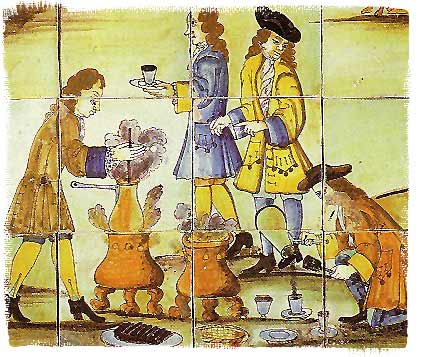
Spanish, ceramic tiles, The laborious process of making chocolate
After 1700 chiles disappeared as a major ingredient in chocolate drinks, although they were still used in traditional Mexican mole sauces. In Sweetness and Power: The Place of Sugar in Modern History, Sidney Mintz offers a plausible explanation for the replacement of sugar for chiles:

Raimundo Madrazo, Hot Chocolate, mid-18th Century
The seemingly unquenchable desire for sugar in the modern world is not simply the outcome of the tongue’s biologically based affinity for sweetness, but rather the historical result of a conjuncture of factors. As Mintz traces sugar’s transformation from a medicinal additive to a luxury good among the upper classes, he argues that sugar “embodied the social position of the wealthy and powerful.” He points to “sugar’s usefulness as a mark of rank—to validate one’s social position. To elevate others, or to define them as inferior.” Sugar use traveled down to other classes in large part because their members accepted the meanings of their social superiors: “those who controlled the society held a commanding position not only in regard to the availability of sugar, but also in regard to at least some of the meanings that sugar products acquired … the simultaneous control of both the foods themselves and the meanings they are made to connote can be a means of a pacific domination.” – Tasting Empire: Chocolate – History cooperative
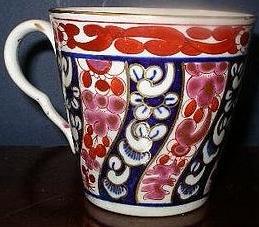
English worcester porcelain chocolate cup, 1800
During the 18th century, techniques were invented to improve the grinding of cocoa beans and by the end of that century chocolate was prepared with milk and sugar. It wasn’t until the 19th century that chocolate was molded into shapes and eaten as solid bars.
Even with the new grinding mills, the process of making chocolate remained laborious. Jim Gay, who makes chocolate in Colonial Williamsburg, explained in an article for American Heritage Chocolate:
The chocolate production process [he] follows involves “roasting cocoa beans, shelling them, crushing them in a large mixing bowl and transferring them to a heated grinding stone. Using an iron rolling pin, the cocoa beans are ground into a liquid and sugar and spices are added.” Gay explained that 18th-century chocolate “isn’t something you’re used to.” Its less sweet than modern chocolate and grittier because its impossible to grind the particles that finely using hand-made processes. Gay also said that “each month [the chocolate] has a slightly different texture and flavor; the flavor profiles always [change].” – http://www.dogstreetjournal.com/story/3152

Chocolate beans ground into powder
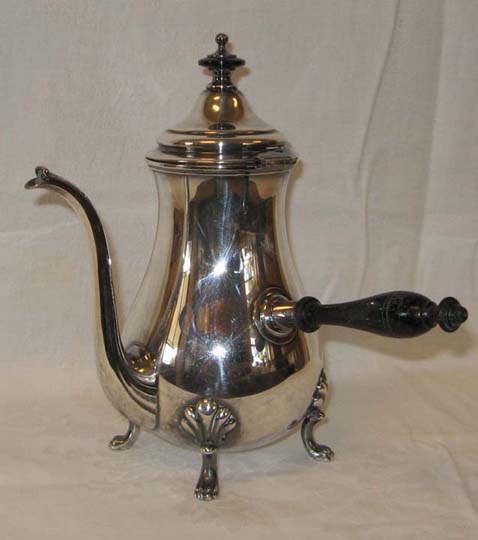
The craze for drinking tea, chocolate, and coffee during this period resulted in an increased demand for porcelain and ceramic tea sets, chocolate pots, and coffee mugs. In response to public demand porcelain manufactures began to make specialized vessels that reflected the unique requirements that each beverage demanded in brewing and presentation, and which led to instantly identifiable tea, chocolate, andd coffee set. Coffee pots were generally taller and slimmer than short round tea pots, which were designed to keep boiling water hot. As in the image below, spouts were placed low on the body of small chocolate pots, which also sported a straight handle.
 In comparison to chocolate pots, coffee pot spouts were long and sometimes arched, while the chocolate pot spout was fairly short (see image below). The inside of a coffee pot spout typically had a filter, or small partition with holes that kept the grounds from getting into the cup. A chocolate pot was made with a hinged finial that allowed for the insertion of a swizzle stick for stirring the hot chocolate. To prevent their loss, some of these finials were attached to the pot with a silver chain.
Due to the complexity of making the beverage, chocolate never attained the same popularity as coffee. By the latter part of the 18th century coffee houses had sprung up by the hundreds in London, and although the craze for chocolate had largely gone out of fashion by 1750, one of the most famous chocolate houses, White’s, still leaves a lasting impression:
The fame of St. James’s Street rests mainly upon its association with the coffee or chocolate houses and clubs which for some two and a half centuries have made it and Pall Mall the social rendezvous of masculine aristocratic society in London. This association dates back to the reign of William III, and more particularly to the fire of January 1697/8 which ravaged the Palace of Whitehall and resulted in the removal of the Court to St. James’s. Only two chocolate houses- White’s (1693) and Ozinda’s (1694)-are known to have been in existence in St. James’s Street and Pall Mall before the fire, but the succeeding years saw the establishment of the Cocoa Tree (1698), the Smyrna (1702), the Thatched House Tavern (1704 or 1705) and the St. James’s Coffee House (1705), all catering for the new client created in the neighbourhood by the presence of the Court of St. James.- Jermyn Street Asscociation

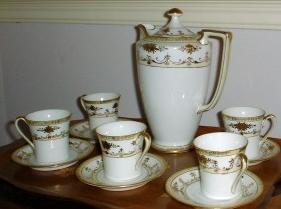
Noritake chocolate set
More links on the topic:
 History Undressed provides an interesting post on the History of Hygiene, Bathing, Teeth Cleaning, Toileting and Deoderizing, including details about the Regency era.
She was a confessed shopaholic, never ordering one thing of a kind, but duplications of each item by the dozens, often with the slightest of variations in materials, lace or design. It was not uncommon for her closet to boast twenty-five copies of a favorite coat. However Rita didn’t dress for display; she dressed for art. Each item was but a piece on the canvas of her body, to convey a mood perhaps, or a “look” she felt that day.
Elizabeth, now that she was settled as the Duke’s mistress and had no more money worries, began to spend lavishly, buying property in London and in the country. She had a house built in London which she named Chudleigh House (after her marriage, it was renamed Kingston House). She also began to entertain, planning lavish parties for her royal friends. She was still one of the Princess of Wale’s Maids of Honor, and her mother had now moved to Windsor as the Royal Housekeeper.

 Jane Austen in Vermont provides a series of links to undergarments in this post, which also refers to the recent sale of Queen Victoria’s enormous bloomers. The queen was only 5′ tall, but her waist was 50″.








 Jane Austen's World
