Feeds:
Posts
Comments

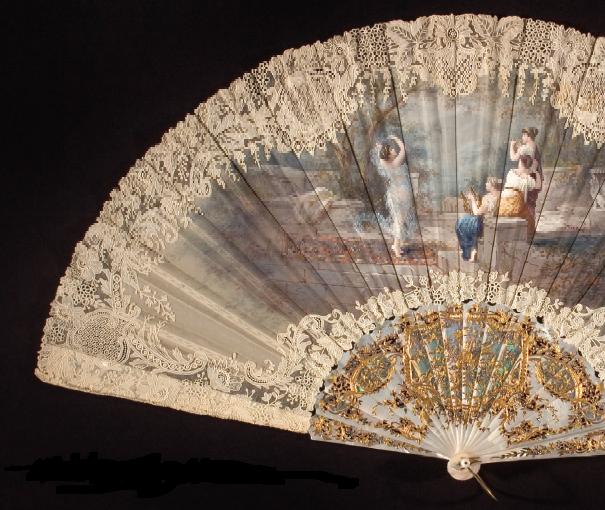
Ladies Regency Fans

When one thinks of a fashionably attired Regency lady, one also thinks of the lovely fan she most likely carried. These graceful objects were first used for cooling, but during the 19th century they became an indispensable fashion accessory. Flirtations were carried on with fans, which hid blushing cheeks or communicated a specific message. (Click on ‘The Language of the Fan’ post below)

In the eighteenth century, wealthy Georgian ladies, especially English ones, waved [fans] at masquerade balls, and wore them as a fashion accessory with almost every outfit that they owned. There were daytime fans, white satin bridal fans and even mourning fans painted with grisaille, i.e. black, white and grey. Classical fans, brought from Italy, replaced the luscious rococo of the French. As well as drawing attention to beautiful and perfectly manicured hands, these items played a big part in delicate flirtations. In fact, a whole ‘language of the fan’ had developed in England in Tudor times which became especially popular for middle and upper-class Victorian women who were courting. A folded fan placed against a lady’s chin told a gentleman that she found him attractive, for example, while snapping a fan shut was a curt dismissal! No wonder that the sixteenth century English writer, Joseph Addison, stated: “Men have the sword, women have the fan and the fan is probably as effective a weapon!”- Life in Italy, Handheld Fans

The following passage was written in the U.S. in mid-nineteenth century America. It describes an oppressively hot day in church in which so many ladies were fanning themselves that they created a significant breeze for others. “One old lady must have been thinking of a dancing-tune to which her feet kept time in the days of her youth, as her fan kept time with a regular hop, skip and jump, not at all like any psalm-tune I ever heard.” The author goes on to describe fans made of red and yellow, or resembling a great palm-leaf, or made of a peacock’s tail or turkey feathers, their delicate  ivory or sandalwood sticks and guards creating clicking sounds.

Those two young ladies who sit where side glances cross very conveniently from the crimson-cushioned pew occupied by a single gentleman, have consecrated theirs to the most effectual display of their ruby lips and laughing dimples, and I am kind enough to hope it will not be “all in vain,” and, as I have hinted, really think fans are often put to a worse use. No insignificant thing is the little flutterer, whatever may be its form or fashion – how many smiles and frowns and titters it hides, to say nothing of the blushes that take shelter behind its graceful folds. Many an ague fit have they given me; yet on the whole, I am not sure that I would banish them; were they the authors of ten times as much mischief, for I think it would cause a flutter among ladies, that would be more deleterious.

Into what a consternation they would be thrown if suddenly deprived of this relief in all embarrassments; and it is a curious fact, that in all heathen as well as all Christian nations, it is a favorite shield of the gentle sex. In all histories of queens and courts and festivals, the fan is conspicuous, whether it be among the Princes of Christendom, in India or China, or in the Islands of the seas. The true reason is that it is so graceful an appendage, and so kind a helpmeet in a moment of timidity or an hour of idleness.” –Minnie Myrtle, The Ladies and Their Fans, New York Times, June 30, 1854

Top Image from: Hagley Magazine: Fan Exhibit

Diagram of fan: The Fan Museum

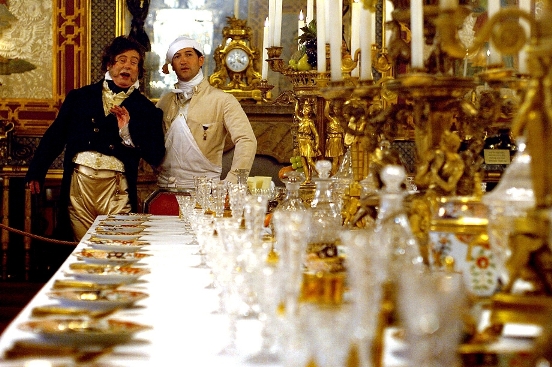
A Feast for a Prince

Planning a banquet for the Prince of Wales (later the Prince Regent) took an enormous amount of time, money, and effort. The following is a partial list of food Lady Fetherstonhaugh of Uppark estimated would serve one hundred guests in 1784:

Kitchen at Uppark

2 Bucks, a Welsh sheep, a doz. Ducks, – 4 Hams, dozens of pigeons, and Rabbits, Flitches of Bacon, Lobsters and Prawns; a Turtle of 120 lbs; 166 lbs. of Butter, 376 Eggs, 67 Chickens; 23 Pints of Cream, 30 lbs. of Coffee, 10 lbs. of Fine Tea; and three lbs. of common tea.

41 Port; 7 Brandy; 1 1/2 Hold of strong Beer; while Musicks cost £26 5s 0d and another chef to assist Moget cost £25; another 2 Bucks added cost £11; 2 more sheep cost only £2 10s, and another 2 carp £1 10s 0d. – National Trust, Investigating the !8th Century. p 26

One can only surmise that too many royal visits could deplete even the wealthiest family coffers! In January 1817, the Prince Regent asked Antonin Careme, the famed French chef, to cook a meal at Brighton:

On 18 January 1817, George invited the greatest (and most expensive) chef in the world, Marie-Antoine Carême, to prepare a unique and extravagant dinner in honour of the visiting Grand Duke Nicholas of Russia. Carême had previously cooked for Napoleon, the Rothschilds and the Tsar. But on that cold night in 1817, Carême outdid all his previous achievements – creating 127 dishes. The evening’s pièce de résistance was a 4ft-high Turkish mosque constructed entirely out of marzipan, although there were pigeon pies, saddles of lamb and a hundred other delicacies. So pleasurable was the feast that the Prince Regent exclaimed: “It is wonderful to be back in Brighton where I am truly loved.” – Blow Out! History’s 10 Greatest Banquets

Read more about food, entertainment, and the master of Uppark in the following links:

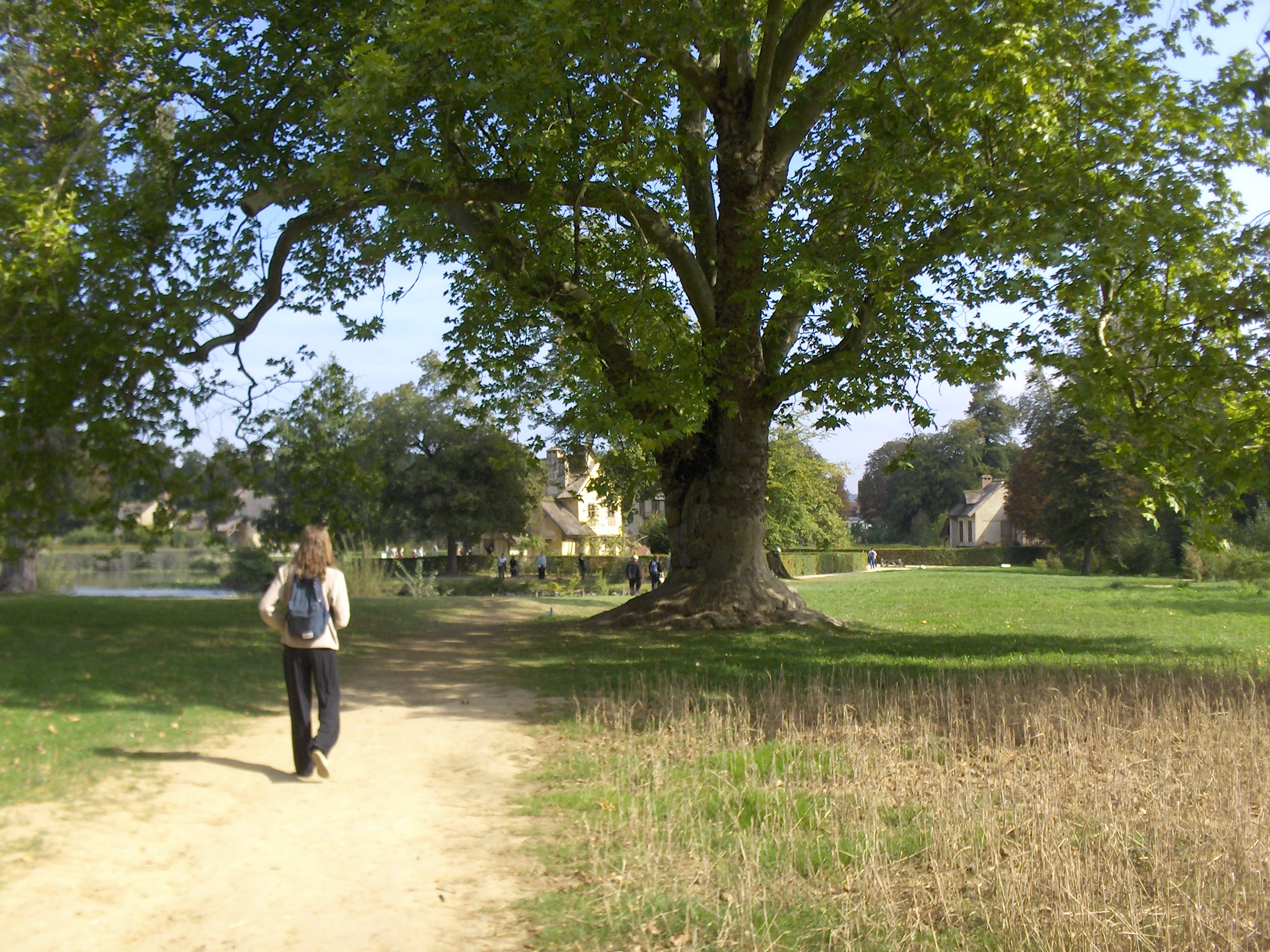
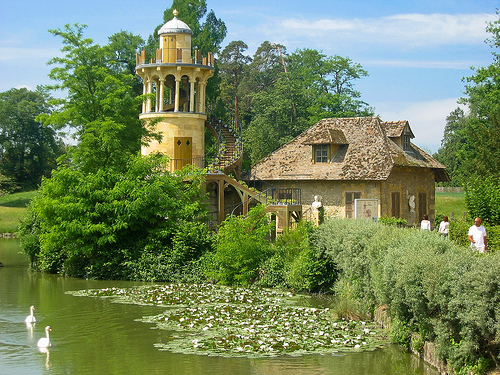
When I took a peek at Marie-Antoinette’s Gossip Guide I was reminded of the eclectic surprise that awaited me on the grounds of Versailles during a visit a couple of years ago – Marie-Antoinette’s English garden and  Petit Hameau. This picturesque,  thatched-roofed village, inspired by Hubert Robert’s paintings, was created by palace architect Richard Mique in 1783 – 1785. One approaches the tiny hamlet through a naturalized English style landscape filled with follies and grottoes, and that opens up to a Grand Lac in the center of an enchanting faux village.

‘Everyone had heard of her private retreat at Trianon, and of the little hamlet she was having her architect construct there. It seemed a perverse extravagance, for the Queen to create a village for her own amusement while in many parts of France real peasants in real villages were in dire want. In her make-believe village stood eight small thatch-roofed cottages, their plaster walls cleverly painted with cracks to make them look weathered, their gardens full of vegetables and fruit trees. Nearby were barns, a poultry yard, and a mill. A farmer named Valy was brought in to live in the farmhouse and look after the livestock. Cows were pastured in a small field, and milked into porcelain tubs in an exquisite little dairy. The Queen had her own cows, named Brunette and Blanchette, and white goats and white lambs, rabbits and cooing pigeons and clucking hens. There was a note of pathos at the miniature hamlet, amid the abundant charm; it represented an almost childlike vision of a simpler, happier world. But the Queen’s critics saw nothing of this. To them the village was one more in a long list of frivolous purchases. They called it “Little Vienna,” and made fun of Antoinette indulging in her rustic pleasures.’ (C Erickson, To the scaffold the life of Marie Antoinette Robson Books 2000 p. 163)

Marie liked to dress simply in this setting, pretending to live a rustic lifestyle.


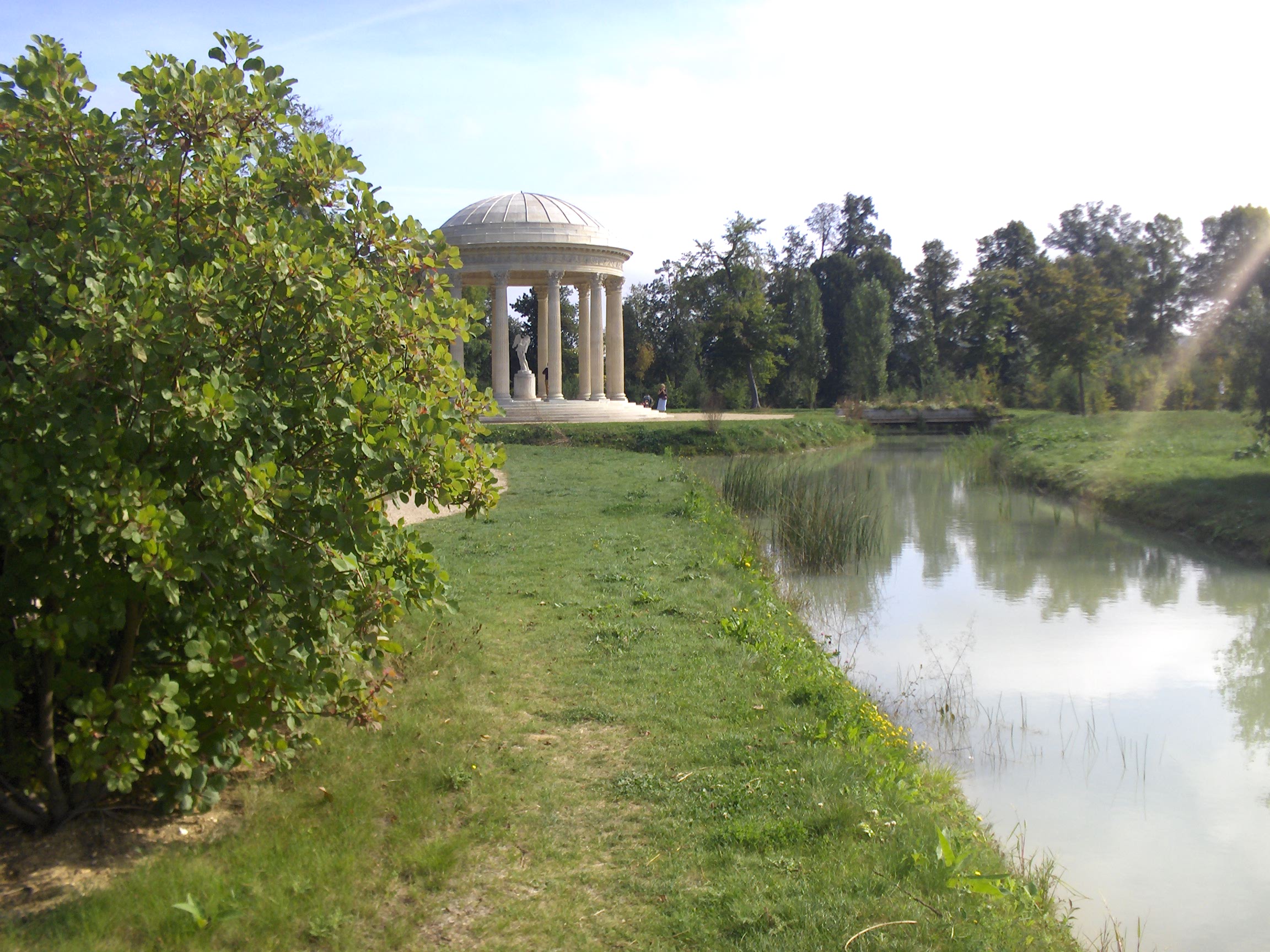
The Temple of Love, a folly inspired by antiquity, sits on an artificial island.

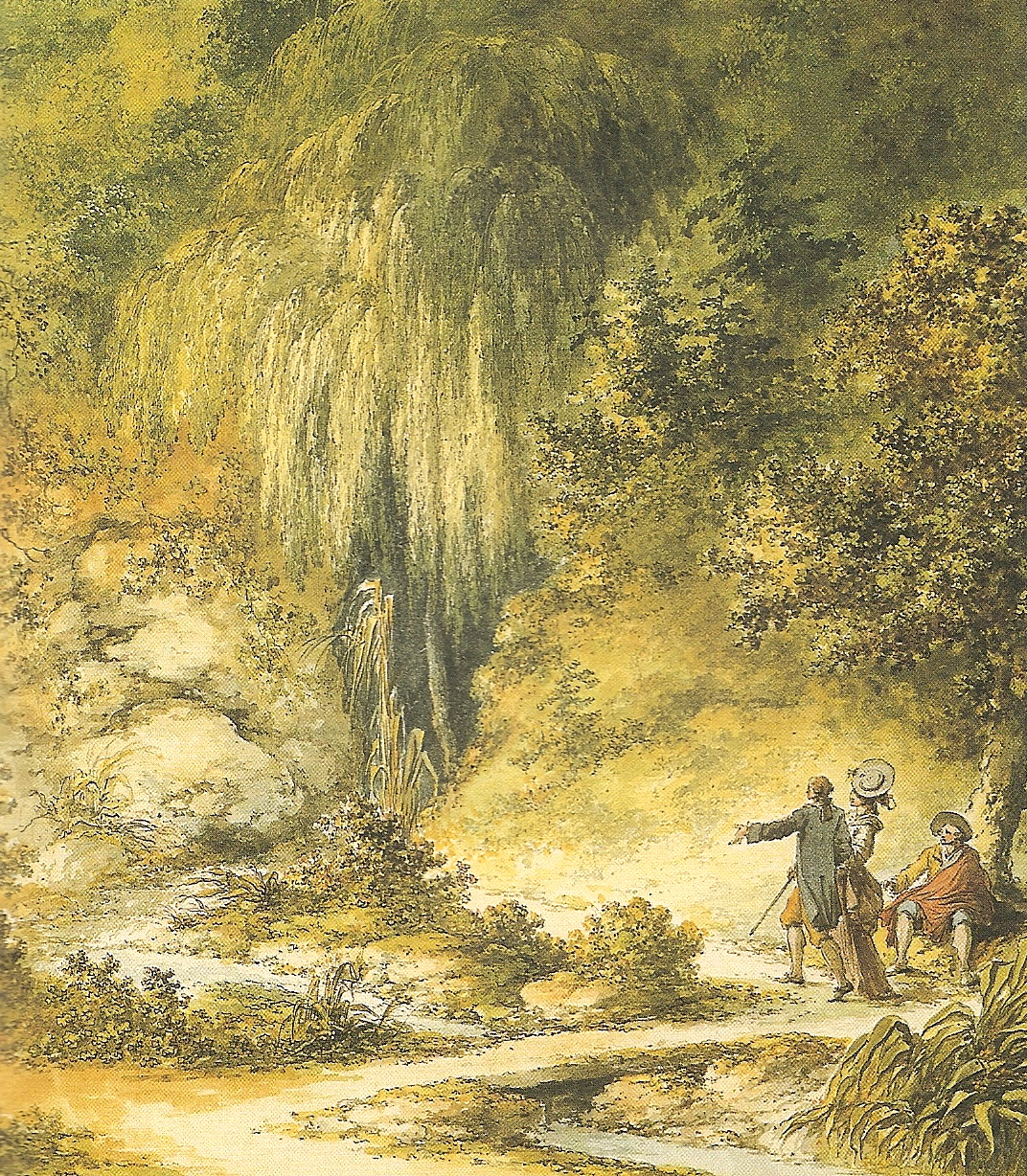
One passes a rustic grotto as one walks towards the small hamlet.


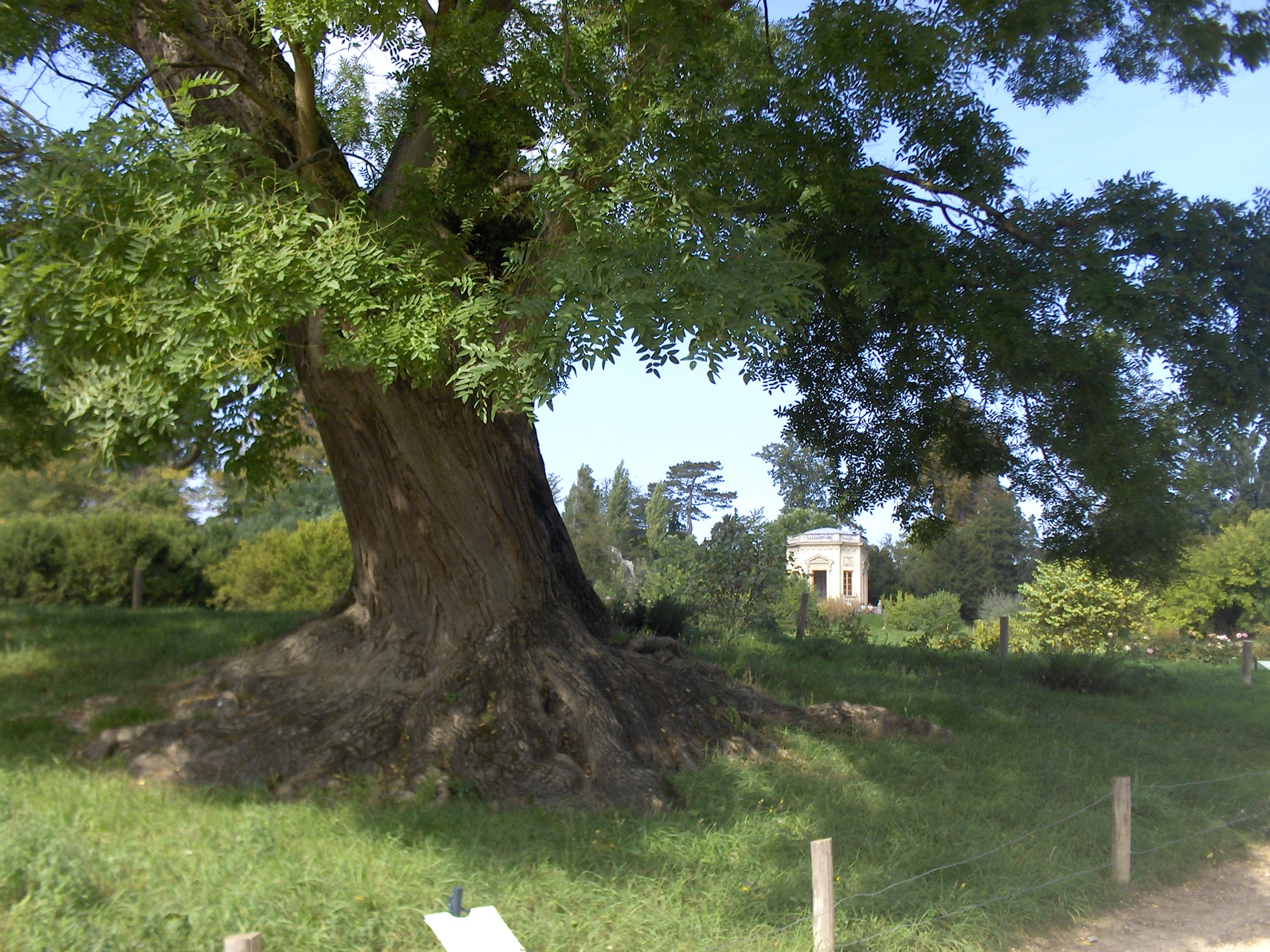
A violent storm in 1999 felled scores of ancient trees planted in Marie-Antoinette’s day, including a tulip tree from my home state Virginia, but many like this beautiful specimen survived.


Twelve cottages once encircled the lake. I find it simply amazing that during the French Revolution the citizenry did not overrun these symbols of a rich woman’s fantasy of the simple life and raze it, as it sat quite near the Village of Versailles, which is now part of the outskirts of Paris.


Marie Antoinette had her own tiny “play” house, which was connected to the billiard room by a wooden gallery. She and her female friends liked to dress as shepherdesses or milk maids while they occupied this pretend world. Flower pots were placed on the stairs,as in the photo. The barn was used as a ballroom, but it has since been demolished. Today one can still visit the mill (with its waterwheel), the guard’s room, the dovecote, and the kitchen.

More links about this topic:

First Image from the Guide Book: Marie-Antoinette’s Estate

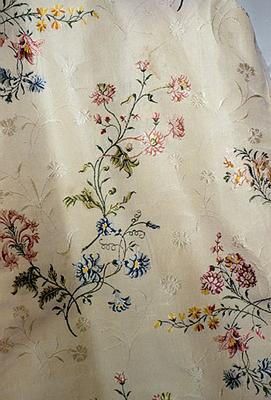
Manchester Art Gallery features Dressing Up, Dressing Down on its website. Check out this virtual exhibit of late 18th century dress online. Jane Austen would have been quite familiar with these gowns during her childhood.

Norwich Textiles offers a beautiful site with a history of its lush fabrics. Click here to read about the manufacture of its 19th century fabrics, including the Norwich Shawl, so popular during the regency era.

If you are privileged to own vintage clothing, this excellent article tells you how to store the items properly. Click here.

Image: Manchester Art Gallery

Also read: Fabrics in the Regency Era

July 18th (today) marks the anniversary day of Jane Austen’s death in a rented house in College Street, Winchester. Her life was all too short (December 16, 1775 – July 18, 1817), and her output all too meager for those who wish she had written more novels. This post consists of a series of recollections of Jane’s last days from her, her family, and her biographers:

During her illness, Jane wrote:

“I live chiefly on the sofa, but am allowed to walk from one room to the other. I have been out once in a sedan-chair, and am to repeat it and be promoted to a wheeled chair as the weather serves.”

“On this subject I will only say further that my dearest sister, my tender watchful, indefatigable nurse has not been made ill by her exertions. As to what I owe to her, and to the anxious affection of all my beloved family on this occasion, I can only cry over it, and pray to God to bless them more and more.” 

Her brother Henry wrote that “she supported, during two months, all the varying pain, irksomeness, and tedium,” attendant on her decline “with more than resignation, with a truly elastic cheerfulness.” “She retained,” he says, “her faculties, her memory, her fancy, her temper, and her affections, warm, clear, and unimpaired, to the last . . . . She expired on Friday, July 18 (1817), in the arms of her sister.”

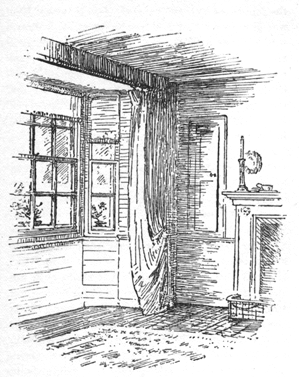
We have followed Miss Austen to Winchester, and have visited the house in College Street where she passed the last weeks of her life. College Street is a narrow picturesque lane, with small old-fashioned houses on one side, terminating in the ancient stone buildings of the College. The garden ground on the opposite side of the street belonged, and still belongs, to the head master. We have entered the “neat little drawing-room with a bow window” which remains unchanged. It is a pretty quaint parlour, with a low ceiling and a narrow doorway. Its white muslin curtains and pots of gay flowers on the window sill lent a cheerful air to the room. We almost fancied we could see Miss Austen seated in the window writing to her nephew, glancing from time to time across the high-walled garden, with its waving trees, to the old red roofs of the Close, with the great grey Cathedral towering above them.- Constance Hill, Jane Austen, Her Homes and Friends

The parlour in College Street

Of her last days, her brother Henry wrote in the introduction of Persuasion and Northanger Abbey, published posthumously:

But the symptoms of a decay, deep and incurable, began to shew themselves in the commencement of 1816. Her decline was at first deceitfully slow; and until the spring of this present year, those who knew their happiness to be involved in her existence could not endure to despair. But in the month of May, 1817, it was found advisable that she should be removed to Winchester for the benefit of constant medical aid, which none even then dared to hope would be permanently beneficial. She supported, during two months, all the varying pain, irksomeness, and tedium, attendant on decaying nature, with more than resignation, with a truly elastic cheerfulness. She retained her faculties, her memory, her fancy, her temper, and her affections, warm, clear, and unimpaired, to the last. Neither her love of God, nor of her fellow creatures flagged for a moment. She made a point of receiving the sacrament before excessive bodily weakness might have rendered her perception unequal to her wishes. She wrote whilst she could hold a pen, and with a pencil when a pen was become too laborious. The day preceding her death she composed some stanzas replete with fancy and vigour. Her last voluntary speech conveyed thanks to her medical attendant; and to the final question asked of her, purporting to know her wants, she replied, “I want nothing but death.”

Jane’s last poem written July 15th:

When Winchester Races

When Winchester races first took their beginning
It is said the good people forgot their old Saint
Not applying at all for the leave of Saint Swithin
And that William of Wykeham’s approval was faint.

The races however were fixed and determined
The company came and the Weather was charming
The Lords and the Ladies were satine’d and ermined
And nobody saw any future alarming.–

But when the old Saint was informed of these doings
He made but one Spring from his Shrine to the Roof
Of the Palace which now lies so sadly in ruins
And then he addressed them all standing aloof.

‘Oh! subjects rebellious! Oh Venta depraved
When once we are buried you think we are gone
But behold me immortal! By vice you’re enslaved
You have sinned and must suffer, ten farther he said

These races and revels and dissolute measures
With which you’re debasing a neighboring Plain
Let them stand–You shall meet with your curse in your pleasures
Set off for your course, I’ll pursue with my rain.

Ye cannot but know my command o’er July
Henceforward I’ll triumph in shewing my powers
Shift your race as you will it shall never be dry
The curse upon Venta is July in showers–‘.

About Jane’s funeral, David Nokes writes in Jane Austen: A Life:

The funeral took place on the morning of Thursday 24 July at Winchester Cathedral. “It is a satisfaction to me,’ Cassandra wrote to Fanny, that her sister’s dear remains were ‘to lie in a building she admired so much – her precious soul I presume to hope reposes in a far superior mansion.’ Only three of the brothers – Edward, Henry and Frank – were present at this ‘last sad ceremony’. Charles, at Easbourne, was too far away to attend; James, too, stayed away. ‘In the sad state of his own health and nerves,’ he said, ‘the trial would be too much for him.’ Women were not expected to attend such melancholy ceremonies; their grief, it was thought, might overcome them. The funeral was held in the early morning; it ‘must be over before ten o’clock,’ Cassandra told Fanny, ‘as the Cathedral service begins at that hour’. Before the coffin was closed, she cut off several lock of Jane’s hair as family mementoes. ‘Everything was conducted with the greatest tranquility,’ she wrote. She and Martha Lloyd ‘watched the little mournful procession the length of the street & when it turned from my sight I had lost her for ever.’ (p. 521)

More about Jane’s last days: