Feeds:
Posts
Comments

These days, a new cookbook seems to be published every day. Over 100 years ago Mrs. Beeton’s Book of Household Management reigned supreme in England. Preceding her by well over a hundred years was Hannah Glasse, the author of The Art of Cookery Made Plain and Easy. In a 2007 Journal Live article, which includes a biographical sketch of Hannah, Jane Hall writes:

She was not a professional cook, however, her expertise lying in dressmaking. Yet when The Art of Cookery was published it was an instant success. Equally popular with ladies of the house and domestic cooks and servants, it would go on to be reprinted in no less than 26 editions – and is still available today.

The book was intended as an instruction manual for servants: “the lower sort,” as she called them.

During the 1700s there was a fashion for books of this kind, which were designed to save the lady of the house from the tedious duty of instructing her kitchen maids. As Hannah said, the book should “improve the Servants and save the Ladies a great deal of Trouble.”

As with some predominant attitudes of today, women cooks were considered to be vastly inferior to male chefs:

In male-dominated Georgian England, it was assumed a woman couldn’t have written such an eloquent and well-organised work. Leading literary figure Dr Samuel Johnson famously said of Hannah’s effort: “Women can spin very well; but they cannot make a good book of cookery.” He promised to write the best collection of recipes ever; he never got around to it.

The following is a list of Hannah’s food for this month – June: The products of the kitchen and fruit garden

ASPARAGUS, garden beans and pease, kidney beans, cauliflowers, artichokes, Battersea and Dutch cabbage, melons on the first ridges, young onions, carrots and parsnips sown in February, purslain, burrage,burnet, the flowers of nasturtian, the Dutch brown, the imperial, the royal, the Silesia and cofs lettuces, some blanched endive and cucumbers. and all sorts of pot herbs.

Green gooseberries, strawberries, some raspberries, currants, white and black duke cherries, red harts, the Flemish and carnation cherries, codlings, jannatings, and the masculine apricot And in the forcing frames all the forward kind of grapes The Art of Cookery, Made Plain and Easy Which Far Exceeds Any Thing of the Kind Yet Published … By Hannah Glasse

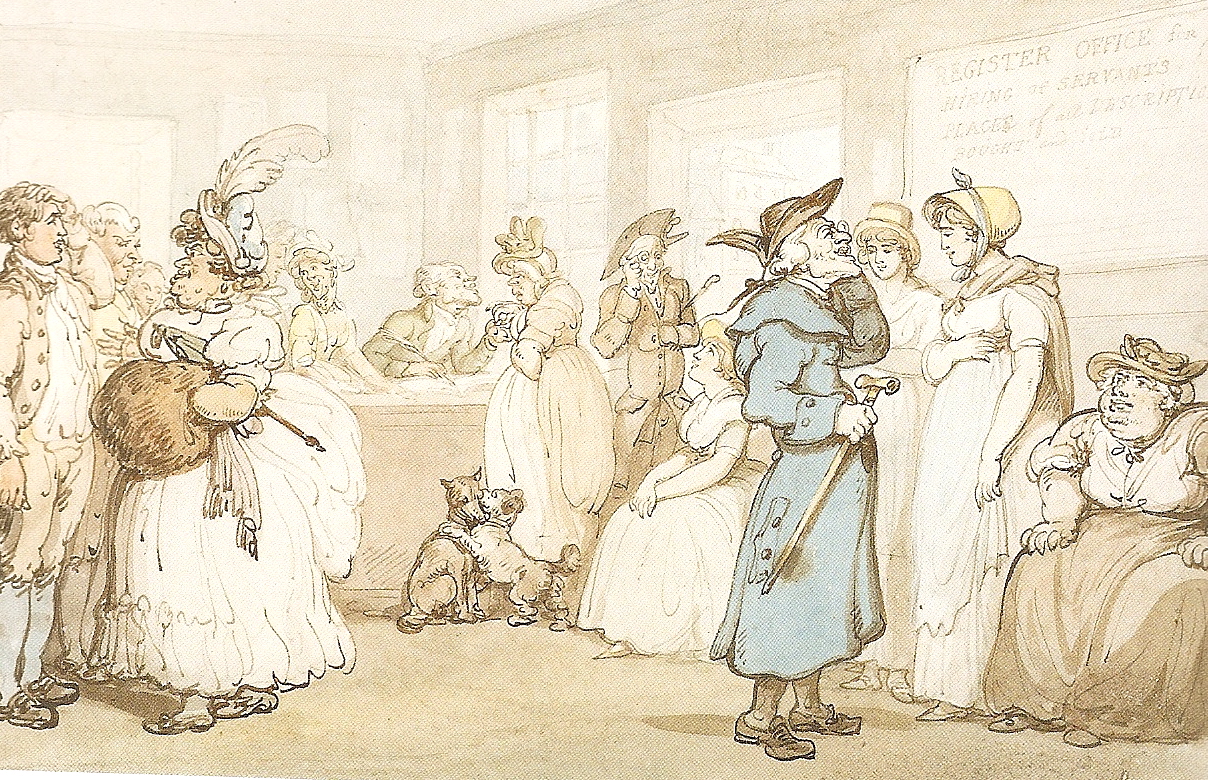
Register Office for the Hiring of Servants, Thomas Rowlandson, c. 1800-05

Contrary to the image of a faithful servant who spends the better part of his life in service to his master, the domestic trade was in reality a transitory one. Servants could be hired and asked to start within a day. They could also be fired on the spot without references.

Servants came and went at a great rate; in the late seventeenth and early eighteenth centuries, ‘most men had left service before they were forty. This was partly because employers did not want middle -aged footmen or valets, but also because servants themselves tended to see the work as part of the life-cycle rather than a career for life.’ – *Below Stairs, p 95

In Memoirs of an Eighteenth-Century Footman, John MacDonald writes: “When I had been a week in London, I met the Irish Chairman that carried Mr Hamilton and Major Joass when in London. I said to him, ‘Do you hear of any place for me?’ ‘By G-d, Johnny, I do; go to Major Libbelier; he lodges at a hair-dresser’s in Lower Grosvenor Street; go to him, Johnny, early tomorrow morning.’ I went – the maid told him I was below. ‘Call him up.’ ‘Well, sir, what are your commands?’ ‘Where you ever in Ireland?’ ‘Look to my recommendations.’ ‘I know Colonel Skeene, and Major Joass in particular. Then you have been through Ireland?’ ‘I have, sir.’ ‘Very well, I’ll give you fourteen shillings a week; and if I go to Ireland, I’ll give you sixpence more a day on the road.’ I dressed him and he was pleased.”

The best way to hire a servant was to find one through an advertisement. A personal character, reference, testimonial or note written by a former employer was essential before taking someone on.

It is not a safe plan to go to a Registry unless you know all about it first, though there are some which are really trustworthy. But a servant who once finds his or her way to a Registry Office is almost always unsettled, and no sooner in a place than looking out for another. The average London wages may be set down as: Butlers, £40 to £100; Footmen, £20 to £40; Pages, £8 to £15; Cooks, £18 to £50; House. maids, £10 to £25; Parlour-maids. £12 to £30; “General Servants,” Anglice Maids of all Work, £6 to £15. [Note: these are 1840’s wages.] A month’s notice required before leaving or dismissing; but in the latter case a month’s wages (and board wages if demanded) will suffice. For serious misconduct a servant can be discharged without notice. When left in town, additional board wages will be required at the rate of about 10s. per week. Victorian London – Dickens

Read about the working conditions of servants in my previous posts. Click here

*Source: Below Stairs: 400 Years of Servants’ Portraits, Giles Waterfield, anne French, with matthew Craske, Foreword by Julian Fellowes, National Portrait Gallery, London, 2003.

No, this anime is not Jane Austen’s Emma. This Emma, or a series of Japanese cartoons, depicts the story of a Victorian maid who falls in love with a member of the gentry. These cartoons are subtitled in English, and it is best to view them with the sound turned low. (Unless you understand Japanese!)
As you can see, the drawings are remarkable. Click on the link above to see a YouTube version of the series.

Click here for a review of these animes.

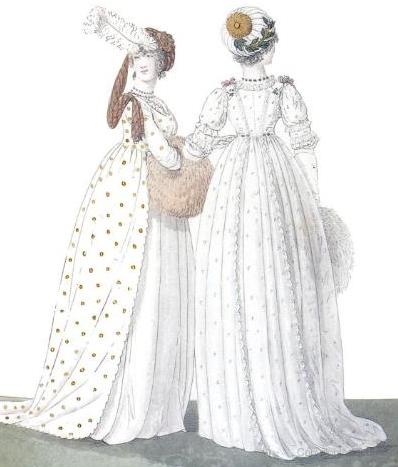
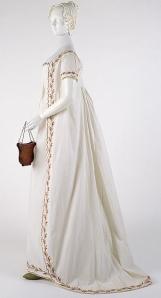
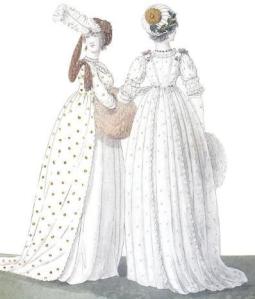
The popularity of the high-waisted regency gown is due to both to French influence in fashion and the Neoclassical rage that swept Europe during the 18th Century. Marie Antoinette is said to have inspired the round gown of the 1790’s, which is essentially a dress and robe joined together and tied in the front (view a rotating video of an early example at the V&A Museum or click on this link to view a typical round gown of the era). Later, Josephine Bonaparte who reigned supreme in her position as a fashion icon, influenced the slim, high-waisted, gossamer thin chemise dress of the early 19th Century.

The round gown, a precursor of the Empire gown, had a soft, round silhouette, with full gatherings and a train, and straight, elbow-length sleeves. These gowns were in stark contrast to the stiff, brocaded or rigid silk dresses of the roccoco period. The round gown’s train, which was common for a short time for day wear and lasted until 1805-06 for the evening, would be pinned up for the dance, as Katherine and Isabella did for each other in Northanger Abbey. One must question how practical these long white muslin dresses with their trailing trains were in England, a country renowned for wet weather and muddy roads.
In England especially, daytime dresses were more modest than their evening counterparts. A few French images depict young ladies wearing day gowns with plunging decolletes, but this was not generally the case, and it is a point that cinema costume makers frequently miss. Until 1810, a fichu or chemisette would fill in the neckline. At first, embroideries on hems and borders were influenced by classical Greek patterns. After Napoleon’s return from Egypt in 1804, decorative patterns began to reflect an eastern influence as well.

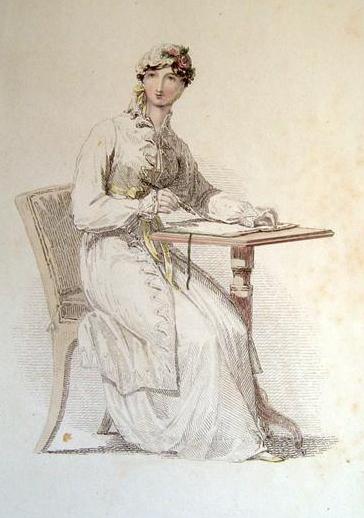
Around 1808, the soft gathered gowns gave way to a slimmer and sleeker silhouette. Darted bodices began to appear and hemlines started to rise. Long sleeves and high necklines were worn during the day, while short sleeves and bare necklines were reserved for evening gowns. The sleeves were puffy and gathered, but the overall silhouette remained sleek, with the shoulders narrow. The shape of the corset changed to reflect the looser, draped, shorter waisted style.
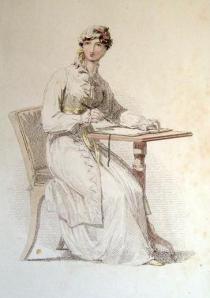
Due to the war between England and France, and the restrictions of travel to the Continent, the designs of English gowns began to take on a character of their own, as French influence waned. Between 1808 and 1814, English waistlines lengthened and decorations were influenced by the Romantic movement and British culture. Dresses began to exhibit decorations that echoed the Gothic, Renaissance, Tudor, and Elizabethan periods. Ruffled edges, Van Dyk lace points, rows of tucks on hems and bodices, and slash puffed sleeves made their appearance. The length of the gown was raised off the ground, so that dainty kid slippers became quite visible.

After the 1814 peace treaty, English visitors to France began to realize just exactly how much British fashion had split from its French counterpart. Parisian waists had remained higher, and skirt hems were wider and trimmed with padded decorations, resulting in a cone-shaped look. English fashion quickly realigned itself with the French, and the silhouette changed yet again.

Dresses now boasted long sleeves, high necks, and a very high waist, The simple classical silhouette was replaced by a fussier look. Ruffles appeared everywhere, on hems, sleeves, bodices, and even bonnets. In 1816-1817, the waistline fell just under a woman’s breasts, and could go no higher. There was only one way that waistlines could go, and by 1818, they began to drop by about an inch a year.
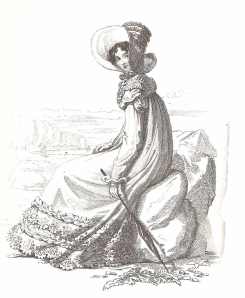
By 1820 the simple classic lines of the chemise dress had disappeared and completely given way to a stiffer, wider silhouette with a quite short hem. New corsets were designed to accommodated the longer waistline. Remarkably, Anglomania hit France, and the French began to copy the English fashion.

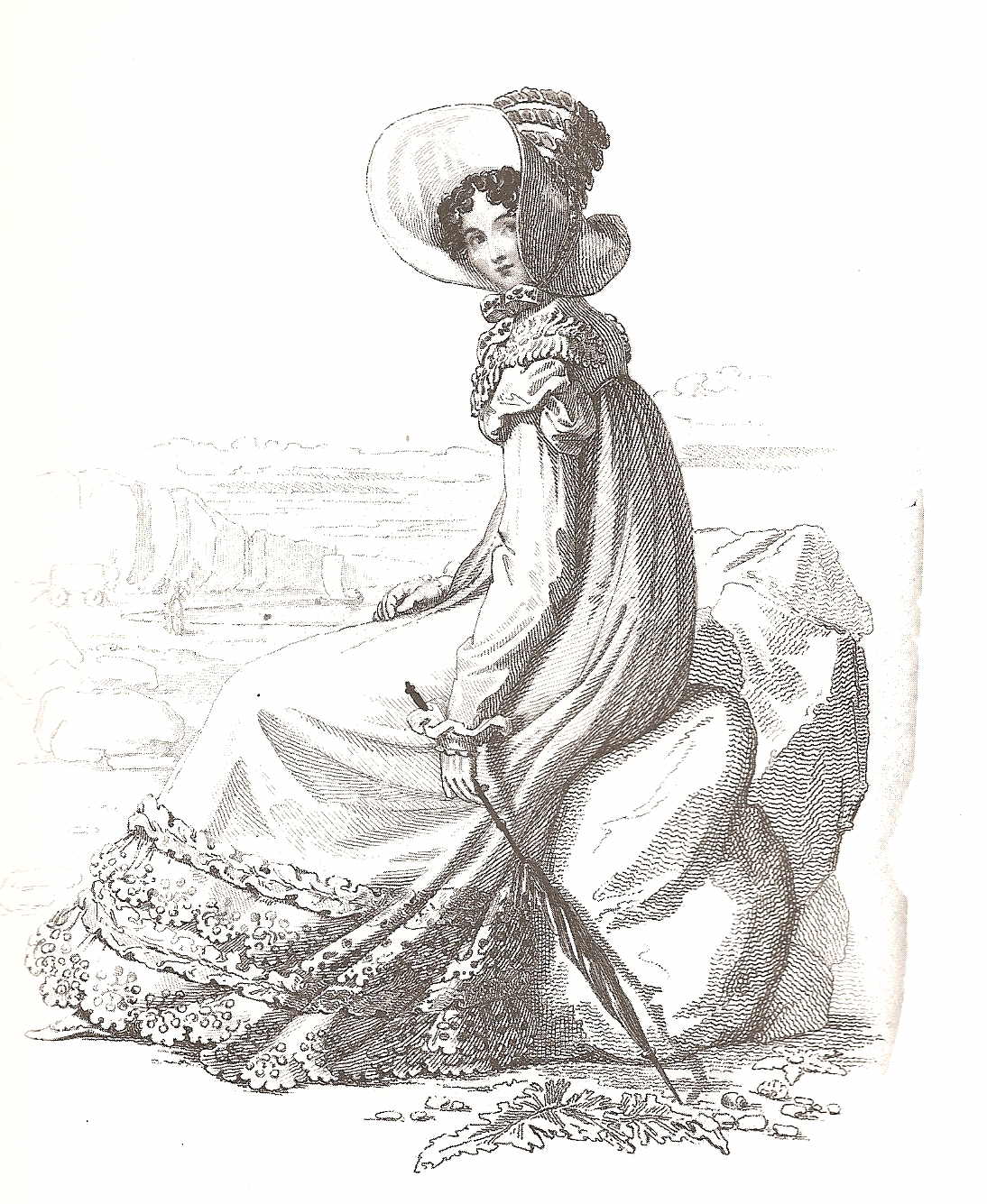
The rows of ruffles, pleats, appliques, and horsehair-padded decorations stiffened the skirt into a conical shape, creating a puffy silhouette. Big hats were worn to counterbalance the broad shoulders, much as big hair balanced wide shoulder pads during the 1980’s. By 1825 the waist had reached a woman’s natural waistline in fashion plates, but according to evidence in museums it would take another five years before this fashion caught up with the general public.
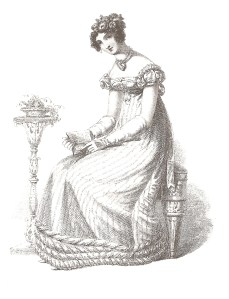
Leg of lamb sleeves (gigot sleeves) appeared, and dress decorations became intricate and theatrical.

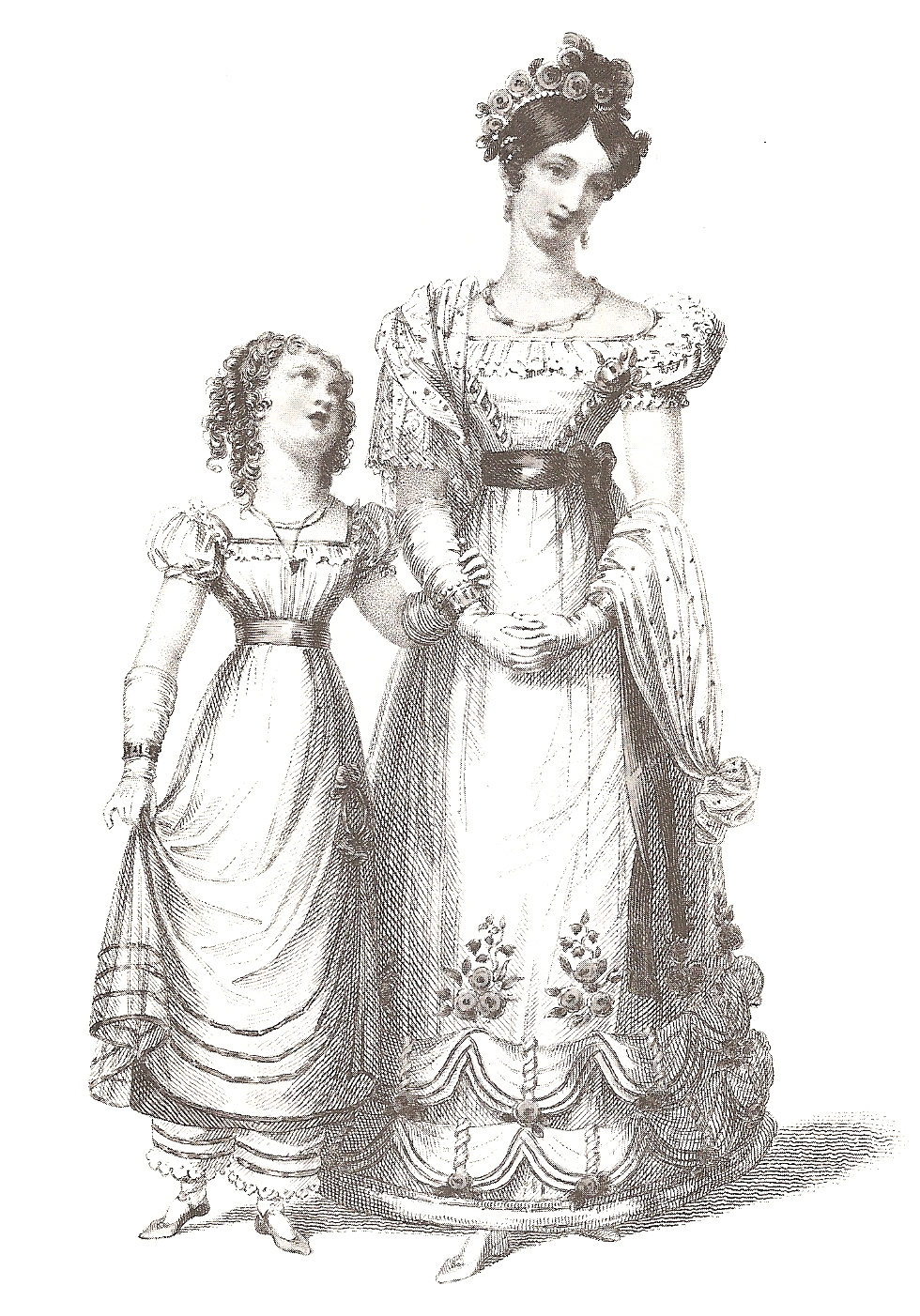
By 1820 the basic lines were almost submerged in ornamentation. The romantic past held a treasure trove of ideas for adorning a lady’s costume. From the sixteenth and seventeenth centuries came puffs bursting through slashed and the revival of the Spanish ruff. collars and cuffs developed points a la Van Dyke and sleeves could be a la Babrielle (after Garielle d’Estrees, mistress of Henry IV of France). Skirts were festooned with roses or made more flaring with crokscrew rolls … Fantasy seemed to now no bounds. (Ackermann’s Costume Plates, Stella Blum, page vi)

Read more about regency fashion trends in the links below:
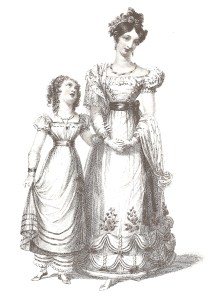
Kathy Decker’s Regency Style, year by year

Jessamyn’s Regency Costume Companion

The Regency Fashion Page

1800s-1820s: Thumbnails

Ackermann’s Costume Plates

Regency Open Robe: 1795

Fashion Prints: Walking Dresses, 1806-1810

Museum Links to Clothing Images

Two Dresses, 1810, French

Images:

First image: Round gown, 1798, Metropolitan Museum

Second image: Round gowns, Heideloff Gallery of Fashion, 1794

Third image: Ackermann plate of a walking dress, 1818

Fourth image: Ackermann plate of an evening dress, 1820

Fifth image: Ackerman plate of a ball dress and young lady’s dress, 1826

Father’s Day is a perfect time to describe George Austen (1731-1805 ) through his daughter’s biographers. By all accounts he married for love, adored his family, and was so handsome even in old age that he turned strangers’ heads as he walked the streets of Bath. (Click here to read my 2007 post about him.)

Here then, are some quotes about George Austen’s life by authors who wrote about the Austen family. The quotes are about the Reverend’s early life when he was a student, and later the young and vigorous father of a growing family. I will reserve the story of his later life and the circumstances of his death for another post.

Little George Austen lost both his parents at the tender age of six, and...

…all that we know of his childhood is that his uncle Francis befriended him, and sent him to Tonbridge School, and that from Tonbridge he obtained a Scholarship (and subsequently a Fellowship) at St. John’s College, Oxford–the College at which, later on, through George’s own marriage, his descendants were to be ‘founder’s kin.’ He returned to teach at his old school, occupying the post of second master there in 1758, and in the next year he was again in residence at Oxford, where his good looks gained for him the name of ‘the handsome proctor.’ In 1760 he took Orders, and in 1761 was presented by Mr. Knight of Godmersham–who had married a descendant of his great-aunt, Jane Stringer–to the living of Steventon, near Overton in Hampshire. It was a time of laxity in the Church, and George Austen (though he afterwards became an excellent parish-priest) does not seem to have resided or done duty at Steventon before the year 1764, when his marriage to Cassandra Leigh must have made the rectory appear a desirable home to which to bring his bride.
Jane Austen, Her Life and Letters: A Family Record, Chapter I, William Austen-Leigh and Richard Arthur Austen-Leigh (Portrait above is of George as a young man)

George was orphaned young, but luckily had Austen uncles and aunts who brought him up…He was tall, thin, scholarly and good-looking with chestnut-brown hair that turned silvery white in later life, and peculiarly bright hazel eyes. A distant cousin of George’s, Mr. Thomas Brodnax May Knight of Godmersham Park in Kent, also owned two estates in Hamphire, Chawton and Steventon, and so was able to present his young kinsman to the living of this latter small rural parish, which would provide an income just about sufficient to support a family. The World of Jane Austen, Deirdre Le Faye, p 11-12

The Reverend George Austen was a very handsome man with bright hazel eyes and finely curling hair, prematurely, white; he was a distinguished classical scholar, and he was also acutely sensitive to the construction of the English sentence. He taught all his own children in their early years, and one of his sons till the later became of university age, and he augmented his income by taking pupils in to the house, three and four at a time until his own family grew too large for them to be accommodated. Jane Austen, Elizabeth Jenkins, p 6.

George found a position as Second Master at his old school. It gave him a house, and he was able to supplement his earnings by lodging some of the boys, as his grandmother had done; but it was not enough to launch him on a properly independent life. During the school holidays he sensibly returned to Oxford to keep up his contacts, and when after three years his college invited him to be assistant chaplain, he want back gladly. He took another degree in divinity. He was well liked, and was soon appointed Proctor, in charge of discipline among the undergraduates, and known as “the handsome Proctor” for his bright eyes and good looks. By now he had certainly met the niece of the Master of Balliol, Miss Cassandra Leigh, and may have begun to think the life of a bachelor Fellow, however comfortable, had its drawbacks. (Image: Interior at Dean Cottage) Jane Austen, Claire Tomalin. P 21

George and Casandra married on 26 April 1764 at Walcot church in Bath, where her family had been living since her father’s retirement. She wore a smart and sensible red woollen dress that would serve her for several years to come…The newly-weds left immediately for Hampshire, where George took up his position as rector of Steventon. Steventon parsonage was in a state of disrepair and not habitable, so George rented Deane parsonage, a couple of miles from Steventon. He only had an income of 100 pounds a year and whatever the farm attached to the Steventon living yielded, but Cassandra’s father had died a month before she married, and her mother soon came to live at Deane, where she no doubt made a substantial contribution to the household expenses. Becoming Jane Austen, Jon Spence, p15-16

The Austens first settled in Deane, accompanied by Cassandra’s mother and the motherless seven-year-old son of Warren Hastings, future governor-general of India. After being in the Austen’s care for three years, young Warren, a sickly child, died, “which caused Mrs. Austen as much grief as if he had been her own child – the Austen’s kind affection was long after remembered with gratitude by the boy’s father.” Jane Austen’s Town and Country Style, Susan Watkins, p11.

In his study [George] kept his rows and rows of books; one of his bookcases covered sixty-four square feet of wall, and he was always collecting more, not just the classics but new ones, from which he read aloud. He also knew enough science to show [his children] the worlds in miniature revealed by his microscope…But Mr. Austen’s world was as much about the farm as about the study. The children often saw him riding about on his horse, and conferring with his bailiff John Bond. …There was his parish business to attend to, and his Sunday services. Jane Austen, Claire Tomalin, P 30-31

“Traditionally, land known as glebe was attached to most parsonage houses for the cultivation of food. At Steventon the glebe amounted to three acres, but Mr. Austen also rented the 200-acre Cheesedown Farm from Thomas Knight. Though he employed a bailiff, John Bond, Mr. Austen took an active role in the management of the farm, which produced all the family’s meat as well as wheat, barley, oats and hops. Surplus produce was sold to bring in extra income”. Jane Austen’s World, Maggie Lane, P 25

There were eight Austen children: James born 1765, Edward born 1767, Henry born 1771, Cassandra born 1771, Francis born 1774, Jane born 1775, Charles born 1776. [George, born 1766, lived away from the family.] George Austen was fond of all his children and so was Mrs. Austen. They enjoyed their company, took pains with their education, interested themselves in their careers, delighted in their successes. These were frequent. To judge by results, the Austens brought up their children extremely well. A Portrait of Jane Austen, David Cecil, P 28 – p 32

Read More About Reverend George Austen in these links: