Feeds:
Posts
Comments

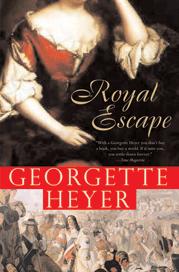
Gentle Readers, Source Books has reissued a number of Georgette Heyer novels, including two historical novels, The Spanish Bride and Royal Escape, which is about Charles II’s escape to Europe after his defeat by Cromwell. Coincidentally, NPR’s Nancy Pearl chose another Heyer historical novel, Infamous Army, as one of her recommended summer reads.

Hillary Major, a friend and colleague who had never read a Georgette Heyer novel, but who is quite knowledgeable about life and historical events of the era, agreed to review Royal Escape for this blog.

Let’s give Georgette Heyer and her publicists props for her subtitles; she certainly tells it like it is: “a novel in which a daredevil king with a price on his head fools his enemies and terrifies his friends.”

Rightly or wrongly, Heyer expects her reader to know her history – that, though defeated by Cromwell’s forces in 1651 and exiled to Europe for most of a decade, Charles II assumed the throne in 1660, when England’s monarchy was restored (by invitation of Parliament). Thus, despite quite a bit of action in Royal Escape, this is not a novel of suspense. Instead, it’s truly a character study. Heyer spends the length of the novel fleshing out her “daredevil king” and exploring the effects his journey through the English countryside have on Charles the man. Charles is without a doubt the book’s most complex character – foolishly brash in the opening pages as he urges the defeated Scots army to greater efforts; nearly despairing as he contemplates capture or a life in exile (while hiding out in a big tree); saucy in his overtures to a tavern mistress; reckless in risking his life (and his companions’) for a spot of lunch; coolly determined in his plan to disguise himself as a servant despite the indignities. On the whole, however, Heyer’s Charles comes across as confident, persistent, charming, unshakeable in the face of danger – in fact, not so surprisingly, an air of majesty hangs about him like a mantle.

What keeps the book interesting are the small details of how a royal intruder affect the life of an everyday Englishman or woman. From the poor householders who, quite against their will, find themselves slaughtering a neighbor’s sheep for the king’s mutton supper to the not-so-secret Catholic noble who finds his home’s hidey-holes a bit overcrowded with priest, pupils, and royalty, Charles disrupts business-as-usual wherever he goes.

The large cast of minor characters are not treated with as much depth as is the person of Charles: by and large, each is exactly what he seems to be: the poor but loyal farmer, the stern and loyal ex-soldier, the loyal servant, the loyalist noblewoman, the staunchly loyal nobleman. (Get the picture?) True, Heyer adds a twist to some of these types: the steadfast fop, for example, is hardly a literary cliché. And Heyer makes it clear that women are an integral part of the king’s escape, dramatizing such quandaries as whether giving the king the best eiderdown will damage his masquerade as a servingman. While her older female characters are generally wise dames indeed, her younger women fall victim to some rather unfortunate typecasting. Jane is the first young lady to assist Charles in his pose as a servant and escort; she is both sensitive and sensible, the romantic heroine who doesn’t (quite) give in to the romance. The next young woman to perform the role, however, is cast as foolish, fearful, and perhaps even a bit of slut – this despite the fact that she faces even more real danger than Jane and that her fears are quite well-founded. Georgette, couldn’t you be a bit kinder to womankind?

In the end, the almost-too-sweet Jane is the character who best sums up the tone of the novel (as she assures her cousin Harry Lassels that she does not intend to give in to Charles’ not-so-subtle advances):

“I shall not regret, Harry. You spoke of our journey as an adventure. Indeed, it is one, and I have thought that since the King is merry we should be so too. We shall never have another adventure like to this, you and I…. He will go his way, and we ours, but this will be a little part of our lives that we shall remember always, like a fairy tale told us in our childhood. You are anxious because the King kissed me, but you need not fear for me. I am not for him, since I am not a princess to whom he may offer marriage, and not a trollop whom he would make mistress. … In my heart, I know him for an easy lover, but no ravisher.”

Between Heyer’s idealized worldview and the informed reader’s confidence of an eventual happy ending, Royal Escape reads a bit like an advertisement for monarchy. This said, it’s certainly an entertaining one. I shall not regret my first Georgette Heyer read; indeed, I rather enjoyed the journey. Who wouldn’t want to abandon her cynicism (and occasionally her good sense) and, like Jane, join Charles and company on a merry adventure?

Links

My other Georgette Heyer Reviews:

Versailles and More is a fabulous blog created by Catherine Delors and filled with rich images and fascinating information about 18th-century France. I would like to particularly point out In the Footsteps of Gabrielle: Fashions Before the Revolution. The title of the post says it all.

Image: Detail of a portrait of Louise-Marie de Bourbon-Penthièvre by Louise-Elisabeth Vigée-Lebrun.

Fans of Jane Austen’s novels and the regency period are generally aware of the restrictions society imposed on women, especially on those who publicly pursued careers. During her lifetime, Jane Austen’s novels were attributed to “a lady” to hide her identity as an author. Female painters who attended art academies were banned from attending life drawing classes, which placed them at a distinct disadvantage when painting or drawing human figures, and explained why so many female painters concentrated on still-lifes and landscapes. Ladies who supported themselves through their talents were thought to be immodest; worse, popular and academic opinions decreed that their skills and aesthetic understanding would always be inferior to a man’s

In her critical essay, “Poet and Lyricist Anne Hunter: More than “Haydn’s Muse””, Joy M. Currie writes: “Expectations for British women in the late eighteenth and early nineteenth centuries included what Mary Poovey calls ‘the paradoxical commands of propriety-that desire express itself through modesty, that power be deflected into influence, that fulfillment be won through meekness’. These expectations were particularly significant for women writers who wanted to publish what they wrote, since to write and publish inherently meant challenging accepted standards of propriety.”

In a recent post on 18th Century Worlds, Ellen Moody made a few observations about the poet, Anne Hunter (1742-1821). On her separation from her grown daughter, Anne wrote the following poem (1802) :

To my daughter On Being Separated from Her on Marriage

Dear to my heart as life’s warm stream
Which animates this mortal clay,
For thee I court the waking dream,
And deck with smiles the future day;
And thus beguile the present pain
With hopes that we shall meet again.

Yet, will it be as when the past
Twined every joy, and care, and thought,
And o’er our minds one mantle cast
Of kind affections finely wrought?
Ah no? the groundless hope were vain,
For so we ne’er can meet again.

May he who claims thy tender heart
Deserve its love, as I have done.
For, kind and gentle as thou art,
If so beloved, thou art fairly won.
Bright may the sacred torch remain,
And cheer thee till we meet again.

As Ellen Moody explained:

It would have been harder for Anne Hunter to be separated from her married daughter than women today as she was not allowed an occupation outside the home. While she ran parties and socialized (being married to the famous surgeon, John Hunter, and living in London and helping him with his career),she also spent much of her life in impoverished circumstances, some of it in Scotland. So the loss of a daughter would be keenly felt – as there were no trains, and no phones.

Her poem is sentimental and pious in the way of earlier poetry when it comes to families, but note the phrase “as I have done.” Hunter’s daughter would also experience a profound change of life. You didn’t need wedding ceremonies in the 18th century to show that getting married for a woman changed her life. Her daughter might end up pregnant continually, and in those days “pregnancy was life-threatening. And the mores of her era decreed that her daughter should be under her husband’s control.

Anne Hunter’s poem does not make it into Lonsdale’s book of 18th century women poets nor any poems like the above one. The imagined community of poetry for this period was widening to include figures like Anna Barbauld and Joanne Baillie, partly because their progressive stance was one which did not threaten the essential patriarchal or capitalist-militarist social order. Minor women who were said to be “bought back” included two Annes: Anne Grant and Anne Hunter. Grant’s and Hunter’s poetry hark back to 18th century modes with a new spirit in them too – of emotion, landscape, about bonds.

Anne Hunter was the daughter of Robert Home, a surgeon in the military; and it was said his father was forced into this position because he displeased his family by marrying imprudently. (I don’t put scare quotes around these words but hope people know I wouldn’t share the attitudes which would utter them.) When still young, Anne began to publish poetry in the vein of Jane Elliot (lyrical, nature poetry, landscape).

After a long engagement she married a now well-known and important figure in history: John Hunter, the famous surgeon in London (1728-93). Among other things (I came across this in another study) he tried to help women who were accused of murdering their babies when the neonate died. The law said that a woman accused of infanticide had to prove the baby had not been alive when born. The law was used against women who had children out of wedlock: a huge percentage of accusations were against women who had illegitimate children, and they generally were servants or agricultural workers.

Anne’s brother became her husband’s pupil and himself became a well-known surgeon. She had 4 children in 5 years; 2 survived infancy. She did become involved with fashionable circles in London (as the wife of this man she could and might), but her friendships with Elizabeth Montagu,”Elizabeth Carter, Mary Delany, and “Horace Walpole and Hester Thrale did not exactly (it is said) please her husband.

He is presented as this taciturn, obsessively hard-working man as a personality. She presented herself as modest and unassuming and so went over well in the public media of the period.

Then her husband after quarreling with colleagues, had a heart attack and died, and left such a complicated will (he did not trust her), that she was ejected from their house and only survived with a pension from the Queen (so, appearing conventional and having women friends with connections helped). Eventually Anne got some of the proceeds of the estate, and then when Parliament voted to establish a Hunter Museum and established it for the Royal College of Surgeons. She got a tidy sum and with the pension, lived comfortably thereafter. Then she collected her poems and published them; they are dedicated to her son, a Captain.

Lonsdale reprints Hunter’s “North American Death Song” where she imitates the death chants as she imagines them of an Indian. This was much admired – to me it’s not half-erotic enough and Elizabeth Tollett’s “Winter Song” is much better. Anne Hunter also published a volume inspired (she said) by the drawings of Susan Macdonald who died at age 21 in 1803. Her daughter was a widow by the time Anne Hunter died so maybe she and said daughter did meet and live together once again.

There is a good book on Anne’s husband: John Kobler’s The Reluctant Surgeon: A Biography of John Hunter. The Akadine Press (1988), 1st printing (1999). The 18th century is a very interesting period to study in the area of medicine. Did you know the first attempts at
modern dentistry
(painful and also shocking) involved servants and slaves and poor people who gave up their teeth for the rich to have rammed into their mouths) There was an article in Eighteenth Century Life about this.” Ellen

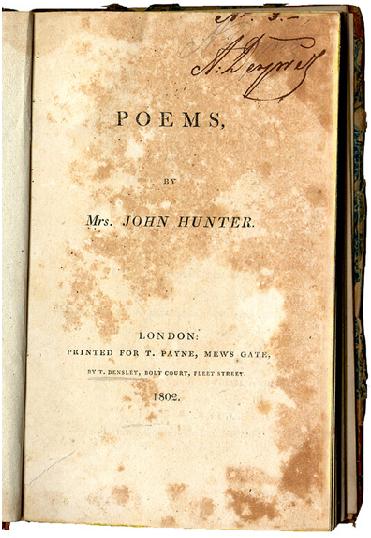
I’d like to add some additional thoughts to Ellen’s excellent summation of Anne Hunter’s life. While it is true that Anne was better known as Mrs. John Hunter and hostess of a weekly salon than as a poet and lyricist, her poems and song lyrics were widely distributed during her lifetime. When the famous composer Franz Joseph Haydn moved to London in 1791, he settled near the Hunters in a house on Great Pultney Street. A friendship developed between the composer and Anne, which led to Haydn’s composing English songs using Anne’s lyrics. As you can see from the samples below, Anne’s words were quite ladylike and proper. According to the Cambridge Companion to Haydn, “Without Anne Hunter’s influence and poetic inspiration, it is unlikely Haydn would have tried his hand at composing English songs. Indeed, circumstances suggest that Anne Hunter passed on to Haydn all her verses during the first London sojourn.” Anne published two volumes of poetry, Poems (1802) and The Sports of the Genii (1804). They were so well received that it was said that Robert Burns copied several into his Commonplace Book.

The mermaid’s song

Lyrics: Anne Hunter; Music: (Franz) Josef Haydn (1732-1809)

Now the dancing sunbeams play
On the green and glassy sea,
Come, and I will lead the way
Where the pearly treasures be.

Come with me, and we will go
Where the rocks of coral grow.
Follow, follow, follow me.

Come, behold what treasures lie
Far below the rolling waves,
Riches, hid from human eye,
Dimly shine in ocean’s caves.
Ebbing tides bear no delay,
Stormy winds are far away.

Come with me, and we will go
Where the rocks of coral grow.
Follow, follow, follow me.

Song

SPRING returns, the flowrets blow;
Will hope return? ah, no! ah, no!
With the dreams of youth she flies,
And like the rose, her emblem, dies.
Fancy droops beneath the shade,
And all the gay delights are fled.
Spring returns, the flowrets blow;
Will hope return? ah, no! ah, no!
Poems, Anne Home Hunter

My Mother Bids Me Bind My Hair

My mother bids me bind my hair
With bands of rosy hue;
Tie up my sleeves with ribbons rare,
And lace my bodice blue!

“For why,” she cries, “sit still and weep,
While others dance and play?”
Alas! I scarce can go, or creep,
While Lubin is away!

‘Tis sad to think the days are gone
When those we love were near!
I sit upon this mossy stone,
And sigh when none can hear:

And while I spin my flaxen thread,
And sing my simple lay,
The village seems asleep, or dead,
Now Lubin is away!

Anne Hunter [1742-1821]

Audio version: http://www.eaglesweb.com/Sub_Pages/hunter_poems.htm

Learn more about Anne in these links:

Links to Ellen Moody’s other posts and sites below:

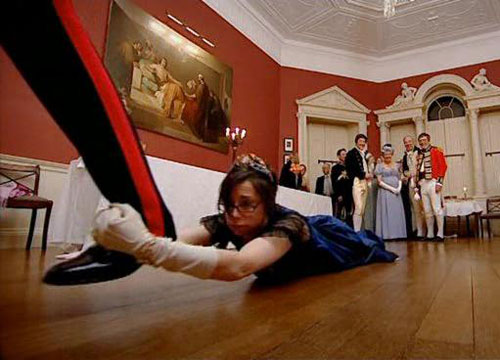
Ah, BBC. It seems that this august station has been running a series of historical food shows called The Supersizers Go. Giles Coren stars with Sue Perkins in this funny, and informative BBC Two show, which ran for six weeks in Britain starting May 20. Click here to see the first YouTube video, which will lead you to the others. Giles wrote the following in a recent Times Online article:

The Regency

Ah, the era of Jane Austen, of balls and dresses and, ah, balls and, um, dresses. They don’t really eat in the books, do they? That’s why they all look so good in frock coats and riding breeches. And I make a pretty awesome Mr Darcy, too. Sue can hardly keep her hands off.

I spend much of the time wearing a corset (as Beau Brummel often did, and no doubt Mr Darcy too, the old queen) and so cannot really force down much of the food – which in this period is a combination of patriotic roast beef eaten in defiance of the perfidious French and, conversely, poncy, heavily sauced French food, of the kind cooked for aristocrats by top chefs fleeing France as their noble patrons were beheaded.

I visit a Dr Petty in Harley Street, who predicts great digestive discomfort and an attack of gout from the purine in all the port I’ll be drinking: during the Napoleonic wars claret was not available, so we got stinko on the sticky stuff instead, imported from our old allies, Portugal.

But I have the time of my life. Determined to keep looking rakishly handsome in my fine clothes, I burn up thousands of calories stalking my estate with a blunderbuss, firing at poachers robbing my rabbits in defiance of the Enclosures Act.

Breakfast having just been invented, I make that my main meal. But it is so recently invented that it comprises only bread, so I don’t eat much of it.

Pineapples are newly available too but, you know, who gives?

As for lunch, that doesn’t seem to have been invented either. But they do have a thing called “nuncheon”, which is most often cheese served deliberately with the maggots who live in it. I dine only on the occasional sandwich at the casino tables

(invented by the Earl of Sandwich for that very purpose) and so go to bed reasonably hungry – a good way to stay slim.

At the end of this immersion I do, in fact, have dangerously high uric acid, indicating the imminence of an outbreak of gout. But I am in terrific shape on the surface.

One Times Oline critic wasn’t all that crazy about Giles’ antics with his costar, but he did concede the the show was full of interesting historical tidbits, such as the following:

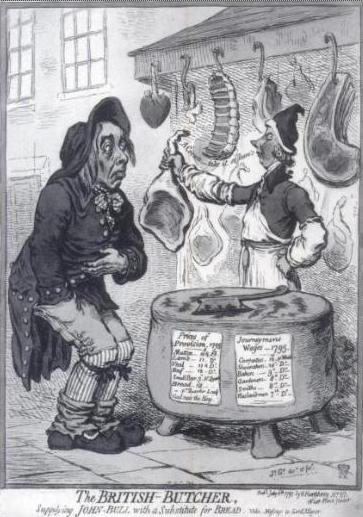
Wartime Britain went hungry between 1789 and 1821 but it was also the age of excess. The average weight of an ox went from 370lb to 800lb (186kg to 363kg) and the Army swelled from a force of 39,000 in 1793 to 264,000 by 1815. The cartoonists who used the Regent’s corpulence as a metaphor for his kingdom’s corruption clearly got it right.

A detailed review of the Regency Supersizers Go show sits on Just Hungry, a great site which had the good taste to feature this blog. In its post find a detailed description of the meal. For more information about the gastronomic delights of the era, click on the links below:

At first I was skeptical of the new Oxford World’s Classics reissues of Jane Austen’s famous novels. After all, didn’t I own a slew of editions from various well-known publishers already? And how different could each be from the other? The central core of these novels – Jane’s words – remains essentially unchanged, although a few of my books are illustrated, and one is the estimable Annoted Pride and Prejudice edited by David M. Shapard. So I asked myself: Why would Oxford University Press spend so much money and effort reissuing classics that it had first published in paperback form in 1980, and brought back in 1998, 2004, and now again this year?

Then I received my package of books from Oxford University Press. First, the cover illustrations are luscious. Pride and Prejudice’s jacket boasts a detail of a Sir Thomas Lawrence portrait of Mrs. Edward John Littleton. And second, this book contains the sort of information that rounds out the reading experience for both the experienced and novice reader.

I read recently that a reissue is only as good as its introduction. Written by scholars and authorities on the topic, a book’s introduction should add to our understanding of the work. Fiona Stafford, a Reader in English at the University of Oxford, does just that. Her essay discusses how Jane engages the reader with the text, and how she invites our speculations about the characters.

Part of [the novel’s] satisfaction, perhaps, is the persistent involvement of the reader in the narrative. Again and again, we are led into mild questioning about what has taken place, and thus encouraged to come up with a workable solution. Conversations between Jane and Elizabeth frequently offer alternative explanations for conduct or character and, in so doing, engage the reader in the debate. Is Mr. Bingley in love with Jane? Can Mr. Wickham be believed? How can Charlotte Lucas be engaged to Mr. Collins? – p. xix

Ms. Stafford also discusses the history of the epistolary novel and its influence on this book. In an age of strict conventions, letters allowed people to write down their emotions and show their true character. Think of the tone of Lydia’s careless letters after she elopes with Mr. Wickham, or the impact that Mr. Darcy’s impassioned letter of explanation had on Elizabeth. This is the first time in the novel that we are treated exclusively to his voice and point of view, and her reaction (and the reader’s) is a powerful one.

This Pride and Prejudice reissue is full of features that teachers and students of fine literature will especially love. They are:

  • A Chronology of Jane Austen, which lists important events in Jane’s life against an historical backdrop.
  • A select bibliography. Thanks to Google reader, many of these references can be found online.
  • Two appendixes: One titled “Rank and Social Status”, the other simply titled “Dancing.”
  • Textual notes, which compare various printed editions
  • Explanatory notes. These annotations, though not as extensive as David Shapard’s, help to explain obscure customs and terms from days gone by.

The Jane Austen reissues by Oxford World’s Classics came out on June 15th. As far as my thrifty pocketbook is concerned, the price of this quality trade paperback novel is just right.

Click here for my review of Lady Susan:A vicious Jewel