Feeds:
Posts
Comments

Book: Sense and Sensibility. Topic: John Dashwood’s promise to his father on his deathbed.

In this series of posts on ‘Jane’s Own Words’, I will simply let Jane speak for herself. The reasoning Fanny Dashwood uses to justify why John should not support his step mother and half sisters in the first Chapter of Sense and Sensibility, and how he comes to agree with her, is sheer genius, and is as harshly comic a passage as I have ever read. First, the death bed scene…
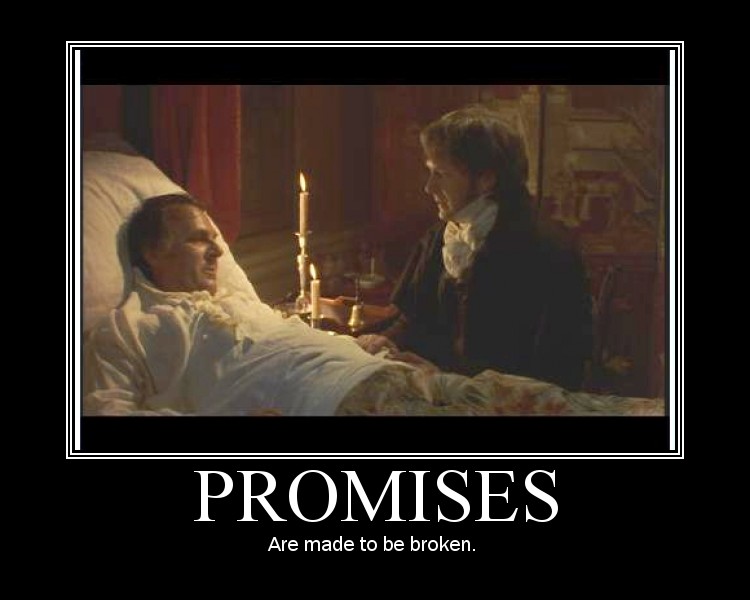
From Chapter One: Sense and Sensibility:

[Mr. Dashwood’s] son was sent for, as soon as his danger was known, and to him Mr. Dashwood recommended, with all the strength and urgency which illness could command, the interest of his mother-in-law and sisters.

Mr. John Dashwood had not the strong feelings of the rest of the family; but he was affected by a recommendation of such a nature at such a time, and he promised to do everything in his power to make them comfortable. His father was rendered easy by such an assurance, and Mr. John Dashwood had then leisure to consider how much there might prudently be in his power to do for them.

He was not an ill-disposed young man, unless to be rather cold hearted, and rather selfish, is to be ill-disposed: but he was, in general, well respected; for he conducted himself with propriety in the discharge of his ordinary duties. Had he married a more amiable woman, he might have been made still more respectable than he was; he might even have been made amiable himself; for he was very young when he married, and very fond of his wife. But Mrs. John Dashwood was a strong caricature of himself; more narrow-minded and selfish.

When he gave his promise to his father, he meditated within himself to increase the fortunes of his sisters by the present of a thousand pounds a-piece. He then really thought himself equal to it. The prospect of four thousand a-year, in addition to his present income, besides the remaining half of his own mother’s fortune, warmed his heart and made him feel capable of generosity. “Yes, he would give them three thousand pounds: it would be liberal and handsome! It would be enough to make them completely easy. Three thousand pounds! he could spare so considerable a sum with little inconvenience.” He thought of it all day long, and for many days successively, and he did not repent.

Click here to continue: Read Fanny’s self-serving justifications in convincing her weak-willed husband to relinquish his promise to his dying father to take care of Mrs. Dashwood and his half-sisters. To my way of thinking this is one of the funniest, most biting, and accomplished passages in any literary work.

Click here to read all my posts on Sense and Sensibility

Image created through Big Huge Labs. John Dashwood (James Fleet) and Mr. Dashwood (Tom Wilkisnon) from Sense and Sensibility, 1995.

Letters, Letter-writing and Other Intimate Discourse by Wendy Russ at Wendy.com includes links to Jane Austen’s letters, Brabourne edition, on the Republic of Pemberley, and Austen on Epistolary letters, also from The Republic of Pemberley. The reason I am pointing you to Wendy’s site is the number of links she provides to letter writing in general.

One of the most moving and memorable letters I have ever read, which she also includes, is by Sullivan Ballou. He is the Civil War soldier who wrote  the memorable letter to his wife before he died. If you have not read it, I recommend that you do, for his words echo what is in a soldier’s heart when he is poised for battle and thinks of his beloved. Here is a portion of that letter, which is so appropriate for Memorial Day:

But, O Sarah! If the dead can come back to this earth and flit unseen around those they loved, I shall always be near you; in the garish day and in the darkest night — amidst your happiest scenes and gloomiest hours – always, always; and if there be a soft breeze upon your cheek, it shall be my breath; or the cool air fans your throbbing temple, it shall be my spirit passing by.”

I cry every time I read this letter, and when I think of a true hero (pardon me, Mr. Darcy), I think of Mr. Ballou. Here is a 3 minute YouTube link if you would like to listen to his beautiful words instead.

Image of Fanny Knight by Cassandra Austen.

Invariably, when we think of Regency fashion, we think of the empire style and a white muslin gown, such as this lovely, modern example from A Fashionable Past. Please click on the link to learn the details about the creation of this gown and spencer jacket.

Muslin today is a much coarser cloth than it was two hundred years ago. The following quotes are from several sources, some from the web and one from A Frivolous Distinction by Penelope Byrde.

… muslin was a somewhat sheer, very soft, drapey cotton fabric, sometimes with a rather loose weave, and almost invariably white – closer to cambric, or a slightly softer, looser version of what is now sold as voile or fine batiste. Think of a cross between a fine handkerchief and cheesecloth, if you can! (Jessamyn’s Regency Page)

However well muslin might wash it was, nevertheless, not very practical to wear light-coloured gowns, as Mrs. Allen complained in Northanger Abbey: ‘open carriages are nasty things. A clean gown is not five minutes wear in them. You are splashed getting in and getting out.’ White gowns could only really be indulged in by those with means and leisure; they were certainly a mark of gentility but might also be considered unsuitable in certain circumstances. In May 1801 Jane Austen wrote from Bath of a Mrs and Miss Holder: ‘it is the fashion to think them both very detestable, but they are so civil, & their gowns looks so white and so nice (which by the bye my Aunt thinks an absurd pretension in this place) that I cannot utterly abhor them’. In Mansfield Park Mrs Norris commends a housekeeper who ‘turned away two housemaids for wearing white gowns’. (Byrde, p 16-17)

A renewed interest in the styles of classical Greece and Rome began in the last half of the 18th century. This revival of classicism had a tremendous influence, transforming not only fashion but also architecture and the decorative arts in Europe and North America. The simpler clothing of ancient Greece and Rome inspired women’s fashions. For example, a dress called a chemise was adopted to give women a supposedly natural look and to replace the ostentatious and ornate styles that preceded the French Revolution. Fashion, Valerie Steele

The chemise—named after an undergarment it resembled—was made of white muslin, had a high waist just under the bosom, and hung fairly straight to resemble a classical column. No petticoats or hoops were worn underneath it, and many fashionable women stopped wearing corsets as well. Over time, the chemise revealed more and more of a woman’s body. Today this style of dress is commonly known as the Empire style because it was especially popular during the Consulate and empire of Napoleon I of France, which began in 1799.Encarta Encyclopedia

La Belle Assemblee, 1807

Where doubt may be about this or that hue being becoming or genteel (as it is very possible it may neither be the one nor the other), let the puzzled beauty leave both, and securely array herself in simple white. That primeval hue never offends, and frequently is the most graceful robe that youth and loveliness can wear. (The Mirror of Graces, 1811, p22)

Click here for more links about white gowns:

Click here for my other posts on fashion

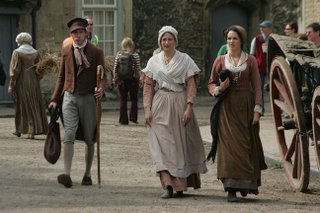
Cranford producers realized that Knutsford, the Chesire market town in which Elizabeth Gaskell’s novel is set, has become too modern to serve as a realistic background for a movie based upon the novel. Lacock to the rescue!

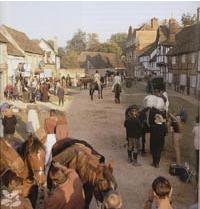
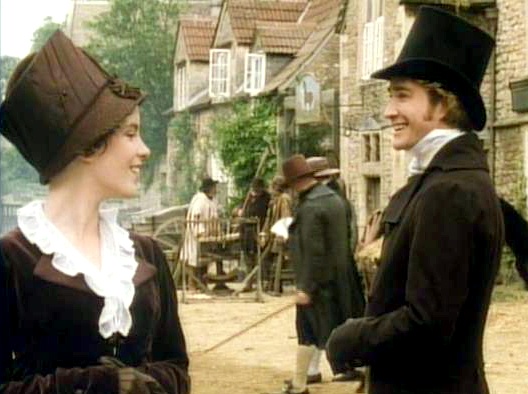
Pride and Prejudice 1995 required a picturesque village. The crew went to Lacock and renamed it Meryton! (Third image below)

Emma 1996 required a piano to be hoisted to the second floor of an old and narrow apartment. A house in Lacock fit the bill!


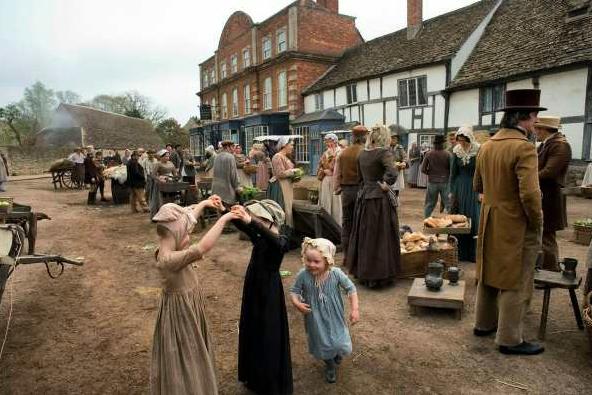
With streets that have remained essentially unchanged for centuries and with the absence of arial wires and satellite dishes, Lacock in Wiltshire has become a hot location for period films. Movies that have been filmed there and that you may recognize are: Pride and Prejudice 1995, Emma 1996, Moll Flanders, Robin Hood: Prince of Thieves, Harry Potter, The Other Boleyn Girl, The Wolf Man, Lark Rise to Candleford, and Cranford. The pictures in this Lacock link were taken in April 2007, prior to a Cranford shoot. The jail in the middle of the road which held young Harry’s father is made of fiberglass.

One can imagine how disruptive these frequent location shoots can be for Lacock’s residents, even though they are compensated. Locals were given £100 if their houses were affected during filming, and they could make extra cash by serving as extras. Aceshowbiz (See photos above and below.)

Town residents stand to make more off Harry Potter 6, but the inconveniences will be greater. High Street and Church Street will close during filming, and the bus stop outside the George Inn will be relocated. Businesses that break closure rules will risk a fine of £1,000. (Swindon Advertiser). For the “privilege” of hosting the Harry Potter crew again, Warner Brothers will pay the village £30,000, which will be split between the Abbey owners National Trust and Lacock Parish Council. The movie-making teams will be allowed to return for four days in October to shoot scenes between 5 PM and 5 AM with Daniel Radcliffe.

When town resident Mary Little, 55, learned that part two of Cranford would be filmed in Lacock, she said: “It would be lovely to work with the cast and crew again – it was brilliant the first time around.

“Hopefully Dame Judi will come back, especially after she pledged her support to help save the post office.

“Everyone in the village quite enjoys the buzz of having stars coming here and us appearing in films and the TV.”

The Talbot family is the main reason why this picturesque village, which dates back to Saxon times, stayed so quaint and old-fashioned. Laycock’s landlords since the mid-19th century, the family refused to let the railway in! Their most famous son is Fox Talbot, a pioneer in photography.

Lacock’s history is a long and proud one. The medieval abbey dates back to 1232, and during the Middle Ages the small village became a prosperous and thriving community through its wool industry. Situated on the ‘cloth road’ from London and the River Avon, it had access to the sea at Avonmouth near Bristol. The village was also located on a direct route between London and Bath, and it became a popular stop for travelers. To this day, Lacock remains a small village:

Gaining residence in one of the 89 houses, which date back to the 16th century, is no mean feat. The National Trust has a written letting policy, favouring people with family connections in the village. Having children is also an advantage. Graham Heard, National Trust property manager for Lacock, said: “We have to be selective. People who apply to live here should contribute to community life, so commuters are far from ideal.

Despite having a population of only about 350, Lacock still boasts five pubs, a village hall, a church, a primary school and a local store complete with post office.” (This is Wiltshire)

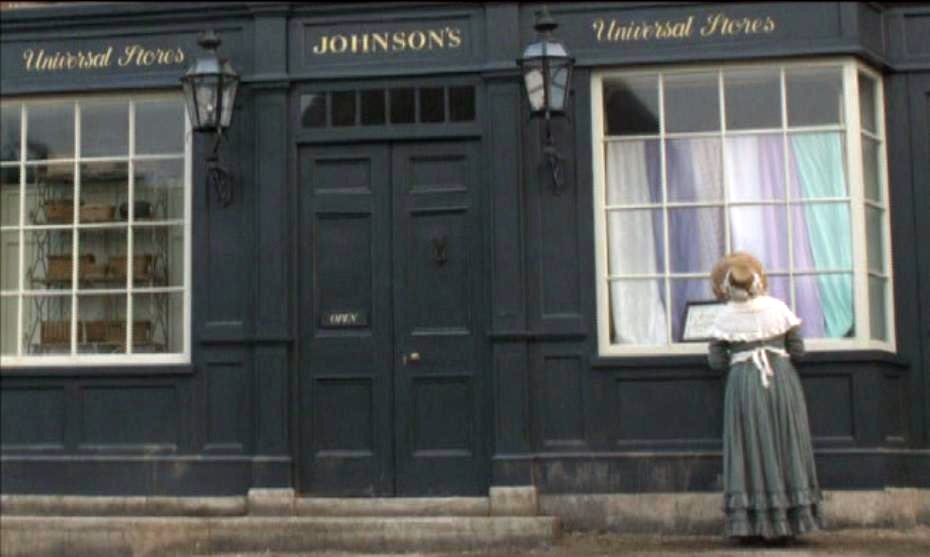
For Cranford, the village’s Red Lion pub in the High Street was turned into Johnson’s Store. Its ground floor frontage was given a face-lift with a coat of dark gray paint and dry goods were placed in the windows. (Radio Times)

To read more information about Lacock, and to see more images, click on the links below:

It’s Lights Camera and Action in Lacock

Lacock: A Hive of Filming Activity

Picture tour of Lacock

Lacock: National Trust Village and Abbey

Lacock Images

Lacock

Lacock Abbey

Breathtaking Wiltshire Images

DjD Chronology

Hay in Art: Fox Talbot’s photograph

Wiltshire on Film

Old photos of Lacock: Francis Firth

Walker’s Web Lacock to Bowden Hill, 5.5 miles

Filming in Lacock

Lacock Village: Popular Film Location, Ripple Effects

Lacock, Wiltshire: Britain Express

Quintessentially English: History of Lacock

Sophie Hoffman: European Destination

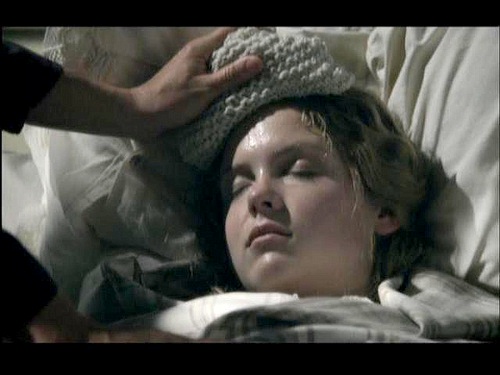
As I noted in an earlier review of Cranford, the plot of this Elizabeth Gaskell adaptation revolves around change. Episode Three, to be aired on PBS this Sunday, carries this point further. The two physicians, one of the old school and one trained with new techniques, his head filled with knowledge of the latest medical advances, take center stage as they try to save their patients from the dreaded diseases that rarely afflict civilized society today: croup, whooping cough, scarlet fever, tuberculosis, cholera, dysentery and typhoid fever. Young Dr. Harrison redeems himself time and again by applying new solutions to old problems, thereby saving patients who would not have survived their ordeal with traditional remedies.

In Jane Austen’s time, or the early part of the 19th century, there was a clear distinction between a doctor, surgeon, and apothecary. Doctors were gentlemen of the old school and deemed socially acceptable. They were often invited to dine with the families they treated, or spend the night as guests.

Doctors and physicians occupied the highest rung on the social ladder. Such citizens were considered gentleman because 1) their training did not include apprenticeship and 2) the profession excluded, supposedly, manual labor. Doctors were permitted to dine with the family during home visits, while other practitioners took dinner with the servants. A physician’s fee was wrapped and placed nearby, for theoretically gentleman did not accept money for their work.

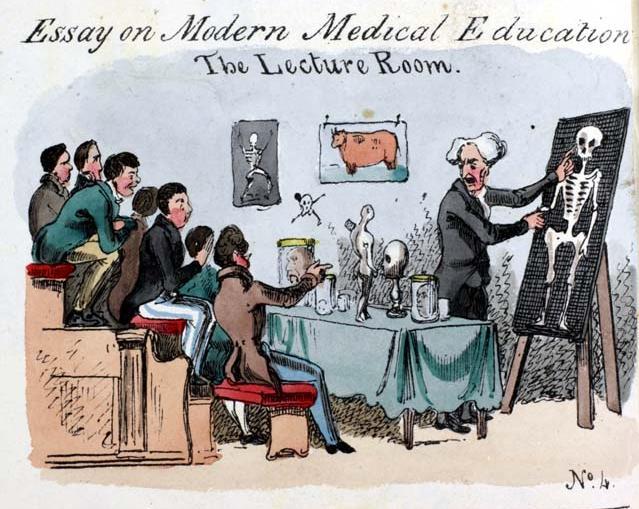
Illustration of Lecture Hall from the Glasgow Looking Glass, 1825-1826

A young man embarking on a medical career would attend a prestigious school at Cambridge and Oxford. There he would study Greek and Latin, and, rather than practice on patients, he would observe medical procedures in a lecture hall. Chances were that he received his license without ever having any clinical experience at all.

Cartoonists and satirists, such as Hogarth and Rowlandson, showed little mercy towards doctors and their poor attempts at treating patients. Even the life-saving vaccine for small pox was treated with some humor and derision by James Gilray, since the innoculant came from a cow.

The Cow Pock, James Gillray, 1802

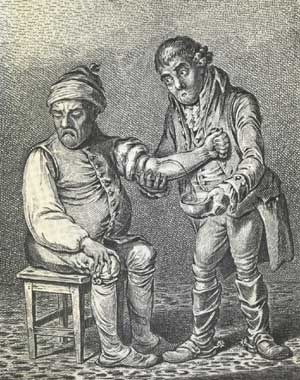
Accepted practices of the day did not include washing hands or changing soiled clothes or bandages, so that doctors often spread illnesses or caused infections. Bleeding through cutting or leeches was an accepted form of treatment:

The most common way of treating a high fever, for example, was to cut open a vein and drain blood from the patient — and not in a small way: a good doctor was expected to cut deep enough that the patient’s blood would spurt into the air with every heartbeat! To make matters worse, the most commonly prescribed “drug” of the time was the toxic element mercury, usually in the form of mercuric chloride.

Surgery was extremely painful, and anesthesia in the form of ether did not appear until 1846. Until that time, doctors relied on mandrake, alcohol, opium, and cannabis for pain relief. (Cocaine was only available in the New World.) Non drug methods of pain relief included cooling the patient or affected area, hypnosis, nerve compression, and blood letting. Because surgeons actually treated the patient by performing physical labor – a trade, so to speak – they occupied a lower rung on the social ladder.

Apothecaries, who learned their profession through apprenticeship and who were definitely considered to be in “trade”, ranked even lower on the social scale. As a group they had “seceded from the Worshipful Company of Grocers, and were incorporated as a separate city livery company in 1617, were supposed to stay in their shops and dispense the prescriptions written by the physicians.” [Apothecaries, Physicians and Surgeons, Roger Jones]

In regions where doctors were scarce, apothecaries also made house calls and treated patients, but largely they mixed drugs and dispensed them, and trained apprentices. A drug’s efficaciousness was hit or miss. By sheer accident, some effective substances were discovered: digitalis, quinine, and calamine, to name several; and a number of proven herbal remedies helped to relieve symptoms. Generally, however,

The technology of making drugs was crude at best: Tinctures, poultices, soups, and teas were made with water- or alcohol-based extracts of freshly ground or dried herbs or animal products such as bone, fat, or even pearls, and sometimes from minerals best left in the ground—mercury among the favored. The difference between a poison and a medicine was a hazy differentiation at best: In the 16th century, Paracelsus declared that the only difference between a medicine and a poison was in the dose. All medicines were toxic. It was cure or kill.

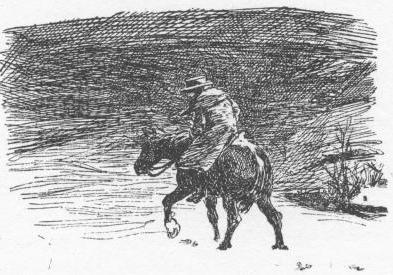
The life of a country doctor was an itinerant one. The 1999 mini-series Wives and Daughters aptly depicted a doctor’s long day, in which he rose at dawn to make his rounds and see patients, often returning exhausted past sunset on his equally weary horse.


Illustration, George du Maurier, 1913

By the end of the 19th century, the medical field had become more professional and organized. Scientific breakthroughs, which included anesthesia, rabies vaccinations, techniques for immunization, sterilization of medical equipment, and an understanding of the origins of infections and of the bacterial world, helped to move the field forward.

Find more links below about medicine during this era:

Images: Photo stills from Cranford and Sense and Sensibility (bleeding Marianne Dashwood); James Gillray cartoons