
It’s spring, and the Baltimore Sun’s John McIntyre recommends some drinks with the author in his blog: gin with Fitzgerald, tea with Dr. Johnson, and madeira with Jane Austen. He chose madeira for Jane because it is “a little sweeter and lighter than sherry, which would also be suitable.” Other popular fortified wines of the time were sherry and port. Only gentleman drank the latter, as well as claret, an expensive French bordeaux.
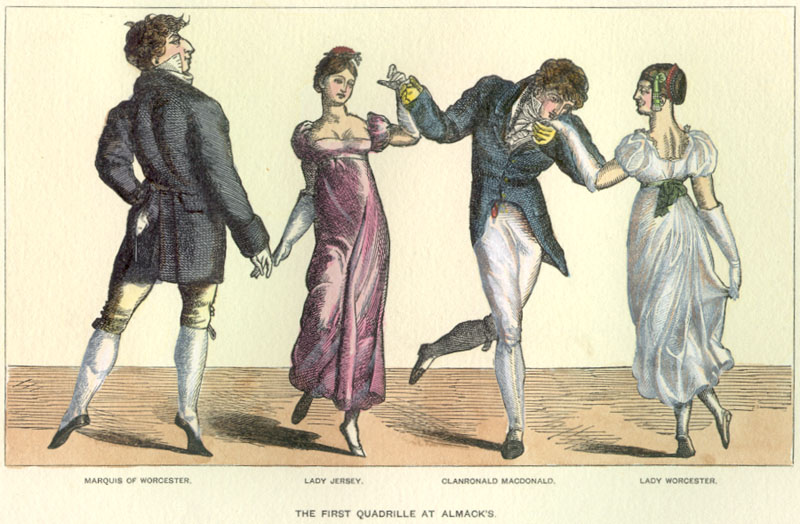
The patronesses of Almack’s served orgeat and ratafia, two sugary sweet drinks. Refreshments at this tony establishment were supposed to be insipid, but both drinks have strong flavors.
Orgeat syrup, made with almond extract, sugar, and orange flower water, was (and still is) added as a flavoring to punch, hot chocolate, coffee, sparking water, or cocktails. This thick, sticky, and opaque milky liquid would have been considered too sweet by itself, and a small amount went a long way. A non-alcoholic orgeat lemonade would have consisted of orgeat syrup, lemonade, and soda water, and might well have been the sort of drink served at an Assembly.
Ratafia, which denotes almost any alcoholic or flavored water, could be made in several ways – distilled or with an infusion of fruits and spices. Ratafia’s alcoholic base would have consisted of marc brandy and the unfermented juice of the grape. The length of time for fermentation for this drink varies. A liquer made in mid-December, for example, could be ready to serve two months later on Valentine’s Day. One recipe for dark brown ratafia suggested that it be stored in an oak barrel for at least two years.
Capillaire, another drink of that era, seems similar to ratafia in that it is described as any simple syrup flavored with orange flowers. I was not able to find out more about this drink, other than as a vague reference.

As mentioned above, Mr. McIntyre chose madeira for Jane. This sweet, fortified wine was hugely popular during the late 18th and early 19th centuries, especially in Colonial America. Brandy was added to the wine to stop the conversion of alcohol from the sugars in the grapes.
British laws prohibited the exportation of wines to the colonies except for Madeira. This brandy-laced wine became so popular in colonial America that nearly 25% of all Madeira wine was shipped there. An interesting chemical reaction occurred inside the casks during the long, hot, and rocky sea voyage across the ocean – the wine improved vastly in flavor. “Why these wines, exposed to constant rocking, extreme heat, and the barrels often found soaking in bilge water, were not ruined, is a mystery.” (Into Wine) It was popularly thought at the time that for Madeira to age well, the wine had to cross the equator in order to heat up sufficiently. In those days, as now, the wine was offered as an aparatif, or with cheese or desserts after dinner.
Cordial waters or Liquers d’Italien had enjoyed a long reputation as wholesome, medicinal drinks, and personal recipes abounded. One 1820 recipe for Yellow Escubac included adding the following ingredients:
One ounce of saffron, one ounce of Damascus raisins, one ounce of cinnamon, three pounds of sugar, one ounce of liquorice, one ounce of corianders, three pints of brandy, two pints of water. Pound these ingredients, and dissolve the sugar in two pints of water; put the whole in ajar to infuse for a month, taking care to stir it up every second day, or third at farthest. – From: G.A. Jarrin, The Italian Confectioner (London: 1820)
Unlike Mr. McIntyre, I would have chosen a slightly different drink for Jane, a French wine perhaps, or, as Jane wrote to Cassandra, the orange wine, which would want “our care soon.” Whatever her choice of drink, a lady was not supposed to get drunk or tipsy, but as Dr. Jennifer Kloester allows, in an age that was generous in serving drink, sobriety would not have been easy state to maintain:
In general, upper-class women did not get drunk, although the prevalence of alcohol in society sometimes made this difficult. The arrack-punch served at Vauxhall Gardens was drunk by both men and women, despite a reputation for potency. It was said to have been made from the grains of the Benjamin flower mixed with rum and was freely imbibed on gala nights. Some men preferred to mix their own punch as Freddy did in Cotillion and rum punch (rum, lemon, arrack and sugar), Regent’s punch (various fruits, rum, brandy, hock, Curaçao, Madeira and champagne) and Negus (port, lemon, sugar and spices) were popular brews. Fortified wines such as Madeira and sherry were also popular with men and some women during the Regency but red wines such as claret, burgundy and port tended to be the more exclusive province of male drinkers. Brandy, gin and rum were drunk by upper-class men, although they often chose to drink the rougher forms of these spirits in the less salubrious surroundings of the inns and taverns of the poorer quarters of London. – Georgette Heyer’s Regency World
Learn more about Madeira and other alcoholic drinks that could be served to ladies of the Regency era in these links:
Dance image from Wikimedia Commons.
 Miss Austen Regrets
 Andrew Davies









 Jane Austen's World