Feeds:
Posts
Comments

Ah, the novels of Jane Austen! In my teenaged mind they conjured up romantic tales, white muslin dresses, perfectly coiffed and finely dressed gentlemen, ballroom dancing, visits to Bath, and carriage rides through gentle rolling hills.

Early Austen films from the late 1930s to the 1970s BBC television series, concentrated on immaculate clothes and manners. The people in Austen’s plots lived graceful and beautiful lives. Although she added comic and/or mean characters who helped to make her plots memorable.

But, as I reread Austen’s novels throughout my adulthood, I realized she cared deeply about the plight of the poor and mentioned them frequently in her novels. Emma Woodhouse and Anne Elliott carried baskets of food to the less fortunate. Genteel families put together gift baskets for those who struggled during the holidays. Mrs Smith, Anne Elliott’s friend, lived in an undesirable neighborhood in Bath, and was so penurious that she depended on the kindness of others to survive and made trinkets to supplement her meager income. 

The environmental conditions of life in London and nearby cities from 1775, the year of Austen’s birth, through 1817, the year of her death was not mentioned in her wonderful books. But she must have known of the pervasive poverty in England, and especially about the pollution that was recorded in detail by people who lived in those times. Their records reveal that not everything during these years was a bed of roses.

In fact, the reality of life in Georgian London at the start of the 18th century was stark for a majority of the people, especially the poor.

The city was…a very dangerous and unhealthy place. Overcrowding, poor sanitation, and disease led to more people dying each year than being born. With contaminated drinking water, the streets acting as open sewers, and the choking atmosphere, diseases such as cholera, smallpox, and tuberculosis were widespread.” Georgian London 1714 – 1837

St. Paul’s Cathedral, from St. Martin’s-le-Grand Thomas Girtin British 1795–96, Public Domain image, Met Museum.

By 1800, the population had risen to the extent that London was probably the first city in the world with over 1,000,000 citizens. However the average life expectancy across London was still only 30 while in rural England it had risen to over 40.” Georgian London 1714 – 1837

In regard to this last statement, Austen, who died at the age of 41, barely attained the rural ‘over 40” life expectancy. Whereas her immediate family lived longer lives: father 75 yrs, mother 87 yrs, sister 72 yrs: and brothers Edward, 75 yrs, James, 54 yrs, and Francis, 91 yrs. Yet so many poor factory workers or individuals who lived in dire poverty in tenements and suffered from poor nutrition did not survive beyond the age of 30. The poorest died in their 20’s.

An old article in an old online site from the Republic of Pemberley, which has since been updated, discusses Some downsides of Regency London. (long), which includes the environmental conditions caused by pollution before and during Austen’s birth. 

Air pollution: Soot, Fog, and Smog

Nelson’s column, blackened. *3 link below

Coal was the primary source for heating and cooking in houses and shops during the 18th & 19th centuries. London and the industrial cities north of London used coal as their primary resource. Major cities produced so much soot that it spread everywhere. Even the spa city of Bath was affected.  

11 Trim Street, Bath, sooty. This building has not been cleaned to show the effects of soot.

Fog and smog were also the main results. In 1817 Sir Richard Phillips described the smoke of London spreading twenty or thirty miles from the metropolis and killing or blighting vegetation. He goes on to say:

“Other phenomena are produced by its union with fogs, rendering them nearly opaque and putting out the light of the sun; it blackens the mud of the streets by its deposits of tar, while the unctuous mixture renders the foot-pavement slippery; and it produces a solemn gloom whenever a sudden change of wind returns over the town the volume that was previously on its passage into the country.” ( “A Morning’s Walk from London to Kew” (page 11) Sir Richard Phillips, 1817. Googlebooks text is online.)

Keeping clothes clean for long was nearly impossible in a city filled with chimneys. Considering the pervasive smoke and soot, one wonders how long delicate white muslin gowns or white shirts would stay clean. One would walk around the city for a few hours, only to find that those garments looked grubby. Wealthy individuals could afford to change their clothes frequently to look respectable, but the working and lower classes did not have such a luxury. Unlike the rich, they could not pay laundresses to wash their clothes frequently. 

The consummate Georgian dandy was Beau Brummel, whose first biographer, Captain William Jesse, quoted Brummel as saying about the maintenance of his clothes: “No perfumes, but very fine linen, plenty of it, and country washing.” In other words, those with the means sent their laundry to country villages for a thorough washing.

Effects of chimneys during the Industrial Revolution

A more serious effect of all those coal fires in towns and cities, like London and Bath, was smog. 

“…unpleasant, choking smog spoilt food, smutted linen and buildings and suffocated vegetation. It also suffocated the citizens. As early as 1610 a surveyor complained that the chimneys proliferating in the country ‘raise so many duskie clouds in the ayre [which] … hinder the heat and light from the Sunne from earthly creatures” (Hubbub: Filth, Noise, and Stench in England, 1600-1770, Emily Cockayne, p. 209, Yale University Press, 2007) Hubbub is also available for free on the Internet Archive

An EPA Journal article written by by David Urbinato in 1994 mentions the following:

“Smog in London predates Shakespeare by four centuries. Until the 12th century, most Londoners burned wood for fuel. But as the city grew and the forests shrank, wood became scarce and increasingly expensive. Large deposits of “sea-coal” off the northeast coast provided a cheap alternative. Soon, Londoners were burning the soft, bituminous coal to heat their homes and fuel their factories. Sea-coal was plentiful, but it didn’t burn efficiently. A lot of its energy was spent making smoke, not heat. Coal smoke drifting through thousands of London chimneys combined with clean natural fog to make smog. If the weather conditions were right, it would last for days.”

Animal pollution:

In the late 18th century and throughout the 19th century, London was filled with horse manure and urine from the thousands of horses that pulled Hansom cabs and other vehicles. The manure and urine, along with the carcasses of dead horses, polluted the city with the stench and poisoned water, which threatened the health of its residents. 

Manure produced:

In London, 50,000 horses produced 570,000 kilograms of manure and 57,000 liters of urine each day. Horses, it was calculated, produced 15–35 pounds of manure per day each.

“Each horse also produced around 2 pints of urine per day and to make things worse, the average life expectancy for a working horse was only around 3 years. Horse carcasses therefore also had to be removed from the streets. The bodies were often left to putrefy so the corpses could be more easily sawn into pieces for removal.” The streets of London were beginning to poison its people.” –   The Great Horse Manure Crisis of 1894: Historic UK  

One should also take into account the number of oxen, mules and donkeys used for hauling. Big dogs pulling carts did their business in the streets as well. Add the drovers who came from all parts of the Kingdom driving livestock to market: the problem of cleaning the streets of effluvium and stench became an almost impossible fight. 

“During Jane Austen’s time and into the earliest days of the twentieth century, crossing sweepers made a living sweeping pedestrian crossings, stoops, and sidewalks of horse manure and litter” – Jane Austen’s World, 2007. 

Crossing Sweepers

With all that manure, crossing sweepers were essential for moving dirt and droppings out of the way. This link to the article explains how vital poor males were for keeping the crossings clear for pedestrians. 

Smithfield Market:

“Between 1740 and 1750 the average yearly sales at Smithfield were reported to be around 74,000 cattle and 570,000 sheep.[43] By the middle of the 19th century, in the course of a single year 220,000 head of cattle and 1,500,000 sheep would be “violently forced into an area of five acres, in the very heart of London, through its narrowest and most crowded thoroughfares”.[44] The volume of cattle driven daily to Smithfield started to raise major concerns. – Wikipedia

Smithfield,Last day of Old Smithfield, 1855

It is hard to imagine the noise from bellowing cattle and bleating sheep, the immeasurable amount of excrement and urine deposited as they walked along narrow lanes, the smells from the droppings and their effect on the populace in terms of the unhygienic streets. 

“Of all the horrid abominations with which London has been cursed, there is not one that can come up to that disgusting place, West Smithfield Market, for cruelty, filth, effluvia, pestilence, impiety, horrid language, danger, disgusting and shuddering sights, and every obnoxious item that can be imagined…” Maslen, Thomas (1843). Suggestions for the Improvement of Our Towns and Houses. London: Smith, Elder & Co. p. 16.

Sewage & Dirty, Fetid Water:

“Most buildings were not connected  to the various rudimentary urban subterranean sewerage schemes developing in the seventeenth and eighteenth centuries. Waste water combined with surface rainwater in street gutters known as kennels [street gutters].” (p 195, Hubbub)

Wide roads had gutters on either side, narrow roads had a gutter running down the center. The water in these gutters ran into ditches then into streams, which fed into faster waters, like the Thames, which carried most of the dirty watery waste that came from a combination of households, plus manufacturing wastes that included soap, which bubbled. The gutters needed to be kept free from blockages, if they were not, then the streets flooded or street puddles stagnated. Citizens, often tasked to  keep the gutters clean outside their doors, cast rotting fruit and vegetables, dung, and human waste that also blocked the flow of water.  (Hubbub, p 195-197)

When the waste was unblocked, it entered the gutters and then was dispensed into streams and rivers that turned into polluted the water.

“Matt Bramble gives his impression of the quality of liquid to be obtained from the Thames: ‘If I would drink water, I must quaff maukish content of an open aqueduct, exposed to all manner of defilement; or swallow that which comes from the river Thames, impregnated with all the filth of London and Westminster – Human excrement is the least offensive part of the concrete, which is composed of all the drugs, minerals, and poisons, used in mechanics and manufacture, enriched with the putrefying carcases of beasts and men; and mixed with the scouring of all the wash-tubs, kennels, and common sewers, within the bills of mortality.” (p 111, SATIRE IN THE EXPEDITION OF HUMPHRY CLINKER BY TOBIAS SMOLLETT, 1771)

Night Soilmen:

Thomas Rowlandson, Collecting the Night Soil, pub 1788

“In cities, neighboring privies were placed side by side in yards and drained into a common cesspool located under an alley that ran between the row of cottages or townhouses. In rich to middle class households, nightsoilmen would be paid to cart the waste away when the household was sleeping. This service was quite expensive, and quite often neglected in poorer districts where the lower classes could not (and landlords would not) hire these men until the cesspools were filled to overflowing.” (Privies and Waterclosets, written by  David J. Eveleigh, A Jane Austen’s World Review, 2010)

Austen visited her brother, Henry in London three times — to his addresses on Sloan St in 1811 & 1813, and Henrietta St in 1814. While she situated many of her characters living in or visiting London, in her novels she did not mention the horrors of the slaughters that occurred in Smithfield Market, the sounds of fearful animals, their horrific deaths, and their blood running in the streets as their carcasses were dismembered, not to mention the stench. 

These events did not play a part in her plots, which had an undercurrent of dark moments as well. We must assume that Austen knew more about London’s pollution, its filthy air, and rutted roads covered with excrement. She simply chose to use only the moments she needed to drive her stories forward. Her two last novels had serious undertones. One wonders that, had she lived longer, if the darker edges of Georgian life would have crept deeper into her plots.

Additional Links:

Yorkshire, Air Pollution. Stone cleaned on the right


Hello, dear readers! This month, I’m featuring this new edition of Pride and Prejudice, a Handwritten Classics edition. This is a luxurious collector’s edition in two volumes, featuring Austen’s complete novel. Inside, you’ll find a collection of characters’ letters and papers, written and folded by hand.

This new collector’s edition offers a luxurious cloth binding, deluxe paper, and new printed ephemera that lend an additional dimension to the reading experience. Examples include a newspaper clipping announcing that Netherfield Park is available to let, an invitation to the ball at Netherfield, an illustrated guide to Pemberley, Darcy and Elizabeth’s marriage license, and so forth.

Order Your Copy Here

About the Book

This collector’s edition invites fans inside the world of Jane Austen’s Elizabeth Bennet. A deluxe, cloth-bound, two-volume set includes gorgeous replicas of the characters’ letters, plus all-new mementos, such as the Darcys’ marriage certificate and an invitation to the ball at Netherfield.

Heller’s specially curated edition, first published in 2020, brought these epistles to life and became a fan favorite. Pockets throughout the novel contain handwritten replicas of nineteen letters, from Mr. Collins’s unctuous letter of introduction to Jane’s urgent missive announcing Lydia’s elopement. Readers can pull out each piece, peruse its contents, and feel transported to the breakfast table at Longbourn.

Heller’s research notes shed fascinating light on how she imbued each letter with the character’s unique personality and recreated historical postage marks. Delve deeper into the history with guest essays by Philip Palmer, curator and department head at the Morgan Library & Museum, and Dr. Juliette Wells, curator of the Morgan’s 2025 exhibition of Austen’s own letters, A Lively Mind: Jane Austen at 250. For anyone who loves Austen, and for anyone who still cherishes the joy of letter writing or collects printed memorabilia, this book offers an immersive experience of a favorite story.

You can revisit Austen’s original text and experience it in a unique way with physical ephemera that links you directly to the world of Elizabeth Bennet and Mr. Darcy. From the masterful calligraphy and the painstaking attention to historical detail to the hand-folding of the letters and other paper memorabilia—this book is an object made by fans for fans.

The novel is presented in two volumes, cloth-bound, foil-stamped, and housed in an elegant slipcase. It offers an exceptional reading experience, stands apart on the shelf, and makes for a truly lovely gift and keepsake. 

Barbara Heller

Barbara Heller is a set decorator for film and television, including The Americans and When They See Us, and a writer and director of award-winning short films that have screened at festivals around the world (Cannes, Berlin, Sundance). She graduated from Brown University with a degree in English Literature. Her previous books include special editions of Pride and PrejudiceLittle WomenPersuasion, and Anne of Green Gables. You can read about her work and visit her online HERE.

How the Series Began

Heller, an avid Austen fan, shares about creating this series of handwritten editions of classic books and how it all started:

“I was re-reading Pride and Prejudice for the gazillionth time, savoring my favorite passages in Mrs. Gardiner’s “long, kind, satisfactory” letter to Elizabeth, when a sudden desire to have that letter in my hand came over me. To hold the very letter that Elizabeth Bennet once received – ink faded, paper yellowed – would be utterly satisfying. In truth, I wanted to possess the originals of all the letters in Pride and Prejudice. A vision of myself at a flea market, happening upon the letters, was so real that I experienced the twin electric thrills of discovery and possession. I became determined to transform reverie into reality.

“[It took] three fascinating years during which I examined hundreds of letters written in early 19th century England; dove deep into their cryptic postal marks; agonized mightily over each character’s handwriting, and met the talented scribes who could write a period hand.

“I was extraordinarily lucky to find a home amongst the Austen lovers at Chronicle Books. In this special edition, each letter is tucked inside a glassine envelope bound at the appropriate place in the novel. I have now read the letters so many times I practically have them memorized; and yet, with every re-read, I still get caught up in the story, discover something new, and marvel at (and feel grateful for) the genius of Jane Austen.”

Jane Austen Book Collecting

I personally think this is an edition for serious book collectors and Jane Austen collectors. The price point is high, but it’s currently on sale right now on Amazon (subject to change). It would make a lovely gift or a fun splurge for yourself. It is truly an immersive experience.

As I thought about how I would use this book, I think it would make a wonderful display at a Jane Austen party, book club, program, or exhibit. I can imagine gathering a group of Austen friends together to dress up, have tea, and read the letters and papers out loud together.

As we step into Fall over the next few months, I look forward to sharing several new books that are releasing this year in celebration of Jane Austen’s 250th! I hope you’ve found a few books to add to your shelves along the way.


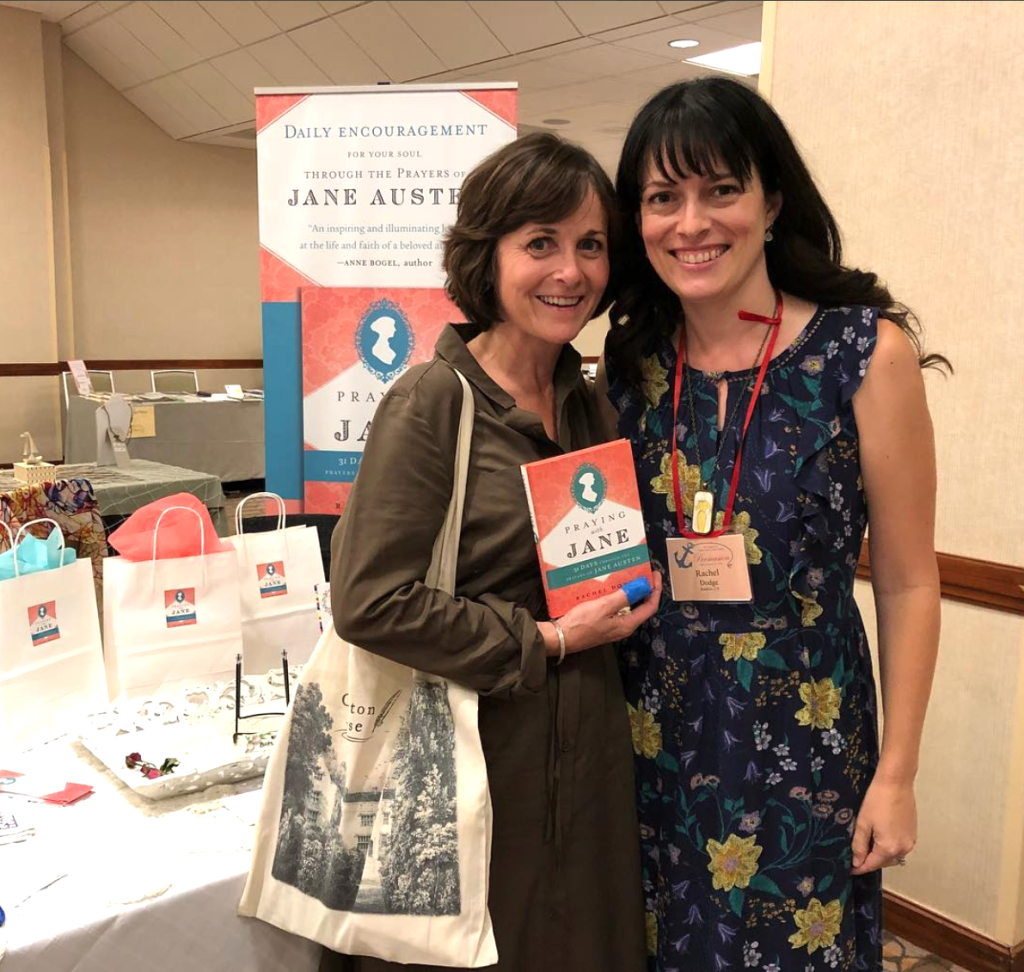
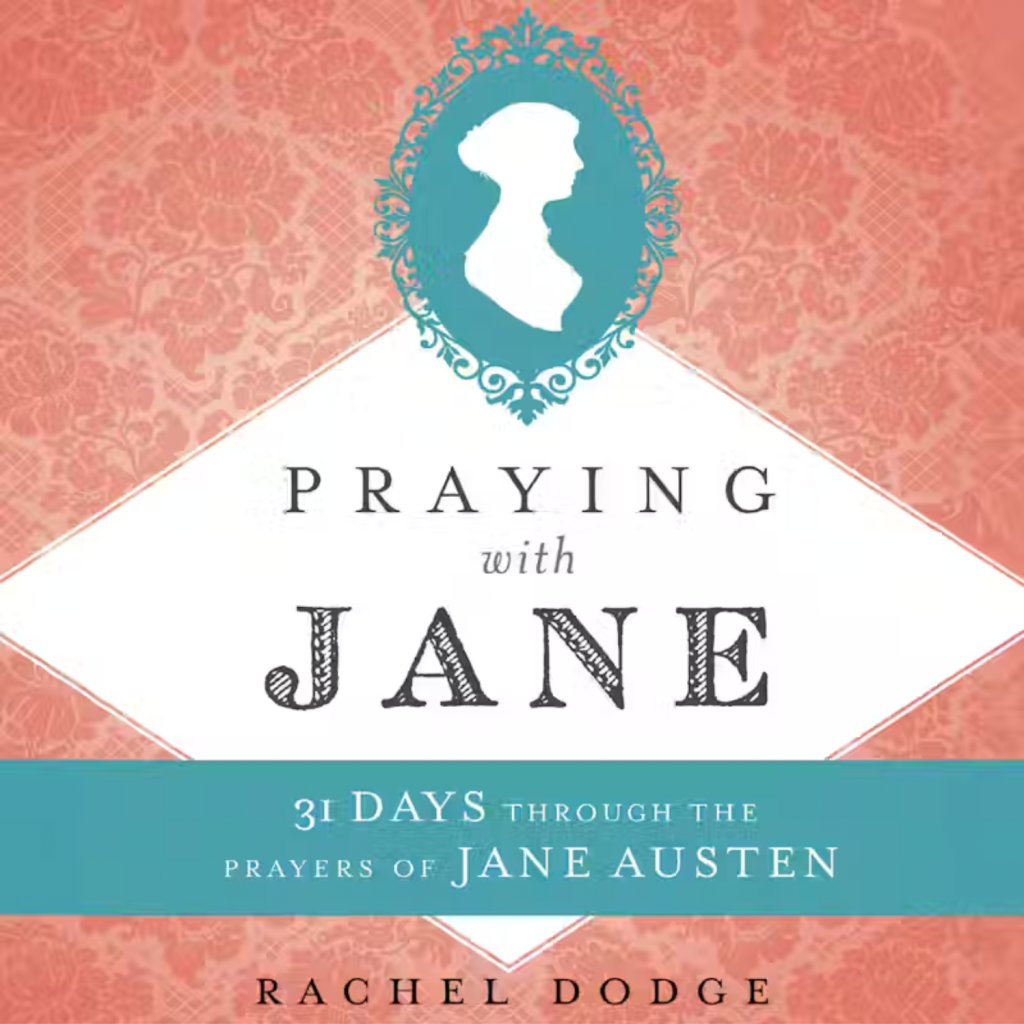
RACHEL DODGE teaches writing classes, speaks at libraries, teas, and conferences, and writes for Jane Austen’s World blog. She is the bestselling, award-winning author of The Anne of Green Gables DevotionalThe Little Women DevotionalThe Secret Garden Devotional, and Praying with Jane: 31 Days Through the Prayers of Jane Austen. A true kindred spirit at heart, Rachel loves books, bonnets, and ballgowns. Visit her online at www.RachelDodge.com.

A Book Review by Brenda S. Cox

Austen’s Endings

A happy ending, but we don’t see how they got there: Edmund falling in love with Fanny at the end of Mansfield Park disappoints because of the lack of details.

A major complaint that readers have about Austen is her endings. In both Sense and Sensibility and Mansfield Park, we have a sudden romance that is practically a footnote to the last chapter—Marianne marries Colonel Brandon with just, “Marianne found her own happiness in forming his,” and Fanny marries Edmund once he learns “to prefer soft light eyes to sparkling dark ones.” Northanger Abbey introduces a new character, Eleanor’s viscount, to facilitate Henry and Catherine’s marriage.

In Emma and Persuasion we do get some romantic talk (or writing) from the hero. However, in response, Emma says “just what she ought” (which is??), and Anne receives Wentworth’s look “not repulsively.” Then they talk, but we don’t hear their words.

Darcy, of course, simply tells Elizabeth his “affections and wishes are unchanged,” perhaps not willing to risk another disastrous proposal, and Elizabeth “immediately, though not very fluently, gave him to understand that her sentiments had undergone so material a change, since the period to which he alluded, as to make her receive with gratitude and pleasure his present assurances.” But what exactly did she say?

In all cases we have more author commentary than demonstrations, more of what writers call “telling” rather than “showing.”

Movie-makers have had to put words to all these proposals, and fill in some blanks. For example, they show Colonel Brandon rescuing Marianne from the rain, and wooing her with music. But why didn’t Jane Austen, who gave us so many delightful conversations and events, show us all those details herself?

Jane Austen & the Price of Happiness

Jane Austen & the Price of Happiness, by Inger Brodey, explores possible reasons for Austen’s less than romantic endings.

When I listened to Jane Austen and Her Endings: A Visit with Inger Brodey on Austen Chat, I was intrigued by Inger’s thoughts on analyzing those endings of Austen’s novels and trying to figure out why Austen didn’t give us all the details we want. Recently I finally got to buy (at JASP, from Jane Austen Books), and read, Jane Austen & the Price of Happiness by Inger Sigrun Brodkjær Brodey.

It’s a fascinating book, and written quite accessibly. (I found only a couple of unfamiliar academic terms*; in general it’s written in everyday English.) The illustrations are fun, including cartoons, images from movies, and more.

Each chapter analyzes one of the novels, in the order they were written, so we see the development of Austen’s techniques. Brodey looks at various aspect of each novel with new insights and considers the impact of the ending. Then she looks at some popular adaptations of that novel, mostly films plus a few books. She considers how they handle the ending and whether their endings fit Austen’s goals.

Her chapter titles give you some idea of her thoughts:

  • Introduction: “Perfect Felicity”
  • Chapter 1: “Commonplace Happiness” (Northanger Abbey)
  • Chapter 2: “Expecting Literary Justice” (Sense and Sensibility)
  • Chapter 3: “The Limits of Romance” (Pride and Prejudice)
  • Chapter 4: “The Thin Veil of Comedy” (Mansfield Park)
  • Chapter 5: “The Art of English Happiness” (Emma)
  • Chapter 6: “Resources for Solitude” (Persuasion)
  • Conclusion: “Coauthoring Happiness”

Brodey says that, for one thing, Austen is trying to show readers that their expectations of romantic idealism come from the sort of sensibility she satirizes. Austen disrupts those expectations. She shows us that the romantic outcomes we want, expect, and demand are not inevitable: this is fiction. Her stories are realistic, with characters operating in ordinary, everyday life, but the “happily ever afters,” the “perfect happiness,” may or may not happen in real life.

There are other reasons for Austen’s nuanced endings, which I’ll leave you to discover from Inger’s book. However, I’ll share a few highlights from the chapter on Mansfield Park, as an example of some of the many insights in the book.

“The Thin Veil of Comedy” Chapter on Mansfield Park

Readers are expected to be attracted by Mary Crawford’s charm, which hides her poor moral values.

Mansfield Park was published after the light, bright, and sparkling Pride and Prejudice. It deals with harder truths. Brodey claims Austen’s “novels alternate between the bright and witty heroines whose primary obstacles are internal, and the more understated, misunderstood, and wiser heroines whose primary obstacles are external” (p. 138). I had to think about this one, but it’s true—Catherine Morland is not witty, but she does face internal obstacles of her own credulousness and illusions; Elinor Dashwood is wise and misunderstood; Elizabeth Bennet, obviously bright and witty, needs to overcome her pride and prejudices; Fanny Price is also wise but understated and faces external challenges; Emma is again bright and witty and needs to overcome her own pride; Anne Elliot is quiet but wise.

Austen shows, especially in Mansfield Park, that charm can be dangerous. Mary Crawford is lively and charming like Elizabeth Bennet. She and her brother Henry charm Edmund, Maria, and Julia, as well as readers, just as Wickham charmed Elizabeth. However, charm without a strong moral foundation leads to disaster. Austen is challenging her readers “to love the less prepossessing characters and see beyond the false power of charm.” 

Henry Crawford might have changed due to his love for Fanny, and might have earned her love, but he did not.

The final chapter of Mansfield Park tells us outcomes for many characters, who are apparently as important as Edmund and Fanny. We see the reformation of some, such as Tom Bertram and Sir Thomas Bertram. Austen reveals the sad but not completely tragic endings of those who were not willing to change, including Henry and Mary Crawford. Henry could even have had an alternate ending, with a happy marriage to Fanny, if he had been willing to persevere in his resolutions of self-improvement. Brodey says, “It somewhat diminishes [Fanny’s] marriage to Edmund to know that a marriage to Henry would not have been disastrous. Once again, Austen surprises the reader out of extravagant expectations of the novel. We get shades of gray where we hope for black and white, realism where we crave romance” (p. 148).

As in other endings, Austen intrudes in the first person, saying “My Fanny indeed at this very time, I have the satisfaction of knowing, must have been happy in spite of everything.” Austen reminds us that this is fiction and that she, as the author, is controlling the ending. She also refers to Fanny as a living human being, though. In showing her own attachment to Fanny (“my Fanny”), she “models the attachment that she believes Fanny deserves” (p. 147).

She challenges our readerly expectations of fantasy endings, including a sense that “second attachments are degrading for romantic heroines” (p. 149); shades of Marianne Dashwood! We believe that Edmund and Fanny will be happy together, even though it is Edmund’s “second attachment.” They do not need some intense eternal passion to experience happiness.

I hope these brief points pulled from one chapter might give you a little more understanding and appreciation of Mansfield Park. I encourage you to read all of Jane Austen & the Price of Happiness. I think you will find it fascinating and illuminating, as I did!


*Here’s one word I learned from this book: apophasis. It means “raising an issue by claiming not to mention it,” or, as Brodey puts it, “tell[ing] the reader what will not be told.” Austen’s endings often use this technique. For example, near the end of Mansfield Park: “But there was happiness elsewhere which no description can reach. Let no one presume to give the feelings of a young woman [Fanny] on receiving the assurance of that affection of which she has scarcely allowed herself to entertain a hope.” As Brodey says, it’s an annoying technique. But Austen has her reasons.


Brenda S. Cox is the author of Fashionable Goodness: Christianity in Jane Austen’s England. She also blogs at Faith, Science, Joy, and Jane Austen.
By Brenda S. Cox

Last month, June 19-22, I had the joy of attending JASP, the Jane Austen Summer Program. I had only attended once before, during covid when it was online. That was fantastic, so I was delighted to finally get to go in person.

This year’s theme was Sensibility and Domesticity. The focus was on Sense and Sensibility (S&S), domestic arts, and trans-Atlantic connections between the young USA and Austen’s England.

Laura Klein and Megan Poff play and sing pieces from Jane Austen’s own playlist that relate to Sense and Sensibility, such as “Begone Dull Care” which they connected with Willoughby. JASP 2025

Plenary Sessions

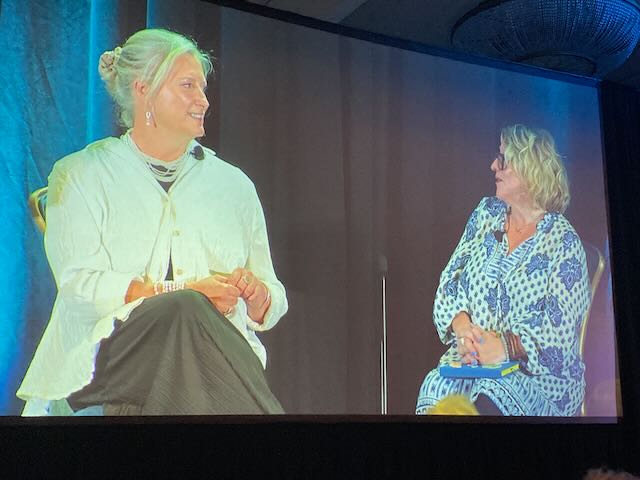
Plenary talks explored household books of the time; effects of the war on home life; “The Constitutional Safeguard of a Flannel Waistcoat”; and the Jane Austen Playlist, with a performance of songs connected to S&S.

In “Reading the Americas with Jane Austen,” Susan Allen Ford (author of What Jane Austen’s Characters Read And Why) explained what Austen would have learned about the Americas in books Austen is known to have read. For example, novelist Charlotte Turner Smith used her study of botany and travel writing to describe American scenery, as a teaching technique. In the introduction to her collection of tales, The Letters of a Solitary Wanderer, Smith argues that “young persons, who have no taste for any thing but narrative, may sometimes, by the local description of a Novel, learn what they would never have looked for in books of Geography or Natural History.” However, she presents Native Americans as savage and violent.

Anne Grant’s Memoirs of an American Lady, which Austen also read, gives a different perspective. It shows Native Americans as noble friends. Grant grew up in close contact with Mohawks, even learning to speak their language. Austen was able to get multiple perspectives on North America.

Susan Allen Ford, who spoke on Austen’s readings about America, shows rare books. JASP 2025

Jennie Batchelor, author of Jane Austen Embroidery, offered two fun embroidery workshops and a final plenary on “Transatlantic Domestic Arts in the Era of Jane Austen.” Jennie told us about resources used by women in England and America at the time, such as The Young Ladies School of Arts. That book gives instructions and receipts (recipes) for many kinds of ladies’ activities, from breeding canaries to gilding. It includes the technical, scientific knowledge needed for many of these skills. Fashionable boarding schools also taught such arts.

As one example, Sense and Sensibility mentions filigree work, which Lady Middleton expected Lucy to do at night by candlelight. Elinor kindly volunteered to assist Lucy. Filigree is quilling: cutting and rolling up small pieces of paper and fastening them onto a surface. This was quite fiddly, eye-straining work that Lucy was constrained to do in order to please her hostess.

Jennie Batchelor led two embroidery workshops, following patterns she adapted from magazines of Austen’s time. Some participants are tracing patterns onto their fabric at the windows, as Austen might have done. JASP 2025

Context Corners and Discussion Groups

I was particularly looking forward to one special feature of JASP: context corners and discussion groups. Graduate students led four 15-minute sessions (“context corners”) discussing various aspects of Sense and Sensibility. Topics connected S&S with sensibility and sisters; inheritance law; the East Indies; and “Scandal and the Fallen Woman.” For that final topic, we considered when the “fallen woman” was considered morally corrupt and when she began to be considered as a victim of immoral men or capitalism. We also learned definitions of a “rake” and saw comparisons with real people, noting similarities between William, Lord Craven, and the fictional John Willoughby.

In a Context Corner on “Scandal and the Fallen Woman,” Nellie Downie told us about a real Dashwood family who were involved in various scandals. They were quite different from Austen’s Dashwoods. JASP 2025

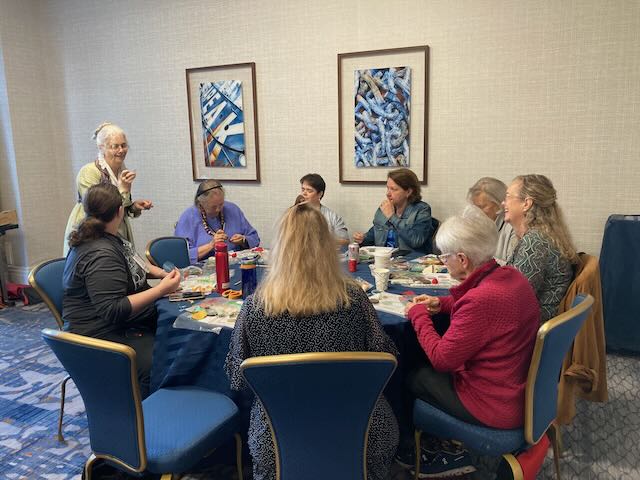
After each context corner talk, we split up into small groups named after places in S&S. Mine was Norland Park. Using lists of excellent discussion questions and quotes, we had far-ranging discussions which were great fun. We had 45-60 minutes per discussion, so we could really get into it and trade ideas, building off of each other’s insights.

Education was a major emphasis of the conference, and teachers had their own forums in addition to the regular events.

In the Norland Park group, as in all the other groups, we had lively discussions on many aspects of Sense and Sensibility. JASP 2025

And More Delights

The rest of the time was filled with fun events, including:

  • An opening banquet
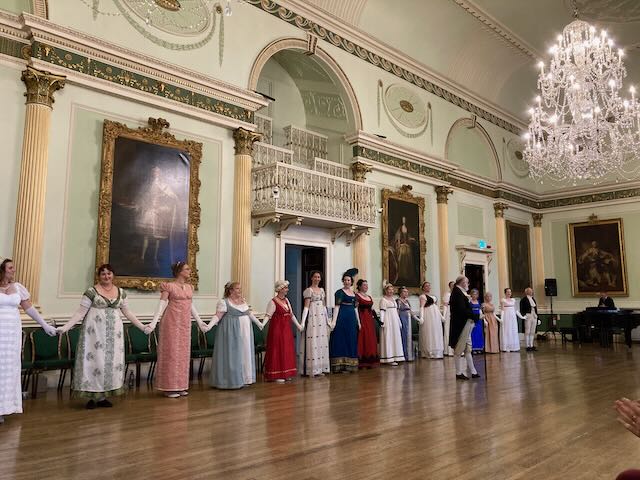
  • Multiple fun dance practices with “Mr. Steplively” and a Saturday night Regency Ball, with Regency Games for those who preferred not to dance. (A nice touch was the availability of reasonably priced costumes for those who wanted to rent Regency gowns.)
Ready to promenade from the hotel to the ball. Breckyn Wood, Erna Arnesen, Betty Parker Ellis, Jeanne Talbot, JASP 2025.
Dancing at the Regency Ball, JASP 2025
  • A theatrical evening, where we got to watch an original play connected S&S with Hamlet, and a screening of Sense and Sensibility: The Musical, a delightful take on the novel.
  • An adaptations panel which included music and costumes used in film versions of S&S, and more.
  • Optional tours
  • An emporium selling Jane Austen Books along with other fun items, and a silent auction.
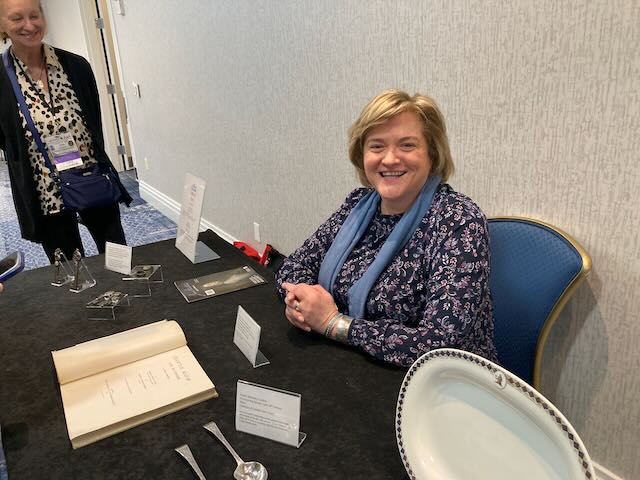
  • A display of early editions of S&S and contemporary books by William Cowper, Sir Walter Scott, James Thomson, William Gilpin, and more.
Inger Brodey, president of the Jane Austen Collaborative (of which JASP is a part), shows her early copies of books by Thomson and Gilpin.

Location, Location

Past JASPs have been held at UNC-Chapel Hill. This year about 150 participants met in New Bern, a historic town near the coast in North Carolina. Waterside views were lovely, and we got to tour the beautiful Tryon Palace and its extensive grounds. Our sessions were held at the North Carolina History Museum nearby.

Next summer, JASP is moving to Seton Hill University in Greensburg, Pennsylvania. The topic will be Pride, Prejudice, and the Pursuit of Happiness. I’m hooked on this great program, and I hope to see some of you there!

(Note: All photos ©Brenda S. Cox, 2025, please ask permission before using.)

Tryon Palace, first permanent capitol of North Carolina, also Governor Tryon’s home, completed in 1770. Reconstructed and reopened in 1959. Well worth a visit! JASP 2025
Touring the Tryon Palace was like touring an aristocratic home of Austen’s day, with period-appropriate furnishings, all the way down to the kitchen, where a real chicken was roasting in the fireplace. JASP 2025

Brenda S. Cox is the author of Fashionable Goodness: Christianity in Jane Austen’s England. She also blogs at Faith, Science, Joy, and Jane Austen.

As we continue our tour of new books and media for Jane Austen’s 250th anniversary celebration, my choice this month is the much-anticipated Jane Austen in 41 Objects by Kathryn Sutherland. This extensive new “biography” features the beloved 41 Objects from the Jane Austen Museum, along with beautiful photographs and in-depth information about each item in the collection.

“Jane Austen’s House holds an unparalleled collection of objects relating to Jane Austen’s life and works, her family circle and her legacy. Here you can see some of the treasures of the collection, ranging from books and letters to pieces of furniture, clothing and paintings. Many of these objects can be seen in the House . . .” (Jane Austen’s House)

Book Review

For those who have had the opportunity to visit Jane Austen’s House Museum, many can attest that it’s hard to take everything in during a tour of the house. This book provides a closer look at each object in greater details. I was quite intrigued by the items and information I had missed during my visits over the years and from my searches online. For those who have not yet visited JAHM, this is the perfect book for your shelves! It gives Jane Austen fans a wonderful glimpse into the collection of objects often on display there, collecting them all in on place.

This book provides the perfect “virtual tour” because there’s so much more in the book than you can find online or in person. This book is also much more thorough in its explanation of and historic information about each of the 41 objects than anything I have seen. For instance, reading about the Jane Austen plate was brand-new to me.

What’s more, I believe that this book provides information about objects that may not currently be on view at the museum. I don’t think all 41 objects are always available to the public in one place. If memory serves, some objects move here and there to other exhibits, so again, seeing it all in one place is quite impressive and educational.

Jane Ausen’s Writing Desk

Book Description

Jane Austen in 41 Objects by Kathryn Sutherland is a new kind of biography on Jane Austen examining the objects she encountered during her life alongside newer memorabilia inspired by the life she lived.

More than two hundred years after Jane Austen’s death at the age of just forty-one, we are still looking for clues about this extraordinary writer’s life. What might we learn if we take a glimpse inside the biographies of objects that crossed her path in life and afterward: things that she cherished or cast aside, that furnished the world in which she moved, or that have themselves been inspired by her legacy?

Among objects described in this book are a teenage notebook, a muslin shawl, a wallpaper fragment, a tea caddy, the theatrical poster for a play she attended, and the dining-room grate at Chawton Cottage where she lived. Poignantly, the last manuscript page of her unfinished novel and a lock of hair, kept by her devoted sister, Cassandra, are also featured. Objects contributing to Austen’s rich cultural legacy include a dinner plate decorated by Bloomsbury artists Vanessa Bell and Duncan Grant, Grayson Perry’s commemorative pot from 2009, and even Mr Darcy’s wet shirt, worn by Colin Firth in the 1995 BBC adaptation.

This is a different kind of biography, in which objects with their own histories offer shifting entry points into Jane Austen’s life. Each object, illustrated in color, invites us to meet Austen at a particular moment when her life intersects with theirs, speaking eloquently of past lives and shedding new light on one of our best-loved authors.

Featured Objects

Sutherland provides a tour of all 41 objects with photographs and information about each one. This truly does gives the reader more time to examine and take a thorough look at each object. Though one could find many of these objects online, it’s much easier to study them in a book format.

Marianne Knight’s Dancing Slippers

About the Author

Kathryn Sutherland is a trustee of Jane Austen’s House and Professor of English and Senior Research Fellow, St. Anne’s College, Oxford. Her publications include Jane Austen’s Textual Lives: from Aeschylus to Bollywood (2005), the online edition of Jane Austen’s Fiction Manuscripts (2010), and Jane Austen’s Fiction Manuscripts (5 vols, 2018). Other edited works include: James Edward Austen-Leigh, A Memoir of Jane Austen and Other Family Recollections (2002) and Jane Austen, Teenage Writings (2017).

During the 200th anniversary year of Austen’s death, she curated two major exhibitions: “The Mysterious Miss Austen,” in Winchester, Hampshire, and “Which Jane Austen?” at the Bodleian Library, Oxford. She wrote essays for and edited the accompanying exhibition book, Jane Austen: Writer in the World (2017).

Celebrating 250 Years

This collection is another wonderful product of the 250th anniversary of Jane Austen’s birth and the celebrations happening worldwide all year long. I’m thankful that Kathryn Sutherland, Jane Austen’s House, and Bodleian Library Publishing, Oxford made it possible for Jane Austen fans to have access to these artifacts in book form. If you really want to “geek out,” this is the book for you!


RACHEL DODGE teaches writing classes, speaks at libraries, teas, and conferences, and writes for Jane Austen’s World blog. She is the bestselling, award-winning author of The Anne of Green Gables DevotionalThe Little Women DevotionalThe Secret Garden Devotional, and Praying with Jane: 31 Days Through the Prayers of Jane Austen. A true kindred spirit at heart, Rachel loves books, bonnets, and ballgowns. Visit her online at www.RachelDodge.com.