Feeds:
Posts
Comments

Gentle Readers

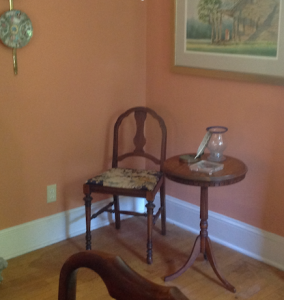
tiny jane austen tableau

Vic’s tribute to Jane Austen in the corner of her living room: a facsimile of Jane’s chair and writing table.

This blog has lain idle for a little over a year, but I plan to resurrect it. For the time being, I’ll add one or two posts per month until I am able to devote more time to my favorite author again. I am pleased to announce that this year’s first post (by Rachel Dodge on Regency manners and greetings) will be published tomorrow.

I am also in the process of updating the links in the pages that sit on top of the blog. These updates should be completed by mid-summer.

With much affection and gratitude for your patience, Vic


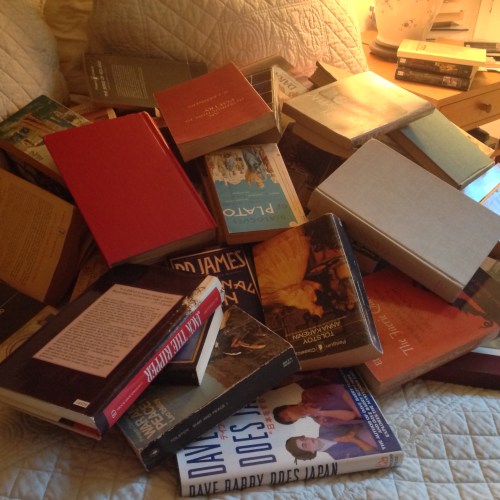
A local historical society will be hosting a book sale this weekend to raise funds. I am finally ready to part with a substantial number of some of my most beloved books (art, art history, English literature, nature books, etc).

IMG_2308

Waiting to be bagged and donated

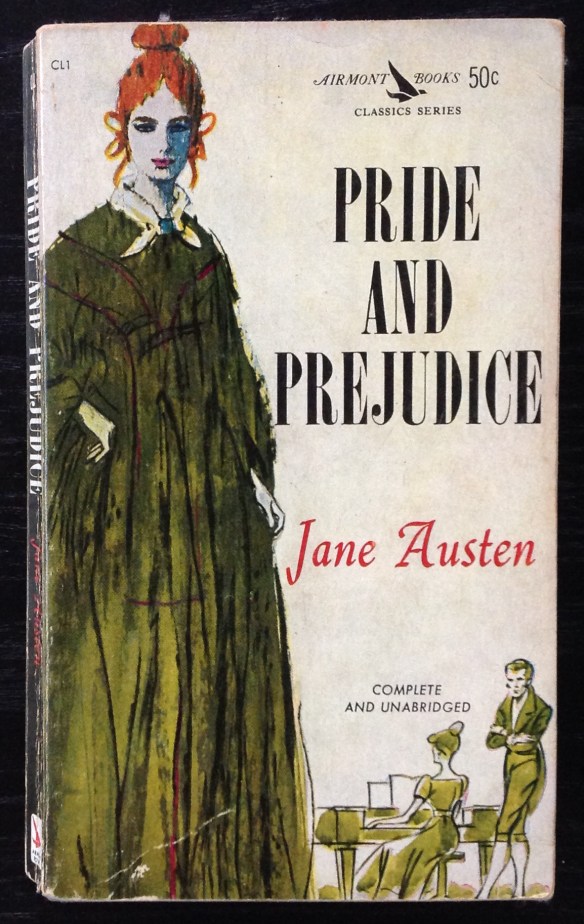
The first three Jane Austen novels I purchased sat forgotten on the top shelf – all in paperback form. I had always thought that I first read Pride and Prejudice at 14, but the book’s publication date tells me that I was 13!

IMG_2315

I reread the tale of my beloved Mr. Darcy and his Lizzie Bennet so many times that my parents gave me this Modern Library edition of Jane Austen’s six great novels at Christmas, just before I turned 14. I have cherished it and still cherish it for all the good times I spent reading at night before turning off the light. (This book did not sit forgotten.)

I will keep this edition through all my future moves and until my last breath, since I only need a Jane Austen novel to keep me happy.

IMG_2313

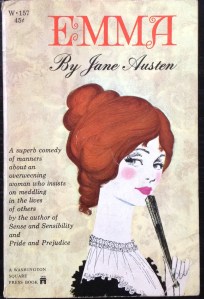
Interestingly, I was 15 when I read my second JA book, Emma, which I purchased to read on vacation. At that tender age, I found the book too talky and not nearly as romantic as P&P. Mr. Knightley seemed so OLD and staid compared to the dangerously handsome Mr. D, and bossy Emma was not the sort of girl I wanted to befriend, whereas Lizzie seemed she could fit right into my group. So, it took decades before my mature self tackled Emma again.

IMG_2317

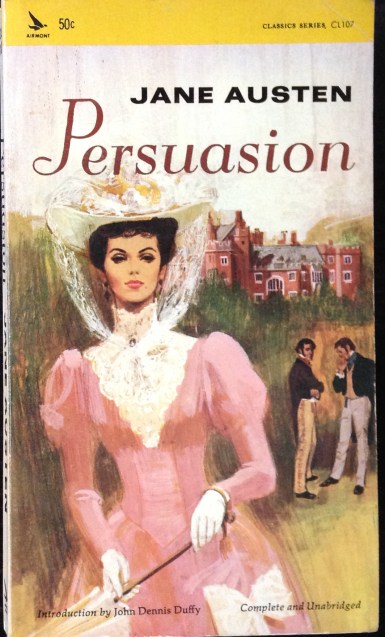
I read Persuasion at 17, too young to appreciate the fact that Anne Elliot’s bloom had faded from sadness or to truly understand the reason why she listened to Lady Russell’s advice. As a rebellious teen of the 60’s, how could I relate to her decision? I am now somewhat longer in the tooth (ahem) and am able to appreciate this gem of a novel fully, as Jane intended.

c201d9ce8c21c05acce03e14d356d677

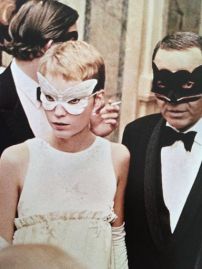
Mia Farrow and Frank Sinatra in the 60’s.

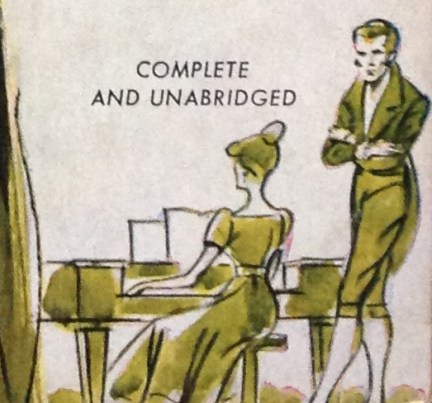
Now, let’s discuss the 60’s covers of these paperback editions. Mind you, this was an era when high-waisted empire dresses were popular (see Mia Farrow at right) but the cover artists generally ignored this fact. They preferred to see Lizzie in a dark and heavy Gothic gown, more suited to a Bronte novel than a Regency tale. Note that Emma has a decided Victorian look, as does Anne Elliot. At least the P&P cover included this fairly accurate regency scene of Mr. Darcy listening to Lizzie at the piano.

IMG_2315 copy

One of the reasons I like the Complete Novels is the cover art by Paul Galdone, a popular children’s author of the day. The scene reminds me just a bit of  the classic covers painted by Arthur Barbosa of Georgette Heyer novels in the 40’s and 50’s.

My old Jane Austen paperback covers represent a major characteristic of cover illustrations -they reflect the concept of female beauty of the era. Hence the 60’s birdwing eyebrows, eyeshadow, eye liner, and lipstick on Lizzie, Emma, and Anne. You’ll observe similar treatments of “historic” costumes and makeup in past times in cinema and other forms of popular entertainment throughout the decades. Recall the costumes and makeup of 1940’s Pride and Prejudice or the BBC’s versions of Jane Austen novels in the 1970’s. Ouch!

Regardless of the inaccuracies of their covers, I plan to keep these three books. For sentiment’s sake.


Recollect that the Almighty, who gave the dog to be companion of our pleasures and our toils, hath invested him with a nature noble and incapable of deceit.”- Sir Walter Scott, 1825

My beloved Cody died in my arms this week.  He was put to sleep to relieve his pain from cancer and pancreatitis. He’s been sickly for a while, but these past weeks have been especially difficult as his gait slowed to a snail’s pace. By mid-week he’d given up “fooling” me with his stoicism. On Wednesday morning he let me know in no uncertain terms that he was ready to leave this earth.

Cody was a mutt (a combination of several terrier breeds) and a sturdy, stubborn little creature who would not give up a hunt or chase, or his intention to dig or enter a culvert. Cody was a vermin chaser and no mole, vole, mouse, chipmunk, squirrel, rabbit, or saddle back cricket was safe when he was lithe and young. I have saved many a wild creature over the years by restraining my determined little man.

Terriers in the Georgian era lived useful and utilitarian lives. Until people discovered their endearing house pet qualities, these dogs worked hard for a living. Work is perhaps not the best term for the actions of a dog that LOVED the chase and knew instinctively how to run down a rat, fox, groundhog, or mouse, or dig towards it and kill it with such efficiency that the prey never knew what struck it. 18th and 19th century farmers would have lost an entire season’s stored crop or chickens over the winter to vermin had it not been for the constant vigilance of their terriers. I have seen these dogs at work in a city alley (on a YouTube video). The alley was sealed on both sides as three domesticated terriers went into action. Instinct took over. Two flushed out a rat from the bottom of a garbage pile, while a third pounced on the fleeing rat on top of the pile where it emerged. The terrier lifted the rat by its neck and broke it in an instant. Terriers working in concert can kill 80 or more rats in one get go and still retain the sweet personality of a loving family pet.

As one modern article states:

Besides being efficient, death-by-dog is more humane for the rat and better for the environment than poison, say ratting proponents. Commonly used anticoagulant poisons thin the blood and cause internal bleeding. Rats die slow deaths, and they pass the poison on to anything that eats them, from wildlife to farm animals.” – Andy Wright, Modern Farmer: When Terriers Attack, 2014

cody waits

Cody, watchful and gentle and showing his wheaten colors.

Part of Cody’s mutt terrier mix was soft-coated wheaten terrier. In the 18th century, this breed of terriers was kept by poor Catholic Irish tenant farmers. These all-purpose dogs were bred to hunt, poach, stand guard, catch vermin, and be a companion. This latter trait made it a gentle dog (like my Cody) and much prized when the breed was shown in the show ring. Terriers are not only great companions, they are fearless, athletic and seldom lose sight of their goal. Whenever Cody saw a hole in the ground or an open culvert, he would poke his nose into the opening, regardless of what creature he might encounter.

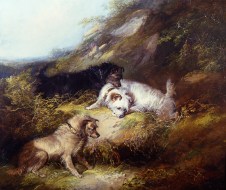
In this oil painting entitled Terriers Rabbiting, for sale in the Rehs Calleries in NYC and painted by George Armfield (c.1808 – 1893) in 1860, one can see the patient determination of the three terriers as they wait for the rabbit to emerge. Note how their short legs provide them with a low center of gravity (which gives them a tremendous advantage in going to ground, digging, and pulling). They also have thick necks and stocky bodies that provide them with additional muscular strength, much like a stocky boxer.

My very domesticated Cody would patiently sit in front of a hole in my garden waiting for a vole to peek its head out. He would then strike with swift, deadly accuracy and leave me a present.

I would laugh as he chased creepy-looking saddelback crickets in zig zag patterns across my basement floor, eating their bodies but leaving the prickly legs for me to sweep up. With a terrier patrolling the house, one has few mouse, rat, spider, or cricket investations.

OLYMPUS DIGITAL CAMERA

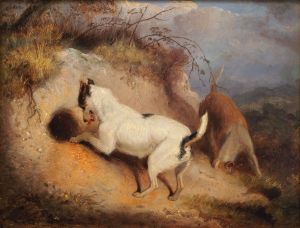
Edward Walter Webb, Terriers Rabbitting, ca. 1840. Click here to enter Richard Gardner Antiques.

In the above painting, for sale at Richard Gardner Antiques, terriers are digging for rabbits, typical behavior for this breed. In Victorian times, terriers are more often depicted as lovable house pet breeds, although the second painting from Antiques Atlas will attest that even a cute fox terrier is an efficient killing machine of an animal its size.

Whenever Cody entered a culvert or dug a hole too deep for me to retrieve him easily, I would grab him by the base of his thick tail and pull him out. The Westie in the short video below was able to back out comfortably from a substantial hole all by itself.

Here’s a link to an image of an owner pulling a terrier by the tail. I’m sure it didn’t mind. My Cody certainly didn’t. Hah!

More on the topic:

The Eighteenth Century Goes to the Dogs, James Breigh, Colonial Williamsburg

Inquiring readers,

In celebration of the 200 year anniversary of the publication of Jane Austen’s Emma, frequent contributor, Tony Grant, visited Chawton House to view a special exhibit. Read his post about the exhibit on Jane Austen in Vermont in this link. Tony reserved a slew of photos for this blog and added his commentary. I inserted some observations by Constance Hill and Jane’s grand niece to round out this post. Enjoy!

Chawton is a Hampshire village and civil parish. It lies within the area of the South Downs National Park. The 2000 census shows that 380 people live in Chawton.
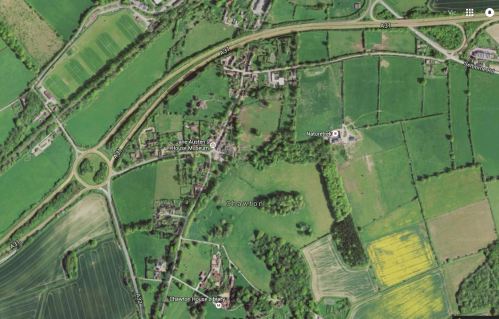
Google map

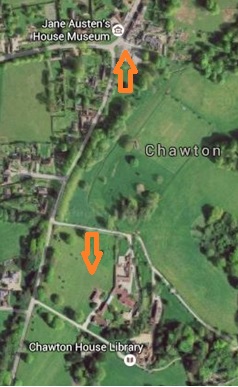
Google map of Chawton, and Chawton Cottage and Chawton House in relation to each other.

Chawton village is first mentioned in 1086 in the Domesday Book which was administered from Winchester, the first capital of England, under William the Conqueror,after 1066. The fact that the village lies on a main route from London to Portsmouth by way of Winchester suggests that because of its important position there must have been a Saxon settlement there before 1066 and possibly going back to Iron Age times. The Normans did instigate the creation of new villages such as at West Meon a few miles south of Chawton but most settlements were continued from previous ages. Its location shows it as perhaps a stopping place on a major route but its prime importance would have been farming.

Farming must have been its main importance right up to and after the second world war. Chawton House and its estate has sheep and horses on it to this day. There are still many farms in the area. However the population today is not what it would have been in the past. In previous centuries there would have been representatives of the whole range of the class system.
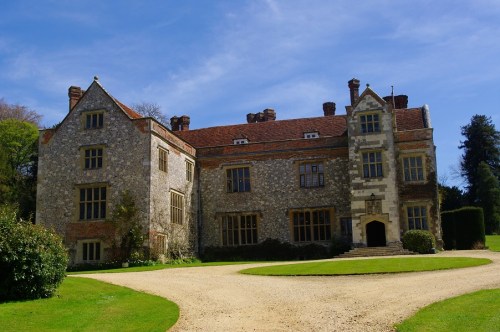
The Great House

The great house at Chawton owned by the Knight family, image by Tony Grant

The Knight family owned the great house and estate and most famously from the early nineteenth century, Edward Knight, Jane Austen’s brother. The middle classes would have been represented by Jane Austen and her family and perhaps the local vicar of the parish of St Nicholas and some minor landowners and farmers. Probably the working class and farm labourer class predominated though. There are plenty of small Victorian cottages, Georgian cottages and cottages dating back to the 16th century and before in Chawton and surrounding areas. These would have been accommodation for farm workers. Nowadays though these cottages surrounded by idealistic country gardens, climbing roses and wisteria, looking picture postcard perfect, are owned by wealthy people who work in the City and use them as weekend homes.

There are examples of large Georgian and Victorian mansions in the village. They can only be owned by company directors or wealthy bankers and other people of that ilk. Looking at estate agent web sites for Chawton, a mansion such as the one you can see at the start of the long driveway that leads to Chawton House, is priced at £2,000,000. The small picture postcard cottages start at about £350,000. The prices of the two properties I have quoted are the top and bottom of the range.

The ordinary, everyday worker is excluded. I am sure there are no farm labourers are living in Chawton these days.This is a shame because local customs are lost. The rich diverse local customs formed over time by families living there for their whole lives, generation after generation, is lost and although Chawton looks lovely today it has lost to a certain extent, its heart. It has lost its soul.
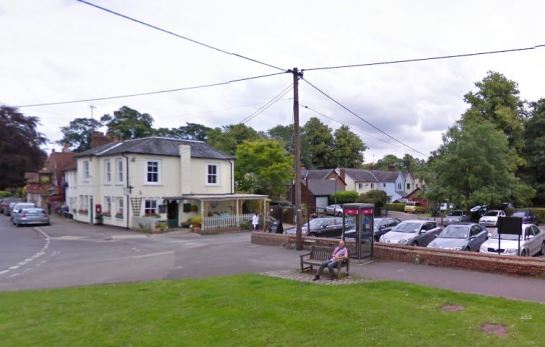
car park

Chawton Car Park, Image Google earth

All is not lost. The other day I walked from the car park, opposite Jane Austen’s cottage next to the Greyfriar pub, along the road to Chawton House Library. On my left, through the trees and across the children’s playground a gentleman was sitting astride a motor mower cutting the grass on the village cricket pitch. I could see that the sight screens were in place for a match and the cricket club flag was flying from the club house flagpole.
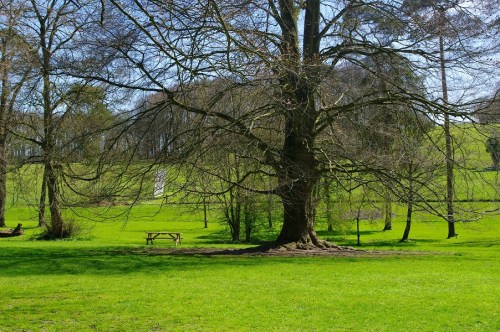
Sight screen on the cricket pitch

Sight of village cricket pitch. Image by Tony Grant

As I approached the Great House I passed Chawton Village Junior School on my right. Put in mind that this was midweek, a Wednesday, and the time was 12.30. The school was in the middle of its lunch break and a whole mass of children were playing in the playground on climbing frames and ladders. They were yelling and whooping and having the time of their lives. I always feel heart warmed at the sound of children. I have spent my whole working life as a teacher teaching them after all. So really there are three things.

Chawton has a great pub, The Greyfriars, it has a wonderful vibrant school and the village a cricket team. A new heart has been created perhaps? Yes, not all is lost.
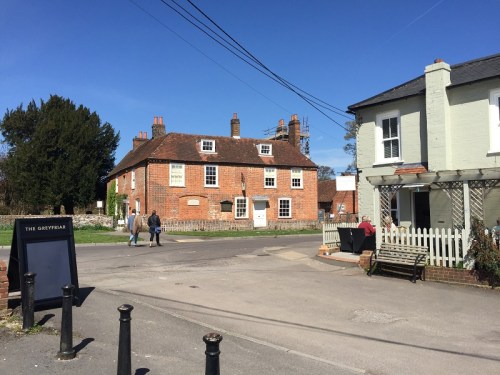
junction

Jane Austen’s Chawton Cottage is straight ahead. To the right is Cassandra’s Cup, a tea house attached to The Greyfriar pub.

Chawton Cottage, a former steward’s cottage, was previously home to local farmers. Between 1781 and 1787, the house was briefly a public house called The New Inn. This pub was the site of two murders. After the second murder, the house was let by Edward Austen Knight to a Bailiff Bridger Seward. (Wikipedia)

Edward then allowed his mother and sisters to move permanently into the residence. Jane lived there with her mother and sister, Cassandra, and long time family friend Martha Lloyd, from 1809 until May 1817, when she moved to Winchester to be near her physician before her death in June of that year. (Wikipedia
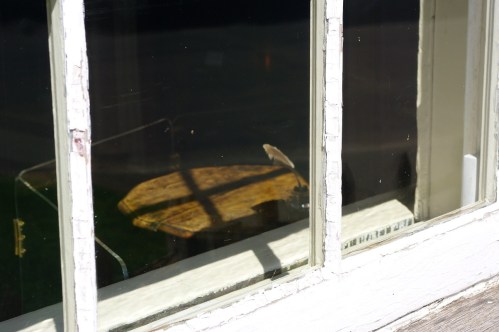
Through the window

View of Jane Austen’s writing desk from the cottage window. Image Tony Grant

Later in the 18th century, Jane Austen’s brother Edward Austen Knight (who had been adopted by the Knights) succeeded, and in 1809 was able to move his mother and sisters to a cottage in the village. Jane would spend among the most contented, productive years of her life here.
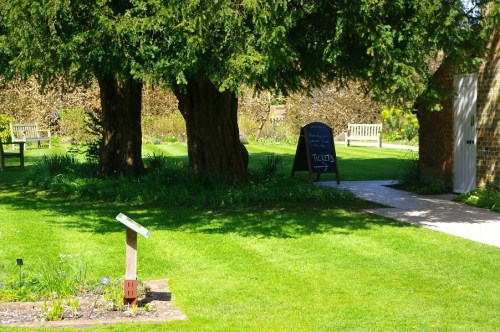
 

trees

A glimpse of the cottage’s garden.

“I remember the garden well,” writes Miss Lefroy [a grand-daughter of the Rev. James Austen]. “A very high thick hedge divided it from the (Winchester) road, and road it was a pleasant shrubbery walk, with a rough bench or two where no doubt Mrs. Austen and Cassandra and Jane spent many a summer afternoon.”

Miss Lefroy recalls her mother’s happy memories with her Aunt Jane, Aunt Cassandra, and grandmother in Chawton.

“As may be supposed a great deal of intercourse was kept up between Steventon and Chawton. Our grandfather was a most attentive son, and one of the pleasures of my mother’s youth was sometimes riding with him to see her grandmother and aunts through the pretty cross roads and rough lanes, inaccessible to wheels, which lay between the two places . . . In her Aunt Jane, who was the object of her most enthusiastic admiration, she found a sympathy and a companionship which was the delight of her girlhood, and of which she always retained the most grateful remembrance . . . But I will copy my mother’s own account.

‘”The two years before my marriage and the three afterwards, during which we lived near Chawton, were the years in which my great intimacy with her was formed; when the original seventeen years between us seemed reduced to seven or none at all. It was my amusement during part of a summer visit to the cottage to procure novels from the circulating library at Alton, and after running them over to narrate and turn into ridicule their stories to Aunt Jane, much to her amusement, as she sat over some needlework which was nearly always for the poor. We both enjoyed the fun, as did Aunt Cassandra in her quiet way though, as one piece of nonsense led to another, she would exclaim at our folly, and beg us not to make her laugh so much.'” – Constance Hill, Jane Austen: her homes & her friends, 1902.
view from chawton cottage

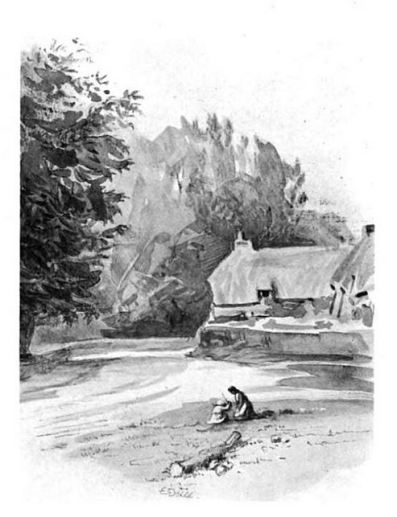
View from Chawton Cottage in the early 19th century painted by Ellen Hill


The village of Chawton lies in a specially beautiful part of Hampshire, about five miles from Gilbert White’s own Selborne, and, like it, famed for its hop fields and its graceful ‘hangers.'”

Chawton Cottage stands at the further end of the village, being the last house on the right-hand side of the way just where the Winchester road branches off from that to Gosport, and where a space of grass and a small pond lie in the fork of those roads.”


Chawton has a single church, St Nicholas. A church has stood on the site in Chawton since at least 1270 when it was mentioned in a diocesan document. The church suffered a disastrous fire in 1871 which destroyed all but the chancel. The rebuilt church was designed by Sir Arthuer Blomfield and is now listed Grade 2.” – (Wikipedia)
The two Cassandras

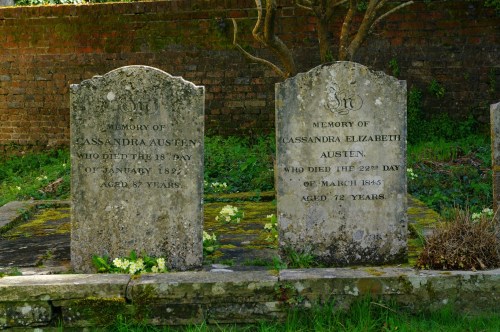
The Knight family is buried in the churchyard. Jane Austen’s mother and sister are buried there also.

“The ‘Great House’ and the cottage lie within a few hundred yards of each other, the gates of the park opening upon the Gosport road. The house, a fine old Elizabethan mansion, with its Tudor porch, and its heavy mullioned windows, may be seen by the passer-by, standing on rising ground; while a little below it, in a gentle hollow, lies the old church of Chawton–a small grey stone edifice embowered in trees.”- Constance Hill
chawtoncottage_chawtonhouse

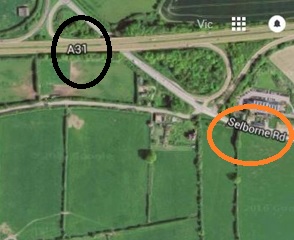
Chawton has only two road exits, one leading to a roundabout connected to the A31 and the A32, and the other to the A339/B3006 Selborne Road.

The village of Chawton lies in a specially beautiful part of Hampshire, about five miles from Gilbert White’s own Selborne, and, like it, famed for its hop field and graceful “hangers”; while within easy reach is the cheerful little town of Alton.” – Hill
 

Selborne Rd

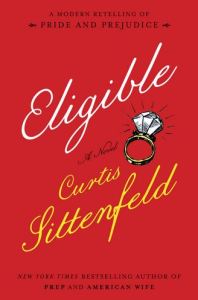
Eligible_SittenfeldIn 2011, The Austen Project approached best-selling author Curtis Sittenfeld to write a modern retelling of Pride and Prejudice, which she entitled Eligible (out in bookstores now). On Thursday, April 21, 2016, Diane Rehm, one of my favorite radio hosts, interviewed Sittenfeld regarding her new novel. As the interview wore on it became obvious to me that 1) this author, who  had not read Pride and Prejudice since she was a teenager, should have done more research about the economic and social situation of the Bennets, Darcys, and Bingleys in Regency England, and how this impacted their actions, and that  2) Diane Rehm and Sittenfeld had little understanding of the economic impact that Austenesque films, television shows, book adaptations, blogs, online forums, and fan fiction have on today’s book and entertainment industry.

After listening (impatiently) to the interview, I wrote this comment on Ms. Rehm’s website, which also features a link to the interview and a 4-page excerpt of the novel.

I author the Jane Austen’s World blog, which examines the Regency era during Jane Austen’s time. I looked forward to this interview, since I listen to the Diane Rehm Show and am a Jane Austen fan. I am no fan of Jane Austen fan fiction, however. Reading the excerpt of “Eligible” and listening to Ms. Sittenfeld read from her book left me strangely cold. Austen’s fans are drawn to her novels because of her enormous talent in describing her characters with humor, or satire, or barbed arrows in her swift, spare, and witty style. Her words fairly sparkle off the page and her main protagonists seem like living creatures. In this instance, the dialogue seems strangely flat, I recognize the names of the characters, but not their essence.

I don’t care how many best sellers a novelist has written, most (many, all) are unable to adapt Austen’s works and write something better or wittier. I am thinking of P.D. James and her awful “Death Comes to Pemberley” and Colleen McCullough’s appallingly bad “The Independence of Mary Bennet,” both of which became best sellers because of their authors’ fame, not because of the excellence of the adaptations. In fact, I was able to purchase both books online for $1.00. Both were in remarkably fresh condition, as if they had been warehoused for a while.

Another sense I got from the interview was Ms. Sittenfeld’s inability to understand her audience – the Jane Austen fan. Chip Bingley participated in the novel’s version of “The Bachelor.” Really? Sittenfeld and Rehm devoted a good portion of the interview to this topic. I felt my mind drifting and my interest in the novel vanishing. I suppose Cincinnati is as good a place as any to fill in for Meryton, but I am not convinced.

I will review [the book] on my blog and withhold judgment for the time being. I am not optimistic that I will change my mind.

In my opinion, only Emma Thompson has channeled Jane Austen successfully in recent years. Much of the script of 1995’s Sense and Sensibility, while staying true to Austen’s intent, are really Emma’s words as the film’s script writer. Some scenes and details are added, since films are a visual medium, yet I left the theater feeling as if I had watched a movie whose script was written by Jane Austen.

This review in The Guardian by Ursula K. LeGuin (an author I admire enormously) starts out by saying:

It was badly done’ – to quote Mr Knightley – an ill-judged rendering of Jane Austen’s most famous work…

Those words are kind compared to the rest of LeGuin’s review, which includes this interesting statement:

I wondered what could possess a writer to tie her novel so blatantly and rigidly to a very well-known one – taking the general plot and the name of every character, so that comparison with the original becomes as unavoidable as it is crushing…We are in a period of copycatting, coat-tail-riding, updating and mashup; rip-off is chic, character theft from famous predecessors is as common as identity theft via credit cards…

In her interview with Rehm, Sittenfeld explains her modus operandi,

when I started rereading “Pride And Prejudice,” I did think, oh, I have so many ideas. This would be such a delightful way to spend a few years.” ….My approach was to basically keep the plot or keep the architecture of the novel and also to keep the names because I didn’t want readers to be distracted, thinking, well, who’s who?…

Sittenfeld enjoyed her years of writing the novel, contacted only occasionally (with no pressure) from the publisher, and writing according to a strict outline and timeline, often with Pride and Prejudice propped on her lap for quick reference to remind her of major plot lines that described both character and setting.

In another recent review, Jim Higgins of the Milwaukee Journal Sentinal, describes the same situation that Sittenfeld and Rehm had gone over during their interview – how Chip Bingley, a physician and bachelor on the reality show “Eligible,” found fame courting 24 women on national television. Lizzie is now 38 and her sister Jane is 40 – today’s versions of single women about to enter that twilight world of spinsterhood.

Eligible is supposed to be an act of homage, an act of admiration. It’s not supposed to be an improvement upon ‘Pride and Prejudice.’ I don’t think ‘Pride and Prejudice’ needs to be improved on. I think it’s a wonderful, perfect novel.”- Sittenfeld, Milwaukee Journal Sentinal.

In this respect, Sittenfeld recognizes Jane Austen’s  unmatched talent as an author completely, but does she? Really? Higgins calls Sittenfeld’s verbal exchanges among the Bennets “sharp;” Ursula LeGuin describes them as mean-spirited.

As for me, I shall purchase the novel way after its sell date, read it, and write a review based on my reaction to Sittenfeld’s adaptation of my favorite novel of my favorite author. Meanwhile, I can only go by the interview I heard and the short excerpt I read.

As for Diane Rehm and my total love for her show – one disappointing interview in hundreds, well, that gives her a great track record IMO.

Inquiring readers: Frequent contributor, Tony Grant, would like to add his thoughts to the discussion in this comment:

I have only ever read one so called spin off novel and that was The Wide Sargasso Sea by Jean Rhys. Her book adds to the world of great literature dealing with important and deep issues. Whether it is a true spin off, mash up, is questionable. It is such a rich and important book. If the so called spin off genre could achieve what she achieved in adding to our experience of the human condition I would read those sort of books but until then they are not for me. Jane Austen engages us with the world within the strictures of her time but also in a way that is relevant to all times.She really doesn’t need to be messed with. I wonder what she would think.The book you describe sounds like a sad attempt at making money on the coat tails of a popular author. I am not one to burn books but we could have quite a conflagration if all the mash ups, spin offs, fan fictions etc were piled up and set light to… ha!Ha!
( I must admit a secret regret, I did read one fan fiction take on Pride and Prejudice a few years ago because it was written by an acquaintance . But I try to forget that experience.)