Feeds:
Posts
Comments
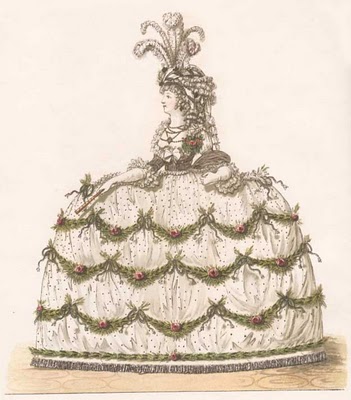
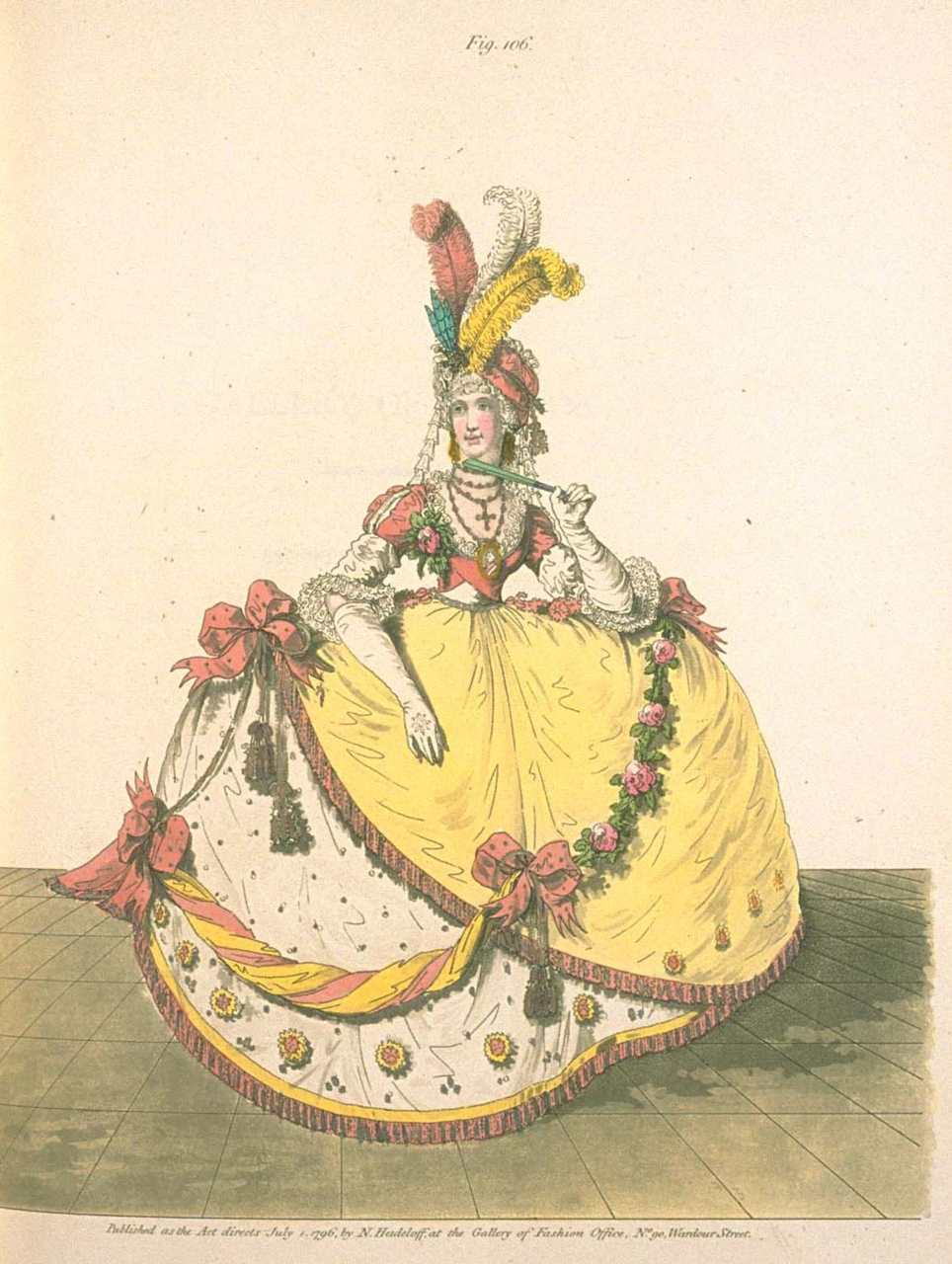
Court dress, Heideloff gallery, 1794-95

Court dress, Heideloff gallery, 1794-95

Female gowns worn at court during the Regency era looked ungainly. Instead of the lovely columnar silhouette of the Grecian-inspired draped gown, court gowns at this time made their wearers resemble the upper half of an extravagantly decorated apple or a pregnant cake topper.

These custom creations, made with sumptuously expensive materials, adhered to the rules laid down by Queen Charlotte, who presided over the royal drawing rooms until her death.Earlier Georgian gowns flattered a lady’s waist, with corsets that made the waist seem miniscule. As waists rose, the silhouette of the gowns became grotesque, swallowing a lady’s figure in a ball of fabric.
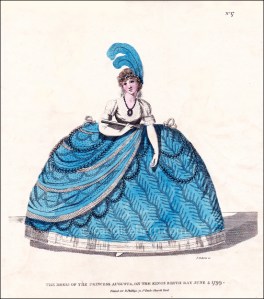
dress of the princess augusta_1799_hern

The dress of the Princess Augusta, on the King’s Birthday, June 4, 1799. Phillips, The Fsshions of London and Paris, July 1799. Source: candicehern.com

While narrow clinging draperies falling about the feet in loose folds were being worn everywhere else — in the Park at assemblies, balls, routs, and dinners — ladies still went to Drawing rooms in enormous hoop petticoats. The rigidity of Court etiquette has always preserved decayed fashions…The effect of a hugely puffed out skirt under a low and extremely short bodice was most disfiguring. If hoops were unsightly before they became ten times more so then. – Georgiana Hill, A history of English dress: from the Saxon period to the present day, 1893,  p 291

1805 court dress_pub. tabart co bond street

A lady in court dress, 1805. Pub. by Tabart & Co. June, 1805, Bond Str.

Young ladies presented at court for the first time wore white gowns. Married ladies could wear a variety of colors.The gowns’ narrow trains looked out of proportion to the wide-hooped skirts. Head-dresses consisted of a diamond encrusted bandeau and from three to five to seven to more feathers. A variety of feathers were used for head ornamentation – heron, ostrich (the favorite), Bird of Paradise, pheasant, and macaw.
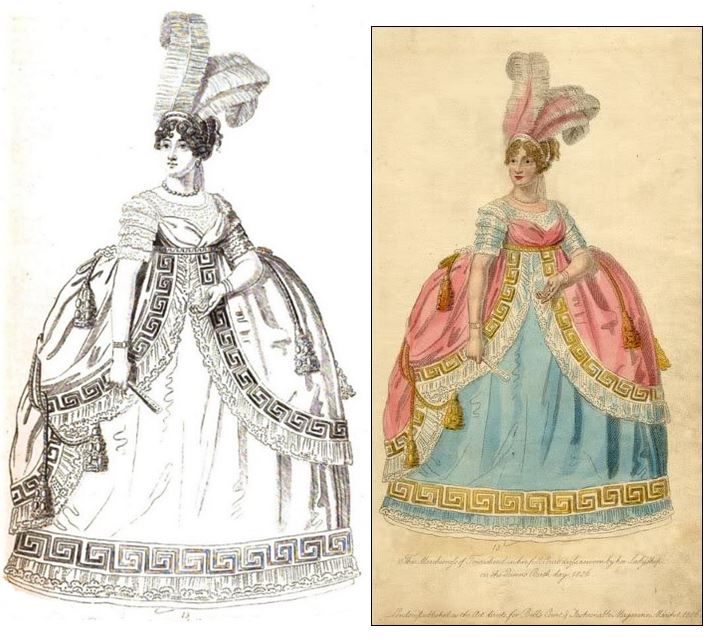
marchioness of Townshend_1806_2

Court gown, 1806, Marchioness of Townshend. Only the wealthy could purchase fashion magazines with colored plates. Most were published in black and white.

Upon the marriage of her Royal Highness the Princess of Wales, the Marchioness of Townshend was appointed Mistress of the Robes, a situation which she still holds. Bell’s Court Fashionable Magazine, La Belle Assemblee, Vol 1, Part 1, p 17-18

Occasions for a woman’s appearances at court included the presentation of the daughters of peers and rich merchants who wished to make their debut in Society, after a woman was married, and after an honor had been conferred on her husband, such as a diplomatic mission or a new title.
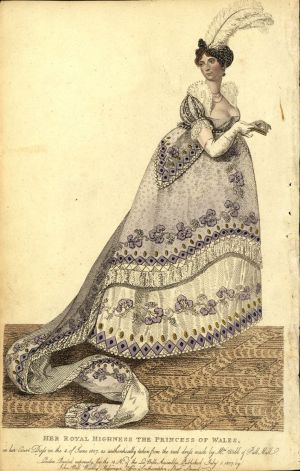
Publisher, John Bell. Caption on image: Her Royal Highness the Princess of Wales in her court dress on the fourth of June, 1807, as authentically taken from the real dress by Mrs. Webb of Pall Mall. London. Printed for the 18 no. of the La Belle Assemblee, published July 1, 1807 by John Bell, Weekly Messenger Office, Southampton Street, Strand..

Publisher, John Bell. Caption on image: Her Royal Highness the Princess of Wales in her court dress on the fourth of June, 1807, as authentically taken from the real dress by Mrs. Webb of Pall Mall. London. Printed for the 18 no. of the La Belle Assemblee, published July 1, 1807 by John Bell, Weekly Messenger Office, Southampton Street, Strand. Digital Collection, University Libraries, University of Washington. Fashion Plate Collection, SpecColl GT513 F37 1800

In 1808 the hoops were wider than ever, but the waist was longer, in fact almost in its natural place. No pointed waists were seen; they were all round, whether high or low The contrast between a lady in Court dress and a lady arrayed for a fashionable party was so great that they seem to belong, not only to totally different periods, but to different nations.- Hill, p. 293

Rowlandson, Drawing Room at St. James's Palace in London, Microcosm o fLondon, 1810. Image, Wikimedia Commons.

Rowlandson, Drawing Room at St. James’s Palace in London, Microcosm of London, 1810. Image, Wikimedia Commons.

Feathers were worn very large and high in the earlier years of the century. There was little taste shown in the disposition of the plumes. -Hill, p 293

Court etiquette was strict; young ladies took lessons on how to walk when approaching the queen, proper curtsies, entering the room, and leaving the room. Court gowns cost the earth, but every young lady worth her salt had to presented to the queen before she could officially enter the Marriage Mart and engage in the rounds of social activities that the London Season offered.
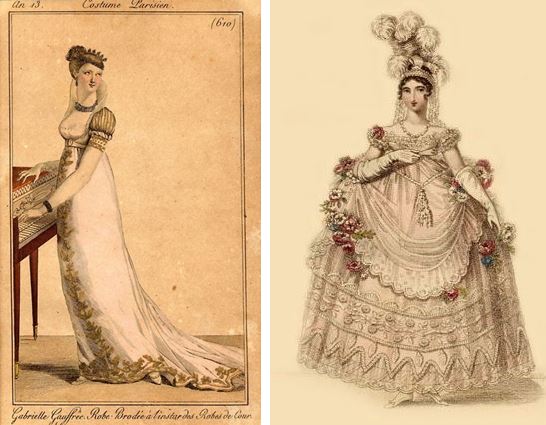
Parisian_1809_British_1817_court

Parisian court gown with high-standing Medici collar and train, 1807 (l). British court gown, with garlands of roses and 5-ostrich feather headdress, 1817-1818 (r).

By 1807, Parisians had sensibly adopted court gowns that resembled contemporary fashion silhouettes, while the British still clung to the more traditional, old-fashioned hooped skirts.
1808 La Belle Assemblee court dress

1808 La Belle Assemblee court dress. Waists had lowered somewhat, and the gowns did not look quite as ridiculous, but waists would soon rise again, stopping to just below the breasts. I imagine the assembled ladies at court looked like a flotilla of colorful balloons.

[The Regency] was a money making time for milliners, tailors, upholsterers and purveyors of all sorts As for the jewellers, their shops were literally ransacked, and diamonds were hired at ten per cent. -Hill, p294

Dressing for court was an enormously expensive investment. Careful attention was paid to displaying embroidery and embellishment in the most elaborate patterns. In a united show of thriftiness, Queen Charlotte and the young princesses frequently embroidered their own gowns. Designs were representations of natural objects, such as acorns, shells, wreaths of silver leaves and cloth roses, and peacock feathers. Gowns were made with silver tissue, net, satin, and chenille.
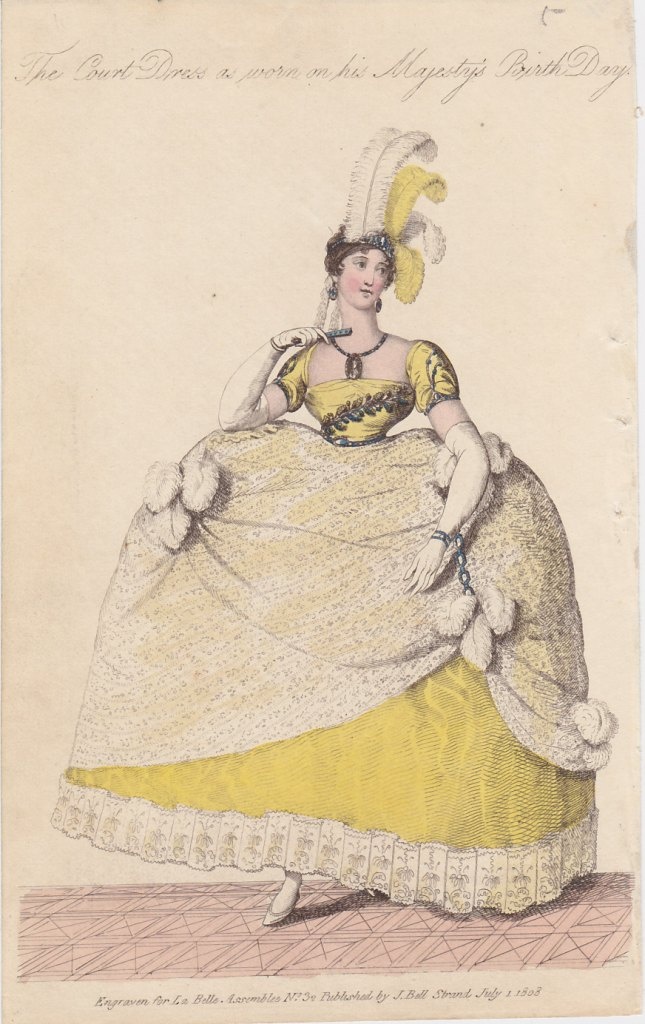
1808 La Belle Assemblee court dress

1808 La Belle Assemblee court dress

Pearls and diamonds were the regulation Court jewellery, and always used for necklaces and bandeaux, though all sorts of stones might be employed for garniture.-Hill, p296
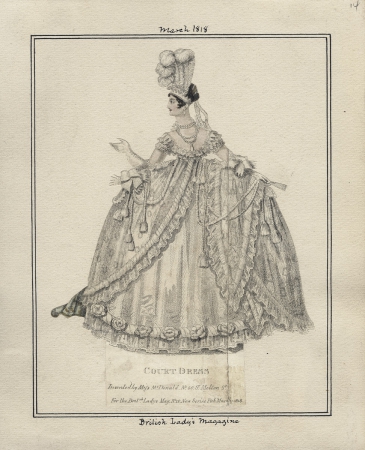
1818 Court dress, British Ladies Magazine. Collection, Los Angeles Public Library

1818 Court dress, British Ladies Magazine. Collection, Los Angeles Public Library

Queen Charlotte presided over the royal drawing rooms until she died in 1818. Her daughters took on her duties at court in her place, but the standards for wearing round hoops continued at this time. When the Prince Regent ascended the throne in 1820 as King George IV, the rules for hoops were finally abandoned. Head-dresses. which were generally made of diamond bandeaux and white ostrich feathers, remained.

Hoops continued to be worn at Court up to the reign of George IV. It seems, however, that people were getting thoroughly tired of them, and that the milliners were less careful than when hoops were a universal fashion; for in 1818 there was a complaint in the Lady’s Magazine of the “ill-contrived” hoops seen at the Drawing-rooms, and ladies were warned that a good effect could not be produced unless great attention were given to procuring a well-formed hoop. -Hill, p. 297
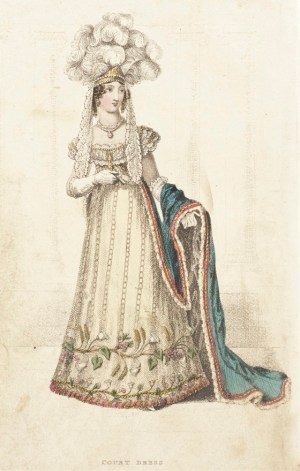
John Bell, Publisher. Court dress, London, England, July 1, 1822. LACMA50 collection

John Bell, Publisher. Court dress, London, England, July 1, 1822. LACMA50 collection

When at length hoops were abolished by the good taste of George IV., the costumes worn at Drawing-rooms took the form of the fashions of the day. The clinging gowns were never seen at Court, for by the time the Court had left off wearing hoops the wider skirts were in fashion. In the reign of William IV. Court dress was pretty much the same as the full dress of the period, except for the trains and high feather. -Hill, p. 297
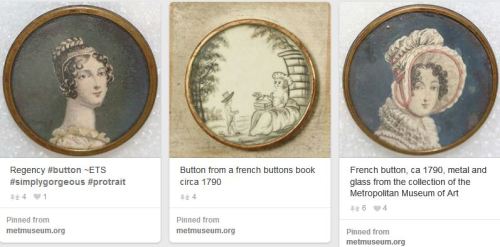
Buttons, Georgian Style

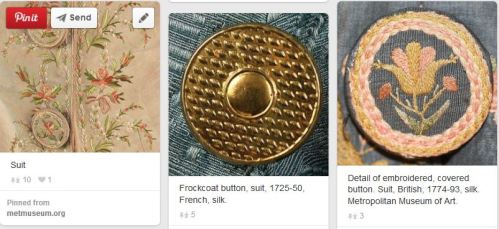
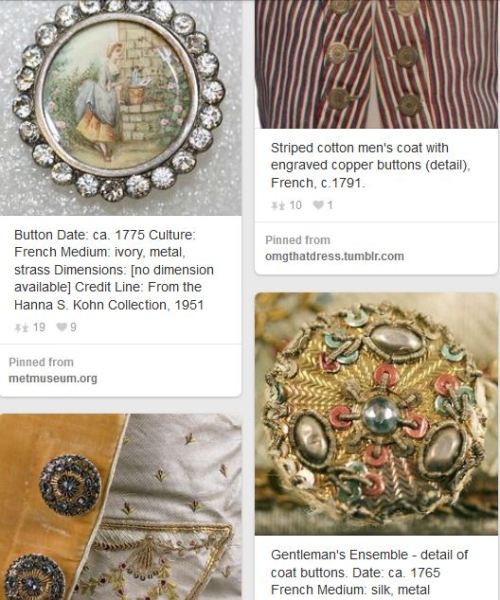
For a few years I have been collecting images of beautiful hand-crafted 18th century buttons on my Pinterest board: Buttons, Georgian Style. The buttons, as you can see from the collection, are tiny works of art. Some feature scenes or portraits, others are embroidered or worked metal.

Buttons from the collection at the Metropolitan Museum of Art.

Buttons from the collection at the Metropolitan Museum of Art.

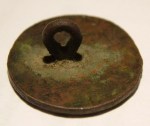
Button with shank

Button with shank

The history of buttons is fascinating. The earliest discovered button was made 5,000 years ago from a curved shell. It served a decorative function and fit into a loop, such as for a heavy robe or flowing garments. By the middle ages, the wealthy began to wear buttons that helped to fit their clothes more tightly around the body. Unlike today’s buttons, many of which are punctured with holes, most buttons back then were made with shanks, which gave button-makers leeway to decorate button faces with artistry and imagination.

Buttons for men's coats

Buttons for men’s coats

The first button-makers guild was formed in France in 1250. Only the very wealthy – kings and nobility – could wear buttons then. They were such a valuable commodity that one could pay off a debt with a single button. Ladies could detach their sleeves with laces or bows or buttons. These sleeves could be washed separately from their garments, exchanged with other outfits, or even given to a lover as a token. During the Renaissance, luxurious buttons indicated social status. King Francis I ordered buttons from his jeweler; Henry VII met his future wife, Anne of Cleves, wearing bejeweled buttons.

more buttons

As an aside, ladies wore their buttons on the left to make it easier for their maids to dress them. Men usually dressed themselves and thus their buttons were placed on the right. Button decoration, of course, changed with the taste of the time, from the renaissance to the baroque, to rococo, and neoclassic. By the mid-18th century, the more prosperous middle class merchants advertised their new status wearing elaborate and expensive buttons.

Steel Buttons

In a period when ladies were piling towers of greased and powdered hair on their heads, men were adorning themselves with immense cut steel buttons and shoe buckles. One exquisite thus decorated gives a lady a Coup de Bouton which has the same effect as a mild sunstroke Plate XXVI, Social Caricature in the Eighteenth Century, George Paston, 1902, Google eBook

The variety of buttons made in the 18th century was staggering. They were crafted with ceramics, enamel, fabric, metal, repoussé or hammered metal, horn, bone, tortoise, gemstone, glass, ivory, papier mache, wood, iridescent white oyster, conch,  and materials under glass, such as fabric paint, feathers, paper collage or decoupage, etc. Dandies in the Georgian era resembled colorful peacocks, dazzling onlookers, as the caricature above points out. Beau Brummel’s influence on male fashion subdued such bright fripperies.

buttons met museum2

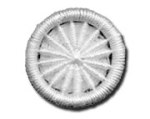
Buttons also took on many forms, like those that were hollowed-out for smugglers to carry contraband for transporting jewels .The poor fashioned their own buttons from bone, horns, shell, or wood. Dorset buttons, which resembled tiny wheels, were made by binding linen yarn or cheap woolen yarn over a disc.

dorset_button

Dorset button image from the Dorset Guide. Dorset Guide.

There was quite a cottage industry for Dorset buttons at this time. Work was scarce in that region in the mid-18th century, but there were some women who made buttons from home. This was a primary industry in Dorset for over a century. Women workers, often the sole breadwinners of the family, averaged 2 shillings a day for making 6 or 7 dozen buttons, which provided more preferable conditions for making money than laboring on a farm. Tracey Chevalier wrote a novel, Burning Bright, which was about Philip Astley and his amphitheatre. In it she featured a girl from Dorset who made buttons for a living – fascinating.

Interestingly, these beautiful buttons on my Pinterest page were worn by males. It wasn’t until the mid-19th century that women’s clothes began to feature buttons again. During the Georgian and Regency periods women’s clothes were pulled together and kept in place by laces, pins, sashes, and bows.

Links:

I used to regard A&E as one of the premier cable channels in the U.S. Known then as the Arts and Entertainment Network, it ran such prestigious shows as the 6-hr 1995 adaptation of Jane Austen’s Pride and Prejudice, Inspector Morse, Midsommer Murders, and Biography. (These days this once admirable network features rubbish like Storage Wars, Duck Dynasty, Dog, the Bounty Hunter, Flipping Las Vegas, and Donny Loves Jenny.)  Regardless of the transformation, I shall always be grateful to A&E for showcasing P&P in the fall of 1995. For six weeks we were treated to this marvelous adaptation of Jane Austen’s most famous novel. The mini-series held me spellbound (and my then husband as well). I wanted to be Lizzy to Colin Firth’s Mr. Darcy. What romantic-minded lady didn’t?

Colin Firth as Mr. Darcy and Jennifer Ehle as Elizabeth Bennet

Colin Firth as Mr. Darcy and Jennifer Ehle as Elizabeth Bennet

Rewatching the first minutes of the first episode, I was reminded of how compact and economical those opening scenes were – and how they crucially fed our expectations for the rest of the series. In interviews over the years, Andrew Davies, the screenwriter, said that he wanted to emphasize the lives of Regency men as well, and so the film opens with Mr. Bingley and Mr. Darcy racing through the fields on their steeds to view Netherfield Park, which was available to let. The relationship between Darcy and Bingley is immediately established – Bingley the eager puppy wanting his friend’s approval, and Darcy’s slightly caustic reply as a supportive older friend, cautioning him that he’ll find the society something savage.

As the two friends gallop away, the camera pans to Elizabeth, who pauses during her country walk to watch the men disappear. We follow the tomboyish Lizzy as she skips home over a dirt path, past a field with horses, and to the Bennet family home, Longbourn. Lizzy gazes through the window into her father’s study, while in the background we hear loud bickering between two young women. Mr. Bennet, holding a book in his right hand, rolls his eyes as Lizzy smiles in acknowledgment. This brief exchange demonstrates their close relationship in an instant.

We are then treated to a raucous scene in the parlor with Kitty, Lydia, and Mrs. Bennet in all their argumentative glory. Only Mary sits quietly, reading a book amid the mayhem. A calm, beautiful Jane greets Lizzy, who has just entered the hallway. Both respond to their mother’s shrill cries with half smiles and serene expressions. These scenes, in which the viewer meets quite a few of the principal characters, took all of 3 minutes.

We next see the Bennets at church in their Sunday best. The costumes are sumptuous; the locations are authentic – not the staged sets that were so prevalent in BBC dramas of the 70’s and 80’s. I recall the excitement I felt when I saw the care that the director and producers had taken to give us an “authentic” English Regency experience. Cameras followed the actors as they moved through the rooms of real houses and the lanes and paths of actual locations. The stilted production techniques inside studio interiors that used two or three fixed camera angles belonged to the past. The BBC and PBS had finally caught up with commercial television in shooting and producing drama that seemed realistic.

The church scene provides us with two of Jane Austen’s most famous lines. Mrs. Bennet runs after Mr. Bennet screeching, “Mr. Bennet, wonderful news. Netherfield Park is let at last!” We are then treated to the brilliant witty dialogue that Jane Austen crafted for Mr Bennet as he replies to his wife’s many suppositions and inanities.

Andrew Davies gives Lizzy the honor of speaking the novel’s famous opening line, “For a single man in possession of a good fortune must be in want of a wife.” How apropos. Only 4:20 minutes have elapsed at this point. Even my ex, who had not read any of Jane’s novels, understood the plot for the full 6 episodes – two bachelors, five single girls, a silly mother, a sarcastic father, and romance and social history galore. We settled in for six hours of satisfying viewing time.

I could continue, but at this rate it would take me over 400 pages just to describe the first episode. Suffice it to say that I love Colin Firth as Mr. Darcy and prefer Jennifer Ehle as Lizzy (horrid wig and all) over Keira Knightley as Lizzy 2005. Some critics with modern sensibilities found Ehle too old and zaftig for the part of Lizzy Bennet. Jennifer was 25 when she took on the role, only 5 years older than Lizzy. (Twenty-five year old Julia Sawalha, who played 15 year old Lydia, was ten years older! And let’s not argue about 30-something Greer Garson playing Lizzy Bennet in 1940 P&P. Awful.)

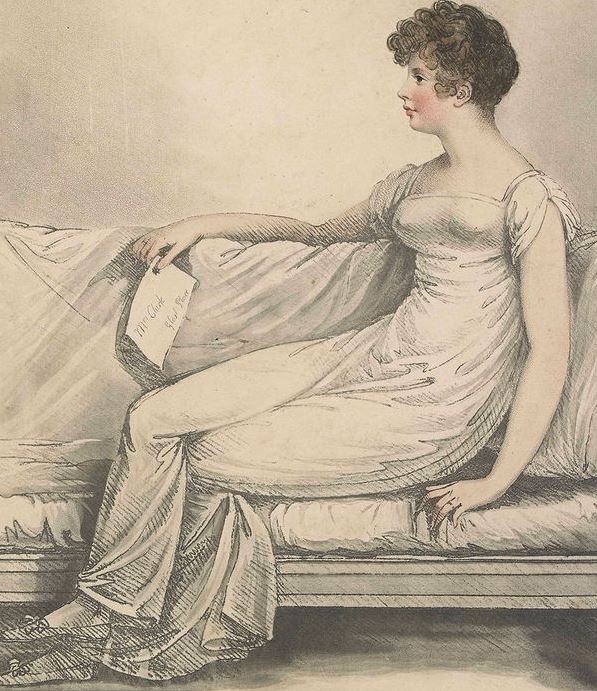
Mary Anne Clarke by Adam Buck, 1809. View more images here.

Mary Anne Clarke by Adam Buck, 1809. View more images here.

As for Jennifer Ehle being too heavy for the part of a 20 year old Regency girl, those critics need only to examine images of that era to see that Jennifer was the perfect size to play Lizzy. Keira Knightley possesses the thin fashionable looks that suit our 21st century tastes, but not those that depict early 19th century beauties. Feel free to disagree.

The 1995 adaptation of Pride and Prejudice also benefited from the immensely satisfying performances of Benjamin Whitrow as Mr Bennet, Alison Steadman as Mrs. Bennet, David Bamber as the incredibly silly Mr. Collins, and Barbara Leigh-Hunt as insufferable Lady Catherine de Bourgh. I found very little fault with the supporting actors, who played their roles to perfection. I can’t say how often I’ve seen this version of P&P – 12, 15 times? I’ve lost count. Be assured that I’ll enjoy many more viewings.

In case you wondered how Mr. and Mrs. Darcy would look after 15 years of marriage, here’s a lovely image.

If you wonder how our favorite couple would have aged, here's an image of Mr. Darcy and Elizabeth 15 years later.

Mr. Darcy and Elizabeth 15 years later. Colin Firth and Jennifer Ehle in 2010 after the King’s Speech premiere.

Additional bits of information about P&P 1995:

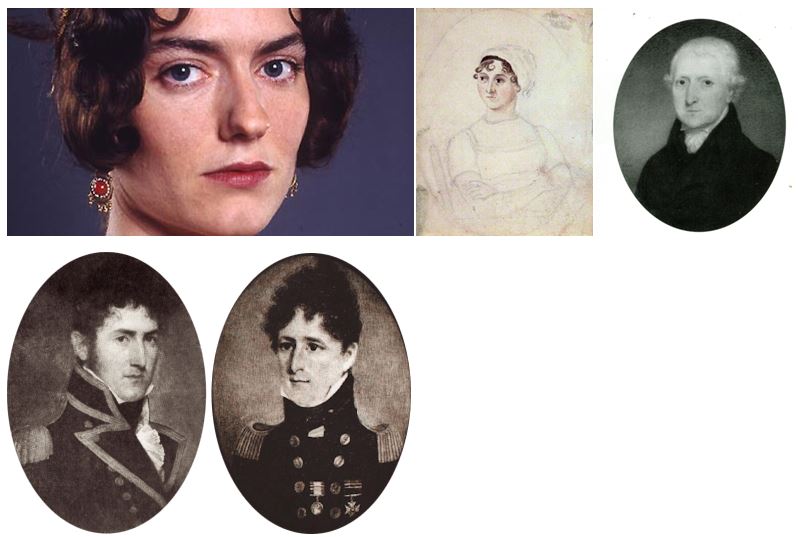
Left to right; Anna Chancellor, Jane Austen, Rev. George Austen. Bottom: Francis (l) and Charles (r) Austen.

Left to right; Anna Chancellor, Jane Austen, Rev. George Austen. Bottom: Francis (l) and Charles (r) Austen.

Dear Readers, my apologies for abandoning my blog for so long. I now know why Jane Austen was silent for so long in Bath after she moved there and lost her dear father. I’ve been meaning to write new posts every month since last January, but life simply got in the way. Then I received this lovely little book in the mail. It is a perfect gift for my Janeite friend, who is due to give birth to her first child later in October/November

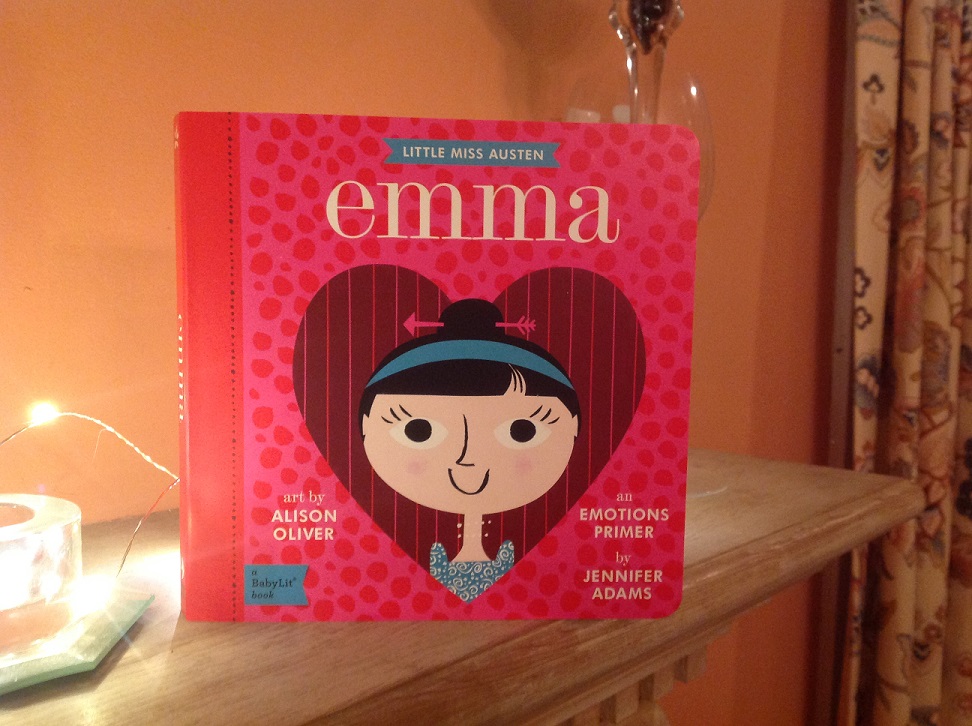
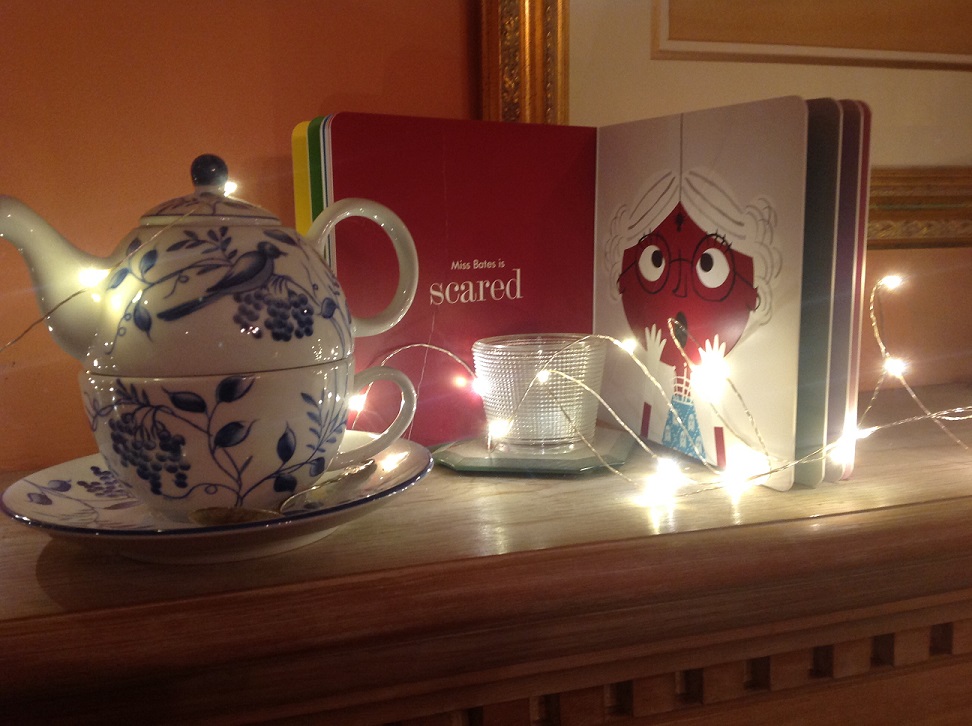
Emma, an emotions primer by Jennifer Adams, is the PERFECT gift for the budding little Janeite growing inside my good friend. As you can see from the images I took of a few pages, our sweet new girl will learn about emotions from the most perfect Miss Manners of them all – our dear Miss Jane.

Little Miss Austen: Emma Cover

Little Miss Austen: Emma Cover

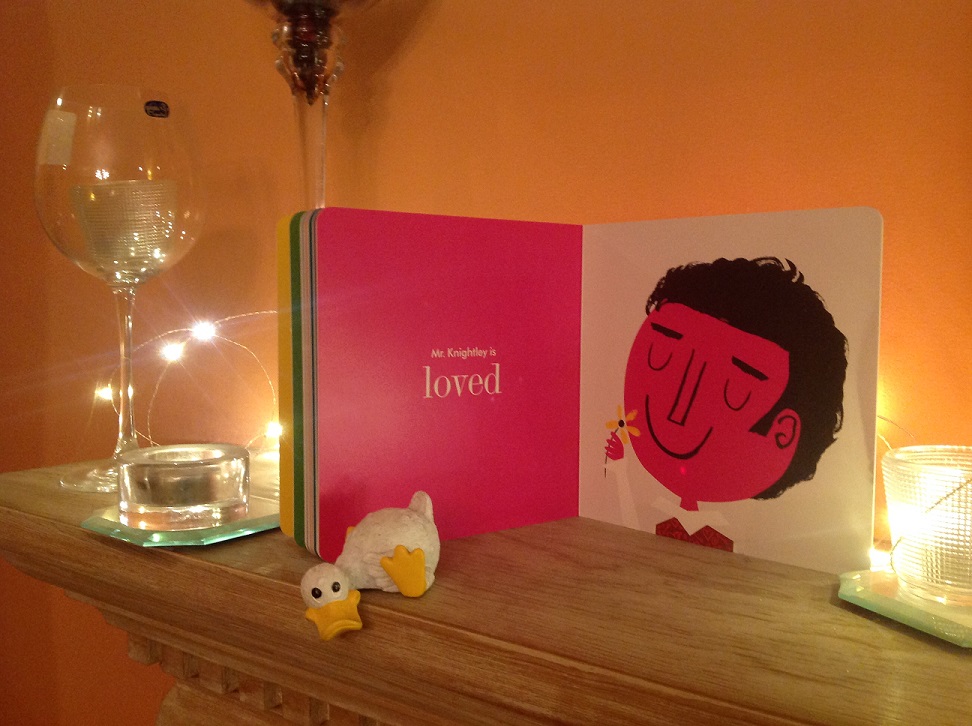
Mr. Knightley (one of my favorite JA heroes) is loved. My mantle duck certainly thinks so.

Mr. Knightley (one of my favorite JA heroes) is loved. My mantle duck certainly thinks so.

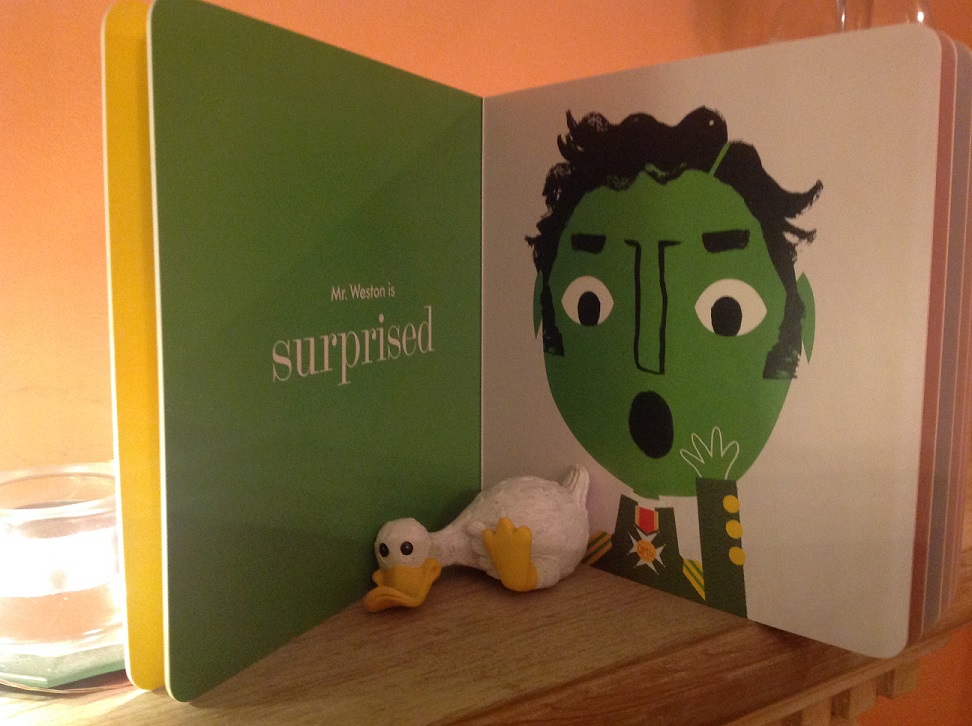
Mr. Weston looks a bit green, does he not? He is surprised, actually.

Mr. Weston looks a bit green, does he not? He is surprised, actually.

Poor Miss Bates is scared. Let's give her a cuppa, shall we?

Poor Miss Bates is scared. Let’s give her a cuppa, shall we?

My prediction is that Kate (and Jeff, her hubby) will love reading this book by Jennifer Adams to their precious twee girl. Ms Adams, btw, is a prolific author. The art by Alison Oliver will visually stimulate their baby’s eyes. The colors are bold; the shapes dramatic.

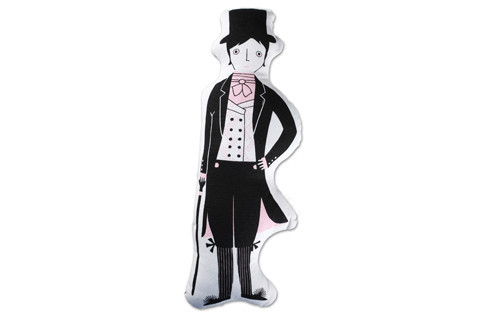
Here’s the link to BabyLit books: http://babylit.com/. I MUST get a Mr. Darcy doll for Kate’s babe when she turns 2 years. old.

darcydoll_grande

Emma: $9.99 U.S. @ BabyLit
Mr. Darcy Doll $15 U.S. @ BabyLit

Detachable, or false sleeves were common during the Regency era. They were basted to the armholes of a gown for easy removal.  Before 1810, both the permanent and detachable sleeves were often made of similar fabrics. After 1810, however, they could be made from different materials. Two different kinds of removable sleeves were made: undersleeves and oversleeves.

1810 portrait of a lady

Portrait of a lady by Henri François Mulard, ca. 1810 white dress, undersleeves, lace, blue and white sash and fichu, shawl, fawn gloves, coral beads, and hair comb.

This sumptuous painting of a lady wearing the most fashionable dress and accessories shows how the undersleeves add warmth to a gown that could best be described as thin and ethereal. The undersleeves are made of the same soft cotton as the overdress with its short, puffy sleeves.

undersleeve 1810 national trust

Undersleeve, net, lace and mother-of-pearl, English, ca. 1810. Killerton House, National Trust Inventory nr. 1363159.2

These lacy undersleeves did not provide much warmth, but certainly added drama to a dress. I imagine they could be worn under a number of short sleeve garments.

detachable sleeve early 19th c mfa

Early 19th c. American detachable sleeves. MFA Boston.

This dress, made of red violet silk figured weave, had silk and cotton linings, silk piping, and was closed with a metal hook and eye. Museum of Fine Arts Boston.

dress with detachable sleeves

Detachable sleeves made this dress quite suitable for spring, summer, and early fall.

Opnamedatum: 2013-04-16

This dress, ca. 1810 – ca. 1815, look like it has detachable sleeves made from the same fabric. Rijksmuseum.

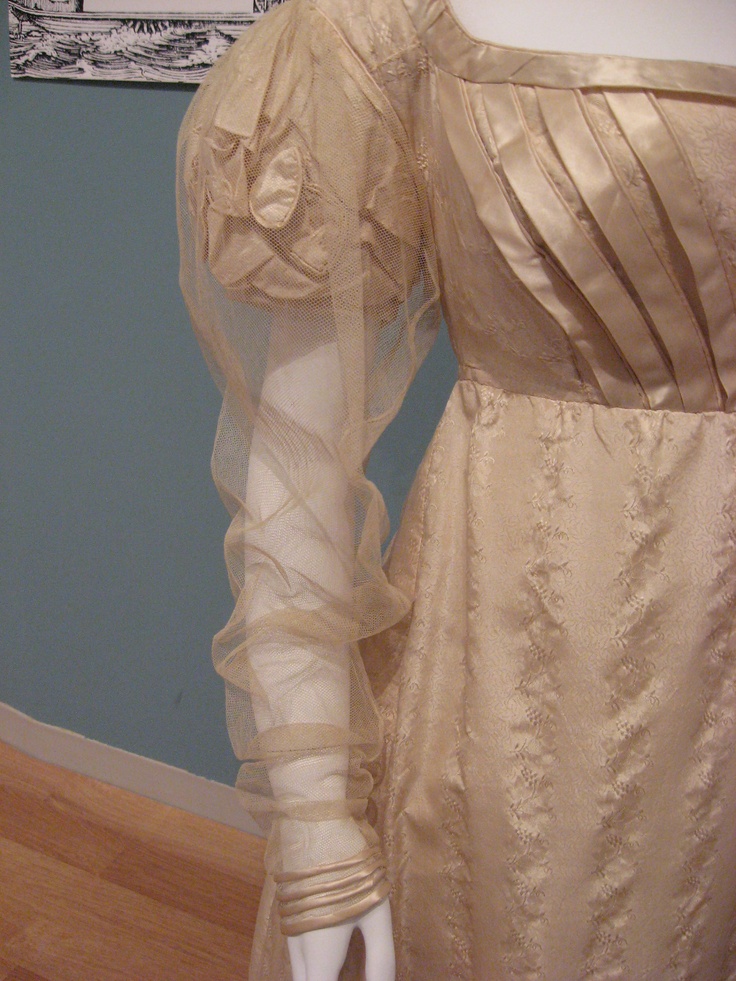
The English ivory silk evening dress below has sheer, detachable oversleeves. Circa 1820. Kent State University Museum. While the undersleeves look more practical and serviceable, these oversleeves are breathtakingly gorgeous.

bodice detail Kent State u

Regency ball gowns with net overlays became quite popular after 1810. The bodice detail of the 1820s evening gown below shows the exquisite sheer detachable oversleeve, which reveals the detailed puffed sleeve below.

closeup gauze sleeve

closeup 1gauze oversleeve

Detail of the net oversleeve. It is a miracle that such good examples of these delicate gowns have survived. (Kent State Museum)

Also on this site: