My dear Cassandra, Where shall I begin? Which of all my important nothings shall I tell you first? – Jane Austen, June 15, 1808
 Whenever we catch sight of Jane Austen in recollections and letters, her sister Cassandra is usually not far away. Although the two spinster women were frequently separated by visits to their friends and relatives, they shared a bedroom all their lives and presumably each others’ thoughts and secrets. Cassandra was separated from the family in her crucial formative years as a baby. After her birth, Mrs. Austen breast fed her first daughter for three months before handing her over to a village woman to be cared for until she was 18 months of age. The Austens, it seemed, followed this unusual habit with all their children, which must have worked well for them, for all eight survived in an age when child mortality was high.

Cassandra's silhouette
Two years after Cassandra’s birth, the Austens were blessed with a second daughter, Jane. Wherever Cassandra went, Jane followed. When 10-year-old Cassandra was sent off to boarding school in 1783, 8-year-old Jane demanded to go, refusing to be separated from her older sister…
…not because she was thought old enough to profit much by the instruction there imparted, but because she would have been miserable (at home) without her sister; her mother observing that ‘if Cassandra were going to have her head cut off, Jane would insist on sharing her fate. – Constance Hill, Jane Austen, Her Homes and Her Friends
Visits played an important part of Regency life and we have the frequent separations between Jane and Cassandra – who was often called to Godmarsham Park to help with her widowed brother Edward’s brood of children – to thank for their prolific correspondence. The letters between the two sisters reveal the intimate details of ordinary life, talking of purchasing ribbons and refashioning clothes or sending gifts. The sisters might well have written about more earth shattering events, but we shall never know, for Cassandra burnt or destroyed so much of Jane’s correspondence in 1843. The letters that do remain provide us with a glimpse into their relationship:
I saw some gauzes in a shop in Bath Street yesterday at only 4s. a yard, but they were not so good or so pretty as mine. Flowers are very much worn, and fruit is still more the thing. – 1799
and
I cannot possibly oblige you by not wearing my gown, because I have it made up on purpose to wear it a great deal, and as the discredit will be my own, I feel the less regret. You must learn to like it yourself and make it up at Godmersham. – 1800

Cassandra and Jane in Becoming Jane
After moving to Chawton Cottage, Cassandra and Mrs. Austen took over most of the duties of the house and garden, allowing Jane to capitalize on the most fruitful period of her writing. Once settled in a routine, she polished off earlier drafts of Sense and Sensibility and Pride and Prejudice, getting them published, and began to write new novels. The Austen women made do with very little, always economizing. Caroline Austenn, their niece, wrote, “The house was well furnished, and it was altogether a comfortable and ladylike establishment. Tho’ I believe the mean which supported it were but small.” In Chawton Cottage, Cassandra mourned the women’s lack of complete self-sufficiency, noting, “We have not even so much as a cow.” Chawton villagers recorded that “the Austen’s manservant would walk up to Chawton House each day accompanied by Cassandra’s dog “Link”, who would carry home the pail of milk in his mouth.” (Maggie Lane, p. 19). It is evident from the letter Jane sent to Cassandra in 1816, that she was grateful for Cassandra’s housekeeping activities:
It had been a busy week, and I wanted a few days quiet, and exemption from the thought and contrivances which any sort of company gives. I often wonder how you can find time for all you do, in addition to the care of the house; and how good Mrs West could have written such books and collected so many hard words, with all her family cares, is still more a matter of astonishment! Composition seems to me impossible, with a head full of joints of mutton and doses of rhubarb. – Jane Austen, Sept 8
A Times Online article describes Greta Scacchi’s portrayal as Cassandra in Miss Austen Regrets “as a bedraggled bread baker, chicken plucker and general rural dogsbody.” But the fact was that without Cassandra’s physical, mental and emotional support, and her brothers’ contributions to their annual income, Jane would not have had the freedom to actively pursue her career as a writer.
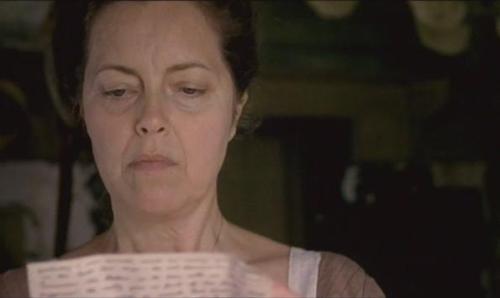
Greta Scacchi as Cassandra reads Jane's letter

An older Cassandra
After Jane died in Cassandra’s arms, one can only imagine how bereft the older sister must have felt for the remaining 28 years of her life. Like Elinor Dashwood, she held her emotions in check. When Cassandra’s short engagement to Thomas Fowle ended in tragedy, Jane worried over her sister’s restraint in grieving. It is our tragedy that Cassandra chose not to follow a similar restraint in preserving Jane’s letters. In 1843, Cassandra wrote on a bundle of Jane’s letters: “To be burned.” Of the letters that survived, her niece Caroline noted that a number had “portions cut out“. How ironic that in the twilight of her life Cassandra destroyed the very letters that must have given her a great deal of comfort and made her laugh or cry, and that, for a very short while, brought her sister back to life during the long evening hours she spent alone.
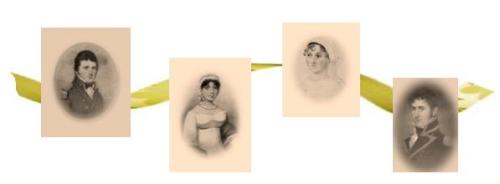
Francis, Cassandra, Jane, and Charles were the Austen's youngest children.
More links about this topic:
- The Death of a Fiance in Persuasion and The Constant Heart – The story of Cassandra and her fiance Thomas Fowle
- The Destruction of Jane Austen’s Letters
- Cassandra Austen: Jane Austen Centre Magazine
- A Glimpse of Jane Austen at Work – Glimpse of Jane and Cassandra giggling and animated as they edit her novel.
- A Glimpse of Jane Austen – Fanny Knatchbull’s impressions of her aunts Jane and Cassandra.
- Cassandra Elizabeth Austen: Protector or Vandal of Jane Austen’s Legacy
- Cassandra and Jane
- Lane, Maggie. Jane Austen and Food, The Hambledon Press, London, 1995, ISBN 1 85285 124 4
Gentle reader: In honor of JASNA’s annual meeting in Philadelphia this week, this blog, Austenprose, and Jane Austen Today will be devoting posts to Jane Austen and her siblings. Look for new links each day.
- Jane Austen’s Siblings – Rev. James Austen 1765-1819 – comprehensive information about James Austen on Austenprose
- Jane Austen’s Siblings – Rev. Henry Austen – 1771 -1850 – Henry was Jane Austen’s favorite brother
- Sir Francis William Austen: Glimpses of Jane’s sailor brother through letters
- Edward Austen Knight: A tightwad or a man with heavy responsibilities?








 Jane Austen's World