by Brenda S. Cox
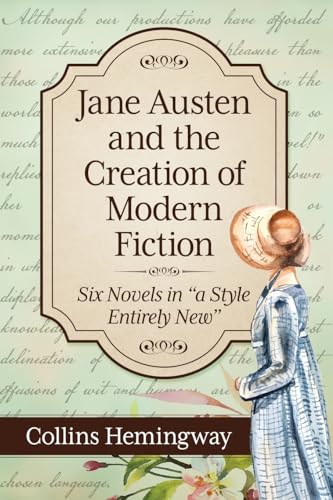
A few days ago I reviewed Collins Hemingway’s fascinating new book on the development of Austen’s writing techniques, Jane Austen and the Creation of Modern Fiction: Six Novels in “a Style Entirely New.” Today we meet with the author to get his perspectives on the book.

I asked Collins Hemingway to tell us more about Jane Austen and the Creation of Modern Fiction.
JAW: What led you to write this book, Collins?
Collins: I’ve read Austen all my life, but I did not read much commentary during my 25-year high-tech career. When I came back to Austen fulltime, I read a ton of Austen scholarship from the last 20 years. I noticed that there wasn’t much about her writing, as writing. Scholars would mention a technique and use it as a launch point for broader criticism. With rare exceptions, they would not analyze the technique itself or how it affected the reader. I saw this as an area in which I could add something new.
JAW: You have, of course, written a fiction series, The Marriage of Miss Jane Austen. How did your experiences writing fiction about Austen feed into your development of Jane Austen and the Creation of Modern Fiction?
Collins: Writing the novels led directly to this book, though it took several years of hard reading, notetaking, and writing to flesh out the meat over the bones. I have shared that story on my blog.
JAW: The book is full of great insights. For you, what was one of the most helpful, something that helped you see Austen’s novels in a new way?
Collins: After completing the fiction trilogy, I went a step further, going through each of Austen’s six novels line by line, noting everything of interest to a writer. I ended up with 20 to 30 pages of handwritten notes on each one. Then I began to consolidate various topics. For instance, I ended up with five pages of notes just on description, collated from all her books, including the juvenilia. Then I examined the patterns in different aspects of writing and tried to understand how the patterns fit within and between each book.
As the patterns began to organize themselves, I realized that there was a distinct trend from early to late. In each book, Austen learned something, then applied it in the succeeding books. Like Virginia Woolf examining the early works and the unfinished works, I began to see the internal structures of each book. (As my wife would caution—in my opinion.) I could see how Austen was feeling her way along in the early works, then painting like a master in the later ones.
JAW: You’ve pointed out the strengths and weaknesses of each of Austen’s novels. It appears that you see Emma as the most “perfect” novel, as other commentators do. But for you personally, which novel do you tend to enjoy re-reading the most, and why?
Collins: Depends on my mood. P&P for its sheer energy, and for Liz bowing to no one, ever. Emma for its magnificence, page by page. Persuasion for the depth of Anne’s feeling. MP, though it is in no way my favorite, when I just want to admire the structural purity and the work she put into it.
JAW: You talk about many techniques of modern fiction that Jane Austen helped to develop and show how they developed in her novels over time. Could you briefly list for us some of those techniques, so readers can see some of the treats they have in store?
Collins: She was a master of dialogue probably from the day she first picked up a quill pen. Description. Behavior. Character motivation and interaction. Complex plots (without castles, brigands, or shipwrecks.) Ever deeper and subtler ways to get into her characters’ minds.
JAW: What is one takeaway that you want readers to have when they finish reading your book?
Collins: What Austen accomplished would make any author proud. But the fact that she learned all that she did on her own, away from other writers, pulling the best from a small number of others (such as Richardson, in a very specific way), building on a few good things from tradition, figuring out the rest on her own—it’s astonishing. And she did it in her too short 41.5 years of life!
JAW: What was the most fun part of the book to write?
Collins: My breakthrough in really understanding the internals came through descriptions. They unlocked the issues in NA and S&S, showed how radically different P&P was from the earlier two, and became miraculously mature in MP. This was the most fun. Especially when I realized the difference in the way Austen treated Lady Russell and Anne as they entered Bath in Persuasion. It took my breath away to see what Austen had done.
You may want to read my review if you missed it earlier. This is a fascinating book if you want to better understand Jane Austen’s modern writing techniques and how she developed them herself. Jane Austen and the Creation of Modern Fiction is available from Amazon and from Jane Austen Books. Jane Austen Books is currently offering it at a substantial discount.
Brenda S. Cox is the author of Fashionable Goodness: Christianity in Jane Austen’s England. She also blogs at Faith, Science, Joy, and Jane Austen.







 Jane Austen's World