Feeds:
Posts
Comments

Posts Tagged ‘jane austen’

Dancing With Mr. Darcy is a fabulous book. A book reviewer isn’t supposed to reveal an opinion right away, but I have many reasons for liking this compilation, which began as a short story competition in 2009 sponsored by Chawton House Library to celebrate the bicentenary of Jane Austen’s arrival in the Hampshire village of Chawton. This was a momentous occasion in Jane’s life, for she would enjoy her most productive years there.

Dancing with Mr. Darcy is great for bed time reading.

When my head hits the pillow, I can stay awake for 20 minutes at the most. That’s just the right amount of time to savor one of these stories, which is between 2,000-2,500 words in length, reflect upon it, and turn off the light. The book will remain on your bedstand for at least 20 nights if you stick to this schedule. But here’s the kicker: It’s hard to put down.

The stories are truly original.

The inspiration for these stories was taken from any theme in Jane Austen’s novels, like a character or single sentence. Authors could also draw upon Chawton House, an Elizabethan mansion, as their muse. Whatever they decided, they were encouraged to get their creative juices flowing. And were they ever!

The book opens with a story inspired by Chawton and a dead Jane Austen crossing the River Styx . She is accused in a Higher Court by the older female characters she created for wilfully portraying them as manipulative harpies and scolds. I wondered how author Victoria Owen would resolve this curious plot, but it ended beautifully and logically. Another story that drew my attention was Felicity Cowie’s ‘One Character in Search of Her Love Story Role‘, in which the central charcter, Hannah Peel, a contemporary heroine, finds her voice by interacting with classic literary heroines, including Jane Bennet and Jane Eyre.

Fresh voices are given an opportunity to shine.

Unknown authors do not often get to compete in a public forum for an opportunity to have their work published with the backing of a prestigious institution. I read the short biographies at the end of the book, and while many of the authors took creative writing or majored in English, some are still students, one lives on a farm, another is a book reviewer, several are scholars, another is a math and science teacher, and yet another was educated to be a lady. With such a variety of backgrounds, it is no wonder that the stories are not clichéd.

Many of the tales had contemporary settings, and there were times that I had to puzzle out just what their connection was to Jane Austen or Chawton house. Like all compilations, I preferred some stories over others, such as Kelly Brendel’s Somewhere, inspired by a passage in Mansfield Park, and Eight Years Later, which is Elaine Grotefeld’s take of love lost and found again in the mode of Persuasion.

Jane Austen would have approved.

The variety of the stories, and their excellence and fresh approach to the Austenesque genre makes this book stand out from the pack. Jane Austen would have approved of their original plots, their intelligent writing, and the variety of ideas that sprang from the original impetus. These twenty stories were selected from 300 submissions, and one can only imagine how many good stories barely missed the cut.

Sarah Waters at Chawton House, July 2009. Image @Chawton House

In a different way, I found this compilation equally as thrilling as A Truth Universally Acknowledged, edited by Susannah Carson, a book of critical insights by famous authors about Jane Austen that I adored and reviewed late last year. Stories that are judged, weighted, or juried tend to have an edginess and contemporary bite that attract me.

In this instance, the stories were judged by a Chair judge, Sarah Waters, the author of Tipping the Velvet and Fingersmith, and a panel of judges: BBC journalist Lindsay Ashford; author Mary Hammond; Rebecca Smith (five-times great niece of Jane Austen, descended through her brother Frances); and freelance editor Janet Thomas.

The book is available today at your local or online bookseller. Run, don’t walk to obtain your own copy. I give it three out of three Regency fans and then some.

Read Full Post »

In Sense and Sensibility, a conversation between Marianne and Elinor during Edward Ferrars’ visit to Barton Cottage reveals how much income Marianne considers suitable for setting up house. The Dashwoods had been reduced to living on £500 per year, or around 17,000 pounds in today’s terms. Marianne mentions a sum of £1,800 – 2,000 pounds a year as being adequate in an age when male servants earned from £20 to £60 a year and a female servant from £5 to £15 pounds per year. While these incomes seem desperately low, room and board were usually included. Coal cost 50 pounds per year, and the rent of a medium sized house in London ranged from £12 to £25 per year.* If a family’s income was less than £100 for a single person or £200 for a couple, then the head of the house would probably have to work for a living.

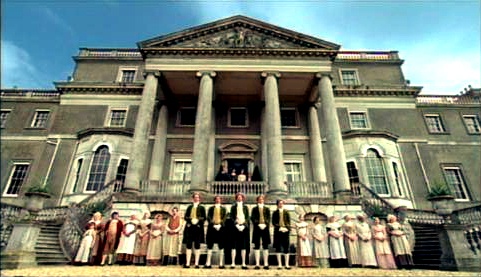
“An income of two thousand pounds was considered quite comfortable, allowing people to maintain a large house, keep horses and a carriage, and employ eleven servants.” (Life in Regency England: More Than Games). Such an income would not have been enough to maintain Norland Park (below), but it would have been quite enough for Willoughby, who married an heiress with £50,000. The interest on that sum would have been £2,000 per year.

Edward: “As moderate as those of the rest of the world, I believe. I wish as well as every body else to be perfectly happy; but, like every body else it must be in my own way. Greatness will not make me so.”

“Strange that it would!” cried Marianne. “What have wealth or grandeur to do with happiness?”

“Grandeur has but little,” said Elinor, “but wealth has much to do with it.”

“Elinor, for shame!” said Marianne, “money can only give happiness where there is nothing else to give it. Beyond a competence, it can afford no real satisfaction, as far as mere self is concerned.”

“Perhaps,” said Elinor, smiling, “we may come to the same point. Your competence and my wealth are very much alike, I dare say; and without them, as the world goes now, we shall both agree that every kind of external comfort must be wanting. Your ideas are only more noble than mine. Come, what is your competence?”

“About eighteen hundred or two thousand a-year; not more than that.”

Elinor laughed. “Two thousand a-year! One is my wealth! I guessed how it would end.”

“And yet two thousand a-year is a very moderate income,” said Marianne.“A family cannot well be maintained on a smaller. I am sure I am not extravagant in my demands. A proper establishment of servants, a carriage, perhaps two, and hunters, cannot be supported on less.”

Elinor smiled again, to hear her sister describing so accurately their future expenses at Combe Magna.

“Hunters!” repeated Edward—“But why must you have hunters? Every body does not hunt.”

Marianne coloured as she replied, “But most people do.”

Knowing her situation and prospects, we see how far fetched Marianne’s statements must sound to Elinor and Edward. A woman without fortune needed luck on her side to snag a husband with such an income: she could not depend on looks alone, although great beauty, such as Lady Emma Hamilton possessed, helped a great deal. If a woman had only beauty, then an extravagant man like Willoughby, who could not live without his hunters, must look else where for a bride. As Stephanie Edelman writes in a JASNA Essay contest:

    Austen demonstrates throughout Sense and Sensibility just how much inheritance influences the marriage market. Willoughby, who “had always been expensive,” intended to “re‑establish [his] circumstances by marrying a woman of fortune”­–Miss Grey, with her “fifty thousand pounds” ‑‑despite his attraction to Marianne. His actions are not surprising, for even Mrs. Jennings explains that “when there is plenty of money on one side, and next to none on the other” romance can take a back seat to economics. Beauty sometimes compensates for a lack of fortune, as Mrs. Jennings hopes when she claims that Marianne would be perfect for Colonel Brandon, “for he was rich and she was handsome”, but a loss of beauty lowers one in the marriage market. Because Marianne worries herself sick over Willoughby and, in John Dashwood’s opinion, “destroys the bloom forever”, he “question[s] whether Marianne now, will marry a man worth more than five or six hundred a‑year, at the utmost”. Thus we see families being formed, not on the basis of love and respect, but on inheritances, yearly incomes, and how much one is willing to pay for beauty. – The Family of Dashwood by Stephanie Edelman

For a fuller explanation of incomes during the Regency era and their relative value today, click on my other post, Pride and Prejudice Economics.

More links on the topic:

*The Period House: Style, Detail, and Decoration: 1774 – 1914, Richard Russell Lawrence and Teresa Chris, Phoenix Illustrated, 1996, 192 pages

Images: 1st – Sense and Sensibility 2007; 2nd – Sense and Sensibility 1996.

Read Full Post »

Watching the new adaptation of Sense and Sensibility, I realize I have a love/hate relationship with screenwriter Andrew Davies. I love him because he wrote the scripts for several of my favorite Jane Austen film adaptations and his movies are exciting to watch. I dislike his work because he tinkers with Jane’s intent and plot. He cannot leave well enough alone, and yet his movies of Jane’s novels attract huge ratings. Take this latest film adaptation, for example. I’m amazed by how much I like it, despite Andrew’s heavy hand in making the heroes seem more real and inserting scenes that Jane never intended. In fact, Mr. Davies’ name seems to be displayed as prominently in the credits as Jane Austen’s. Food for thought.
So what did I like and what didn’t I like about the film that caused me to continue my love/hate relationship with Mr. Davies? I’ll vent first, and discuss …

… A Few Pesky, Bothersome Moments

1) A Very Un-Janelike Sex Scene Opens the Film
There had been such a ruckus over the movie’s sexy opening sequence, that when I finally saw it my only thought was, “Meh, is that all?” The scene starts the film off on a wrong note, however, which takes away from the dramatic tension later on. Barbara Larochelle, the Sense and Sensibility discussion moderator on The Republic of Pemberley , explains in Sensibility Crashing Against Sense how the opening sequence dilutes the impact of the viewers’ dawning awareness that Willoughby is a cad and nothing like a romantic hero.

After the turgid opening scene, we are treated to the true beginning of Sense and Sensibility: the death of Mr. Dashwood and John’s promise to take care of his stepmother and stepsisters.

2) Making Fun of a Chubby Child
The plot quickens when Fanny Dashwood, with husband and child in tow, hastens to Norland Park the Monday after the funeral to assume her duties as its mistress. Her strong hold over John, as Davies implies as she blows out the candle, are her talents in bed. Fanny, played with just the right amount of snaky oiliness by Claire Skinner, firmly puts the kabosh on her husband’s plans to support his step mother and half sisters. Young Henry, or Harry, is depicted as a chubby child. Morgan Overton, the young actor who portrays him is forced to wear a frightful wig (or hairstyle), spectacles, and skeleton suit with frilly collared shirt. He is seen chomping on food almost the entire time he is on screen, except in this image. This stereotypical portrayal of an overweight child was obvious and unnecessary. Sorry Andrew, fat is not funny. Ever. Besides, Jane would not have taken such cheap pot shots.

3) Where are the Palmers and Lucy Steele?
Fast forward to life at Barton Cottage: Mrs. Dashwood now must live on a pitiful income of 500 pounds per year. This means serious economizing and downsizing for the ladies Dashwood. Frequent meals at Barton Park help to defray some expenses. We meet Sir John Middleton and his brood, and his mother-in-law, Mrs. Jennings. The Palmers were practically non-existent, however. A new viewer would have no concept of Mr. Palmer’s rudeness, for example, or of Mrs. Palmer’s irritating gaiety. Lucy Steele, who came across as sweet and ditzy rather than manipulative, was given so little screen time that her marriage to Robert Ferrars must have come as a complete surprise to those who had not read the novel. However, to be fair to Andrew Davies, we are treated to a fine characterization of Miss Anne Steele, who as played by Daisy Haggard, nearly steals the show.

4) Marianne is Gentled Like a Horse

After her illness, Marianne is “gentled” by Colonel Brandon. In fact, her mother and sister look on approvingly as they watch the Colonel use a classic horse training technique of turning his back to Marianne to pique her interest. (“Nine times out of ten a wild horse would follow”, as Elinor remarked, watching the Colonel in action). In Mr. Davies quest to show Jane’s heroes in a more manly setting, we also see the Colonel tenderly handle a hawk. As Marianne looks on with stars in her eyes, Colonel Brandon commands softly, “Come here.” How subtle was that message? Excuse me, Mr. Davies, but women are not chattel and I was a bit put off by these scenes. As Mr. Knightley would say, “That was very badly done.”

However, I Liked this Film Adaptation Overall …

… and the aforementioned concerns did not ruin my enjoyment of the movie. Of the four new adaptations based on Jane’s novels shown this season, it is the best one. The film’s three-hour length allowed for a more leisurely exploration of Marianne’s infatuation with Willoughby (Dominic Cooper). We also see more of Colonel Brandon (David Morrissey), who is given as much screen time as Willoughby. We meet Mrs. Ferrars (Jean Marsh), a character as formidable and steely-eyed as Lady Catherine de Bourgh, and, as mentioned before, Lucy Steele’s vulgar sister, Anne, makes an unforgettable appearance. However, other characters are hardly given the time of day, which makes me wish that all Jane Austen adaptations are required to be six hours in length, like A&E’s Pride and Prejudice.

I loved Hattie Morahan’s performance as Elinor Dashwood. Her Elinor is stoic, restrained, and vulnerable. We can feel her internal pain and struggle over Edward’s engagement to Lucy Steele, and at Marianne’s side during her illness. In fact, I will no longer be able to read S&S in the future without seeing Hattie as Elinor.

If you have seen my avatar, you must have guessed how much I admire Kate Winslet’s robust performance as Marianne. In addition, my Jane Austen character quiz profile is Marianne, so I am particularly fond of this 17-year-old heroine. While I adore Kate’s interpretation, I found Charity Wakefield’s Marianne equally compelling, though in a sweeter, quieter way. She is young enough to play the part of a teenager, and her large expressive eyes lent a piquant touch to her character’s mixture of recklessness, immaturity, and innocence. In this adaptation Marianne is so heedless of convention, she is shown visiting Allenham with Willoughby, not merely speeding through town in a phaeton as in the 1996 adaptation.

I also thought that Marianne’s illness in the 2008 film adaptation, while not strictly accurate, was closer to Jane’s original intent. In the 1996 movie version, Marianne walked for miles in the rain to view Willoughby’s estate, and the sickroom scenes were so overwrought with emotion, that I thought, “Enough!” In this film’s more restrained sick room scenes, Colonel Brandon’s concern over Marianne’s condition is stressed as much as Elinor’s. His visit to her sick bed sets the stage for Marriane’s developing relationship with the Colonel and her interest in him as a suitor.

David Morrissey plays the Colonel heroically, and in my mind his interpretation of the character surpasses Alan Rickman’s. One explanation for this is that the Colonel’s scenes are fleshed out in S&S 2008, and we get to know him as a man as well as a long-suffering hero. Mr. Morrissey is also much handsomer than Jane describes, which places Dominic Cooper in a difficult position. His Willoughby is not quite good looking enough to play the role of a man who is described as surpassingly handsome. In fact, Dominic reminds me of The Artful Dodger all grown up. I know looks aren’t everything, but I fail to understand why Marianne is so drawn to Willoughby when such a handsome Colonel has been courting her. Oh, I know she was turned off by the Colonel’s age, but David Morrissey is so yummy that any self-respecting girl in need of a husband would not quibble with the age difference if he came a’calling.

Dan Stevens as Edward Ferrars is also too handsome for the part, though I liked his kind eyes and expressive face. He is well matched with Hattie Morrahan in looks and height, and they seem like a perfect couple. It is entirely believable that Dan/Edward would be happy living the simple life of a minister in a small cottage with his frugal and practical Elinor.

Except for the Marianne-in-training sequences, I rather enjoyed our glimpses of our heroes in manly scenes, cutting wood, hunting, hawking, or riding flat out. Such touches are what make Andrew Davies adaptations stand out from the rest of the field.

I finish this review with Mrs. Dashwood. Ever since I saw Janet McTeer in Songcatcher, I have adored her. An actress with a remarkable scope and range, she played the widow and loving mother with the right amount of grief, bewilderment, and strength. Her realization that her cushy life was over when Elinor rejected her first two choices for a rental house foreshadowed the challenges she would have to face as a poor widow. However, except for some crucial scenes, Janet was given remarkably little to do in this film except to stand still for reaction shots. This is another strong argument for shooting a mini-series.

I have seen this film three times already and intend to see it again tonight. Needless to say, I highly recommend it. Oh, dear, I just had a thought. What will I do with my Sunday nights after The Complete Jane Austen series has ended? Watch A Room With a View, of course. The movie will be aired on Masterpiece Classic, April 13th, one week after Part II of Sense and Sensibility has aired.

Click here for my 2009 review of Sense and Sensibility, which features additional images.

Read Full Post »

True or False? A single woman in possession of a good fortune has some free will in the choice of a husband. False, as far as Mrs. Ferrars and Fanny Dashwood are concerned. The woman in question is Miss Morton, the late Lord Morton’s only daughter. This young lady not only comes from a good family, she is in possession of £30,000. Such prized attributes make her a hot commodity on the regency marriage mart.

In Sense and Sensibility, the reader is made acutely aware that Mrs. Ferrars has chosen Miss Morton for her eldest son, Edward. The readers never meet this poor girl, although her unseen presence looms large in the novel. Edward’s purse strings are controlled by his mother, and he stands to lose a fortune if he refuses to obey her. As Fanny Dashwood is quick to remind Mr. Dashwood, Edward will do his mother’s bidding. He has no choice.

Unbeknownst to both Fanny and Mrs. Ferrars, however, Edward has been engaged these many years to Lucy Steele, a little miss nobody with nothing but air and dust in her coffers. As soon as Mrs. Ferrars discovers this unpleasant fact, she disinherits Edward, and quickly switches sons on poor Miss Morton. This suggests that Robert and Edward are fairly interchangeable in their mother’s eyes*, and that Miss Morton would hardly notice the difference between them. (Or care if she did.)

As Miss Morton is lobbed from one son to the next, we begin to feel sorry for her. There is no mention of love or affection, merely the assumption that just as the Ferrars are after Miss Morton’s fortune, so Miss Morton must covet the Ferrars’s fortune. A conversation between an incredulous Elinor and her half-brother John Dashwood illustrates the point:

“We think NOW,”–said Mr. Dashwood, after a short pause, “of ROBERT’S marrying Miss Morton.”

Elinor, smiling at the grave and decisive importance of her brother’s tone, calmly replied,

“The lady, I suppose, has no choice in the affair.”

“Choice!–how do you mean?”

“I only mean that I suppose, from your manner of speaking, it must be the same to Miss Morton whether she marry Edward or Robert.”

“Certainly, there can be no difference; for Robert will now to all intents and purposes be considered as the eldest son;–and as to any thing else, they are both very agreeable young men: I do not know that one is superior to the other.”

Poor Miss Morton: first regarded as a piece of goods, and then jilted by two men! What a degrading situation. Wait, perhaps not. She escaped a lifetime of domination by an awful mother-in-law. We might laugh today at this comedic situation, but in a highly stratified society the BUSINESS of marriage was taken seriously. After coming out, young women were expected to display themselves and their talents in the best light possible, or their prospects of marriage might dim. They spent the social whirl meeting the right people and being seen in the right places. I suspect, however, that Miss Morton with her £30,000 pounds would be regarded as a diamond of the first water even if she developed acne, and had cross eyes and a snaggle tooth.

For more on the topic, please click on the links below:

Read Full Post »

Mrs. Darcy’s Dilemma, which SourceBooks is now republishing for international distribution, takes place in an age of change, just as Queen Victoria is coming to the throne in 1837. Mr. and Mrs. Darcy, they of Pride and Prejudice fame, are now middle-aged. He is balding, she is an anxious mother, but they are still a charming, witty and fortunate couple, who know their happiness – until they make the mistake of inviting the two daughters of Mrs. Darcy’s profligate sister Lydia to visit at Pemberley…and trouble begins. The Darcys’ sons are far too interested in the young ladies; the younger, Cloe, is a faultlessly modest creature, but the elder, Bettina, is another pair of gloves entirely, and her flamboyant career includes a shocking turn on the London stage…Diana Birchall, Author

As I finished reading this satisfying and entertaining novel by Diana Birchall, I knew that all was right with Jane Austen’s world again. Mr. and Mrs. Darcy are still deeply in love; their children will find some measure of happiness; and the rest of Jane Austen’s characters are living out their lives much as we suspect they would.

Elizabeth was too wise to take either her husband’s love or his wealth for granted, and she never forgot to exult in all her manifold sources of happiness. It is impossible for human nature to be altogether without worry or pain, however, and Elizabeth’s anxieties were all reserved for her children.

At the start of the novel, Elizabeth Darcy, a matron in her forties and mother to Fitzwilliam, Henry, and Jane, receives a letter from her sister, Lydia Wickham. In reaction to the hardships Lydia describes, the Darcies invite the two oldest Wickham girls, Bettina and Cloe, for a protracted visit to Pemberley. This action sets the plot in motion. Before the generous-hearted Darcies realize what has happened, their eldest son Fitzwilliam, whose preference for horses far outweighs his common sense, has run off to London with the brazen Bettina. Shades of Wickham’s and Lydia’s ill considered elopement! Everyone is appalled when they do not marry, except for Lydia who doesn’t see why a 10-minute ceremony “should signify.”

Meanwhile, Henry, the second and more sensible son, has fallen for sweet and proper Cloe. He proposes to her, but deeply mortified by her sister’s actions, the penniless Cloe seeks a position as a governess.

As these events unfold, we meet Pride and Prejudice’s familiar cast of characters. Mr. Collins is as intolerable as ever. Due to the unfortunate circumstance of Mr. Bennet’s long and healthy life – and his desire not to shuffle off his mortal coil too soon – both the Collinses have become fractious from waiting. Charlotte has grown increasingly irritated with Mr. Collins in their tiny cottage crammed with furniture and their half dozen children.

Lady Catherine de Bourgh is still overbearing, and the early death of her only daughter Anne has not diminished her dislike of Elizabeth. Lydia seems not to have grown wiser at all, despite having raised a family in poverty and her disappointment with Mr. Wickham, a dissipated wastrel. Mary is a widow who has taken care of the aging Mr. Bennet since Mrs. Bennet’s death. Kitty as Mrs. Clarke, a minister’s wife, has turned into a sour childless woman. Having taken second place to Lydia in her younger years, she now feels inferior to Elizabeth and Jane, who married well. The book’s subplots echo many of Jane’s other novels, and one feels a comfortable familiarity with these characters as the novel progresses.

Ms. Birchall does not disappoint her readers. The plot is fast paced, and the story believable. “My primary interest in writing Mrs. Darcy’s Dilemma, which I did years before the booming proliferation of romantic sequels,” she says, “was in employing something as similar to Jane Austen’s original language as might be possible for an American writing two hundred years later. In other words: not possible at all! However, I have steeped myself in her prose, reading the novels not tens, not hundreds, but thousands of times over a thirty year period, and among many other things, Jane Austen proved to be the best writing teacher any author could have.”

My only (minor) quibble with the book is that it is not long enough. I would love to have read more scenes with Mr. Darcy and his wife in them. Diana is also known for her humor, and her wit was in too short supply. Had the book been longer, I believe we might have been treated to more sparkling and scintillating dialog. I have one final quibble: Diana describes our fabulous fifty-something Mr. Darcy as balding. I beg to differ, Ms. Birchall. Please take a look at this photo of a lovely man at 48, in which not a single follicle seems to be challenged. Could Mr. Darcy not have had a similar set of hair?

More about Diana Birchall:

Her Jane Austen-related novels, Mrs. Darcy’s Dilemma and Mrs. Elton in America, were both published by Egerton Press, a small English company, in 2004, and her pastiche/satire In Defense of Mrs. Elton was published by the Jane Austen Society in the US, UK and Australia in 2000. Her “day job” is as the literary story analyst at Warner Bros Studios in California, reading novels to see if they would make movies. She is also a ballet dancer and has taken classes most of her life.

Read Full Post »

« Newer Posts - Older Posts »