Feeds:
Posts
Comments

Posts Tagged ‘Jane Austen’s Desk’

Interview by Brenda S. Cox

“no one can be really esteemed accomplished [without] a thorough knowledge of music, singing, drawing, dancing, and the modern languages”–Pride and Prejudice

Jane Austen and Company, who have given us many fascinating series of talks, have been focusing on Austen and music this year. We asked Inger Brodey, Eric Bontempo, and Susan Ellen Ford to tell us more about that.

JAW: Thanks for joining us, Inger, Eric, and Susan. I understand that the three of you are directing the Jane Austen & Company program. Jane Austen & Co has been doing a series on Music and the Regency this year. Readers can watch and listen to the recordings here. Can you tell us about that?

Jane Austen & Co. did a series on Music in the Regency during 2025, and you can still enjoy the recordings online for free.

Eric:

Sure! Music making and music appreciation could be complicated—even contested—activities during the late eighteenth and early nineteenth centuries. In 2025, Jane Austen & Co. wanted to look at aspects of public and domestic music in the Regency period, and zero in on Jane Austen’s own musical experience. Back in February, we kicked things off with Jeff Nigro’s talk on “Georgian Fangirls” and the influence that Italian castrati had on Regency Music in England. Then, Gillian Dooley discussed music in Austen’s life and work, including some of what Austen would have played and sang. Kathryn Libin moved our series outward to women and musical education during this period. In April, Laura Klein discussed the evolution of keyboard music during this period and considered the music Austen was practicing when she was writing.

This fall, we’ve added three more events to the series. Lidia Chang from Colorado College gave an insightful talk on “Frivolity, Foppery, and the English Gentleman at Music.” And just two weeks ago, Jeanice Brooks from the University of Southampton delighted us with her talk exploring how music making shaped perceptions of people and lands far beyond the British home. The grand finale of the series came in late November when Penelope Appleyard and Jonathan Delbridge revealed the new song they have commissioned, recorded, and released to celebrate Jane Austen’s 250th Anniversary.

JAW: Tell us a little about one of those recorded events that our readers might enjoy listening to.

Grand finale of Music and the Regency, “A Song for Jane”

Eric: I think our grand finale to “Music and the Regency” is definitely worth watching. The 90-minute episode has a little bit of everything: Penelope Appleyard and Jonathan Delbridge performed live, and you can watch their stunning renditions of songs that Jane Austen loved and copied down in her family’s music books. They performed “Robin Adair” and a “Song for Burns” before delighting us with their recently commissioned setting of Austen’s teenage poem “Ode to Pity.”

In between performances, they walked us through the historical context of these songs, the musical instrument being played by Jonathan, and their connection to Jane Austen and her novels. It was fascinating, and if you watch until the end, you’ll notice that the audience Q&A kept the momentum going!

JAW: What are a few interesting things that you personally have learned from that series?
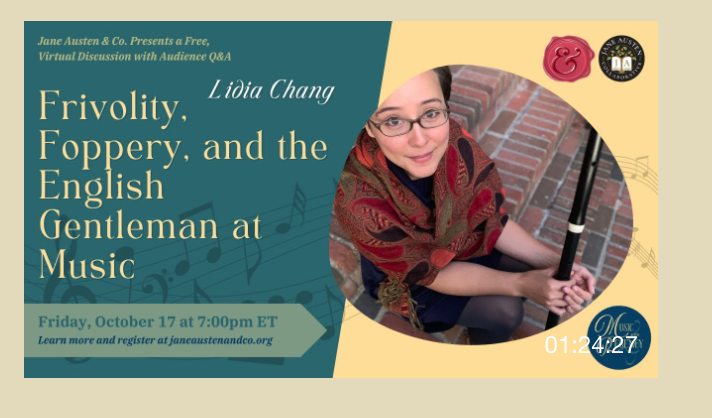
Lidia Chang’s episode on music and gender

Susan: One of my favorite episodes was the interview with Lidia Chang. She taught me a great deal about music and gender. I was interested to hear about how seldom amateur men would perform music, compared to women. She also drew connections to the few examples from the novels where men perform for private audiences.

JAW: What will the next series be?

Susan: Jane Austen & Company is launching a brand new series focusing on Jane Austen’s “Unsung Characters.” We are envisioning a series of presentations that explores Austen’s minor characters and the un-thought-of connections that may tie them together. We will be announcing the list of speakers and presentations soon!

JAW: A few months ago I reviewed your lovely new site, Jane Austen’s Desk. How is that going?
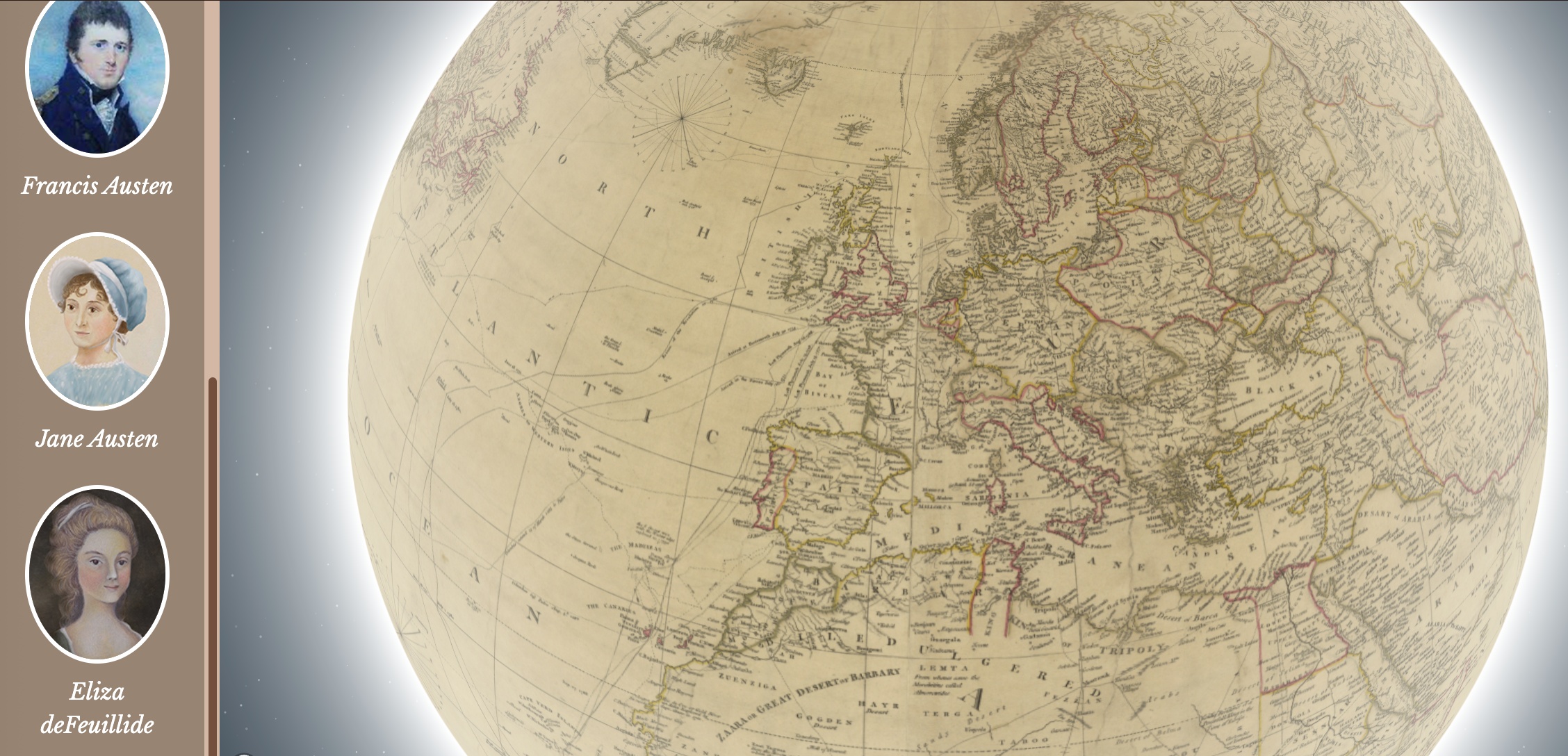
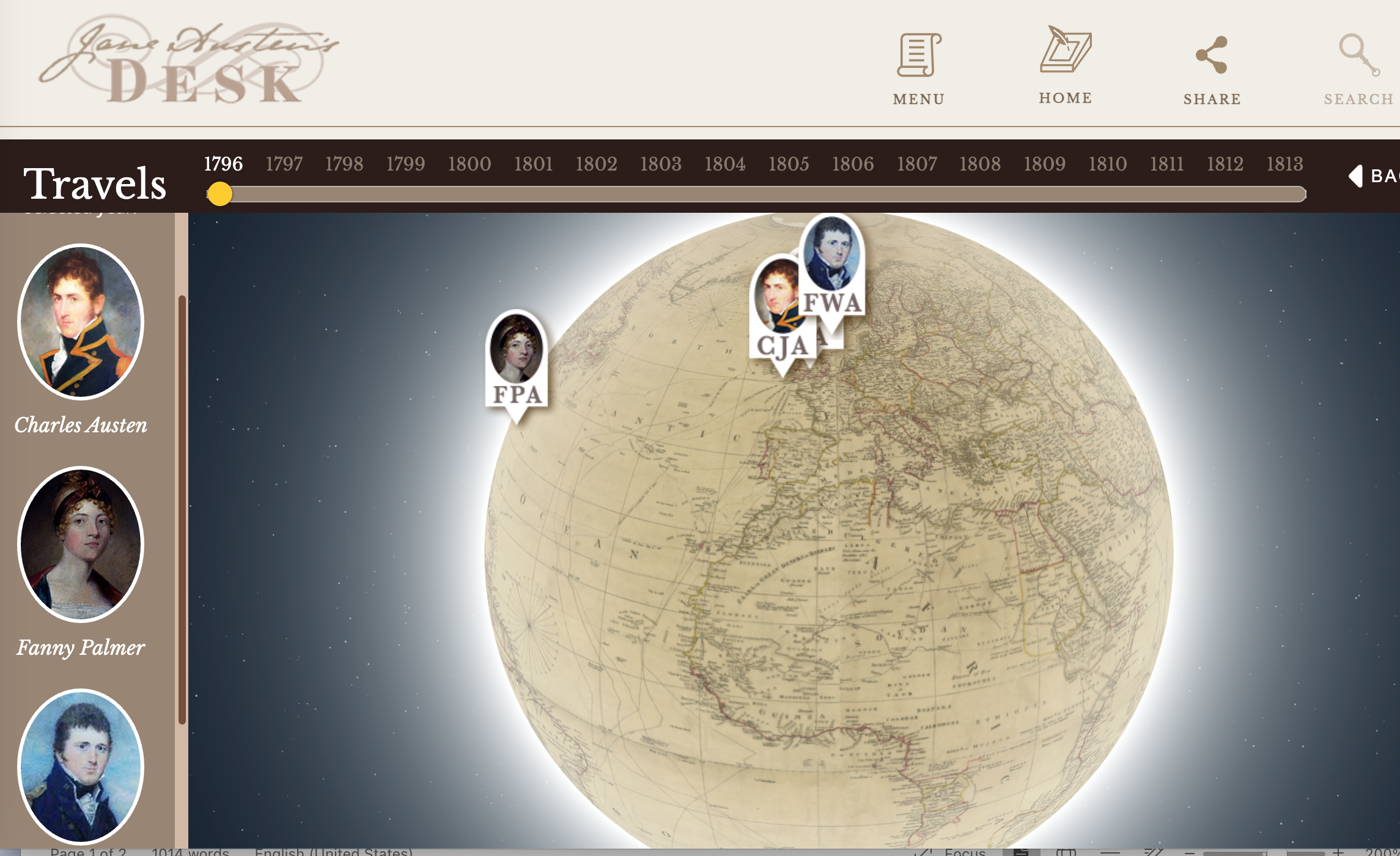
Eliza de Feuillide is now in the travel section of Jane Austen’s Desk.

Inger: Yes, we were very grateful for your review! Since then, we have added a few things to Jane Austen’s Desk. Most importantly, we’ve added a new traveller: Eliza De Feuillide, Austen’s first cousin and sister-in-law. We included a new hand-drawn portrait of her and programmed in most of her travels during Austen’s lifetime. We really wanted another female traveller, along with Fanny Palmer Austen, to indicate what we are calling Austen’s “vicarious travels.”  We are countering the image of Austen living a sheltered existence by showing visual, interactive representations of how much her correspondents travelled, giving her vivid, second-hand experience of diverse regions of the world. 

Susan: In honor of our new holiday campaign to raise funds, we also added some professionally recorded Christmas music, performed by Laura Klein on a period harpsicord, and some holiday greenery.  Have you seen them yet? (You have to ignore, momentarily, the unseasonable weather for March 30.)

Under the painting for travel sits a thus-far mostly silent pianoforte on the website Jane Austen’s Desk. We can participate in bringing it to life!

JAW: I understand you are raising money for adding music to that site. What are you hoping to add? How will that enrich the site?

Inger: Music was key to Jane Austen’s creative process. As you know, in her years at Chawton Cottage, she got up early in the mornings to play her pianoforte and compose her thoughts. This Kickstarter will raise the funds necessary to give tribute to the specific music Austen knew, loved, and transcribed by hand. We will add interactive tools with access to this music to our free website, making it come alive for all kinds of Janeites. The music will be performed by professional performers on historical instruments. We will provide historic illustrations, information about composers and specific pieces, and crisp images of Austen’s own sheet music.

An exciting part of the plan is to link the mentions of music in the novels to recordings by Laura Klein, and vice versa. So when you read about Mary Crawford playing a glee, for example, you can play an example and learn about what glees are. It’s an important dimension of our plan to show how the many different parts of Austen’s lived experience come together in her masterful novels.

JAW: That sounds fantastic, Inger. Why do you need to raise the money with a Kickstarter?

Inger: The design and building of our site has been primarily funded by two “Digital Projects for the Public” grants from the National Endowment for the Humanities. We were hoping for the largest, phase 3 grant in this line, but the whole program has been cancelled at the NEH, so we are forced to look elsewhere for our funding.  What we really need is a patroness! 

JAW: Lady Catherine de Bourgh, take note. Or perhaps someone who has “more true enjoyment of music” than she does, or “better natural taste”! How can our readers contribute, if they wish?

Inger: Our Kickstarter campaign is at: https://www.kickstarter.com/projects/janeaustencoll/adding-music-to-jane-austens-desk. On that site there are also two videos: one about our team that is making Jane Austen’s Desk and the other about the goals of our project. Kickstarter campaigns are all or nothing, so if we don’t meet our target by December 28th, then we don’t receive any of the promised funding! It’s a little nerve-wracking!

JAW: We very much hope you get all your need! Readers and music lovers, here’s an opportunity to contribute. Inger, Eric, and Susan, thanks for all your hard work to make so much great material available to us in such a fun way. (I vote that you do embroidery next 😊, but the music, “a very innocent diversion,” will be delightful!)


Brenda S. Cox is the author of Fashionable Goodness: Christianity in Jane Austen’s England. She also blogs at Faith, Science, Joy, and Jane Austen.
Read Full Post »

by Brenda S. Cox

“There must have been many precious hours of silence during which the pen was busy at the little mahogany writing-desk, (This mahogany desk, which has done good service to the public, is now in the possession of my sister, Miss Austen) while Fanny Price, or Emma Woodhouse, or Anne Elliott was growing into beauty and interest.”–A Memoir of Jane Austen by James Edward Austen-Leigh, her nephew

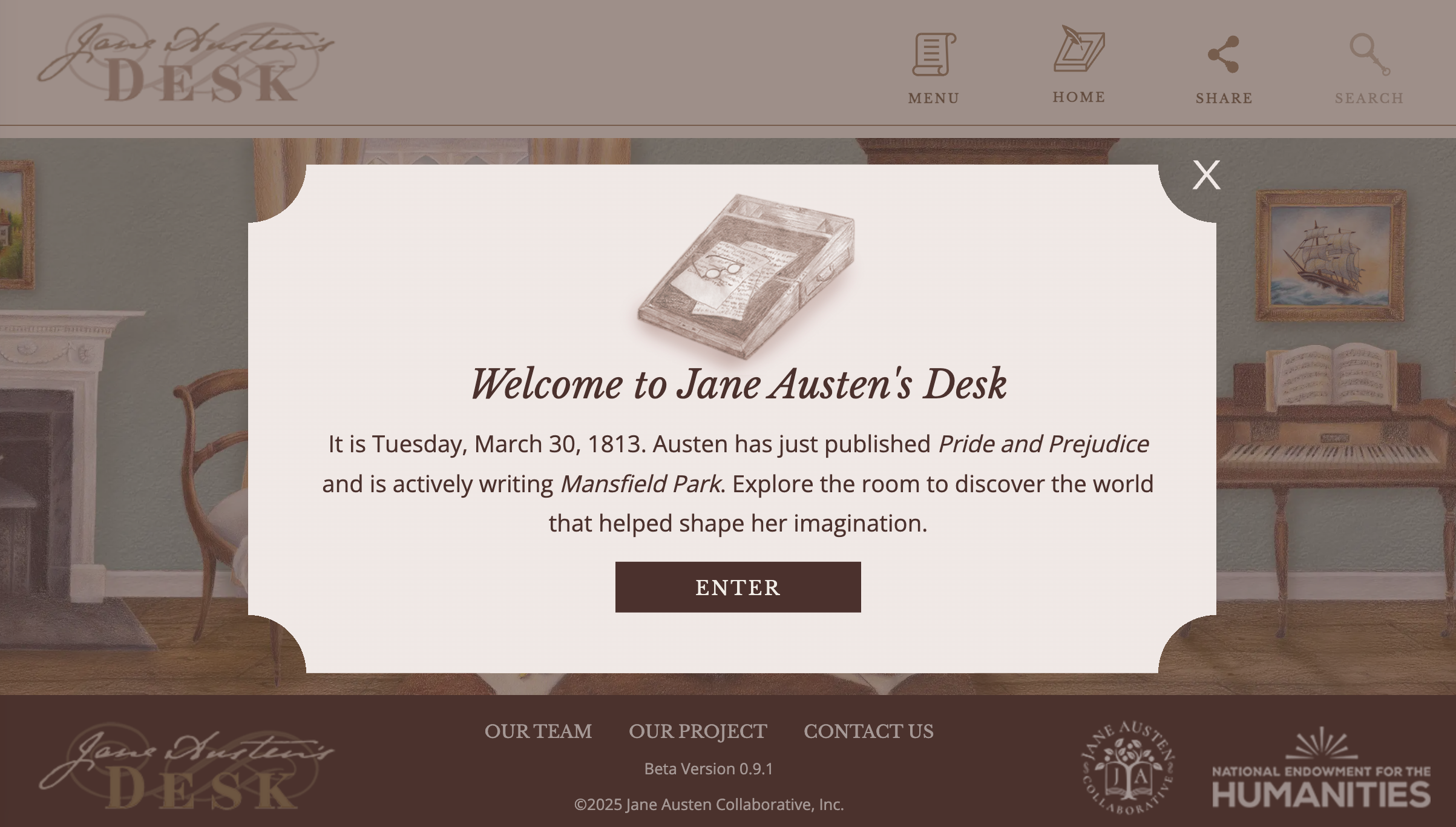
Welcome page to the website “Jane Austen’s Desk”

Wouldn’t you love to explore Jane Austen’s desk and room? Inger Brodey, Sarah Walton, and their amazing team at the Jane Austen Collaborative are recreating Jane’s desk and room for us to visit virtually.

While the website is still a beta version, I found lots of great information there. The plan is for it to become a “portal” linking to many Austen resources.

The site opens with a view of a room loosely based on the drawing room of Jane Austen’s House in Chawton

Jane Austen’s Desk

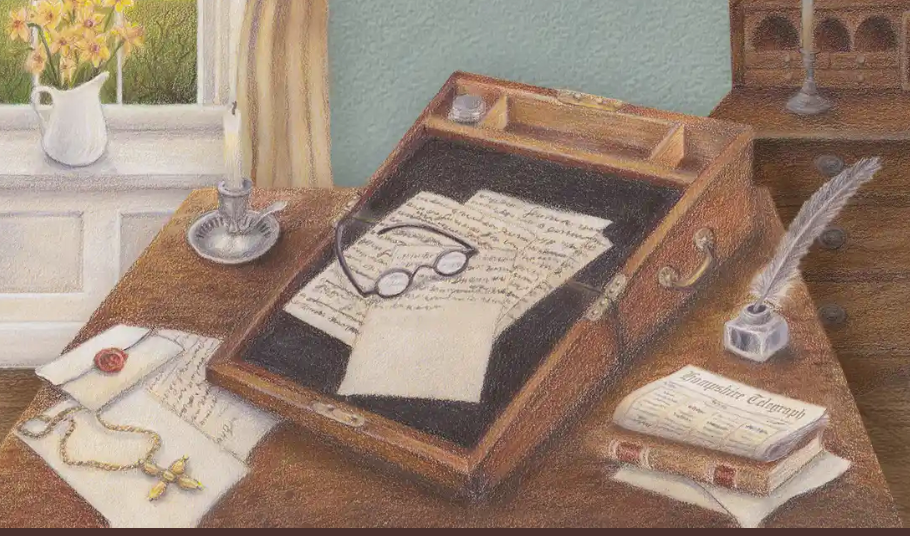
When you visit the room, you might want to start at the desk itself—Jane’s travel desk sits on a table. You’ll see manuscripts of several of the novels, which you can open and enjoy in early editions. Commentary tells more about the novel and the edition, with direct links to interesting sections like “Darcy’s list of desirable female accomplishments” and “Fanny asking about the slave trade.”

Nearby are newspapers, one of the most fun links. Several contemporary papers are included. You can hone in on a number of interesting articles, ranging from her brother Edward’s selling part of Stoneleigh Abbey, to reports of her brother Frank’s naval exploits, to the story of a swindler who pretended to be a rich person’s housekeeper!

Jane Austen’s travel desk (the real one is owned by the British Library). The manuscripts on the desk, the newspapers next to it, and the cross, take you to various resources.

The Bookshelf

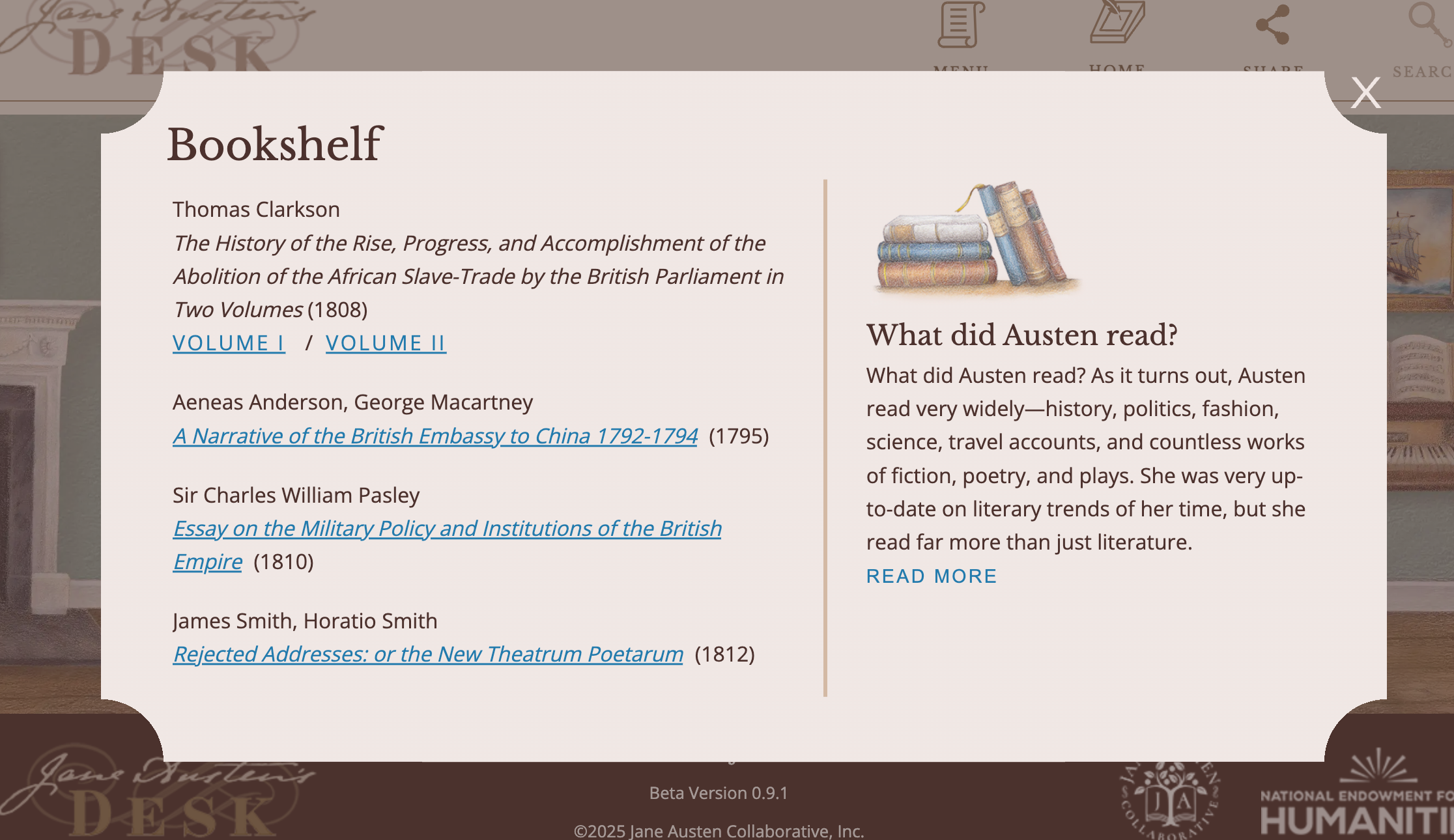
Click on the bookshelves in Rev. Austen’s bureau-bookcase , and you’ll see some books mentioned in Austen’s writings. I expect this will be expanded later. But for now, you can read from several authors Austen said she was “in love with”—Thomas Clarkson (on abolition), Sir Charles Pasley (on the military), and James and Horatio Smith (verse parodies). We also have a book that Fanny Price was reading, George Macartney on the British Embassy to China.

For each, you will find an easy-to-read early version of the book; clear commentary; pictures; and links to relevant passages in the novels and letters. Two also link to related articles. A great start if you want to explore these books connected to Austen!

Catalogs on the ledge of the bookcase open up to records of the Alton Book Society that Austen enjoyed. You’ll find lists of members, rules, and lists of the books that the members, including Austen, traded around. This gives us another peek into Austen’s life and reading.

The Bookshelf takes you to some books Austen read.

Travels

A pianoforte stands next to the bookcase. It will eventually be connected to Austen’s music.

Above the pianoforte, click on the portrait of a ship on the sea. You go to a globe, where you can follow the travels of Austen’s family.

Jane Austen’s Desk, travel section. You can trace the positions of Frank and Charles Austen, Charles’s wife Fanny Palmer, and Jane Austen herself, year by year. You can also read stories about Frank and Charles’s experiences at sea.

Silhouettes on the wall connect you to Jane Austen’s family tree. If you click on the orange “i”, you get more information about each person. The plus buttons reveal more generations.

Many of these features include audio commentary as well as written commentary. For example, Lizzie Dunford of Jane Austen’s House tells us about the topaz crosses Charles brought back for his sisters.

There are great possibilities for future additions.

An Interview with Inger Brodey

Inger Brodey, who runs the Jane Austen Summer Program, tells us more about the project:

JAW: Inger, what gave you the idea for doing this website?

Inger: I was interested in Austen’s own creative process, and also in countering the myth that she was not well informed in the science and politics of her day. I found a kindred spirit in Sarah Walton, who was a grad student when we started. In the 1990s, both Sarah and I had been enchanted by JK Rowling’s website with clickable, magical elements on her desk to interact with. 

JAW: How is the website being funded?

Inger: We have received two rounds of funding from the National Endowment for the Humanities, and have applied for more. We intend to create a GoFundMe or Kickstarter campaign to seek private funding to support specific new developments, such as the learning games we have in mind. 

JAW: What are some parts you are excited about adding in the future?

Inger: The current setting is Spring 1813, while [Jane Austen] is writing Mansfield Park. Eventually we hope to add additional settings: for example, Summer or Winter 1814, when she was composing Emma; or Autumn, 1815, when Persuasion was in process. 

JAW: What are some parts that you and your team are finding challenging?

Inger: Well, it all takes much more time to create than one would imagine. We have a great team of programmers and designers, including the wonderful Harriet Wu who has drawn the site by hand. We constantly try to find the sweet spot where we can appeal to both scholars and the general public, and to all ages. Just as with our Jane Austen Summer Program, we also focus on providing tools for educators who wish to bring Jane Austen into the classroom. 

JAW: What other ideas do you have for expansion in the future?

Inger: As you can see on the site, there are many objects with potential to “animate” in the future. We are collaborating with Laura Klein to add music to the piano, Jennie Batchelor for sewing, and have plans for links to weather and agricultural information (via the scene out the window), tea culture (via the kettle), letter writing (via a folded letter), and many more. 

We applied for a grant to develop a state-of-the-art platform for navigating, reading, notating, and analyzing Austen’s novels, including the potential for crowd-sourced editions. 

As long as we can continue to find funding, I think this will be a lifelong project—there is so much potential to grow!

JAW: Thanks, Inger, we look forward to that!

The Desk, the Summer Program, and Online Talks

Gentle readers, I recommend you explore Jane Austen’s Desk. The website has not yet been configured for mobile phones, so you’ll need to access it on your computer or tablet.

When you’ve finished exploring, go back to the main page and take a survey, to possibly win a prize. The survey takes some thought and time, but you will get to give input for what you’d like to see in the future at this very helpful site.

The same Jane Austen Collaborative who created Jane Austen’s Desk also runs the Jane Austen Summer Program. This year it will be held June 19-22, 2025, in North Carolina. The theme is “Sensibility and Domesticity,” exploring “topics including medicine, birth, and domestic arts in Regency England and colonial North Carolina.” They will “focus on Austen’s first published novel, Sense and Sensibility—considering the birth of her career as a published writer as well as taking a transatlantic look at the world into which she was born.” I’m signed up, and would love to see some of you there!

Of course, even if you can’t get to North Carolina, you can always enjoy Jane Austen & Co.’s great offerings online. They are currently exploring Music in the Regency; I enjoyed a recent talk on Women & Musical Education in the Regency Era, by Kathryn Libin. Get on their mailing list for announcements of upcoming events.

They generously provide free access to recordings of their previous talks, on topics including “Austen and the Brontes,” “The Many Flavors of Jane Austen,” “Everyday Science in the Regency,” “Reading with Jane Austen,” “Asia and the Regency,” “Race and the Regency,” and “Staying Home with Jane Austen.” Something for everyone, it seems to me.

So much Jane Austen to enjoy!

Brenda S. Cox is the author of Fashionable Goodness: Christianity in Jane Austen’s England. She also blogs at Faith, Science, Joy, and Jane Austen.

Read Full Post »