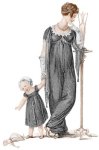
I’ve placed these gorgeous Ackermann fashion plates here to wish my readers who are mothers a Happy Mother’s day. Aren’t these images precious?
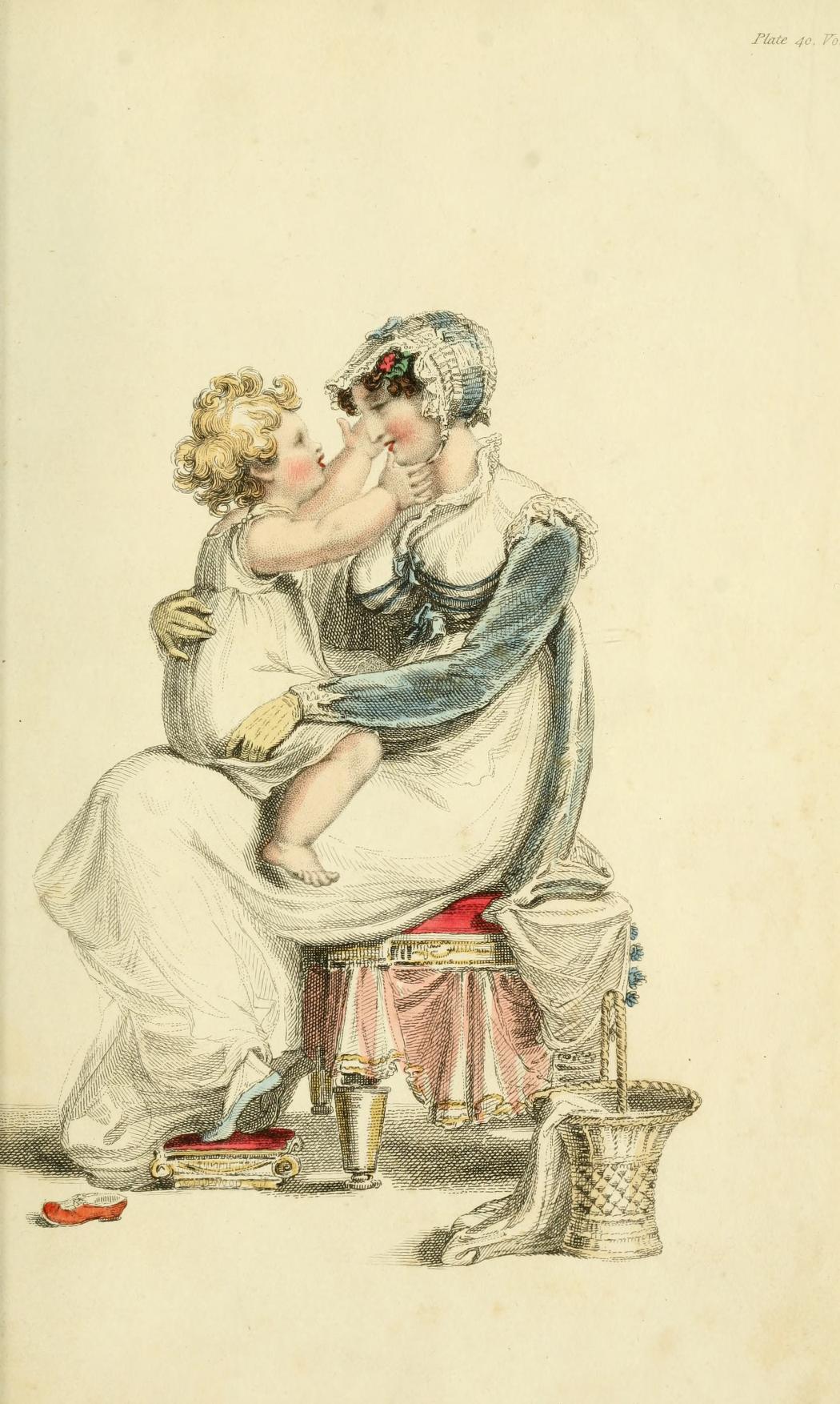
1812 morning dress or domestic dress.
Click on images to enlarge.

1826 evening gowns, March.
Posted in 19th Century England, Children's regency fashion, Jane Austen's World, Regency Life, Regency Period, Regency style, Regency World, tagged Ackermann fashion plates, Ackermanns Repository, Regency Fashion on May 13, 2012| 10 Comments »
I’ve placed these gorgeous Ackermann fashion plates here to wish my readers who are mothers a Happy Mother’s day. Aren’t these images precious?
1812 morning dress or domestic dress.
Click on images to enlarge.

1826 evening gowns, March.
Posted in 19th Century England, Fashions, Jane Austen's World, Regency Life, Regency society, Regency style, tagged Ackermann fashion plates, Circassian, Limerick glove, Regency Fashion on April 27, 2012| 16 Comments »
Recently I commented on a morning gown whose influences were largely from British history. In this April 1812 Ackermann fashion plate, the pink ball gown is indicative of the impact of trade and foreign travel in eastern lands and the advances of the Industrial Revolution on fashion. A young lady attending the ball would have (in her mind) come as a strong exotic eastern woman, resplendent in her turban, peasant bodice, and other rich oriental details.

Click on this fashion plate to enlarge it.
Ball Dress: a round Circassian robe of pink carpe , or gossamer net, over a white satin slip, fringed full at the feet; a peasant’s bodice of pink satin or velvet, laced in front with silver, and decorated with the same ornament. Spanish slash sleeve, embellished with white crape foldings, and finished at its terminations with bands of silver. A Spartan or Calypso helmet cap of pink frosted crape, with silver bandeaus, and embellished with tassels, and rosets to correspond. A rich neck-chain and ear-rings of Oriental gold. Fan of carved ivory. Slippers of pink kid, with correspondent clasps; and gloves of white kid: an occasional square veil of Mechlin lace.”

Detail of the Spartan or Calypso helmet cap, mechlin lace, fan, peasant bodice, and Limerick gloves.
Eastern Turkish influence includes those of Circassian women, whose reputation dates back to the Ottoman Empire and the Sultan’s harem. Circassians became a common symbol of orientalism during the Romantic era. In Europe and America
Circassians were regularly characterised as the ideal of feminine beauty in poetry, novels, and art. Cosmetic products were advertised, from the 18th century on, using the word “Circassian” in the title, or claiming that the product was based on substances used by the women of Circassia.- Wikipedia
The gossamer net represented the advances made in machine made lace during the late 18th and early 19th centuries. (Click here to read my article about net lace.)
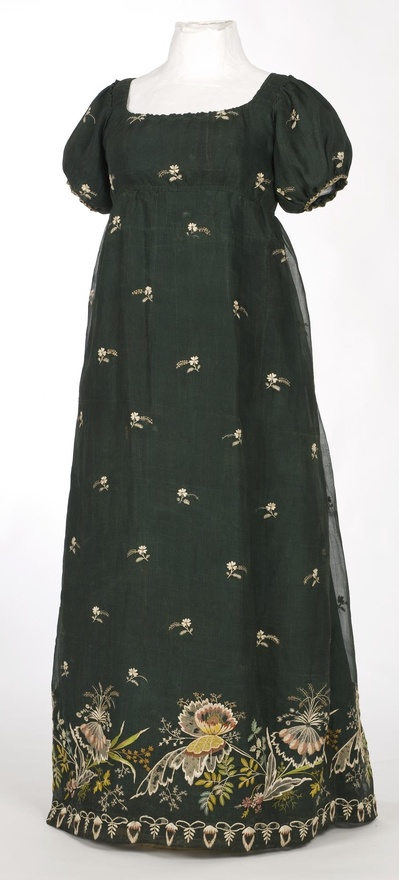
Early 19th century dress made with embroidered black net.
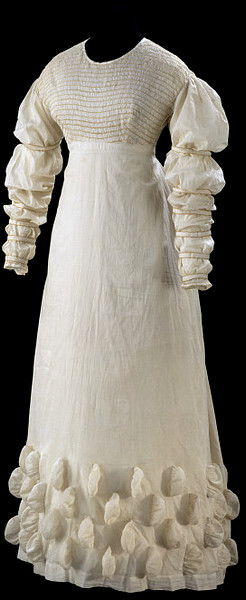
The white crape foldings in the Spanish slash sleeves remind me of the puffs in the hem of this early 19th century gown.
Limerick gloves were “a celebrated style of glove that became popular throughout England and Ireland during the late 18th, early 19th century. Commonly referred to as ‘chicken-skins’, the gloves were renowned for their exquisite texture. They were made from a thin strong leather derived from the skin of unborn calves and sold encased in a walnut shell.”
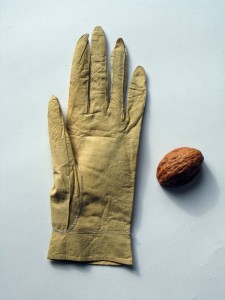
Limerick glove. Image @The Museum of Leathercraft.
Circassian women were regarded as strong, beautiful, and exotic, which is how the woman wearing the ball dress depicted in the Ackermann fashion plate must have felt.
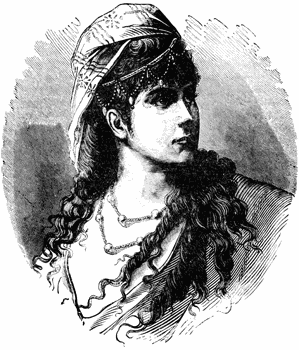
Circassian woman. Image @Clipart, etc.
The circassian robe, or an outer garment used in ceremonial occasions, is not as evident in the fashion plate as in the dress below, where it flows over the gown’s train.
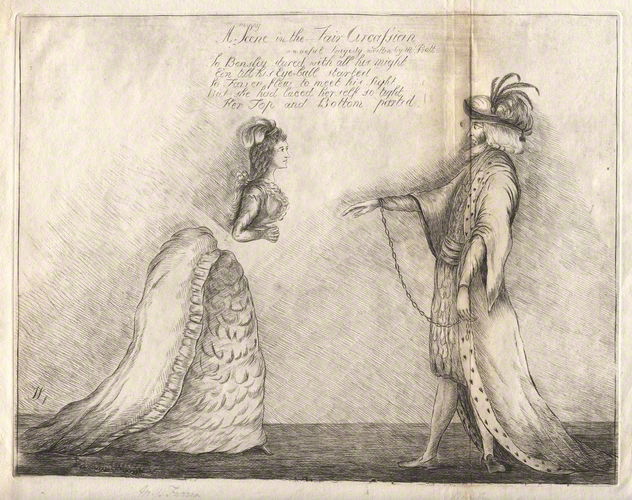
Eliza Farren in 'A Scene in the Fair Circassian' with Robert Bensley by James Sayers. Etching ca. 1781 from the National Portrait Gallery NPG D9544
Rich lace, tassels, and an ivory fan completed our fashionable lady’s the ensemble.
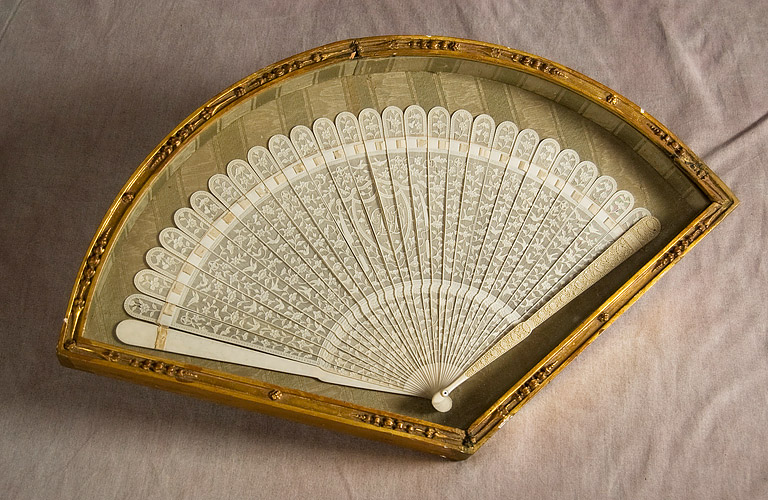
Decorative imported ivory fan. Image @Independence Seaport Museum.
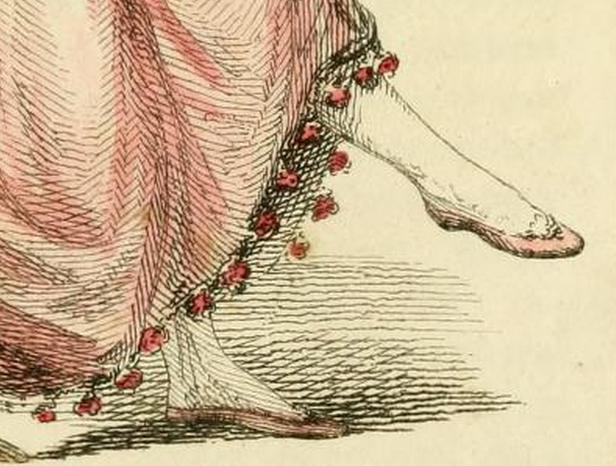
Detail of the hem.
More about the ball gown’s fashion influences:
Posted in Fashions, Jane Austen's World, Regency Life, Regency Period, Regency style, Royalty, tagged Princess Charlotte, Princess Charlotte's blue gown, Regency Fashion on April 22, 2012| 17 Comments »
It is a rare occasion when we can compare a gown in a portrait with the actual dress. The painting, after George Daw, of the Prince Regent’s daughter, Princess Charlotte, shows her wearing a charming blue gown in a domestic, albeit royal, setting.
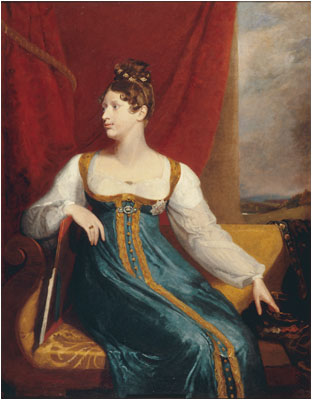
Princess Charlotte in her Russian Dress. Painting after George Daw, 1817. Image @Wikipedia
A second portrait depicts the same dress more royally. Princess Charlotte (or the artist) has accessorized the dress with ermine, lace, and pearls.
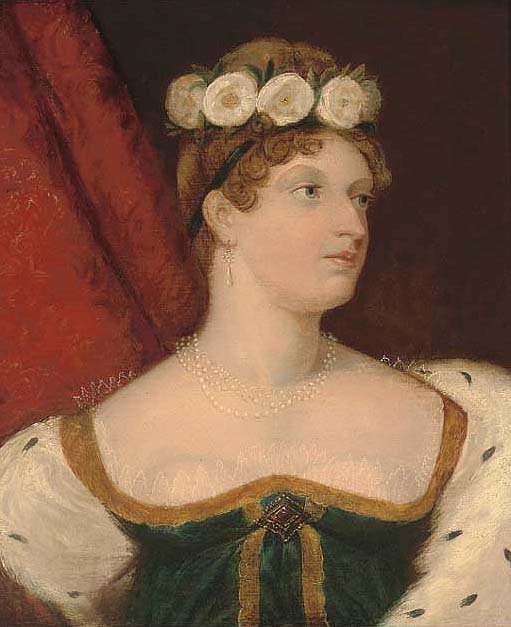
Image @Grand Ladies
The mannequin from the Museum of London exhibit a few years back is dressed more informally, as if she was in the morning room reading. I found the image on Pinterest, but unfortunately the pin did not state the image’s origin. (A reader wrote that the dress belongs to the Royal Collection.)
As you can see, the dress no longer possesses the rich blue hue as shown in the paintings. So many of the costumes of that era are not only in a fragile state and can rarely be shown, but we cannot trust that the colors have remained the same.
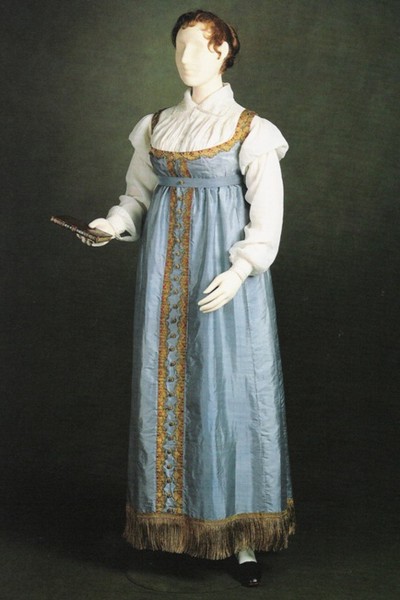
Princess Charlotte's "Russian" outfit as shown at The Museum of London. The gown belongs to The Royal Collection.
Below is the original portrait by George Daw, which shows Princess Charlotte wearing the same dress. Click here for yet another view of Charlotte in a similar gown, but without the trim and wearing a lace cap. My sense is that after her death Princess Charlotte’s image became sought after and that many portrait copies were made (both in oil and in print) to satisfy the mourning public.
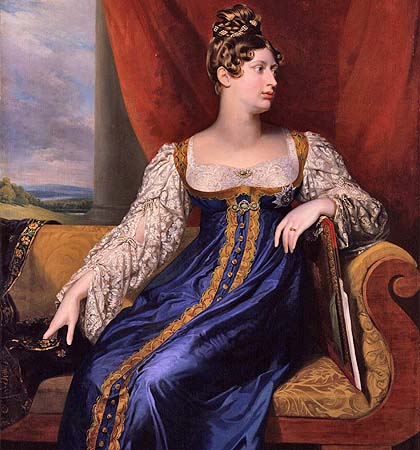
Princess Charlotte, George Daw, 1817. Image @National Portrait Gallery
Find more views of the gown at Jenny La Fleur’s site. Images of the gown can be seen in the exhibit catalogue called In Royal Fashion: Clothes of Princess Charlotte of Wales and Queen Victoria, 1796-1901, which can only be obtained second hand.
The exhibit: Princess Charlotte, The Lost Princess, will be on display at the Prince Regent Gallery in the Brighton Pavillion through 10 March, 2013.
My other posts about Princess Charlotte:
Posted in Fashions, jane austen, Jane Austen's World, Regency Life, Regency style, Sense and Sensibility, tagged Capote bonnet, Heideloff fashion plate, Regency Fashion, Regency hats on April 20, 2012| 13 Comments »
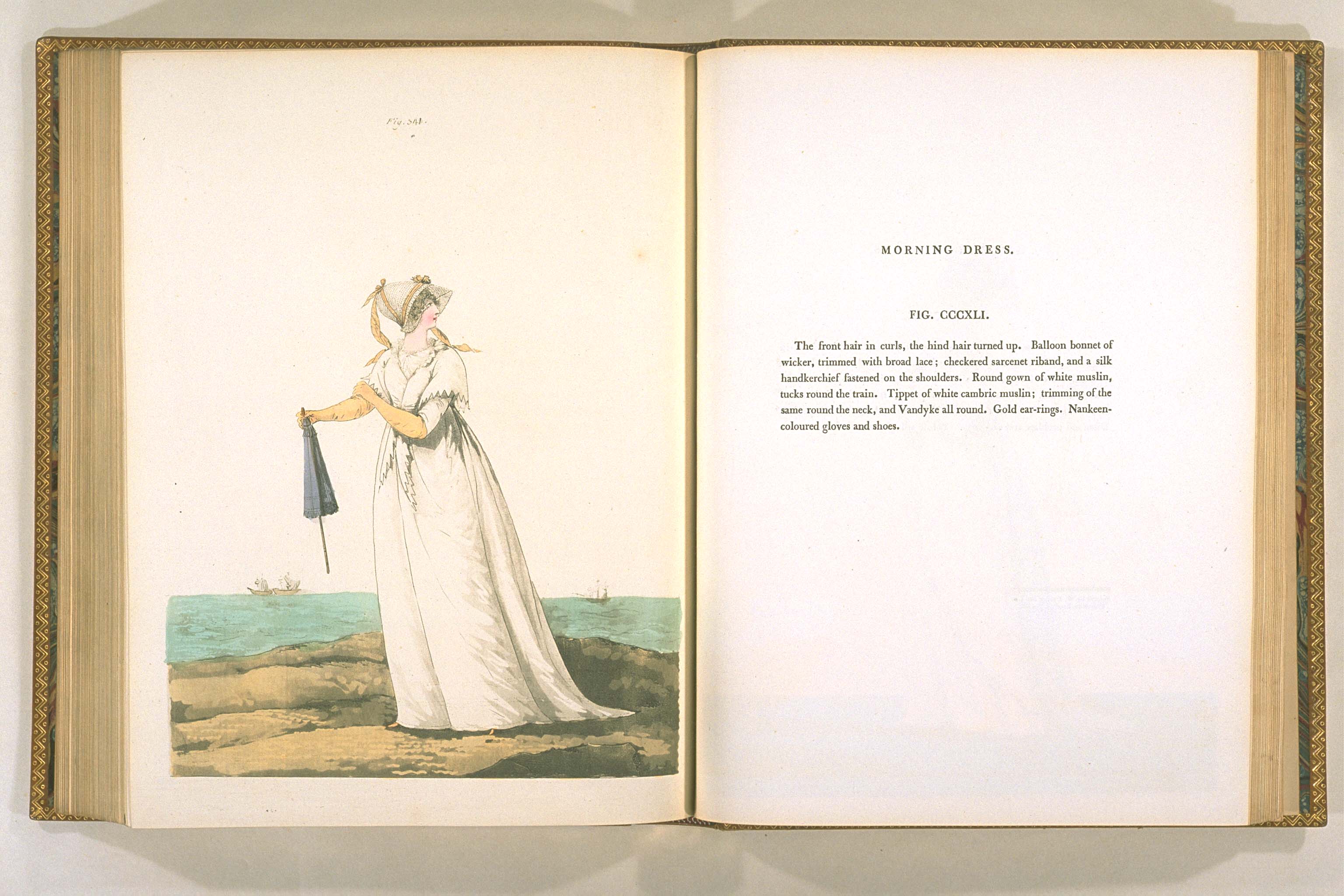
In Sense and Sensibility 1996, Kate Winslet as Marianne wears a charming straw sun bonnet as she recuperates from her illness. When I ran across the fashion plate of a morning dress from The Gallery of Fashion, 1794-1798, I was immediately struck by the similarity, although the brim in the fashion plate is more elaborate.
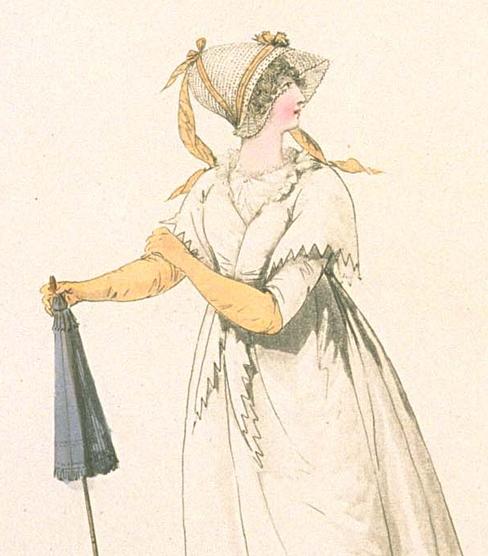
Detail of a morning gown and balloon bonnet, Heideloff, The Gallery of Fashion
The magazine described the head wear as a “balloon bonnet of wicker, trimmed with broad lace. The front hair is in curls, the hind hair is turned up.” I suspect that Lydia Bennet would have wrapped ribbons around her capote much as in the above image.
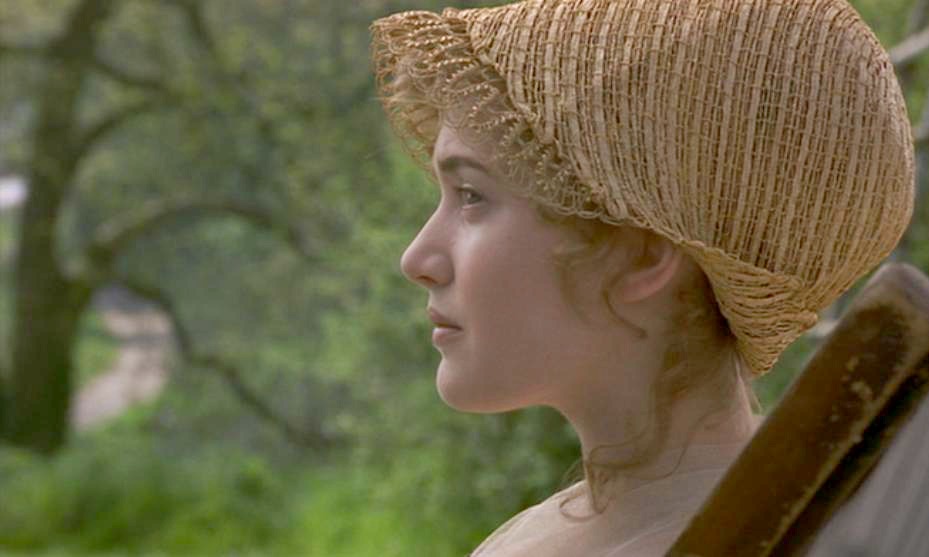
Kate Winslet’s capote is simpler, but equally charming. Capotes, or scoop-shaped bonnets, were popular in the early Regency and first made their appearance in the 1790s. The hats accommodated the modish hair styles of that era, which were short or piled on top of the head.

Bonnet, 1805-1810. Image@The Victoria & Albert Museum
Generally made to be worn outdoors, capotes were also worn as evening headwear early in the 19th century. This evening capote is elaborately trimmed.
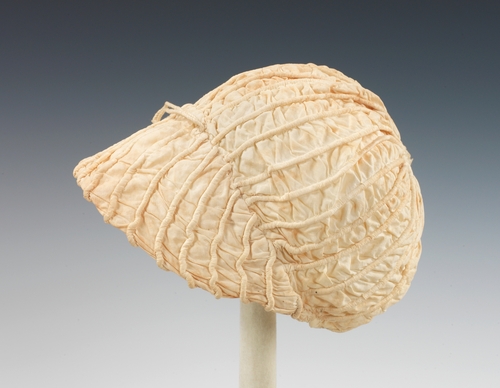
Infant bonnet, 1820. Image @Metropolitan Museum of Art
The charming bonnet was made for an infant. Click here to read the description. The image below shows a modern interpretation of a Regency era capote bonnet. (Living With Jane)
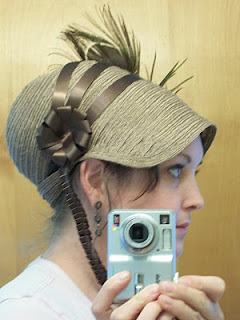
Image @Living With Jane
The shape of the Capote bonnet changed as hairdos changed, and the hat crown shifted to accommodate the increased height of swept up hair. The poke, or brim, also became larger over time. This definition describes the Victorian capote: Close fitting bonnet with rigid brim, either of straw or boned into shape. Soft, shirred crown , ribbon bows tied under the chin, Victorian 19 c. with deep ruffle in back. Also poke bonnet, fanchon, scuttle bonnet, sun bonnet. – Glossary of hats, Village Hat Shop.
View images of the Victorian capote here http://www.metmuseum.org/collections/search-the-collections/80044650 and here http://www.metmuseum.org/collections/search-the-collections/80044657. You can see the vast difference between the two styles, yet they are still capotes.
This link leads to instructions for making a Capote Beguin, or Edwardian Era bonnet.
Make Your Own Regency Bonnet
More on the topic:
Posted in Fashions, Georgian Life, jane austen, Jane Austen's World, Regency Life, Regency style, Regency World, tagged Ackermann fashion plates, morning gowns, Regency Fashion on April 18, 2012| 18 Comments »
Fashion is always more than it seems on the surface. Take this charming Regency morning dress from Ackermann’s Repository (April, 1812), for example. Its detailed description in the magazine demonstrates how many historic influences shaped this romantic costume. The lady who wore these garments as a total ensemble would have known about its medieval, Elizabethan and Jacobean associations.

Morning or Domestic Costume: A superfine Scotch or French cambric over a cambric slip, with full long sleeve, and ruff a la Mary Queen of Scots. A neck-chain and sight set in gold; bracelets and necklace of white or red cornelian. A Flora cap, composed of white satin and lace. A capuchin or French cloack of blossom satin, or Pomona green, trimmed with thread lace. Slippers of pale pink or green; and gloves of tan or Limerick kid.
Cambric material, also called batiste and made of bleached linen or cotton, was widely used in the 19th century for handkerchiefs, shirts, bed and table linens, and as fabric for lace. Scotch cambric was actually a fabric made in India. French cambrics were hard to come by after the British banned imports from France during the war.
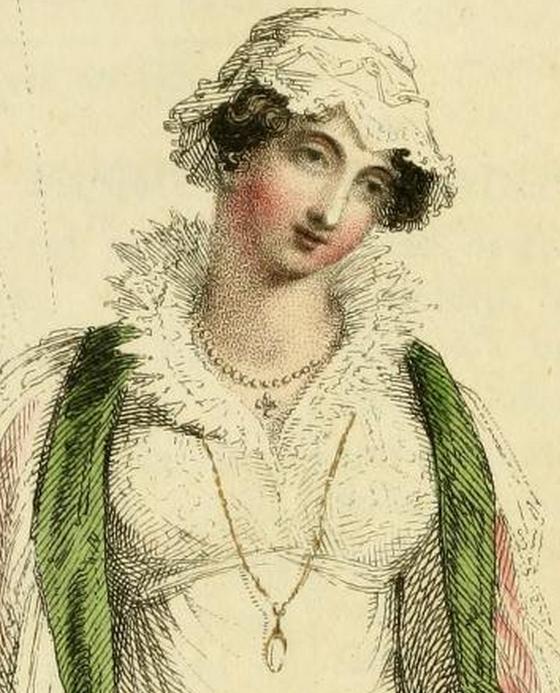
Detail of cap, ruff, and necklace with quizzing glass, or 'sight'.
The Mary Queen of Scots ruff indicates the influence of the Elizabethan era in fashion and architecture. At this time, British fashion began to diverge from French fashion because of the Napoleonic wars, which effectively blocked normal communication and travel between the two countries. By 1811, fashion designers, who were influenced by the Romantic sensibilities of British poets and philosophers, looked to the Tudors and the Gothic eras for new fashion statements. Ruffles and slashed sleeves began to appear, and gowns began to veer from the elegant simplicity of Grecian designs to more embellished dresses.

Flora McDonald
I found almost no references to the flora cap, which hugs the skull. In this instance, a lace brim frames the face and hair. Historically, Flora McDonald was immortalized through her association with Bonnie Prince Charlie, and in the early 19th century, Sir Walter Scott symbolized her as the embodiment of romanticized Scottish Jacobitism. One portrait of Flora shows her wearing a lace cap. Interestingly, today’s baseball and American hunting caps pop up when one Googles either Flora cap or Jacobean hats.
Cornelian, primarily found in India, was a popular semi-precious stone used in jewelry. The rust red is more prevalent over the white. Think of the colors of a cameo and you will have an idea of what bracelets and necklaces made of cornelian might look like. In this instance, the fashion plate depicts a white carnelian necklace.
Capuchin cloaks were loose hooded cloaks whose design origins dated back to the medieval period. Capuchin monks, a 16th century off shoot of the Franciscan monks, wore distinctive pointed hooded cloaks, whose popularity remained strong through the 18th and 19th centuries.
I found this Victorian reference to Limerick kid gloves highly fascinating:
the best foreign glove is not better in any respect than the best Irish glove,—because the best London-made kid glove is rarely imported, or, if imported, cannot be sold as cheap as the best Dublin, Cork, or Limerick kid,—because the majority of imported gloves are made by frame, instead of by hand, and that the stitching by hand is much surer and firmer than sewing by machine; as, if one stitch give in a hand-made glove, that stitch alone goes, while if a stitch give in a machine-made glove, the whole finger is apt to go—and, lastly, because the article that is generally sold, is made of what, in the trade, is called “seconds,” the raw material being what is technically termed ” slink lamb,” and not kid; the difference of which may be better understood when I state that “seconds,” or “slink lamb,” can be bought by the manufacturer at from 1s. 3d. to 2s. per dozen, while kids range from 8s. 6d. to 14s. per dozen. What is usually called French kid, is, in reality, Italian lamb. So that my advice is—stick to the Irish kid, which will give good wear, and look charmingly on the hand.” – The industrial movement in Ireland, as illustrated by the National exhibition of 1852 (Google eBook), John Francis McGuire, 1853, p. 87

Detail of the Limerick kid gloves.
Although this lady is wearing a household garment meant to be seen only by family and close friends, and which she will keep on until she goes out to shop or visit friends, she is also wearing a cloak and gloves. One of the coldest vacations I ever spent was a week in April in London (the second coldest was a windy weekend in August in San Francisco). I visited a friend who lived in an ill-heated apartment, and I shivered for 7 days during one of the rainiest weeks this Dutch girl ever experienced. I imagine that the domestic outfit portrayed in this fashion plate was well suited to staving off cold drafts and the shivers.
Several years ago I engaged in an online discussion about whether a lady wore gloves indoors. My “opponent” was adamant in her assertions that ladies did NOT wear gloves inside, saying that Regency portraits indicated that they never would. Never say never. I replied that this made no sense. Ladies tried to look their “Sunday” best for expensive portraits destined to be hung in long galleries, which meant showing off their most beautiful clothes and their milk white, unsullied hands. Besides, I found one or two paintings that portrayed a woman wearing gloves inside the house. I imagine that in some instances, a visitor might keep her gloves on if her visit was short and she was offered nothing to eat or drink. (Think of Lady Catherine de Bourgh’s imperious visit to the Bennets to confront Elizabeth about her intentions with Mr. Darcy.) The gloves in this print might mean that the woman was sitting in a glassed-in conservatory or in the confines of her private garden.
A lady who lived in a freezing mausoleum of a house would be a fool not to keep her gloves on. This fashion plate shows such a sensible young woman.
2025 AGM in Baltimore

RECOMMENDED BOOKS AND RESOURCES



Available through December 31st, 2025. Click on image for details, and share this poster with other teachers and students!


Click on image to read the story.

Gentle readers: Please feel free to post your comments and continue the conversation! Due to SPAM, we will no longer accept comments on posts after 30 days of publication. In some instances, links will be removed from comments as well.


If you would like to share a new site, or point out an error, please email us. (Yes, we are fallible. We'll own up to our mistakes and will make the corrections with a polite smile on our faces.) Write us at

Thank you for visiting this blog. Your comments and suggestions are most welcome.
STAGE-COACH AND MAIL IN DAYS OF YORE: A PICTURESQUE HISTORY
OF THE COACHING AGE, VOL. II, By CHARLES G. HARPER. 1903. Click on this link.

Disclaimer: Our team makes no profit from this blog. We may receive books (physical or digitized) for review purposes.
Copyright Statement: © Jane Austen's World blog, 2009-2024. Unauthorized use and/or duplication of this material without express and written permission from this blog’s author and/or owners is strictly prohibited. Excerpts and links may be used, provided that full and clear credit is given to Jane Austen's World with appropriate and specific direction to the original content.
 Jane Austen's World