Feeds:
Posts
Comments

Posts Tagged ‘Regency Fashion’

Copyright @Jane Austen’s World

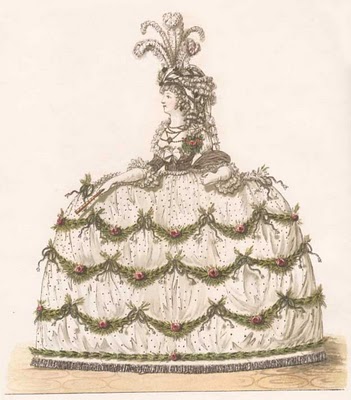
Looking at the images in this post, one can only imagine how difficult it was for a woman in full evening dress (or court dress) to move around. Between taking care of her shawl, reticule, dance card, and fan, she had to walk upright and sedately so that her head feathers did not topple over after an abrupt movement or caught fire under chandeliers ablaze with candles.

1794-95 Court Dress

Examining the above image, one can readily see that these costumes were designed for high-ceilinged rooms that were opened by high double doors.

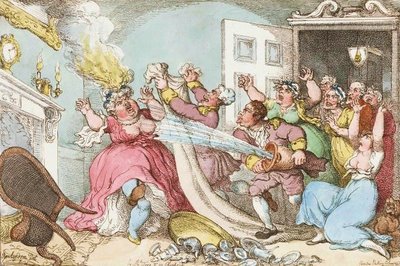
A lady's wig catches fire. Thomas Rowlandson. Image @Yale University

In this dramatic image, Thomas Rowlandson catches a moment of real danger both for the lady whose wig (and feathers) caught fire, and for the guests, who might have been trapped in a house fire, for water to put out flames was not easily obtained.  In the late 18th century The London Times reported on several more incidents in which ladies found ways to accommodate their head feathers, or in which the feathers (and mother nature) got the best of them.

Lady Godina's Rout

At all elegant Assemblies there is a room set apart for the lady visitants to put their feathers on, as it is impossible to wear them in any carriage with a top to it. The lustres are also removed upon this account, and the doors are carried up to the height of the ceiling. A well-dressed Lady who nods with dexterity can give a friend a little tap upon the shoulder across the room without incommoding the dancers. The Ladies feathers are now generally carried in the sword case at the back of the carriage.  – Times,  Dec 29, 1795.

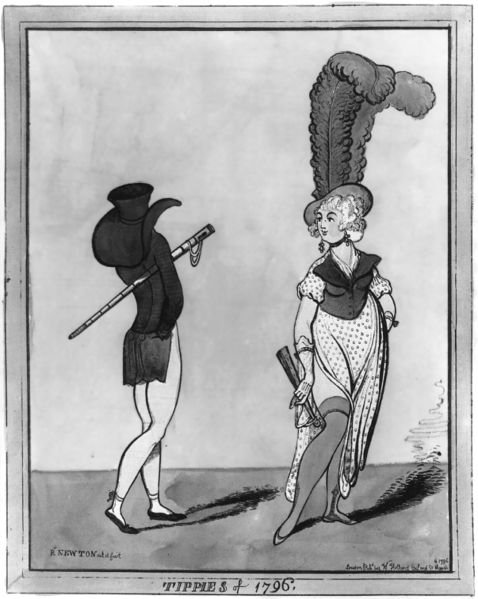
Tippies of Newton, 1796 caricature by Richard Newton. Image @Wikimedia Commons

A young lady only ten feet high was overset in one of the late gales of wind in Portland Place, and the upper mast of her feather blown upon Hampstead Hill.  “The maroon fever has been succeeded by a very odd kind of light-headedness, which the physicians call ptereo mania, or feather folly.” The Ladies now wear feathers exactly of their own length, so that a woman of fashion is twice as long upon her feet as in her bed. –  Times, Dec 30, 1795.

1796, High Change in Bond Street, Gillray

We saw a feather in Drury Lane Theatre yesterday evening that cost ten guinea. We should have thought the whole goose not worth the money.  – Times, Jan 6, 1796.

A Modern Belle Going to the Rooms at Bath, James Gillray, 1796. Image @Wikimedia Commons

Here is a contrivance by which A Modern Belle going to the Rooms or Balls can go fully dressed with her feathers fixed. There is to be seen in Gt Queen Street a Coach upon a new construction. The Ladies set in this well and see between the spokes of the wheels. With this contrivance the fair proprietor is able to go quite dressed to her visits, her feathers being only a yard and a half high. –  Times, Jan 22, 1796.

Vis a vis Ladies Coop, 1776

The Times described predicaments regarding head feathers that were not new. Note how twenty years before, both high wigs AND feathers were accommodated. And, indeed, feathers, whether made from ostrich, emu, goose, or peacock, remained popular as a head dress for years to come.

The headdress, while always including a veil, also required feathers as part of it, although, the number and size of the feathers varied with the Monarchy. At the time of Queen Charlotte, young ladies wore one single towering ostrich feather, but through the years, the number of feathers required increased. By the Edwardian Era, the widespread use of feathers to decorate hats and bonnets began the passage of laws that restricted using certain types of bird’s feathers.*

Queen Victoria hated small feathers, so orders were issued that Her Majesty wanted to see the feathers as the young lady approached. Later in Queen Victoria’s reign, as well as in the court of Edward VII, the mandated headdress was three feathers arranged in a Prince of Wales plume–that is, the center feather was higher than the two on each side of it–and it was worn slightly on the left side of the head. Tiaras were worn by married women, and it was extremely difficult to keep the feathers in place, especially during the curtsy.

More on the topic:

Read Full Post »

Copyright (c) Jane Austen’s World.

Hear what a male writer has observed on the fashion of exposing the bosom! A woman, proud of her beauty, says he, may possibly be nothing but a coquet: one who makes a public display of her bosom, is something worse.” – The Mirror of  Graces, by A Lady of Distinction, 1811, p. 120

Could the above statement possibly be true in light of our modern assumptions that the Georgian bossom was displayed in all its soft glory for all to see?
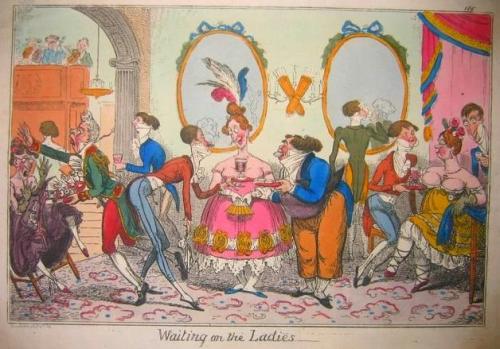
Waiting on the ladies

Our modern perception is heavily influenced by the caricatures of the period that make fun of unrestricted Regency gowns. But how much did contemporary cartoonists exaggerate? And what sort of woman would have exposed her bosom to such an extent that she would have been regarded as worse than a coquet? To be fair, the above image depicts a time (the 1820s) when the waist had gone as high as it could go under a woman’s bosom, skirts had widened and become conical shaped, and hems were festooned and decorated and shortened to reveal slippers and ankles.

Regarding the bosom, the proof is in the pudding, and the best way to assuage our curiosity is to view contemporary examples year by year.
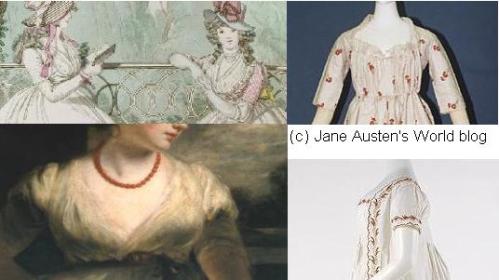
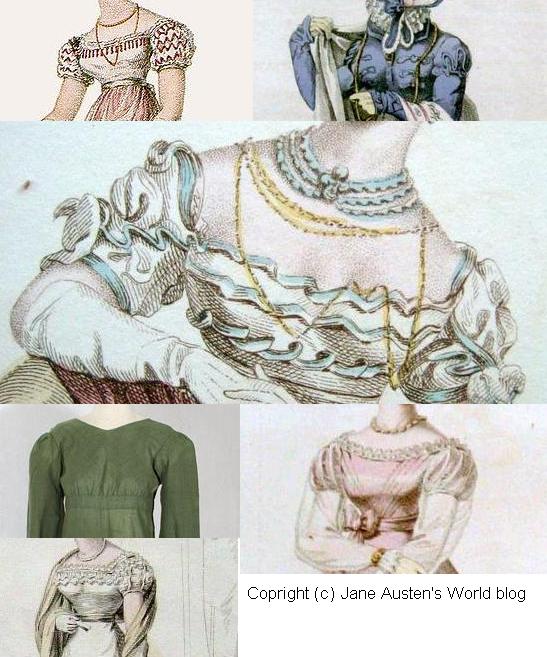
From left, upper row: 1794-1795 walking gowns. 1795-1800 round gown. From left, lower row: 1797 Countess of Oxford. 1798, round gown.

Gentle reader, as you peruse the gallery of images, please look for a pattern. You shall begin to see a distinction between day and evening dress, regardless of the time of year.
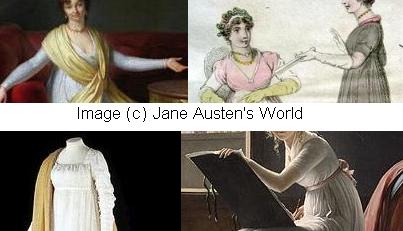
1st column, top: 1800, Salucci family. Bottom: 1800 V&A gown. 2nd column, top: 1801 April day gowns. Bottom: 1801 Marie Denise Villiers

While I believe that a variety of cleavages were on display during the Regency era (and I shall delve more into this topic later), the top left portrait of Mrs. Salucci is one of the few instances in which a shadowed cleavage is clearly painted or drawn.
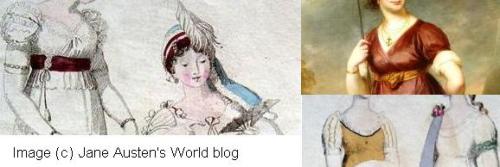
1802 Bosoms. Top right: Princess Augusta. Other two images from Ladies Monthly Museum.

Why is this? One can safely assume that a voluptuous woman with large breasts, even when wearing a dress with a modest neckline, would reveal some cleavage. Thin girls or women with small bosoms would not have as much difficulty following the rules of decorum. Before the 20th century, the feminine ideal was a woman whose curves were bounteous and whose figures were pleasingly plumb. Rich husbands and fathers were proud to show off their well-fed women. Only the poor, who toiled all day and never had enough to eat, or the sick, or those who were metabolically overchallenged, were thin and scrawny. Thus, it made sense that during the Regency heaving bosoms were de rigueur. But were they?
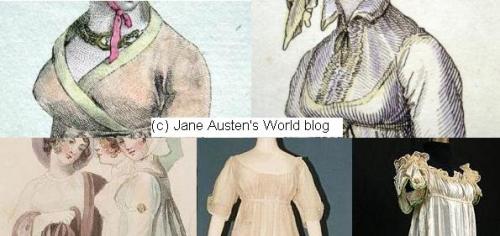
In this image I have included both French, English, and American gowns. Left to right, clockwise, starting at the top. 1803, Costume Parisien. 1803, Mirroir de la Mode. 1805, American neoclassical gown. 1805, English cotton muslin, Kyoto costume Institute. 1804, three French Promenade dresses.

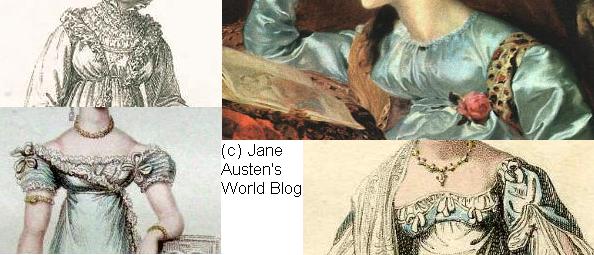
Regardless of nationality, a woman could choose to be as modest (or daring) as she liked. As far as I can tell from fashion images and portraits, modesty won hands down. High necklines, chemisette inserts,  and high collars ruled the day. But night provided a different story.
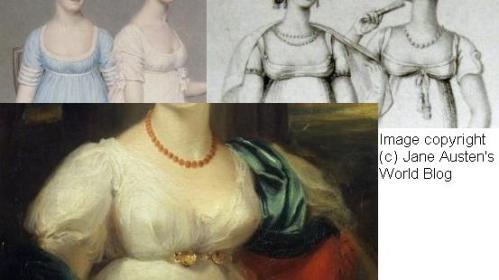
1806 gowns. Top left, Binney sisters. Top right, Opera and drawing room gowns. Bottom image, Lady Codrington.

In the above composite image of 1806 gowns, more of the bosom is revealed than in previous images. Consider the sources. The Binney sisters and Lady Codrington, who were sitting for their portraits, would have chosen their best gowns to wear. Full dress, or evening dress, revealed more skin. The third image also depicts evening wear. In those two images you can more readily understand why empire gowns created such a stir at first:

Observers of the period frequently deplored the absence of modesty conveyed by a style that was predicated on the prominence and exposure of the breasts and on the barely veiled body….Sheer, narrow dresses … caused a sensation at the beginning of the nineteenth century, more because of their contrast with the elaborate hooped costumes of previous decades than for any real immodesty. – Source: Two dresses [French] (1983.6.1,07.146.5) | Heilbrunn Timeline of Art History | The Metropolitan Museum of Art
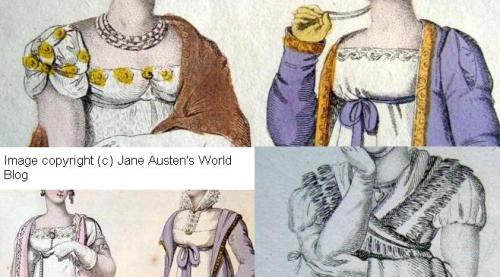
1807 Regency gown fashion plates

By now you have seen enough examples to have noticed a trend. Examine the above fashion plate images. Which necklines belong to full dress, or evening gowns, and which belong to day gowns or walking gowns? Of the five necklines, only the top left can be construed as revealing. And this neckline, depending on the size of the woman’s breasts, could be both modest or plunging.

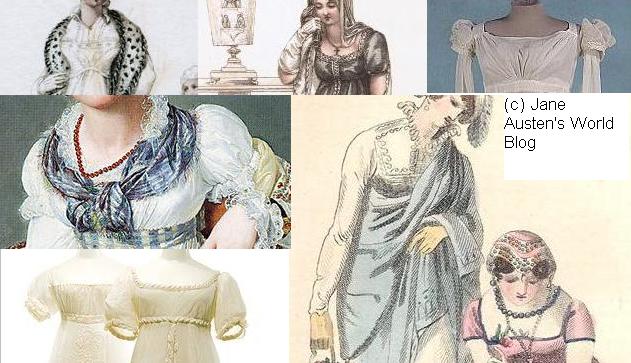
1810 Regency gowns

The 1810 Regency gowns demonstrate a variety of necklines and layers of clothing. As in Cassandra’s portrait of Jane Austen,  chemissetes were widely used. Fichus, shawls, tippets, and pelerines were also popular. The widow in the evening mourning gown (top middle) wears a cross that lies inside her cleavage. The white embroidered gowns (top right and lower left) demonstrate how the neckline is determined by whether the gown is worn for day (top right) or for evening (lower left, image of French gowns, Metropolitan Museum of Art.)
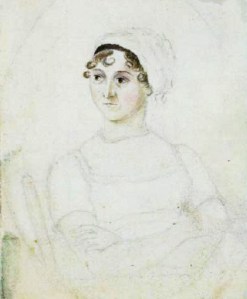
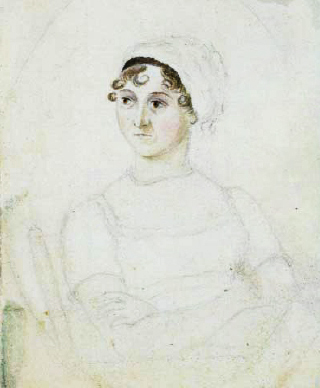
Jane Austen by Cassandra, 1810

In the image painted by Cassandra, Jane wears a simple gown, much like the Binney sisters were wearing. You can observe her chemisette under the low neckline, which created a more modest look for day time.

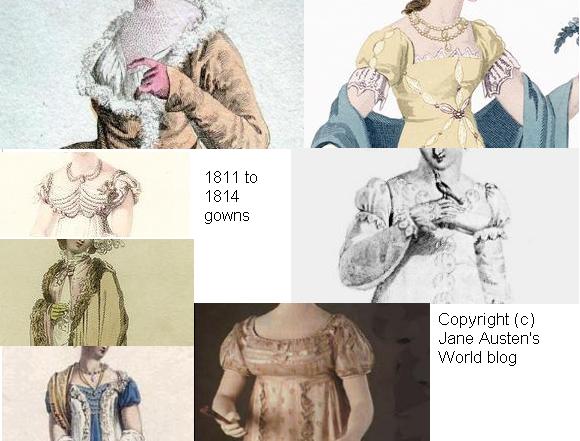
Regency gowns, 1811-1814

Princess Charlotte’s 1814 bellflower court gown (lower right), while breathtaking, did not reveal her bosom. The image of the 1812 full dress (second from top on the left) is a bit misleading, for the decorative drooping elements give the illusion that the neckline is lower than it actually is.  (In this example, it is hard to see the line of the silk fabric running across the top.) The other day gowns cover the torso quite modestly.
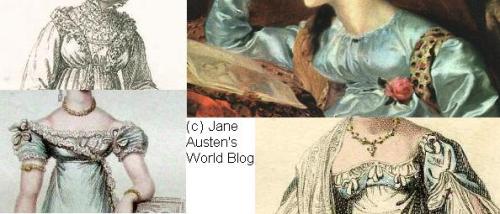
1815-1816 Regency Gowns

The high necklines of the 1815 morning gown at top left and Mrs. Jens Wolff’s 1815 satin dress at top right would make a Quaker lady proud. The two 1816 evening gowns show a relatively modest neckline (lower left) and one that could be quite daring (lower right).

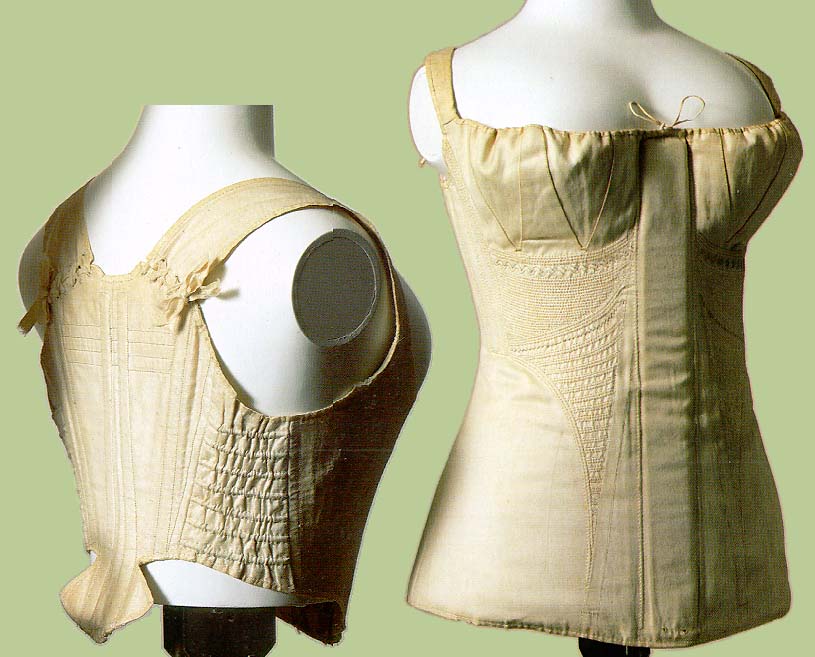
Until now I have not discussed the role that corsets played in propping up the bust line. Regency stays, which were darted and laced in the back, were quite short and were much less constricting than earlier Georgian models that cinched in the waist. The purpose of the Regency stay was to support a woman’s bust and create the distinctive Regency “shelf” silhouette.
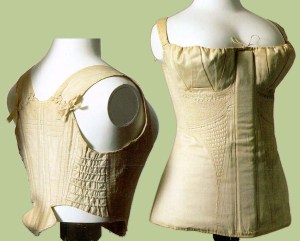
1819 stays (short on left, long on right with inserted busk). Image @ Kyoto Costume Institute

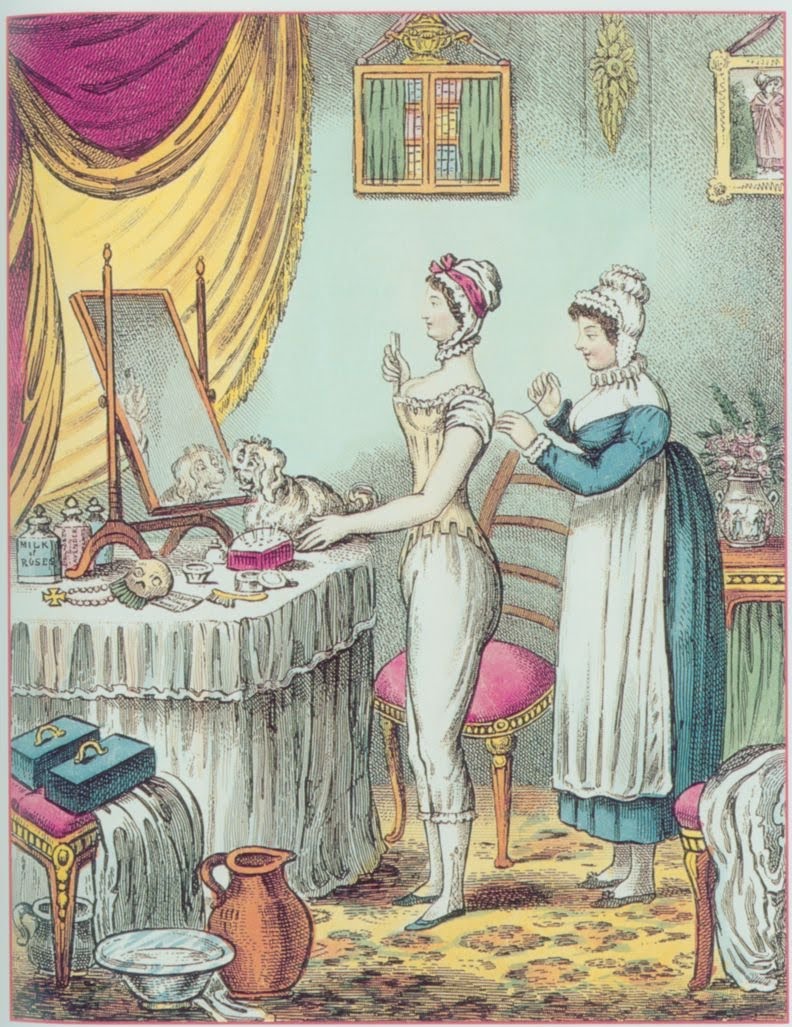
A rigid wood or bone busk, which served to separate the breasts and encourage good posture, was inserted in the stays (or corseted petticoat).
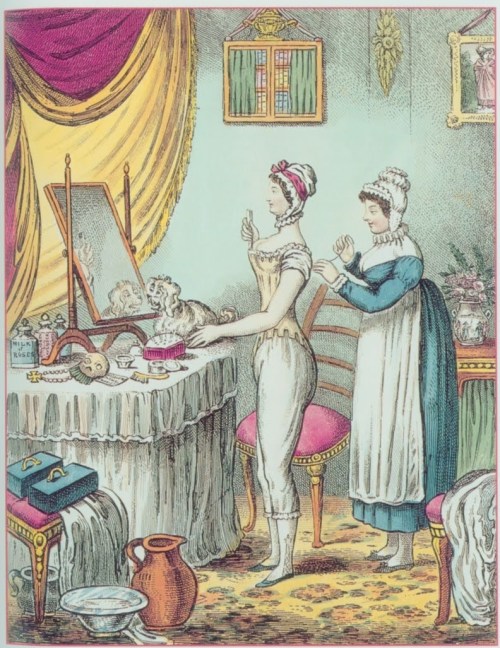
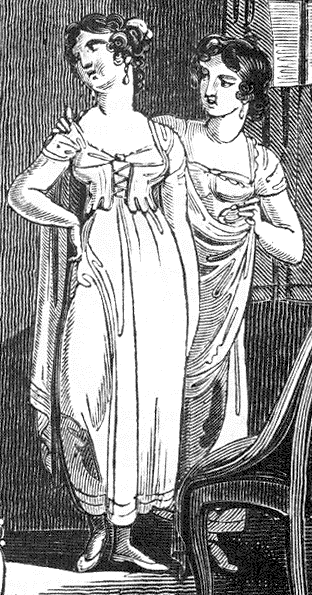
1810 German copy of James Gillray's cartoon. The lady inserts her busk as her maid ties her stays.

Busks might provide one explanation of why so few drawings and paintings of the era depict a deep, shadowed cleavage, for the breasts were splayed aside. The busks were often hand-carved and decorated by a woman’s sweetheart. The exerpt from a poem entitled: On a Juniper Tree, cut down to make Busks, waxes eloquently about the tree’s sacrifice for beauty.

She cut me down, and did translate,

My being to a happier state.

No martyr for religion died

With half that unconsidering pride;

My top was on that altar laid,

Where Love his softest offerings paid:

And was as fragrant incense burned,

My body into busks was turned:

Where I still guard the sacred store,

And of Love’s temple keep the door.

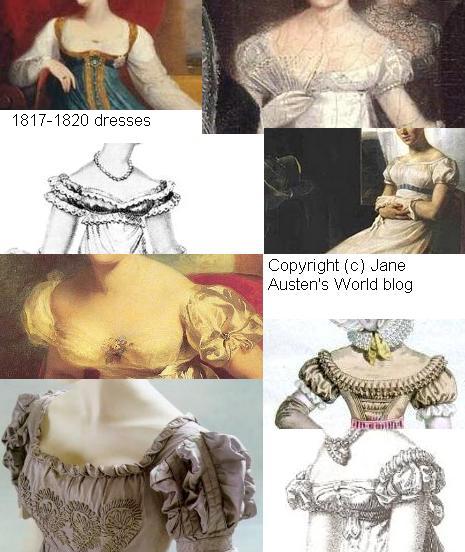
1817-1820 dresses

By 1817, the stark neoclassical outlines of empire gowns at the turn of the century had given way to a fancier more decorative outline, in which embellishments were added both at the top of the gown and at its hem. The 1817 portrait of Princess Charlotte (top left) is bittersweet, for she died in fall of that year in childbirth. Once again, the popular princess fails to exhibit her cleavage.

Rolinda Sharples’ painting of the cloak room at Clifton Assembly Rooms (top right) shows a woman with a small bust wearing a low décolleté ball dress. Countess Blessington (second from bottom, left) also wore a daring neckline for her sitting for her portrait by Thomas Lawrence. The two evening gowns at the bottom are modest, and the 1820 beige walking dress with its high ruff neck demonstrates the Tudor influences in dress embellishments. Also note the lowered waistline.
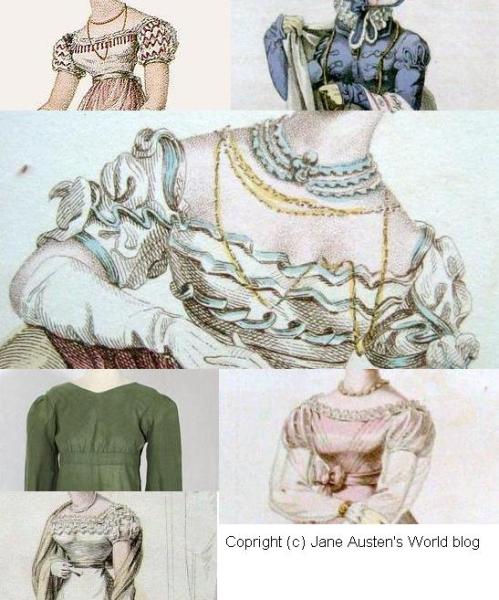
1823-1825 dresses

By 1823, Jane Austen had been dead for six years. She would have been shocked to see how many furlebows, tucks, rows of lace, and ribbons decorated ladies gowns. At this time, the waistline was gradually lowering back to its natural position. Gone was the neoclassical Regency empire silhouette. Note how the three ball gowns shown in this series of images provide hardly any chance for a lady to show off her cleavage.

One can see the hint of shadow of the woman’s breasts in the large 1823 La Belle Assemblee image in the center and how the artist accommodated the influence of the busk. I included the plain every day green 1825 American gown to show the kind of dress an ordinary woman would sew for herself and wear.

I hope this post has cast a light on a Regency lady’s bosom. A Lady of Distinction wrote in 1811:

Let the youthful female exhibit without shade as much of her bust as shall come within the limits of fashion, without infringing on the borders of immodesty. Let the fair of riper years appear less exposed. To sensible and tasteful women a hint is merely required.”

A tasteful hint? I can only conclude that exposing too much of one’s bosom was not considered lady-like behavior. Thin and small breasted women experienced an easier time following society’s strictures. The well-endowed had a tougher row to hoe, although an enterprising young virgin could always insert a handy nosegay to hide her feminine bounty or add  a pretty bow or a lace embellishment at the precise spot where a gentleman’s eyes should not stray.

Brazen hussies, light skirts, and women of easy virtue could bare as much skin as they pleased, having no reputation to protect. A very rich matron, whose place in society was secure, might be tempted to show more of her bosom than was prudent, but even she would refrain from displaying too many of her feminine allures before she was married!

Next, I will discuss heaving bosoms in Regency films and on book covers, and how the two media have influenced our perception of Regency bustlines.

More on the topic:

Read Full Post »
Copyright (c) Jane Austen’s World. Look at this lovely Regency lady in this image from 1814. Her petticoat peeps under her fashionably short gown, whose conical shaped skirt has been given a definite shape by the undergarment.

1814 Ball Dress, Costume Parisien

At the turn of the century, when lighter cloths were used to fashion gowns and when the dress silhouette was columnar and worn close to the body, the use of a chemise or petticoat was even more crucial, for the thin fabric would cling to the legs and work its way between them without the barrier of the petticoat. A few weeks ago, one of my posts created a stir when I revealed that drawers were regarded as optional underwear for Regency ladies, and readers wondered how a Regency lady could withstand the cold in winter.

Morning Dress, Ladies Monthly Museum.

While bloomers were optional,  a petticoat was an absolutely necessity. Dress fabrics were gossamer thin, and petticoats, made of sturdier linen or cotton, and reinforced with tucks and perhaps a thin line of boning at the hem, served to give shape to the hem of the dress, keeping it away from the feet and body. As skirts rose, the decorative elements of a petticoat peeped out under the skirt. Below, one can see a typical petticoat of the day (with corset on top of it). This one is short, but the tucks are evident.

Petticoat

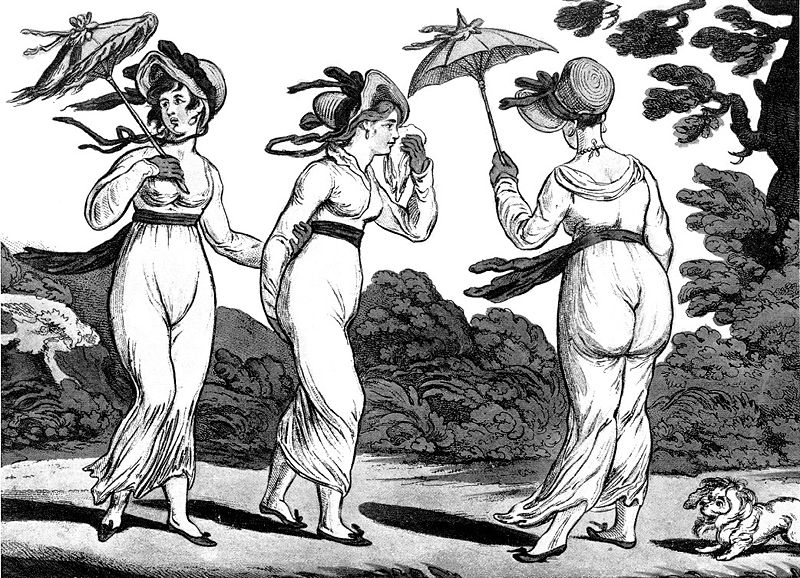
Without this undergarment, the thin fabric of a ladies gown would hug her body, revealing her legs and her mons of Venus in stark outlines when she moved. Gillray’s cartoon of The Three Graces in High Wind demonstrates how revealing Regency dresses were, even when petticoats were worn.

The Three Graces in High Wind, James Gillray, 1810

Illustrators James Gillray, Isaac Cruickshank, and Thomas Rowlandson relished making fun of the new fashions. In the image below Gillray shows the effects of wearing a gown without underwear and taking the fashion features of décolleté and side slits to the extreme. Rather than creating an elegant effect, the lady resembled a tart.

Boilly’s painting shows how clearly the chemise, which ended above the knees, shows through the thin fabric of this lady’s gown.

Point de Convention, Louis-Léopold Boilly, ca. 1797. Image @ Wikimedia Commons.

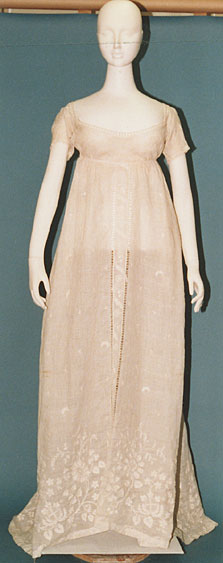
This image from the Kyoto Costume Institute also demonstrates the transparency of Regency gown fabrics.

White muslin dress with whitework embroidery, 1810. Image Kyoto Costume Institute.

The unusual (and rare) practice of dampening one’s gown at the turn of the century was most likely followed by light-o-loves, courtesans, ladybirds, cyprians, and women of ill repute. Aristocratic women who were confident in their unassailable status might have gotten away with such licentious behavior on a dare, and their fashion inclinations might have been considered “au courant”, but no proper lady, no young miss on the marriage mart, no merchant’s daughter looking to improve her station in life, would for a moment consider walking out in public without the protection of a chemise or petticoat, much less wet her gown to make it more revealing. While caricaturists showed enormous zest in depicting the new revealing fashions, they exaggerated the trend of these flimsy gowns out of all proportion in their visual commentaries.

Isaak Cruikshank, Parisian ladies in full winter dress, 1800. Image @ Wikimedia Commons.

Addendum: I must add that another primary purpose of these undergarments was to protect the delicate outer garment from soiling. In Regency times people did not wash themselves frequently, and petticoats and chemises presented a barrier between unwashed and sweaty skin and the dress. Since undergarments were made of sturdier fabrics, they could be laundered more often. In addition, people with less means owned fewer gowns and employed fewer servants to do the laundering. Even these ladies owned a number of chemises (usually homemade) and petticoats that could be washed frequently, thereby protecting their every day AND special gowns.

More on the topic:

Read Full Post »
Copyright (a) Jane Austen’s World. Gentle Readers, The previous post elicited a question about Regency underdrawers or a lady’s unmentionables. My answer was so long that I decided to create a new post from it.

1742 and 1794 fashion silhouette contrast

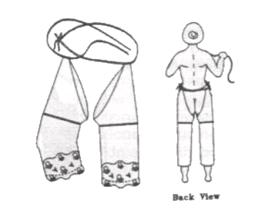
Drawers, which made their first serious appearance in 1806, and were fashioned after men’s underdrawers, were still optional during 1810. They would be worn more frequently as the century progressed. Underdrawers were considered risque, for the garments resembled men’s pant legs.  Even if the garments were worn, they did not resemble the pretty underdrawers that we associate with the Victorian era.

Image of early under drawers

As you can see in this image, early ladies underdrawers consisted of two tubes of cloth that were tied to the waist, allowing a woman to, uhm, attend to her business without having to remove too many clothes. In an era without indoor plumbing, this must have been an important consideration.

I recently viewed a shameless cartoon by Thomas Rowlandson of a group of travelers (3 ladies and a gent, all family members), who were attending to their calls of nature on the side of the road. Because the image is quite vulgar, which many of Rowlandson’s images tend to be, I will only link to it. From the headdresses that the ladies are wearing, this cartoon was drawn much earlier than 1806. As you can see, no underdrawers obstructed the group from relieving their most pressing needs.

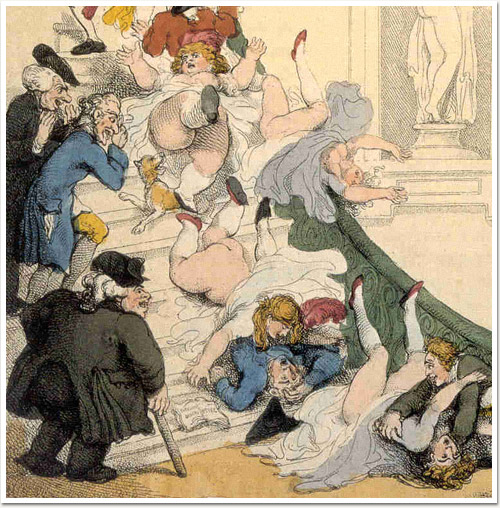
Detail of the Exhibition Staircase, Rowlandson, 1800

Detail of Rowlandson's Exhibition Staircase, 1800

Rowlandson’s Exhibition Staircase cartoon has a given date of 1800. The ladies’ tumble down a steep, crowded staircase forcibly reminds us that underdrawers were still a fashion consideration for the future.

Underdrawers belonging to the Duchess of Kent, 1810-1820. *Image@Regency Society of America Pro Boards

By 1820, wearing drawers was still optional, but by the 1850’s, the caged hooped skirts made them a necessity, for a hoop could be wildly unpredictable. One wrong swinging move or errant gust of wind, and a lady’s most delicate (or indelicate) parts would appear in full view. The 1956 version of The King and I contains one of my favorite scenes in which the King’s wives wear Western dresses for the first time. When the King enters, they immediately drop down to bow to him. Their hooped skirts swung straight up in the air, revealing their bare bottoms and shocking Anna, who had not anticipated such an END (ahem) to her well-meant scheme.

Caged crinoline

Needless to say, by the mid-19th century, ladies wore drawers as a matter of course.

*Regency Society of America Pro Boards

Read Full Post »

Copyright (c) Jane Austen’s World. A fine mist and cool air will  greet my dog and me on our morning walk. I intend to put on a thick short coat and scarf, and faux fur lined boots. How would my Regency counterpart have dressed in November, 1810, precisely 200 years ago?

More elegantly, I decided. While I putter on my computer in my jammies and robe, and sip coffee upon first rising, my Regency counterpart would have sipped hot chocolate from a delicate china cup and written letters, read from a book, or practiced on the pianoforte, as Jane Austen was wont to do in the early morning.

The maid would have started a fire in the morning room, but the house overall would have felt much cooler than it did even a month ago. A Rumford stove, which was becoming quite popular, would have retained  more heat, but as you can see, our Regency miss is swathed in a cap, long sleeved dress, and a high-necked chemisette. She wears gloves, stockings, and thin slippers. Layered as she is (for she probably wore a corseted petticoat underneath her ensemble and perhaps even a chemise), she would have felt comfortably warm. Had she still felt cold, she could opt to throw a thick shawl around her shoulders and a small throw over her lap.

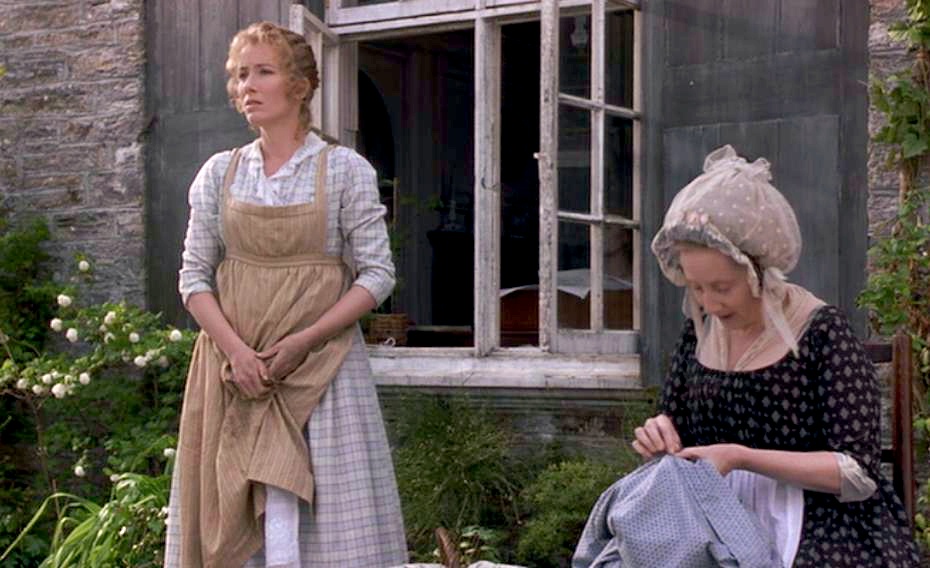
Morning dress, or undress, were dresses worn by ladies who expected to be seen only by close members of the family or guests in the home. They were never meant to be seen by visitors. Undress outfits, especially in more modest households where women worked alongside their servants, preparing vegetables or overseeing household duties, gardening and the like, were covered by aprons and pinafores.

In this image from Sense and Sensibility 1996, Elinor and Mrs. Dashwood are shown wearing undress. As soon as Edward Ferrars nears the house, the women tidy themselves, taking off their aprons, and making sure they look neat and presentable. They would not have had time to change into nicer outfits, nor would they have likely had many choices of dress to choose from.

Some Regency ladies who stayed at home all day would remain in a state of undress until dinner, when they changed into a gown suitable for the dinner table. Others would change their outfit much sooner, when they were ready to leave the house or if they had arranged to receive visitors. After I finish writing this post, I shall put on my half-dress, replacing my morning robe with a walking outfit consisting of a hooded sweatshirt, long-sleeved t-shirt, jeans a short coat and a scarf. I’ll exchange these outdoor exercise clothes with a more formal office look for work, which means that I will have worn three outfits by nine a.m.

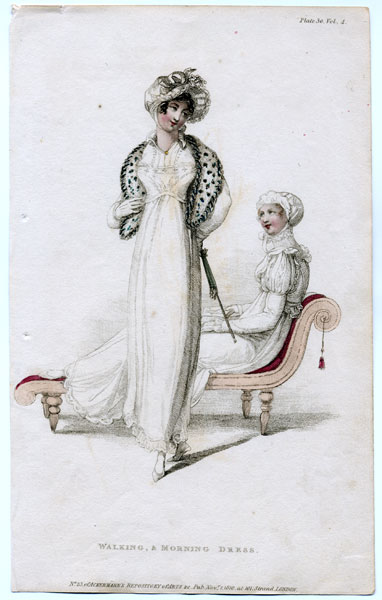
My Regency counterpart would also change her outfit. A lady of fashion would look vastly more elegant  in her walking outfit with its little fur tippet artfully arranged over a long-sleeved spencer jacket than me in my walking suit. If she was married or a spinster, she would place her  jaunty hat with its  soft capote crown over a cap, whose lace trim would peep out from beneath the hat’s brim. Sturdier leather slippers, leather gloves, a reticule and umbrella or parasol would complete the ensemble.

A middle class lady would look less modish than the idealized women depicted in Ackermann’s Repository, which was the Vogue magazine of its day. She would have fewer clothes to choose from, and most likely possessed only one walking outfit instead of a variety, and certainly not in the first stare of fashion.

Whatever her social background, our Regency lady was now ready to meet the world and visit friends, go shopping, or generally run errands outside of the house. The walking outfit in the Ackermann plate provided sufficient layers for a lady to stay warm during her walks and errands. Should the November day turn particularly windy and wet, she would most likely trade the tiny fur tippet for a more substantial shawl or cloak. The middle class Regency lady might trade her shawl for her only cloak, which she would keep for years until its usefulness was outworn.

More on the topic:

Read Full Post »

« Newer Posts - Older Posts »