• Home
  • Audio/Podcasts
  • Austensites
  • AV/E-Texts
  • History
  • JA Novels & Bio
  • Links
  • Original Sources/19th C. Texts
  • Social Customs During the Regency
  • Teacher/Student
  • Writer/Literature Resources

Jane Austen's World

This Jane Austen blog brings Jane Austen, her novels, and the Regency Period alive through food, dress, social customs, and other 19th C. historical details related to this topic.

Feeds:
Posts
Comments
« Jane Austen’s Nephew Edward Learns she is an Author
Jane Austen Emma: An Annotated Edition by Bharat Tandon, A Review »

The Miraculous Rescue of Miner John Evans in 1819

September 27, 2012 by Vic

The Industrial Revolution is not mentioned specifically, but implied in Jane Austen’s novels, the more rapid means of transportation being one of them. Life was hard for the working poor, and many died premature deaths. But miracles did occur. Take the tale of John Evans, a miner in a coal pit at Pentre’r Fram Colliery, Minera, Wrexham, Wales. On the 27th of September in 1819, almost 200 years ago, the pit flooded and two men lost their lives and a third went missing.
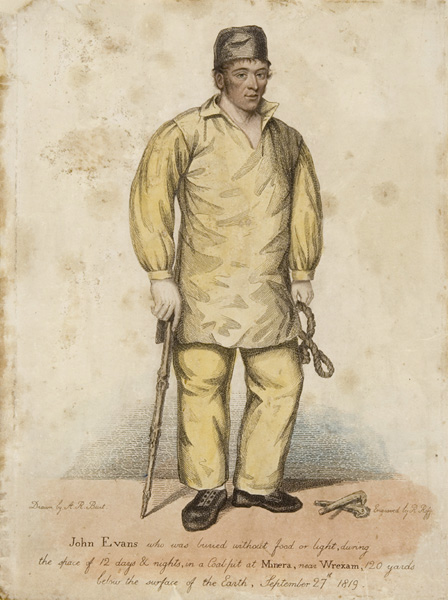
John Evans in 1819. Image from the National Museum Wales

The miner was trapped by the flood 120 yards below the surface with 18 other men. Fifteen were rescued, but not Evans and two other miners. During the 7 days that it took to pump the water out, three coffins were made to bury the presumed dead men. On day 8, two bodies were recovered, but John Evans was nowhere to be found. His wife begged for the rescuers to continue so that she could give her husband a proper burial.

He was found alive on the 13th day. His daughter reported that he had managed to survive by eating tallow candles and drinking water droplets from the roof of the mine. After his rescue, John took the coffin home with him and used it as a cupboard for many years. He died in April, 1865 at the advanced age of 73. The colliery closed during the Depression after 124 years of continuous work. – Callaghan Family Archives


Share with others:

  • Click to email a link to a friend (Opens in new window) Email
  • Click to print (Opens in new window) Print
  • Click to share on Facebook (Opens in new window) Facebook
  • Click to share on Reddit (Opens in new window) Reddit
  • Click to share on X (Opens in new window) X
  • Click to share on Pinterest (Opens in new window) Pinterest
  • Click to share on Tumblr (Opens in new window) Tumblr
  • Click to share on LinkedIn (Opens in new window) LinkedIn
Like Loading...

Related

Posted in 19th Century England, Working class | Tagged 19th Century Great Britain, Collier, Industrial Revolution, John Evans, Mining accident 1819 Wales, Mining history | 10 Comments

10 Responses

  1. on September 27, 2012 at 10:20 Chris Squire's avatar Chris Squire

    It is no surprise that the term ‘industrial revolution’ is not used by Austen is that it was not coined until years after her death:

    ”industrial revolution n. a rapid development in industry; spec. (freq. with capital initials) the development which took place in England in the late eighteenth and early nineteenth centuries, chiefly owing to the introduction of new or improved machinery and large-scale production methods.

    1848 J. S. Mill Princ. Polit. Econ. II. iii. xvii. 119 The opening of a foreign trade..sometimes works a complete industrial revolution in a country whose resources were previously undeveloped.
    1884 A. Toynbee (title) Lectures on the Industrial Revolution in England . . ‘


  2. on September 27, 2012 at 10:22 Chris Squire's avatar Chris Squire

    I meant ‘ . . AS it was not coined . . ‘


  3. on September 27, 2012 at 10:48 Vic's avatar Vic

    Agreed, Chris. What I meant to say was that she did not comment on the rapid changes. Interesting, for her life must have benefited greatly from the inventions. She does mention the Rumford stove in Northanger Abbey, but this is rare.


  4. on September 27, 2012 at 11:35 manzoni laura's avatar manzoni laura

    the real point Jane austen rarely describes the working classes because it was out of her experience. Probably she didn’t mention the issues of the industrial revolution because never saw directly the trasformations of an exploding industrial city like manchester. i don’t think that industrial revolution affected noticeably the still rural areas in which she lived. she doesn’t mention also the problems liked to the enclosure act. also, these problems and their social implcations became evident much later, when Mrs. Gaskell wrote about them.


    • on September 27, 2012 at 16:34 Tony Grant's avatar Tony Grant

      Yes I’ve wondered about Jane’s experience of the agricultural revolution. Her brother Edward Knight was a rich landowner with estates in Hampshire, at Chawton and in Kent just outside of Canterbury. He must have had to grapple with the changing rural scene.. Jane must have observed it all.
      She wrote about the changing face of Briitain, most obviously in Sanditon which was a new type of settlement new invented in the 18th century.Sanditon would have been about the intricacies of it’s development and social mix. Why didn’t the agricultural or industrial revolution impinge on her ? Maybe she chose to ignore it.She lived at time when Romanticism was holding sway but there is no inclination towards the Romantics way of looking at life either.


  5. on September 27, 2012 at 11:54 Raquel Campos's avatar Raquel Campos

    Hola. Yo creo que el tema de las clases trabajadores no está muy explotado en las novelas de Jane Austen nu en ninguna novela de regencia. Me ha gustado el post y conocer la vida de este minero.
    Un saludo!


  6. on September 27, 2012 at 12:18 Lynnelle's avatar Lynnelle

    I was reading Sense and Sensibility the other day, and noticed for the first time, a reference to enclosure (ch. 33). John Dashwood is telling Elinor about all of the expenses he has:

    “He paused for her assent and compassion; and she forced herself to say,

    “Your expenses both in town and country must certainly be considerable;
    but your income is a large one.”

    “Not so large, I dare say, as many people suppose. I do not mean to
    complain, however; it is undoubtedly a comfortable one, and I hope will
    in time be better. The enclosure of Norland Common, now carrying on,
    is a most serious drain. And then I have made a little purchase within
    this half year; East Kingham Farm, you must remember the place, where
    old Gibson used to live. The land was so very desirable for me in
    every respect, so immediately adjoining my own property, that I felt it
    my duty to buy it. I could not have answered it to my conscience to
    let it fall into any other hands. A man must pay for his convenience;
    and it HAS cost me a vast deal of money.”

    This speech is just dripping with irony, in my opinion. :-)


  7. on September 27, 2012 at 13:31 bluffkinghal's avatar bluffkinghal

    Good job they weren’t using wax candles by then …!


  8. on September 27, 2012 at 14:12 Mary Simonsen's avatar Mary Simonsen

    Good for John Evans. Two of my ggrandfathers were killed in the mines in PA.


  9. on October 4, 2012 at 12:21 ellaquinnauthor's avatar ellaquinnauthor

    It’s amazing what mankind accomplished without the use of modern technology.


Comments are closed.

  • Enter your email address to subscribe to this blog and receive notifications of new posts by email.

    Join 7,249 other subscribers
  • 2025 AGM in Baltimore

  • Items of Interest

  • Blog Stats

    • 18,359,704 hits
  • Follow Jane Austen's World on WordPress.com
  • RECOMMENDED BOOKS AND RESOURCES

  • Fashionable Goodness: Christianity in Jane Austen's England is now available! By JAW contributor Brenda S. Cox. See Review. Available from Amazon and Jane Austen Books.
  • We also recommend JAW contributor Rachel Dodge's devotionals based on Jane Austen's prayers and classic literature. Reviews:
    Praying With Jane: 31 Days Through the Prayers of Jane Austen
    The Anne of Green Gables DevotionalThe Little Women Devotional
    The Secret Garden Devotional
  • The Tour of Doctor Syntax. Edited by Ben Wiebracht. Read the review of the book at this link. Click to order the book on Amazon US or Amazon UK or Jane Austen Books
  • FREE Student Membership to JASNA

    Available through December 31st, 2025. Click on image for details, and share this poster with other teachers and students!

  • The Obituary of Charlotte Collins by Andrew Capes

    Click on image to read the story.

  • Comments

    “My idea of good company…is the company of clever, well-informed people, who have a great deal of conversation.” – Jane Austen, Persuasion


    Gentle readers: Please feel free to post your comments and continue the conversation! Due to SPAM, we will no longer accept comments on posts after 30 days of publication. In some instances, links will be removed from comments as well.

  • Administrators and Contributors

    Vic Sanborn, founder of this blog, is supported by a team of talented and knowledgeable writers about Jane Austen and the Regency era. They are:

    • Brenda Cox
    • Rachel Dodge and
    • Tony Grant, who now contributes his photos from London and England

    Click on their names to enter their own blogs.

    In addition, we thank the many experts and authors who frequently contribute their posts and opinions, and who continue to do so freely or at our request.

  • Pin It!

    Follow Me on Pinterest
  • Top Posts

    • The heaving Regency bosom, or was it? Some facts laid bare.
      The heaving Regency bosom, or was it? Some facts laid bare.
    • Regency Fashion: Men's Breeches, Pantaloons, and Trousers
      Regency Fashion: Men's Breeches, Pantaloons, and Trousers
    • Highclere Castle Floor Plan: The Real Downton Abbey
      Highclere Castle Floor Plan: The Real Downton Abbey
    • Dressing for the Netherfield Ball in Pride and Prejudice: Regency Fashion
      Dressing for the Netherfield Ball in Pride and Prejudice: Regency Fashion
    • Social Customs During the Regency
      Social Customs During the Regency
    • Jane Austen’s Regency Women: A Day in the Life, Part 1
      Jane Austen’s Regency Women: A Day in the Life, Part 1
    • Dancing at the Netherfield Ball: Pride and Prejudice
      Dancing at the Netherfield Ball: Pride and Prejudice
    • Men's hair styles at the turn of the 19th century
      Men's hair styles at the turn of the 19th century
    • Regency Hygiene: The Bourdaloue
      Regency Hygiene: The Bourdaloue
    • Jane Austen’s Christmases
      Jane Austen’s Christmases
  • Recent Posts

    • Coming Soon: Birthday Tales for Jane Austen’s 250th
    • Book Review: The Austens, by Sarah Emsley
    • Praying with Jane Audiobook with Amanda Root
    • Book Review: The Worlds of Jane Austen: The Influences and Inspiration Behind the Novels
    • Books Purchased at the 2025 AGM in Baltimore
  • Links to Jane Austen Blogs

    Click here to enter the page. Topics include Regency fashion, historic foods, Jane Austen societies, British sites, related topics. Click on image.

  • May we suggest?

  • Unknown's avatarHello, my name is Vic and I live in Maryland, USA. I have adored Jane Austen almost all of my life. I am a proud lifetime member of the Jane Austen Society of North America. This blog is a personal blog written and edited by me and my team. We do not accept any form of cash advertising, sponsorship, or paid topic insertions. However, we do accept and keep books and CDs to review.

    If you would like to share a new site, or point out an error, please email us. (Yes, we are fallible. We'll own up to our mistakes and will make the corrections with a polite smile on our faces.) Write us at

    gmailbw

    Thank you for visiting this blog. Your comments and suggestions are most welcome.

  • Project Gutenberg: eBook of Stage-coach and Mail in Days of Yore, Volume 2 (of 2), by Charles G. Harper

    STAGE-COACH AND MAIL IN DAYS OF YORE: A PICTURESQUE HISTORY
    OF THE COACHING AGE, VOL. II, By CHARLES G. HARPER. 1903. Click on this link.


  • Top Posts & Pages

    • The heaving Regency bosom, or was it? Some facts laid bare.
    • Regency Fashion: Men's Breeches, Pantaloons, and Trousers
    • Highclere Castle Floor Plan: The Real Downton Abbey
    • Dressing for the Netherfield Ball in Pride and Prejudice: Regency Fashion
    • Social Customs During the Regency
    • Jane Austen’s Regency Women: A Day in the Life, Part 1
    • Dancing at the Netherfield Ball: Pride and Prejudice
    • Men's hair styles at the turn of the 19th century
    • Regency Hygiene: The Bourdaloue
    • Jane Austen’s Christmases
  • Tour Chawton Cottage on YouTube

  • Disclaimer: Our team makes no profit from this blog. We may receive books (physical or digitized) for review purposes.

  • Copyright Statement: © Jane Austen's World blog, 2009-2024. Unauthorized use and/or duplication of this material without express and written permission from this blog’s author and/or owners is strictly prohibited. Excerpts and links may be used, provided that full and clear credit is given to Jane Austen's World with appropriate and specific direction to the original content.

Blog at WordPress.com.

WPThemes.


  • Reblog
  • Subscribe Subscribed
    • Jane Austen's World
    • Join 7,249 other subscribers
    • Already have a WordPress.com account? Log in now.
    • Jane Austen's World
    • Subscribe Subscribed
    • Sign up
    • Log in
    • Copy shortlink
    • Report this content
    • View post in Reader
    • Manage subscriptions
    • Collapse this bar
 

Loading Comments...
 

    %d
