• Home
  • Audio/Podcasts
  • Austensites
  • AV/E-Texts
  • History
  • JA Novels & Bio
  • Links
  • Original Sources/19th C. Texts
  • Social Customs During the Regency
  • Teacher/Student
  • Writer/Literature Resources

Jane Austen's World

This Jane Austen blog brings Jane Austen, her novels, and the Regency Period alive through food, dress, social customs, and other 19th C. historical details related to this topic.

Feeds:
Posts
Comments
« Jane Austen First Editions: How Much is Yours Worth?
The College of William and Mary, A Sir Christopher Wren Building in Williamsburg, Virginia? »

The Bathing Dress: Fashion in the Georgian Era

April 27, 2013 by Vic

During the 18th century women wore a long flannel shift while bathing, sometimes with lead weights sewn into the hem to keep the skirts from floating up. (Word Wenches: Keeping It Clean.) In  Worn Through, Dr. Kimberly Chrisman-Campbell discusses monkeys in art in a blog entitled Monkeys a la mode. The creatures served as satirical stand-ins for humans, much as dogs did in satirical early 20th century poker paintings.
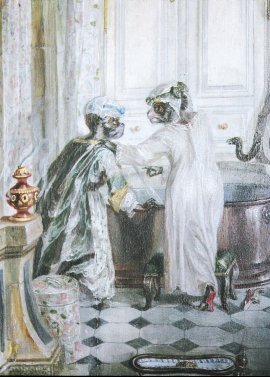
Bathing_scene

Image @Worn Through. Click on image to go to the source.

I found Chrisman-Campbell’s passage about the bath of particular interest:

The bath scene is a rare and realistic image of an eighteenth-century bathroom and bathing ritual; the monkey kicks off her red-heeled shoes (long before Louboutins, these signified that one had been presented at Versailles, an allusion to the family’s courtly connections) but she will wear her lace-trimmed white linen chemise in the tub.

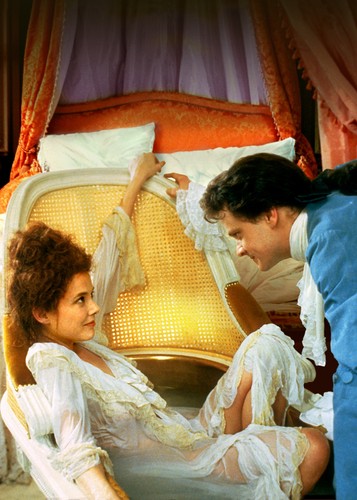
One wonders how much the habit of wearing a bathing gown in a bath had to do with modesty. The time it took to prepare for a bath was long and arduous. Water had to be hauled from the well, heated in sufficient quantities, and then hauled up the stairs before the water cooled. One did not take a quick bath in such an instance, but would linger in the tub until the water became too cold for comfort. One imagines that a roaring fire kept the room (and bather) warm. In those days, aristocratic women entertained visitors in their dressing rooms while wearing elaborate dressing gowns. As shown in the scene below, they also entertained visitors while bathing.
Valmont_stills_21959

Annette Bening and Colin Firth in Valmont

In the  film Valmont, Bening’s Marquise Isabelle de Merteuil uses the bath as a prop to demonstrate her power and sexuality. Her bathing dress enhances her curves and disguises very little. This film clip shows one delicious bath scene.


No One Compares to You

Valmont
— MOVIECLIPS.com


In this image from Mr. Vernon, Martha Washington’s bathing dress is plain and pedestrian by comparison. It is a mystery to me why the bathing dress was worn, for anyone who has walked in the rain knows how quickly wet clothes can cool the skin. One can only imagine the chilling effect of wet cloth in drafty houses.

Bathing gown. Image @ Mount Vernon

Bathing gown. Image @ Mount Vernon

By the late 18th century/early 19th century, bathing dresses were fashionable at seaside resorts. One can readily understand why, for in the image below a man on horseback pulls the bathing machine into the water. The bather peeks out of the door, unwilling to expose herself until all was safe. In fashionable Brighton, men and women bathers were separated and swam from different beaches. Away from prying eyes, some women felt free to bathe nude.

TopILNewsBathingMachine

Tide Coming in Fast and a Jibbing Horse”, a 19th century engraving from the Illustrated London News which shows how a bathing machine was towed in and out of the sea by a man on horseback. Image @The Brighton Swimming Club

As you can see from this 1813 image from the Costumes of Yorkshire, many women still chose modesty over nudity. The dippers were female, and the male rider on horseback kept well away from view.
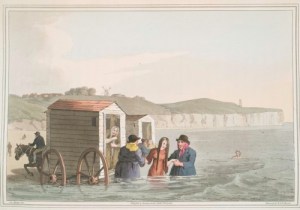
1813-From-The-costume-of-Yorkshire-illustrated-by-a-series-of-forty-engravings-being-fac-similes-of-original-drawings-500x351

Sea Bathing’ 1813 From “The costume of Yorkshire, illustrated by a series of forty engravings, being fac-similes of original drawings” NYPL Digital Collection

If modesty was the reason for wearing bathing costumes made from linen or cotton, then their purpose failed. As seen in this 1916 photograph, wet fabric didn’t hide the details of the nude body as much as accentuate the curves. The veiling was illusory and the result much sexier than the nude body itself.

bathing suit 1916

Wet suit 1916: Alfred Stieglitz(‘Ellen Koeniger’, 1916, gelatin silver photograph, 11.1 x 9.1, J Paul Getty Museum, Los Angeles)

In an interesting aside, this image of a medieval bath from Leeds Castle shows that bathing wasn’t always regarded as a harmful exercise by the British.

Medieval bath, Leeds Castle

Medieval bath, Leeds Castle

Read more about the seaside and seaside fashions on this blog to round out your knowledge of how the Regency folks enjoyed their seaside excursions:


  • Seaside Fashions Regency Style
  • Perils of the Sea: Shipwrecks off Dorset’s Deadly Coast
  • Martha Gunn, Brighton’s Queen of the Dippers
  • Benjamin Beale’s Invention for Bathing Machines

Share with others:

  • Click to email a link to a friend (Opens in new window) Email
  • Click to print (Opens in new window) Print
  • Click to share on Facebook (Opens in new window) Facebook
  • Click to share on Reddit (Opens in new window) Reddit
  • Click to share on X (Opens in new window) X
  • Click to share on Pinterest (Opens in new window) Pinterest
  • Click to share on Tumblr (Opens in new window) Tumblr
  • Click to share on LinkedIn (Opens in new window) LinkedIn
Like Loading...

Related

Posted in 19th Century England, Jane Austen's World, Regency Life, Regency World | Tagged Bathing dress, Regency Fashion, Regency sea bathing | 8 Comments

8 Responses

  1. on April 27, 2013 at 11:36 Suzanne's avatar Suzanne

    Your blog posts are always so well-written and informative, and I look forward to seeing them pop up in my email. Thank you for the time and hear that you put into each one!


  2. on April 27, 2013 at 13:18 Sarah Joyce's avatar Sarah Joyce

    So interesting! I have been doing a bit of research into Mary Wollstonecraft Godwin, particularly the period she was in Scotland as a teenager…just prior to meeting Percy Shelley (1812-14). She had been experiencing some ongoing health problems (and I think wasn’t getting along with her stepmother). In 1812 the 15 year old was sent to Dundee for her ‘health’. Godwin, her father, (through the doctor) had instructed her host family to ensure she bathed in the sea as therapy. I have been very interested in what this entailed – and now you have answered my question! Brilliant!


    • on April 29, 2013 at 06:25 Kevin Brewer's avatar Kevin Brewer

      Dundee waters would be a bit on the nippy side, I would imagine. There is some interesting stuff on MWG in Simon Schama’s wonderful book A History of Britain: 1776-2000, The Fate of Empire ISBN 0563487194, in which he situates her so well it makes me want to read the sequence that leads up the The Vindications (there were 2 one of the rights of men and one, the well known one, of women). It all started with walking. Read it. Schama is a great writer and the stuff flies off the page.


  3. on April 27, 2013 at 20:26 ellaquinnauthor's avatar ellaquinnauthor

    I agree, I love your posts.


  4. on April 30, 2013 at 10:20 not Bridget's avatar not Bridget

    Tom Stoppard used Juliet Nicolson’s “The Perfect Summer: England 1911, Just Before the Storm” for background details when writing the screenplay for “Parade’s End.” One scene he added (it was not in the novels) showed “water men” delivering hot water for a bath; the scene was the Tietjens family pile–still without plumbing in 1912, However, Sylvia declined to wear a bathing dress; the surroundings may have been archaic but SHE was modern….


  5. on April 30, 2013 at 14:43 Mary MacGowan's avatar Mary MacGowan

    Hello! I am trying to find out more about the parents of Harris, Alathea, Catherine and Elizabeth Bigg-Withers. Can you tell me a little about them? I will also email you (marymacgowan (at) ya hoo dot com)
    Regards, Mary


  6. on April 30, 2013 at 22:56 sydneyreadseverything's avatar sydneyreadseverything

    Your blog is so amazing and informative. Thanks!


  7. on May 3, 2013 at 11:17 Jean | Delightful Repast's avatar Jean | Delightful Repast

    Vic, thank you for another educational and entertaining post. Think of the weight of those wet garments! How could one manage to swim with legs all tangled up in cloth!


Comments are closed.

  • Enter your email address to subscribe to this blog and receive notifications of new posts by email.

    Join 7,248 other subscribers
  • 2025 AGM in Baltimore

  • Items of Interest

  • Blog Stats

    • 18,371,385 hits
  • Follow Jane Austen's World on WordPress.com
  • RECOMMENDED BOOKS AND RESOURCES

  • Fashionable Goodness: Christianity in Jane Austen's England is now available! By JAW contributor Brenda S. Cox. See Review. Available from Amazon and Jane Austen Books.
  • We also recommend JAW contributor Rachel Dodge's devotionals based on Jane Austen's prayers and classic literature. Reviews:
    Praying With Jane: 31 Days Through the Prayers of Jane Austen
    The Anne of Green Gables DevotionalThe Little Women Devotional
    The Secret Garden Devotional
  • The Tour of Doctor Syntax. Edited by Ben Wiebracht. Read the review of the book at this link. Click to order the book on Amazon US or Amazon UK or Jane Austen Books
  • FREE Student Membership to JASNA

    Available through December 31st, 2025. Click on image for details, and share this poster with other teachers and students!

  • The Obituary of Charlotte Collins by Andrew Capes

    Click on image to read the story.

  • Comments

    “My idea of good company…is the company of clever, well-informed people, who have a great deal of conversation.” – Jane Austen, Persuasion


    Gentle readers: Please feel free to post your comments and continue the conversation! Due to SPAM, we will no longer accept comments on posts after 30 days of publication. In some instances, links will be removed from comments as well.

  • Administrators and Contributors

    Vic Sanborn, founder of this blog, is supported by a team of talented and knowledgeable writers about Jane Austen and the Regency era. They are:

    • Brenda Cox
    • Rachel Dodge and
    • Tony Grant, who now contributes his photos from London and England

    Click on their names to enter their own blogs.

    In addition, we thank the many experts and authors who frequently contribute their posts and opinions, and who continue to do so freely or at our request.

  • Pin It!

    Follow Me on Pinterest
  • Top Posts

    • Highclere Castle Floor Plan: The Real Downton Abbey
      Highclere Castle Floor Plan: The Real Downton Abbey
    • Men's hair styles at the turn of the 19th century
      Men's hair styles at the turn of the 19th century
    • Regency Fashion: Men's Breeches, Pantaloons, and Trousers
      Regency Fashion: Men's Breeches, Pantaloons, and Trousers
    • Cassandra Writes About Jane Austen's Death, July 18, 1817
      Cassandra Writes About Jane Austen's Death, July 18, 1817
    • Dancing at the Netherfield Ball: Pride and Prejudice
      Dancing at the Netherfield Ball: Pride and Prejudice
    • Dressing for the Netherfield Ball in Pride and Prejudice: Regency Fashion
      Dressing for the Netherfield Ball in Pride and Prejudice: Regency Fashion
    • Pictorial History of Regency Hairstyles
      Pictorial History of Regency Hairstyles
    •  A Triple Tragedy: How Princess Charlotte's Death in 1817 Changed Obstetrics
      A Triple Tragedy: How Princess Charlotte's Death in 1817 Changed Obstetrics
    • Jane Austen’s Regency Women: A Day in the Life, Part 1
      Jane Austen’s Regency Women: A Day in the Life, Part 1
    • Regency Hygiene: The Bourdaloue
      Regency Hygiene: The Bourdaloue
  • Recent Posts

    • Coming Soon: Birthday Tales for Jane Austen’s 250th
    • Book Review: The Austens, by Sarah Emsley
    • Praying with Jane Audiobook with Amanda Root
    • Book Review: The Worlds of Jane Austen: The Influences and Inspiration Behind the Novels
    • Books Purchased at the 2025 AGM in Baltimore
  • Links to Jane Austen Blogs

    Click here to enter the page. Topics include Regency fashion, historic foods, Jane Austen societies, British sites, related topics. Click on image.

  • May we suggest?

  • Unknown's avatarHello, my name is Vic and I live in Maryland, USA. I have adored Jane Austen almost all of my life. I am a proud lifetime member of the Jane Austen Society of North America. This blog is a personal blog written and edited by me and my team. We do not accept any form of cash advertising, sponsorship, or paid topic insertions. However, we do accept and keep books and CDs to review.

    If you would like to share a new site, or point out an error, please email us. (Yes, we are fallible. We'll own up to our mistakes and will make the corrections with a polite smile on our faces.) Write us at

    gmailbw

    Thank you for visiting this blog. Your comments and suggestions are most welcome.

  • Project Gutenberg: eBook of Stage-coach and Mail in Days of Yore, Volume 2 (of 2), by Charles G. Harper

    STAGE-COACH AND MAIL IN DAYS OF YORE: A PICTURESQUE HISTORY
    OF THE COACHING AGE, VOL. II, By CHARLES G. HARPER. 1903. Click on this link.


  • Top Posts & Pages

    • Highclere Castle Floor Plan: The Real Downton Abbey
    • Men's hair styles at the turn of the 19th century
    • Regency Fashion: Men's Breeches, Pantaloons, and Trousers
    • Cassandra Writes About Jane Austen's Death, July 18, 1817
    • Dancing at the Netherfield Ball: Pride and Prejudice
    • Dressing for the Netherfield Ball in Pride and Prejudice: Regency Fashion
    • Pictorial History of Regency Hairstyles
    • A Triple Tragedy: How Princess Charlotte's Death in 1817 Changed Obstetrics
    • Jane Austen’s Regency Women: A Day in the Life, Part 1
    • Regency Hygiene: The Bourdaloue
  • Tour Chawton Cottage on YouTube

  • Disclaimer: Our team makes no profit from this blog. We may receive books (physical or digitized) for review purposes.

  • Copyright Statement: © Jane Austen's World blog, 2009-2024. Unauthorized use and/or duplication of this material without express and written permission from this blog’s author and/or owners is strictly prohibited. Excerpts and links may be used, provided that full and clear credit is given to Jane Austen's World with appropriate and specific direction to the original content.

Blog at WordPress.com.

WPThemes.


  • Reblog
  • Subscribe Subscribed
    • Jane Austen's World
    • Join 7,248 other subscribers
    • Already have a WordPress.com account? Log in now.
    • Jane Austen's World
    • Subscribe Subscribed
    • Sign up
    • Log in
    • Copy shortlink
    • Report this content
    • View post in Reader
    • Manage subscriptions
    • Collapse this bar
 

Loading Comments...
 

    %d
