• Home
  • Audio/Podcasts
  • Austensites
  • AV/E-Texts
  • History
  • JA Novels & Bio
  • Links
  • Original Sources/19th C. Texts
  • Social Customs During the Regency
  • Teacher/Student
  • Writer/Literature Resources

Jane Austen's World

This Jane Austen blog brings Jane Austen, her novels, and the Regency Period alive through food, dress, social customs, and other 19th C. historical details related to this topic.

Feeds:
Posts
Comments
« May in Jane Austen’s World
June in Jane Austen’s World »

Jane Austen’s Family Churches: All Saints’ Church at Deane

May 29, 2024 by Brenda S Cox

From her birth in 1775 until her family moved to Bath in 1801, Jane Austen spent most of her time in a small triangle of villages: Steventon, Ashe, and Deane. Her father was rector of both Steventon and Deane, leading services and preaching at both parish churches, and serving the people of both communities.
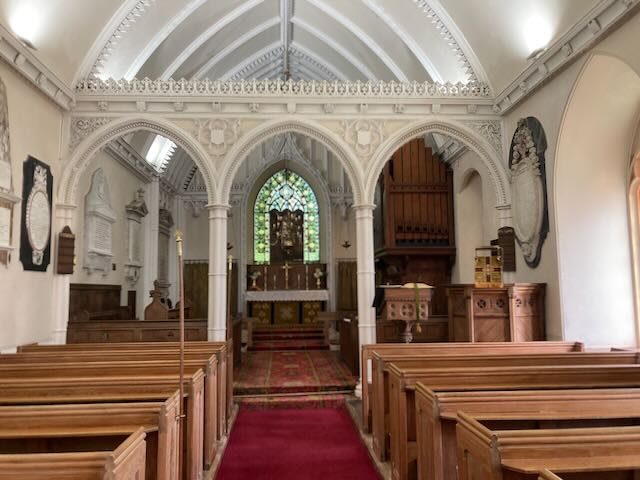
Nave and chancel of Holy Trinity Church at Deane.
The damp Deane parsonage where the Austens lived is long gone; it was replaced by a new building in 1855. One of the churchwardens says, “There was a rectory in the paddock opposite the path leading to the church, which burnt down. I believe the wall [old section in this photo] protected this rectory.”

Deane Parsonage and Living

George and Cassandra Austen lived in the Deane parsonage until 1768 when the Steventon parsonage was ready. Their first three children, James, George, and Edward, were born there. Mrs. Austen’s widowed mother, Jane Leigh, also lived with them at Deane, though she died shortly after the move to Steventon.

The Steventon living was worth only about £100 a year, including about three acres of glebe farmland. So Mr. Knight also let George Austen farm the 200-acre Cheesedown Farm for more income. Still, the Austens found the income too low to support their rapidly growing family. George’s great-uncle Francis of Sevenoaks in Kent bought the options on two nearby livings, Ashe and Deane, for George’s benefit.

The rector of Deane died before the rector of Ashe, so George Austen took the living for the parish of Deane, and Francis sold the other option to another relative, who later installed the Lefroys at Ashe. In 1773, Mr. Austen became rector of Deane, another small parish of “about two dozen families of farm labourers . . . worth £110” per year (Le Faye, 25). He also began taking in boys as students, to further supplement his income.

The Deane parsonage now belonged to George Austen, as part of the living. From 1786-1788, Madam Lefroy’s younger brother, Egerton Brydges, rented it from him and lived there. In 1789, George advertised the parsonage for rent, as “a neat brick dwelling-house with four living-rooms and four bedrooms, as well as all the necessary store rooms and servants’ quarter, plus a large garden, coach-house and stabling for six horses” (Le Faye, 68), making it sound more desirable than it had been. The next tenants were a clergyman’s widow, Mrs. Lloyd, and her daughters Martha and Mary. (Good Bible names for sisters; see John 11.) Martha and Mary soon became close friends of Jane and her sister Cassandra. Eventually both Lloyd sisters married into the Austen family.

In 1792, Jane’s eldest brother James and his wife Anne took over Deane parsonage, spending £200 to refurnish it, more than they could actually afford. James became his father’s curate at Deane, also serving two other small parishes. Their daughter Anna (Jane Anna Elizabeth Austen) was born in the Deane parsonage in 1793, with the help of her grandmother. “Mrs. Austen rose from her bed in the middle of the night, and walked by the light of a lantern a mile and a half of muddy country lane to attend her [daughter-in-law], and to usher into the world a new grandchild” (Le Faye, 84).

James’s wife Anne died in 1795, and Mary Lloyd returned to Deane parsonage as James’s second wife in 1797. In 1801, James and his family moved to the Steventon parsonage when George Austen retired to Bath. James served as curate of Steventon until his father died in 1805, when James became rector of Steventon.
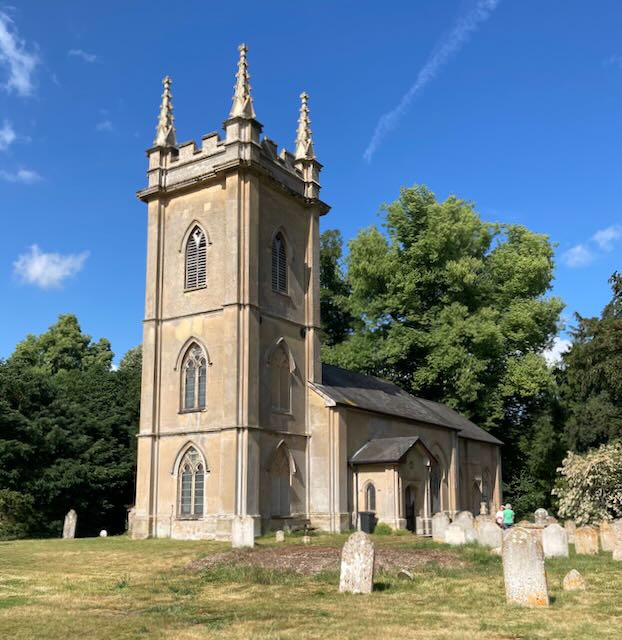
Holy Trinity Church at Deane was completely rebuilt, 1818-1820, in the pointed Gothic style. Much of the church was built of Coade stone, an artificial stone invented and produced by a woman, Eleanor Coade (1733-1821). She developed an amazing material that could be made to look like either wood or marble, resisted weathering, and could be molded into mass-produced items ranging from tiny ornaments to the pinnacles of this church. Thousands of intact examples of Coade stone can still be seen across England and abroad today.

Jane Austen’s Connections with Deane

Jane Austen mentions Deane in 27 of her existing letters. She also includes it in one of her juvenile pieces, “Memoirs of Mr. Clifford.” Mr. Clifford’s “first Day’s Journey carried him only to Dean Gate where he remained a few Days and found himself much benefited by the change of Air.” She is referring to the Deane Gate Inn, where men of the Austen family would catch the stagecoach. It is now a restaurant, the Palm Brasserie.

Jane often visited the parsonage at Deane, first when the Lloyds were living there, then when her brother and his family were there. Dampness and flooding were still an issue. On Oct. 27, 1798, she wrote:

“There has been a great deal of rain here for this last fortnight, much more than in Kent, and indeed we found the roads all the way from Staines most disgracefully dirty. Steventon lane has its full share of it, and I don’t know when I shall be able to get to Deane.”

In November and December she again talks about visits to her sister-in-law Mary at Deane, who gave birth to James Edward (who became Jane Austen’s first biographer) on Nov. 17:

I went to Deane with my father two days ago to see Mary, who is still plagued with the rheumatism, which she would be very glad to get rid of, and still more glad to get rid of her child, of whom she is heartily tired. Her nurse is come and has no particular charm either of person or manner; but as all the Hurstbourne world pronounce her to be the best nurse that ever was, Mary expects her attachment to increase. . . . Sunday. — I have just received a note from James to say that Mary was brought to bed last night, at eleven o’clock, of a fine little boy, and that everything is going on very well. My mother had desired to know nothing of it before it should be all over, and we were clever enough to prevent her having any suspicion of it”—Nov. 17-18, 1798

Jane continued to visit Mary every few days, reporting on her health. She even visited when ice covered the ground: 

“I enjoyed the hard black Frosts of last week very much, & one day while they lasted walked to Deane by myself.–I do not know that I ever did such a thing in my life before. . . . Mary went to Church on Sunday, & had the weather been smiling, we would have seen her here before this time”—Dec. 18, 1798.  This may have been when Mary was “churched,” a ceremony celebrating the safety of a mother after childbirth.

The main families of Deane, Steventon, and Ashe all visited each other and went to balls together. Jane danced at the Harwoods’ ball, in Deane, on Jan. 8, 1796. She often mentions John Harwood in her letters; for example:

“This morning has been made very gay to us, by visits from our two lively Neighbours, Mr. Holder and Mr. John Harwood.”—Dec. 18, 1798
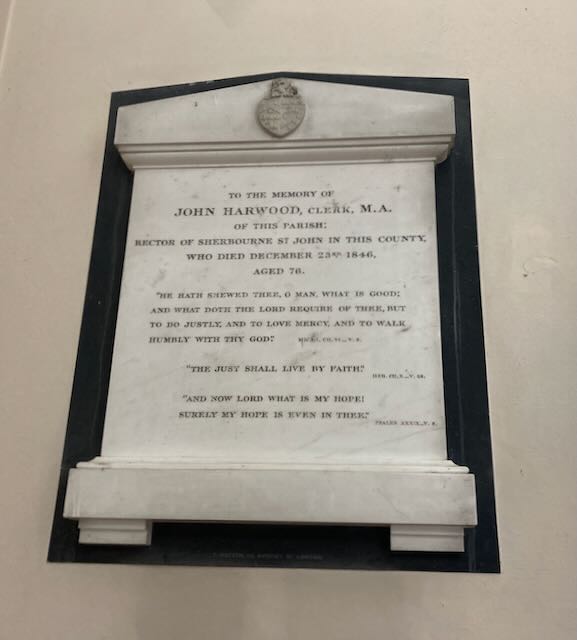
Deane church memorial to John Harwood (1770-1846), a member of the Harwood family of Deane, friends of the Austens. Harwood was rector of nearby Sherbourne St. John, where James Austen was vicar from 1791 to 1819. (The parish had both a vicar and a rector until 1844; the rector got more of the tithes.) Jane Austen mentions John Harwood in her letters in the context of visits, balls, and other events.
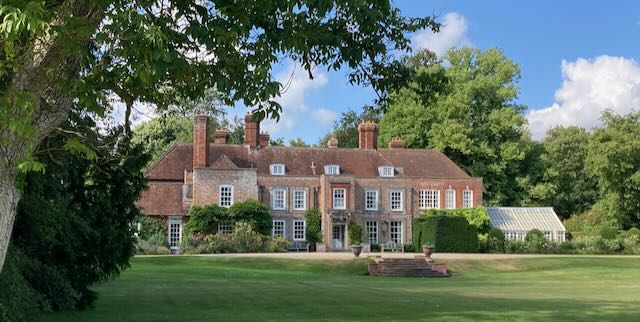
The Harwoods owned Deane House, now The Old Manor House. It can still be seen from the Deane church. Jane Austen danced there.

All Saints Church at Deane, Then and Now

In July, 1818, the Norman-era church at Deane was “in so Dangerous a state of Ruin as to be unsafe for the congregation.” So the patron, Wither Bramston of Oakley Hall, got approval from the Bishop of Winchester to rebuild it at his own cost, about £8000. It was consecrated two years later.

All Saints at Deane is considered “one of the most complete and successful” 19th century Gothic churches (Tanner). It is also renowned for its eight bells, which are rung regularly, and an 1820 Gothic chancel screen. The church today is a grade II listed building, but is not the same as the medieval church building where George and James Austen ministered. Some monuments from their time are on the walls of the current church, however.

An entrance to the Deane church marks its rebuilding in 1818.
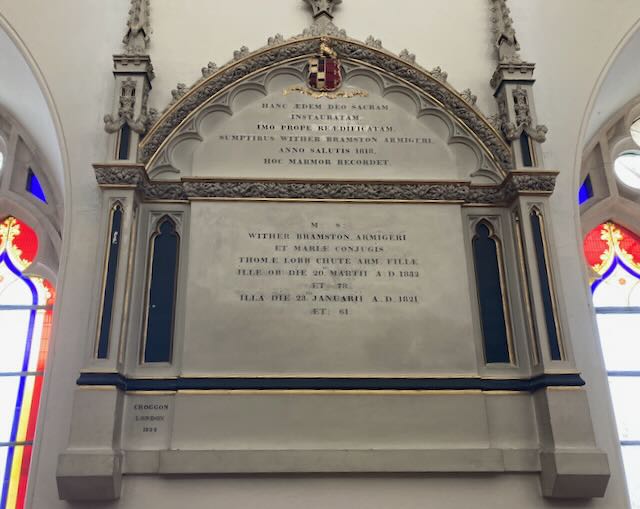
Memorial in Latin to Wither Bramston, died 1832, and his wife. As patron of the Deane living, he rebuilt the Deane church in 1818-1820 (as recorded in the top section of the memorial), at his own expense.

The church could seat 146 people in 1851. On Census Sunday, 94 parishioners attended in the morning and 124 in the evening. Leading up to World War I, the rector offered daily Communion in the church, and in 1917, he reported twenty people in the choir for Evensong. However, the population dropped, and in 2011, Deane included only an estimated 55 inhabitants, with an average age of over 60.

Now there are about 25 houses in the village, and about 8-10 people attend Sunday morning services twice a month. For a larger service, like the Christmas carol service, they may have about 40 attendees. Weddings are held there occasionally, and special services like pet blessings. All Saints is part of the United Benefice of North Waltham, Steventon, Ashe, and Deane.

Our guide to the church, Sue Hebeler, said she loves this church since it is her local church and her husband is buried there. She appreciates the traditional, old-fashioned services. If you’re in the vicinity, you may also enjoy a visit to this lovely, peaceful church.

This embroidered tapestry blesses the church, which was called St. Mary’s before it was rebuilt over 200 years ago. The picture may be more like the church’s earlier form. It reads, “Peace be within this sacred place; And joy a constant guest; With holy gifts and heavenly grace; Be her attendants blest.”

All images in this post ©Brenda S. Cox, 2024.

Brenda S. Cox is the author of Fashionable Goodness: Christianity in Jane Austen’s England. She also blogs at Faith, Science, Joy, and Jane Austen.


Posts on Other Austen Family Churches

Steventon

Chawton

Hamstall Ridware and Austen’s First Cousin, Edward Cooper

Adlestrop and the Leigh Family

Stoneleigh Abbey Chapel and Mansfield Park

Great Bookham and Austen’s Godfather, Rev. Samuel Cooke

Ashe and the Lefroy Family


Sources and Further Reference

Deirdre Le Faye, Jane Austen : A Family Record. Much of Le Faye’s information about Deane is also online at Deane

Terry Townsend, Jane Austen’s Hampshire, has a helpful chapter on Deane.

Richard Tanner, Ashe & Deane, explores the area.

Trailblazing Women of the Georgian Era by Mike Rendell includes a fascinating chapter on Eleanor Coade—manufacturer of artificial stone.


Share with others:

  • Click to email a link to a friend (Opens in new window) Email
  • Click to print (Opens in new window) Print
  • Click to share on Facebook (Opens in new window) Facebook
  • Click to share on Reddit (Opens in new window) Reddit
  • Click to share on X (Opens in new window) X
  • Click to share on Pinterest (Opens in new window) Pinterest
  • Click to share on Tumblr (Opens in new window) Tumblr
  • Click to share on LinkedIn (Opens in new window) LinkedIn
Like Loading...

Related

Posted in Churches of the Austen family, Clergy, Jane Austen's family, Jane Austen's letters, Jane Austen's religion, Jane Austen's World | Tagged Deane, George Austen's churches, James Austen, John Harwood, Martha and Mary Lloyd, Wither Bramston | 6 Comments

6 Responses

  1. on May 29, 2024 at 03:46 dholcomb1's avatar dholcomb1

    Another wonderful post about a church related to Jane.

    denise


    • on May 29, 2024 at 14:02 Brenda S Cox's avatar Brenda S Cox

      Thanks, Denise! I felt very privileged to be able to see these churches, and I’m so glad I can share them with you all!


  2. on May 29, 2024 at 22:54 Kevin Lindsey's avatar Kevin Lindsey

    Fascinating and informative article. I really appreciate all of your pictures too!


  3. on May 30, 2024 at 04:30 margaretmills3's avatar margaretmills3

    Thank you, Denise. These articles are such enjoyable reading and are much appreciated.


  4. on May 30, 2024 at 04:31 margaretmills3's avatar margaretmills3

    Thank you, Denise. These articles are such enjoyable reading and are much appreciated.


  5. on May 30, 2024 at 04:34 margaretmills3's avatar margaretmills3

    Apologies, Brenda – I should of course have thanked you for the article (that will teach me to check my typing!).


Comments are closed.

  • Enter your email address to subscribe to this blog and receive notifications of new posts by email.

    Join 7,248 other subscribers
  • 2025 AGM in Baltimore

  • Items of Interest

  • Blog Stats

    • 18,377,705 hits
  • Follow Jane Austen's World on WordPress.com
  • RECOMMENDED BOOKS AND RESOURCES

  • Fashionable Goodness: Christianity in Jane Austen's England is now available! By JAW contributor Brenda S. Cox. See Review. Available from Amazon and Jane Austen Books.
  • We also recommend JAW contributor Rachel Dodge's devotionals based on Jane Austen's prayers and classic literature. Reviews:
    Praying With Jane: 31 Days Through the Prayers of Jane Austen
    The Anne of Green Gables DevotionalThe Little Women Devotional
    The Secret Garden Devotional
  • The Tour of Doctor Syntax. Edited by Ben Wiebracht. Read the review of the book at this link. Click to order the book on Amazon US or Amazon UK or Jane Austen Books
  • FREE Student Membership to JASNA

    Available through December 31st, 2025. Click on image for details, and share this poster with other teachers and students!

  • The Obituary of Charlotte Collins by Andrew Capes

    Click on image to read the story.

  • Comments

    “My idea of good company…is the company of clever, well-informed people, who have a great deal of conversation.” – Jane Austen, Persuasion


    Gentle readers: Please feel free to post your comments and continue the conversation! Due to SPAM, we will no longer accept comments on posts after 30 days of publication. In some instances, links will be removed from comments as well.

  • Administrators and Contributors

    Vic Sanborn, founder of this blog, is supported by a team of talented and knowledgeable writers about Jane Austen and the Regency era. They are:

    • Brenda Cox
    • Rachel Dodge and
    • Tony Grant, who now contributes his photos from London and England

    Click on their names to enter their own blogs.

    In addition, we thank the many experts and authors who frequently contribute their posts and opinions, and who continue to do so freely or at our request.

  • Pin It!

    Follow Me on Pinterest
  • Top Posts

    • Happy Birthday, Jane Austen!
      Happy Birthday, Jane Austen!
    • Jane Austen’s Christmases
      Jane Austen’s Christmases
    • Cassandra Writes About Jane Austen's Death, July 18, 1817
      Cassandra Writes About Jane Austen's Death, July 18, 1817
    • Exploring Jane Austen's Prayers
      Exploring Jane Austen's Prayers
    • Highclere Castle Floor Plan: The Real Downton Abbey
      Highclere Castle Floor Plan: The Real Downton Abbey
    • Regency Fashion: Men's Breeches, Pantaloons, and Trousers
      Regency Fashion: Men's Breeches, Pantaloons, and Trousers
    • Dancing at the Netherfield Ball: Pride and Prejudice
      Dancing at the Netherfield Ball: Pride and Prejudice
    • Social Customs During the Regency
      Social Customs During the Regency
    • Regency Hygiene: The Bourdaloue
      Regency Hygiene: The Bourdaloue
    • Pictorial History of Regency Hairstyles
      Pictorial History of Regency Hairstyles
  • Recent Posts

    • Happy 250th Birthday, Jane Austen!
    • Coming Soon: Birthday Tales for Jane Austen’s 250th
    • Book Review: The Austens, by Sarah Emsley
    • Praying with Jane Audiobook with Amanda Root
    • Book Review: The Worlds of Jane Austen: The Influences and Inspiration Behind the Novels
  • Links to Jane Austen Blogs

    Click here to enter the page. Topics include Regency fashion, historic foods, Jane Austen societies, British sites, related topics. Click on image.

  • May we suggest?

  • Unknown's avatarHello, my name is Vic and I live in Maryland, USA. I have adored Jane Austen almost all of my life. I am a proud lifetime member of the Jane Austen Society of North America. This blog is a personal blog written and edited by me and my team. We do not accept any form of cash advertising, sponsorship, or paid topic insertions. However, we do accept and keep books and CDs to review.

    If you would like to share a new site, or point out an error, please email us. (Yes, we are fallible. We'll own up to our mistakes and will make the corrections with a polite smile on our faces.) Write us at

    gmailbw

    Thank you for visiting this blog. Your comments and suggestions are most welcome.

  • Project Gutenberg: eBook of Stage-coach and Mail in Days of Yore, Volume 2 (of 2), by Charles G. Harper

    STAGE-COACH AND MAIL IN DAYS OF YORE: A PICTURESQUE HISTORY
    OF THE COACHING AGE, VOL. II, By CHARLES G. HARPER. 1903. Click on this link.


  • Top Posts & Pages

    • Happy Birthday, Jane Austen!
    • Jane Austen’s Christmases
    • Cassandra Writes About Jane Austen's Death, July 18, 1817
    • Exploring Jane Austen's Prayers
    • Highclere Castle Floor Plan: The Real Downton Abbey
    • Regency Fashion: Men's Breeches, Pantaloons, and Trousers
    • Dancing at the Netherfield Ball: Pride and Prejudice
    • Social Customs During the Regency
    • Regency Hygiene: The Bourdaloue
    • Pictorial History of Regency Hairstyles
  • Tour Chawton Cottage on YouTube

  • Disclaimer: Our team makes no profit from this blog. We may receive books (physical or digitized) for review purposes.

  • Copyright Statement: © Jane Austen's World blog, 2009-2024. Unauthorized use and/or duplication of this material without express and written permission from this blog’s author and/or owners is strictly prohibited. Excerpts and links may be used, provided that full and clear credit is given to Jane Austen's World with appropriate and specific direction to the original content.

Blog at WordPress.com.

WPThemes.


  • Reblog
  • Subscribe Subscribed
    • Jane Austen's World
    • Join 7,248 other subscribers
    • Already have a WordPress.com account? Log in now.
    • Jane Austen's World
    • Subscribe Subscribed
    • Sign up
    • Log in
    • Copy shortlink
    • Report this content
    • View post in Reader
    • Manage subscriptions
    • Collapse this bar
 

Loading Comments...
 

    %d
