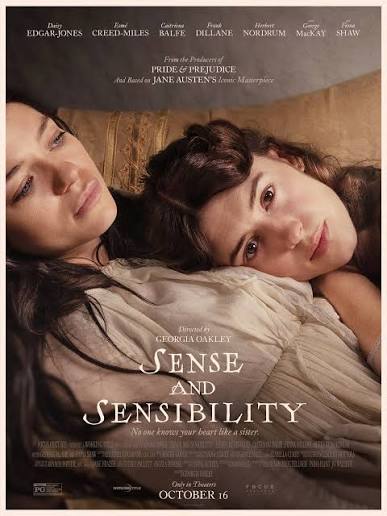
Dear readers, I confess I was delighted by the newest film adaptation of Sense and Sensibility. However, in saying that, I realize that I invite much debate in the comments. But that is all part of the fun of a new adaptation. Some will love it. Some will hate it. Others will enjoy picking it to pieces and debating what they loved or hated.
For me, going to the movie theater to watch a film is a rare treat. Plus, Austen movies provide much nostalgia and joy for me. I grew up watching the film adaptations with my parents, and I have many wonderful memories of rainy-day Austen movie marathons. I passed that down to my now-adult daughter, who grew up watching Austen film adaptations with me. A night out at the movies together was a glorious fall treat for us.
Spoiler alert: My thoughts below include a few basic spoilers that most Austen fans will already know about, but if you’ve never read Sense and Sensibility or seen any of the film adaptations, you might want to wait to read this. For everyone else, if you want to see the film without knowing much about it beforehand, feel free to come back and read this after you see it.
The Basics
First of all, I will of course admit that the film includes many historical, textual, and literary inaccuracies, like most modern Austen film adaptations. So, if you’re a true purest, you will probably detest this film. You might still want to see it so you know what all the fuss is about, but maybe wait and stream it later it in the comfort of your own home.
Second, if you liked or hated the 2005 Pride and Prejudice adaptation, you will most likely love or hate this film. Both films come from Focus Features and Working Title Films, and it’s clear that the idea behind this new film was and is to create another experience much like the 2005 P&P. The style and cinematography are quite similar, as are the types of textual and historical inaccuracies.
For those of you who tend to enjoy lavish Austen film adaptations, knowing that certain liberties will be taken in film-making, you’ll probably enjoy this one.
Cinematography
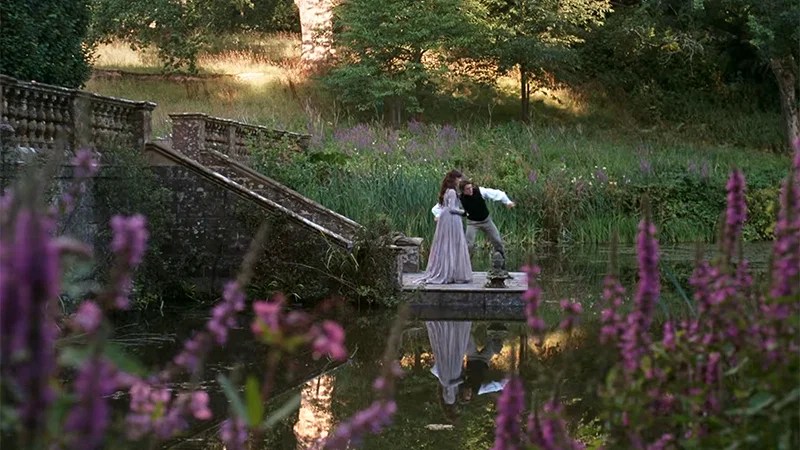
I have to start with the filmmaking itself. The cinematography in this film is gorgeous, emotional, and extremely moving. The sweeping countryside, the landscapes, and the seaside are beautiful. Barton cottage and the lovely country setting around it were all a feast for the eyes.
There is something so comforting about being transported into Austen’s world with its country estates, cottages, gardens, rolling hills, visits, and balls. The décor, the carriages, and the costuming all provided a visual treat. I want to see the movie again, just to take in all of the aesthetic details.

The Characters and Actors
I was also pleasantly surprised by how much I enjoyed several of the casting choices. Daisy Edgar-Jones blew me away as Elinor Dashwood. She captured Elinor’s quiet, reserved nature while still allowing us to see her depth of feeling beneath the surface. I also enjoyed George MacKay as Edward Ferrars. He was reserved, manly, honorable, and thoughtful. He and Edgar-Jones had wonderful chemistry throughout the film. Several scenes brought me to tears.

Herbert Nordrum as Colonel Brandon was intriguing to me (though I admit, I was hoping he would tidy up his hair and beard as the film progressed – I always love a little “glow-up” in a movie). I don’t know if anyone can ever replace Alan Rickman in my mind, but Nordrum kept me captivated. His quiet mannerisms reminded me a bit of Gabriel Oak (Matthias Schoenaerts) in the 2015 film adaptation of Far from the Madding Crowd.

And then there was Fiona Shaw who I felt was brilliant as Mrs. Jennings. I thought she stole the show! Her role didn’t stick to the text perfectly, but she captured the air of Mrs. Jennings beautifully. The whole theater giggled every time she spoke during the entirety of the film. I’ll leave it at that, just so I don’t spoil the fun.

Now, on to the characters who were not quite so delightful.
I hated Willoughby, but in the best possible way. Frank Dillane made Willoughby positively despicable. At first, my daughter and I thought, “oh no, it’s going to be hard to hate him,” but he became easily hate-able very quickly. My main complaint about Willoughby and Marianne was that the film took very little time to develop their love story.
Esmé Creed-Miles as Marianne was not quite to my taste, but I may be in the minority. Her portrayal was simply not the Marianne I have always imagined. She seemed more like a character in a gothic period piece like Wuthering Heights, which I can appreciate, but I have never seen Marianne in that light.
I found Sir John Middleton, played by Turlough Convery, to be a bit too much. Lady Middleton, played by Chloe Pirrie, was another interesting choice. I found her funny, but I didn’t like that she was made into a comic character instead of the elegant, cold, distant, snobbish woman she is in the novel.

Personal Pet Peeves
My two biggest pet peeves were Marianne’s hair and costuming and the dancing at the balls. Marianne’s stringy, unkempt hair hanging around her face throughout the film drove me crazy. She looked like a lost waif for most of the film. Elinor’s was half-up, half-down quite a bit, but it at least looked romantic and lovely.

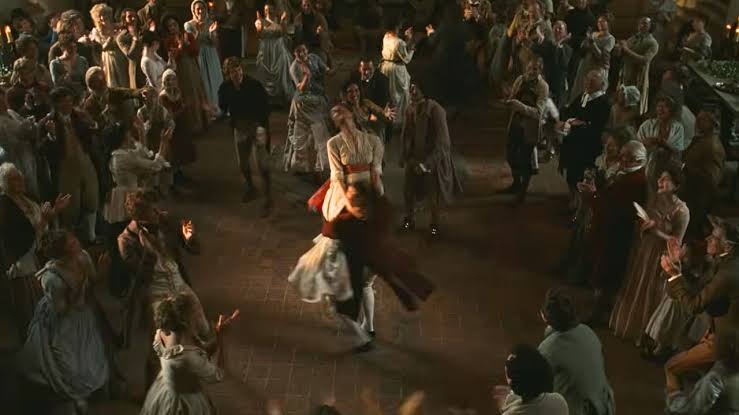
The dances seemed strange and very un-Regency-like in my mind. They were almost modern or Avant-garde at times. In several scenes, the dancing was inappropriate between men and women and nothing like Austen would have seen in a ballroom. Because of that, the dancing was quite distracting.
I did a bit of research and it seems as though the dance choreography in the film is getting quite a bit of criticism. I found this article by Dr. Meg Kobza, a historian at Newcastle University, quite helpful in understanding the topic: “What Was Going On With The Dancing In Sense And Sensibility? A Regency Expert Explains.”
Fun for Austen Fans
Overall, I enjoyed the film as a romantic at heart. I loved being immersed in the countryside, the music, the costumes and ballrooms, the gatherings of family and friends, and the familiar world of Austen’s characters. Most of all, I enjoyed seeing how another generation of filmmakers imagines Austen’s characters and the world of her novels.
I think most Austen fans who love a new adaptation and can bear with some of the usual inaccuracies will enjoy this one. If you are longing for a lovely Austen-esque fall treat, if you enjoy new Austen films for the fun discussion they inevitably invite, or if you like to watch new film adaptations for the mere pleasure of seeing Austen’s legacy continue to grow and progress to new and wider audiences, this one is worth seeing. If you just want a night out to see a beautiful film that’s clean and fun, then this is just the ticket.




Your review of the new P&P is spot-on! I agreed with everything you said. But, will add my two-cents’ worth by saying it will never be up to the 1995 version.
Thank you!
Everyone giggled whenever Mrs. Jennings (Fiona Shaw) spoke at the cinema session I attended, too!
I couldn’t agree more with your summary. The dancing and Marianne’s hair niggled at me, but otherwise I enjoyed the film very much.
I agree about the dancing. No elegance. More like a country stomp. Marianne’s character was not developed as well as Elinor’s, and Col. Brandon seemed too young to be retired. The scenery was beautiful and it was enjoyable to compare to earlier adaptations. It’s just really difficult to make a film that does the novels justice in the time frame allowed. I enjoyed it but will not make it a point to see it again. Nothing can beat the 1995 P&P adaptation.
My PEEVE!!!!was the change of Edward’s relationship with Lucy. It became confusing and not as believable to stop Elinor from sharing her knowledge. The book version is 100 per cent better.
Thank you for a lovely analysis. I, too, found much to enjoy and would never miss an adaptation of Austen. Eleanor and Edward moved me. Margaret was good. The visual aspect of the film seemed drawn from the landscape art of the time. Lovely. The hair was distracting. Why a scene in the National Gallery, which opened in May, 1837?
The dancing seemed to be designed to evoke mood. Fiona Shaw WAS amazing! My biggest complaint about Willoughby was not that he was hateful, but that he wasn’t really a character in his own right. He was someone for others to react to.
Thank you again.
I loved it! Yes, the hair a bit distracting and the dancing, well, somewhat weird, but I will definitely see it again for the delightful cinematographic experience.
Thank you for your review. I won’t bother going now. Like 2005 P&P which I loathe, I shall loathe this most definitely. Stringy hair, weird dancing, hateful Willoughby etc – as bad as a tall, flat chested toothy Keira Knightly as my beloved Elizabeth and pigs wandering through Longbourn!
I hope I remembered the pig bit correctly. I’ve tried to rewatch that P&P and can’t get past the first few minutes.
Thank you for your review. I hope to see it soon. D
Thanks for your review. We are planning on seeing it next week. I’m ok seeing different adaptions, and your comparison to the 2005 P &P gives me an idea of what to expect. My wife, who is a sewist and quilter, came across a video interviewing the woman in charge of the wardrobe. The attention to historical detail and thoughtfulness about settings was amazing. They even used historical fabric they found in London! That also made me want to see it!
I like your review Rachel. We could discuss the meaning of the dance sequences further. I wrote a review too after seeing the film with Marilyn. One comment I had from an anonymous commentator who was so exercised they couldn’t disagerre with me more. Thery didn’t go into detail unfortiunately. The film made me laugh. I thought the emotional turmoil was done well. I liked the modern interpretation.
All the best, Tony
I had a lovely time watching the movie. You didn’t mention Fanny Dashwood. We don’t see her much, but I felt that every time she appeared, the actress portrayed a very contemptuous Fanny Dashwood, that was truly faithful to the book.
Thanks, Rachel, for this excellent review. I have not seen it, but one other reviewer described Elinor as being overly emotional and chasing after Edward. Which to me takes out some of the heart of the original story. Did others find that to be true?