By Brenda S. Cox
In the 1850s, one of many visitors to Winchester Cathedral asked the verger where to find Jane Austen’s grave. (A verger is a church official responsible for the building, among other duties.) The verger responded,
“Pray, sir, can you tell me whether there was anything particular about that lady—so many people want to know where she was buried?”

Winchester Cathedral

Flagstone over Jane Austen’s grace in Winchester Cathedral
Memorials to Jane Austen in Winchester Cathedral
We could all tell him what was “so particular” about that lady! The verger might have looked at the ledger stone in the north aisle of the cathedral for clues. It reads (italics added):
In Memory of JANE AUSTEN, youngest daughter of the late Revd GEORGE AUSTEN, formerly Rector of Steventon in this County, she departed this Life on the 18th of July 1817, aged 41, after a long illness supported with the patience and the hopes of a Christian. The benevolence of her heart, the sweetness of her temper, and the extraordinary endowments of her mind obtained the regard of all who knew her, and the warmest love of her intimate connections. Their grief is in proportion to their affection, they know their loss to be irreparable, but in their deepest affliction they are consoled by a firm though humble hope that her charity, devotion, faith and purity have rendered her soul acceptable in the sight of her REDEEMER.
This was probably written by Jane’s brother Henry, perhaps in consultation with the rest of her immediate family. The style fits with other epitaphs of the time—not focusing on worldly achievements or fame, but on spiritual attributes, the love of her family and friends, and her hope of heaven. That verger might only have wondered about “the extraordinary attributes of her mind”—the only clue to Jane’s genius as a writer.

The north aisle of Winchester Cathedral, where Jane Austen is buried.
All those Victorian visitors to the Cathedral indicated Austen’s increasing popularity. This encouraged her nephew, Rev. James Edward Austen-Leigh, to write her first biography, the Memoir of 1870. The proceeds paid for an additional plaque in the Cathedral, which does mention her writing, but not in detail.

Plaque on the wall next to Austen’s grave, placed by her nephew, James Edward Austen-Leigh, son of her brother Rev. James Austen. Designed by architect Thomas Henry Wyatt, who had worked on Austen-Leigh’s parish church at Bray.
The plaque reads [brackets and italics added]:
Jane Austen, known to many by her writings, endeared to her family by the varied charms of her Character, and ennobled by Christian Faith and Piety, was born at Steventon in the county of Hants [Hampshire] Dec xvi mdcclxxv [Dec. 16, 1775] and buried in this Cathedral July xxiv mdcccxvii [July 24, 1817] “She openeth her mouth with wisdom and in her tongue is the law of kindness.” Prov. xxxi v. xxvi [Proverbs 31, verse 26]
Above this memorial tablet is a third memorial—a stained glass window paid for by public donations in 1900, as Austen’s reputation expanded even more. St. Augustine of Hippo is at the top—Augustine can apparently be shortened to “Austin,” who knew? Below him we find King David, writer of most of the Psalms, with his harp; St. John with the first words of his gospel, “In the beginning was the word”; and other biblical writers (the sons of Korah) with quotations from the Psalms. The quotations are about the fear of the Lord, meekness, wisdom, understanding, justice, and salvation. (They are in Latin with slightly different numbering than today, but the modern verse numbers are: Psalm 34:11, 25:9, 49:3, 71:15).

Stained glass window in Winchester Cathedral commemorating Jane Austen. Designed by C.E. Kempe, 1900, paid for by public subscription.
One more memorial to Austen now graces Winchester Cathedral. Outside, in the Cathedral Close, a new statue depicts Austen, installed for the 250th anniversary of her birth. (A “close” is enclosed land belonging to a cathedral, generally including schools, offices, and homes for the bishop and clergy.)
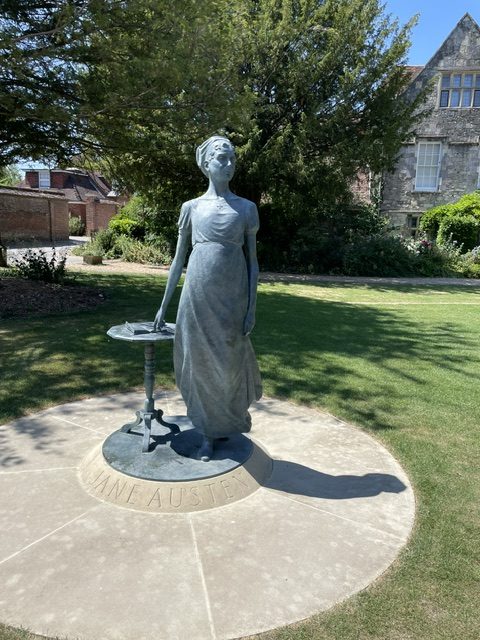
Jane Austen statue in Winchester Cathedral Inner Close.
Photo ©Betty Parker Ellis, 2026. Taken during the 2026 JASNA Summer Tour.

Baptismal Font at Winchester Cathedral. The nearby sign says, “The font is used in baptism, by which sacrament a person becomes a member of the Church. This mid 12th century font of black Tournai marble is decorated with carvings showing the miracles of St. Nicholas, patron saint of children.”
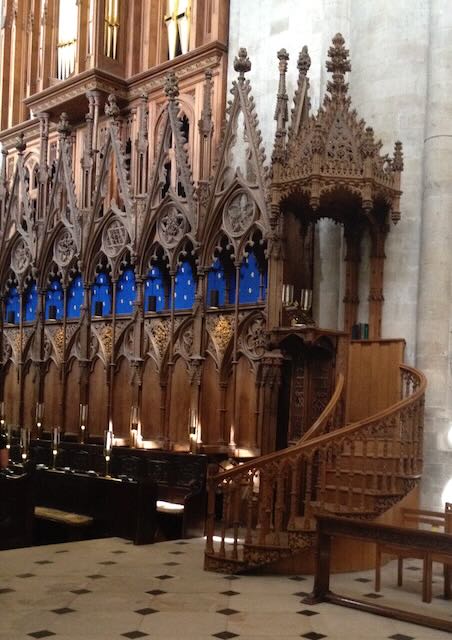
Pulpit and stalls at Winchester Cathedral

Screen at the high altar of Winchester Cathedral
How was Jane Austen connected to Winchester?
Jane Austen and her family were connected with Winchester Cathedral through their churches. Jane lived her early life in the parish of Steventon, where her father was rector of the parish church. Later in her life she lived in the parish of Chawton, where her brother Edward Knight was squire of the parish, and her brother Henry was briefly curate at the Chawton church.
In the Church of England, parishes are combined into dioceses. Each diocese is led by a bishop, whose center is the cathedral. Both Steventon and Chawton are in the diocese of Winchester, led by the Bishop of Winchester from Winchester Cathedral.

Nave and chancel of Winchester Cathedral
The Austens were also connected to Winchester through its school. Winchester College, near the Cathedral, is the oldest of England’s “public schools.” (The approximate equivalent in the US would be an elite boarding school for junior high and high school.) Some students were “scholars,” on scholarships, and others were “commoners” who paid fees to attend.
Eight of Jane Austen’s nephews attended Winchester College as commoners (paying students)—six of her brother Edward’s sons (Edward, George, Henry, William, Charles, and Brook), one son of her brother Frank (George), and one son of her brother James (James Edward). The college was strict and spartan. The boys ate mainly boiled beef or mutton with bread and beer. Student prefects brutally ruled younger students. Students occasionally rebelled—Austen’s nephew Charles Bridges Knight was part of a rebellion in 1818 which led to thirty expulsions.

Memorial to William of Wykeham, who rose from humble beginnings to become Bishop of Winchester and Chancellor of England. He founded Winchester College in 1382; eight of Jane Austen’s nephews attended there.
Jane corresponded with her nephew James Edward and others about the school. On July 9, 1816 she watched “a countless number of Postchaises full of Boys pass by” “full of future Heroes, Legislators, Fools, & Vilains” (going home for the summer from Winchester College). (‘Vilains’ is Austen’s spelling.)
Winchester is only 17 miles from Chawton and 14 miles from Steventon. Jane’s father, George Austen, had an account with John Burdon’s bookshop in Winchester. That shop is now called P&G Wells. Jane loved both books and music. Her piano teacher came from Winchester, where he was assistant organist at the Cathedral. He gave lessons to Jane and others in Steventon. He was George William Chand, later organist of the Cathedral and College.

Winchester bookseller which supplied books to Jane Austen’s family.
Jane also had a friend living in Winchester. Elizabeth Bigg of Manydown Park (brother of Harris Bigg-Wither who proposed to Jane) married Rev. William Heathcote, a prebendary (official) of the Cathedral. Austen might have visited one of their homes in the Cathedral Close. Elizabeth left there when she was widowed, but moved back to the Close when her son entered Winchester College. Cassandra, Jane, and Martha Lloyd did visit her there for a week at the end of 1814.
When Jane moved to Winchester for medical treatment, in her final illness, it was her friend Elizabeth who arranged for her lodgings at 8 College Street. Elizabeth visited her every day.

Jane Austen spent her last eight weeks at 8 College Street in Winchester, where she died.
Austen apparently loved the Cathedral. She might have appreciated its long history, or its medieval beauty. Cassandra wrote,
“it is a satisfaction to me to think that [Jane’s dear remains] are to lie in a Building she admird so much—her precious soul I presume to hope reposes in a far superior Mansion” (July 20, 1817).
Memorial to Samuel Wilberforce, Bishop of Winchester, 1869-1873; son of William Wilberforce, “The Great Emancipator.” Jane Austen “loved” Thomas Clarkson’s writings; he fought against slavery alongside William Wilberforce.
Winchester Cathedral is full of history, and rotates exhibits on various topics. Page from the twelfth-century Winchester Bible. Pigments used to decorate the Bible were also displayed: lead white, orchil (purple), ochres (yellow, brown), red lead, vermilion (red-orange), verdigris (green), lapis lazuli (most expensive, from Afghanistan), carbon black, gold, granular gold, and gold leaf.
Why was Jane Austen buried in Winchester Cathedral?
When Jane Austen died in Winchester (See What Killed Jane Austen?), she was not wealthy or well-known. Because she died in the parish of St. Swithun’s, she had the right to be buried in the Cathedral precinct. However, to be buried inside the Cathedral, she needed social connections, which her family had.
Jane’s brother, Rev. Henry Austen, may have made the request to the Dean and Chapter of the Cathedral, who would make that decision. He was likely supported by Elizabeth Heathcote, widow of a prebendary, and George William Chad, the organist and Jane’s former piano teacher.
The Dean, Thomas Rennell, was a friend of the Chutes of the Vyne, who knew Jane and her family. The Chutes were also friends and patrons of her brother James, giving him a church living. Jane’s mother’s connections with the aristocratic Leigh family probably also helped. Her father is mentioned in all capital letters on her gravestone, so his holding a Hampshire living for forty years may have been taken into account. Her brother James was too ill at the time to come to Winchester, but he had also held several parish livings for some years.
One more speculation: Henry may have told the Dean that the Prince Regent admired Jane’s work and asked her to dedicate Emma to him. Connections, connections.
It was also expensive to be buried in the Cathedral. The expenses for Austen’s very modest funeral came to £92, paid from her own modest savings. Presumably that included standard burial costs: 10 guineas (£10.50) for burial in the aisle of the Cathedral, plus 6 shillings, 8 pence (1/3 of a pound) for the tolling of the bell. (Burial in the choir would have been 50 guineas; burial near the choir or above the steps, 20 guineas.) Official records say Austen’s estate, after payment of funeral and other expenses, was worth £661 and 2 shillings.
In the end, Jane Austen was buried inside Winchester Cathedral, now considered one of the Jane Austen family churches. She was the only one of her siblings to be buried in a cathedral. Her grave there has attracted many visitors for more than two hundred years. Winchester Cathedral made a great decision in allowing Jane’s grave to be inside!
During the 2023 JASNA Summer Tour, we strewed flowers on Jane Austen’s grave.
Winchester Cathedral’s lovely bookshop offers my book, Fashionable Goodness: Christianity in Jane Austen’s England, along with many other excellent books and souvenirs.
Winchester Cathedral is a beautiful, peaceful place of worship. Have you ever visited Jane Austen’s grave? I found it a very moving experience, as have many others. What did you think and feel there?
All photos in this post ©Brenda S. Cox, 2026, unless otherwise noted.
Brenda S. Cox is the author of Fashionable Goodness: Christianity in Jane Austen’s England. She also blogs at Faith, Science, Joy, and Jane Austen.
If you have been enjoying this series on Jane Austen Family Churches and would like to contribute to the needs of those churches, keeping them viable and helping them better preserve and present Austen’s legacy, please go to JASNA’s Donate to Austen-Related Institutions. Thanks!
Sources and Further Reading
Jane Austen and Winchester: An Introduction, published by Winchester College.
Jane Austen’s Hampshire by Terry Townsend shows Jane’s connections to various locations in Hampshire, including Winchester.
Jane Austen and Winchester Cathedral, booklet by Michael Wheeler
Deb Barnum’s post on Winchester from the 2025 JASNA Summer Tour shows interior shots of the house in which Austen died; Winchester College; the Epiphany Chapel; bits and pieces of the Cathedral stored in the Crypt; and more.
Winchester Cathedral and Jane Austen
Winchester Cathedral architecture, gorgeous photos
“Austen and Cathedral: Was Interment a Signal Honor?”
Other Austen Family Churches
Adlestrop and the Leigh Family
Great Bookham and Austen’s Godfather, Rev. Samuel Cooke
Hamstall Ridware and Austen’s First Cousin, Edward Cooper
Stoneleigh Abbey Chapel and Mansfield Park
Tonbridge: Home Parish of Jane Austen’s Father
St. Peter’s Hurstbourne Tarrant (the Lloyds’ church)
Churches Mentioned in Austen’s Novels
St. Swithin’s, Walcot and other churches in Northanger Abbey




As a British author, I’ve been several times to her grave and I always cry. Just so young… Just think if she’d just made fifty, even. Thanks for posting, though. Lovely evocative photos!
Thank you for sharing, Alice. Those “what-if’s” are appealing. Wouldn’t we all love to know even just how she would have finished Sanditon? But we are thankful for the years she had and the wonderful novels she wrote. :-)
Hi Brenda,
I hope your Summer is going well?
I first visited Winchester Cathedral when I was about 8 or 9 years of age travelling up from Southampton on a green Hants and Dorset bus to the bus station in the mddle of Winchester with my grandmother.
The reason for my interest then was the things we were learning in our history lessons at school. Winchester was the seat of governemnet when William the Coinqueror invaded England. It was their the Domesday Book was written. We were big on learning about 1066 and the Domesday book at school. Also we learned a lot about KIng Alfred the Great whose capital was Winchester. Did you see the foundations of the old Saxon cathedral to the north side of the present day Norman cathedral?
We also , at the age of 9, we were fascinated by the death of William Rufus, son of William the Conqueror, who was inadvertently killed in the New Forest by an arrow aimed at a wild deer deflecting off a tree and killing him. (Can you actually believe that? Was it an assassination?) Rufus is buried infront of the high altar.
Also the Bishop of Winchester, Henry Beaufort, in 1431 was the judge who condemned Joan of Arc to buring at the stake. England governed part of France in those days. There is a beautiful golden statue of Joan in the Cathedral.
Then there was the Civil war connections. Oliver Cromwell and his men used the cathedral as a stable for their horses after besieging and defeating the city.
The cathedral font, by the way ,is one of two brought to England from France. The other is in St Michaels Church in Southampton, a few hundred yards from Castle Square where Jane lived.
I am afraid in those days Jane Austen was far down the list of interest for me. I think my grandmother showed me her grave in the north aisle of the cathedral but it didn’t register much with me at the time.
I enjoyed reading your article. All the best, Tony
Thanks for that additional history, Tony! Such a rich place. I enjoyed seeing other historical sights in Winchester, but thought it would be a little much to include them here. I appreciate your adding these insights for our readers.
I have visited the grave of Jane Austen and was moved to tears. While there, a woman from Australia was videoing it for her daughter back home as she was a huge fan. I thought that was wonderful.
Brenda, this was a lovely article. I was able to visit Winchester in the 80’s and was so struck by Jane’s grave sight and how truly spectacular the cathedral was. It was one of the best experiences on my trip! Thanks for sharing so much interesting background information. And I love the new statue -what a great addition!
Brenda, thank you for writing this fascinating article. I always learn so much from you about Austen’s life, family, and Regency history. I plan to visit Winchester, Chawton and other Austen-related sites one day. Thank you for sharing your insights!