Feeds:
Posts
Comments

Archive for the ‘18th Century England’ Category

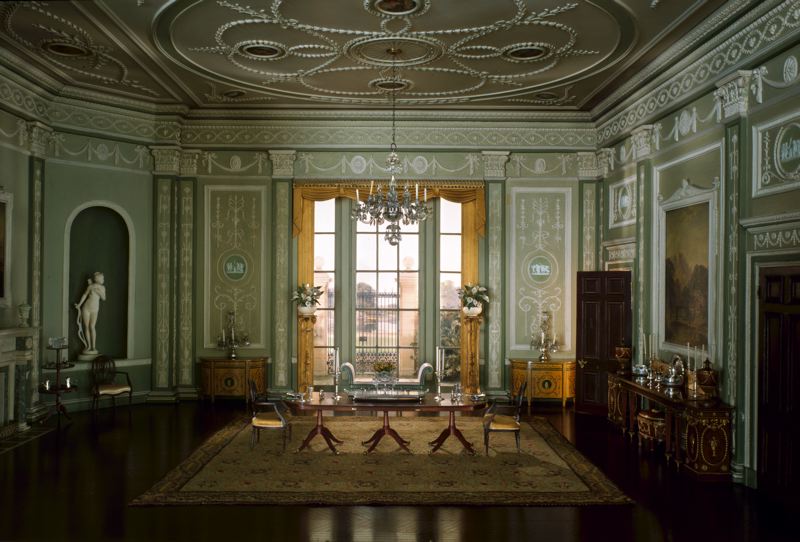
Copyright (c) Jane Austen’s World. Mrs. James Ward Thorne of Chicago was no ordinary luxury-loving, self-indulgent socialite.  Her love for doll houses as a child spilled over into adulthood, and she collected miniature furniture as she traveled through Europe. Her hobby led her to commission cabinetmakers and architects to recreate dozens of detailed historically accurate and important rooms on a scale of one inch to one foot. Each room was not only made to scale, but so were the upholstery, textiles, rugs, and curtains, which were fashioned by the Needlework Guild of Chicago.

Mrs Thorne bequeathed 26 European rooms and 98 American rooms to the Art Institute of Chicago. When I visited that world renowned museum, I had the forethought to bring my Flip Camera. My amateurish videos managed to capture the three-dimensional quality of the rooms and how they were lighted. Each room provides a peek into another space, giving the sense that doors and windows open up to a real world outside or lead to hallways and other important spaces.

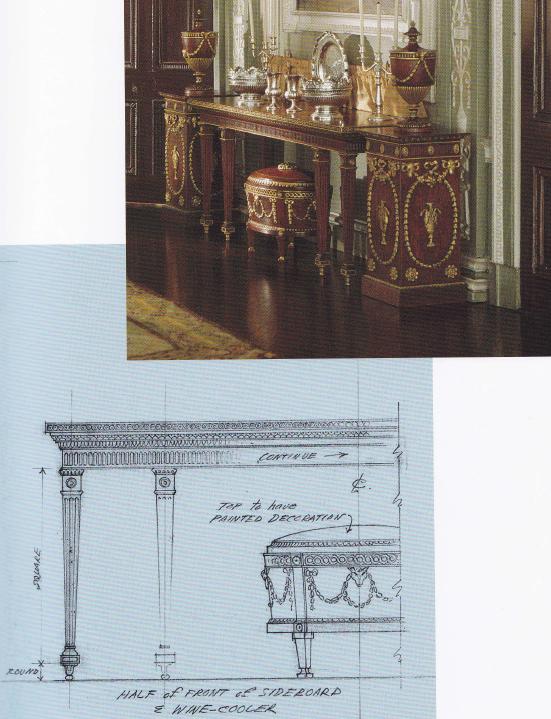
Detail of side table with flanking pedestals and oval wine cooler, with architectural drawing.

Image scanned from Miniature Rooms: The Thorne Rooms at the Art Institute of Chicago.

This remarkably detailed model of an English dining room was based on the interior of the dining room designed by Robert Adam at Home House in London. Features from the dining room in Saltram in Devonshire were also incorporated into the miniature. Comparing the miniature model (below) with the life-sized recreated Adam dining room from Lansdown House, which is now housed at the Metropolitan Museum in New York city, one can see how faithful Mrs. Thorne and her artisans were in recreating details and proportions.

About this work: Art Institute of Chicago

Like Adam, who had control over all aspects of the design, including the architecture, decoration, antiques, furniture,wall papers, paint and plasterwork, Mrs. Thorne closely oversaw each detail of her exquisite rooms. The furniture throughout Mrs. Thorne’s version of the Adam dining room were decorated with ram’s heads, as was the frieze. The urns on the fireplace mantle are copies of Wedgwood examples, and the paintings over the mantle and side table are after Claude Lorrain.

Dining room, Lansdowne House, Metropolitan Museum of Art

Heilbrun Timeline of Art History

More on the topic:

Read Full Post »

Copyright @ Jane Austen’s World

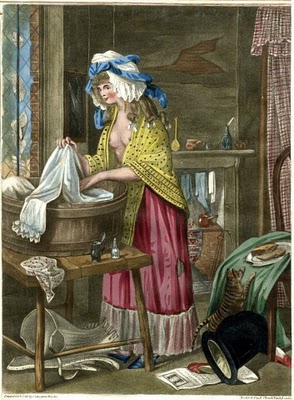
Before that you suffer it to be washed, lay it all night in urine, the next day rub all the spots in the urine as if you were washing in water; then lay it in more urine another night and then rub it again, and so do till you find they be quite out.
Hannah Woolley, The Compleat Servant-Maid, 1677

The Last Shift, Carrington Bowles

Urine for spot cleaning? Yes, you read the first word correctly.  Since the middle ages, professionals belonging to guilds manufactured soap and candles, for both products required tallow. They traditionally manufactured soaps from sodium or potassium salt or alkalis present in plant materials, and boiled the ingredients with animal fat. In the 19th century, it was discovered how to make caustic soda from brine. Soap makers no longer relied on cut wood to make soap and the cleaning industry was never the same again.

Before innovations during the Industrial Revolution changed laundry day forever, it was generally known that that alkaline substances, such as bleach or ash, dissolved or disintegrated stains and soils, enhancing the water’s ability to clean clothes.

Urine is alkaline, and since the days of ancient Rome, this by-product of the human body was used as a bleaching agent. “Pecunia non olet — money does not stink”,  Emperor Vespasian reportedly said when he started taxing this trade.*

Yes, urine stinks. But so do bleach and vinegar, a weak acid. The stinking ingredient that turns us off and that makes urine such a good cleaning agent – ammonia – is a substance that our modern cleaning products include in abundance.**  Eighteenth century English wool manufacturers used both urine and sheep or pig manure for washing. In addition, urine also sets dye. (The seller of my beautiful little handmade rug from Turkey cautioned that its vegetable dyes were set with goat urine. Twenty years after its purchase, the rug no longer smells, but its fragile colors must be vigilantly protected from direct sunlight.)

As recently as the early 20th century, urine was collected in barrels in Japan and fermented for use in laundering. The Japanese threw the contents of their slop jar into the barrel, then separated the feces from the liquid urine. The feces were used as fertilizer to enrich the soil, and the urine was collected by laundry shops, who fermented the liquid and used it  as a bleaching agent by pounding it into the cloth. – Edible Soap, A Harmless Natural Soap for the Family. It is the fermentation process that probably made urine safe to handle, much like fermented beer or distilled alcohol were safe to drink in the days before sterilization.

Urine from the animal of choice was also used to improve the complexion. Samuel Pepys’ wife decided to try the urine of puppies (‘puppy-dog water’), for instance, in March 1664 (Diary of Samuel Pepys). This may have been less foolish than spending a hundred bucks on a small pot of modern-day moisturiser, since the ‘active’ ingredient in urine is urea, and urea creams are inexpensive, effective and regularly recommended by dermatologists. – The Thirteenth Depository: A Wheel of Time Blog

This YouTube video uses urine to demonstrate that it is as powerful a cleanser as commercial products.

More on the Topic

*The Historical Development for Washing Laundrys

**Pepys Diary

Read Full Post »

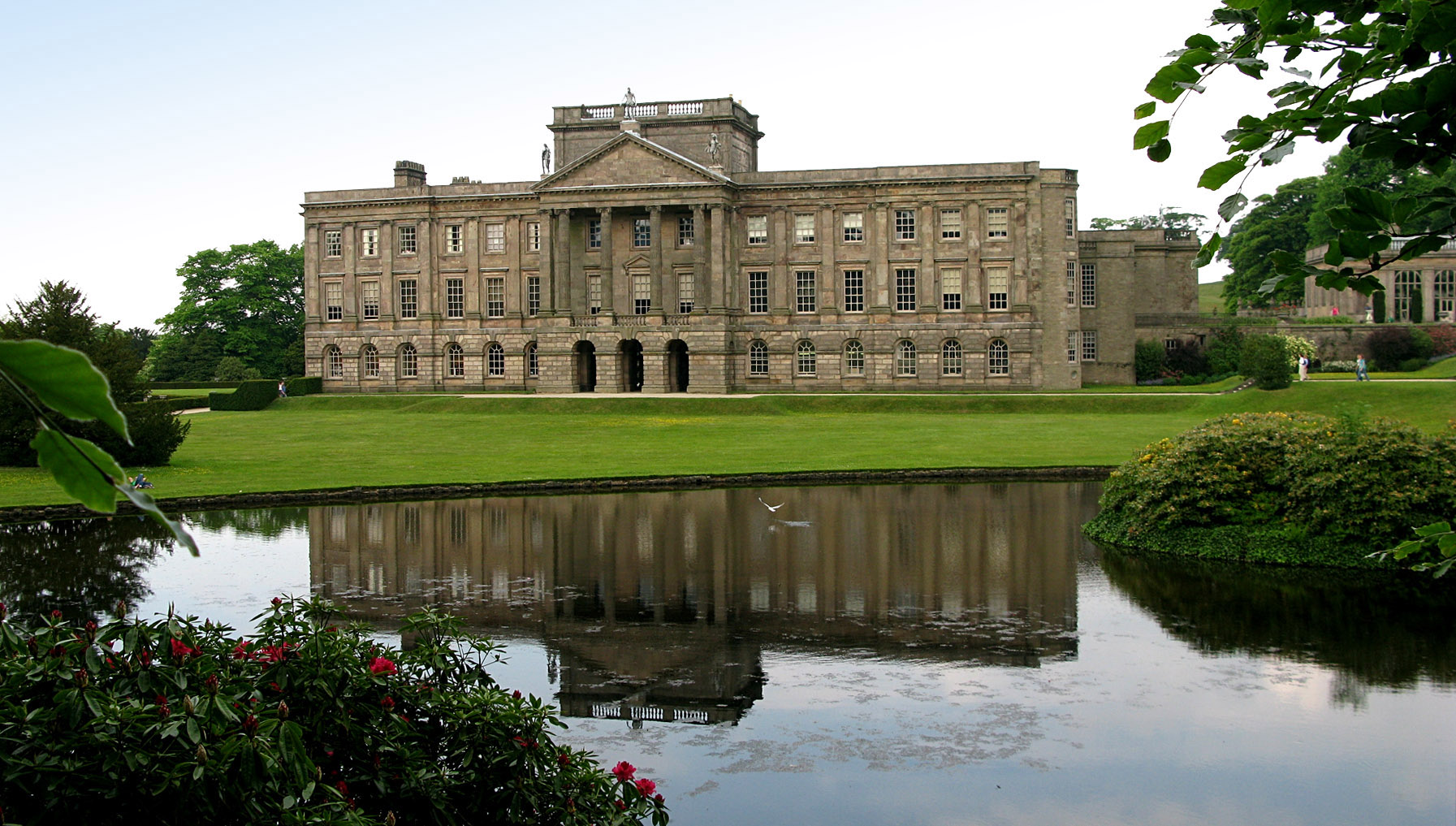
Copyright (c) Jane Austen’s World. Lyme Park in Chesire is best known today as the exterior of Pemberley in Pride and Prejudice 1995. The house, situated near the village of Disley, was the principal seat of the ancient family of Leghs, whose ancestor fought bravely in the battle of Cressy. Once a hunting lodge, the building dates back to Elizabethan times. Its classical facade was designed in the 1720’s by the famed Venetian architect, Giacomo Leoni. The lake made famous by Colin Firth’s dip was once the source of a cascade, or a staircase with water running down it, from 1703-1818.

Lyme Park. Image @Lesley Rigby, Panoramio

The vast moors and lands of Lyme Park housed herds wild cattle and fallow and red deer, which had roamed the area for around five hundred years. Lyme Park’s stags were famous for their size and fierceness, but their wildness did not prevent them from being driven annually across the water. The two sources below do not list the reason for this custom, but one imagines it was to drive the herds to “greener” pastures.

Manners & Customs of all Nations

CURIOUS CEREMONY OF DRIVING DEER THROUGH THE WATER (FORMERLY PRACTISED) IN LYME PARK CHESHIRE

(For the Mirror)

ORMEROD, in his splendid History of Cheshire, says, “The park of Lyme, which is very extensive, is celebrated for the fine flavour of its venison, and contains a herd of wild cattle, the remains of a breed which has been kept here from time immemorial, and is supposed indigenous. In the last century a custom was observed here of driving the deer round the park about Midsummer, or rather earlier, collecting them in a body before the house, and then swimming them through a pool of water, with which the exhibition terminated.”

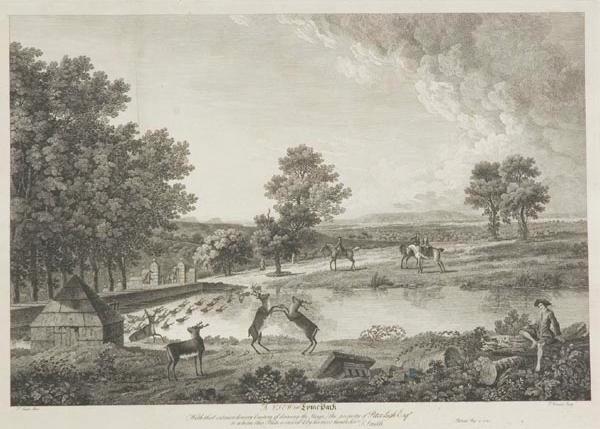
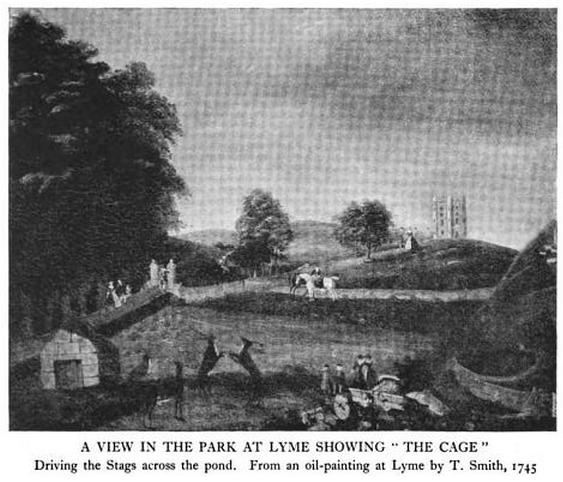
Driving the stags, a view of Lyme Park, 1745. Engraved by F. Vivares after a painting by Thomas Smith. Notice the differences in details between the print and the painting.

There is a large print of it by Vivares, after a painting by T. Smith, representing Lyme Park during the performance of the annual ceremony, with the great Vale of Cheshire and Lancashire as far as the Rivington Hills in the distance, and in the foreground the great body of the deer passing through the pool, the last just entering it, and the old stags emerging on the opposite bank, two of which are contending with their forefeet, the horns at that season being too tender to combat with. This art of driving the deer like a herd of ordinary cattle, is stated on a monument at Disley, to have been first perfected by Joseph Watson, who died in 1753, at the age of 104, “having been park keeper at Lyme more than sixty four years.”

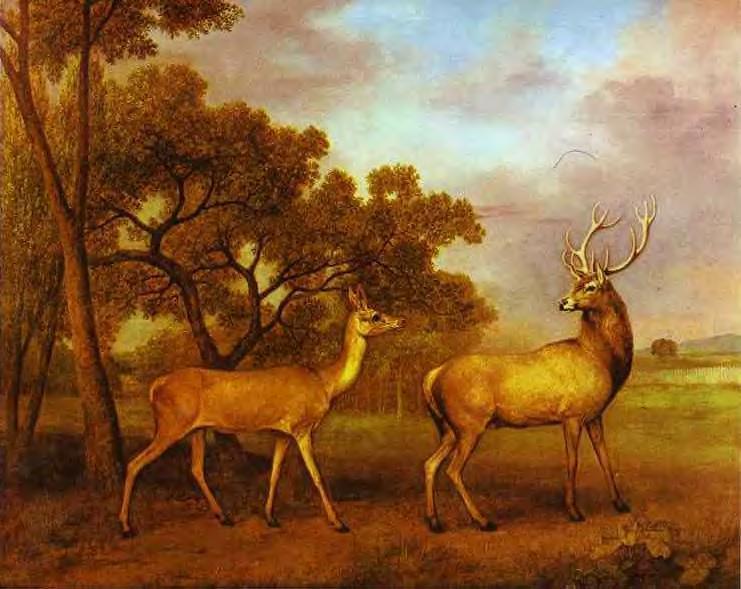
Red deer stag and hind, George Stubbs, 1792

The custom however appears not to have been peculiar to Lyme, as Dr Whitaker describes, in his Account of Townley, ( the seat of a collateral line of Legh,) near the summit of the park, and where it declines to the south, the remains of a large pool, through which tradition reports that the deer were driven by their keepers in the manner still practised in the park at Lyme.” – The Mirror of Literature, Amusement, and Instruction, Vol 14, Percy and Timbs, 1829, p 101-102

In connexion with these deer a very curious custom prevailed at Lyme from earliest times, namely, the driving of the stags at midsummer across a pond, called the Stag Pond — now no longer in existence. This performance was attended by a certain amount of ceremony, it formed a species of entertainment, and neighbours and friends from a distance were invited to be present and to take part in the chase. Vivares,* in a print after a picture by T. Smith,| still preserved at Lyme, represents the stags swimming across the pond, those in the foreground emerging from the water and fighting with their forefeet, the horns being in velvet : in the background are the ladies and gentlemen following the hunt on horseback, dressed in eighteenth-century costume. The print is inscribed :

A View in Lyme Park
With that extraordinary Custom of driving the Stag,

the property of Peter Legh Esqr

to whom this plate is inscribed by his most humble

servant T. Smith

Published Aug : 17. 1745.

* Fran9ois Vivares (1709-1780), a French landscape engraver; came to London 1727 ; kept a print shop, 1750-1780. – The House of Lyme, From its Foundation to the end of the Eighteenth CenturyEvelyn Caroline Bromley-Davenport Legh Newton (baroness), Lady Newton, G.P. Putnam, 1917

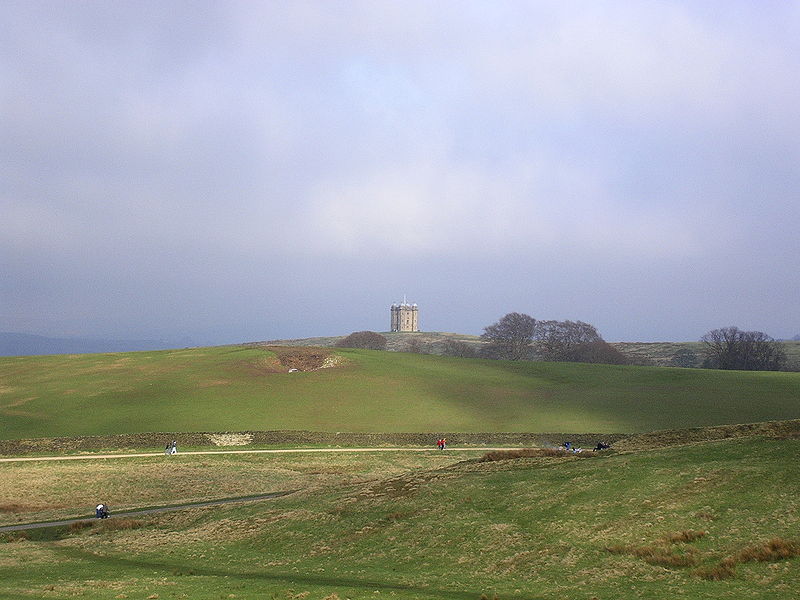
The Cage at Lyme Park overlooking the moors. Image @Wikimedia Commons. The structure was built as a hunting lodge and later used as a lockup for poachers.

More on the topic:

Read Full Post »

The Bennet sisters of Pride and Prejudice were considered gentlewomen because their father, having inherited money, did not have to work for a living. In Jane Austen’s era, families with inherited money were considered to have a higher class and social standing than a family that lived on an income gained through hard work and labor. However,

The squire of a great country house, in the eighteenth or nineteenth century, standing on his terrace looking out across his broad acres, was rarely the owner of his land or even his house. He was the life tenant, in possession of the family capital but unable to deal with his estates as if he owned them outright. His interests were subordinate to those of the family, and the family was of more importance than he was. He was the king in check, his freedom of manoeuvre limited by a peculiarly English system of inheritance, the strict settlement (English & Saville, 1983, p. 11).

As the plot of Pride and Prejudice unfolds, one starts to sympathize with silly Mrs. Bennet’s determination to marry her daughters off to practically any eligible (and unknown) man who happened to stop by the neighborhood. Due to the stipulations of Mr. Bennet’s will that only a male heir can inherit his estate, none of the Bennet girls will receive any of their father’s money. Unless they married well, they will be left destitute. For Mrs. Bennet the situation was made even more galling knowing that Mr. Bennet’s cousin, a man the family had never met, would also inherit Longbourn House, their family home.

Mr. Bennet to Mrs. Bennet:

“About a month ago I received this letter, and about a fortnight ago I answered it, for I thought it a case of some delicacy, and requiring early attention. It is from my cousin, Mr. Collins, who, when I am dead, may turn you all out of this house as soon as he pleases.”

“Oh! my dear,” cried his wife, “I cannot bear to hear that mentioned. Pray do not talk of that odious man. I do think it is the hardest thing in the world that your estate should be entailed away from your own children; and I am sure if I had been you, I should have tried long ago to do something or other about it.”

Jane and Elizabeth attempted to explain to her the nature of an entail. They had often attempted it before, but it was a subject on which Mrs. Bennet was beyond the reach of reason; and she continued to rail bitterly against the cruelty of settling an estate away from a family of five daughters, in favour of a man whom nobody cared anything about.

“It certainly is a most iniquitous affair,” said Mr. Bennet, “and nothing can clear Mr. Collins from the guilt of inheriting Longbourn. But if you will listen to his letter, you may perhaps be a little softened by his manner of expressing himself.” – Pride & Prejudice, Chapter 13

As it turns out, Mr. Collins, a ridiculous and self-important man, had good intentions. He arrives at the Bennet’s doorstep determined to ask for one of the Bennet daughters’ hand in marriage. In his mind, his generous act would make up for the unfairness of the will’s stipulation. Mr. Collins tells Mrs. Bennet about his desire to court Jane, the eldest daughter. When Mrs. Bennet informs Mr. Collins that Jane is practically engaged to Mr. Bingley, he quickly turns his attentions to Elizabeth, providing one of the most memorable marriage proposals in literary history, and one that I relish reading over and over. Learn more about entails from Wikipedia below:

Pride and Prejudice contains a particularly thorny example of the kind of problems which could arise through the entailing of property. Mr. Bennet, the father of protagonist Elizabeth Bennet, had only a life interest in his property, known as Longbourn. He had no authority to dictate to whom it should pass upon his death, as it was strictly arranged to be inherited by the next male heir. Had Mr. Bennet fathered a son, it would have passed to him, but it could not pass to any of his five daughters. Instead, the next nearest male heir would inherit the property; in the course of the novel, this was revealed to be Mr. Bennet’s cousin, William Collins, a minister in his mid-twenties. The inheritance of the Longbourn property completely excluded the five legitimate Bennet daughters. Such entails typically arose from wills, rather than from marriage settlements, which usually made at least some provision for daughters.

Read more about the topic here: The British Aristocracy, Capital and Income, and Nineteenth Century Company Accounting, Christopher J. Napier

Illustration by C.E. Brock. In the novel, I recall the proposal scene occurring after breakfast. I do not recall Jane describing Lizzie at her sewing table as Mr. Collins proposes.

Update: Read more about the entail as explained by a British lawyer named Henry in a post I titled: Everything You Wanted to Know About the Entail in Downton Abbey and More.

Read Full Post »

In reading Undressing Mr. Darcy, this phrase leaped off my computer screen:

Another of Beau Brummel’s innovations was the semi-starched cravat: a neck cloth folded and arranged exquisitely carefully beneath chin and shirt front. It is reported washerwoman fainted when he introduced this. And no wonder, on top of everything they had to wash, iron, and mend they now had this semi-starched neck cloth: not full starch so it could be done with all the others, no, it had to be semi starched.

Until recently I would not have singled out this phrase, but as I have been reading about scullery maids (click on link), the enormity of their tasks (and those of washer women and the lowly house maids) have begun to hit me in a real sense. Imagine cleaning dishes or doing laundry in an era when there was no running water piped into the house. The very rich might have a private cistern or well nearby, but for the majority of households during the 19th century and before, water had to be carried into the house from a distance. The town pump or well, while centrally situated in a village or city square, might not be conveniently located near one’s house. In addition to the village well, households in the country could also rely on local streams, rivers, or lakes for their source of water, but again, these bodies of water were probably located some distance away.

Whatever the chore, water had to be carried back to the house by the servants of an upper class house or by the mistress or a maid of all work of a modest household. According to Digital History, Washing, boiling and rinsing a single load of laundry used about 50 gallons of water. Over the course of a year she walked 148 miles toting water and carried over 36 tons of water. Homes without running water also lacked the simplest way to dispose garbage: sinks with drains. This meant that women had to remove dirty dishwater, kitchen slops, and, worst of all, the contents of chamberpots from their house by hand.

One can just imagine how many buckets of water were required for one hot steaming bath. It is no wonder, then, that people of that era took infrequent baths.

It is also documented that the women of those bygone days universally dreaded laundry days. In fact, because of the sheer enormity of the task, people had a habit of changing their shirts and underwear only once a week. A chemise, which was worn next to the body, was washed more frequently than a gown. These shapeless undergarments were made of white linen, muslin, or cotton so that they could take the frequent harsh treatment of boiling and pounding in lye without losing shape or color. According to Reflections on Early Modern Laundry, “undergarments were not permanently gathered at the neckline and sleeves, but made with casings and drawstrings so the garment could be laid out flat for drying and ironing.”

In the absence of electric dryers, laundry had to dry naturally. This could be a problem during cold dank winters when clothes took forever to dry. One can now understand why Beau Brummel’s penchant for wearing white, lightly starched cravats (and he often went through a bundle before being satisfied of the results) would make a laundress faint.

Here are two more descriptions of washing and doing laundry before modern conveniences took over. The first one is from Digital History:

On Sunday evenings, a housewife soaked clothing in tubs of warm water. When she woke up the next morning, she had to scrub the laundry on a rough washboard and rub it with soap made from lye, which severely irritated her hands. Next, she placed the laundry in big vats of boiling water and stirred the clothes about with a long pole to prevent the clothes from developing yellow spots. Then she lifted the clothes out of the vats with a washstick, rinsed the clothes twice, once in plain water and once with bluing, wrung the clothes out and hung them out to dry. At this point, clothes would be pressed with heavy flatirons and collars would be stiffened with starch.
The most interesting bit of information about laundering in the 19th century and before was the following excerpt from Reflections on Early Modern Laundry:

First, remember that many of the fabrics that they used, especially the wools, are things that we now usually dry-clean because they are difficult to wash. Woolen garments had to be washed separately in cold water to avoid shrinkage and pilling. I will not even address the issue of trying to clean silks, brocades, and other luxury fabrics …

Dyes were not color-fast, and fabrics shrank at different rates. If you read the descriptions of how to wash a “good” dress, the laundress started by removing the trimming and the buttons. Then she separated the lining from the garment itself (picking the seams). If the skirt was full enough that the weight of the wet fabric would cause it to stretch unevenly, she took the skirt off the bodice and took the gores apart at the seams. Then she washed it, dried it, checked to see if the lining and the garment still matched up in size, made any necessary adjustments, and sewed it back together.

Laundry: Reflections on Early Modern Laundry: This online article explains how laundry techniques hardly changed at all between the 16th and 19th centuries.

Digital History: Housework in late 19th Century America:Find a detailed description of the 19th century American housewife’s duties on this site. They are not so vastly different than those of the ordinary housewife in England.

Victorian Baths: Addresses how cleanliness and hygiene were tackled during the late 19th century.

Click on the English Heritage Site for a view of a laundry room.

Paintings of laundry maids by Henry Robert Morland, circa 1785

Read Full Post »
« Newer Posts - Older Posts »