Feeds:
Posts
Comments

Archive for the ‘18th Century England’ Category

In the past, this blog published several articles on hairstyles for men and women in the Regency era. This post discusses hairstyles in Georgian times. During a recent visit to the Walters Art Museum in Baltimore, I had the pleasure of examining a small, but excellent collection of Greco Roman statues and ancient artifacts. Strolling through several galleries, I took photographs of the hairstyles of the female figures.  The Walters Art Museum’s antiquities collection ranks among the top tier in North America (JSTOR). The images below are confined to the photographs I shot at the museum and the public domain portraits I found to compare them to.

A Change Towards the Neoclassical Ideal

From the late 16th century to the mid-19th century (until train travel changed the nature of long-distance travel), young male British aristocrats embarked on a Grand Tour to the Continent for several months or years to round out their education. Accompanied by a teacher or guardian, they completed their knowledge of the classics, studied art, and enjoyed a life of leisure, luxury, and exotic (at times erotic) adventures.

The itinerary included stays in France (Paris being a much sought after destination), The Netherlands, Switzerland, Germany, and, of course, Italy.  Rome remained the premier stop, but trips to Venice, Florence, Pompeii, and Greece were also prized. Travelers returned home with souvenirs, works of art to decorate their houses and gardens, and a thorough appreciation of the Neoclassical ideals of ancient Rome, Greece, and the near East, as well as the Renaissance principles of art and architecture.

Influence of Neoclassicism on Women’s Hairstyles and Fashion

Transformation in women’s clothing and hair styles developed slowly during this period, but changed quickly between 1778 and 1793, influenced not only by the Grand Tours, but also in reaction to the French Revolution (1789-1799).  Even before the war, Marie Antoinette sought refuge from the extravagant dress at Versailles in her Hameau de la Reine, which was built for her on estate grounds.  Here she could enjoy a more natural environment than court life offered and dress “down” from elaborate corseted dresses and the over-the-top hair styles that were caricatured.
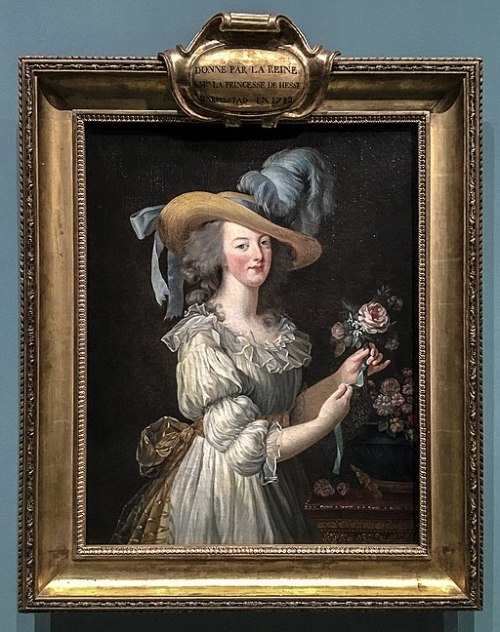
Marie Antoinette in a chemise gown. 1783. Elisabeth Louise Vigée Le Brun. Wikimedia Commons

Marie Antoinette, by Elisabeth Louise Vigée Le Brun, 1783. She is wearing a relatively loose and simple gaulle gown or chemise a la reine, made of muslin. Wikimedia image.

Marie Antoinette, along with the ladies of her court, walked and relaxed in light-loosed dressed in the gardens, grounds, and working farm that surrounded the hamlet. To complement a more “natural” look and in keeping with the casual atmosphere, she and her female entourage wore straw bonnets and loosely curled hairstyles, which, for its time, were “simple.”

The print below shows the old school reaction to the new styles. The Merveilleuses were instrumental in transforming fashion to the Neoclassical style during the the French Directorate (1795-1799) in the last four tumultuous years of the French Revolution.
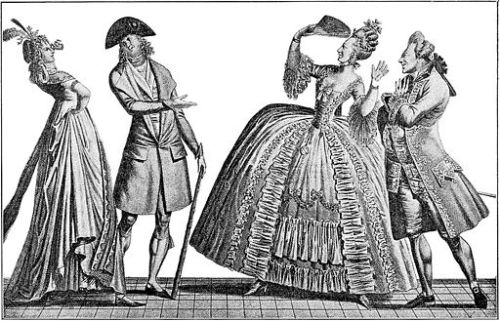
From Vernet's

From Vernet’s “Incroyables et Merveilleuses” series, 1793. Public Domain image.

Comparisons of images of Greco Roman statues to contemporary Georgian paintings

As previously stated, this post contains the original images I took in the Walters Art Museum. The quoted text about the ancient statues is rewritten from the museum informational labels for each sculpture or relief.

Right: Relief of Apollo and Artemis, ca 50 B.C. Walters Art Museum. Image by V. Sanborn. Left: Portrait of Louise of Mecklenburg-Strelitz, Queen of Prussia, 1802. Josef Grassi. Wikimedia Commons. Comment: The Queen of Prussia wears a diadem much like Artemis in the 50 B.C. relief panel. Differences in hairstyles are due to adaptations made by the Europeans, who were influenced by the ancients, but who did not slavishly copy the hairstyles and hair jewelry. Their adaptations were unique to their era.

Left: Detail, Maidens Playing “Knucklebones”. Greek, late 4th or early 3rd century B.C., Terracotta. Walters Art Museum. Image by V. Sanborn. Right: Harriet Melon by John Russel, 1804. Image from The Peerage. Comment: One can see almost a direct correlation between these two hairstyles, centuries apart. The primary difference is in the soft curls framing the face and forehead in Harriet’s undo  In 1804, soft white muslin dresses, draped gently from a high waist, were all the style. Emma Thompson and Kate Winslet wore hairstyles in 1995’s Sense and Sensibility that were remarkably similar to the terracotta maiden’s, with touches of the ringlets popular in the early 19th century.

Left: BonnetAbout 1810, 19th centuryGift of Mrs. C. Walsh © McCord Museum View the leghorn bonnet at this link. Right: Portrait of a Woman. Roman, Trajanic period, ca A.D. 10. Walters Art Museum. Image by V. Sanborn. Comment: I found no online examples that emulated this elaborate Roman hairstyle, but I loved how the leghorn bonnet echoes it. By 10 A,D., Roman women wore complicated hairstyles requiring daily maintenance by attendants. Wigs, hairpieces made from the hair of slaves, and padding kept in place with hair nets, pins, or combs, were used to create a sculptural “do.” (Hairstyles through the ages.)

Left: “This portrait of Livia was created not long after her marriage to Emperor Augustus…She…set a new fashion with her innovative nodus hairstyle, in which a section of hair is arranged in a roll over the forehead, while the rest of the hair is swept back in loose waves and secured in a bun at the nape of the neck.” (Text from the Walters Art Museum). Livia, Late Republican period, mid-late 30s B.C. Image by V. Sanborn. Right:  Louise, Queen of Prussia by Elizabeth Vigee Lebrun, 1801, Schloss Charlottenburg. Public domain image Comment: Louise wears an adaptation of the nodus hairstyle. Hers is looser with curls framing her forehead and face. Her low bun is larger, looser, and curlier. 

Top left and right: Portrait of a Young Woman. Roman (Egypt?), late Republican period, ca. 50 B.C. Walters Art Museum. Image by V. Sanborn. “The realism of the young woman’s fleshy features and the detailed treatment of her elaborate hairstyle are typical of the late Republican period.” (Text from Walters Art Museum.) Bottom left: Detail of An Embarrassing Proposal, 1715-1716, Jean Antoine Watteu, Hermitage MuseumBottom right: English School, A Lady, profile facing to the left, wearing pale lilac dress with white sleeves and coral necklace (early 19th Century), watercolour on card, , set in a red leather travelling case. Oval, 78mm (3in) high.Bonham’s. Comment: The lovely bust of the young Roman woman demonstrates a hairstyle that spans a hundred years between the early 18th and early 19th centuries. The Roman hairstyle reminded me of several Watteau paintings from the early 18th century. The lady at bottom right also wears a version similar to the Roman example, but is more complicated. In the Watteau painting, the ladies demonstrate three versions of a similar underlying style. In this instance, Greco Roman influence definitely made its appearance at the start of the Georgian era in England (1714-1830). French influence on English fashion is well known.

Top right: Standing Maiden. Greek (Tarentum, Italy) 3rd century B.C.. Terracotta with traces of paint and gilding. “…the draping of the fabric on top of the maiden’s high, ‘melon” hairstyle are typically South Italian.” (Quoted text from the Walters Art Museum.) Image by V. Sanborn. Top left: Fashion plate, Costume Parisiens, 1815. Bottom: Detail of an 1812 print. Comment: From the original model of a high melon hairstyle, one can see the inspiration for the hairstyles featured in the two prints. These early 19th century hairstyle adaptations don’t strictly follow the original example, but pay homage to it. In the fashion plate, one can observe the French empire custom of inserting flowers, ribbons, and hair jewelry. The two ladies busying themselves with needle work affect simpler hairstyles that echo the high “melon” look but that leave the bun loose and curling down the back of the head. 

Right: Head of a Maiden With Lampadion Hairstyle. Greek, 3rd-2nd century B.C. “Dicaearchus (active about 320 -300 B.C.) a pupil of Aristotle’s, remarked that women described this hairstyle with topknot as the lampadion, or “little torch.” (Quoted text from the Walters Art Museum.) Image taken by V. Sanborn. Left: Portrait of a young girl, Louis-Léopold Boilly. Date unknown. Middle: Portrait of young woman, bust, wearing a gray-brown dress Laplatte Adèle (late 18th century-early 19th century) Paris, Louvre Museum, DAG. Comment: The Lampadian hairstyles as worn by the ladies in the two paintings, closely resemble the Greek example. Women still wear  this today, including me when I’m dressed casually.

Top right and middle: Terracotta Head of a Woman with Long Curls. Greek (South Italy), 3rd century B.C. Walters Art Museum. Image taken by V. Sanborn  Top left: Portrait of Mrs Moffet, 1826, Sir Martin Archer Shee, Walters Art Museum. Image by V. Sanborn. Lower left: Princess Louise of Prussia (Princess Antoni Henryk Radziwill), 1802. Metropolitan Museum of Art, Public domain image. Lower middle:  Miniature of Mrs Russell by John Smart. 1781. Christie’s. Lower right: Detail of Mrs John Gibson. Portrait by Jacob Eichholz, ca 1820. Sotheby’s. Comment: This hairstyle is personally one of my favorites. I used to wear a version of it when I had long straight hair. I’d pull a ponytail to the side and let my hair fall over my shoulder. Mrs. Moffet has the closest proximation to the terracotta head, but the other variations are equally lovely and span decades if not centuries.

Top left: Head of a Satyr, 2nd century A.D. Roman copy after a Hellenistic Greek original. Walters Art Museum. Image taken by V. Sanborn. Top right: Mrs. Fox,ca. 1805. Benjamin Trott, American. Metropolitan Museum of Art. Public Domain image. Below:  Portrait of Lady Caroline Lamb, ca. 1805, Sir Thomas Lawrence. Wikimedia Commons. Comment: Lady Caroline Lamb, Lord Byron’s mistress, was known for her eccentric often manic ways and short curly hair. Mrs. Fox sports a “do” similar to the Satyr’s. Children, both boys and girls, sported this attractive style during the latter part of the 18th C. and early years of the 19th century.

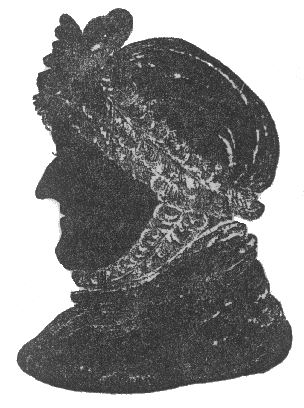
Silhouettes of Jane Austen (left) and her sister, Cassandra (right), as young women. Wikipedia. Below sits my Pinterest board entitled Regency hairstyles. You might have fun finding images that resemble the hairstyles by the Greco Roman statues or by the two Austen women!

Sources:

Sorabella, Jean. “The Grand Tour.” In Heilbrunn Timeline of Art History. New York: The Metropolitan Museum of Art, 2000-, http://www.metmuseum.org/toah/hd/grtr/hd_grtr.htm (October 2003)

Cadeau, Carmen. “Women’s Fashion During and After the French Revolution (1790 to 1810),” All About Canadian History…Except not really. More like bits an pieces. Retrieved  8/14/2019: https://cdnhistorybits.wordpress.com/2016/01/19/womens-fashion-during-and-after-the-french-revolution-1790-to-1810/ (January 2016)

Victoria and Albert Museum. “Style Guide: Regency Classicism.” Retrieved 8/22/2019: http://www.vam.ac.uk/content/articles/s/style-guide-regency-classicism/

Batman, E. (2004). The New Galleries of Ancient Art at the Walters Art Museum, Baltimore. American Journal of Archaeology, 108(1), 79-86. Retrieved from http://www.jstor.org/stable/40024677

The Scandal of Marie Antoinette’s Gown,  Meghan Masterson, Meghan Masterson blog. Retrieved 8/22/2019 from https://meghanmastersonauthor.com/the-scandal-of-marie-antoinettes-gowns/

Hairstyles Through the Ages, Crystalinks, History. Retrieved 8/22/2019 from https://www.crystalinks.com/hair.history.html

Warnock, R. (1942). Boswell on the Grand Tour. Studies in Philology, 39(4), 650-661. Retrieved from http://www.jstor.org/stable/4172592
Read Full Post »

you want to hear about the wedding; and I shall be happy to tell you, for we all behaved charmingly.” –Emma

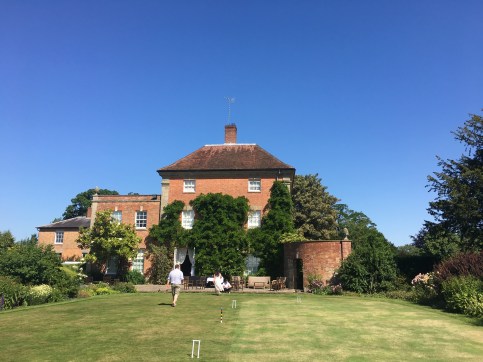
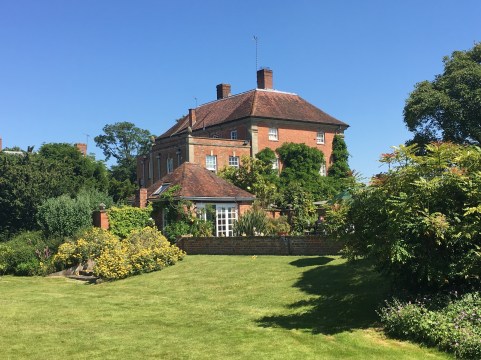
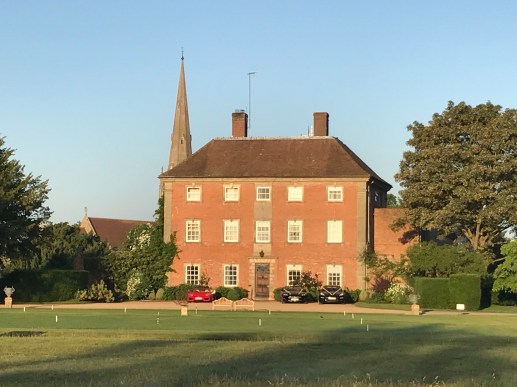
My husband and I were invited to a family wedding in England last June. The venue: Sherbourne Park, a Grade II Georgian house on a large estate dating back to 1730, just a few miles from Warwick and Stratford-upon-Avon. From the moment I first saw photos of Sherbourne Park, I felt a bit like a heroine in one of Jane Austen’s novels. I imagined myself walking the beautiful grounds, toasting the happy couple, and exploring as much of the house as possible.

Sherbourne House Exterior

Sherbourne Park. Image 1 by Rachel Dodge

You can imagine the added thrill I felt when I discovered we were also invited to stay the night at the “great house” after the wedding. My response was similar to that of Catherine Morland’s when she received her invitation to visit Northanger Abbey:

[Sherbourne Park]! These were thrilling words, and wound up [my] feelings to the highest point of ecstasy. [My] grateful and gratified heart could hardly restrain its expressions within the language of tolerable calmness. To receive so flattering an invitation! To have [my] company so warmly solicited! (NA 140)

With Sherbourne Park “on my lips,” I penned a quick “Yes!” on the reply card and began planning our trip.


Dressing the Part

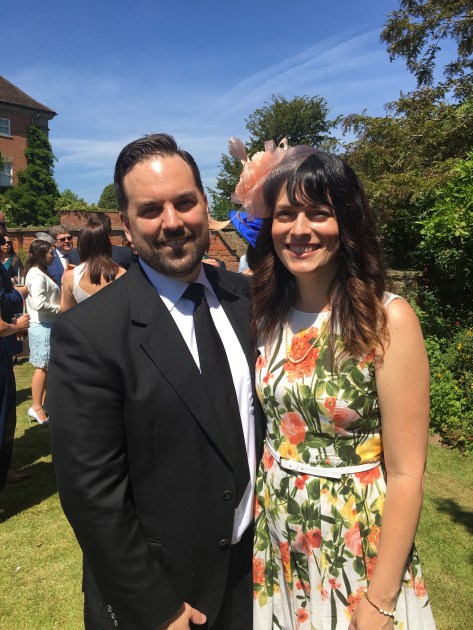
Dress and hat at the wedding at Sherborne

Image by Rachel Dodge

As one of the “California relatives,” I certainly didn’t want to wear the wrong thing and open myself up to comments such as Mrs. Allen’s: “There goes a strange-looking woman! What an odd gown she has got on! How old-fashioned it is! Look at the back” (NA 23). Though I agree that a “woman can never be too fine while she is all in white” (MP 222), I knew I should leave that to the bride. Having “the greatest dislike to the idea of being over-trimmed” like Mrs. Elton, I decided that “a simple style of dress” would be “infinitely preferable to finery” (E 302).

My aim:

“nothing but what is perfectly proper” (MP 222).

The Question of Hats

Like Austen herself, I decided to wait until I arrived in England to “begin my operations on my hat, on which . . . my principal hopes of happiness depend[ed]” (Letters 17). Our English relatives assured us that many women would wear hats or fascinators. In Warwick, I found a small millinery shop filled with a variety of hats and fascinators. With the help of the capable shopkeeper, I found the perfect fascinator to match my gown. And unlike Lydia Bennet, I did not feel the need to “pull it to pieces” to see if I could “make it up any better” (PP 219).

Sherbourne Park

Sherbourne house exterior 2

Sherborne Park exterior image 2 by Rachel Dodge

The day of the wedding, we dressed in our finery and drove to Sherbourne Park, a 2,000-acre estate in Warwickshire. Tucked far back from the main road, the entrance was difficult to find, but at last we found the long, tree-line driveway. Much like Elizabeth Bennet, I “watched for the first appearance of [Sherbourne Park] with some perturbation” (PP 245). When “at length” we came out of the trees, my “spirits were in a high flutter.” I found that my mind was not “too full for conversation,” and I “saw and admired every remarkable spot and point of view,” exclaiming at every new sight. When I finally saw the house, I “felt that to be mistress of [Sherbourne Park, once upon a time] might be something!” (245).


The Church

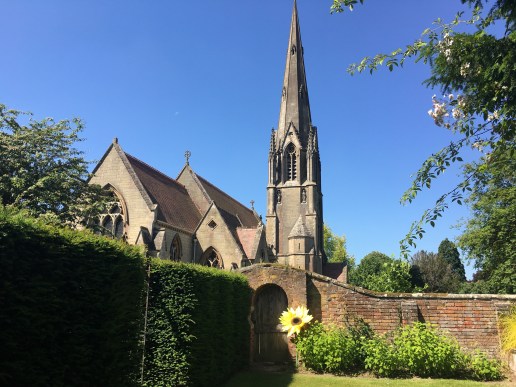
Shelbourne All Saints Church of England

Shelbourne-All Saints Church of England. Image by Rachel Dodge.

The wedding ceremony was held in Sherbourne-All Saints Church of England, built in 1864, and was complete with Scripture readings and hymns on the organ. I wished to see if the bride had chosen to “put on a few ornaments,” since a “bride, you know, must appear like a bride” (E 302) and “longed to know if [the groom] would be married in his blue coat” (PP 319). The bride was as beautiful as could be and the groom was indeed in navy blue tails.

I found the “church spire . . . remarkably handsome” (MP 82).

However, unlike Maria Bertram, I was quite happy to find the church situated “so close the Great House,” only a short walk through the garden. I did not find the bells “annoying” at all! In fact, at the end of the service, as the newlyweds led the way out of the church, the church bells added much joy to the occasion. They continued for at least ten minutes and made a glorious clamor.

The Garden

Images of the gardens at Sherbourne Park by Rachel Dodge

A “taste for flowers is always desirable . . . as a means of getting [us] out of doors, and tempting [us] to more frequent exercise than [we] would otherwise take.” (NA 174)

Following the ceremony, we moved into the garden and gathered by the pool house for cocktails, appetizers, and ice cream. The garden at Sherbourne Park boasts beautiful flower beds, flowering trees and bushes, and many pretty paths to explore. “It was hot; and after walking some time over the gardens in a scattered, dispersed way, scarcely any three together” (E 360), we made our way toward the house and found “[s]eats tolerably in the shade” (359).

During the course of the afternoon, we heard that a member of the wedding party had actually fainted due to the warm weather. I thought perhaps someone should call for the local “Mr. Perry,” but another guest assured us that he “popped right back up” and we need not worry.

The Wedding Breakfast

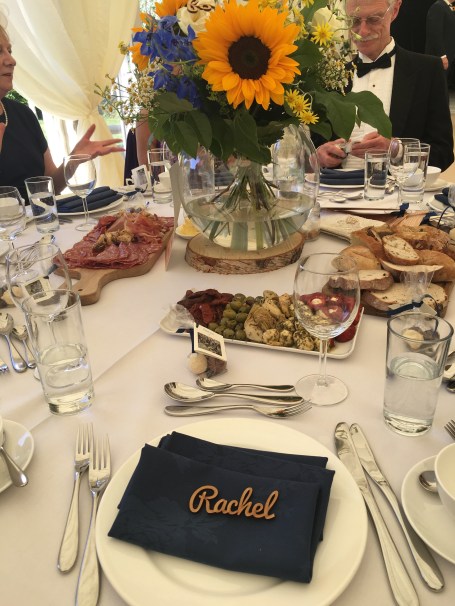
Image of the wedding breakfast

The wedding breakfast. Image by Rachel Dodge.

 [Y]ou shall all have a bowl of punch to make merry at her wedding.” (PP 307)

If Mr. Woodhouse couldn’t believe the “strange rumour in Highbury of all the little Perrys being seen with a slice of Mrs. Weston’s wedding-cake in their hands” (E 19), he could never have approved of the sublime variety (or amount) of food we enjoyed during the formal wedding breakfast. As we worked our way through multiple courses of delicious food and drink, a gentleman at our table leaned over and said, “It’s best to pace yourselves.” I took his advice and was quite happy with the results.

Though many of the mealtime formalities Jane Austen knew are no longer in use, I found one matter of wedding meal etiquette intriguing: During the wedding breakfast, all of the women kept their hats on. Later, after the speeches, the Mother of the Bride took off her hat, and the rest of the ladies in attendance followed suit.

The Great House

Sherbourne Park exterior image 3

Sherbourne Park exterior image 3 by Rachel Dodge.

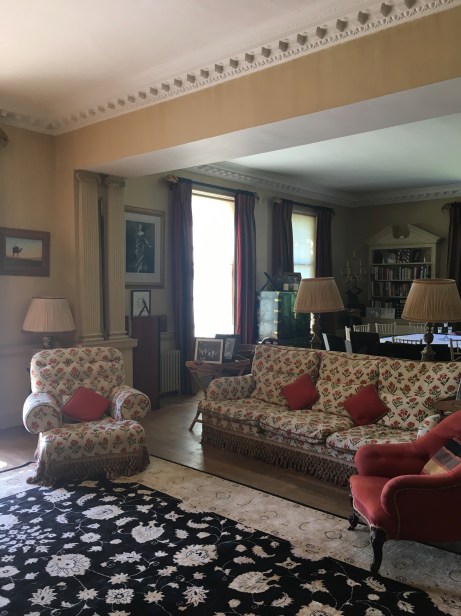
Interior 1

Interior of Sherborne Park. Image by Rachel Dodge

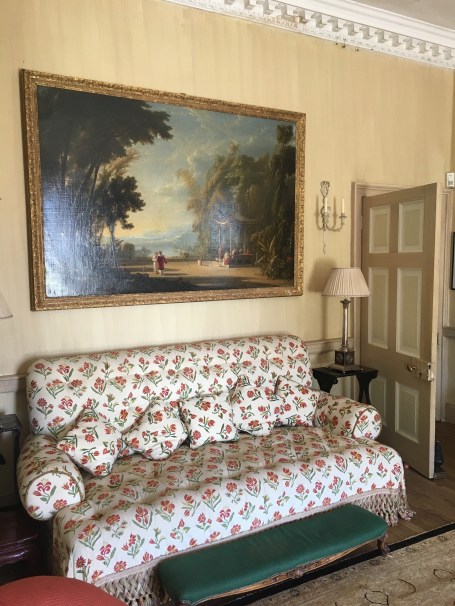
Interior 2

Interior of Sherborne Park. Image by Rachel Dodge

After an evening of dining and dancing, we entered the grand entrance hall of the great house with our luggage, found our rooms, and said goodnight. I thought of the description of Catherine Morland’s chamber in Northanger Abbey as I entered our room: “The walls were papered, the floor was carpeted; the windows were neither less perfect nor more dim than those of the drawing-room below; the furniture, though not of the latest fashion, was handsome and comfortable, and the air of the room altogether far from uncheerful” (NA 163).

Though I felt quite at ease sleeping there, I later found out that my sister-in-law felt a bit more like Catherine as she tried to fall asleep in the dark, creaking old house.

In the morning, we came downstairs to tea and toast in the large, formal dining room. Again, I was reminded of the descriptions in Northanger Abbey: Sherbourne Park’s

“dining-parlour was a noble room [. . .] fitted up in a style of luxury and expense” (NA 165-6).

While we were eating, the current owner of Sherbourne Park, Robin Smith-Ryland, came down from his residence upstairs and told us about the history of the estate. The Ryland family has held it for over 200 years, and they now run the house and grounds as a venue for corporate events, weddings, and hunting/fishing outings. Smith-Ryland gave us a tour of the house, which can accommodate up to 15 guests. The drawing room, morning room, open fireplaces, and multiple bedrooms were laid out most invitingly.

After brunch in the garden, we moved into the drawing-room to visit with our relatives and enjoy the aftermath of the wedding day. Alas, later in the morning, we packed our things and began to say our goodbyes. We waved as “the bride and bridegroom set off . . . and everybody had as much to say, or to hear, on the subject as usual” (PP 146).

All in all, it was a beautiful wedding weekend. The best part truly was spending the long weekend with my family. I can only hope that we’ll be invited back for the bride’s younger brother’s wedding one day because as we all know, “the expectation of one wedding” always makes “everybody eager for another” (PP 360).

You can follow Rachel Dodge at www.racheldodge.com or on Twitter, Instagram (@kindredspiritbooks), or Facebook.

Works Cited

Austen, Jane, and R. W. Chapman. The Oxford Illustrated Jane Austen. Oxford UP, 1988.

Austen, Jane. Jane Austen’s Letters. Edited by Deirdre Le Faye, 4th ed., Oxford UP, 2011.


Read Full Post »

Gentle Reader,

This week marks the July 4th holiday in the U.S., which means family gatherings, outdoor picnics, firework celebrations, and, most of all, ice cream! This delicious treat became more and more common at the turn of the 19th century when the method of transporting and storing great big blocks of ice over long distances became economically feasible. 

On July 1, 1808, Jane Austen wrote to her sister Cassandra from Godmersham:

But in the meantime for Elegance & Ease & Luxury . . . I shall eat Ice & drink French wine, & be above Vulgar Economy.

This statement reveals a number of  interesting details about her stay at her rich brother’s (Edward’s) mansion:

  • Ice cream was expensive (vulgar economy). We know our Miss Jane counted her pennies and did not live a life of extravagance, thus her tart observation.
  • Edward spared no expenses in giving his family this luxurious dessert.
  • Treating guests to ices in July during an era without electricity meant that Edward’s estate must have had an ice house to keep the ice frozen.
027

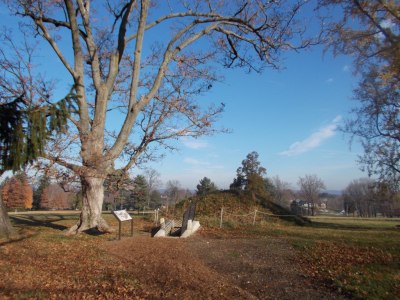
Georgian ices had to be served immediately before they melted. Image by Vic Sanborn: Hampton Mansion

The ice used for Edward’s ices most likely came via a variety of routes – local frozen ponds, rivers, or lakes in winter, or enormous blocks harvested in Norway or Canada, which were then shipped to the UK and transported by barge up canals to their final destinations – The Sweet Things in Life, Number One London Net.

hampton-002

Mound of the ice house on the grounds of Hampton Mansion. Image@Vic Sanborn

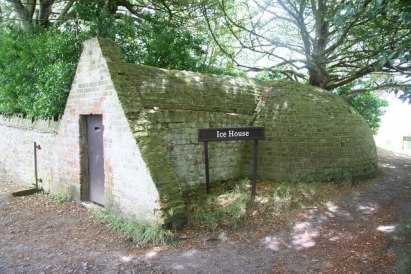
There were many forms of ice houses and ways to keep ice frozen, such as in the one I described in a previous post, 1790 Ice House, Hampton Mansion, and the one at Tapeley Park (see image below). Ice houses provided a dark, cool spot that preserved enough of the precious commodity to last until the next frost or ice block delivery.

Ice_House_-_geograph.org.uk_-_878045

The 18th century ice house at Tapeley Park, U.K. is above ground. Image from Wikimedia Commons.

Unlike modern-day methods of home ice-cream making … the Georgian method of creating a frozen sweet treat was so effective that it could turn liquid solid within 45 minutes. The secret to this 21st-century trouncing wizardry? Two buckets, some ice and a bit of salt. – Would You Eat Ice Cream From 300 Years Ago?, The Telegraph, Alexi Duggin, 2015

After chopping and shaving huge blocks of ice, making ice cream was rather simple:  Use a recipe you love. Fill a bucket with ice. Add ice cream ingredient to a second, smaller bucket and place it inside the larger bucket. Add salt to the ice, and stir regularly. Voila! Liquid is turned solid. Serve immediately before your creation melts.

When I was in my 20’s, my then husband and I used an old-fashioned ice-maker to make the most delicious peach ice cream with the fruit in season. Our ice cream took longer to make, simply because we used more sugar than the Georgian recipes. We cranked and cranked that ice seemingly forever, but it was worth the trouble. When we had company, there was never enough to go around.

Recalling how hot summers were without air conditioning, one can only imagine how refreshing it must have felt to eat something ice cold on a summer’s day in an era with no electricity and when people wore layers and layers of clothing.


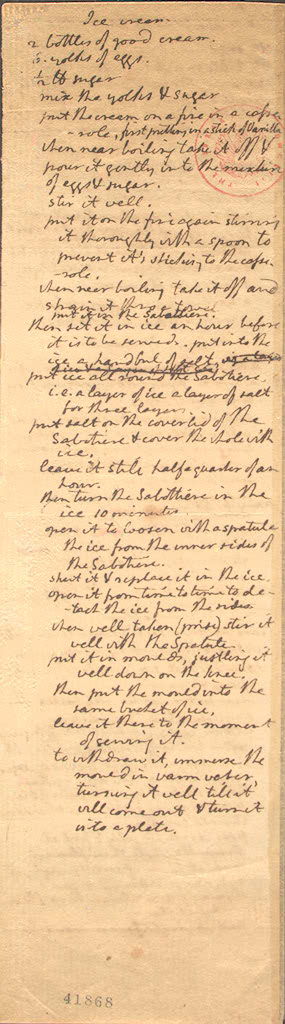
uc004810.jpg_TJ Recipe hands

Thomas Jefferson’s handwritten recipe for making vanilla ice cream @ Open Culture.

According to Monticello.org, ice cream began appearing in French cookbooks starting in the late 17th century. 

There “are accounts of ice cream being served in the American colonies as early as 1744.” Jefferson likely tasted his fair share of the dessert while living in France (1784-1789), and it would continue to be served at Monticello upon his return. Open Culture: Thomas Jefferson’s handwritten vanilla ice cream recipe 

Mr. Jefferson’s recipe is a tad hard to read, so I searched for one in an early cookery book and found one from the 1733 edition of Mrs. Mary Eale’s Receipts. It offers this fine recipe, which requires from 16 -18 lbs of ice to be chopped:

To ice CREAM.
Take Tin Ice-Pots, fill them with any Sort of Cream you like, either plain or sweeten’d, or Fruit in it; shut your Pots very close; to six Pots you must allow eighteen or twenty Pound of Ice, breaking the Ice very small; there will be some great Pieces, which lay at the Bottom and Top: You must have a Pail, and lay some Straw at the Bottom; then lay in your Ice, and put in amongst it a Pound of Bay-Salt; set in your Pots of Cream, and lay Ice and Salt between every Pot, that they may not touch; but the Ice must lie round them on every Side; lay a good deal of Ice on the Top, cover the Pail with Straw, set it in a Cellar where no Sun or Light comes, it will be froze in four Hours, but it may stand longer; than take it out just as you use it; hold it in your Hand and it will slip out. When you wou’d freeze any Sort of Fruit, either Cherries, Rasberries, Currants, or Strawberries, fill your Tin-Pots with the Fruit, but as hollow as you can; put to them Lemmonade, made with Spring-Water and Lemmon-Juice sweeten’d; put enough in the Pots to make the Fruit hang together, and put them in Ice as you do Cream


Tomorrow, on July 4th, you can be sure I’ll celebrate with a delicious bowl of ice cream. My favorite is still peach ice cream, followed by vanilla, and peppermint in the winter.

Happy holiday, all! Let me know which flavors you prefer and if you’ve ever hand-cranked your own ices.  Vic

More resources: 


Read Full Post »

images

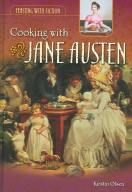
Cooking With Jane Austen, Kirstin Olsen

What can be a better way to celebrate fall and the Thanksgiving holiday than to examine a recipe or two from Kirstin Olsen’s 2005 book, Cooking with Jane Austen? – spending time with family and friends and sharing the food!

I’ll just get my two major complaints about the book out of the way. The font is difficult to read – too fancy for my taste – and the book’s cost: $55.00. I found my copy (in excellent shape) via second hand means, which I recommend.

Now, for the good news. While we know that Jane Austen was spare in her descriptions of food, interiors, and clothing in her novels, she provided enough hints for Ms. Olsen to peruse cookery books of that era. Using a variety of sources, Ms. Olsen found recipes similar and close to those she thought Jane might have known. Elizabeth Raffald’s and Hannah Glasse’s recipes are consulted, as well as those from John Farley, Martha Bradley, and more. Ms. Olsen provides historical context at the start of her book and with each recipe category. Even if you never try out one of the recipes, you can glean much information for your personal interest or to add authenticity to a novel you are writing.

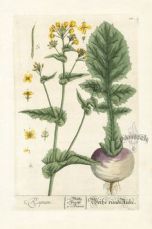
Turnip_Elizabeth Blackwell

Illustration by Elizabeth Blackwell

Boiled Turnips

This recipe for boiled turnips begins with a quote from Mr Woodhouse in Emma (172)

An historic explanation of the popularization of the turnip follows, with a typical description of a recipe from an 18th century cookery book:

Turnips may be boiled in the pot with the meat, and indeed eat best when so done. When they be enough, take them out, put them in a pan, mash them with butter and a little salt, and in that state send them to the table…

Ms. Olsen then provides the modern recipe for today’ cook, which is extremely useful for those of us who wish to recreate a regency meal for our Jane Austen book clubs.

Modern Recipe for Boiled Turnips

1 lb turnips, 3 T. butter, 1 tsp. salt.

Wash and peel the turnips and trim off the tops an bottom. Cut them into 1″ dice. Bring a pot of salted water to a boil and add the turnips, boiling them until fork-tender, about 15 minutes. Mash the turnips with the butter and salt and serve immediately. (Olsen, p 216)

For my taste, I would prefer boiling the turnips with the meat, as suggested in the 18th century description, much as I prefer making stuffing inside the turkey over making the stuffing separately in the oven. The bird’s natural fat and juices add much more flavor, don’t you think?

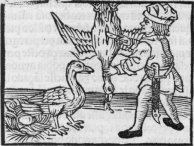
Roast Stubble Goose

Goose_thehistoricfoodie

Roast Stubble Goose image found on The Historic Foodie blog

Here’s another recipe to celebrate this season and holiday – Roast Stubble Goose. It starts off  with a quotation from Emma, a novel filled with references to food. (Thank you, Jane.)

Mrs. Martin was so very kind as to send Mrs. Goddard a beautiful goose: the finest goose Mrs. Goddard had ever seen. Mrs. Goddard had dressed it on a Sunday, and asked all the three teachers, Miss Nash, and Miss Prince, and Miss Richardson, to sup with her. (Emma 28-29.)

Ms. Olsen tells us that a stubble goose is an older bird that fattened on harvest gleanings. In Jane Austen’s time, it was traditionally served with applesauce.

Elizabeth Raffald’s recipe for Roasted Stubble Goose starts with:

Chop a few sage leaves and two onions very fine; mix them with a good lump of butter, a teaspoonful of pepper and two of salt. Put it in your goose, then spit it and lay it down, singe it well, dust it with flour; when it is thoroughly hot baste it with fresh butter…

In this section of Cooking With Jane Austen (p 121-126), Ms. Olsen offers old and modern recipes for roast stubble goose, roast green goose, goose with mustard, and roast turkey. The book consists of 414 pages, so there are numerous recipes to try.

Other Jane Austen themed food books that I love include: Tea With Jane Austen by Kim Wilson and The Jane Austen Cookbook by Maggie Black and Dierdre le Faye, both still readily available. Also on this blog: 18th Century Cookery Books and the British Housewife and a review of Jane Austen and Food by Maggie Lane.

To all my U.S. readers, have a splendid Thanksgiving holiday. While we are thankful for our lives, family, and friends, please give a special thank you to the animals who were sacrificed to nourish us. They “gave” up their most precious gift – their lives.

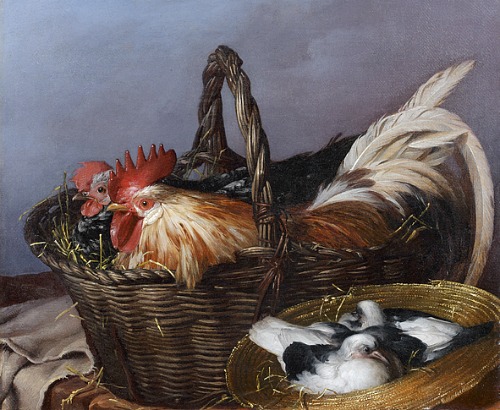
chickens and pigeons 18th c.

Chickens and pigeons, 18th c. painting


Read Full Post »

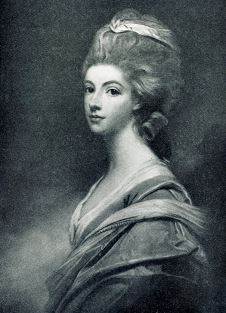
Cassandra Austen

Cassandra Austen in old age

Jane Austen’s family was not rich, by any means, but the family was genteel and belonged to the English gentry. Rev. Austen earned a respectable living as a rector at Steventon rectory. His wife, Cassandra, was a close relative of Theophilus Leigh, head master of Balliol College. She was also a relation of the Leighs of Stoneleigh Abbey, a most impressive and well-regarded family.

When handsome Miss Leigh married the very handsome Mr. George Austen, her life became no picnic. After his marriage, Mr. Austen took to farming with a spirit. This meant that while he enjoyed the prestige of becoming a gentleman farmer, Mrs. Austen took over the daily charge of the dairy with a bull and six cows, plus ducks, chicken, guinea-fowl and turkeys, the vegetables that were grown in the garden, the honey used for mead, and the home-made wines.

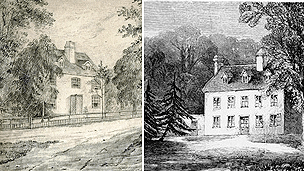
Steventon Rectory, Images from BBC

Steventon Rectory, Images from BBC

Any surplus allowed the Austen family to sell the produce for a profit. Under Mrs.Austen’s supervision during Jane’s childhood and spinsterhood years, only tea, coffee, chocolate, spices sugar, and other luxury foods were purchased. As James Edward Austen-Leigh wrote in 1870 in his Memoir of Jane Austen,

I am sure that the ladies there [Steventon] had nothing to do with the mysteries of the stew-pot or the preserving pan;but it is probable that their way of life differed a little from ours, and would have appeared to us more homely.”

As with many wives of her station, Mrs. Austen accepted her role as the family’s housekeeper. However, she relied on servants, such as a cook and maid of all work to actually do the “hard” work, such as cooking, cleaning, laundry, and general sewing. While her servants performed the tasks, Mrs. Austen determined the duties of the day, much like a general manager. She met daily with her cook to superintend the meals of the day. There were also a dairy maid and a washer woman, who came once a month. Cassandra Austen’s other important tasks were to train her daughters in the art of overseeing a household.

Susanna Whatman shortly after her marriage

Susanna Whatman shortly after her marriage

Susanna Whatman was a contemporary of Mrs. Austen. Born in 1752, she was married to James Whatman, a papermaker. Shortly after her marriage in 1776, she wrote a housekeeping book to instruct her servants and offer advice about housekeeping duties and domestic life.

The following passage of her advice is of particular interest. Rev. Austen kept an extensive library, much like Mr. Bennet in Pride and Prejudice. In this instance, Mrs. Whatman instructs the housemaid to clean the library.

The sun comes into the Library very early. The window on that side of the bow must have the blind let down. The painted chairs must not be knocked against anything, or against one another. A chair must not be placed against the door that goes into Mr. Whatman’s Dressingroom. All the space between the daydo and skirting board is plaister. Therefore, if it is knocked, it will break. The books are not to be meddled with, but they may be dusted as far as a wing of a goose* will go. Nothing put behind the door besides the ladder. Tea leaves* used on the carpet in this room, Drawingroom, and Eating Parlor, and Mrs. Whatman’s Dressingroom, no where else.

*wing of a goose – dusters were made with goose feathers from their wings.

**During the Georgian era, carpets were sprinkled with moist tea leaves and cleaned with a hair broom.

Read Full Post »

« Newer Posts - Older Posts »