Feeds:
Posts
Comments

Archive for the ‘19th Century England’ Category

Inquiring readers: Paul Emanuelli, author of Avon Street (click here to view the book and order it), has contributed posts for this blog before about the City of Bath as a Character ,  Law & Order and Jane Austen’s Aunt,  Walking in Austen’s Footsteps, and Food – To Die For: Food Preparation in the Georgian EraHe has graciously sent in an article about crime and an incident involving Jane Austen’s aunt, Mrs James Leigh-Perrot. Paul writes about Bath in his own blog, unpublishedwriterblog. It is well worth a visit!

Workhouses are thought to date back as far as the fourteenth century and the aftermath of the “Black Death.” The plague was merciless in Britain and outbreaks recurred at intervals throughout the fourteenth and fifteenth centuries. As a result, the working population was decimated and the shortage of labour pushed up wages. To try and halt this, several Acts of Parliament were passed aimed at forcing all able-bodied men to work and to keep wages at their old levels, but their main effect was to create itinerant labourers who travelled around the country looking for areas where they could earn more.
bathmap1902-2500

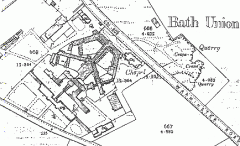
Layout of Bath Workhouse in 1848

The Poor Law Act of 1388 tried to stop this by introducing regulations restricting the movements of all labourers and itinerant beggars. No one could leave their own parish to seek work elsewhere without the written permission of the local Justice of the Peace, and the poor were prohibited from begging and could only receive help from the Parish in which they were born. Alms houses were built for the destitute but the earliest known reference to the term “Workhouse” dates back to 1631, when the mayor of Abingdon (near Oxford) records:-

“wee haue erected wthn our borough, a workehouse to sett poore people to worke”

A further Poor Law Act in 1597 governed the care of the destitute right up until the 19th Century. This law required the local justices of the peace to appoint, annually, “Overseers of the Poor” to find work for those in need, to apprentice children, and to provide,

“the necessary relief of the lame, impotent, old, blind and such other being poor and not able to work”.

This Poor Law required poor rates to be charged as a local tax, replacing voluntary charitable funding. The rate of charge and arrangements for distribution were to be decided by the Overseers. Though most parishes had houses set aside for the old, infirm and destitute these were more like alms-houses than workhouses and most support was given in the form of subsistence payments known as “out relief.”

bath1

Aerial photo of Former Bath Workhouse taken in early 20th Century

The real growth in workhouses took place in the nineteenth century, following the end of the Napoleonic Wars. Hundreds of thousands of troops returned home to find there was no work for them. Most had been agricultural workers before the war and the new technology in farming had reduced the need for labour. At the same time a series of poor harvests had pushed up food prices and the Importation Act of 1815 had prohibited the importation of cheaper cereals from abroad. For most people, bread was the main part of their diet and yet they could no longer even afford bread. So many had become destitute and were starving by the early 1830s that the system could not support them. The Government sought a cheaper alternative to “out relief.”

Read the rest of Paul’s fascinating post and the workhouse in Bath at this link:

Click Here

In keeping with December, Charles Dickens’ anniversary, and a Christmas Carol, Paul sent this message:

 In “A Christmas Carol” the Spirit of Christmas Present reveals two children hidden under his robes. Scrooge asks him if they are his children and the Spirit replies that they are the children of Man – “This boy is Ignorance. This girl is Want. Beware them both, and all of their degree, but most of all beware this boy, for on his brow I see that written which is Doom, unless the writing be erased.’

‘Have they no refuge or resource.‘ asks Scrooge.

‘Are there no prisons.‘ said the Spirit, turning on him for the last time with his own words. ‘Are there no workhouses.‘”

OliverTwistOliver Twist

Oliver Twist Workhouse image

The well known passage from Oliver Twist:

“Child as he was, he was desperate with hunger, and reckless with misery. He rose from the table; and advancing to the master, basin and spoon in hand, said: somewhat alarmed at his own temerity:

‘Please, sir, I want some more.’

The master was a fat, healthy man; but he turned very pale. He gazed in stupified astonishment on the small rebel for some seconds, and then clung for support to the copper. The assistants were paralysed with wonder; the boys with fear.

‘What!’ said the master at length, in a faint voice.

‘Please, sir,’ replied Oliver, ‘I want some more.’

More about Avon Street: Order the book
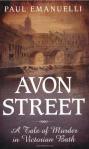
  • Paperback: 320 pages
  • Publisher: The History Press (March 28, 2012)
  • Language: English
  • ISBN-10: 0752465546
  • ISBN-13: 978-0752465548
Read Full Post »

Inquiring readers: Susannah Fullerton and I met in Brooklyn at the annual JASNA meeting, where she was promoting two books and gave two workshop presentations.  Here, then, is our share of our ongoing conversation:

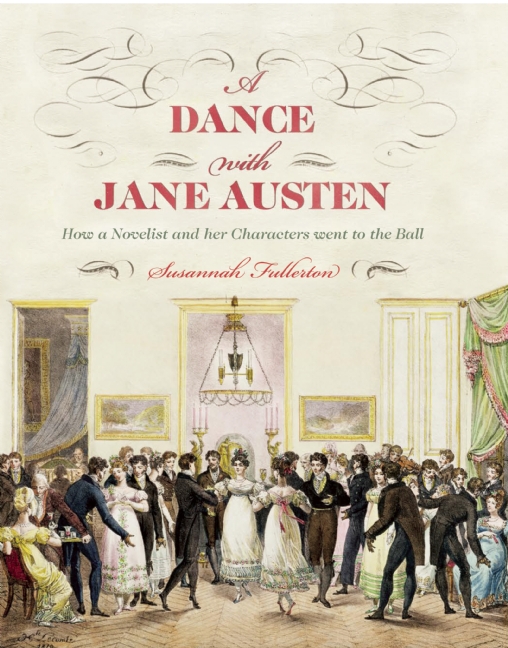
Susannah, it was such a pleasure meeting you at the AGM in Brooklyn. I felt as if we had known each other for years, so instant was our connection. As we talked, I came to realize that you lecture, travel, act as guide, write, and have two books coming out in a HALF year, AND you are a wife, mother, and president of JASA (Jane Austen Society of Australia). At the conference you had boundless energy. How and where do you find the time to do it all and look so fresh and enthusiastic? I am in awe.

There’s a lovely quote in Emma when Miss Bates says, ‘It is such a happiness when good people get together – and they always do.” Vic, that’s how I felt when I met you in Brooklyn – an instant recognition that we had masses in common and would get on really well. I do have an incredibly busy life and it has been especially busy these last 2 years with 2 books to write. However, I do find it hard to say ‘no’ to lovely literary projects. I have been President of JASA for 17 years (I’m wondering if that should put me in the Guinness Book of Records?) and I have a fabulous committee, so running the society is a joy. Of course we are all very excited about next year’s big P & P anniversary. My literary tours are great fun. When you yourself get an incredible thrill from walking down the Gravel Walk in the footsteps of Anne Elliot and Capt. Wentworth, or seeing the topaz crosses at Chawton, or actually standing in the room where Jane Austen died (which I did on 2 of my literary tours) then it’s fantastic to be able to take other people on tours where they can share that same excitement. My tours are with ‘Australians Studying Abroad’, and I don’t only take tours to England but to France, Scotland and the USA as well. It’s all such fun that somehow I find the energy to do it all.

In reference to your interview on Jane Austen in Vermont, you mentioned that the time for a book about dance in Jane Austen’s time was right. I agree with you. What were some of the facts you uncovered that surprised you and that you were anxious to share with the world?

What really surprised me was that no-one had written a book on Jane Austen and dancing before now! I think what you find when you focus on one particular aspect of Jane Austen’s fiction is an increased awareness of how utterly brilliant she was. When I wrote Jane Austen and Crime I found that the tiniest bit of information about something like poaching was used by Austen in a way that had so many wider implications if you knew about the laws and perceptions of poaching at that time. In Mansfield Park Mr Rushworth boasts about his “zeal after poachers”, yet completely fails to stop Henry Crawford from ‘poaching’ his wife – the ‘poaching’ undercurrents in the novel are so brilliantly done. I found the same with dancing – when you learned exactly what behaviour was expected in a ballroom, you became so much more aware of the subtler nuances of dialogue and action. For example, it was not proper etiquette to compliment your partner on their dress or looks, because it was taken for granted that everyone would be nicely dressed at a ball. You shouldn’t praise someone for doing what it was assumed they would do anyway – ie, dress nicely. This gives extra point to Mrs Elton’s behaviour at the Crown Inn ball – of course, no-one compliments her on her dress because they are behaving properly, but Mrs Elton is desperate for such attention so she takes on the task herself: “How do you like my gown? How do you like my trimming? How has Wright done my hair?” etc. The more you delve into any aspect of Austen’s world, the more you find and you come away with an even greater awe of her incredible achievement!

Was there any information in A Dance With Jane Austen that you wished you had expanded upon but simply could not due to lack of space and time?

It could have been nice to have included more particular information about steps for individual dances, but unless you are a Regency dancer yourself, that information might be rather dull on the page – more fun to ‘do’ than to read about, I think.

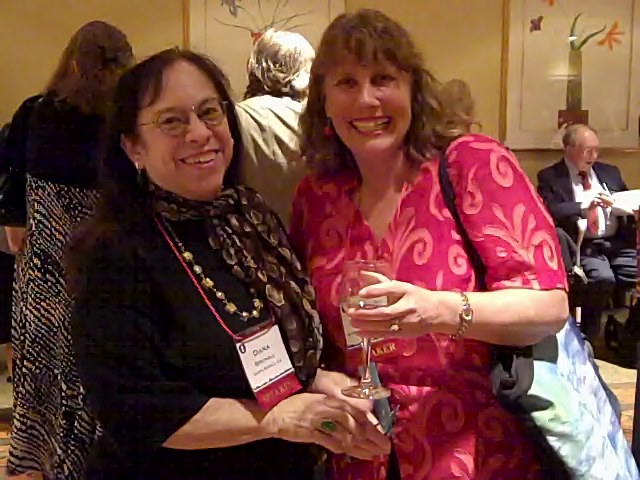
Authors Diana Birchall (l) and Susannah Fullerton (r) at the Brooklyn AGM

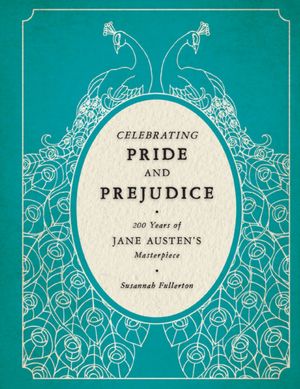
When we were at the AGM, you were promoting your next book as well, Celebrating Pride and Prejudice: 200 Years of Jane Austen’s Masterpiece. Other authors must be as curious as I am: How did you find the time to write TWO books with such close deadlines? Did you lock yourself in a closet and have food passed to you through a grate?

Just last week I received the most wonderful parcel in the post – two copies of Happily Ever After: Celebrating Jane Austen’s Pride and Prejudice and two copies of Celebrating Jane Austen’s Pride and Prejudice: 200 Years of Jane Austen’s Masterpiece. These are the UK and American editions of my new book. They are both gorgeous and I was so thrilled I danced round the kitchen with the copies in my arms! The book is dedicated to my daughter “my dearest loveliest Elinor Elizabeth” and she is really thrilled about that. Yes, it was quite a task to finish 2 books so close together. I was just finishing A Dance with Jane Austen when Frances Lincoln suddenly took up my suggestion that a book about 200 years of P & P would be a good idea. I must admit I lay awake most of that night, wondering if I could manage to do it given the tight time frame. But how could I resist? Spending 6 months with Elizabeth and Darcy was pure bliss and no book has given me so much pleasure to write. There were days when I was so involved I forgot to think about cooking dinner. Part of the joy was learning as I went along – discovering new depths and brilliancies in the novel. Just as an example – when I was writing my chapter on Elizabeth Bennet, I stopped to think about how she is first introduced to the reader. Most of us know her so well that it feels she has always been a part of our lives, but what are Elizabeth’s first words in the novel?? I had to go and check because I couldn’t actually remember the very first words she gets to speak in the text. And they are words that contradict her mother! In that age of conduct-book heroines, females who were expected to be obedient to parents, meek, silent and submissive, Elizabeth arrives on the literary scene with a contradiction!! Instantly we know that this woman is going to be different – unlike any heroine before (and of course since as well).

What should readers expect from Celebrating Pride and Prejudice that will make your book stand out from other publications about this novel?

I have tried in my book to give an all-round picture of why this novel has lasted 200 years and goes from strength to strength. I tell of its beginnings; Jane Austen’s struggles to get it out into the world; initial reactions to the book and then reactions as the 19thC continued and went into the 20thC; I have a chapter about the first sentence and why it has become so justly famous; I look at the use of letters in the text; I discuss the translations and how badly the novel fared for a long time in other languages and I look at the challenges faced by translators (would Mr and Mrs Bennet say ‘vous’ or ‘tu’ to each other? They have shared a bed and had 5 children, but still call each other Mr and Mrs – a translator has to make that sort of decision); I look at the extraordinary range of film versions (Dutch, Mormon, Spanish, Italian, Israeli etc); I look at the illustrations it has had foisted upon it over the years – some lovely and some truly terrible (and I include some fabulous pictures as examples) and the different sorts of covers it has been enclosed in; I look at P & P tourism which is now a big industry; I explore the amazing range of merchandise from baby’s nappies to skateboards, cosmetics to clothes pegs, china to jewellery etc. Some of the chapters I most enjoyed writing were about the characters of the novel – I have separate chapters on Darcy and Elizabeth, but then also include chapters on ‘her Relations’ and ‘his Relations’, and one on the ‘Other Characters’. I found that grouping them into ‘his’ and ‘her’ relatives made me think about them in a new way and helped make it clear why hero and heroine had become the sort of people they are.

Anything else you wish to add?

There is a T-shirt which has printed on it “What do you mean Mr Darcy isn’t real??” I think I need to buy that T-shirt! Elizabeth and Darcy, Mr and Mrs Bennet, Mr Collins and Lady Catherine, and all the characters of Pride and Prejudice are as real to me as the people I see every day. There is so much to celebrate about this utterly wonderful book by Jane Austen. My way of celebrating was to write a book about why it is so brilliant, and of course I very much hope that many readers will want to buy and read my book to discover just why, 200 years ago, the world became a far better place!

As always, Susannah, it is a pleasure chatting with you. I wish you nothing but the best and hope to see you during your spring tour in the U.S.! – Vic

NOTICE: CONTEST CLOSED. Congratulations Monica! Dear readers: Susannah is graciously giving away a free copy of A Dance With Jane Austen. Please leave your comment stating which Jane Austen character you would most like to dance with and why! The contest is open to all and closes at midnight November 27th, US Eastern Standard Time.

Susannah’s Books:

Preorder Celebrating Pride and Prejudice at this link.

Order A Dance With Jane Austen at this link

Order Susannah’s first book, Jane Austen and Crime, at this link

Read Full Post »

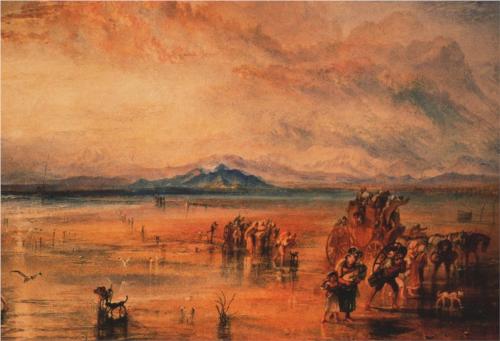
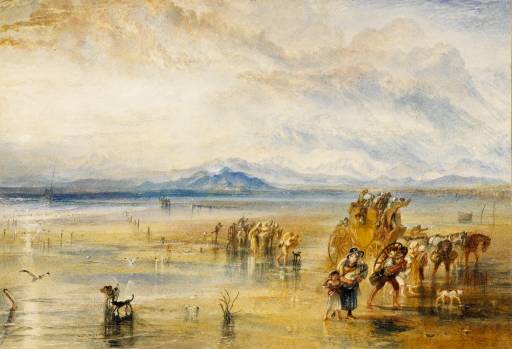
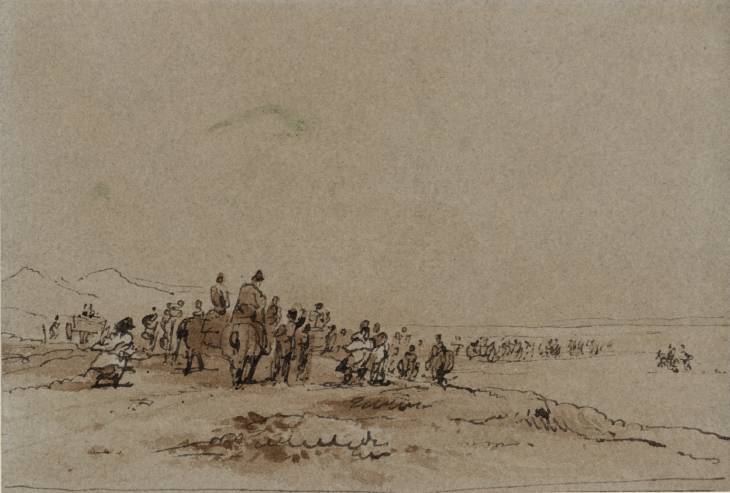
I’ve previously discussed the difficulties and dangers of travel in the Regency era in a number of posts on this blog, but the Lancaster Sands in Lanchashire presented a variety of difficulties for even the most knowledgeable traveler. My first introduction to this region was via a William Turner painting, Lancaster Sands, painted ca. 1826. I was struck by the laborers and villagers walking alongside a coach in shallow water. Why would a coach travel so slowly that pedestrians could keep pace?

Lancaster Sands, William Turner. Image @Wiki Paintings. Birminham Museum and Art Gallery

Thumbnail showing truer colors of Turner’s painting.

As it turns out, the crossing over the Lancaster Sands to reach Ulverston was fraught with danger, especially after heavy rains. In the early 19th century travelers crossed this watery passage in the Lake District at low tide, for this was the shorter (but more dangerous) route.

The sands forming the Bay of Morecambe, covered by the sea at high water, are crossed every day by travellers whose time or inclination leads them to choose this route rather than one more circuitous, and nearly thrice the distance, inland. – The Sands, John Roby

The crossing was extremely hazardous due to shifting sands and the timing of the departure had to be perfect:

“Coach services, scheduled to accommodate the changing tides, ran between hotels in Lancaster and Ulverston. In 1820, one traveller relates, he was rudely awakened in his Lancaster hotel at five in the morning when the coach driver burst into his bedroom shouting, “For God’s sake make haste! The tide is down … if you delay we shall all be drowned.” – The Pleasures and Treasures of Britain: A Discerning Traveller’s Companion (Google eBook)David Kemp Dundurn, Jan 12, 1992 – p. 307

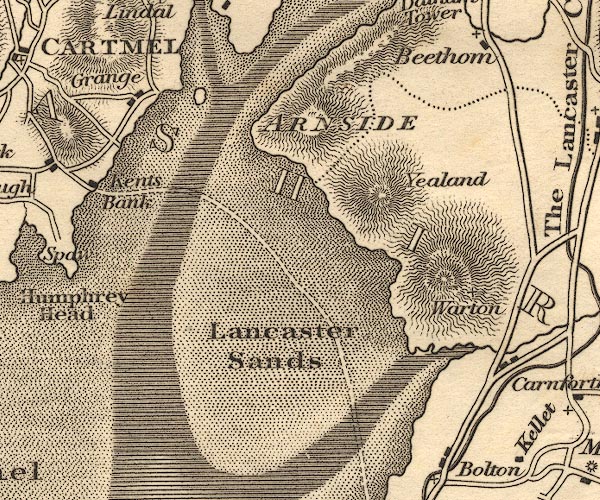
Otley Map, Lancaster Sands, 1818. Image @Portsmouth University.

Today, as over 150 years ago,  the Sands Road requires a guide to help travelers negotiate the dangerous tide floods.

Before the railway was made, the old way of crossing the sands from Lancaster to Ulverstone must have been very striking, both from the character of the scenery around and a sense of danger, which cannot but have given something of the piquancy of adventure to the journey. The channels are constantly shifting, particularly after heavy rains, when they are perilously uncertain. For many centuries past, two guides have conducted travellers over them. Their duty is to observe the changes, and find fordable points. In all seasons and states of the weather this was their duty, and in times of storm and fog it must have been fraught with danger. These guides were anciently appointed by the Prior of Cartmel, and received synodal and Peter-pence for their maintenance. They are now paid from the revenues of the duchy. The office of guide has been so long held by a family of the name of Carter, that the country people have given that name to the office itself. A gentleman, crossing from Lancaster, once asked the guide if “Carters” were never lost on the sands. “I never knew any lost,” said the guide; “there’s one or two drowned now and then, but they’re generally found somewhere i’th bed when th’ tide goes out.” A certain ancient mariner, called Nuttall, who lives at Grange, on the Cartmel shore, told me that “people who get their living by ‘following the sands,’ hardly ever die in their beds. They end their days on the sands- and even their horses and carts are generally lost there. I have helped,” said he, “to pull horses and coaches, ay, and, guides too, out of the sands. The channel,” he continued, “is seldom two days together in one place. You may make a chart one day, and, before the ink is dry, it will have shifted.” I found, indeed, by inquiry, that those who have travelled the sands longest, are always most afraid of them ; and that these silent currents, which shimmer so beautifully in the sunshine, have been “the ribs of death” to thousands. – Over Sands to the Lakes by Edwin Waugh, 1860, Internet archive

Today, signs warn visitors about the passage, stating: “This route has natural hazards, seek local guidance.”  The following link shows modern images of the route (Lake Guide Sands Road), which is still crossed today with experienced guides.  A 19th century visitor related that:

It is safest to cross at spring-tides; the water then is more completely drained out, and the force of the tide sweeps the bottom clean from mud and sediment. – The Sands, John Roby

Many who took this route in days of yore, such as William Wordsworth, found the trip to be so memorable that it lived in their memory for a long time. Turner created a number of striking images of the dangerous crossing. In all of them, the pedestrians and riders stayed close to the coach as guides gauged how and where the sands had shifted with the last tides or storms. Brogs, or broken branches of furze, left by previous guides visually led the way. You can see a few of them placed in the lower right corner of Turner’s painting below.

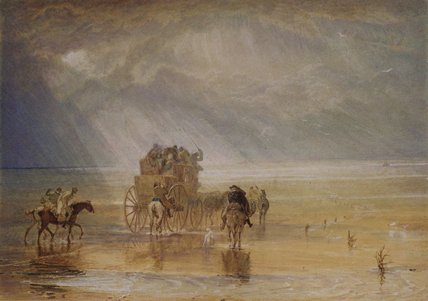
In this dramatic painting, Turner shows the Lancaster coach struggling across the sands and being overtaken by the incoming tide in a rainstorm. (Birmingham Museum and Art Gallery). One can imagine the panic of the passengers upon seeing the incoming water, and the struggles of the horses as they pulled their heavy loads along the soft sands.

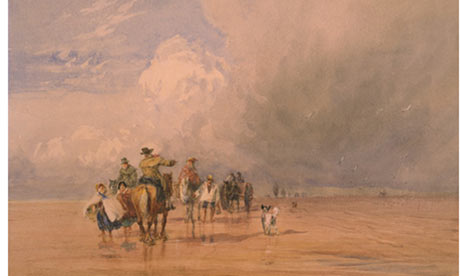
Painter David Cox also painted the Lancaster Sands crossing. His images are less romantic than Turner’s, but dramatic nevertheless:  Lancaster Sands by David Cox, 1835. The route through the sands were ever-changing. The guides tested the way daily, looking for shifts in the channels and for quick sand, but even the most experienced could not prevent the drowning of carriages and coaches and the deaths of people who were caught by the incoming tides or who were trapped in quagmires. Graves in local cemeteries are testament to the many lives that were lost during these crossings.

David Cox, Sketch for Crossing Lancaster Sands. Image @Tate Britain

By the mid-19th century, the railroads provided a safer and faster route. Today, the crossing over the sands is a voluntary one and taken for the experience or thrill, not out of necessity.

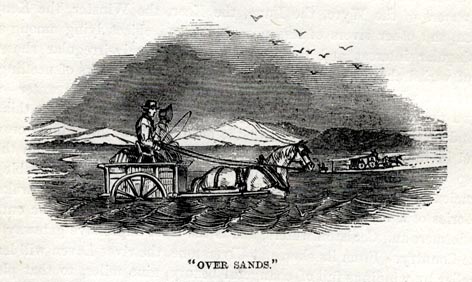
Image of a carriage traversing the Sands in high tides from Waugh’s book.

More on the topic:

This site shows modern images of the Lancaster Sands: Sands Road at Low Water

Old Cumbria Gazzeteer: Lancaster Sands Road 

Read Full Post »

The two first dances, however, brought a return of distress; they were dances of mortification. Mr. Collins, awkward and solemn, apologizing instead of attending, and often moving wrong without being aware of it, gave her all the shame and misery which a disagreeable partner for a couple of dances can give. The moment of her release from him was ecstasy. – Elizabeth Bennet dancing with Mr. Collins at the Netherfield Ball

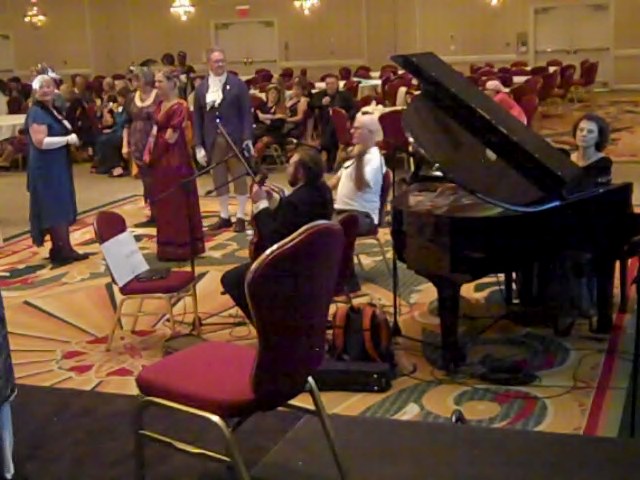
Mr. Collins could have used the services of the excellent caller at the Regency Ball at the JASNA AGM in Brooklyn. Had he been able to follow her direction (or had he learned his dance steps as a child, as did most well-bred Regency children), then he would not have made Elizabeth feel such shame about her partner. When I attended my first Regency ball, I felt as delighted as a child in a candy store at Christmas. The costumes and music lent authenticity to the event. Even those in modern dress (like myself) felt welcome.

As you can see from the clip, individuals with a wide range of dancing talent were present. The caller, or calling master, taught the steps, people practiced, and then they danced to the lovely music provided by the trio.

Caller at the Regency Ball

An important social element was the calling of the dance by the leading lady (a position of honor), who would determine the figures, steps, and music to be danced. The rest of the set would listen to the calling dancing master or pick up the dance by observing the leading couple. Austen mentions in her letters instances in which she and her partner called the dance. – Regency Dance, Wikipedia

I love the next clip, in which the caller sensed a lack of concentration on behalf of her audience. Listen to her final words!

With so many people in one room, and (in those days) the heat from the candles, ballrooms tended to become hot. Flimsy gowns provided little advantage for over-heated bodies restrained by corsets; time and again fans came to the rescue, as in this short scene. The poor men simply had to grin and bear it and sweat the night away, for, believe me, an evening of dance with two sets per dance partner, could be quite strenuous.

After learning the various moves, the group danced the set. The musicians (a trio in this instance) then struck up the music and the dancers progressed through the set, the movements beautiful to behold. My humble flip camera did not do much justice to the proceedings, and could capture only a few of the moments. If you have never attended a Regency ball and are a Jane Austen fan, I suggest that you find a group in your area.

This experience makes Austen’s ballroom scenes come alive as I reread the passages. One also experiences the social aspects of the dance – the dancers themselves, the people arranged on the sidelines watching, the musicians, and the outer rooms, where others assembled and talked  or sought refreshment. In former days, game rooms would be set up for those who opted not to dance.

More images below. If anyone knows the names of the people I captured, please send them on! Thank you.

This slideshow requires JavaScript.

Read Full Post »

Lisa Brown. Image @Edward Voytovich. Click on image for a larger view.

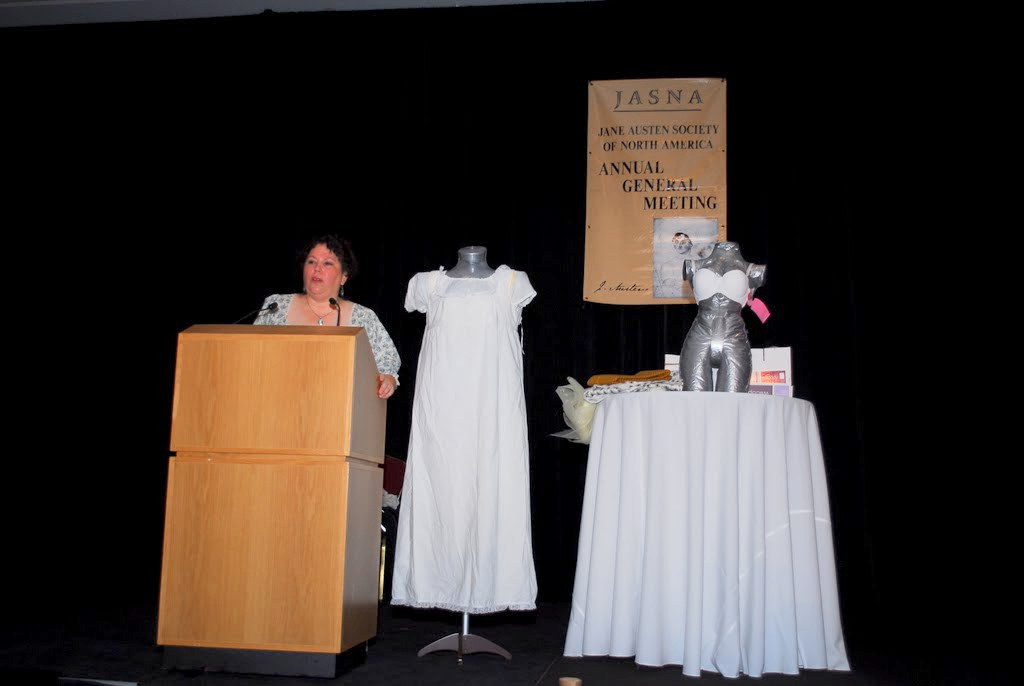
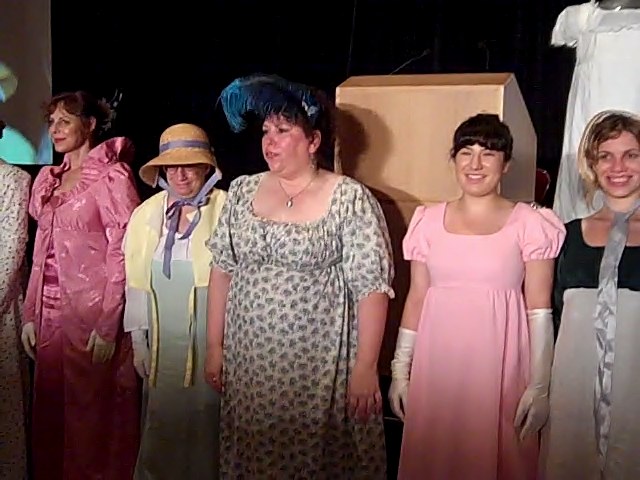
Inquiring readers. My first JASNA AGM in Brooklyn started out with a bang. Not only did I room with the wonderful Deb Barnum (Jane Austen in Vermont), but the first workshop I attended was given by Lisa Brown, co-coordinator of the Rochester and Syracuse Regions of JASNA (and the official photographer at the AGM, it seems). She presented a fashion show and workshop demonstration of Regency fashions, including detailed instructions on how to rework 1970s and 1980s gowns into very creditable Regency costumes. A similar custom was studiously followed by Regency ladies, such as the Miss Bennets and Miss Austens, whose income precluded them from custom ordering as many handmade gowns as they liked. Two hundred years ago, cloth and trim were quite expensive, although changes wrought by the Industrial Revolution in weaving, dying cloth, and creating off the rack gowns would make clothes more affordable as the 19th century progressed. Jane Austen wrote frequently of refurbishing a new bonnet or reworking a gown to suit an occasion.

Lisa Brown stands in the center of her models

Lisa graciously gave me permission to use the videos I took of her fashion show and from my notes. The personal impressions are mine.

The back of Lisa’s gown with the drawstring details. Note the floral print.

The Layers of a Regency gown

In Regency fashion, it’s all about lift and undergarments. The distinctive Regency “shelf” was created with straps tied from the side (not center) and short stays with busks and wires. The stays were drawn from the bottom to the top, and as the stays tightened the bosom (shelf) rose. During the extended Regency era (1795-1820) women wore fewer clothes than their mothers and aunts. Sheer fabrics, exposed bosoms, and bare arms in the evening were the hallmarks of the Regency style.

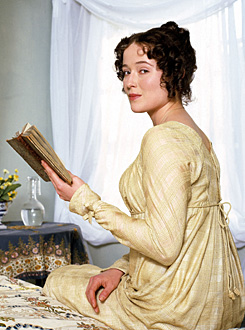
This image of Jennifer Ehle as Elizabeth Bennet shows her wearing a day gown with long sleeves. Note the gathering in the back and the silhouette of her Regency shelf bosom

The typical dress layers included (from skin side out): a simple shift made of sturdy cotton or linen that could withstand repeated laundering; short stays; a petticoat; and a gown. While women wore stocking and garters, under drawers were not generally worn until later in the 19th century. If a woman opted to wear them, they would be crotchless (mostly for convenience.)

Regency gown fashion show

In this video Sarah wears a 1970s dress found in a vintage shop and a period bonnet. The sleeves look modern, but the overall effect is very charming. Sarah is the author of the delightful post: I was a Model in a Regency Jane Austen Fashion Show.

Nadia wears a modern reworked holiday dress that converted nicely into a Regency style costume. I felt that the skirt lacked authenticity in that there was no gathering of the fabric in the back.

Julie wears a simple gray gown. To me the accessories turned this vintage dress into a Regency look, for the dress details were too sleek to be authentic.

Joyce in a green silk tafetta that could have used some trim or a shawl or something to turn this dress into a show stopper.

Jaclyn’s brown tafetta dress is one of my favorites. The gloves, bonnet, puffy sleeves, low scooped neck, and slight gathering in the back added realistic touches.

Jane wears a cotton dress with spencer jacket and long ties. I imagine Mrs. Austen might have looked much like her.

Meg looks like she is going to market. On stage she showed her reversible cape, which she took off for the runway. Her outfit is typical of a married lady who, after her marriage, begins to wear a cap. After turning 27,  unmarried women don caps as well, much like Jane Austen and her sister Cassandra. Meg also wears a delicate fichu, an item typically worn during the day. It can be tucked in or worn out. The fichu indicated casual day dress. If a lady with a limited wardrobe wished to dress up for the evening, she would take off her fichu and add dressier accessories to spruce up her look.

Aniela is also off to market. On stage she wore a spencer, a spinster’s cap, and a tucked-in fichu, a garment appropriate for all ages. Walking down the runway, you can see her fan on a little chain. Angela is a resourceful young woman, who found her short, form-fitting “spencer” at Forever 21. All she needed to do to turn this day gown into evening wear was to take off her cap and fichu, change from short gloves to long gloves, and change her jewelry. Voila! She is ready to visit neighbors for dinner and join in a dance! Notice the Van Dyke points on her sleeve.

Lynn Marie wears a spencer and parasol. Lisa cautioned that only umbrellas made in the 40s, 50s, or 60s would do as Regency parasols. Umbrellas from that time period were still made pagoda style, with the fabric coming up to the top of the frame. Notice how Lynn Marie’s dress has the gathered pleats in the back. If you choose to make a dress with a print pattern make sure that the prints are small and set far apart. Modern prints are often too large and set too closely together. In choosing cloth to make Regency gowns and for the sake of authenticity, Lisa also warned us to stay away from fabrics that are reminiscent of the two Lauras – Laura Ingalls Wilder and Laura Ashley. Hah!

Joyce wears a dark sleeveless pelisse with a long train. An elegant look that flows beautifully when she walks.

Nadia wears long sleeves during day and gloves. Dark fabric was chosen for daywear, since the color was easier to keep clean. Lighter colors, such as whites and pastels, were worn at night. White was a symbol of wealth since laundering took a great deal of time and effort. A white gown easily became soiled and required enormous maintenance to keep pristine (imagine how dirty those trains must have become even if the woman was confined to walking indoors.) Jane Austen’s audience knew exactly how pampered Eleanor Tilney was when her character was described as wearing only white.

In her second costume, Sarah wears a long sleeved dress and a quaint Amish straw bonnet with lining, flowers, and a ribbon. Trims were expensive and transferred from dress to dress, on the neck or sleeves, or at the bottom of a dress. Between 1805-1815, embellishments at the hem increased from 1″ of trim to 2″, to 3″ or more in 1817, the year Jane Austen died.

Jaclyn’s polyester pink 1970s gown turns into a pretty Regency ball gown. Today’s enterprising seamstress can order Indian muslin in specialty stores and find sheer netting overlays at curtain shops.

Julie’s pink gown is based on Empress Josephine’s coronation gown. The elaborate satin overdress is worn over a simpler dress underneath.

Aniela wears a pretty pale dress, very simple in design. Her day look includes short gloves and a basket.  This dress can easily be converted for a night time look by adding the right accessories.

Lynn Marie wears a dramatic ball dress from David’s Bridal. It was an age when showing one’s ankles was deemed scandalous, but showcasing one’s bosom was not. In fact, the Regency shelf was a display area on which a possible suitor could feast his eyes and the lady in question could show off her pretty necklace as well as her womanly assets.

Proper jewelry for that era consisted of small round shapes, such as seed pearls, small crosses, and delicate stones. To resemble a proper Regency miss, one should not wear posts or hoop earrings, long chains of pearls, or chokers, which were a Victorian affectation. Choose flat-heeled ballet style shoes or slippers, and half-boots with outer wear.

More on the topic:

This slideshow requires JavaScript.

Read Full Post »

« Newer Posts - Older Posts »