Feeds:
Posts
Comments

Archive for the ‘Architecture’ Category

This weekend as we celebrate Mother’s Day, my thoughts turn to Cassandra Austen,  wife of Rev. George Austen and mother of Jane Austen. Cassandra was related to the Leighs of Stoneleigh Abbey.  In 1806, the recently widowed Mrs. Austen visited Adlestrop Rectory in Gloucestershire with her two daughters, where they stayed with her cousins Rev. Thomas Leigh and his sister Elizabeth.  During their visit,  Rev. Thomas Leigh learned that the Hon. Mary Leigh of Stoneleigh Abbey had died and that he would inherit the great house, whose origins go back to 1154. The Austen women traveled with Rev. Leigh to Warwickshire. In the following letter, Mrs. Austen writes glowingly about their stay at the mansion:

“STONELEIGH ABBEY,
“August 13, 1806.

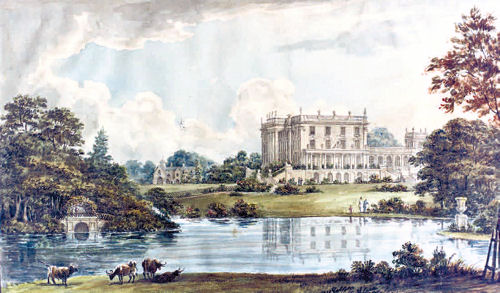
“MY DEAR MARY, – The very day after I wrote you my last letter, Mr. Hill wrote his intention of being at Adlestrop with Mrs. Hill on Monday, the 4th, and his wish that Mr. Leigh and family should return with him to Stoneleigh the following day, as there was much business for the executors awaiting them at the Abbey, and he was hurried for time. All this accordingly took place, and here we found ourselves on Tuesday (that is yesterday se’nnight) eating fish, venison, and all manner of good things, in a large and noble parlour, hung round with family portraits. The house is larger than I could have supposed. We cannot find our way about it – I mean the best part; as to the offices, which were the Abbey, Mr. Leigh almost despairs of ever finding his way about them. I have proposed his setting up direction posts at the angles. I had expected to find everything about the place very fine and all that, but I had no idea of its being so beautiful. I had pictured to myself long avenues, dark rookeries, and dismal yew trees, but here are no such dismal things. The Avon runs near the house, amidst green meadows, bounded by large and beautiful woods, full of delightful walks.

Stoneleigh Abbey, 1808, Humphrey Repton

“At nine in the morning we say our prayers in a handsome chapel, of which the pulpit, &c. &c., is now hung with black. Then follows breakfast, consisting of chocolate, coffee, and tea, plum cake, pound cake, hot rolls, cold rolls, bread and butter, and dry toast for me. The house steward, a fine, large, respectable-looking man, orders all these matters. Mr. Leigh and Mr. Hill are busy a great part of the morning. We walk a good deal, for the woods are impenetrable to the sun, even in the middle of an August day. I do not fail to spend some part of every day in the kitchen garden, where the quantity of small fruit exceeds anything you can form an idea of. This large family, with the assistance of a great many blackbirds and thrushes, cannot prevent it from rotting on the trees. The gardens contain four acres and a half. The ponds supply excellent fish, the park excellent venison; there is great quantity of rabbits, pigeons, and all sorts of poultry. There is a delightful dairy, where is made butter, good Warwickshire cheese and cream ditto. One manservant is called the baker, and does nothing but brew and bake. The number of casks in the strong-beer cellar is beyond imagination; those in the small-beer cellar bear no proportion, though, by the bye, the small beer might be called ale without misnomer. This is an odd sort of letter. I write just as things come into my head, a bit now and a bit then.

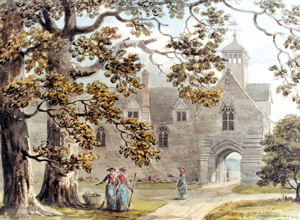
Stoneleigh Abbey, Gatehouse. 1807

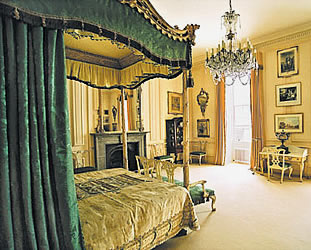
“Now I wish to give you some idea of the inside of this vast house – first premising that there are forty-five windows in front, which is quite straight, with a flat roof, fifteen in a row. You go up a considerable flight of steps to the door, for some of the offices are underground, and enter a large hall. On the right hand is the dining-room and within that the breakfast-room, where we generally sit; and reason good, ’tis the only room besides the chapel, which looks towards the view. On the left hand of the hall is the best drawing-room and within a smaller one. These rooms are rather gloomy with brown wainscot and dark crimson furniture, so we never use them except to walk through to the old picture gallery. Behind the smaller drawing-room is the state-bedchamber – an alarming apartment, with its high, dark crimson velvet bed, just fit for an heroine. The old gallery opens into it. Behind the hall and parlours there is a passage all across the house, three staircases and two small sitting-rooms. There are twenty-six bedchambers in the new part of the house and a great many, some very good ones, in the old.

Bedroom, Stoneleigh Abbey

There is also another gallery, fitted up with modern prints on a buff paper, and a large billiard-room. Every part of the house and offices is kept so clean, that were you to cut your finger I do not think you could find a cobweb to wrap it up in. I need not have written this long letter, for I have a presentiment that if these good people live until next year you will see it all with your own eyes.

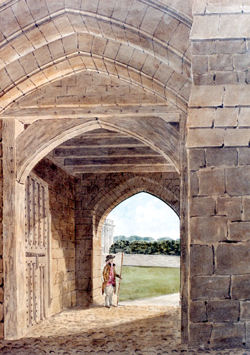
Arch, Stoneleigh Manor, Repton, 1807

“Our visit has been a most pleasant one. We all seem in good humour, disposed to be pleased and endeavouring to be agreeable, and I hope we succeed. Poor Lady Saye and Sele, to be sure, is rather tormenting, though sometimes amusing, and affords Jane many a good laugh, but she fatigues me sadly on the whole. To-morrow we depart. We have seen the remains of Kenilworth, which afforded us much entertainment, and I expect still more from the sight of Warwick Castle, which we are going to see to-day. The Hills are gone, and my cousin, George Cook, is come. A Mr. Holt Leigh was here yesterday and gave us all franks. He is member for, and lives at, Wigan in Lancashire, and is a great friend of young Mr. Leigh’s, and I believe a distant cousin. He is a single man on the wrong side of forty, chatty and well-bred and has a large estate. There are so many legacies to pay and so many demands that I do not think Mr. Leigh will find that he has more money than he knows what to do with this year, whatever he may do next. The funeral expenses, proving the will, and putting the servants in both houses in mourning must come to a considerable sum; there were eighteen men servants.” – Letter, Hill, Jane Austen: Her Homes and Her Friends

More on the topic:

Images: Plants info

Bedroom image: UK Student Life

Add to DeliciousAdd to DiggAdd to FaceBookAdd to Google BookmarkAdd to RedditAdd to StumbleUponAdd to TechnoratiAdd to Twitter

Read Full Post »

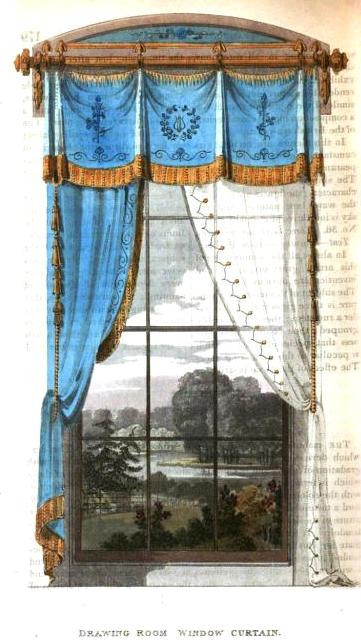
January, 1815 Drawing Room window treatment

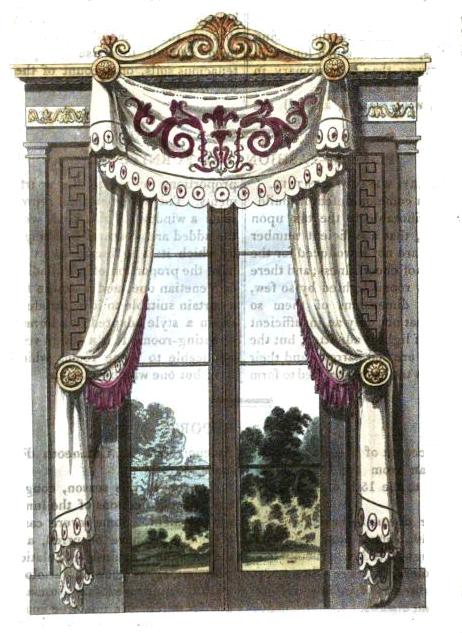
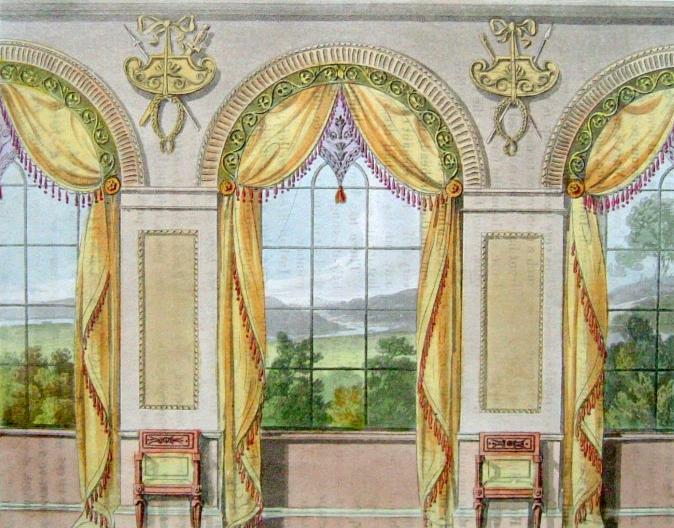
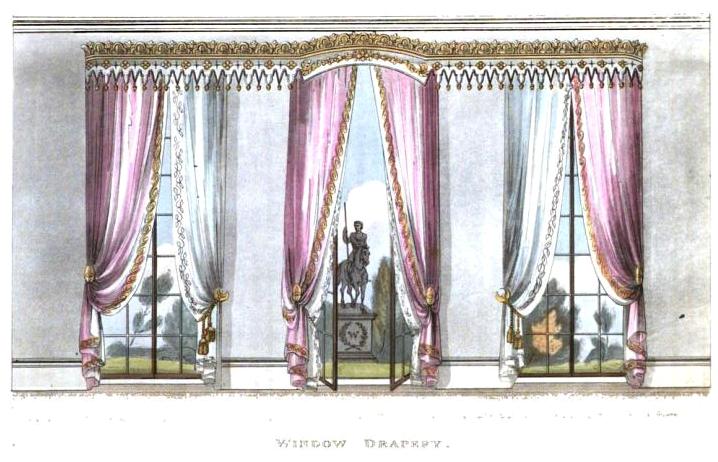
Ah, spring. Time to open the windows and air the rooms … and to consider redecorating. Ackermann’s Repository (1809-1829) didnt just cover fashion. The magazine also featured furniture and embroidery patterns, for example, and window treatments. This is simply a visual post. Enjoy!

1815 window treatment, Ackermann's Repository

1816 Regency dining room curtains, Ackermann's Repository

July, 1820, Window Draperies, Ackermann's Repository

1820 Window Treatment, Ackermann

Wallpaper frieze with drapes, woodcut print on paper, 1800-1820, V&A museum

Read Full Post »

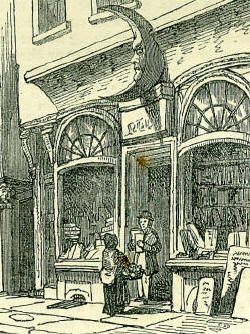
Robert Chamber’s Book of Days was written in 1869. It is organized according to the days of the calendar and serves up history in the way that our ancestors saw it. I have found it to be a treasure of information about late Regency and Victorian London. Click here to read about the book. Below sits an excerpt from the book about the last remaining shop sign in situ over a bookseller shop. Once upon a time, such signs hung over every shop in London, some so precarious that they threatened passersby below.

Bookseller, Chambers Book of Days

In Holywell-street, Strand, is the last remaining shop sign in situ, being a boldly-sculptured half-moon, gilt, and exhibiting the old conventional face in the centre. Some twenty years ago it was a mercer’s shop, and the bills made out for customers were ‘adorned with a picture’ of this sign. It is now a bookseller’s, and the lower part of the windows have been altered into the older form of open shop. A court beside it leads into the great thoroughfare; and the corner-post is decorated with a boldly-carved lion’s head and paws, acting as a corbel to support a still older house beside it. This street altogether is a good, and now an almost unique specimen of those which once were the usual style of London business localities, crowded, tortuous, and ill-ventilated, having shops closely and inconveniently packed, but which custom had made familiar and inoffensive to all; while the old traders, who delighted in ‘old styles,’ looked on improvements with absolute horror, as ‘a new-fashioned way’ to bankruptcy.  March 9th entry

Read Full Post »

This link to the BBC site will lead you to a video of a walk with Amanda Parr through Bath. You will need a Real Player.

Other posts about Bath on this site:

The Comforts of Bath: Thomas Rowlandson

The Viscount and the Toll Keeper’s Daughter: How Thomas Thynne Never Became the Marquess of  Bath

Saving Georgian Bath

Read Full Post »

Bottle with emerald green pigment

Once upon a time green paint literally killed people. In 1814 in Schweinfurt, Germany, two men named Russ and Sattler tried to improve on Scheele’s green, a paint made with copper arsenite. The result was a highly toxic pigment called emerald green. Made with arsenic and verdigris, the bright green color became an instant favorite with painters, cloth makers, wall paper designers, and dyers. The first commercial British arsenic was produced at Perran-ar-Worthal in 1812, and at Bissoe in the Carnon Valley in 1834. Their product appealed to the Lancashire cotton industry which used the chemical in pigments and dyes. It was also used by other industries such as glass manufacture (as a decolouriser), in the production of lead-shot, leather tanning, soaps, lampshades, wallpaper manufacture (to create green and yellow print), pharmaceuticals, agriculture for sheep dips, children’s toys, candles, a highly effective rat poison, etc.*

“Manufacture of [emerald green] began in 1814 at the Wilhelm Dye and White Lead Company of Schweinfurt. It was more popular than Scheele’s green and was soon being used for printing on paper and cloth; it even coloured confectionary. –  The Elements of Murder: A History of Poison, John Emsley

Textured Georgian wallpaper

Emerald green was also called Schweinfurt green, Paris green, and Vienna green. The toxicity of dye made with emerald green was not initially recognized, until the recipe was published in 1822, and
“…its poisonous nature was revealed. Manufacturers then changed the recipe, adding other ingredients to lighten the colour, and changing its name accordingly in an effort to disguise its true nature.” – Murder, Emsley
Eventually, the use of this pigment was abandoned when it became generally known that people who wore clothes dyed with the substance tended to die early. To this day the French avoid making green theater costumes.** Emerald green was also used to color confectionary and cake cake decorations:
“The leaves of artificial flowers in particular were coloured with various arsenic greens and they were very popular in Victorian households. The industry making them employed hundreds of young girls, who suffered accordingly from chronic arsenic poisoning…at a banquet held by the Irish Regiment in London in the 1850’s the table decorations were sugar leaves coloured by them. Many of the diners took these home for their children to eat as sweets and several deaths ensued. At another dinner in 1860 a chef was eager to produce a spectacular green blancmange and sent to a local supplier for green dye. He was given Scheele’s green and three of the diners later died.” – Ibid

Floral border wallpaper, Ipswich, late 18th c.***

Wallpaper made with Scheele’s green was deadly, By 1830, wallpaper production had risen to 1 million rolls a year in the UK, and by 30 million in 1870. Tests later revealed that four out of five wallpapers contained arsenic. Leopold Gmelin (1788-1853), a famous German chemist, suspected as early as 1815 that wallpaper could poison the atmosphere. He noticed that the substance gave off a mouse-like odor when the paper was slightly damp. Gmelin warned people to strip their rooms of the paper and advocated banning Scheele’s green, but he was too far ahead of his time.

In 1861, Dr W. Fraser tested wallpaper that contained arsenic.The threat, he said, came from breathing the dust of the papers, especially flocked wallpaper. The warnings went unheeded, and by 1871, arsenic production had increased to the point that Britain had become its largest producer and consumer. An addition of a small amount of arsenic, for example, would neutralize iron in glass and give it a green tint. “Potassium chromate (K2CrO4) is yellow and this colour can be imparted to certain glasses. To produce emerald green glass in which a yellowish cast has to be avoided the addition of tin oxide and arsenic is necessary.” (Substances used in the making of colored glass.)

Soon arsenic was exported for the making of pesticides in the United States. Health considerations did not end the use of arsenic-laced wallpaper. By the 1870’s synthetic green dyes began to replace arsenic, and fewer people were placed in danger by its poisonous gases. Experiments at the end of the 19th century proved that arsenic pigments in damp or rotting wallpaper were lethal. The mold that grew on damp wallpaper emitted a toxic odor that smelled of garlic.

The French painter Cezanne had an affinity for using paris green, and it might have been no coincidence that he suffered from severe diabetes. The pigment had a tendency to turn black when exposed to heat and thus it did not become universally popular with artists. Even with scientific evidence of its highly toxic nature, production of emerald green paint was not banned until the 1960’s.


More on the topic

Read Full Post »

« Newer Posts - Older Posts »