Feeds:
Posts
Comments

Archive for the ‘art’ Category

Jane Austen was born in 1775, the same year as Mrs. Robert Shurlock (born Henrietta Ann Jane Russell). Had Jane married and given birth to a child in 1801, would she have presented as charming a picture as Mrs. Shurlock and her daughter Ann? Both women would have been twenty-six years of age at the time. From this description of Jane, Mrs. Shurlock could well have been a relative, for according to her nephew James Austen-Leigh, his aunt Jane had:

“ full round cheeks, with mouth and nose small and well formed, light hazel eyes, and brown hair forming natural curls close round her face.”

John Russell, the painter and sitter’s father, was known for his skills with pastels, as this image from the Metropolitan Museum of Art clearly demonstrates. Henrietta took lessons from her father and became a talented artist in her own right.

Read Full Post »

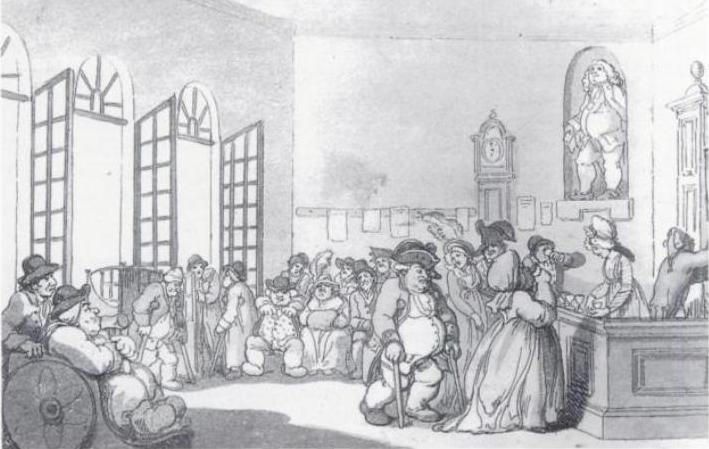
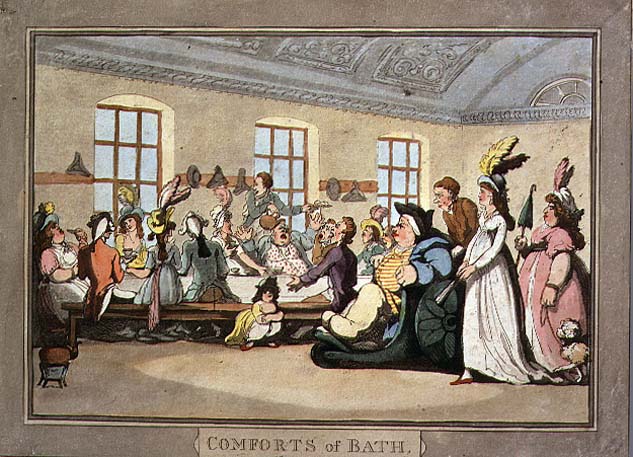
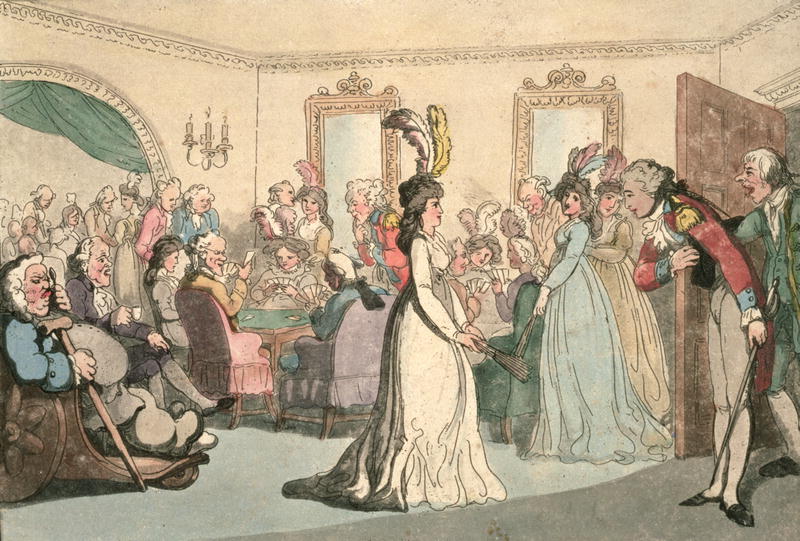
In 1798, the famous caricaturist Thomas Rowlandson drew The Comforts of Bath, a series of satiric drawings. The cartoons were used to illustrate the 1858 edition of the New Bath Guide, written by Christopher Anstey and first published in 1766.* Rowlandson depicted both the social and medical scene in Bath just before the period described by Jane Austen in Northanger Abbey and Persuasion, and by Georgette Heyer in her Regency romances.
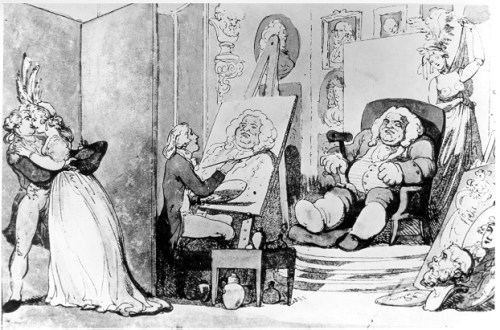
The Portrait, Comforts of Bath, 1798, Thomas Rowlandson

In this post I combined Rowlandson’s images with excerpts from an 1811 guidebook, A new guide through Bath and its environs By Richard Warner. The scenes depict the use of mineral water therapy for the invalids who flocked to Bath, a city whose fashionable post-Nash reputation was already well past its prime and whose medical men were generally regarded as quacks or, worse, “potential murderers”. The rotund gentleman in front and center of all these scenes (who undoubtedly suffered from gout, a painful rich man’s disease), was conjectured to be based after Tobias Smollet’s Mr. Bramble. In the pictorial’s subtext, notice how “Mr. Bramble’s” young wife (companion or daughter) flirts with the young officer who boldly woos her (Image above). Even while satirizing them, Rowlandson gets the social details just right. Underneath each image sits a quote from the guidebook.
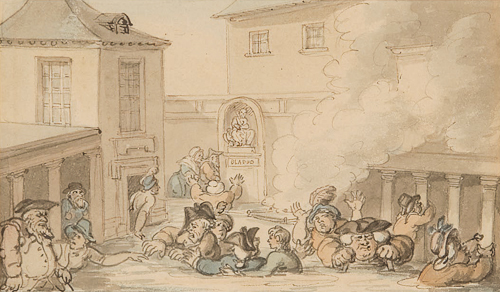
King Bladud's Bath, Comforts of Bath, Rowlandson

It is fit for the patient when he goeth into the bath to defend those parts which are apt to be offended by the bath, as to have his head well covered from the air and wind and from the vapours arising from the bath, also his kidneys if they be subject to the stone, anointed with some cooling unguents as rosatum comitiffs infrigidans Galeni Santo linum &c. Also, to begin gently with the bath till his body be inured to it, and to be quiet from swimming or much motion which may offend the head by sending up vapours thither at his coming forth, to have his body well dryed and to rest in his bed an hour and sweat, etc.” – A New Guide Through Bath, 1811
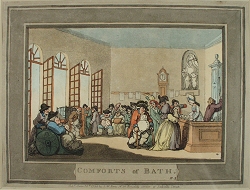
The Pump Room, The Comforts of Bath, 1798, Rowlandson

The new Pump Room supplied water from a covered pump. Before the room was built, the populace drank the waters in the open air. But the new rooms allowed them to

…  take the exercise prescribed to them sheltered from the inclemency of the weather. The work was accordingly begun in 1704, finished two years afterwards, and opened for the reception of the company under the auspices of Mr Nash, who had just then become the Arbiter Elegantiarum of Bath…A New Guide Through Bath, 1811
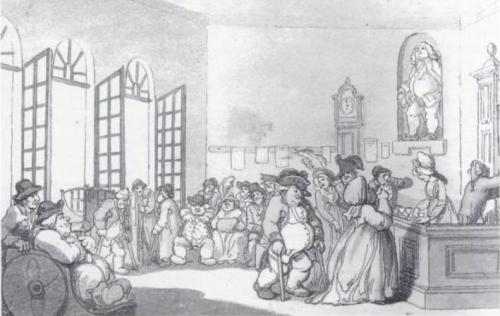
Black and White detail of above print

In the year 1751 [The Pump] Room was enlarged. Accommodated with a beautiful Portico stretching from it in a northern direction in 1786, and adorned with superb Western Frontispiece in 1791, The Corporation further beautified the city in 1796 by taking down the old Pump Room entirely and building on its site the much larger and more magnificent edifice known at present by that name…A New Guide Through Bath, 1811

Public Breakfast, The Comforts of Bath, 1798, Rowlandson

Pertaining to the construction of  the Harrison rooms and the Assembly Rooms:

Temporary booths had hitherto been the only places in which the company could drink their tea and divert themselves with cards, but Mr Harrison, a man of spirit and speculation, perceiving that a building of this nature was much wanted and would probably make him a very suitable return, undertook at the suggestion of Mr Nash to erect a large and commodious room for the purpose of receiving the company.  The succes of this attempt induced a similar one in the year 1728, when another large room was built by Mr Thayer.  A regular system of pleasurable amusements commenced from this period, and the gay routine of public breakfasts, morning concerts, noon card parties, evening promenades, and nocturnal balls rolled on in an endless and diversified succession. – A New Guide Through Bath, 1811
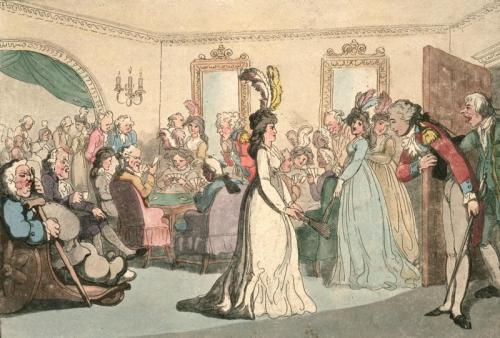
Company at Play, The Comforts of Bath, Rowlandson

Rules card games:

That no persons be permitted to play with cards left by another party;  That no hazard or unlawful game of any sort be allowed in these Rooms on any account whatever nor any cards on Sundays...A New Guide Through Bath, 1811
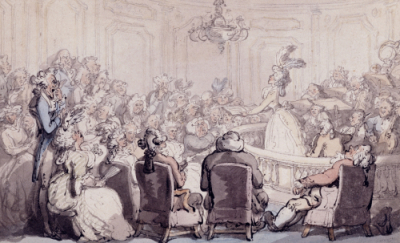
The Concert, Bath Chambers, Rowlandson

For music sweet music has charms to controul; And tune up each passion that ruffles the soul; What things have I read and what stories been told; Of feats that were done by musicians of old – The New Bath Guide, 1779
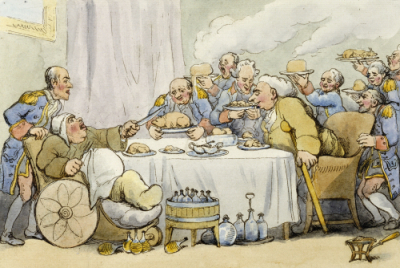
Dinner, Comforts of Bath, 1798

Bath has little trade and no manufactures; the higher clafles of people and their dependents conftitute the chief part of the population, and the number of the lower clafles being but fmall…A New Guide Through Bath, 1811
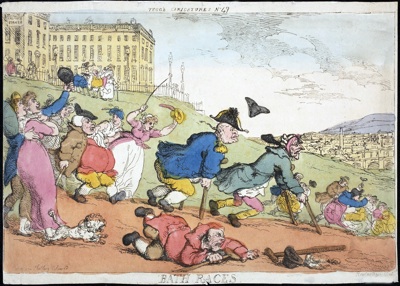
Bath Races, Rowlandson

More on the topic:

Read Full Post »

Pierre-Joseph Redouté’s flower prints are so lush and detailed that you can almost pick the flowers off the page. In the famous rose print below, a single drop of water rests exquisitely on a rose petal of the top rose. Born in a family of artists*, Pierre-Joseph became known as the premier botanical illustrator of his day (indeed, to this day). His influence spread far and wide and can be still felt in illustrations on cards, decorative boxes, books, wallpapers and prints, and calendars.

pierre-joseph-redoute

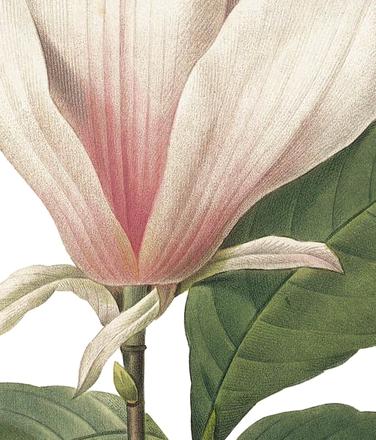
The watercolor images in this post were taken from his famous book of prints, Les Roses. Redouté, known as the “Raphael of flowers, mastered the technique of stipple engraving- in which he uses tiny dots, rather than lines, to create engraved copies of his watercolor illustrations. This new technique allowed him to make subtle variations in coloring (see the detail of the magnolia in the last image below).

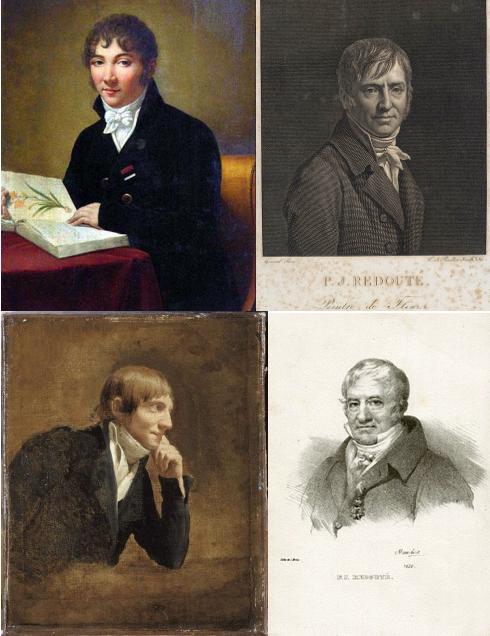
4 faces of PJ Redoute

The four faces (and ages) of Pierre-Joseph Redouté

Redouté completed the three volumes of Les Roses, his best known work, between 1817 and 1824. His most popular illustrations are assembled in Les Liliacées (486 watercolors); and Les Roses (169 watercolors). Hand-colored stipple engravings, such as the magnolia sitting at the bottom of this post, were made from these watercolors. – Discovery Editions

Rosa gallica_maheka from Redoute's Les Roses 1817-1824 Huntington LibraryJosephine, wife of Napoleon Bonaparte, was known for her spectacular garden at Chateau de Malmaison, where exotic plants were cultivated. The plants, acquired from around the world, were documented by France’s leading horticulturists and botanists, and painted by Pierre-Joseph Redouté.
Magnolia

Detail of the magnolia engraving below.

magnolia closeup

More on this topic

Read Full Post »

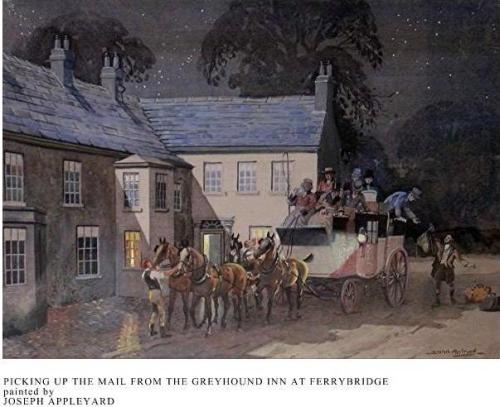
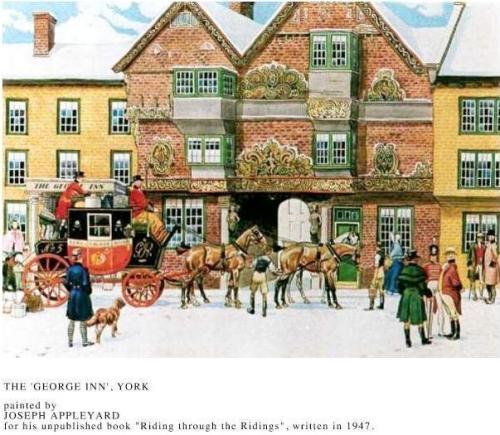
“Riding Through the Ridings”: Random Sketches of Yorkshire Coaching Inns was written and illustrated in 1947 by Joseph Appleyard. An unpublished book, it has found a home online through his son, David. The illustrations fit so well with my recent posts for post boys and the postal mail, that I was eager to share them with you,with Mr. Appleyard’s kind permission.
The George Inn York Joseph Appleyard

The website contains the full transcript and most of the illustrations for “Riding through the Ridings”, whose foreword by Major J. Fairfax-Blakeborough M.C. is telling:
Post-Boys Joseph Appleyard

Some of us are old enough to have talked with the last of the drivers of stage coaches, with post-boys and quaint old ostlers, who could recall the music of the fast-trotting horses and the note on the guard’s horn. Such have heard at first hand of all the bustle there was when the four steaming horses were to be speedily changed, relieved by others standing in readiness for the next stage. More there are who remember the long rows of stables, loose-boxes, saddle rooms and post-boy’s quarters — unused and maybe derelict — in the spacious yards of the old coaching inns. These have also lived to see the end of coach-horse breeding in Yorkshire and the passing of the fairs in the country, at which hundreds of animals were yearly bought to horse the coaches in various parts of the country. Later, in pre-motor days, the best carriage-horses were sold in large numbers at these same Yorkshire fairs; to buyers from all over the world. The horse fairs as they declined, were the swan song of the long ranges of stabling, which were an essential adjunct and integral part of every coaching inn. All this formed the last remaining links with the spacious, leisurely, picturesque coaching-days.

Picking up the mail

Picking up the mail

Major Fairfax-Blakeboroughsums up the illustrations nicely:

The beautifully executed illustrations in this book are marked by their accuracy in technique and detail — no easy achievement in view of the distinctive dress, horse, harness and so forth, which belonged to those days and to a great extent passed with them. Contemporary literature is pregnant with references to the particular care and pride those who played their part in the coaching era took with regard to all these details and how the young sons of patrician families, did not consider their education complete until they could tool a four-in-hand and dress the part with such meticulous exactness that they were mistaken for professional coachmen. The fascinating illustration on the succeeding pages emphasise more than any other of the previous volumes dealing with the epoch, the poetry and romance surrounding it and the important part the old posting houses plated in the life of the nation and as the very hub of their own immediate area.

coach Horse, Joseph Appleyard 1947

coach Horse, Joseph Appleyard 1947

The site also offers a short biography of the artist (1908-1960), and contains photographs, published works, sketches, drawings, book illustrations and newspaper articles of his life and career.

Joe Appleyard attended local evening classes at Leeds School of Art where his fondness of animals gave rise to his interest in Romany and Circus life. He worked full time in window display and general advertising, and painted the scenery of Airedale, Wharfedale and Washburn Valleys in his spare time. Appleyard first began showing his paintings at the Leeds City Art Gallery in 1934, and by 1947 had exhibited over two hundred different works. He co-founded Otley Arts Club, and today his sketchbooks are in a permanent collection at Leeds Art Gallery. His St Leger and racehorse portraits and studies are in a permanent collection at Doncaster Art Gallery.

A light post horse, Joseph Appleyard

A light post horse, Joseph Appleyard

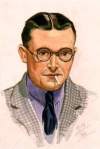
Joe Appleyard, Self portrait, age 26

Joe Appleyard, Self portrait, age 26

David Appleyard writes about designing a website for his father:

The Old Swan Hotel, Harrogate, has three large oil paintings on permanent display, now well restored to remove fifty years of nicotine. The nicotine would not have bothered Joe for he liked his Three Castles cigarettes and as his self-portrait shows political correctness was not an issue in those days! Some twelve years ago I tried to publish “Riding through the Ridings”. My efforts were unsuccessful and the project lay dormant until 1999 when I decided to “publish” it on the Internet. With access to Joe’s remarkably good records the site has grown and showcases more than 200 examples of his work as my tribute to a wonderful father and talented artist.

To see the rest of the illustrations and read the book, click on this link: Joseph Appleyard, Author or type http://www.josephappleyard.co.uk

Read Full Post »

Interior of Lindisfarne Priory, 1797, Thomas Girtin

Interior of Lindisfarne Priory, 1797, Thomas Girtin

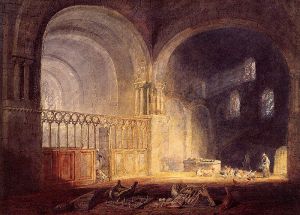
Young Thomas Girtin’s painter friend was the famous artist J.M.W. Turner. As teenagers both men had been employed to color prints with watercolor paints. While Turner lived to be over seventy-five years of age, Girtin died of consumption at 27. Turner would recall in his later years: “Had Tom Girtin lived I should have starved.” No small praise.  During his short life, Girtin gained a major reputation as a watercolor artist and played an important role in establishing English Romantic watercolor paintings as an art form. As one biographer noted, “While Girtin lived, Turner followed.”  One can only imagine how fascinated young and romantically minded Catherine Morland would have been had she seen Girtin’s painting of the priory ruins.

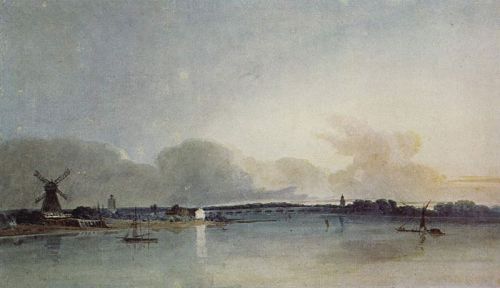
Watercolor landscape, Thomas Girtin, 1800

Watercolor landscape, Thomas Girtin, 1800

Three years before his death, Girtin had acquired important patrons who collected his works. Thankfully the young artist had been prolific and his influence was not soon forgotten. In 1842, while sketching high in the Swiss Alps, a mature Turner, reminded of a unique effect of light in darkness, penciled a brief note in the margin of his drawing: “Girtin’s White House.”

Transept of Ewenny Priory, Glamorganshire, JMW Turner, 1797

Transept of Ewenny Priory, Glamorganshire, JMW Turner, 1797

Read about Thomas Girtin in these links:

Read Full Post »

« Newer Posts - Older Posts »