Feeds:
Posts
Comments

Archive for the ‘Bath’ Category

Having just made a big move myself, I was intrigued by the thought that Jane Austen herself—not to mention several of her characters—knew what it took to move an entire household from one place to another.

One of the best resources available to us regarding a big move is the letter Austen wrote to Cassandra on January 3, 1801, prior to their family’s move to Bath from Steventon. From it, and from the details in her novels, we learn many interesting details about what a big move entailed.

If you’ve ever wanted some Regency advice on moving house, this is for you!
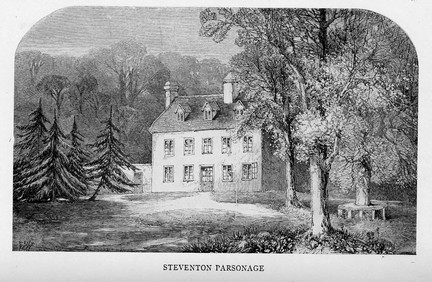
Image of Steventon Rectory, Wikimedia Commons
Steventon Rectory, Wikimedia Commons

Send Your Servants Ahead

In terms of logistics, members of the genteel class usually sent servants ahead of them when they went from one house to another, as we see when Mr. Bingley goes to Netherfield:

Why, my dear, you must know, Mrs. Long says that Netherfield is taken by a young man of large fortune from the north of England; that he came down on Monday in a chaise and four to see the place, and was so much delighted with it that he agreed with Mr. Morris immediately; that he is to take possession before Michaelmas, and some of his servants are to be in the house by the end of next week.

Pride and Prejudice

Similarly, Elinor and Marianne, when arriving in London with Mrs. Jennings after three days of travel, are greeted by “all the luxury of a good fire.” The house is “handsome, and handsomely fitted up.” Elinor writes to her mother before a dinner that will not “be ready in less than two hours from their arrival.” It’s clear that Mrs. Jennings employs servants who clean, cook, shop, and prepare the house for her visits.

Hire Good People

When preparing to move to Bath, Jane Austen’s mother wanted to keep two maids: “My mother looks forward with as much certainty as you can do to our keeping two maids; my father is the only one not in the secret.”

With her typical flair for humor, Austen hoped to engage other servants as well: “We plan having a steady cook and a young, giddy housemaid, with a sedate, middle-aged man, who is to undertake the double office of husband to the former and sweetheart to the latter. No children, of course, to be allowed on either side.”

Do Your Research

In Austen’s letter, she talks about several areas of Bath where they hoped to find a house: Westgate Buildings, Charles Street, and “some of the short streets leading from Laura Place or Pulteney Street.”

About Westgate Buildings, Austen wrote: “though quite in the lower part of the town, are not badly situated themselves. The street is broad, and has rather a good appearance.” Regarding Charles Street, she thought it “preferable”: “The buildings are new, and its nearness to Kingsmead Fields would be a pleasant circumstance.” And concerning the third area: “The houses in the streets near Laura Place I should expect to be above our price. Gay Street would be too high, except only the lower house on the left-hand side as you ascend.”
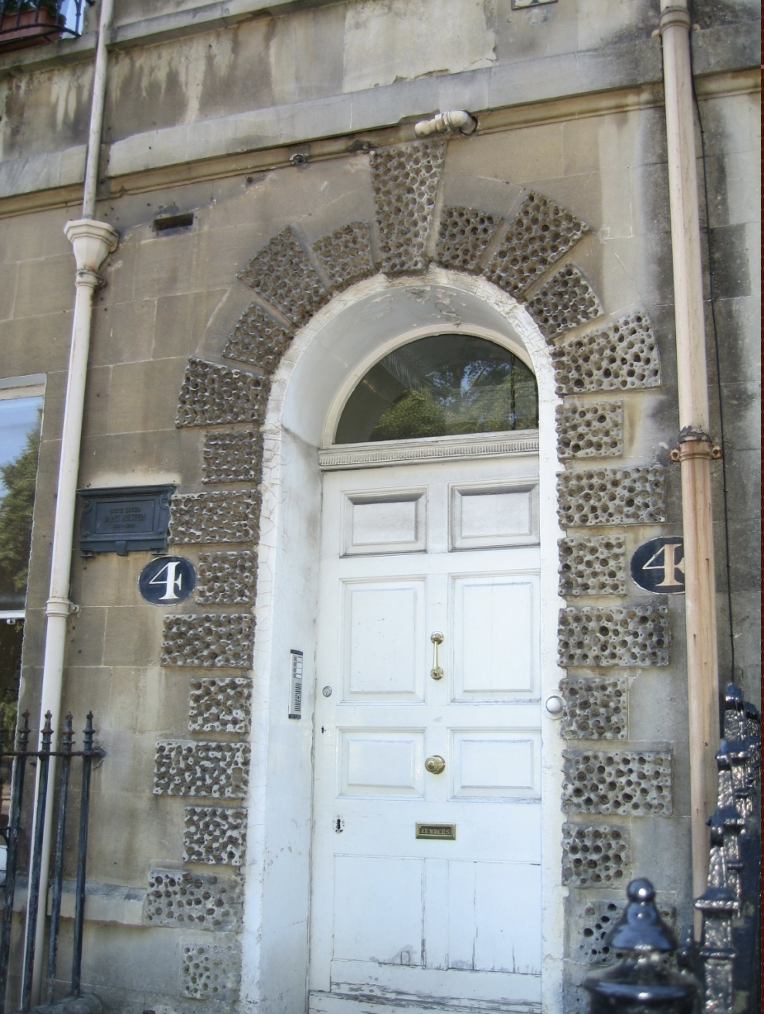
4 Syndey Place, Bath

Mrs. Austen seemed to have a preference: “her wishes are at present fixed on the corner house in Chapel Row, which opens into Prince’s Street. Her knowledge of it, however, is confined only to the outside, and therefore she is equally uncertain of its being really desirable as of its being to be had.”

None of the Austens were in favor of Oxford Buildings: “we all unite in particular dislike of that part of the town, and therefore hope to escape.”

Bring Your Art

We know from Austen’s letter that they planned to take the following pictures and paintings from Steventon to Bath: “[T]he battle-piece, Mr. Nibbs, Sir William East, and all the old heterogeneous miscellany, manuscript, Scriptural pieces dispersed over the house, are to be given to James.”
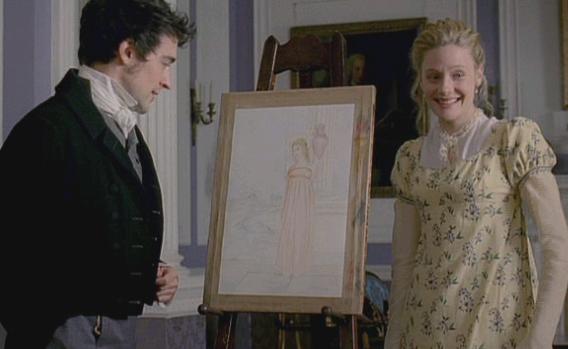
Good artwork is hard to find.

Of special note, Jane tells Cassandra, “Your own drawings will not cease to be your own, and the two paintings on tin will be at your disposal.”

Good Furniture is Worth Moving

Apparently, Rev. and Mrs. Austen had a very good bed that was irreplaceable: “My father and mother, wisely aware of the difficulty of finding in all Bath such a bed as their own, have resolved on taking it with them…” Austen wrote this about the rest of the household beds: “all the beds, indeed, that we shall want are to be removed — viz., besides theirs, our own two, the best for a spare one, and two for servants; and these necessary articles will probably be the only material ones that it would answer to send down.”

When it came to their dressers, they decided it was time for an upgrade: “I do not think it will be worth while to remove any of our chests of drawers; we shall be able to get some of a much more commodious sort, made of deal, and painted to look very neat…”
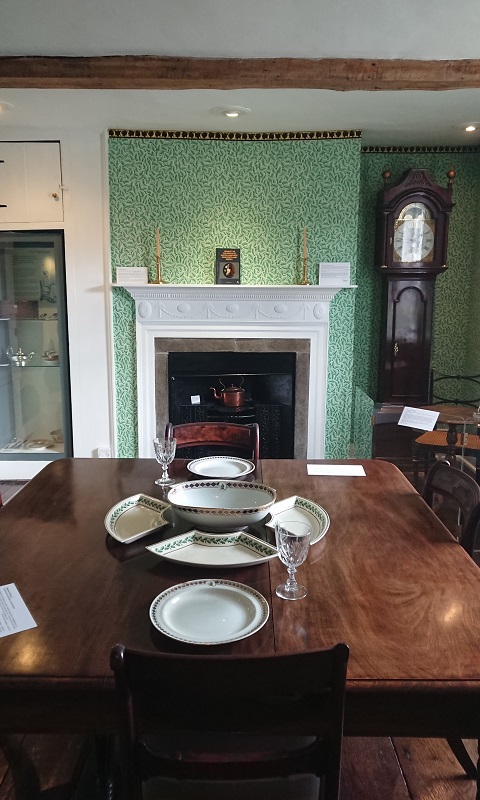
Image of dining room at the Jane Austen House Museum
Jane Austen’s House Museum in Chawton.

As to the rest of their furniture, they decided it would be better to replace most of it in Bath: “We have thought at times of removing the sideboard, or a Pembroke table, or some other piece of furniture, but, upon the whole, it has ended in thinking that the trouble and risk of the removal would be more than the advantage of having them at a place where everything may be purchased. Pray send your opinion.”

Jane’s final comments to Cassandra are amusing as ever: “My mother bargains for having no trouble at all in furnishing our house in Bath, and I have engaged for your willingly undertaking to do it all.”

Visit People on the Way

In Austen’s letter, she explains their family travel plans: “[M]y mother and our two selves are to travel down together, and my father follow us afterwards in about a fortnight or three weeks. We have promised to spend a couple of days at Ibthorp in our way. We must all meet at Bath, you know, before we set out for the sea, and, everything considered, I think the first plan as good as any.”
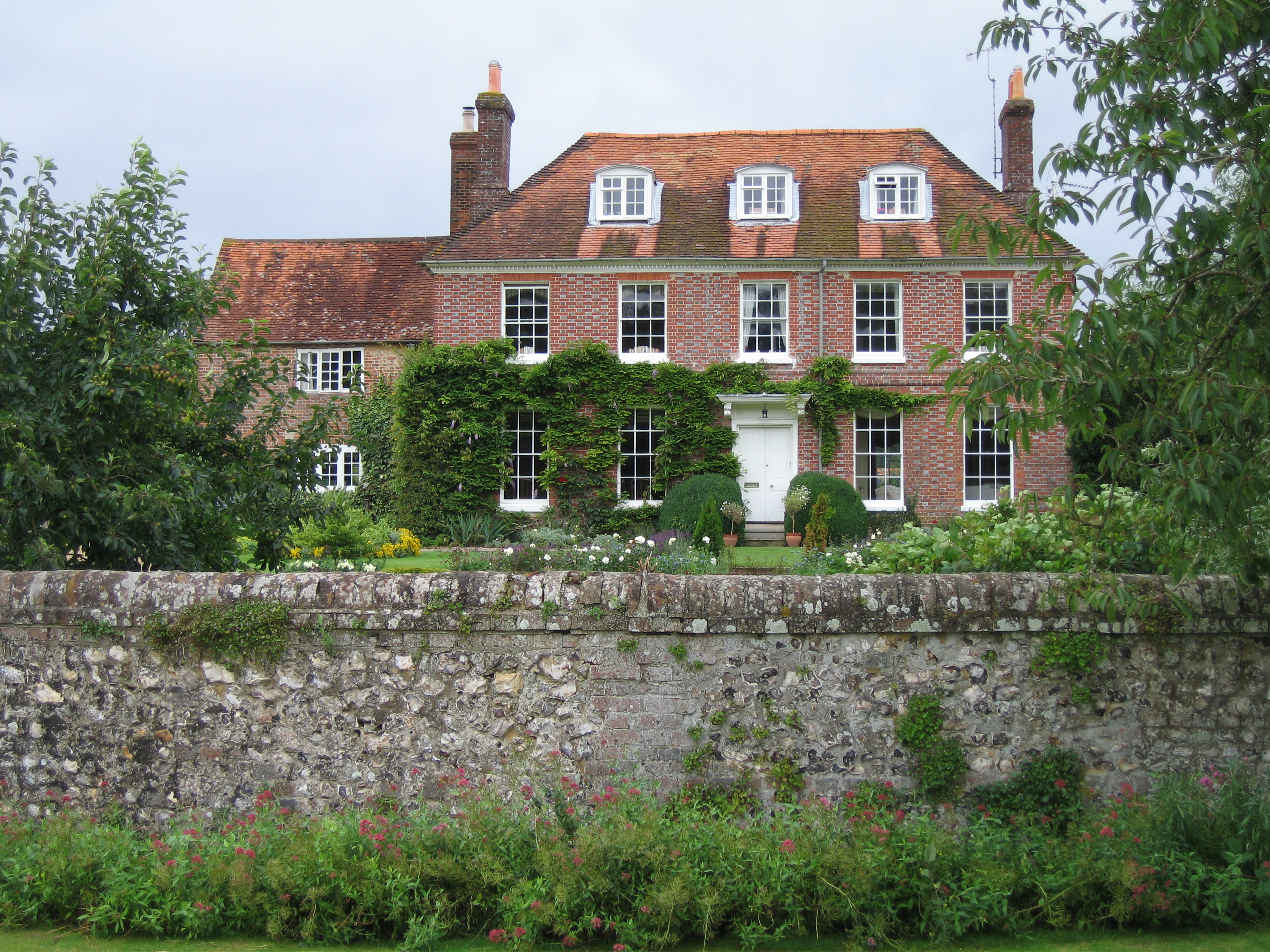
Ibthorpe, Photo by Rachel Dodge

Not So Different

Moving house in Jane Austen’s day was not quite so different from today. Though the modes of transportation and the methods of research and communication were somewhat different, I was delighted to find that the Austens’ moving plans were surprisingly applicable to mine! (Except for the servants.)


RACHEL DODGE teaches college English classes, gives talks at libraries, teas, and book clubs, and writes for Jane Austen’s World blog. She is the bestselling author of The Little Women DevotionalThe Anne of Green Gables Devotional and Praying with Jane: 31 Days Through the Prayers of Jane Austen. Coming this fall: The Secret Garden Devotional. You can visit Rachel online at www.RachelDodge.com.
Read Full Post »

Inquiring readers: In early October, Prof Elaine Chalus, Historian of 18-19C British gender, politics & society, sent a link to eight sessions of the Bath 250, A Virtual Conference, The 250th Anniversary of the New Assembly Rooms of Bath, given on 29th & 30th September 2021. My first recap was of Professor Steve Poole’s presentation about Bath’s sedan chairmen.  

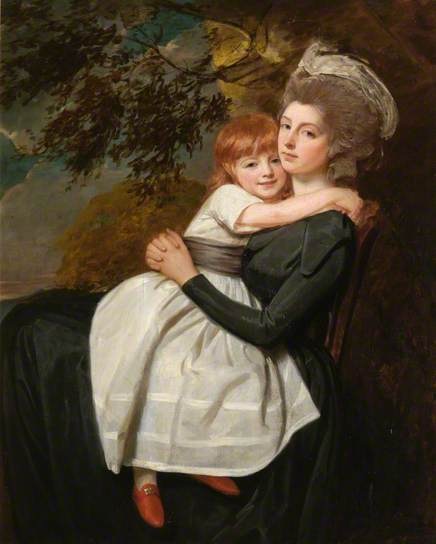
This second summation is of Rachel Bynoth’s discussion, entitled “The Marriage Market Reassessed: Female Emotional Experiences of Eighteenth-Century Bath Through Letters,” and focuses on the relationship between Bess Canning and her mother Mehitable (Hitty) Canning, the wife of Stratford Canning. (See a short synopsis of the family tree and their history at the end of the recap). Bynoth’s discussion also touched on another mother and daughter, whose letter exchanges are not discussed in this post.

About the Marriage Mart

Most of us who know about the 18th-19th century habits and rituals of courtship in Bath have acquired our awareness from reading  history books, articles, and blogs, as well as contemporary works of fiction. Unlike academics, however, most of us haven’t spent years seeking original sources and hunting dusty books in far corners of libraries and second-hand bookstores.  Conferences, such as ‘Bath 250’, present research from those sources. Bynoth’s primary approach to her topic are two key words in her title – emotional experiences. Through their letters, Bynoth follows both Bess’s experience as she attends the parties and balls and avails herself of Bath’s social life, and her mother’s increasing anxiety about her eventual success at attracting a husband during a time of England’s involvement in the Revolutionary War and Napoleonic Wars, when men were in short supply.

Canning-118

Mrs Stratford Canning with her daughter Elizabeth, by George Romney, National Trust for Scotland, Fyvie Castle

In Bynoth’s workshop discussion, she first mentions 16-year-old Bess Canning’s letter to her mother in her first social season in 1792. (Jane Austen was 17 at this time. She wrote Susan/Northanger Abbey at 23-24 years of age, after her first visit to Bath in 1797.)

Hitty replies to Bess:

“I am much pleased with your daily occupations + am glad you are improving your knowledge of housekeeping – it is a very necessary Qualification, for all young Women, but especially such as have small Fortunes – I trust in God my dear Bess with a little care and management; we shall all do very well – but we must act with great Circumspection, for many eyes are upon us + all our actions will be well scrutinized.” – quote from a slide by Rachel Bynoth in her presentation. – Rachel Bynoth

One senses the mother’s love in this missive. Nevertheless, Bynoth points out an underlying anxious tone in their future correspondence, for Hitty, a widow, and separated from her daughter in Bath, must rely on the Leighs, Bess’s chaperones, to supervise her according to her standards. The Leighs understood their responsibilities perfectly. In comparison to the Allens (Northanger Abbey), Bess’s real life chaperones “procured a partner for Bess for almost every ball, thus allowing her to dance.” – Smith, Rachel, “Proceedings of the History of Bath Research Group”, No. 5, 2016-17, pp.27-28.

It was important to Hitty that Bess was perceived as fashionable and erudite, ie. grammatically correct in letters. Her husband, Stratford Canning had died in 1787, five years before her daughter’s debut into society.  One can only imagine a widow’s anxiety for her daughter, especially one with five children to raise. Her letter to Bess commented 

“upon her grammar and spelling frequently. Hitty also criticised her daughter’s attention to her letter-writing, stating that she needed to pay more attention to her form and language in order to improve and insisted that their frequent correspondence would aid her development. This repetition of writing … [came] out of Hitty’s desire for her daughter to avoid the stereotype: that women could not spell or correctly apply the rules of grammar. This was especially important as Hitty moved in upper class circles: her intimate friend was Mrs Sheridan who was close friends with the Devonshire House set. Bess’s actions as a connected young woman would be commented upon and Bess’s trips to Bath in 1792/3 and 1798 highlighted this.” – Rachel Smith, Proceedings 

Mother and daughter corresponded regularly when apart, often every two days, and thus Hitty’s influence on her daughter kept Bess mindful and respectful of her mama’s wishes.

“Hitty’s letters to Bess in Bath show the importance of communication in order to fit in with fashionable society. Hitty’s letter, which asks Bess to report whether she had combed the powder out of her hair, tells one in real terms, how the powder tax affected people as well as demonstrates Hitty’s continuing societal education. This comment, and Bess’s subsequent reply detailing that she now had ‘red’ locks, also proves the significance of the ‘see and been seen’ aspect of society, where Bess would be judged as unfashionable with powdered hair.” – Rachel Smith, Proceedings

One can imagine the pressure Bess must have felt from her mother. At this time in 1792/93, Bess was a young lady new to the conventions of the marriage mart. According to Bynoth, her initial letters to her mother were optimistic and enthusiastic, and not without a little chagrin at Hitty’s attempt to micromanage her from afar. When she wrote about her concern about her progress, Bess, now 17, replied referring to a Bath newspaper account, 

“You may … fully satisfy your curiosity and [it] will convince you that my beauty, elegance, grace and uncommon wit is not to be surpassed.” – Bynoth

This answer should remind today’s readers of the cheeky and testy retorts any teenage girl would send her parents when enjoying the sights and sounds of a resort town. While her parent was becoming increasingly anxious, Bess still held hope in finding a beau.

By 1798, when Bess was 22 years of age and still seeking a husband in Bath, she no longer had all the time in the world by Georgian standards to attract a husband. Recall that Jane Austen visited Bath for the first time in 1797, when she was of a similar age. The author’s descriptions of Bath in NA, written shortly after her experiences, help us to understand the social whirl that both Bess and Jane experienced and the anxiety they must have felt in not satisfying family expectations. 

During this time, suitable men had come in even shorter supply due to the wars and so the ladies and their mammas were bound to be even more disappointed at the lack of suitors. 

“During these wars the shortage of men of marriageable age became particularly acute by the 19th century. Those that were eligible were often overseas, continuing the fights. This made finding a marriage partner even more anxiety inducing and harder.” – Bynoth

One can imagine the pressure on both the mother and the daughter. As her mother hyperventilated in print, Bess attempted to assuage her worries in another letter:

“… pray feel no anxieties about me. Mrs Leigh considers of everything for me & takes as much care & looks after me just as if I were her own. I make no doubt all will go on exactly as you could wish … Do not suffer the least apprehension about my dress & so forth … I must make Hay while the Sun shines if possible & I would have you to know I never looked half so well.“ – Bynoth 

The squeeze was on. While Hitty became increasingly anxious, Bess remained optimistic, but as time passed she too began to notice the lack of suitors. 

Scarcity of Suitors

As Bess’s stay lengthened, she wrote in a more somber tone:

“the girls ought to all pray for peace there. T’ill that much desired blessing arrives, it is in vain for them to crop and dress and go to public places … on hearing of the terrible scarcity of Beaus at Bath.”

Bess then wrote to her mother that the social gatherings consisted of more women and no men, and expressed her boredom and anxiety. For want of something better to do she was forced to “flirt a little with Lady Marianne’s son.”

While Hitty still seemed to feel more anxiety than Bess about her prospects for the future, her daughter expressed an interesting phrase: “Not that I wish to be melancholic, just now.”

Bynoth’s summarizing statement about Bess Canning’s situation sums it up perfectly: 

“Concerning finding a suitable husband or just securing a match, it seems to be less actually trying to find a suitable husband than trying to find a husband at all.”

Conclusion:

After seven more years, Bess did indeed find a beau suited to her station and, we hope, her mother’s wishes for a happy future. She married George Henry Barnett of Glympton Park  on 14th December 1805. This short biographical sketch places her squarely in an advantageous economical position as a wife:

“Despite occasional difficulties caused by wars and the business cycle, two generations of banking, together with other business directorships and socially advantageous marriages (his wife was a first cousin of George Canning, briefly the Prime Minister in 1827), made George Henry Barnett a wealthy man, worth £120,000 at his death in 1871. Both his surviving sons, Henry Barnett (1815-96) and Charles George Barnett (1816-96) followed him into the bank, and remained partners until its final absorption into Lloyds in 1884.” – Landed Families of Britain and Ireland

One assumes Bess achieved her destiny as a wife and mother in Hitty’s eyes. May we all hope she found peace and happiness in the marriage and as a mother as well. Bess died in 1838 at 61, while George Henry died to a ripe and elderly age in 1871. 

Additional links:

Read Full Post »

Inquiring readers: In early October, Prof Elaine Chalus, Historian of 18-19C British gender, politics & society, sent a link to eight sessions of the Bath 250, A Virtual Conference, The 250th Anniversary of the New Assembly Rooms of Bath, given on 29t & 30th September 2021. I have listened to only a few of the presentations and hope to listen to many more before the two weeks are over. The presentation that resonated the most with me so far was of  Stephen Pool’s discussion of the sedan chairmen. I hope my synopsis accurately summarizes his main points.

____________________

After the French Revolution that promoted new ideas about equality, Bath sedan chairmen signed a declaration of fidelity to the King of England and the Constitution. They numbered 326. Interestingly, as a group the general public considered them to be rude and their language offensive, making their support of the King all the more interesting. In their defense, Steve Pool states:

“They worked in all weather. The worse the weather, the more likely they were to be called upon, from morning to night. In standing rain, the chairs became wet, inside and out”

Often, when the weather became intolerable (wind, snow, rain), many chairmen were nowhere to be found, and customers who sought their services were forced to walk towards their destinations through the elements.

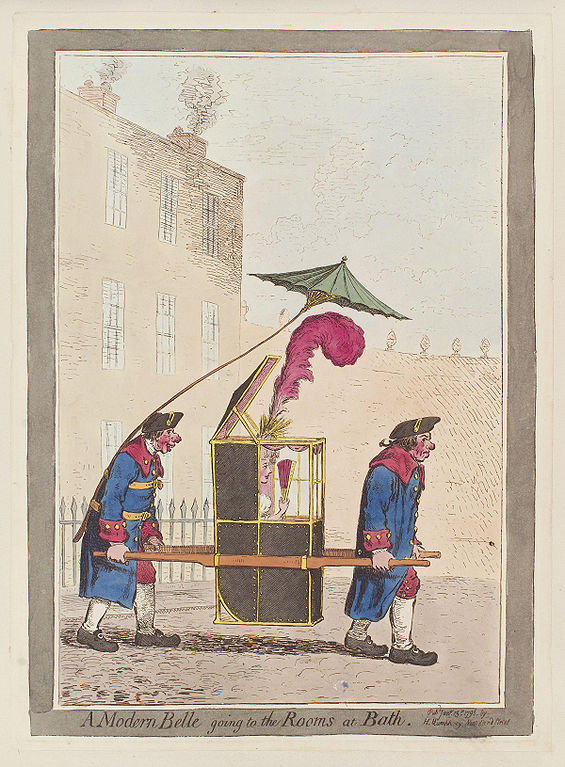
Sedan chairmen’s manners were considered by many customers to be insolent in public situations. The fashionable crowd often  considered them rude and grating. Cartoonists especially loved to capture these exchanges. Today we should not confuse these Georgian caricatures as objective or realistic observations. (Unfortunately, I could not find the many images in the public domain in Steve Pool’s presentation, except for this one.) 

A modern belle going to the Rooms at Bath-Gillray

A modern belle going to the rooms at Bath, James Gillray, 1796. Wikimedia Commons. The chairmen are drawn as rough, unhappy, and loutish. The belle is tender and refined. Notice the traditional Bath chairmen outfits.

Rules and regulations by the magistrates regarding the conduct of chairmen give us an insight into the difficulty they encountered in making a decent living. 

  1. Chairmen were required to apply for a license each winter to operate.
  2. Their clothes and combination of colors were strictly enforced. 
  3. Work began at 6 AM and lasted until midnight.
  4. The number of stands were enforced with the permits restricted for each site. If the maximum number of permits was reached, the chairmen would have to find another stand in another part of town.
  5. Only two places in Bath permitted an unregulated and unranked number of chairs: at the upper and lower assembly rooms, and occasionally “at the theater on play night or outside the Guildhall after an entertainment.” (Interestingly, the magistrates made sure that the stands connected the lower town with the newer uptown.)

Costs for licenses and stands were high for a 12-month period. In addition, complaints about the chairmen’s conduct were heard twice a week by the magistrates at lunchtime. Serious offenses included carrying customers without a license (40 shillings) to standing at a stand that was already full (10-20 shillings.)

When one considers that in 1739  chairmen charged only 1 shilling for any journey between 500 yards and a mile, and only 6 pence within city walls, and that this charge did not change for most of the century, one can understand why the chairmen began to object against the rigid, unchanging pricing system.

One other consideration is the customer’s behavior. Anstey, in his poeticals in The New Bath Guide 1780, described this incident in verse:

THIS Morning, dear Mother, as soon as ’twas light,

I was wak’d by a Noise that astonish’d me quite,
For in Tabitha’s Chamber I heard such a Clatter,
I could not conceive what the Deuce was the Matter:
And, would you believe it ? I went up and found her
In a Blanket, with two lusty Fellows around her
Who both seem’d a going to carry her off in
A little black Box just the Size of a Coffin;

Pray tell me, says I, what ye’re doing of there ?’
Why, Master, ’tis hard to be bilk’d of our Fare,
And so we were thrusting her into a Chair:
We don’t see no Reason for using us so,

For she bad us come hither, and now she Won’t go ;
We’ve earn’d all the Fare, for we both came and knock’d her
Up, as soon as ’twas light, by Advice of the Doctor:
And this is a Job that we often go a’ter
For Ladies that choose to go into the Water.”

Can anyone blame the chairmen for their gruff, forward, and insistent manners? The constant tugs of war among the magistrates, workers, and those of the Quality and rising middle classes who required their services, created many conflicts. The magistrates set down precise distances and costs, which were published in Bath Guides. When the city grew outside of traditional boundaries, the chairmens’ grievances for wanting an increase in fares for lengthier trips, and for the steep uphill treks to Landsdowne, north of the city, fell on deaf ears. 

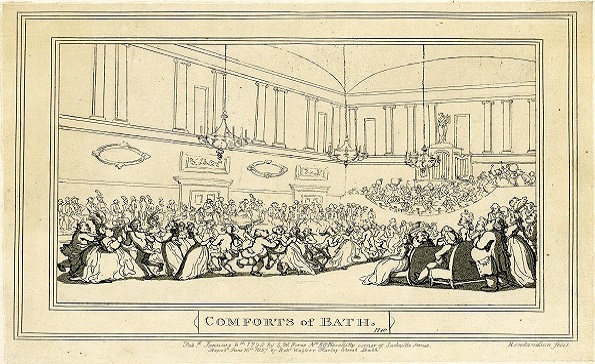
Comforts of Bath Rowlandson Met museum

Rowland, Comforts of Bath, Plate 12. Notice the bath chair on the left. This hill in front of the Royal Crescent, was a favorite setting for the caricaturist to show the challenges of the sick and aging in getting around Bath’s hilly terrain. Public Domain image. Met Museum.

Steve Pool’s discussion included the chairmen’s rebellion, in which they refused to pay for licenses or carrying anyone to their destinations. In 1794, the magistrates included a higher scale of charges. They ended the discussion by stating that “This sweeping industrial relations victory was made possible through democratic reform societies, Mason trades unionism, and a measure of the chairman’s collective industrial strength.”

As a contemporary listener, I compare today’s low wage workers, whose minimum wages have not changed for two decades, with the chairmen in Bath’s past. The Bath chairmen revolted; today’s minimum workers are revolting as well. History’s past has turned full circle and is still relevant today in terms of liberty and equality!

Only a few more days remain for readers to view the Bath 250 Virtual Conference (see link in the introduction), which, in the 5 workshops I’ve viewed, has been filled with new information. 

Sources:

Eighteenth-Century Poetry Archive: Anstey, Christopher, 1724-1805. The new Bath guide: or, memoirs of the B-r-d family. In a series of poetical epistles. [London]: Sold by J. Dodsley; J. Wilson & J. Fell; and J. Almon, London; W. Frederick, at Bath; W. Jackson, at Oxford; T. Fletcher & F. Hodson, at Cambridge; W. Smith, at Dublin; and the booksellers of Bristol, York, and Edinburgh, 1766

Bath: An Adumbration in Rhyme, by John Matthews. A Critical Edition for Readers of Jane Austen. Series Editor: Ben Wiebracht. A book review on Jane Austen’s World blog.

Thomas Rowlandson, Comforts of Bath, Plate 12, Publisher: S. W. Fores (London), January 6, 1798. Public Domain image, Met Museum.

Read Full Post »

Bath 250: A Virtual Conference to Mark The 250th Anniversary of the New Assembly Rooms at Bath – 29th & 30th September 2021

Rowlandson's black and white image of Bath's Ballroom

Streaming videos of all panels are now online for the next 2 wks, courtesy of @mbayliss90. They are:

 
Welcome & keynote from
 
 @Hannah_Greig : Having a Ball in Eighteenth Century England stream.liv.ac.uk/kmeb58mc
 
Panel 1: Assembly Rooms and Before; stream.liv.ac.uk/zunj9zrc Speakers: Cathryn Spence; David Hughes; Rupert Goulding
 
Panel 2; Polite & Impolite Bath; stream.liv.ac.uk/nfzd3vuf Speakers: Rachael Johnson, 

Panel 3; Women’s Experiences of Bath; stream.liv.ac.uk/g8mhfnyv Speakers: @CoffeeBookGirl, @Smudge2492, Mark Philp

Panel 4; Sociability, Celebrity & Politics; stream.liv.ac.uk/2wx54v8c Speakers: @ehchalus@GeorgianLords James Peate, Michael McMullen

Panel 5; Performance; stream.liv.ac.uk/fddhsqk4 Speakers: Ann Hinchcliffe, Matthew Spring, @BreeRob_Kirk Rhian Davies

Panel 6; Roundtable & Q&A Bath Assembly Rooms – The Next 250 years; stream.liv.ac.uk/23e8k8v8 Speakers: @OliverJWCox@OlivetteOtele, Tom Boden, @RegionalHistory

Panel 7; Day 2 Welcome; Bath town; stream.liv.ac.uk/28nxdrnn Speakers: Kevin Grieves, Amy Frost

Panel 8; Bath and Beyond; stream.liv.ac.uk/phncw99k Speakers: @SophieVasset Theophile Bonjour. @smellis_naylor#twitterstorians

Remember: These streaming videos are available for two weeks from the date of this post: 10/8/2021.

_______________________________________

Thank you, Prof Elaine Chalus and the University of Liverpool for posting these links on our Jane Austen and Her Regency World Facebook Group and making the links available to our followers.

In Addition:

In reference to Bath, I also refer you to our recent post by Dr. Ben Wiebracht about his online high school’s class work and publication on Bath: An Adumbration in Rhyme by John Matthews.

Read Full Post »

The Matthews Project

Introduction:

Inquiring readers,

The teacher who supervised the creation of this project, Ben John Wiebracht, contacted Vic Sanborn of Jane Austen’s World in the summer of 2020 to propose a research project his students would work on in the fall. After hearing the details, she instantly agreed to publish the finished result in a post, and to create a page for this blog to share with other teachers and students. (My apologies to Dr. Wiebracht for editing this document. I’ve placed quotations around his writing whenever I’ve made no changes.)

The project, entitled “A Day in Catherine Morland’s Bath,” was published on January 4, 2021. It is still attracting readers and is approaching 1,300 readers!

The Basics:

The teacher: 

Dr. Ben John Wiebracht, English teacher at Stanford Online High School, a private high school under the umbrella of Stanford University.

The class:

The class chose a senior-level elective called “Love Stories” which tracked the evolution of love stories from the classical era to the early nineteenth century. The final unit was on Northanger Abbey. (Virtual book, Little, Brown, and Company, 1903, Internet Archive). 

The students:

The article was researched, written, and designed by LiYuan Byrne, Josephine Chan, Ariana Desai, Carolyn Engargiola, Ava Giles, Macy Levin, Gage Miles, Sophia Romagnoli, Kate Snyder, Oscar Steinhardt, Lauren Stoneman, Alexandria Thomas, and Varsha Venkatram.

Image of the Adumbration class of 13 students and teacher Ben John Wiebracht.

The class and teacher.

The Article and its Inspiration (The What):

  1.  “A Day in Catherine Morland’s Bath.” (Posted January 4, 2021 in Jane Austen’s World.) As the title suggests, the goal of the article is to give the reader a sense of how Catherine Morland, heroine of Northanger Abbey, and tourists like her would have spent their time when they visited the city.
  2. The article was based on a long-forgotten Georgian poem that Dr. Wiebracht dug out of the archives over the summer: “Bath: An Adumbration in Rhyme” (1795), by the physician and poet John Matthews. 
    1. “The poem has a wealth of information on the amusements and absurdities of Bath, but it’s tough sledding for a modern reader, chock-full as it is of now-obscure allusions to Bath customs and institutions. Our job was to track them down.”
    2. “A fun example: Matthews mentions at one point a “priest” by the name of “King.” Eh? It turns out he’s referring to a fellow named James King, who wasn’t a priest at all but one of the city’s two “Masters of Ceremonies” – responsible for “presiding over social functions, welcoming newcomers, and enforcing an official code of regulations designed to preserve decorum and promote social interaction” (Gores, Psychosocial Spaces: Verbal and Visual Readings of British Culture, 1750-1820, p. 71). Matthews calls him a priest to poke fun at the city’s almost religious devotion to entertainment. And this same King plays a brief but important role in Northanger Abbey: he introduces Catherine and Henry. All of which is to say, paying close attention to Matthews can often lead to a fuller appreciation of Austen.”

Note from the Teacher: Searching for a Unique Contribution (The Why):

“The previous sentence begins to answer this question: we wanted to make a serious contribution to the study of Northanger Abbey

But let me speak as a teacher now, and not just a scholar. Over the years, I’ve grown increasingly uncomfortable with the standard way of teaching writing and research at the high-school level: the five-page essay. A thesis statement establishing the argument, some body paragraphs elaborating or demonstrating the argument, plenty of quotations and analysis – chances are you’ve written a couple in your day! In defense of the form, it does offer a space in which students can practice rhetorical and argumentative skills. My problem with the form is that it has no authentic audience, and the kids know it. Now I might pretend it has an audience by telling them, “imagine you’re writing for someone who is familiar with the text, but hasn’t studied it in depth.” Yeah right! In the history of the world, no one has ever thought: “I’m mildly interested in Northanger Abbey; now let me go find some five-page close-readings of it, but only ones with clear thesis statements and at least two quotes per paragraph.” Nope, the only audience for these essays is the teacher, and the teacher is bringing a very different attitude to the piece and making a very different set of judgments about it than the hypothetical “curious reader.” So the poor students have to pretend to be addressing one audience that for them does not exist, in order to please a very different audience. A recipe for stress – not to mention strained and awkward writing.

What if we changed the equation? What if there were ways to really give students an audience for their academic writing? If we could pull it off, I think it would send the message that the work we ask of students is meaningful and important – that the study of literature itself is important. That’s what the football coaches do, after all (the arch-rivals of us English teachers). How do they convince the kids that running into each other at high speeds is a meaningful, important endeavor? They stick them in a stadium where a bunch of people watch them do it, and it becomes immediately, empirically obvious to the students that football matters. In short, they give the kids an audience.

These were the considerations that prompted me to devise the Matthews project and to reach out to Vic about potentially publishing it on JAW – a forum with a thriving conversation about Austen. And this leads to the practical section of this page.”

Working with Your Students (The How):

If you’re interested in running a project like this with your kids, here are some tips to make it work.

  1. Canon-adjacent may be better than canon. What does that mean? It means that if you’re teaching Pride and Prejudice, it’s going to be tough for your students to break new ground simply by scrutinizing that text. But, if you can find some neglected texts whose study might shed light on Pride and Prejudice, then the picture changes. What about some of her juvenilia? What about Fordyce’s Sermons to Young Women, which found an appreciative reader in Mr. Collins? What about some Georgian satire making fun of pompous clergymen? This is something to do over the summer, when you’re planning the class, and it might take some digging: the text has to be obscure enough that it isn’t already saturated with criticism, but relevant enough to your main text that there are readers out there who might care about it. “Bath: An Adumbration in Rhyme” fit the bill: almost untouched by scholarship, but with clear connections to Northanger Abbey.
  2. Line up your venue in advance. This is key: you want the kids to know who their audience is from the beginning. Are you going to create an exhibit for a local public library? Will you try to get something published on a blog? Will you self-publish the students’ work on Amazon or some such service? Whatever the case, the students, like all writers, will do better work if they have a clear idea of whom they are addressing, and in what form. 
  3. Make sure students’ research tasks are well-defined. In our case, that meant combing through the poem, asking questions about various lines. Who are Tyson and King? What is a “macaroni”? Then students volunteered to tackle a certain number of research questions in groups. As a teacher, one of your roles is to be the executive planner, making sure there is the right number of students working on the right things.
  4. Offer continuous feedback. My students turned up all kinds of fascinating stuff in the course of their research, but of course they embarked on some rabbit trails as well. In order to help them make the most of their efforts, it’s a good idea to keep track of what students are doing while they’re doing it, rather than waiting to assess their work at the end. How can you do this? By creating a single google doc to which everybody contributes. Ours had a list of research questions, and I would simply check in every few days to see what students had added. Then I would leave comments offering encouragement, advice, and, if necessary, redirection. 
  5. Dive in yourself. Don’t be afraid to roll up your sleeves and do a bit of writing and research of your own. Remember that your students are still learning the ropes of our discipline. If you want to produce a publishable class project, you’ll probably have to do more than simply split up duties and set deadlines. You’ll have to integrate and harmonize the students’ efforts, and fill in some of the gaps yourself. It can change the classroom dynamic in a refreshing way, too, to join in the action. It’s a bit like the old master-apprentice relationship, according to which teaching is a matter of showing, doing, and collaborating, not just telling or advising.
  6. Don’t grade. Or, if you must, do it on completion alone. A grade is what you give to practice scholarship, to performative scholarship – the five-page essay and other such readerless forms. The point of the project I’m describing is to allow students to do some real work. And a particularly good way to make it real is to remove yourself, the teacher, as the audience. For the purpose of this project, you’re the opposite of an audience, you’re a co-author, and the real audience is what all good writing deserves: an interested public.

Sub pages:

Link to “Bath: An Adumbration in Rhyme, 1795,” John Matthews

Plans for Going Forward: 

Our class ended last December, but currently about half the students and I are working on a new project: a scholarly edition of “Bath: An Adumbration in Rhyme,” complete with an introduction and notes. We’ll be publishing it with Kindle Direct, an Amazon service. Digital copies of the edition will be available to the public at no cost, and hardcopies for under ten dollars.

In the long term, I hope to start a book series to which successive classes can contribute. It might be called something like “Forgotten Contemporaries of Jane Austen.” The goal of the series would be to recover Georgian and Regency writers whose work has fallen out of print, but whose study can shed fresh light on Austen’s life and work. As with the Matthews project, the students and I would work together to introduce and annotate these texts. We would also share the nitty-gritty tasks of publication — obtaining an ISBN, formatting, that sort of thing.

Jane Austen’s World’s Participation in the Project and Two Powerpoint Presentations: Tony Grant and Victoire Sanborn

About the PowerPoints:  

For a visit to Bath and a visual background, Dr. Wiebracht scheduled two workshops, one for Tony Grant, who lives in England and has served as a tour guide to visitors interested in learning more about the places where Jane Austen lived or visited. His PowerPoint and talk were given first, and should be viewed first for those who are interested.

Vic Sanborn’s presentation came the following month. She, too, had visited Bath and used a few of her own photographs, but mostly she concentrated on discussing the years of 1795-98, when Matthews wrote the Adumbration and when Thomas Rowlandson created his illustrations for “The Comforts of Bath.” Tony’s PowerPoint sets up Vic’s perfectly, for her notes are not in the PPT slides. Enjoy!

  • Link to Tony Grant’s PowerPoint Presentation on a Virtual Tour of Bath, given October 2020. This PPT, consisting of Tony’s photographs of his trips to Bath as both a visitor and a guide, comes with descriptions and annotations. If you use his photographs, please give him attribution.
  • Link to Vic Sanborn’s PowerPoint Presentation of Bath 1795, the year the Adumbration was written. The PPT is without explanatory text or the presenter’s voice. A majority of the images are from Thomas Rowlandson’s Prints of “The Comforts of Bath” from 1798. The images, on Wikipedia and the Metropolitan Museum of Art are in the public domain. If Vic Sanborn’s photos are used, please give her attribution. 

Read Full Post »

« Newer Posts - Older Posts »