Feeds:
Posts
Comments

Archive for the ‘Book review’ Category

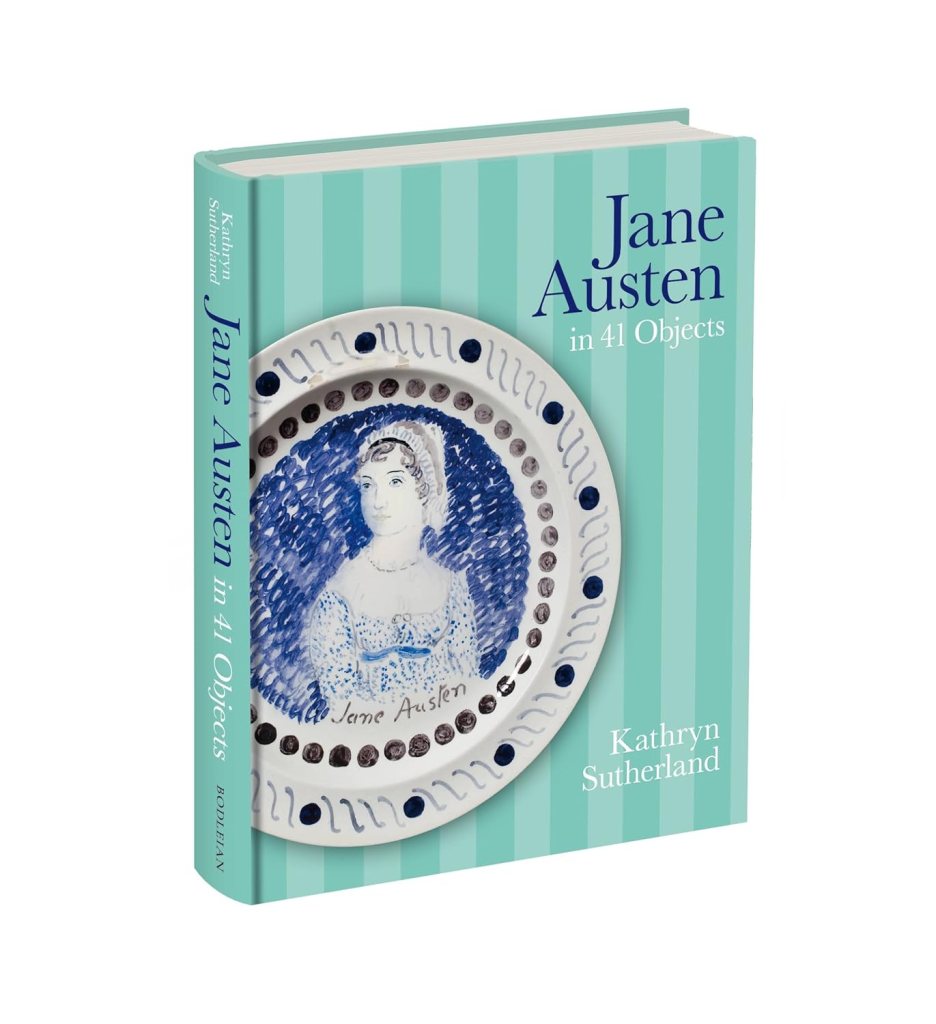
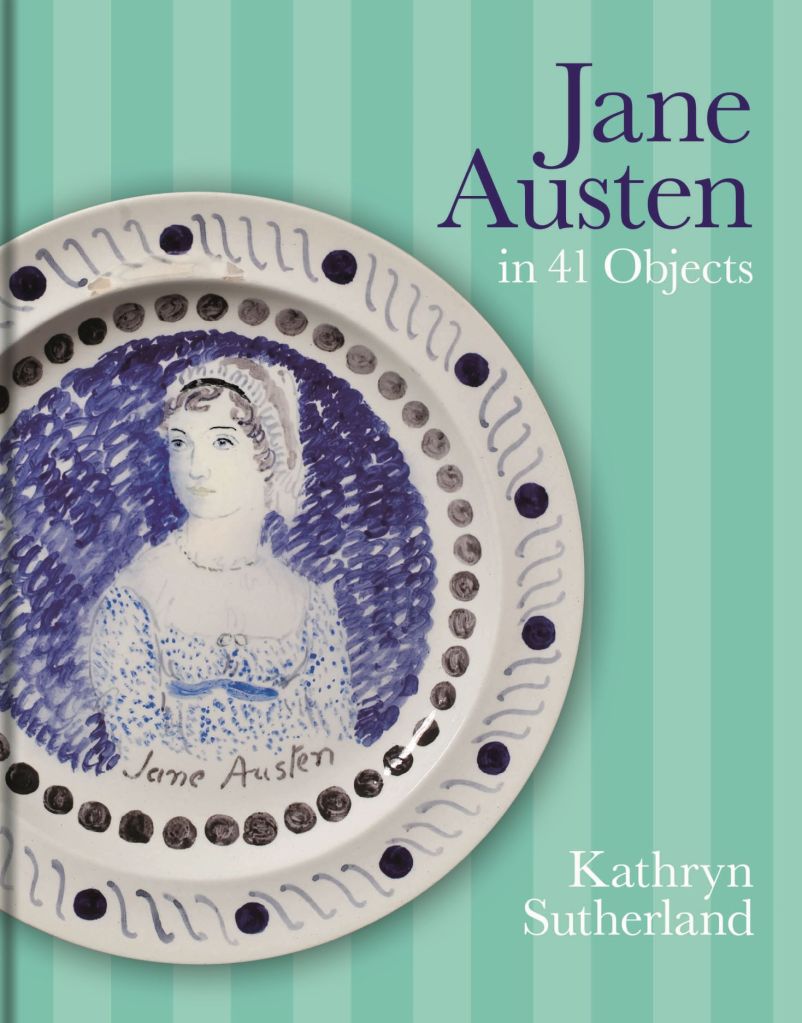
As we continue our tour of new books and media for Jane Austen’s 250th anniversary celebration, my choice this month is the much-anticipated Jane Austen in 41 Objects by Kathryn Sutherland. This extensive new “biography” features the beloved 41 Objects from the Jane Austen Museum, along with beautiful photographs and in-depth information about each item in the collection.

“Jane Austen’s House holds an unparalleled collection of objects relating to Jane Austen’s life and works, her family circle and her legacy. Here you can see some of the treasures of the collection, ranging from books and letters to pieces of furniture, clothing and paintings. Many of these objects can be seen in the House . . .” (Jane Austen’s House)
Book Review

For those who have had the opportunity to visit Jane Austen’s House Museum, many can attest that it’s hard to take everything in during a tour of the house. This book provides a closer look at each object in greater details. I was quite intrigued by the items and information I had missed during my visits over the years and from my searches online. For those who have not yet visited JAHM, this is the perfect book for your shelves! It gives Jane Austen fans a wonderful glimpse into the collection of objects often on display there, collecting them all in on place.

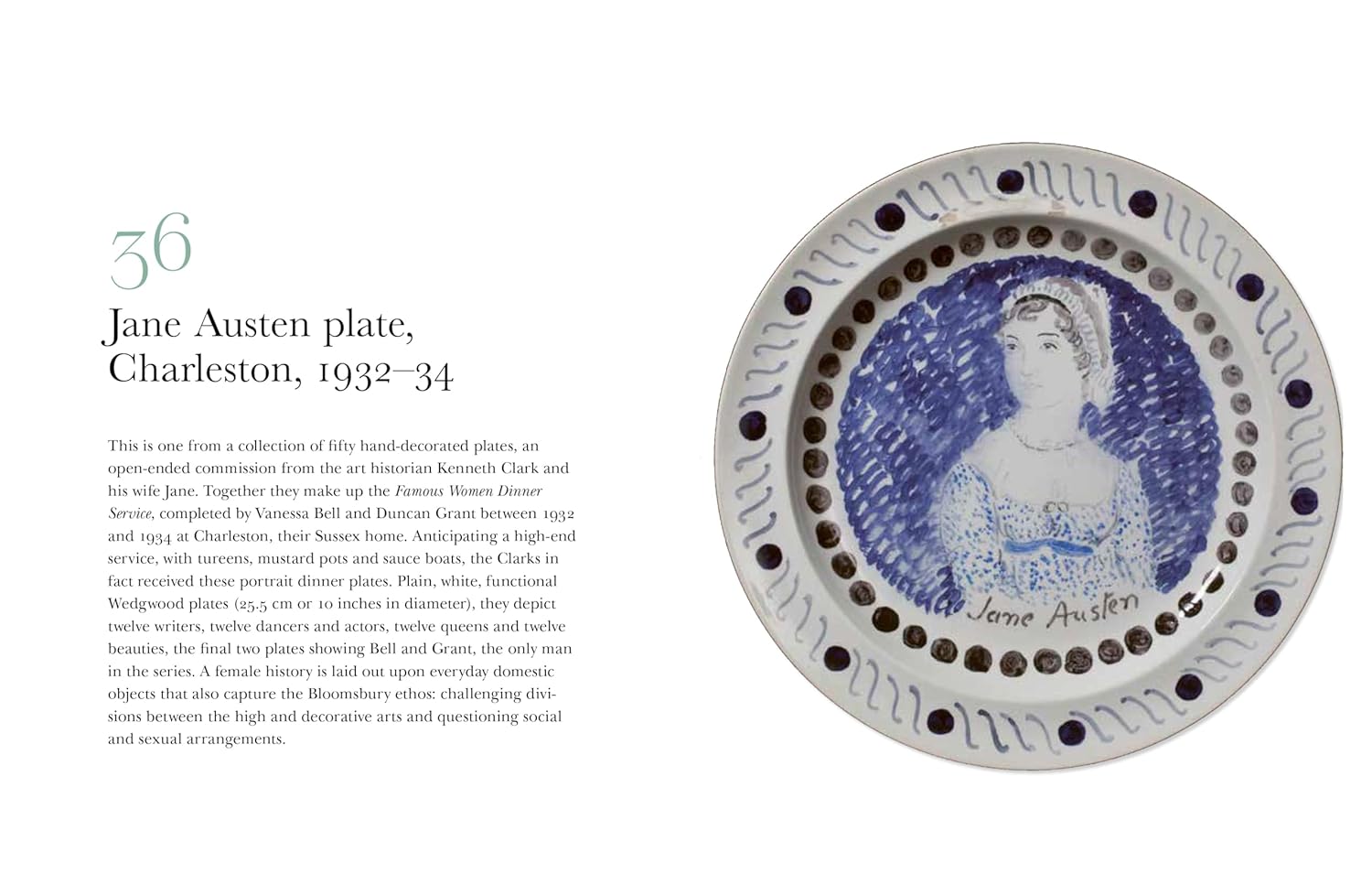
This book provides the perfect “virtual tour” because there’s so much more in the book than you can find online or in person. This book is also much more thorough in its explanation of and historic information about each of the 41 objects than anything I have seen. For instance, reading about the Jane Austen plate was brand-new to me.

What’s more, I believe that this book provides information about objects that may not currently be on view at the museum. I don’t think all 41 objects are always available to the public in one place. If memory serves, some objects move here and there to other exhibits, so again, seeing it all in one place is quite impressive and educational.
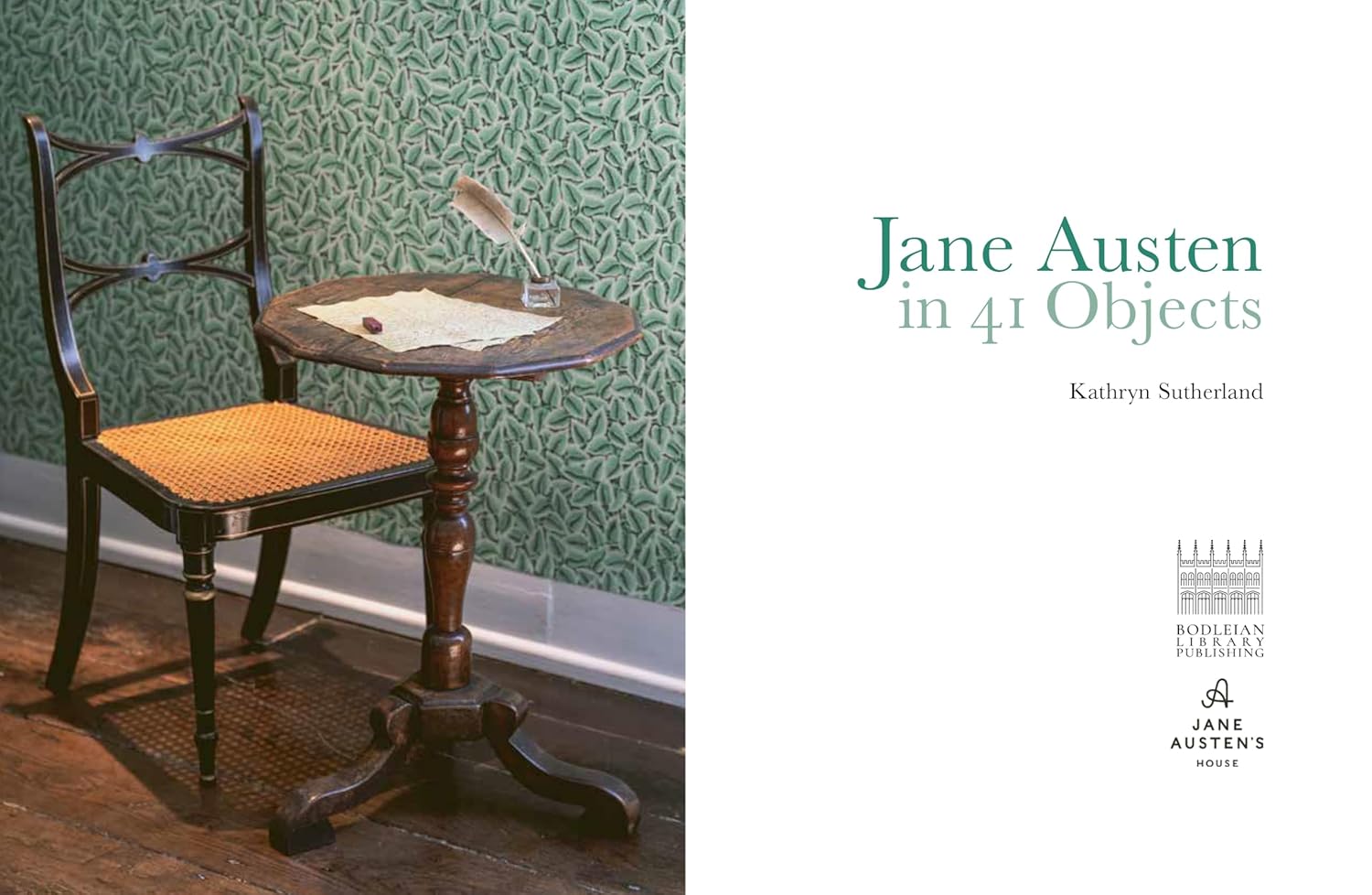
Jane Ausen’s Writing Desk

Book Description

Jane Austen in 41 Objects by Kathryn Sutherland is a new kind of biography on Jane Austen examining the objects she encountered during her life alongside newer memorabilia inspired by the life she lived.

More than two hundred years after Jane Austen’s death at the age of just forty-one, we are still looking for clues about this extraordinary writer’s life. What might we learn if we take a glimpse inside the biographies of objects that crossed her path in life and afterward: things that she cherished or cast aside, that furnished the world in which she moved, or that have themselves been inspired by her legacy?

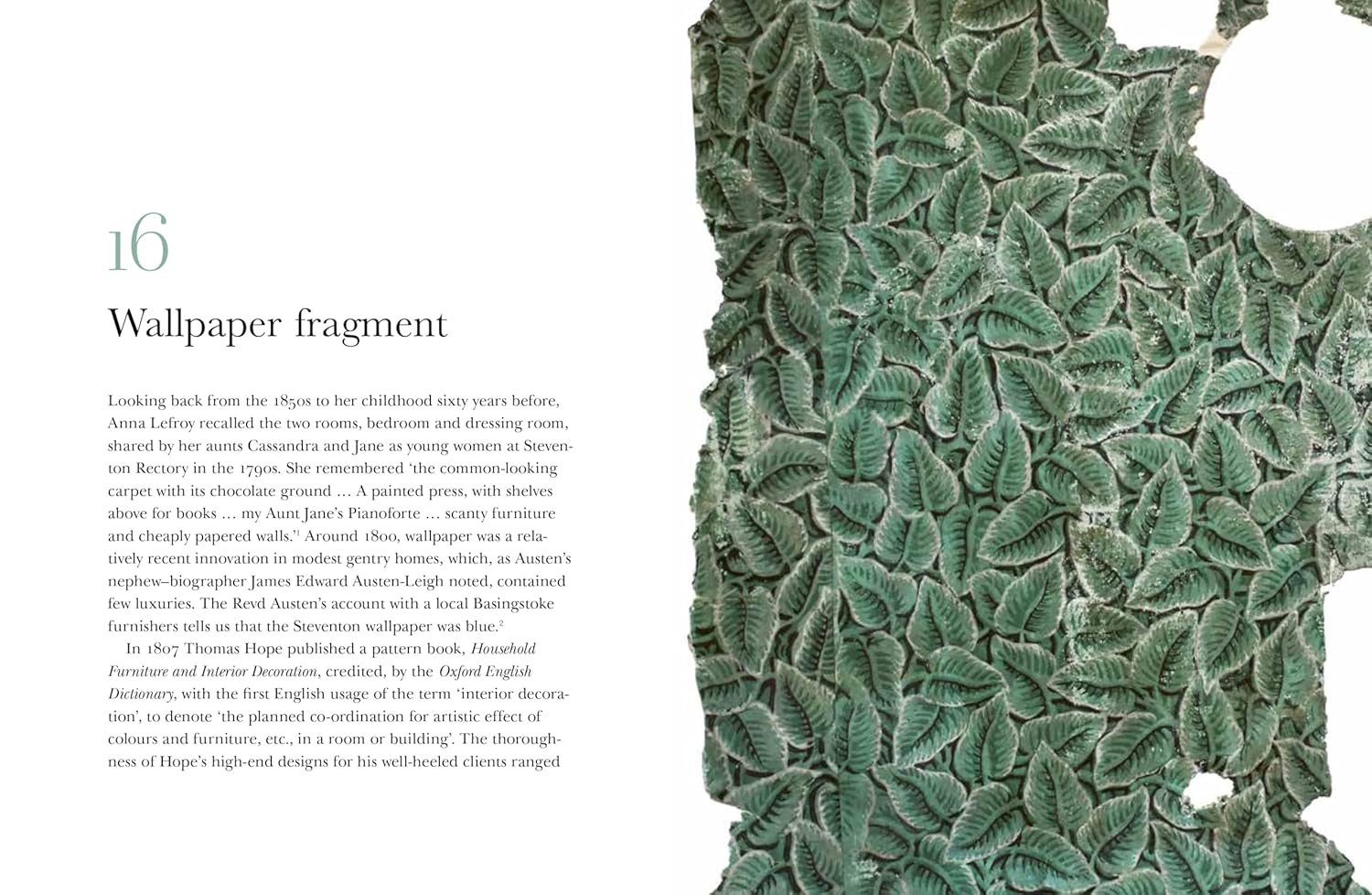
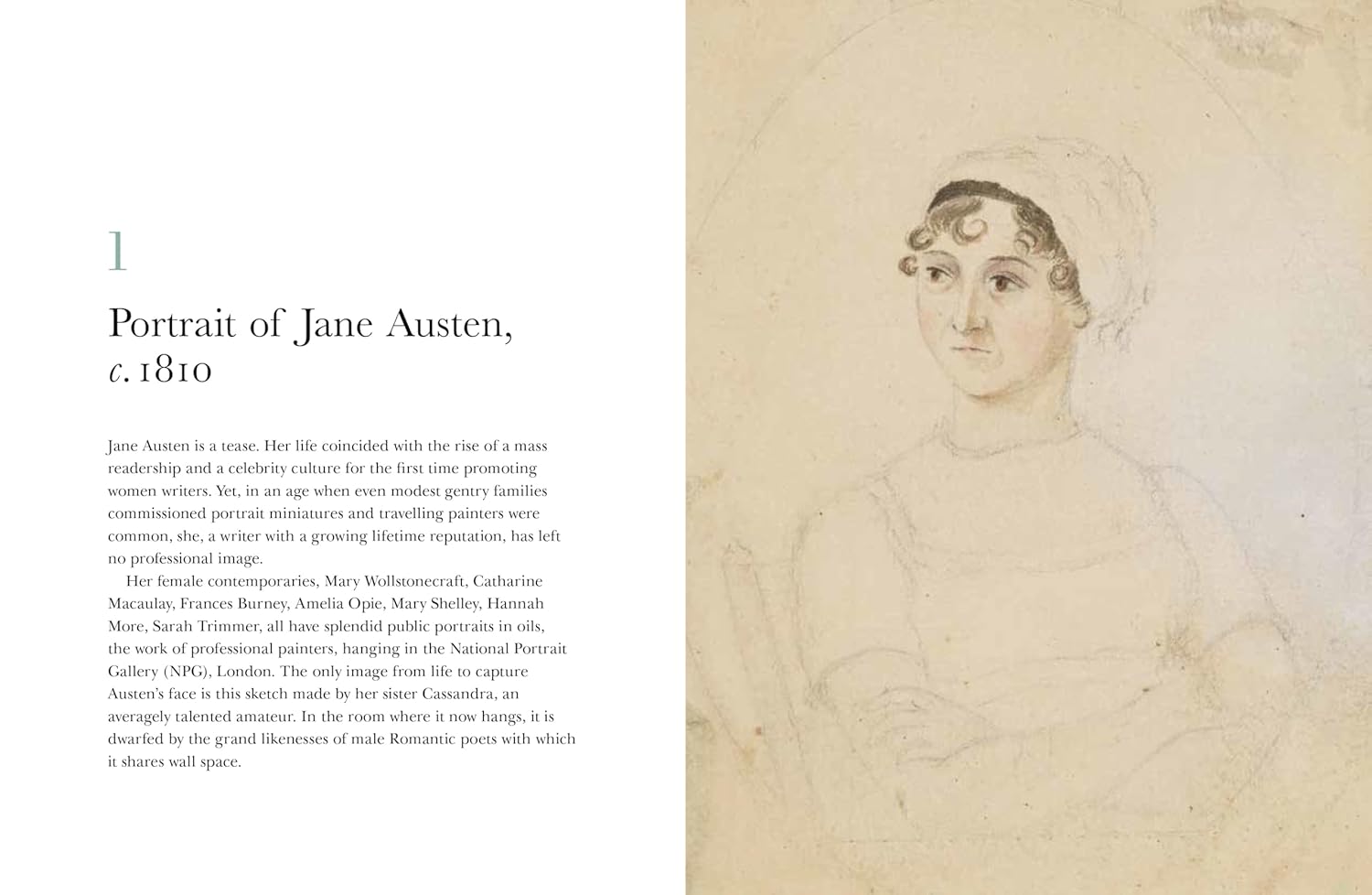
Among objects described in this book are a teenage notebook, a muslin shawl, a wallpaper fragment, a tea caddy, the theatrical poster for a play she attended, and the dining-room grate at Chawton Cottage where she lived. Poignantly, the last manuscript page of her unfinished novel and a lock of hair, kept by her devoted sister, Cassandra, are also featured. Objects contributing to Austen’s rich cultural legacy include a dinner plate decorated by Bloomsbury artists Vanessa Bell and Duncan Grant, Grayson Perry’s commemorative pot from 2009, and even Mr Darcy’s wet shirt, worn by Colin Firth in the 1995 BBC adaptation.

This is a different kind of biography, in which objects with their own histories offer shifting entry points into Jane Austen’s life. Each object, illustrated in color, invites us to meet Austen at a particular moment when her life intersects with theirs, speaking eloquently of past lives and shedding new light on one of our best-loved authors.

Featured Objects

Sutherland provides a tour of all 41 objects with photographs and information about each one. This truly does gives the reader more time to examine and take a thorough look at each object. Though one could find many of these objects online, it’s much easier to study them in a book format.
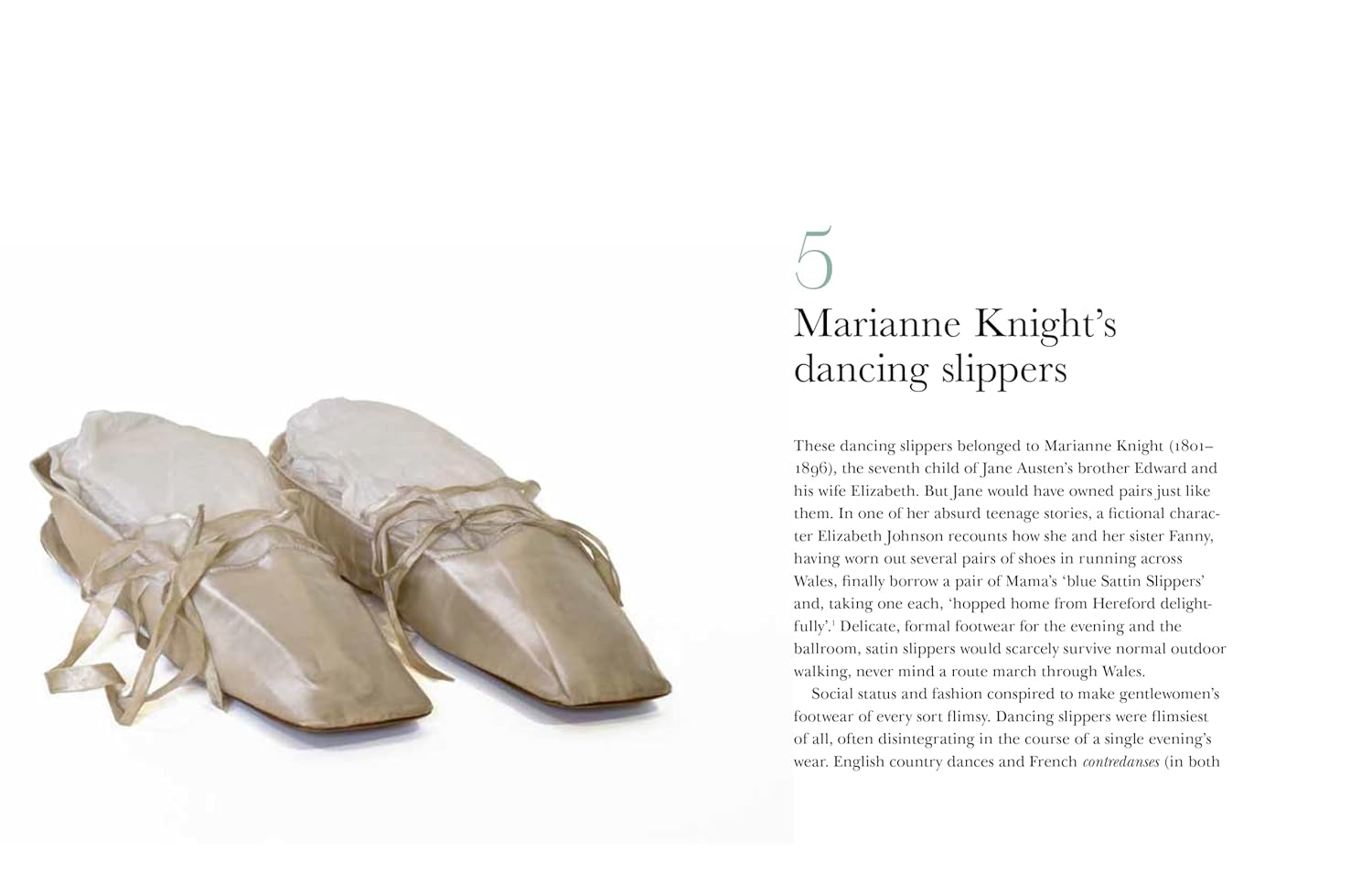
Marianne Knight’s Dancing Slippers

About the Author

Kathryn Sutherland is a trustee of Jane Austen’s House and Professor of English and Senior Research Fellow, St. Anne’s College, Oxford. Her publications include Jane Austen’s Textual Lives: from Aeschylus to Bollywood (2005), the online edition of Jane Austen’s Fiction Manuscripts (2010), and Jane Austen’s Fiction Manuscripts (5 vols, 2018). Other edited works include: James Edward Austen-Leigh, A Memoir of Jane Austen and Other Family Recollections (2002) and Jane Austen, Teenage Writings (2017).

During the 200th anniversary year of Austen’s death, she curated two major exhibitions: “The Mysterious Miss Austen,” in Winchester, Hampshire, and “Which Jane Austen?” at the Bodleian Library, Oxford. She wrote essays for and edited the accompanying exhibition book, Jane Austen: Writer in the World (2017).
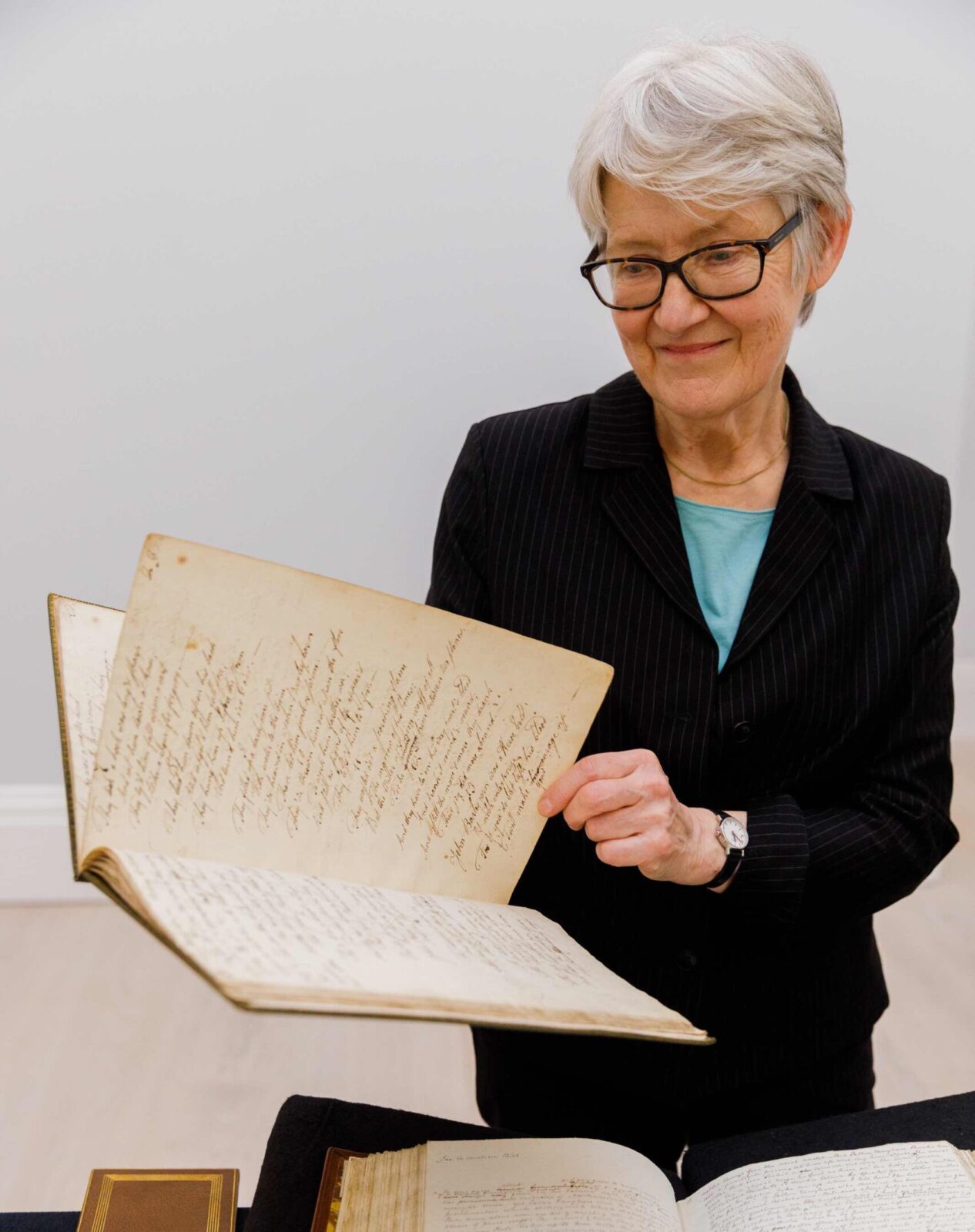
Celebrating 250 Years

This collection is another wonderful product of the 250th anniversary of Jane Austen’s birth and the celebrations happening worldwide all year long. I’m thankful that Kathryn Sutherland, Jane Austen’s House, and Bodleian Library Publishing, Oxford made it possible for Jane Austen fans to have access to these artifacts in book form. If you really want to “geek out,” this is the book for you!

RACHEL DODGE teaches writing classes, speaks at libraries, teas, and conferences, and writes for Jane Austen’s World blog. She is the bestselling, award-winning author of The Anne of Green Gables DevotionalThe Little Women DevotionalThe Secret Garden Devotional, and Praying with Jane: 31 Days Through the Prayers of Jane Austen. A true kindred spirit at heart, Rachel loves books, bonnets, and ballgowns. Visit her online at www.RachelDodge.com.

Read Full Post »

Dear Reader: Two hundred and fifty years ago marked two significant events across two continents – Jane Austen’s birth in Steventon, England, December 16, 1775, and the start of the fight for independence by American colonists in Lexington and Concord on April 19th from Great Britain. And so Jenner’s book, set in GB and the American Colonies comes at a propitious time. The novel’s plot is set in 1865, 48 years after Jane Austen’s death, and just after the Civil War in America ends and followed by the news of Abraham Lincoln’s death, and And so the timing of this novel is timed brilliantly – in honor of the 250th anniversary –  J Austen’s birth and America’s fight for independence from Great Britain.

For this discussion about Natalie Jenner’s latest novel, I listened to an audio version of a book that spans over 300 pages and that the listener takes from 11-12 hours to complete. The author’s complex plot provides numerous characters, and their movements across two nations, often with historical minutia thrown in. One set back as a listener is that, unlike a novel in which one can quickly flip back and forth to check on a detail, an audio book forces one to rewind. Being ham handed, I often missed the stop I needed.

The good news is that once the introductions of the characters are over and the plot truly gets going, it’s hard to stop listening, especially sections 2 and 3. To help listeners keep track of the characters and their settings,, I’ve listed the four main divisions in the novel. They are:

1) Boston: In which the main characters are introduced. (a,b, & c) Sisters Charlotte and Henrietta Stevenson are the spinster daughters of Massachusetts Supreme Court Justice William Stevenson; (d) Constance Davenish is a Boston socialite and suffragette, (e) Thomas Nash, is also a Massachusetts Supreme Court Justice and Justice Stevenson’s friend, and (f) Denham Scott is a mysterious reporter from Great Britain (GB). All these characters, in one way or another, have a keen interest in Jane Austen’s work.

Although he lived in Portsmouth, GB, Sir Admiral Francis Austen, Jane Austen’s brother and the last surviving Austen sibling, is included in this section. Jenner weaves his presence throughout the novel, for he is the engine that propels the plot forward in every section of the novel. 

Also included in this introductory section are the Nelson brothers, Nicholas and Hazlett, who are both Civil War veterans. After the war ends, the bachelor brothers work in Philadelphia as rare book dealers. Philadelphian heiress, Sara-Beth Gleason, daughter of a Pennsylvania state senator, frequently visits the rare book shop, for she has her mind set on one of the Nelson brothers.

In this introductory section, Jenner narrates the details of the characters, their settings, and their connections to each other and their knowledge of J Austen. We know their background mainly through the narrator’s voice, but occasionally  get brief glimpses of their personalities through their letters, particularly between Sir Francis and the Stevenson sisters, as well as his correspondence with the Nelson brothers. Within these letters and the characters’ reactions to them, the plot of the novel unfurls in a more personal way.

2) The Sea. In the second section of the novel, the reader meets  Louisa May Alcott on board the S.S China, a ​​transatlantic mail packet steamer headed from Boston to Portsmouth. Traveling on board are the Stevenson sisters, journalist Denham Scott, the Nelson brothers, Justice Thomas Nash, and Sara-Beth Gleason, who has followed the brothers to England. Remaining in Boston are Justice Stevenson and Constance Davenport. 

By this time, Jenner has largely left narrative exposition in favor of having her characters discuss their thoughts and/or allow the reader to get into their minds via free indirect discourse, the writing method J Austen used inventively in her novels. FID allows Jenner to jump back and forth as the third person narrator as well as enter her characters’ minds. 

The journey on board the S.S. China is lively. Alcott, a spinster, author, and woman’s rights activist bonds with both the women and the men. On board the ship, the passengers find/discuss their common admiration for Jane Austen and her writings. After her death, and as the 19th century progressed, Austen’s reputation had spread to the U.S, whose growing popularity Jenner includes in detail. 

3) Hampshire. The third section of this novel is, frankly, my favorite part of the book. Various threads of  the major plots coalesce and intertwine, in particular, those of Admiral Francis Austen, the Stevenson sisters, and the Nelson brothers. Jenner takes us to Portsmouth Lodge, the admiral’s house, which rises on a point above the harbor. From his perch, Sir Francis looks out to the English Channel with a maritime telescope, watching the ships come and go in the harbor and the activities on the docks. Charlotte and Henrietta Stevenson and Nicholas and Hazlett Nelson visit Sir Frances, who shares important information with them. The group journeys to Chawton House and Chawton Cottage, and follow the paths and roads that J Austen has traveled. In addition, between the group’s conversations with the Admiral and their expanded knowledge of the author from his first-hand accounts, Jenner fully fleshes out the details of her life. Austen has become a living, breathing person in their and our minds.

This section has many twists and turns that lead to a mystery the Admiral holds close to the vest. He also keeps certain plans a secret. These mysteries play an important part in keeping me interested in finding out what they are.


4) The Court. This section, for me, was a let down. Instead of reaching a satisfactory ending that ties loose ends, new twists are introduced. My mind became confused, for I wondered about the reasons for adding additional threads so late in the novel. Of the reviews I read, however, over 90% of the reviewers were satisfied with the ending and praised the novel, giving it from four to five stars. I found only one review in which the reviewer felt that the book was chugging along nicely, until he reached the last section, when he stopped reading because of the muddling of the plot. 

I kept listening until the end, but felt like I had experienced a number of different endings. I thought, much like the endings in the film, ‘Return of the King’, in which the audience sat through Aragorn’s coronation, Sam’s return to the Shire, and Frodo’s departure by ship to the Grey Havens with the Elves, ‘enough is enough.’.

And so I have mixed feelings writing this review, since I like the author’s writing style and her remarkable research. Plus, listening to a novel that is over 300 pages long and has a quite complicated plot that contains numerous characters who live in and travel to different locations can be quite confusing. I’ll eventually read the novel, and am sure that  going at my own pace while leafing through the pages will provide a better ‘reading’ experience.

Links

Read Full Post »

A Book Review by Brenda S. Cox

“Marianne’s ‘excess of sensibility’ almost destroys her reputation, her health and her happiness, wihle Elinor’s more guarded behaviour is rewarded. But that is fiction; what of real life?”—Prologue to Jane and Dorothy, by Marian Veevers

Jane and Dorothy: A True Tale of Sense and Sensibility, The Lives of Jane Austen and Dorothy Wordsworth, by Marian Veevers. The lovely cover attracted my attention as I perused a library book table focused on Jane Austen.

I had read a review of this book some time ago and suggested it to a literary friend, who said there was no connection between Jane Austen and Dorothy Wordsworth, sister of poet William Wordsworth. But I decided to check out the book and find out how the author connects them. I’m glad I did, as it was a fascinating read.

Jane and Dorothy, by Marian Veevers, explores two parallel lives, Jane Austen’s and Dorothy Wordsworth’s. Veevers works for the Wordsworth Trust.

Jane Austen and Dorothy Wordsworth

Jane and Dorothy follows the lives of two women, living at approximately the same time, who never met. Parallel, never intersecting, similar in some ways and contrasting in others. Connections with Austen’s novels are intertwined in their stories. Jane (1775-1817) is compared to Elinor Dashwood, with strong feelings controlled by reason and religion. Dorothy (1771-1855) is more like Marianne, focusing on her emotions. In one teenage letter to a friend who was sympathizing with her misery, Dorothy wrote, “You cannot think how I like the idea of being called poor Dorothy . . . I could cry whenever I think of it.”

Both were writers. Jane Austen, of course, had four novels published during her lifetime, two more shortly after her death, and her Juvenilia and letters published years later.

Dorothy Wordsworth wrote journals, mostly about her ramblings in nature with her brother, who became a famous poet of Romanticism.  William Wordsworth used his sister’s journals as inspiration and a source of details for his poetry. His discussions and experiences with her also inspired him. A few of Dorothy’s own poems were published during her lifetime, but her journals and her travel narrative of a trip to Scotland were only published after her death.

Both Jane and Dorothy were dependent on their brothers later in their lives. Austen and her mother and sister were financially supported by her brothers after her father’s death, and her brother Edward provided Chawton Cottage where she wrote and rewrote her novels.

Dorothy lost her parents early in life and lived with various relatives as a poor relation, similar to Austen’s Fanny Price, until she threw in her lot with her brother William. Dorothy loved William passionately. (The author discusses rumors of sexual involvement and concludes that the rumors were false.) Dorothy devoted the rest of her life to her brother and, eventually, to his wife and children. Their financial situation was much harder than the Austens’, but they survived.

It was interesting to see the similar social and financial restrictions that society placed on both Jane and Dorothy, particularly as unmarried women, and to see how Jane’s life might have played out differently in other circumstances.

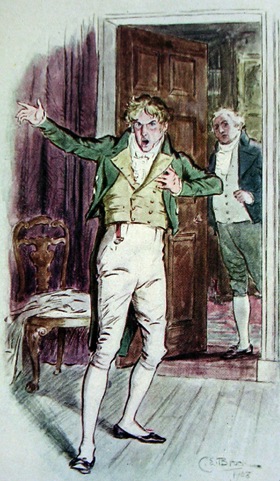
Yates ranting in Mansfield Park. Did Austen love home theatricals, or hate them? Or did she simply see their dangers?
C.E. Brock, public domain.

Austen and Drama

Having read so much about Jane Austen, I wasn’t expecting new insights into her life from this book. However, I found several. I’ll give just one example, from pages 47-50 of Jane and Dorothy.

Veevers discusses Austen’s attitude toward amateur home theatricals in Mansfield Park. Many have commented on the fact that Austen’s family performed such plays when she was growing up, and that she couldn’t really have thought they were wrong. Perhaps it was just the specific circumstances at Mansfield Park that made it wrong, or her attitude had changed due to the growing Evangelical disapproval of drama, or she was attributing disapproval to Fanny and Edmund.

However, Veevers speculates that, first, Jane may not have participated herself in those plays when she was growing up. She says the only evidence we have for that is Jane’s cousin, Phylly Walters, who wrote that “all the young folks” were participating in a performance in 1787—that is rather vague. Or Jane may have participated without enjoying it.

While Austen’s family approved of amateur theatricals, we don’t have to assume that she herself agreed. Instead, those experiences of plays in the Steventon barn may have shown Jane “the dark underbelly” of such practices. Veevers says any “modern-day member of an amateur dramatics company” would recognize these issues. She continues,

“Jane Austen gives an unflinching insider’s view of everything that is worst about amateur acting, from the concealed, but overwhelming self-interest of Julia and Maria Bertram who each hope to have the best part in the play ‘pressed on her by the rest,’ to the self-indulgent over-rehearsal of favourite scenes by some actors, and the insidious, self-gratifying criticisms of others’ performances—‘Mr Yates was in general thought to rant dreadfully . . . Mr Yates was disappointed in Henry Crawford . . .’” etc., etc. “There can be no doubt that this detailed understanding . . . came from real observation. It would seem that brother James’s annual productions in the Steventon barn were riven by jealousy, bad-feeling and unkindness.”—Jane and Dorothy, p. 49

Veevers goes on to speculate that Jane’s opinions may have been influenced by her dear friend Anne Lefroy. Mrs. Lefroy was a clergyman’s wife who apparently disapproved of amateur theatricals, politely declining to participate when a friend invited her. (Also, I would add, it appears those Steventon theatricals were an opportunity for flirtation between Jane’s still-married cousin Eliza and two of her brothers, so perhaps Henry Crawford and Maria Bertram’s fictitious flirtation also had a basis in past experience.)

I don’t think I personally agree with the idea that Austen disapproved of such theatricals, though. Austen certainly enjoyed the professional theatre, “good hardened real acting,” as Edmund Bertram called it, distinguishing that from amateur performances. Austen did, though, write several short, comic plays as a teenager, which may have been acted by her family. On a visit to Godmersham, she and Cassandra acted—most likely by reading aloud— a couple of plays with their nieces and nephews. (The Spoilt Child and Innocence Rewarded, according to Fanny Knight’s diary). Of course, that would have been on a much more limited scale than the play at Mansfield Park, with presumably less objectionable plays.

Whether Austen objected to amateur dramatics in general is questionable, but certainly she had seen enough to very realistically show the pitfalls of such productions in Mansfield Park. So I appreciated this insight from Jane and Dorothy.

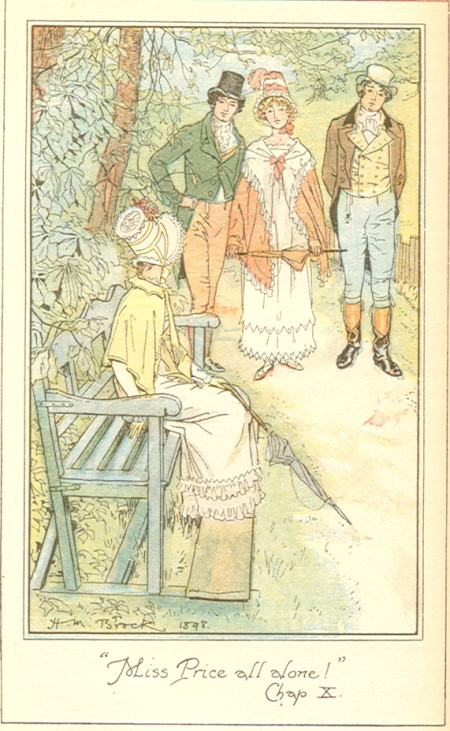
Fanny Price loves nature, like both Jane Austen and Dorothy Wordsworth. Both Jane and Dorothy, like Fanny, experienced being marginalized by wealthier relatives.
H.M. Brock, public domain.

Spinsterhood

The book extensively explores attitudes toward “old maids” in Austen’s society. It’s easy to forget that Austen herself probably experienced prejudices against unmarried women. She certainly sometimes felt herself a poor relation at her wealthy brother’s Godmersham estate. She often lacked autonomy: her living situations and travels were dictated by her parents or brothers. Perhaps those feelings helped her create Fanny Price, dependent and marginalized.

Jane and Dorothy points out many illuminating parallels between Sense and Sensibility and Mansfield Park. Fanny is much like Marianne, with strong feelings. However Austen, when she was a more mature writer, made Fanny spiritually stronger, more nuanced, and with greater depth.

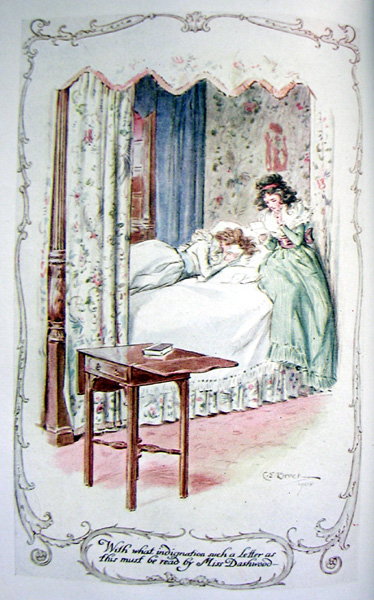
Marianne Dashwood gives way to her feelings and nearly dies. Fanny Price turns to religion and reason to keep her feelings under control, as Marianne determines to do at the end of Sense and Sensibility.
C.E. Brock, public domain.

End of Life

Dorothy lived much longer than Jane. Sadly, though, Dorothy’s last twenty years were spent with “her mind completely broken.” She had given her life to taking care of her family; that same family gave her loving care for those long years. It’s been speculated that she may have had some kind of dementia, or possibly severe depression. (She suffered, in fact, similarly to William Cowper in his final years. Cowper’s poetry, by the way, impacted both women.)

Of course we all wish that Jane had lived longer and written more. However, thinking of the many ways a spinster (like Miss Bates, for example, or Dorothy Wordsworth) might end up in Austen’s world, perhaps Jane’s earlier demise from an unknown disease was not the worst possible ending for her. The recent book and series Miss Austen also imagines long-lived Cassandra suffering late in her life.

As Veevers concludes,

“Jane and Dorothy were two unmarried, childless women who had failed to fulfil the destiny that their society prescribed for their sex. But they neither drooped nor withered as [1838 writer] Carlisle expected, nor developed the chagrin and peevishness which Dr. Gregory [1774] believed inseparable from their condition. Instead they forged their own meanings from their lives. . . . Jane and Dorothy were not simply products of their time. They made choices in their lives, and it was those choices which defined them.”

I found it fascinating to trace the choices of these two parallel lives, and the resulting joys and sorrows, during the same time in history. Well-written, easy to read, and compelling, Jane and Dorothy  is worth reading for anyone who wants to get deeper into “Jane Austen’s World.”


Brenda S. Cox is the author of Fashionable Goodness: Christianity in Jane Austen’s England. She also blogs at Faith, Science, Joy, and Jane Austen.

Read Full Post »

Many Austen fans enjoy viewing various early editions of Pride and Prejudice – and many of us are familiar with the famous “Peacock” edition. I recently had the opportunity to hold and examine a very early “Peacock” edition in my very own hands. (It was beautiful!!! I may have squealed in my head.)

During this 250th celebration year of Austen’s delightful works, I thought a little trip down “Peacock Lane” might be in order! This beautiful edition has a rich history and has contributed to Austen’s lasting legacy.

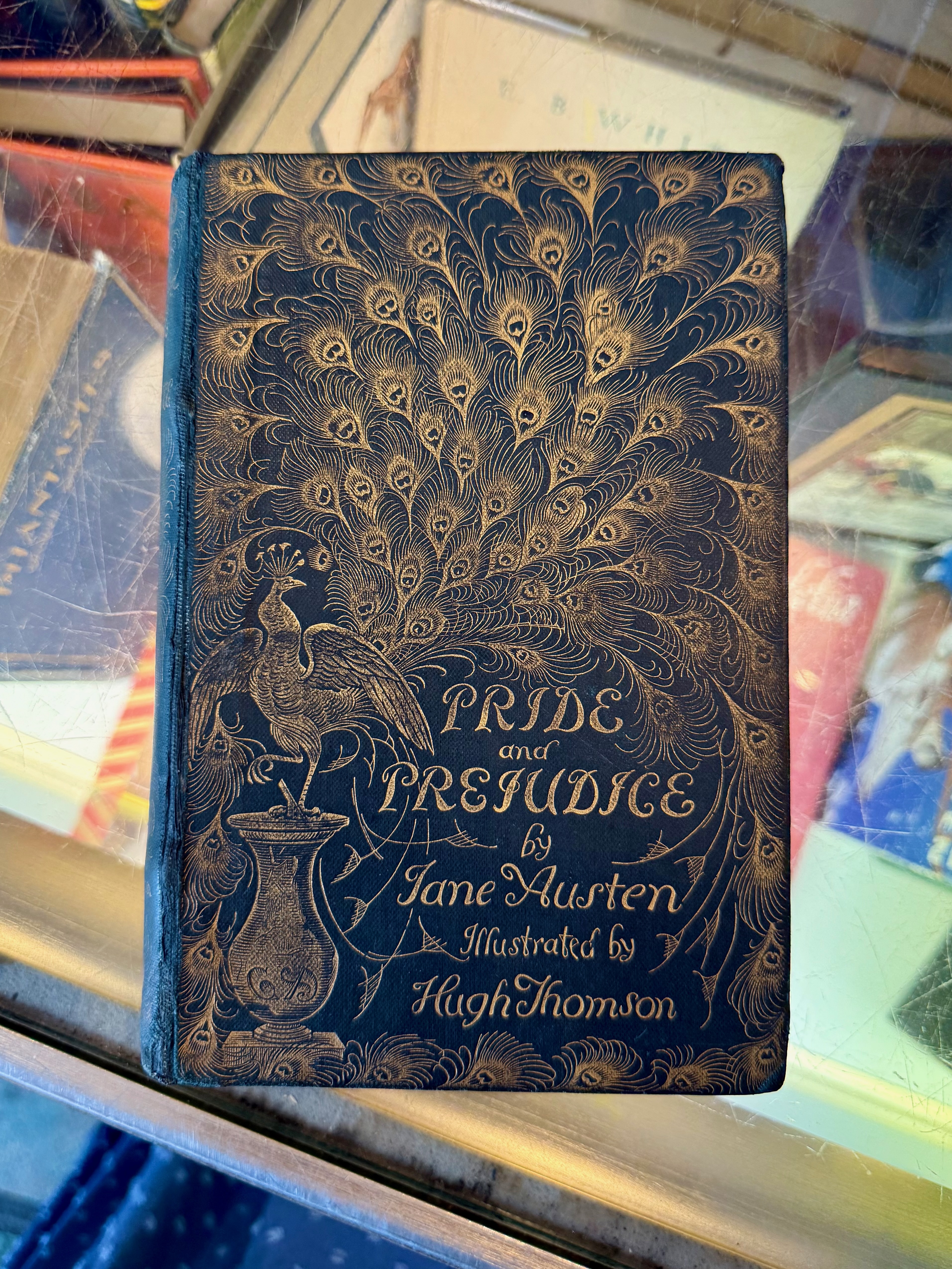
A rare “Peacock” edition in a bookstore I recently visited ($3,500).

The Original “Peacock” P&P

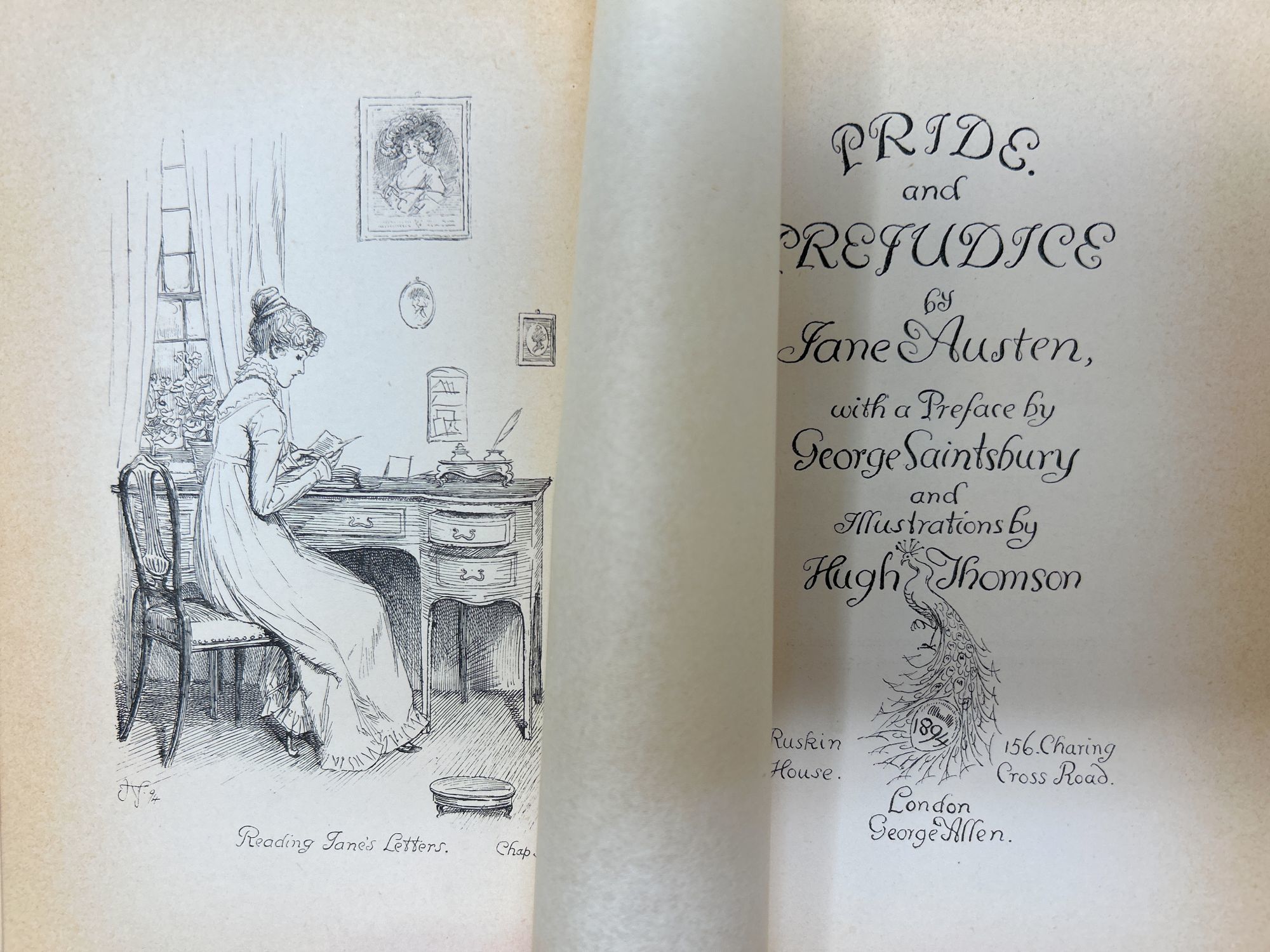
George Allen is responsible for the original 1894 “Peacock” edition of Pride and Prejudice, which includes the now-famous illustrations by Hugh Thomson. It includes 65 illustrations and 160 drawings and designs in total.

According to a University of Michigan Library Online Exhibit, Allen’s “Peacock” edition was not only extremely popular at the time, but it also helped revitalize the popularity of Austen’s works in the late 1800s:

“In reaction to the wave of British nationalism in the late nineteenth century, a renowned publisher of the time, George Allen, sought to preserve traditional English values by publishing a series of illustrated classic works of literature.”

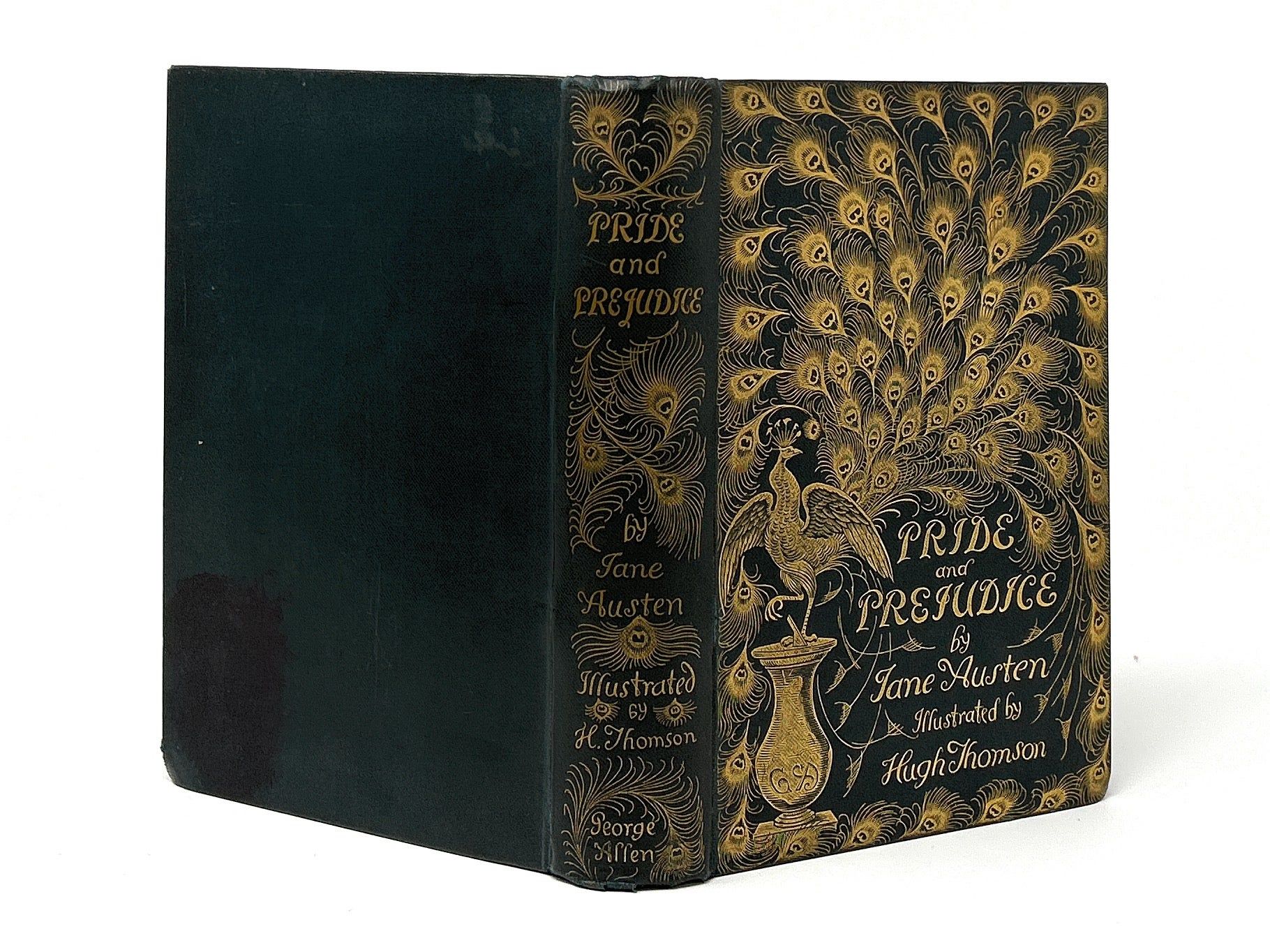
Peacock Edition, Cover and Spine (1894).

There’s a reason people love the “Peacock” edition. The cover is striking with its deep navy blue background, gilded title, and resplendent gold peacock feathers. Every detail is exquisite:

“The edition’s iconic features include its gilded peacock cover (symbolic of pride) and 65 full page illustrations, all created by Hugh Thomson. As an acclaimed illustrator of the time, Thomson’s work symbolized grace and refinement, which made him the perfect choice for capturing Allen’s vision.”

Allen’s goal to revitalize interest in Austen’s work proved successful, but the edition itself did better than he ever imagined and went on to become an iconic edition that book collectors salivate over today:

“The edition surpassed expectations, selling over 11,605 copies in England and 3,500 copies in the United States, within the first year. Its popularity was partly due to its large appeal across class divisions, gender spheres, and political factions, functioning most basically as a gift book and mark of good taste. George Allen’s revival has proven to be timeless. Thomson’s peacock design has become the iconic representation of Austen’s Pride and Prejudice in contemporary marketing and merchandising, continuing to capture audiences today.”

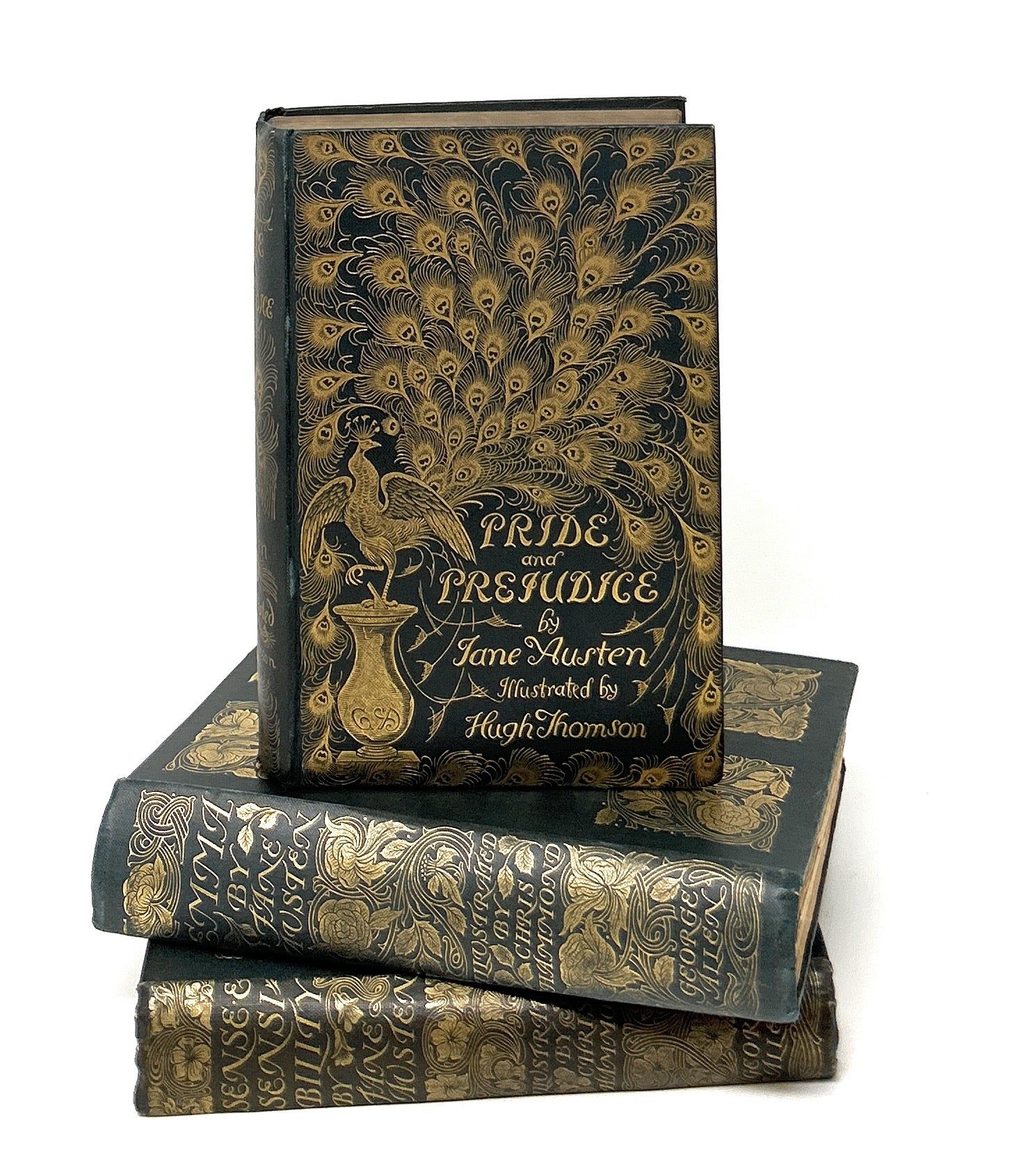
George Allen editions of Pride and Prejudice, Emma, and Sense and Sensibility

“Peacock” Illustrations

If Hugh Thomson’s name sounds familiar, you’re right. Jane Austen’s House Museum shares these intriguing details:

“The Irish illustrator, Hugh Thomson (1860-1920), was best known for his pen and ink illustrations and in addition to Jane Austen’s work, illustrated the novels of Charles Dickens, Elizabeth Gaskell and J.M Barrie. Thomson used to visit the British Museum and V&A to research costume styles, room decorations and furniture design for his illustrations. Despite that his drawings for Pride and Prejudice have a distinct Victorian rather than Georgian feel to them.”

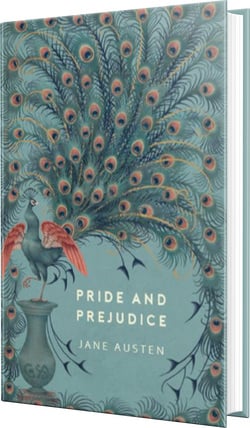
If you’ve ever wondered why Thomson chose a peacock for the cover, you’ll find a clue in the old saying, “proud as a peacock.” Male peacocks have long been associated with pride and vanity because of their vibrant plumage and the way they strut about with their feather fanned out around them. Some believe that the peacock’s elaborate display of its tail feathers, especially by the male during courtship, is a fitting image for Pride and Prejudice’s themes of courtship as well. Either way, the peacock as a symbol of pride seems fitting for the cover of Pride and Prejudice.

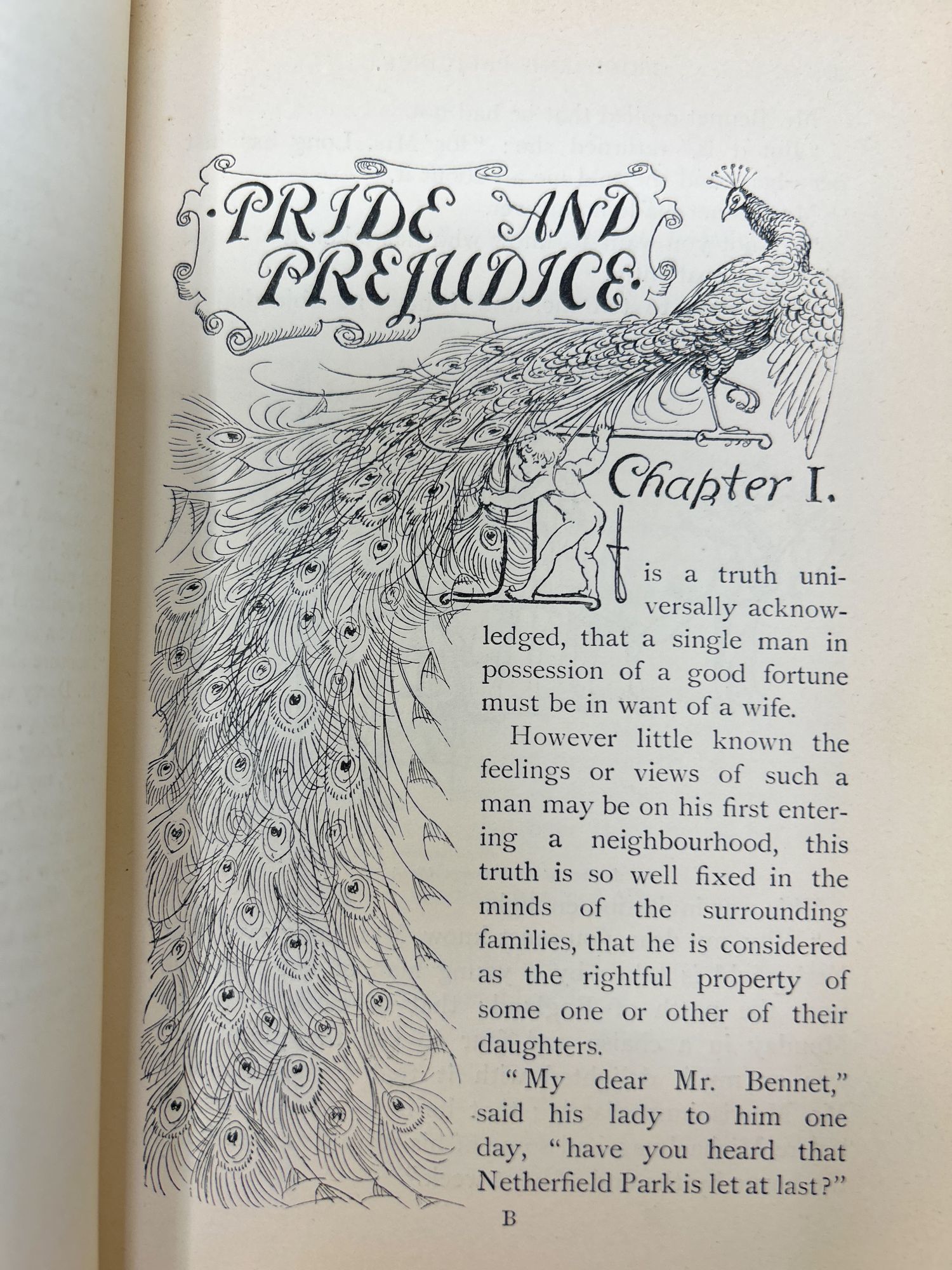
The interior is filled with beautiful full-page illustrations. The first page of the first chapter is particularly lovely with the peacock plumage on full display:

Peacock”-Themed Editions Through the Years

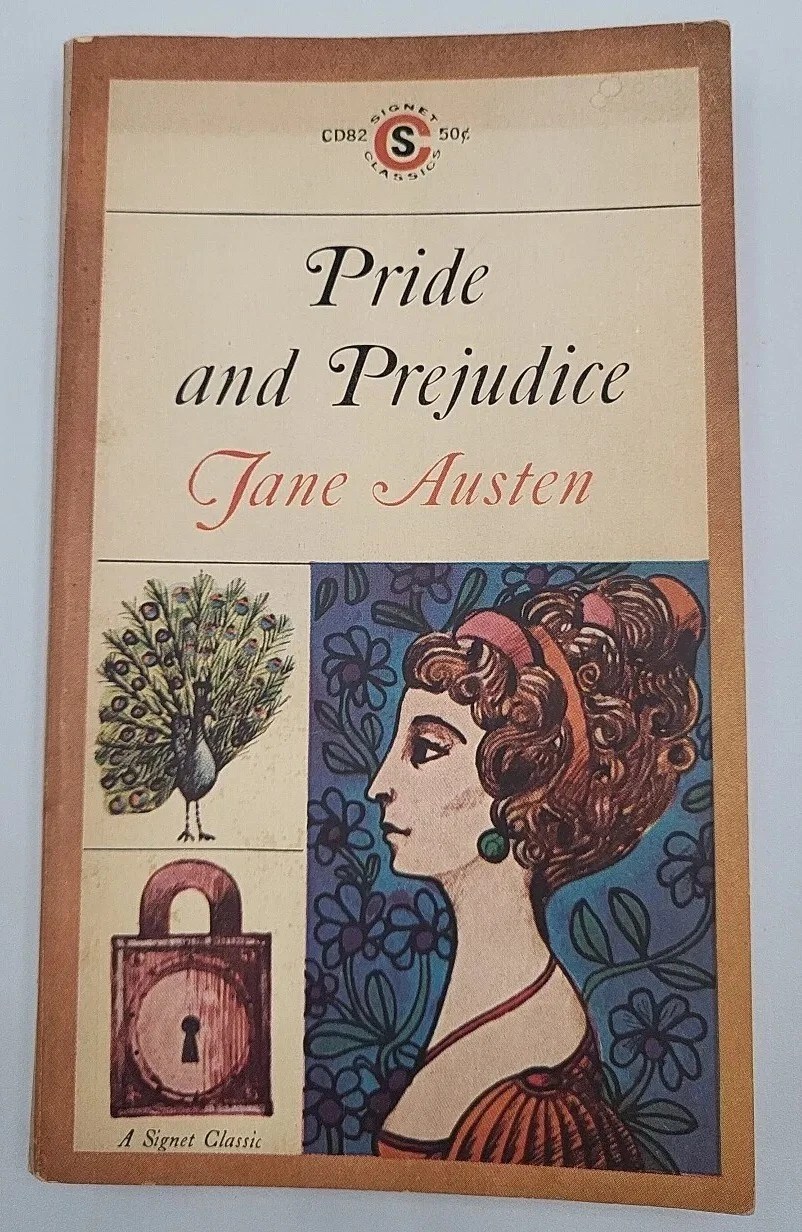
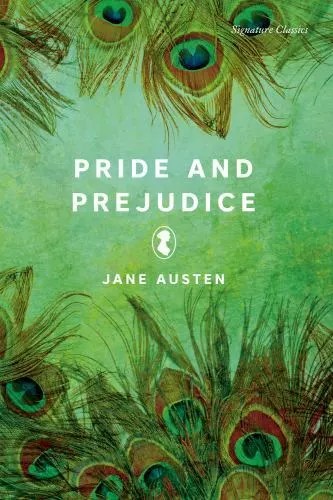
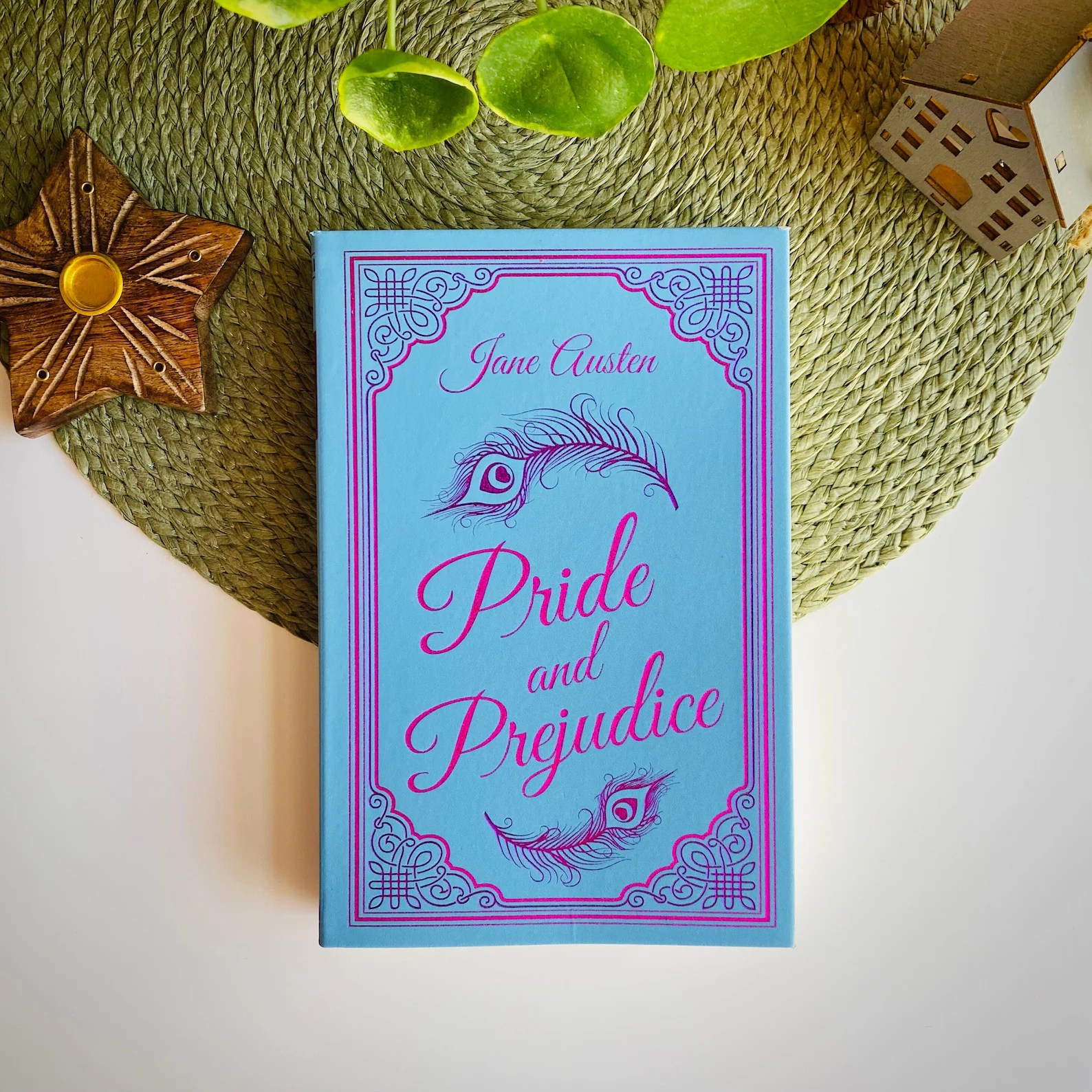
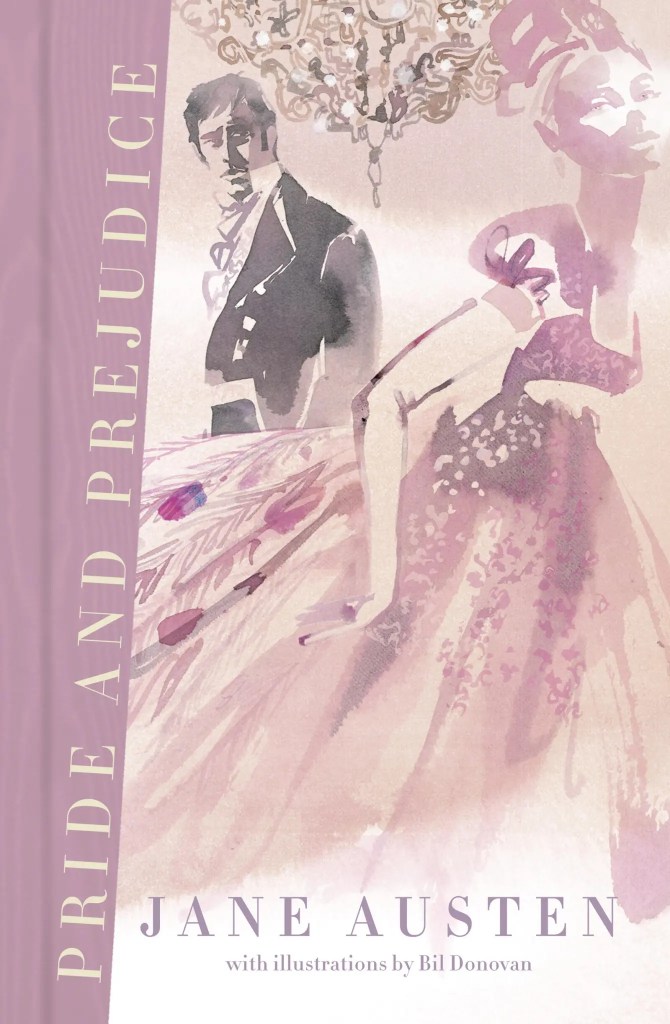
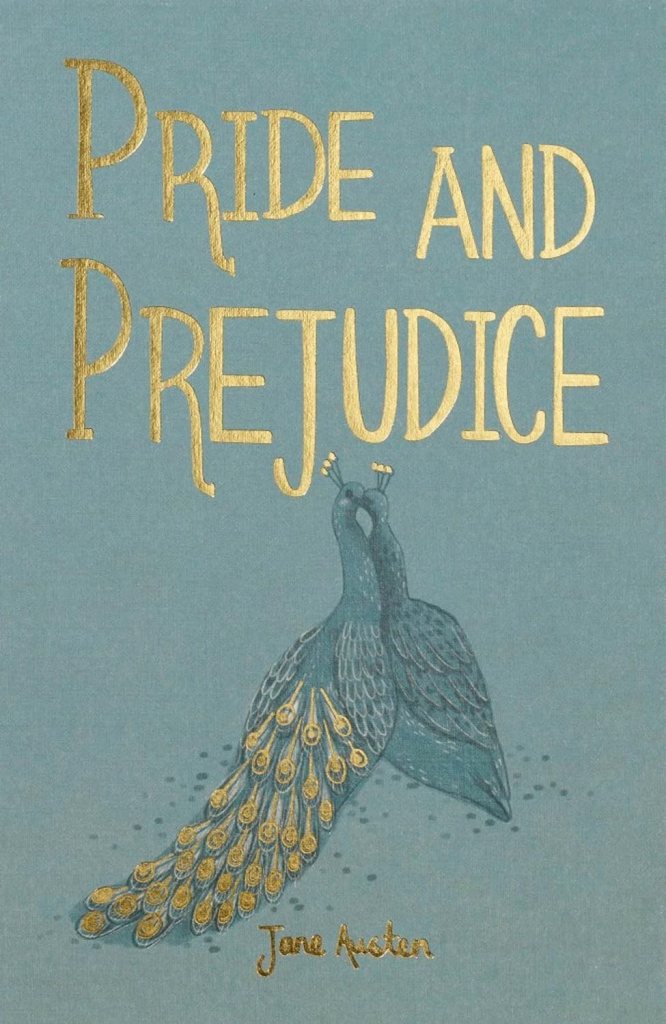
Ever since the original “Peacock” edition was released, many other editions of Pride and Prejudice have featured a peacock or peacock feathers. Each one is a nod to the original and to the overarching theme in the novel. Here are a few select highlights:

Signet Classic, 1961 (I read this one from my dad’s bookshelves growing up)
Union Square & Co. with lush peacock feathers.
Paper Mill Press edition (Hardcover or Paperback).
Union Square & Co. edition (2022) with subtle peacock feathers.
Wordsworth Edition with its peacock mates.
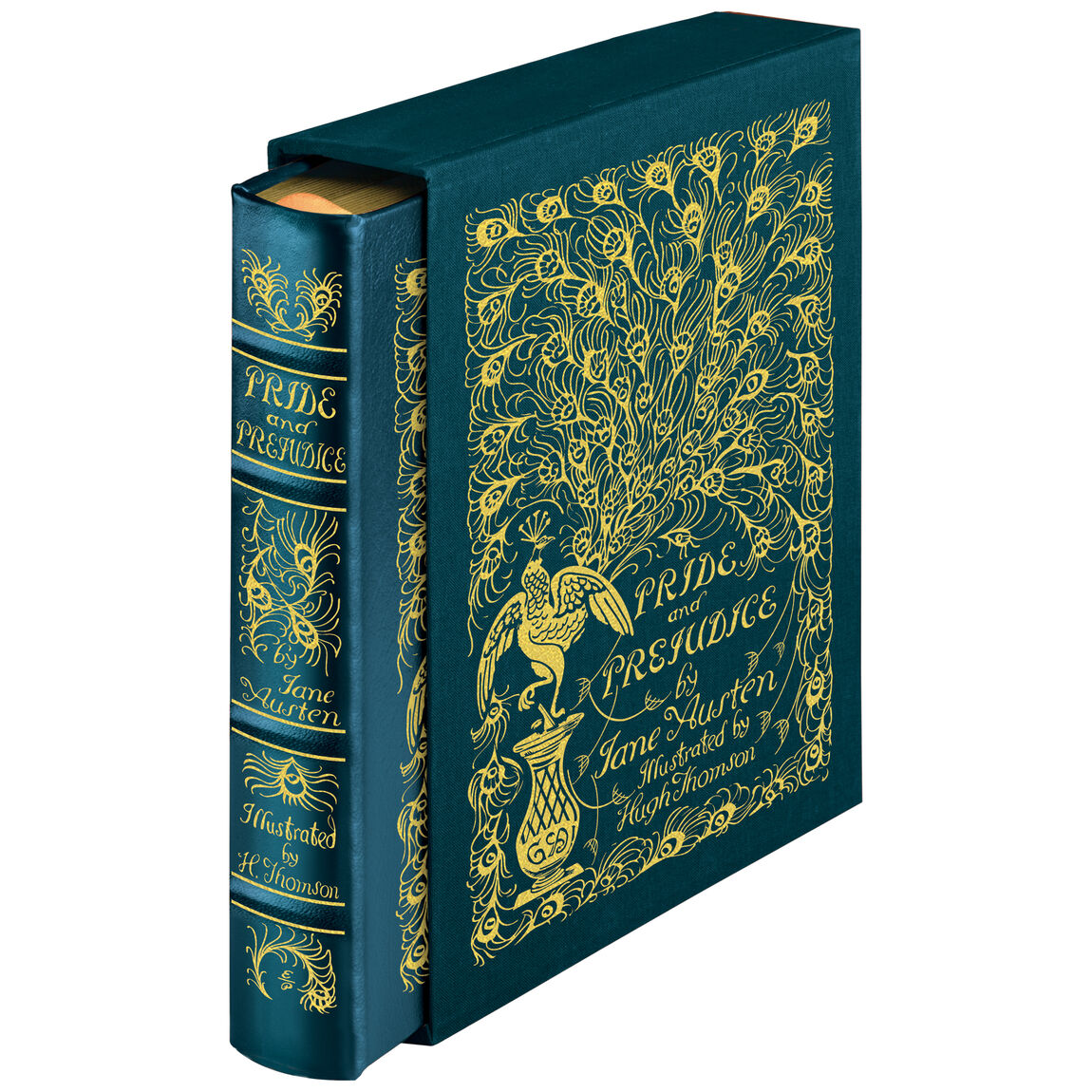
Easton Press collector’s reproduction edition with illustrations by Thomson.

Though the Easton Press leather-bound edition is pricey at $252, it might be worth it to those who want to have a beautiful and exquisitely-reproduced copy of Allen’s original “Peacock” edition with Thomson’s illustrations throughout. It’s truly a work of art in its own right with its “hubbed” spine, sewn pages, acid-free paper, and custom-crafted, clothbound slipcase.

250th Editions Featuring Peacocks

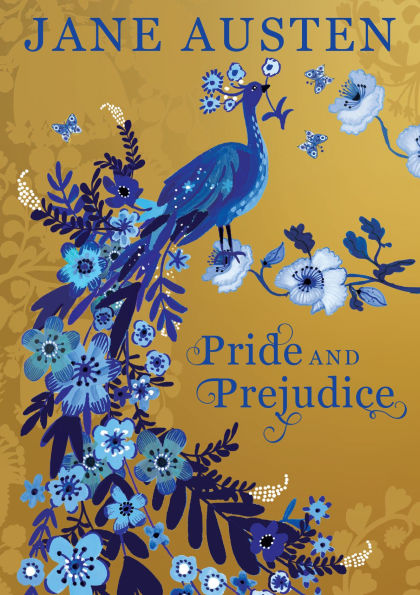
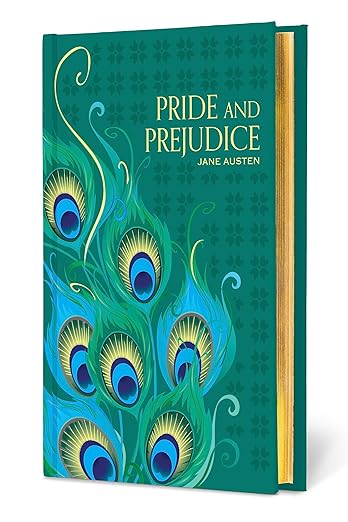
Finally, for the 250th anniversary of Jane Austen’s birth, Austen fans can enjoy several new “Peacock”-inspired editions. These editions pay homage to the original Allen edition with an updated flair. Thus far, I’ve seen these new and upcoming editions advertised:

Plumleaf Press – Now Available from Barnes & Noble.
Union Square & Co. – Signature Gilded Edition (Sept 2025)

Proud as a Peacock

Whichever edition you enjoy reading, it’s clear that the peacock remains an enduring symbol of pride in the novel. As Elizabeth Bennet says about Mr. Darcy after he snubs her: “I could easily forgive his pride if he had not mortified mine.”

A copy of the original “Peacock” edition is worth a lot of money these days, but its impact is truly priceless. Allen and Thomson helped revive and sustain popular interest in Jane Austen’s work far beyond what they ever imagined.


RACHEL DODGE teaches college English classes, speaks at libraries, teas, and conferences, and writes for Jane Austen’s World blog. She is the bestselling, award-winning author of The Anne of Green Gables DevotionalThe Little Women DevotionalThe Secret Garden Devotional, and Praying with Jane: 31 Days Through the Prayers of Jane Austen. A true kindred spirit at heart, Rachel loves books, bonnets, and ballgowns. Visit her online at www.RachelDodge.com.

Read Full Post »

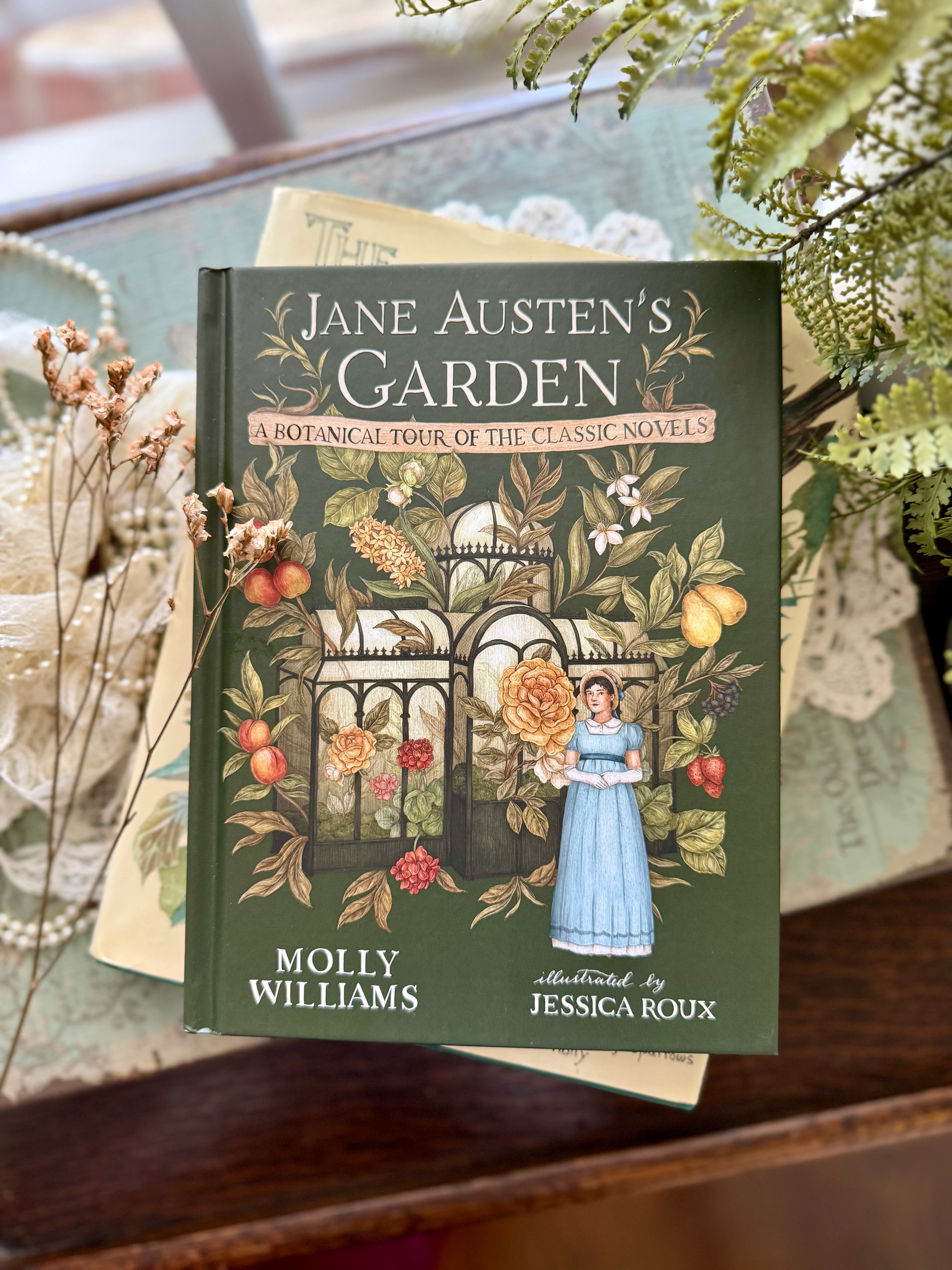
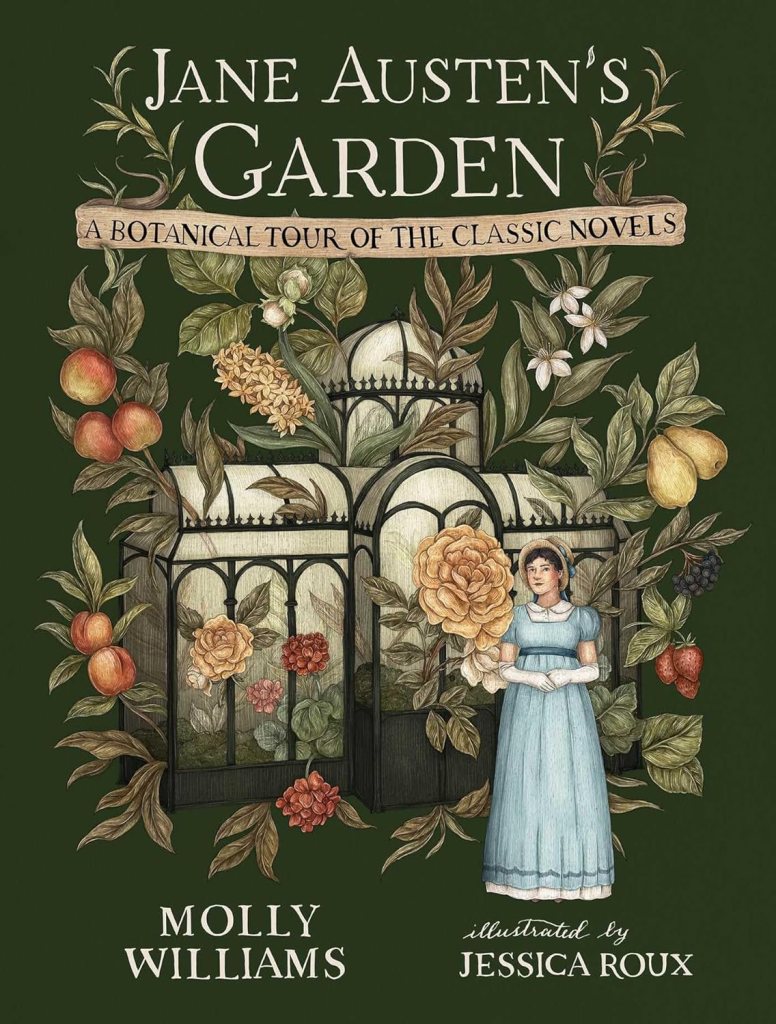
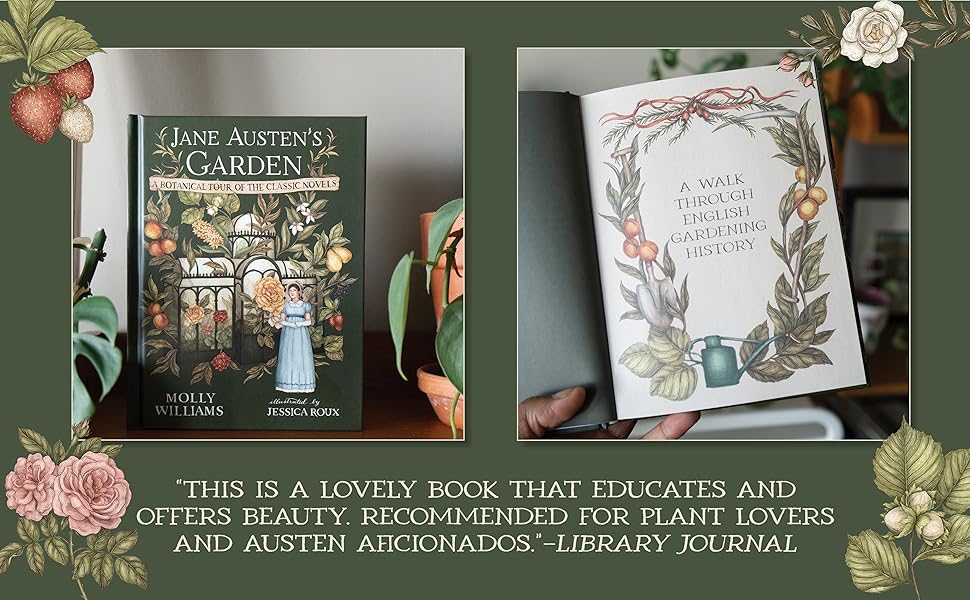
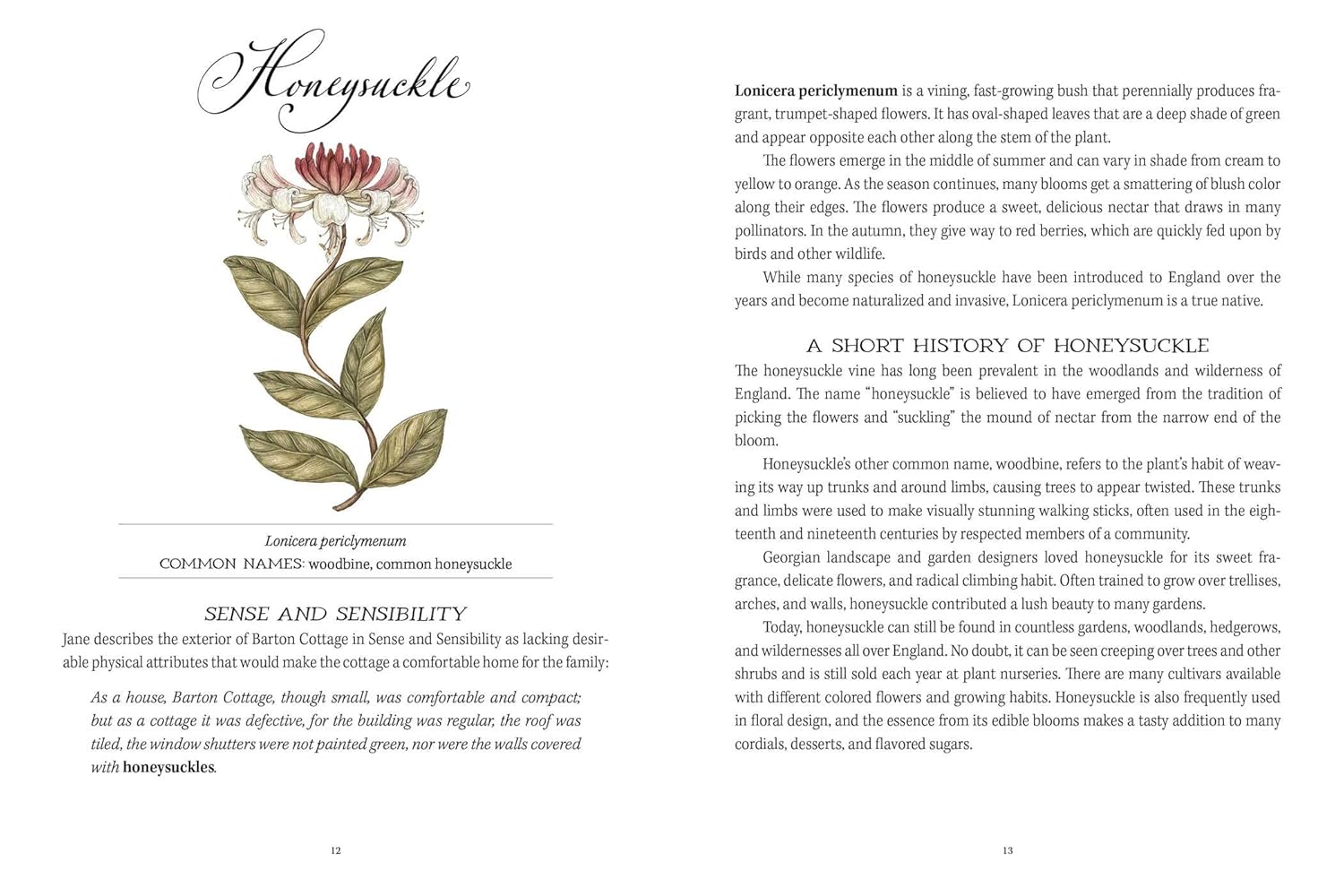
Fellow Janeites, I have a new book review for you in honor of Jane’s 250th year: Jane Austen’s Garden: A Botanical Tour of the Classic Novels written by Molly Williams and illustrated by Jessica Roux. This new book pairs two of my favorite things: Jane Austen and gardening! I looked forward to its release for months and it now sits prominently on my shelves!

Photo by Rachel Dodge, ©2025

Book Review

I knew this book would be beautiful, and I confess that I preordered it based on how pretty it looked. I have another gorgeous book by Jessica Roux called Floriography: An Illustrated Guide to the Victorian Language of Flowers. I’ve always been drawn to the language of flowers and their meanings.

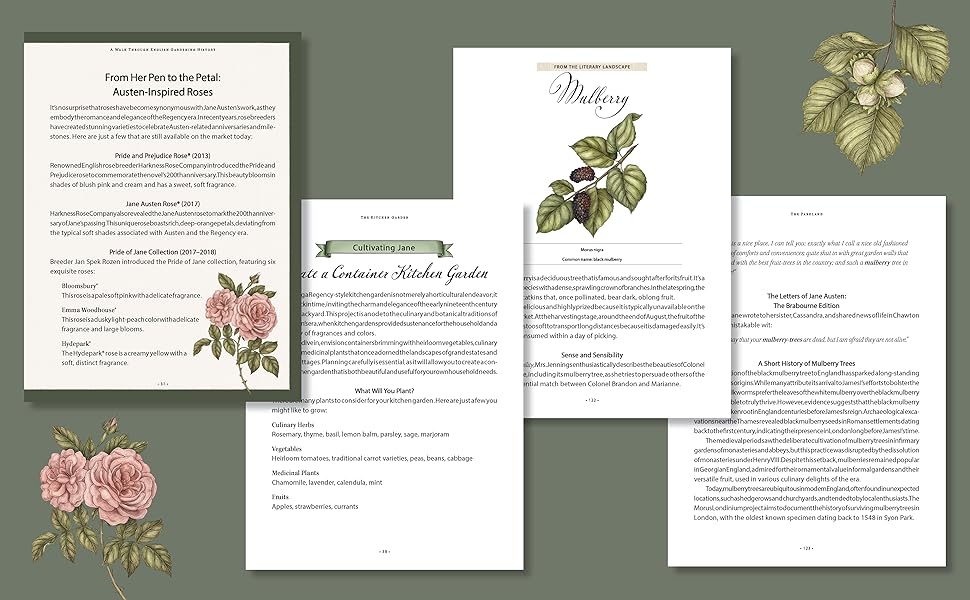
When I ordered it, I assumed Jane Austen’s Garden would mostly include drawings and tidbits of information. However, when it arrived, I discovered that it is filled with detailed information about the flowers, plants, trees, fruits, and vegetables mentioned in Austen’s novels and in her own garden and kitchen garden! There are even instructions about how to grow your own fruits and vegetables at home.

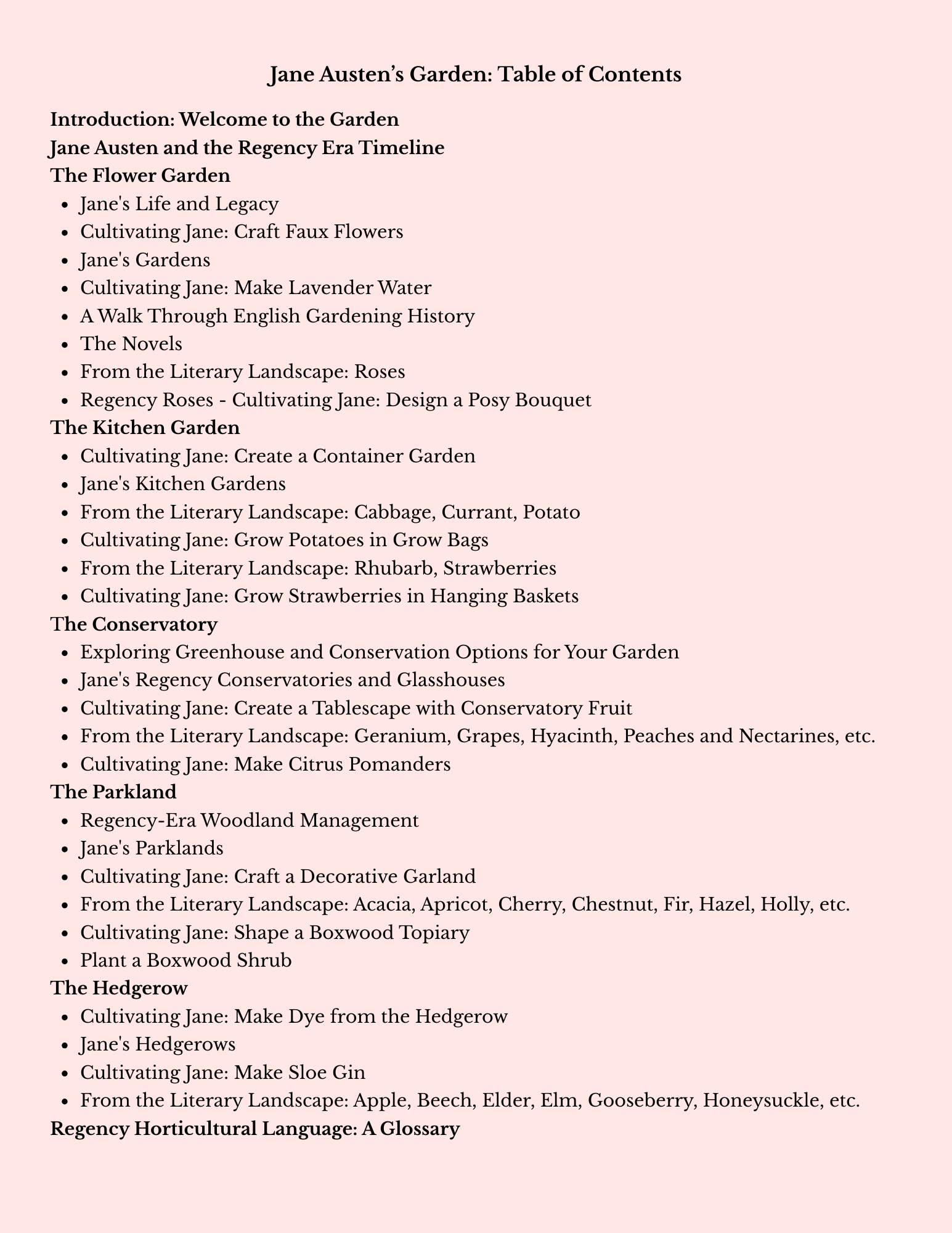
And don’t let the Table of Contents fool you. This book has a LOT to offer. The editor(s) merely listed the craft projects in the book in the Table of Contents, which does a great disservice to Williams’ painstaking research and intriguing information. Williams provides ample material for Jane Austen fans and has done a wonderful job of researching every detail of this book.

Order Your Copy Here:

Literary Landscapes and Illustrations

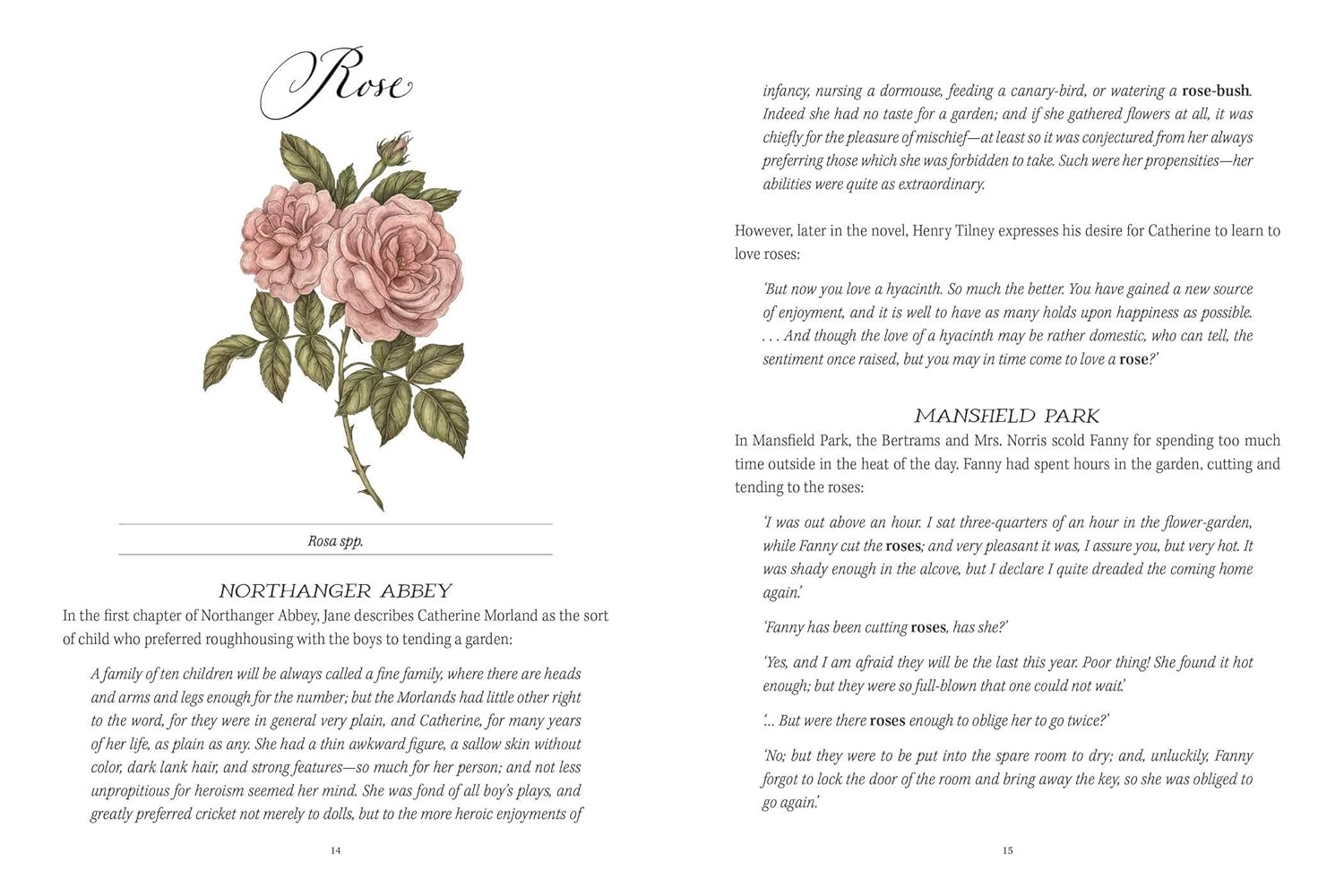
In each chapter, there is a section entitled “From the Literary Landscape.” This is the best part!! This is where Jane Austen fans can really dig into Williams’ research. She outlines the instances when various trees, fruits, or flowers are mentioned in the novels (or how the Austens used them in their everyday lives). Then, Williams goes into detail about what they signified and/or their history. As many of you know from my articles over the years, I love to look for specific items in the novels and research them.

Finally, the illustrations in this book are to die for. Truly, Roux is a most extraordinary artist. You can see more of her art HERE. I truly could look at it all day long!!!! I have a dream of writing a book with botanical illustrations one day, and I can’t imagine having someone like Roux do the artwork. She brings Williams’ research to life and captures the Regency imagination beautifully.

Book Description

An elegantly illustrated celebration of Jane Austen’s life and literature as told through the flowers, plants, and landscapes that inspired her.

Through explorations of the botanical inspirations and symbolism in Austen’s work and personal life, as well as historical information about the gardens and landscapes of the Regency Era, Jane Austen’s Garden will transport readers back in time to the lush English landscape of the early 1800s. Woven throughout are DIY projects to help you create a home garden worthy of a surprise visit from Lady Catherine de Bourgh or maybe just give your dining table a bit of historical flair. Accessible, entertaining, and enhanced by the enchanted illustrations of celebrated artist Jessica Roux, Jane Austen’s Garden is a fun twist on a familiar subject that will delight plant lovers and Janeites alike.

Book Contents

The Table of Contents is misleading as it only outlines the various DIY projects you can try at home. The book itself has a LOT more meat to it, so don’t let the overview dissuade you from purchasing it. In an effort to provide a fuller picture of all that Williams included, I created a full outline of the book:

Below are two examples of how Williams includes information about different flowers and plants in the novels, along with more illustrations from Roux:

About the Author and Illustrator

Molly Williams is the author of Killer Plants: Growing and Caring for FlytrapsPitcher Plants and Other Deadly Flora, and Taming the Potted Beast: The Strange and Sensational History of the Not-So-Humble Houseplant, and she writes regularly for Apartment Therapy‘s gardening and horticulture section. She grew up on a flower farm and is now a professor of writing in New England. You can visit her online HERE.

Jessica Roux is a Nashville-based freelance illustrator and plant and animal enthusiast. She loves exploring in her own backyard and being surrounded by an abundance of nature. Using subdued colors and rhythmic shapes, she renders flora and fauna with intricate detail reminiscent of old-world beauty. She is the author and illustrator behind Floriography: An Illustrated Guide to the Victorian Language of FlowersOrnithography: An Illustrated Guide to Bird Lore & Symbolism, and the Woodland Wardens Oracle Deck & Guidebook. You can visit her online HERE.

250 Years of Bookish Bounty

Books like these truly make the 250th celebration of Jane Austen’s life, writing, and legacy a true gift and a joy. I’m so thankful to the authors, illustrators, editors, and publishers who make books like this possible. The bounty of books releasing this year is a wonder to behold. I hope you’ll check this one out and add it to your bookshelves!


RACHEL DODGE teaches college English classes, speaks at libraries, teas, and conferences, and writes for Jane Austen’s World blog. She is the bestselling, award-winning author of The Anne of Green Gables DevotionalThe Little Women DevotionalThe Secret Garden Devotional, and Praying with Jane: 31 Days Through the Prayers of Jane Austen. A true kindred spirit at heart, Rachel loves books, bonnets, and ballgowns. Visit her online at www.RachelDodge.com.
Read Full Post »

« Newer Posts - Older Posts »