Feeds:
Posts
Comments

Archive for the ‘Clergy’ Category

Interviewed by Brenda S. Cox

“As soon as he can light upon a bishop, he will be ordained. I wonder what curacy he will get!”–Anne Steele, about Edward Ferrars in Sense and Sensibility.

A few days ago, I told you about a fascinating new book on Henry Austen. The author is a retired Church of England bishop, living in Farnham, where Henry Austen served as perpetual curate of the parish church. (A perpetual curate was a curate, substituting for the rector or vicar holding the living of that church. “Perpetual” meant that he could not be fired; he could keep his job for life, just as a rector or vicar did. However, his salary was still only a portion of the tithes that supported the main, absentee clergyman.)

I asked the Right Reverend Dr. Christopher Herbert, who is now a Visiting Professor of Christian Ethics at Surrey University, about his journey in writing this book.

Jane Austen’s Favourite Brother, Henry, was written by an Anglican bishop, Christopher Herbert

Jane Austen’s World: Rev. Herbert, what led you to write Jane Austen’s Favourite Brother, Henry?  How did you get interested in Henry Austen?

Rev. Herbert: In retirement I live in Farnham, Surrey, only a few miles from Chawton. I am the Patron of the Farnham Castle Trust; Farnham Castle was once one of the major homes/palaces of the Bishops of Winchester. At a Trustees’ meeting, discussing how to attract more visitors to the Castle and Farnham, I wondered if there might be some connection with Chawton and Jane Austen. The other Trustees did not know of any, but a friend pointed out an article in the Farnham Herald mentioning a man called Henry Austen christening a baby in the parish church of St Andrew’s. [JAW: This story opens Herbert’s book.]

I followed this up, checking the Parish Registers at the Surrey History Centre, and found many signatures in Henry’s hand—and of course, he was Jane’s brother. I was fascinated. Who was he? How did he become a Perpetual Curate in Farnham? What was his story?

At that point, all that I had were his dates of birth and death, and a few insights from Wikipedia. I had no intention of writing a book about him, but the more I researched his life, the more intriguing Henry became. By the way, my book’s publication in the 250th Anniversary Year was pure chance. I had no idea that was coming up when I raised my initial question!

JAW: How long did it take you to research and write the book?  What were some of the most interesting sources you found?

I took well over two years to research and write the book. That might seem a short period of time. However, in my earlier work as a diocesan bishop, with over 400 churches in my diocese, plus membership of the House of Lords and other national and international responsibilities, I was accustomed to working very rapidly to fulfil all my duties. I also read for [pursued/studied for] an MPhil [Master of Philosophy] and a PhD in Medieval Art History at the University of Leicester whilst I was a bishop, and again, had been able to read and digest and write rapidly. So, I had some of the requisite research skills, and I loved the research process—that joy of discovering new and unexpected jewels.

My most useful primary sources were obtained from the Hampshire County Record Office where I was able to trawl through a great deal of original material, plus similar material such as the Parish Registers of St Andrew’s, Farnham, at the Surrey History Centre.

For secondary sources, I read biographies of Jane Austen by people such as Claire Tomalin, and David Cecil, and accessed the huge online resources of JASNA, etc. I was helped greatly by the staff at Jane Austen’s House, Chawton, and, of course, re-read all of Jane’s novels, plus the utterly invaluable edited version of Jane’s letters by Deirdre Le Faye and invaluable and scholarly papers by people such as yourself [Brenda Cox], John Avery Jones, et al.

Of course, as is often and frustratingly the case, after my book had been published, I came across some more primary material at Winchester College. The researcher’s life, as you know, is littered with ‘if onlys’. [I encouraged him to find a place online to publish his further research.]

Amongst the most interesting material were the Parish Registers of Bentley and Farnham. Those gave me enlightening insights about the lives of Henry and his parishioners.

JAW: What did you learn about Henry that interested you the most?

Apart from my obvious personal affinity with Henry as a clergyman, it was his time as a dealer in Army Commissions, a Banker, and a Tax Collector which I loved researching. I am not an economic historian and so my research in this area was very challenging. I would need to re-train in economic history to begin to fully understand every detail. This was the most difficult part to write, trying to get my head around the economic and financial landscape within which Henry worked.

Beneath all the top-layer elements of his life, I enjoyed delving beneath the wealthy surface and speculating on Henry’s motivations and methods of work. Walking the streets of London and investigating where he lived during this phase of his life was hugely enjoyable.

Following Henry through his banking downfall and his approach to his bishop to discuss the possibility of ordination required a great deal of ‘inner work’ on my part  to comprehend how and why that happened. I have interviewed hundreds of ordinands in my life. It was fascinating trying to get into the mindset of Henry’s bishop, Bishop Brownlow North, who lived in very different times to my own. Like Henry, Bishop North worked with different cultural assumptions than ours. It is such a challenge to try to stretch one’s sympathetic imagination into another era.

By contrast, and bathetically*, it was the fact of Henry having almost 1,000 bottles of wine in his cellars which sticks in my mind!
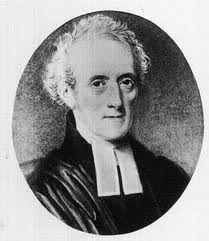
Henry Austen as a Clergyman later in life. Public domain via wikimedia.

JAW: What was something interesting you learned about Jane Austen herself in writing the book?

Oddly, it was spending time exploring Steventon and realising how isolated the Rectory and the village were in the late 18th and early 19th centuries. I had, of course, been to Jane Austen’s House in Chawton a number of times, but in my mind’s eye I had imagined Steventon as a quintessential English Village: village green, church, a few farmsteads, a pub, and even, perhaps, a game of cricket. That idea was completely shattered when I visited Steventon. The cultural life inside the Rectory must have been a great contrast to the isolated, scattered cottages of the poor inhabitants of the village. 

My understanding of the life of Cassandra Austen (Leigh) [Jane’s mother] grew as I thought of her coping with her own children plus the students boarding with them—all that food, oversight of the washing of bedding and getting it dry, all that hullabaloo inside the house during term-time. When did she have a moment to herself?  I began to wonder, as Jane watched her mother, how much Jane recognised the sheer logistical task her mother undertook to keep the ship happy, afloat and moving in the right direction.

This was the most fun part of the book to write, showing the inside of Steventon Rectory with all the liveliness and learning of Jane, Henry, and their siblings.

And, of course, Jane’s letters are an absolute delight. If only there were more…if only…

JAW: If you were able to meet Henry Austen personally, what do you think you would like about him? What would you want to ask him? What parts of his character might you find difficult or less pleasant?

I would enjoy his sense of humour, his generosity towards, and affection for, Jane, and his affection for Liza [his wife Eliza] and her son, Hastings. Not being a risk taker myself, I would love to hear about his own understanding of the nature of financial risk and entrepreneurship. When did he see the storm clouds brewing? Was ordination always at the back of his mind? Was it a kind of attempt to ‘give back’ to society, having enjoyed and then lost the fruits of worldly success?

I would find his undoubted attraction to the aristocratic level of society difficult, but I fully recognise that it was the 18th/early 19th century way. And when he was Perpetual Curate, I suspect I would have found his lack of awareness of the Farnham Workhouse very difficult. However, in fairness, I must add that it might simply be lack of evidence which leads me to suppose that he was not at his best with the poor and impoverished. So much information has been lost. I could be entirely wrong. 

JAW: Why do you think he was Jane’s favourite Brother?

I will say the idea for the title of the book was not mine, it was my publisher’s, but I am entirely happy with it. Why was Henry Jane’s favourite? He was obviously very close to her and looked to her for help whenever he hit a difficult or tragic patch in his life. They shared the same sense of humour, the same love of the quirks of society, the same interest in humanity. And it was Henry who went out of his way to ensure that her books were published. Besides, who but a favourite brother would actually volunteer to read Proofs!?

JAW: What would you like to tell potential readers about your book?

I hope that if they love Jane Austen, my book will reveal some lesser-known aspects of Regency society which might enhance their understanding of Jane and her novels. In brief, context really matters. But, most importantly of all, if my book leads to people reading or re-reading Jane, my hopes will have been more than fulfilled.

JAW: Thanks very much, Christopher! I loved Jane Austen’s Favourite Brother, Henry, and I think our readers will also.

Jane Austen’s Favourite Brother, Henry, by Christopher Herbert, is now available from the publisher, Pen & Sword, and from Amazon in the US and in the UK in hardcover. The Kindle version will be released September 30, 2025.

You can find out more about Dr. Herbert at https://en.wikipedia.org/wiki/Christopher_Herbert and https://www.chpublishing.co.uk/authors/christopher-herbert Since those lists of accomplishments, he has also been involved in the Royal Hospital for Neurodisability in London and the Lyme Resource Centre, a charity based in Scotland raising awareness of the growing incidence of Lyme disease and co-infections in Scotland and elsewhere in the UK.

*I looked up bathetic. It means “producing an unintentional effect of anticlimax.” Nice word!

Brenda S. Cox is the author of Fashionable Goodness: Christianity in Jane Austen’s England. She also blogs at Faith, Science, Joy, and Jane Austen.

Read Full Post »

Book Review by Brenda S. Cox

“I had a letter from him [Henry], in which he desired to hear from me very soon—His to me was most affectionate and kind, as well as entertaining;—but there is no merit in that, he cannot help being amusing.”—Jane to Cassandra, April 8, 1805

“Henry at White’s! Oh, what a Henry!”—Jane to Cassandra, June 23, 1814 (when Henry attended an exclusive high class gathering celebrating Napoleon’s defeat)

Jane Austen’s Favourite Brother, Henry, by Christopher Herbert, gives an in-depth view of Henry Austen’s life, beliefs, and connections with Jane and her novels.

What a Henry

Henry Austen was apparently a lot of fun, and Jane loved her brother dearly. He was also quite versatile. At various times he was:

  • an Oxford student who produced a periodical called The Loiterer with his brother James,
  • paymaster and adjutant in the Oxford Militia,
  • army agent,
  • banker (of a bank that eventually failed),
  • receiver general of taxes,
  • Jane Austen’s own literary agent,
  • clergyman of several parishes,
  • chaplain of the British Embassy in Berlin, and
  • husband of Eliza de Feuillide and later of Eleanor Jackson (niece of Rev. Papillon of Chawton).

Christopher Herbert, in his fascinating new book, Jane Austen’s Favourite Brother, Henry, explores Henry Austen’s life through all these changes.

Culture and Current Events

I loved that Herbert gives lots of cultural details in going through Henry’s life. For example, in the chapter on Henry’s birth, we learn about childbirth practices at the time. During pregnancy, his mother Cassandra Austen, rather than buying special maternity clothes as we do today, would have widened her stomacher, used aprons to cover gaps in clothing, and loosened side lacings. A “churching” service would celebrate her survival of the very dangerous process of giving birth. Philadelphia Hancock, her sister-in-law, may have been there to help the mother before, during, and after the delivery.

The author speculates on what the children growing up in the the rectory may have read, who taught them to read and write, and where they obtained their books.

Current events and ideas are woven in alongside stories of Henry and Jane growing up. The balloon ascent of 1784 is described by quoting a magazine article of the time. We hear about battles, steam power, improvements and enclosures, and the Wesleyan revival which began at Oxford. We see how the ideas of contemporary writers such as John Locke, focusing on reason in understanding God and society, may have affected Jane Austen’s ideas of church and clergy in Mansfield Park, as well as her prayers.

Henry Austen as a Clergyman later in his life. Public domain via wikimedia.

Work and Money

An in-depth discussion explains Henry’s various jobs and what they involved. We see how his bank throve, launching Henry into upper ranks of society, and then failed. The author obviously did quite extensive research to dig this all up, and it was interesting to learn, for example, what exactly an army agent was. (For me, there was a little too much detail, since I’m not interested in finance; however, other readers may find this the most illuminating part!) It seems Henry had some financial dealings which were at least ill-advised, and possibly questionable.

Henry as Clergyman

After his bank failed, Henry reverted to earlier plans and was ordained as a clergyman. In Henry’s one extant sermon, he attacks pride and prejudices. Herbert says Henry is encouraging his congregation toward giving Catholics political rights, a major issue of that time. (See also “Sermons by Jane Austen’s Family.”) Herbert explores what Henry may have believed, also drawing from statements in Mansfield Park.

He also points out that Henry’s pastoral workload was much greater than that of Mr. Elton or other Austen clergymen. In one year, Henry performed 149 christenings, 34 weddings, and 105 funerals! All for very little income. He also had to deal with a new workhouse and other issues related to the poor of his parishes. Henry’s journey as a clergyman, his income and how he spent it, are further explored, as well as his anti-slavery work.

Jane Austen’s Novels

The author skillfully connects concepts to passages in Austen’s novels.  He also explains Henry’s role in getting her novels published. He concludes that there are still some questions about Henry’s life. But we do know that:

“without Henry’s determined and passionate commitment in getting Jane’s novels published, our lives, and the life of the world, would be so much the poorer.”

Amen!

On Thursday I will post an interview with the author, who is uniquely qualified to write this book. He is a former bishop of the Church of England, now living in Farnham where Henry Austen served as perpetual curate in the parish church. Farnham Palace, where the Right Revd. Dr. Herbert is a patron, was a home of the Bishops of Winchester.

I recommend this book to anyone who wants to learn more about Austen’s family and her world.

Jane Austen’s Favourite Brother, Henry, by Christopher Herbert, is now available from the publisher, Pen & Sword, and from Amazon in the US and in the UK in hardcover. The Kindle version will be released September 30, 2025.

Brenda S. Cox is the author of Fashionable Goodness: Christianity in Jane Austen’s England. She also blogs at Faith, Science, Joy, and Jane Austen.
Read Full Post »

Reviewed by Brenda S. Cox

“I have seen nobody in London yet with such a long chin as Dr Syntax” (Jane Austen, March 2, 1814).

I just finished reading, cover to cover, a brand-new book which is over 200 years old. The Tour of Doctor Syntax in Search of the Picturesque, by William Combe, is a classic which Jane Austen herself enjoyed. But it’s out in a new edition, with wonderful illustrations, explanations, and comments.

A fun new annotated version of The Tour of Doctor Syntax, including parallels with Jane Austen’s novels!

The story in verse was first published from 1809-1811 as a series in Ackermann’s Poetical Magazine. Ackermann had a series of prints by the great caricaturist Thomas Rowlandson. They featured a country clergyman with a long pointed chin and a tall white wig traveling through the countryside. Ackermann gave Combe the illustrations for each issue of the magazine, and Combe wrote a section of the story to go with them. He didn’t know ahead of time what the pictures would be for the next issue, but somehow he came up with a coherent story. One interesting facet is that Rowlandson apparently intended to satirize the clergy, but Combe made Syntax into a good, learned man, a little silly, but lovable.

A book version came out in 1812. Dr. Syntax was wildly popular and stayed in print, with multiple printings and editions, well into the 1800s.

This new version of The Tour of Doctor Syntax was edited and annotated by an advanced high school class and their professor, Dr. Ben Wiebracht. Ben actually discovered Dr. Syntax through one of my posts right here at Jane Austen’s World. Recognizing its potential for his class on “Jane Austen and Her World,” he asked Vic Sanborn, owner and primary writer of this website, and myself, to share with his class. Vic owns some lovely Rowlandson prints. We both loved connecting with such bright and interested students, who asked knowledgeable questions.

The Book

They’ve done a brilliant job with the book. It starts with a biography of William Combe and the history of the book itself. Combe’s challenges as a writer in Austen’s age were fascinating to me, as a writer myself. A clear introduction explains “the picturesque,” which is mentioned in Austen’s novels. Parallel to the text are straightforward explanations of difficult terms and phrases. That makes them easy to quickly reference. A glossary in the back gives terms previously defined.

The best part, for me, are comments pointing out parallels with Jane Austen’s work. I can’t even begin to list these, but there are many great insights. Some are about the clergy in Austen’s work, since Syntax is an underpaid country curate like Charles Hayter of Persuasion. Many comments have to do with the “picturesque,” “improvement” and country estates ranging from Sotherton to Pemberley. Others relate to the class system, Gothic novels, and other topics.

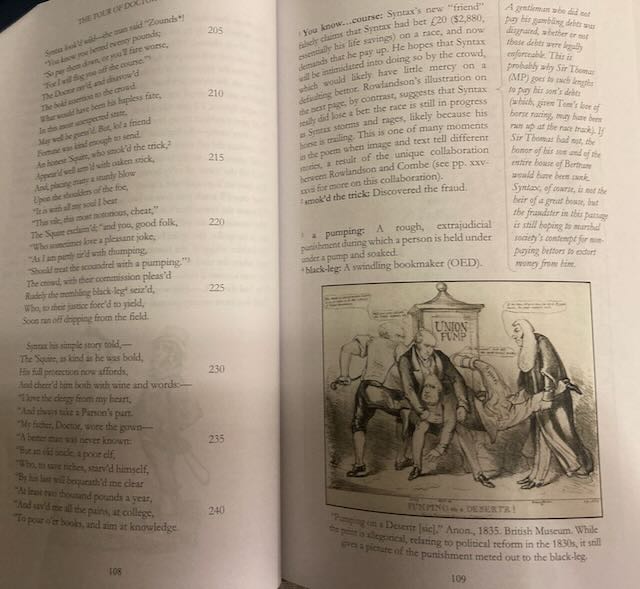
The full text of the poem/story is opposite explanations, comments, and illustrations, making them easy to access. The Tour of Doctor Syntax, 2024.
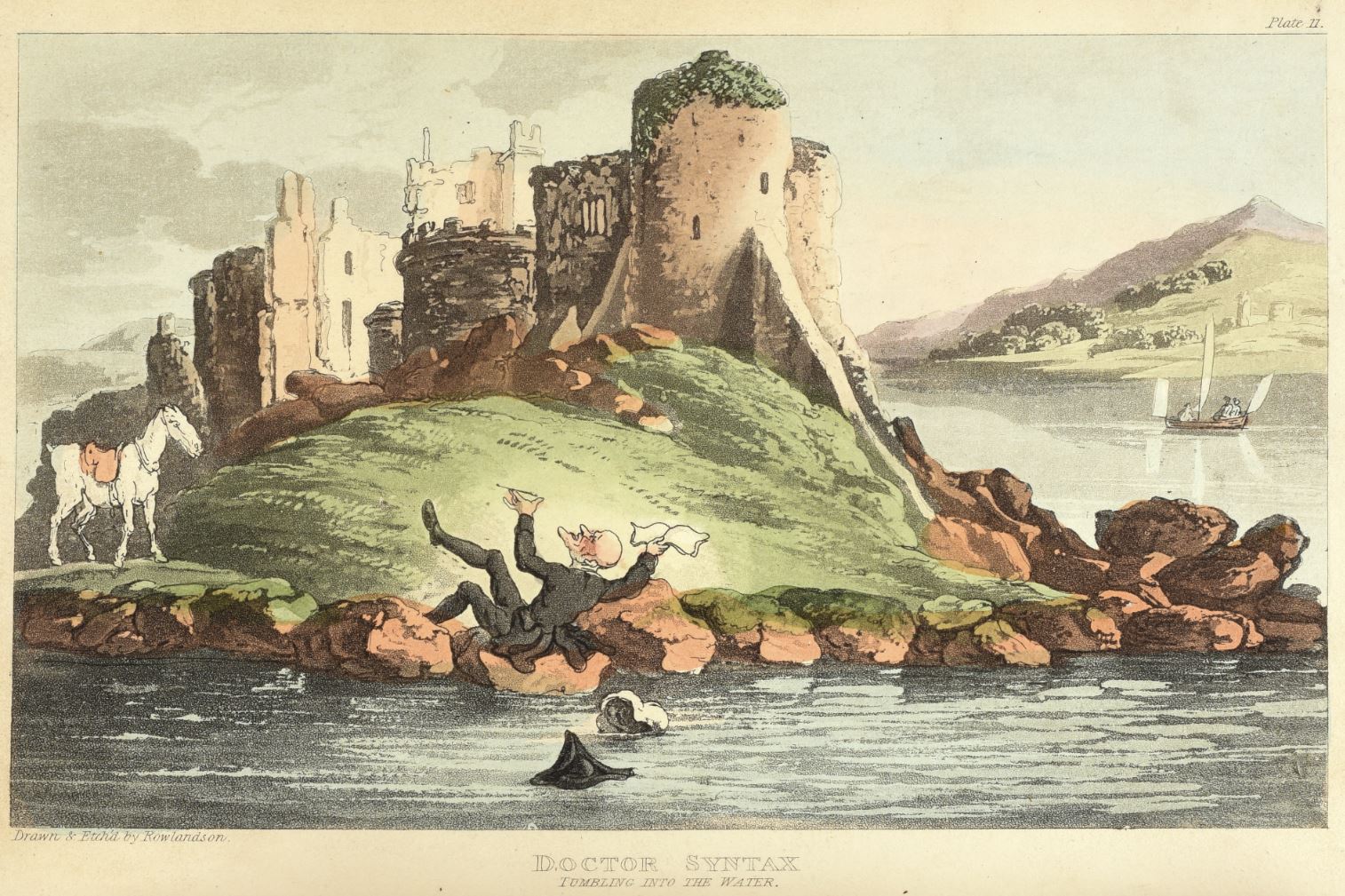
“Doctor Syntax Tumbling into the Lake,” by Thomas Rowlandson. One of the lovely full-page illustrations for this new version of The Tour of Doctor Syntax.
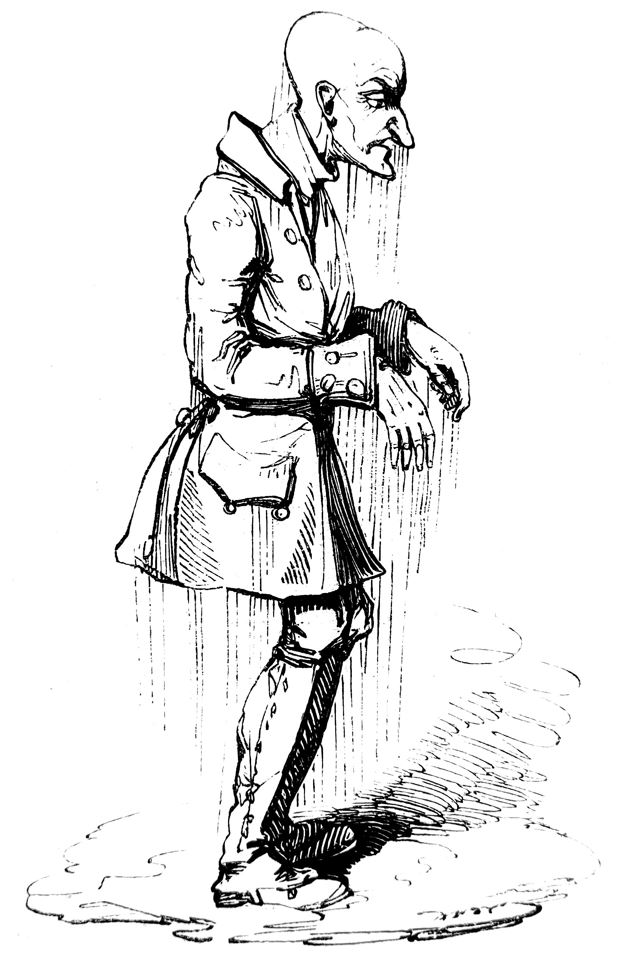
Victorian illustration, 1838, of the same scene, by Alfred Crowquill. The Tour of Doctor Syntax includes both the Rowlandson and Crowquill illustrations.

I also loved the illustrations. The editors chose the best versions they could find of each of the full-page, hand-colored pictures by Rowlandson that were the basis of the book. They added illustrations from a later Victorian version, as well as other entertaining and illuminating cartoons and pictures from the time.

Interview with the Editor

I’ll let Dr. Wiebracht himself tell you more about how this book came about.

Ben, please tell me about your class that produced this book.

The class is called “Jane Austen and Her World” and it’s designed for advanced juniors and seniors. The goal is to see Austen’s novels not as sealed-off masterpieces, floating in a historical vacuum, but as windows into her world. Most class days, our Austen reading is accompanied by shorter texts designed to create a sense of context and show how Austen was in conversation with her contemporaries. For instance:

  • We pair Austen’s account of Bath in Northanger Abbey with a number of late 18th-c. satires of Bath, 18th-c. dance music, and illustrations of the city by Rowlandson and others.
  • We pair Catherine’s pseudo-Gothic adventures in Vol. II with excerpts from The Monk, The Castle of Otranto, and The Mysteries of Udolpho.
  • We pair the private theatricals in Mansfield Park with a viewing of a performance of Lover’s Vows, as well as specimens of anti-theatrical criticism from the period, including a satire on private theatricals by Jane’s brothers!
  • We pair the discussion of landscape gardening in Mansfield Park with images from Humphry Repton’s famous “red books” showing “before and after” estate grounds.

The idea is to understand Austen in a deeper way by developing the practice of “reading outward.” And we incorporate that principle in our work for the class. Instead of the usual school essays, students work with me to create a critical edition of a neglected text from Austen’s time, with annotations and other resources that draw connections between the text and Austen’s life and work.

The class enrolled 16 students (the maximum). They hailed from all over the country and world: Japan, China, and many different U.S. states. This was my first time teaching the course, though I developed the core ideas in an Austen unit for a previous course. In the future, I will probably teach the course every three years. The book project in particular is a heavy lift, and I’m not capable of it every year!           

How did you end up studying Dr. Syntax along with Jane Austen?

I have to back up a bit here. In the course of an Austen unit for a previous class, students and I had created a critical edition of a long-forgotten 1795 poem called Bath: An Adumbration in Rhyme. We used that book to launch a new series called “Forgotten Contemporaries of Jane Austen.” Its goals are:

  • to recover neglected but valuable texts from Austen’s time, and
  • to trace new connections between Austen and her contemporaries.

As I was preparing my Austen class, I settled on Doctor Syntax (first brought to my attention in JAW by one of your articles!) for three reasons.

  • First, the poem had undeniable literary-historical importance – one of the all-out bestsellers of the Regency. A critical edition, I thought, was long overdue.
  • Second, many of its themes – from the plight of poor clergy to the “picturesque” – were major concerns of Austen’s novels, too.
  • Finally, the poem was simply a really good read. Combe’s verses are light, fun, and at times even touching, and Rowlandson’s accompanying illustrations are some of his best work. In every way, the poem deserved to be revived!

What do you hope readers will gain from the book?

There are a lot of things I hope people take away! One would be a deeper appreciation of just how engaged Austen was in the debates and issues of her day. Sometimes Austen is talked about as something of a provincial writer, sealed off from the wider Regency world, modestly toiling away on her “pictures of domestic life in country villages,” as she once put it. But when we keep in mind just how much of a smash hit Doctor Syntax was, and when we consider the many, many parallels between this work and Austen’s novels, which our edition lays out in detail, then we see Austen differently. She now starts looking like a very savvy writer, who understood what the major issues of the day were, what readers were interested in. To be sure, she stuck to her convictions and drew on her own experience and observations, but she did so in a way designed to appeal to a broad, national readership.

I’m also excited for people to meet this poet William Combe, who had one of the most interesting lives of any Regency writer. He was a remarkable literary talent. He doesn’t fit the mold of the “Romantic poet,” which is one reason he might be overlooked. Instead he offers a light, generous humor that shows us that Regency poetry wasn’t all about Byronic heroes and Wordsworthian dreamers. There was a sociable, comic side to the poetry of the period. Combe represents that comic side particularly well.

Finally, I would love it if this book inspired other teacher-scholars to undertake collaborative research with their students – especially at the upper-high-school level. There are so many benefits. For students, it’s a more rewarding and enjoyable approach to literary scholarship than the usual school essays. For teachers, it’s a welcome relief from the role of “judge/grader” – instead you get to teach through co-creation, as is done in most trades through the apprenticeship model. And for the reading public, there’s the benefit of the work produced! I am convinced that student involvement, with the right guidance and leadership from the teacher, leads to better scholarship. It certainly has in my experience.

By the way, while we don’t offer a Kindle edition, we do offer a free etext in the form of a downloadable PDF on our website. We decided from the beginning to be an open-access publisher, in part to make it easier for teachers with low-income students to assign our books. The best way to use the e-text is to enable the 2-page view in your pdf reader – that way the text and notes are neatly parallel, as in the physical book. The etext can also be used as a supplement to the physical book – for instance if you want to do a text search for a particular word.

How did you and the students share the work on this project?

Each student was responsible to annotate one of the poem’s 26 cantos, about ten pages of text. I did the other ten cantos myself. Students also had one or more additional responsibilities, which included:

  • Researching aspects of Combe’s life
  • Researching Gilpin and the picturesque
  • Compiling chronologies
  • Drawing maps
  • Designing the cover
  • Editing the text according to scholarly standards

My job was twofold. First, I offered regular feedback on work in progress, helping students learn how to navigate library databases, write good, concise annotations, etc. I also did the parts of the book that were a bit beyond the reach of high-school students, even excellent ones, which all the students who worked on this book were! For example, I wrote most of the introductory materials, as well as some of the trickier annotations. I helped with the final prose, too, to ensure continuity of voice. That doesn’t mean, though, that the best stuff is mine. Many of the best, most insightful annotations in the book are entirely by students, and every one of my students has some of their own writing, their own voice in the final book – which was a major priority for me. And just as students benefited from my feedback, I benefitted from theirs. They fully earned their editor credits in the final book.

Final Thoughts

Dr. Wiebracht and his class did an amazing job. I highly recommend this book, which is available on Amazon and from Jane Austen Books at a discount. I have not yet read the earlier book in the series, Bath: An Adumbration in Rhyme, but now I want to get hold of that and read it, too!

If you’re at the JASNA AGM this month, you can hear Ben and some of his students speak, and get them to sign your copy of the book. (Unfortunately I’m speaking in a slot opposite theirs, as well as other excellent speakers at that time, so you’ll have to choose! It’s always challenging.) Their talk is also available in the virtual version of the AGM.

The price is very reasonable for a book with color illustrations. I hope you’ll get a chance to enjoy and learn from this lovely book!

Read Full Post »

From her birth in 1775 until her family moved to Bath in 1801, Jane Austen spent most of her time in a small triangle of villages: Steventon, Ashe, and Deane. Her father was rector of both Steventon and Deane, leading services and preaching at both parish churches, and serving the people of both communities.

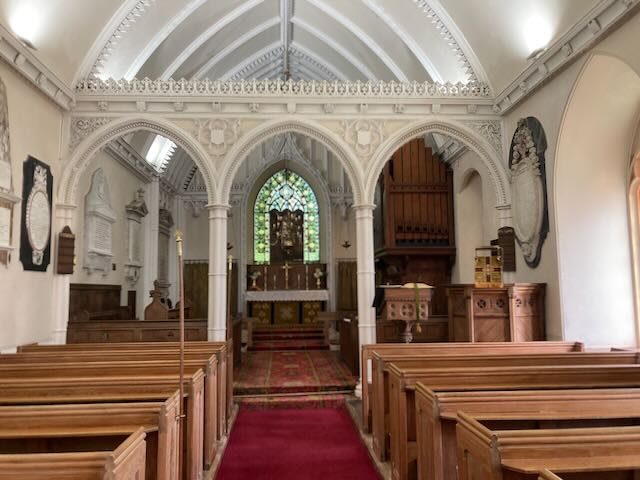
Nave and chancel of Holy Trinity Church at Deane.
The damp Deane parsonage where the Austens lived is long gone; it was replaced by a new building in 1855. One of the churchwardens says, “There was a rectory in the paddock opposite the path leading to the church, which burnt down. I believe the wall [old section in this photo] protected this rectory.”

Deane Parsonage and Living

George and Cassandra Austen lived in the Deane parsonage until 1768 when the Steventon parsonage was ready. Their first three children, James, George, and Edward, were born there. Mrs. Austen’s widowed mother, Jane Leigh, also lived with them at Deane, though she died shortly after the move to Steventon.

The Steventon living was worth only about £100 a year, including about three acres of glebe farmland. So Mr. Knight also let George Austen farm the 200-acre Cheesedown Farm for more income. Still, the Austens found the income too low to support their rapidly growing family. George’s great-uncle Francis of Sevenoaks in Kent bought the options on two nearby livings, Ashe and Deane, for George’s benefit.

The rector of Deane died before the rector of Ashe, so George Austen took the living for the parish of Deane, and Francis sold the other option to another relative, who later installed the Lefroys at Ashe. In 1773, Mr. Austen became rector of Deane, another small parish of “about two dozen families of farm labourers . . . worth £110” per year (Le Faye, 25). He also began taking in boys as students, to further supplement his income.

The Deane parsonage now belonged to George Austen, as part of the living. From 1786-1788, Madam Lefroy’s younger brother, Egerton Brydges, rented it from him and lived there. In 1789, George advertised the parsonage for rent, as “a neat brick dwelling-house with four living-rooms and four bedrooms, as well as all the necessary store rooms and servants’ quarter, plus a large garden, coach-house and stabling for six horses” (Le Faye, 68), making it sound more desirable than it had been. The next tenants were a clergyman’s widow, Mrs. Lloyd, and her daughters Martha and Mary. (Good Bible names for sisters; see John 11.) Martha and Mary soon became close friends of Jane and her sister Cassandra. Eventually both Lloyd sisters married into the Austen family.

In 1792, Jane’s eldest brother James and his wife Anne took over Deane parsonage, spending £200 to refurnish it, more than they could actually afford. James became his father’s curate at Deane, also serving two other small parishes. Their daughter Anna (Jane Anna Elizabeth Austen) was born in the Deane parsonage in 1793, with the help of her grandmother. “Mrs. Austen rose from her bed in the middle of the night, and walked by the light of a lantern a mile and a half of muddy country lane to attend her [daughter-in-law], and to usher into the world a new grandchild” (Le Faye, 84).

James’s wife Anne died in 1795, and Mary Lloyd returned to Deane parsonage as James’s second wife in 1797. In 1801, James and his family moved to the Steventon parsonage when George Austen retired to Bath. James served as curate of Steventon until his father died in 1805, when James became rector of Steventon.

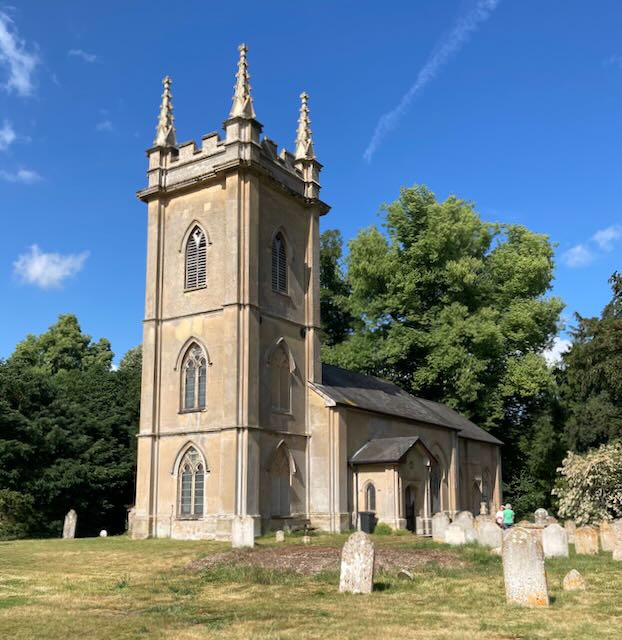
Holy Trinity Church at Deane was completely rebuilt, 1818-1820, in the pointed Gothic style. Much of the church was built of Coade stone, an artificial stone invented and produced by a woman, Eleanor Coade (1733-1821). She developed an amazing material that could be made to look like either wood or marble, resisted weathering, and could be molded into mass-produced items ranging from tiny ornaments to the pinnacles of this church. Thousands of intact examples of Coade stone can still be seen across England and abroad today.

Jane Austen’s Connections with Deane

Jane Austen mentions Deane in 27 of her existing letters. She also includes it in one of her juvenile pieces, “Memoirs of Mr. Clifford.” Mr. Clifford’s “first Day’s Journey carried him only to Dean Gate where he remained a few Days and found himself much benefited by the change of Air.” She is referring to the Deane Gate Inn, where men of the Austen family would catch the stagecoach. It is now a restaurant, the Palm Brasserie.

Jane often visited the parsonage at Deane, first when the Lloyds were living there, then when her brother and his family were there. Dampness and flooding were still an issue. On Oct. 27, 1798, she wrote:

“There has been a great deal of rain here for this last fortnight, much more than in Kent, and indeed we found the roads all the way from Staines most disgracefully dirty. Steventon lane has its full share of it, and I don’t know when I shall be able to get to Deane.”

In November and December she again talks about visits to her sister-in-law Mary at Deane, who gave birth to James Edward (who became Jane Austen’s first biographer) on Nov. 17:

I went to Deane with my father two days ago to see Mary, who is still plagued with the rheumatism, which she would be very glad to get rid of, and still more glad to get rid of her child, of whom she is heartily tired. Her nurse is come and has no particular charm either of person or manner; but as all the Hurstbourne world pronounce her to be the best nurse that ever was, Mary expects her attachment to increase. . . . Sunday. — I have just received a note from James to say that Mary was brought to bed last night, at eleven o’clock, of a fine little boy, and that everything is going on very well. My mother had desired to know nothing of it before it should be all over, and we were clever enough to prevent her having any suspicion of it”—Nov. 17-18, 1798

Jane continued to visit Mary every few days, reporting on her health. She even visited when ice covered the ground: 

“I enjoyed the hard black Frosts of last week very much, & one day while they lasted walked to Deane by myself.–I do not know that I ever did such a thing in my life before. . . . Mary went to Church on Sunday, & had the weather been smiling, we would have seen her here before this time”—Dec. 18, 1798.  This may have been when Mary was “churched,” a ceremony celebrating the safety of a mother after childbirth.

The main families of Deane, Steventon, and Ashe all visited each other and went to balls together. Jane danced at the Harwoods’ ball, in Deane, on Jan. 8, 1796. She often mentions John Harwood in her letters; for example:

“This morning has been made very gay to us, by visits from our two lively Neighbours, Mr. Holder and Mr. John Harwood.”—Dec. 18, 1798

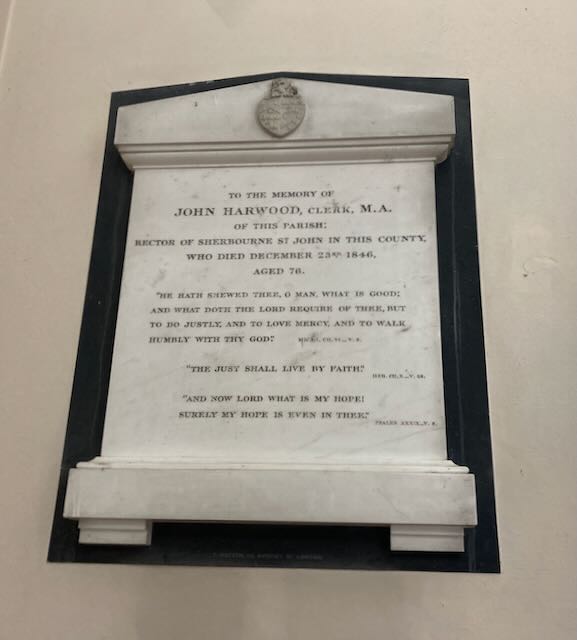
Deane church memorial to John Harwood (1770-1846), a member of the Harwood family of Deane, friends of the Austens. Harwood was rector of nearby Sherbourne St. John, where James Austen was vicar from 1791 to 1819. (The parish had both a vicar and a rector until 1844; the rector got more of the tithes.) Jane Austen mentions John Harwood in her letters in the context of visits, balls, and other events.
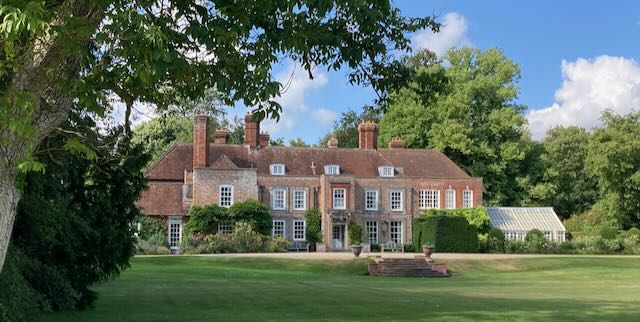
The Harwoods owned Deane House, now The Old Manor House. It can still be seen from the Deane church. Jane Austen danced there.

All Saints Church at Deane, Then and Now

In July, 1818, the Norman-era church at Deane was “in so Dangerous a state of Ruin as to be unsafe for the congregation.” So the patron, Wither Bramston of Oakley Hall, got approval from the Bishop of Winchester to rebuild it at his own cost, about £8000. It was consecrated two years later.

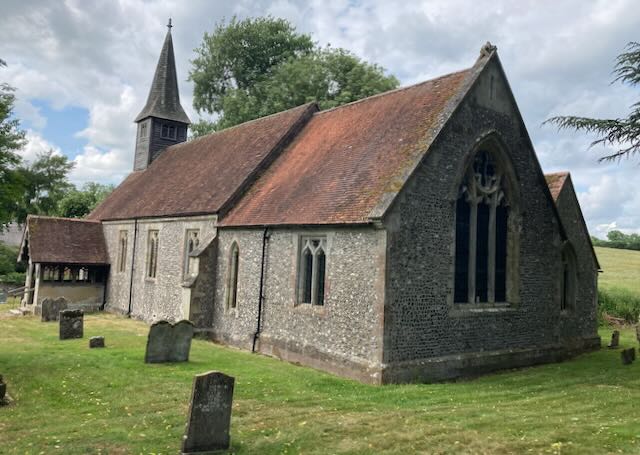
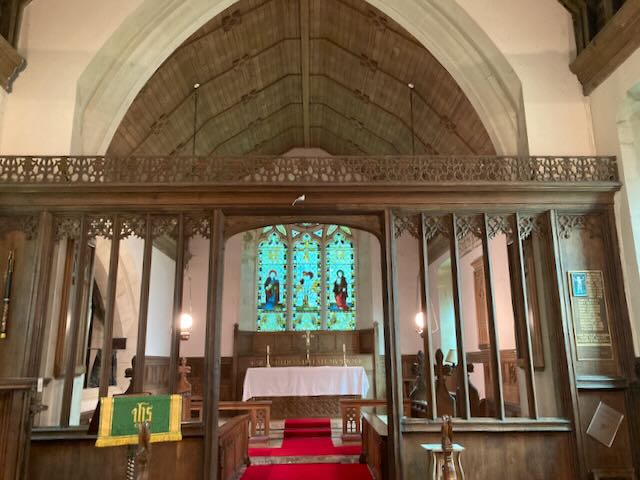
All Saints at Deane is considered “one of the most complete and successful” 19th century Gothic churches (Tanner). It is also renowned for its eight bells, which are rung regularly, and an 1820 Gothic chancel screen. The church today is a grade II listed building, but is not the same as the medieval church building where George and James Austen ministered. Some monuments from their time are on the walls of the current church, however.

An entrance to the Deane church marks its rebuilding in 1818.
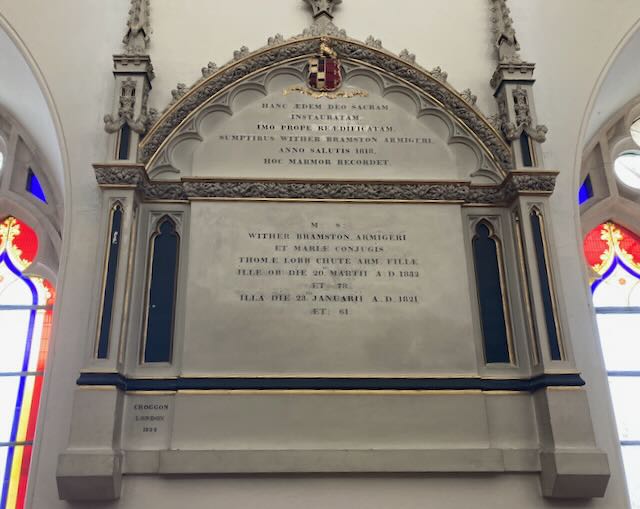
Memorial in Latin to Wither Bramston, died 1832, and his wife. As patron of the Deane living, he rebuilt the Deane church in 1818-1820 (as recorded in the top section of the memorial), at his own expense.

The church could seat 146 people in 1851. On Census Sunday, 94 parishioners attended in the morning and 124 in the evening. Leading up to World War I, the rector offered daily Communion in the church, and in 1917, he reported twenty people in the choir for Evensong. However, the population dropped, and in 2011, Deane included only an estimated 55 inhabitants, with an average age of over 60.

Now there are about 25 houses in the village, and about 8-10 people attend Sunday morning services twice a month. For a larger service, like the Christmas carol service, they may have about 40 attendees. Weddings are held there occasionally, and special services like pet blessings. All Saints is part of the United Benefice of North Waltham, Steventon, Ashe, and Deane.

Our guide to the church, Sue Hebeler, said she loves this church since it is her local church and her husband is buried there. She appreciates the traditional, old-fashioned services. If you’re in the vicinity, you may also enjoy a visit to this lovely, peaceful church.

This embroidered tapestry blesses the church, which was called St. Mary’s before it was rebuilt over 200 years ago. The picture may be more like the church’s earlier form. It reads, “Peace be within this sacred place; And joy a constant guest; With holy gifts and heavenly grace; Be her attendants blest.”

All images in this post ©Brenda S. Cox, 2024.

Brenda S. Cox is the author of Fashionable Goodness: Christianity in Jane Austen’s England. She also blogs at Faith, Science, Joy, and Jane Austen.
 

Posts on Other Austen Family Churches

Steventon

Chawton

Hamstall Ridware and Austen’s First Cousin, Edward Cooper

Adlestrop and the Leigh Family

Stoneleigh Abbey Chapel and Mansfield Park

Great Bookham and Austen’s Godfather, Rev. Samuel Cooke

Ashe and the Lefroy Family


Sources and Further Reference

Deirdre Le Faye, Jane Austen : A Family Record. Much of Le Faye’s information about Deane is also online at Deane

Terry Townsend, Jane Austen’s Hampshire, has a helpful chapter on Deane.

Richard Tanner, Ashe & Deane, explores the area.

Trailblazing Women of the Georgian Era by Mike Rendell includes a fascinating chapter on Eleanor Coade—manufacturer of artificial stone.

Read Full Post »

by Brenda S. Cox

“Madam” Anne Lefroy

Anne Lefroy, a dear friend of young Jane Austen, lived about two and a half miles north of Steventon, in the village of Ashe. Wealthy Benjamin Langlois was patron of the parish church, and he gave the living of Ashe to his nephew, Reverend Isaac Peter George Lefroy (called George) in 1783, when Jane was eight years old. At that time the church was called St. Andrew’s, and Ashe was spelled Ash.

Church of the Holy Trinity and St. Andrew at Ashe. While there has been a church on this site since Norman times, major rebuilding was done in 1878-9 by the Victorian church architect, George Gilbert Scott. So this is not the same building Jane Austen knew. The belfry houses one bell and occasional bats.

Rev. Lefroy’s wife was Anne Lefroy, cultured, educated, and hospitable. She wrote poetry, and had two witty poems published before her marriage. Because of her sophistication and hospitality, in the neighbourhood she was “known affectionately and respectfully” as Madam Lefroy. Mrs. Lefroy was 25 years older than Jane. So how did they become friends?  According to information sheets at the church,

“Anne Lefroy and Jane Austen, despite their age difference, formed a close friendship that started when the Lefroys invited the 11-year-old Jane to play with their 7-year-old daughter. Due to a mutual love of literature, Anne and Jane are believed to have had long literary discussions. Jane was allowed access to the extensive library of the Ashe rectory. Jane may also have shared her writing with Anne who, some have suggested, acted as a surrogate parent. This must have acted as an important source of support for Jane in her early years of writing.”

This is speculative. But Mrs. Lefroy is often mentioned in Jane Austen’s letters. Jane frequently visited the Lefroys’ parsonage and attended dances and parties there and at the local squire’s house, Ashe Park.

Rectors of Holy Trinity, Ashe. Rev. George Lefroy, wife of Jane’s friend Anne Lefroy, was rector from 1783 to 1806. His son John Henry followed him as rector, then another son, Benjamin, who married Jane Austen’s niece Anna Austen.

Tom Lefroy

Famously, Jane danced and flirted with George Lefroy’s nephew from Ireland, Tom Lefroy, when he came for a visit in 1796. She wrote to Cassandra, “Imagine to yourself everything most profligate and shocking in the way of dancing and sitting down together” (Jan. 9, 1796). A week later, on January 15, she wrote, “At length the Day is come on which I am to flirt my last with Tom Lefroy. . . . My tears flow as I write, at the melancholy idea.” She immediately starts another topic and we don’t know if she was joking or serious. She may have hoped to marry Tom, but a proposal never came.

It’s been speculated that Rev. and Mrs. Lefroy sent him away, since he needed to marry someone with more money than the Austens had. Or Tom himself may have decided to leave, and the Lefroys were disappointed in him for flirting and not following through. Jane said Tom was “laughed at” at Ashe because of her, so it might have all been teasing, not serious. In any case, Jane does not seem to have held the outcome against Tom or against Mrs. Lefroy. After all, as she wrote in Pride and Prejudice, “Handsome young men must have something to live on as well as the plain.”

(Tom Lefroy, by the way, pursued a legal career and became a chief justice of Ireland. His son Jeffrey became a churchman, dean of Dromore Cathedral in Ireland, and Tom’s grandson George Alfred Lefroy became an Anglican clergyman and a missionary to India, then Bishop of Lahore and Calcutta. He is remembered for opposing western racism toward Indians.)

Mrs. Lefroy apparently tried to set Jane up later with another friend, the Reverend Samual Blackall, who Jane later called “a piece of . . . noisy perfection . . . which I always recollect with regard.” But nothing came of that, either.

This information sheet at Holy Trinity, Ashe, shows the former rectory, home of Mrs. Anne Lefroy, as it is today, inside and out. Double doors between the drawing room and dining room could be thrown open for parties and dances, including those Jane Austen attended. The brick façade was built by Rev. George Lefroy, who “mortgaged the living,” presumably taking out a loan on the basis of his church income, to pay for improvements to the rectory.
Pews in the Ashe church, and a churchwarden’s stave, which was used to bar the way of congregants who misbehaved.

Jane Austen’s Poem

The strongest testimony of Jane’s attachment to Mrs. Lefroy is a poem Jane wrote to her in 1808. Four years earlier, Mrs. Lefroy had been thrown from her horse and died on Jane’s birthday, December 16.

In the poem, Jane calls Mrs. Lefroy “beloved friend,” and says the reminder of her death is a “bitter pang of torturing Memory.” She describes her:

Angelic Woman! past my power to praise
In Language meet, thy Talents, Temper, Mind.
Thy solid Worth, thy captivating Grace! –
Thou friend and ornament of Humankind! –

She says Mrs. Lefroy was unequalled, angelic, “with all her smiles benign, Her looks of eager Love, her accents sweet.” She spoke with “sense, . . . Genius, Taste, & Tenderness of soul.”

Jane also praises Mrs. Lefroy’s religious principles:

“She speaks; ’tis Eloquence–that grace of Tongue
So rare, so lovely! – Never misapplied
By her to palliate Vice, or deck a Wrong,
She speaks and reasons but on Virtue’s side.

Hers is the Energy of Soul sincere.
Her Christian Spirit, ignorant to feign,
Seeks but to comfort, heal, enlighten, chear,
Confer a pleasure, or prevent a pain. –

Can ought enhance such Goodness? – Yes, to me,
Her partial favour from my earliest years
Consummates all. – Ah! Give me yet to see
Her smile of Love. – the Vision disappears.

And Jane says she hopes to meet her again in heaven.

Mrs. Lefroy as a Clergyman’s Wife

Interestingly, Jane’s tribute is similar to Mrs. Lefroy’s obituary. One section says:

“Her religion predominated over all her excellencies, and influenced and exalted every expression and action of her life. How amiable and angelic she was in the domestic duties of daughter, wife, mother, and sister, . . . She has left a chasm in society. . . . Above all, the poor will receive this afflicting dispensation of Providence with the keenest sorrow and lamentation: she fed, she cloathed, she instructed them, with daily and never-ceasing attention; in grief she soothed them by her conversation and her kind looks; and in sickness, she comforted them by medicines and advice. . . .”

Mrs. Lefroy was very attached to her children, as we see in her letters to her son Christopher Edward. They have been published by the Jane Austen Society. Mrs. Lefroy ran a school from her home. She said teaching other children helped her to not miss her own children so much when they were away at school. She taught poor children to read and write and gave them practical skills to help them support themselves.

Like most clergy wives, she was also involved in medicating her parish as needed, but she took that a huge step further. Smallpox was a great killer in those days. When Mrs. Lefroy learned about the brand-new system of vaccination, she investigated and determined it was beneficial. Then she learned to do it herself, and vaccinated her own family and over 800 poor people, giving them protection from smallpox. The obituary concludes, “Thus she seemed like a ministering Angel, going about to dispense unmingled good in the world.”

A rood screen separates the nave, where the congregation worships, from the chancel, where the altar is located. It was designed to look like the same screen that Austen would have seen in the eighteenth century church at Ashe.

Ashe Church Memorials to the Lefroy Family

While most of the Ashe church is Victorian, a number of memorials remain from Austen’s time. Her Lefroy friends are all buried there.

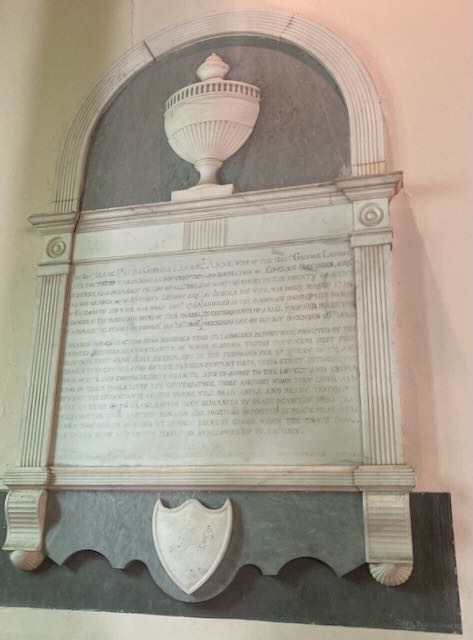
Memorial to Rev. Isaac Peter George Lefroy, “late Rector of this Parish and of Compton in Surry and formerly Fellow of All Souls College Oxford,” born Nov., 1745, died at the parsonage of a paralytic stroke Jan. 13, 1806; and Anne Lefroy, born March, 1749, and “died at the Parsonage House of this Parish in consequence of a fall from her horse the preceding day on Sunday December 16th 1804.”

The memorial to George and Anne Lefroy is very hard to read now, but a page in the church gives the text. The facts of their deaths are followed by:

“Reader: The characters here recorded need no laboured panegyric; prompted by the elevate dictates of Christianity, of whose glorious truths they are most firm believers, they were alike exemplary in the performance of every duty, and amicable in every relationship of life; to their fervent piety their strict integrity, their active and comprehensive charity, and in short to the lovely and useful tenor of their whole lives and conversations those amongst us who they lived, and especially the inhabitants of this parish, will bear ample and ready testimony, after a union of 26 years, having been separated by death scarcely more than 12 months, their earthy remains are together deposited in peace near this marble. Together be raised. We humbly trust in glory when the grave shall give up her dead, and death itself be swallowed up in Victory 

Rev. 14 v. 13

Blessed are the dead, which die in the Lord, even so saith the spirit for they rest from their labours.”

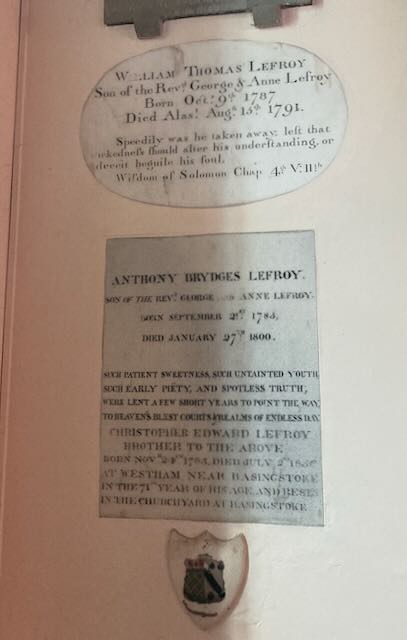
Many children died young. Memorials in the Ashe church commemorate two of the Lefroys’ children who died young, leaving their parents broken-hearted.

William Thomas Lefroy was only three years old when he “Died Alas!” as the plaque says. His brother Anthony Brydges Lefroy was fifteen when he died of an enlarged heart; they speculated it was the result of him falling from a horse two years earlier and not being bled by the doctor. Anne may have written the poem commemorating her son: “Such patient sweetness, such untainted youth, such early piety, and spotless truth; were lent a few short years to point the way; to heaven’s blessed courts, realms of endless day.” The plaque also commemorates their brother Christopher Edward, recipient of Anne’s letters, who lived to the ripe age of 71.

 Memorial in Ashe church to Rev. John Henry George Lefroy, born in 1782, who succeeded his father as rector of Ashe from 1806 until his death in 1823. (He became rector at age 24, the earliest legal age to take a living.)

The memorial to their son John Henry, the next rector of Ashe, focuses a great deal on his parents, George and Anne, who apparently taught him well: [brackets added]

“Heir to the same glorious hopes, he pursued with undeviating fidelity the example of his parents, whose characters are recorded on the adjacent marble. Distrustful alike of clamourous profession [religious ‘enthusiasm’] and philosophical liberality [Deism], he daily sought, with anxious singleness of eye [focus], amidst the tumult of religious opinions, the narrow practical way of Christianity. Imbued from his infancy with the deepest reverence for the benignant [kind, good] character and divine authority of Christ, the spirit of Christianity pervaded his whole walk and conversation; in all the relations of son, brother, husband, father, as a minister, a magistrate, a man, his constant affection, his earnest benevolence, his scrupulous integrity were equally conspicuous; utterly rejecting at the same time, all presumptuous dependence on his own merits, his humble and only confidence in death, as through life, was in the one full perfect, and sufficient sacrifice of his saviour upon the cross, for the sins of the whole world. Having, thus, maintained through life, his parents character, and died in his parents faith, here, at the early age of forty one, he reposes in his parents grave, having left a widow and eleven children to cultivate the memory of his excellence, exert themselves to follow his footsteps, and deplore their irreparable loss.”

Wow! I don’t know who wrote that, but this was an impressive family.

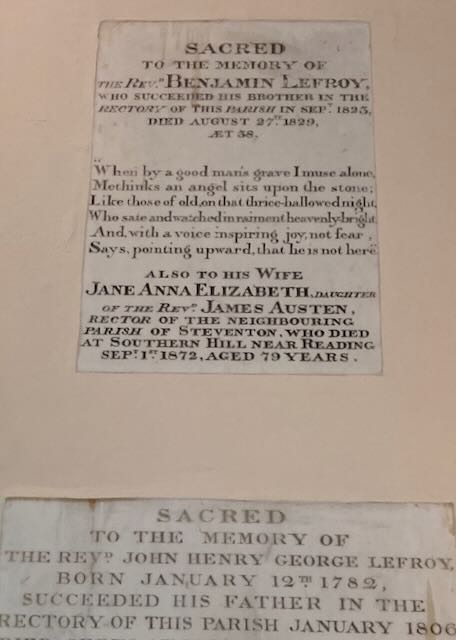
Memorial in Ashe Church to Benjamin Lefroy, the next rector, who married Jane Austen’s niece Anna Austen, also memorialized here.

John Henry’s brother Benjamin Lefroy married Jane’s beloved niece Anna Austen (daughter of Jane’s clergyman brother James). Benjamin followed John Henry as the next rector, for only four more years until he died in 1829, age 38. A poem recalling Christ’s resurrection commemorates Ben Lefroy’s life, and the life of his wife Anna, who died near Reading in 1872, age 79.

“When by a good man’s grave I muse alone,

Methinks an angel sits upon the stone; 

Like those of old on that thrice-hallowed night.

Who sate and watched in raiment heavenly bright,

And, with a voice inspiring joy, not fear,

Says, pointing upward, that he is not here.”

Holy Trinity and St. Andrew’s Church, Ashe, Today

There has been a church in Ashe since Norman times. In 1851, during the only Religious Census taken in England, the church had a seating capacity of 140. Their attendance at the morning service that Sunday was 98, and at the afternoon service, 120. 

However, like many English rural parishes today, the area is now mostly farmland with only about 100 residents in the parish. About 10-15 people attend the church’s Sunday services twice a month. Of course they can attend other churches nearby on the alternate Sundays. Ashe is in a combined benefice with Steventon, Deane, and North Waltham, and they sometimes combine events with the adjoining benefice of Overton. Special services bring in more people; Ashe may fill the church with 140 worshipers at Christmas. They occasionally host weddings; special services, including one for blessing pets; and other events.

The Robin at the Ashe church. When the church was being rebuilt in the nineteenth century, a robin would come in and eat out of the workmen’s hands. It even built a nest in one of the windows. In honor of that robin, one of the carpenters carved this wooden robin, kept in a little closed vault in one wall of the church.
The church sometimes enjoys organ music from this instrument at Ashe church, which I was told is about 150 years old.
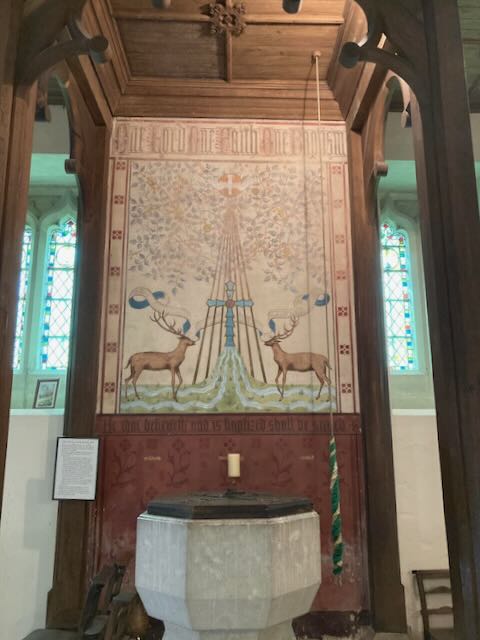
At Ashe church, Victorian stained glass windows and this 1887 painting representing baptism and the Tree of Life, add lovely touches to the walls.

Fiona Price, our guide to the church, said she and her young grandson love the peace and tranquility of the place. Holy Trinity and St. Andrew’s Church at Ashe is an interesting church to visit, near Steventon. It would have been about an hour’s walk away for Jane Austen.

All images in this post ©Brenda S. Cox, 2024.

Brenda S. Cox is the author of Fashionable Goodness: Christianity in Jane Austen’s England. She also blogs at Faith, Science, Joy, and Jane Austen.
The obituary is quoted from a “Provincial Newspaper” in a footnote to S.E. Bridges, “Lines to the Memory of Mrs. Lefroy,” in The Poetical Register, 1805 (London: Rivington, 1807): 67–68. 

Further Resources

The Letters of Mrs. Lefroy, edited by Helen Lefroy and Gavin Turner, published by the Jane Austen Society (U.K.) This is hard to get hold of in the US, though I found it through Inter-Library Loan. I thought it gave the best insights into Mrs. Lefroy, her character, thoughts, and life. 

Jane Austen’s Inspiration: Beloved Friend Anne Lefroy, by Judith Stove, explores Anne Lefroy’s life, writings, and family connections. 

Posts on Other Austen Family Churches

Steventon

Chawton

Hamstall Ridware

Adlestrop and the Leigh Family

Stoneleigh Abbey Chapel

Great Bookham and Austen’s godfather, Rev. Samuel Cooke

Deane

Read Full Post »

Older Posts »