Feeds:
Posts
Comments

Archive for the ‘Emma’ Category

picnic-at-box-hill-frank-saw-emma-first-in-march-2

The wretchedness of a scheme to Box Hill was in Emma’s thoughts all the evening. How it might be considered by the rest of the party, she could not tell. They, in their different homes, and their different ways, might be looking back on it with pleasure; but in her view it was a morning more completely misspent, more totally bare of rational satisfaction at the time, and more to be abhorred in recollection, than any she had ever passed. – Emma, Jane Austen, Chapter 44

  • Re-reading Box Hill: Reading the Practice of Reading Everyday Life offers five articles on the topic of Box Hill. How astounding. Click here to enter the site.

Read Full Post »

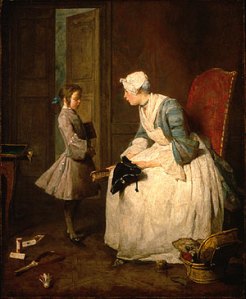
the-governess-1739-jean-simeon-chardin2“With the fortitude of a devoted novitiate, she had resolved at one-and-twenty to complete the sacrifice and retire from all the pleasures of life, of rational intercourse, equal society, peace, and hope, to penance and mortification forever” – Jane Austen about Jane Fairfax in Emma

Working as a governess meant a life of limbo for the poor gentlewoman who was forced to support herself due to reduced financial cirdumstances. Jane Fairfax had every reason to fear her future employment. Governesses were a threat to both their employers and the servants of the house,  reminding their female employers of how close they were to finding themselves in a similar predicament. Because of their genteel upbringing governesses lived a life of isolation, not fitting in with the servants belowstairs, not even the housekeeper, butler, or nanny, who, while they belonged to the upper ranks of servants, came from humble origins. Governesses seldom earned enough to save for their old age, and their services were often exploited and undervalued.  Dinah Birch writes in her review of Other People’s Daughter: The Life and Times of the Governess by Ruth Brandon:

Their “predicament was earnestly debated in journals, advice books and manuals, educational treatises, newspapers, charitable commissions, lectures, reviews and memoirs. She became the object of inadequate charity, useless compassion and offensive condescension. Worse still, she had to endure the sense of having fallen from her proper place in the world, for most governesses had been brought up amid domestic comforts and cheerful expectations.”  

This passage from  The Uneasy World Between describes the governesses’ dilemma succinctly:

The governess was often perceived as being an emotional and social threat. Many gentlewomen were forced into the role by some financial catastrophe, reminding the families they worked for of a terrible possibility. Moreover, their intimacy with children often roused the mother’s hostility, and a war for the child’s love was the result. By the middle of the century, a spate of bank failures had hugely oversupplied the market with under- educated would-be governesses, some of whom were reduced to working for £20 a year, or even for nothing except bed and board. What happened to these when they grew too old to work — perhaps only at 40 — does not bear thinking about. Only very few governesses earned more than £200 a year; Sir George Stephen in 1844 only found a dozen. Charlotte Brontë, paid £20 a year in 1841, was much more typical. The social inequality flowed, however, in an unexpected way. Many governesses, more ladylike than their employers, were expected to give a sheen of social elegance to the children of the nouveaux riches. Resentment tended to flow both from the employers and from the servants’ hall. ‘I don’t like them governesses, Pinner,’ the cook in Vanity Fair says of Becky Sharp. ‘They give themselves the hairs and hupstarts of ladies, and their wages is no better than you nor me.’ The ugly situation was very clear to the more thoughtful women in this class. ‘I should be shut out from society,’ Mary Wollstonecraft wrote, ‘and be debarred the imperfect pleasures of friendship — as I should on every side be surrounded by unequals.’The one truly typical story here, perhaps, is that of a crushed and struggling woman, Nelly Weeton. We only know about her because she wrote a journal, discovered long after her death, cataloguing with great ill-humour and resentment the treatment she received at the hands of her drunken and snobbish employers, her bullying father and brother and ultimately an appalling husband. She’s not an attractive figure, full of self-pity and complaint, but her tragic story shows how much governesses at the bottom end of the market had to put up with.

The classic governess in our collective minds is Jane Eyre. She came from a relatively humble background,  but many a young governess came from a background and breeding that equalled  her employers. This definition written in 1849 in The Living Age  describes how  untenable the situation could be:

“…the real definition of a governess in the English sense is a being who is our equal in birth manners and education but our inferior in worldly wealth.  Take a lady in every meaning of the word born and bred and let her father pass through the gazette and she wants nothing more to suit our highest beau ideal of a guide and instructress to our children…There is no other class which so cruelly requires its members to be in birth mind and manners above their station in order to fit them for their station. From this peculiarity in their very qualifications for office result all the peculiar and most painful anomalies of their professional existence. The line which severs the governess from her employers is not one which will take care of itself, as in the case of a servant.

Governesses depended on the kindness of their employers. Emma’s governess, Miss Taylor, who later became Mrs. Weston, was fortunate enough to be treated like a member of the family. One surmises  that she was one of the few to make closer to the  £200 per year described above, than the average of  £20 pounds per year that most governesses earned. In real life, Agnes Porter (c. 1750-1814) was one of the lucky women to be treated with respect when she worked as a governess to the children and grandchildren of the second Earl of Ilchester. She wrote down her thoughts as an unmarried, employed gentlewoman in journals and letters that have been published. A devoted parent, Lord Ilchester took his children with him on on trips, leaving Agnes with enough  free time to entertain friends in her private apartments. She was also invited to dine  in with the family or spend an evening with them.  While Agnes’s experience was a relatively good one, she still would have preferred to be married. Becoming someone’s wife was a desirable goal, since prospects were bleak for a woman who was not “the property’ by anyone. ‘I could not forbear partially and deeply reflecting on the ills that single women are exposed to, even at the hour of death, from being the property of no one.’ ” (Information from: A Governess in the Age of Jane Austen: The Journals and Letters of Agnes Porter). 

In 1886, novelist Wilkie Collins wrote the following dialogue about the governess, Miss Westerfield,  in The Evil Genius: The Story:

Mrs. Linley returned to the subject of the governess.

“I don’t at all say what my mother says,” she resumed; “but was it not just a little indiscreet to engage Miss Westerfield without any references?”

“Unless I am utterly mistaken,” Linley replied, “you would have been quite as indiscreet, in my place. If you had seen the horrible woman who persecuted and insulted her–”

His wife interrupted him. “How did all this happen, Herbert? Who first introduced you to Miss Westerfield?”

Linley mentioned the advertisement, and described his interview with the schoolmistress. Having next acknowledged that he had received a visit from Miss Westerfield herself, he repeated all that she had been able to tell him of her father’s wasted life and melancholy end. Really interested by this time, Mrs. Linley was eager for more information. Her husband hesitated. “I would rather you heard the rest of it from Miss Westerfield,” he said, “in my absence.”

“Why in your absence?”

“Because she can speak to you more freely, when I am not present. Hear her tell her own story, and then let me know whether you think I have made a mistake. I submit to your decision beforehand, whichever way it may incline.”

The implication, of course, was that anyone with compassion would have hired Miss Westerfield. Learn more about the governess in the following links:

Read Full Post »
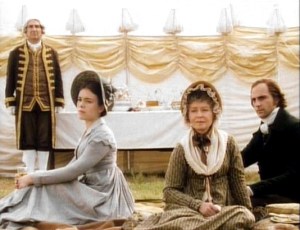
It is ironic that a novel filled with clues similar to those found in a good mystery tale can spin off a film whose clues stand out like a red cape in front of a bull. Jane Austen deftly sprinkled hints about Jane Fairfax’s relationship with Frank Churchill throughout Emma. One has to read the novel twice to find her subtle inferences, and even then one might miss a few. The 1996 film version of Emma, written by Andrew Davies, leaves no stone unturned and drops its clues with such a heavy hand that midway through the film you want to shout – “enough!” Jane and Frank exchange frequent glances, are seen at the piano together in Mrs. and Miss Bates’ apartment, and argue on the terrace at Donwell Abbey. We even see Jane crying after their tiff as she walks through a field hatless. Tsk. Tsk. At least Mr. Davies did not sex up this particular film adaptation.

While I like this film overall, and gave it a favorable review when it was shown during PBS’s presentation of The Complete Jane Austen earlier this year, it did have a cringe worthy moment. Mr. Knightley, forcefully played by Mark Strong, proposes to Emma and says afterwards: “I held you in my arms when you were three weeks old”. Kate Beckinsale as Emma replies before they kiss: “Do you like me now as well as you did then?” Eww! The unfortunate image these words evoke are not at all what Jane intended. Here is how her Mr. Knightley proposes, which is just as it ought to be:

“My dearest Emma,” said he, “for dearest you will always be, whatever the event of this hour’s conversation, my dearest, most beloved Emma—tell me at once. Say ‘No,’ if it is to be said.”—She could really say nothing.—”You are silent,” he cried, with great animation; “absolutely silent! at present I ask no more.”

Emma was almost ready to sink under the agitation of this moment. The dread of being awakened from the happiest dream, was perhaps the most prominent feeling.

“I cannot make speeches, Emma:”—he soon resumed; and in a tone of such sincere, decided, intelligible tenderness as was tolerably convincing.—”If I loved you less, I might be able to talk about it more. But you know what I am.—You hear nothing but truth from me.—I have blamed you, and lectured you, and you have borne it as no other woman in England would have borne it.—Bear with the truths I would tell you now, dearest Emma, as well as you have borne with them. The manner, perhaps, may have as little to recommend them. God knows, I have been a very indifferent lover.—But you understand me.—Yes, you see, you understand my feelings—and will return them if you can. At present, I ask only to hear, once to hear your voice.”

Jane DID bring up the differences in ages, but earlier in her novel, when 21-year-old Emma and 37-year-old Mr. Knightley attended a family gathering soon after Mr. & Mrs. John Knightley arrive for a visit. The conversation occurs some time after Mr. Knightley had chastised Emma for influencing Harriet in declining Mr. Martin’s marriage proposal. In this scene, Emma and Mr. Knightley speak as long-standing friends and as relations through marriage:

Emma: “What a comfort it is, that we think alike about our nephews and nieces. As to men and women, our opinions are sometimes very different; but with regard to these children, I observe we never disagree.”

Mr. Knightley: “If you were as much guided by nature in your estimate of men and women, and as little under the power of fancy and whim in your dealings with them, as you are where these children are concerned, we might always think alike.”

Emma: “To be sure—our discordancies must always arise from my being in the wrong.”

Mr. Knightley: “Yes,” said he, smiling—”and reason good. I was sixteen years old when you were born.”

Emma: “A material difference then,” she replied—”and no doubt you were much my superior in judgment at that period of our lives; but does not the lapse of one-and-twenty years bring our understandings a good deal nearer?”

Mr. Knightley: “Yes—a good deal nearer.”

Emma: “But still, not near enough to give me a chance of being right, if we think differently.”

Mr. Knightley: “I have still the advantage of you by sixteen years’ experience, and by not being a pretty young woman and a spoiled child. Come, my dear Emma, let us be friends and say no more about it. Tell your aunt, little Emma, that she ought to set you a better example than to be renewing old grievances, and that if she were not wrong before, she is now.” – Emma, Chapter 7, Volume One

Since watching this film adaptation, I have often wondered why Mr. Davies inserted those words about Emma as a baby into the script at what should have been a supremely romantic moment. Thankfully the Harvest Ball almost made up for his faux pas, almost, but not quite. Although the scene ends the movie on a perfect note, Jane never wrote it for her novel.
Score: Jane Austen, 100; Andrew Davies, Good try.

For more posts about Emma, 1996, click on the links below:

Read Full Post »

They had a very fine day for Box Hill … Nothing was wanting but to be happy when they got there. Seven miles were travelled in expectation of enjoyment, and every body had a burst of admiration on first arriving…Jane Austen, Emma


One of the most famous scenes in Emma is the picnic scene on Box Hill. Picnics were becoming increasingly popular at the turn of the nineteenth century, when romantic sensibility influenced the trend of eating out of doors as a way to commune with nature. According to the Oxford English Dictionary, the term picnic originally meant “A fashionable social entertainment in which each person present contributed a share of the provisions; now, A pleasure party including an excursion to some spot in the country where all partake of a repast out of doors: the participants may bring with them individually the viands and means of entertainment, or the whole may be provided by some one who ‘gives the picnic’. ”

Even though picnicking became increasingly popular, arranging one was often no easy matter. According to Andrew Hubbell, author of How Wordsworth Invented Picnicking and Saved British Culture*:

To picnic is to consume not only particular food, but also a specific environment chosen according to an aesthetic standard, and a particular form of sharing food according to certain standards of behaviour. It means creating a moveable feast and overcoming difficulties and inconveniences, not only for preparation and transportation,but also for consumption and cleanup. Yet picnicking is the pleasurable pursuit of a leisured people, so the difficulty of moving the feast has some reward. The reward is primarily ideological: it enables the participant to share a form of eating that creates relationships between small groups of people, natural landmarks, and cultural ideals. These relationships form a consciousness of national identity. Picnicking, especially for early nineteenth-century picnickers, was thus away of performing Britishness.


This Romantic aesthetic can be witnessed in the A&E version of Emma, to be show on PBS this Sunday. Box Hill, the setting of Emma’s famous picnic, and comprising of woods and grassland, offered a spectacular view of the surrounding countryside. The experience of eating in such a beautiful setting would appeal to both the eye and palate. Box Hill is covered with box trees, yew trees. and beeches and oaks. To this day, the area is filled with flowers and the sound of bird song, and fully two-thirds of the British butterfly species have been recorded at this site.**
As is still the custom, each member or group invited to a regency picnic brought a dish, usually carried in wicker baskets, for the others to enjoy. In this way a variety of dishes would be shared and tasted. However, without someone to guide them, guests would often bring similar foods. As picnics became more organized and elaborate, one person would take charge of assigning the dishes, ensuring the non-duplication of foods, or a host would offer to take over the responsibility of providing all the food.

As the 1997 A&E film demonstrates, these elegant and sumptuous picnics were not easy to accomplish. Teams of horses were arranged to transport wagons with picnickers, servants, food, and outdoor furniture. If the picturesque spot was located in an out of the way place, the party had to walk the remainder of the way with the supplies. The servants would lay out the dishes, and tables and cloths al fresco. After the parties had dined, these supplies needed to be repacked.

In the film, the servants were shown constantly working to provide a leisurely and pleasurable outing for the picnickers. Their hard work was for naught, however, since no one in the party, most particularly Emma, seemed to be having a good time. As the afternoon progressed, the underlying tension among the diners erupted with Emma’s cruel comment towards Miss Bates.

The Box Hill scene in Emma is pivotal. After Emma insults Miss Bates, Mr. Knightley angrily confronts her about her behavior. Unable to remain blind to her own faults, Emma begins to change and grow. She realizes how much she craves Mr. Knightley’s good judgment, which leads her to a later revelation that she loves him.

Interestingly, at the strawberry-picking at Donwell Abbey the day before, Mr. Knightley says to Mrs. Elton: “The nature and the simplicity of gentlemen and ladies, with their servants, and furniture, I think is best observed by meals within doors.” Given how utterly the Box Hill excursion failed to entertain the picnickers, his words were prophetic.

To read more about the origins of picnics, and about Box Hill, click on the long list of links below.

Box Hill, Emma

Physical Setting of Box Hill

The History of Picnics


Technorati Tags: , , , ,

Read Full Post »

« Newer Posts

