Feeds:
Posts
Comments

Archive for the ‘Georgian Life’ Category

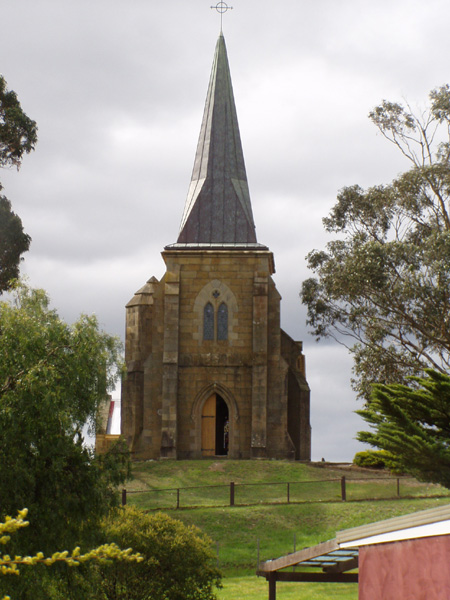
St. Johns Catholic Church, Richmond, Australia

What are the odds that two Richmonds a world apart would boast two historic churches named St. Johns? St John’s in Richmond was built in 1837 and is the oldest Roman Catholic Church in Australia (actually, Tasmania). The structure is situated near the oldest bridge, built between 1823 and 1825 by Australian convicts over the Coal River, and was used by military police and convicts between Hobart and Port Arthur.

St. John's Episcopal Church, Richmond, Virginia

St. John’s Episcopal Church was built in Richmond in 1741. In 1775, Patrick Henry, George Washington, Thomas Jefferson, Richard Henry Lee, Peyton Randolph and other important Virginia delegates met in the church for the Second Virginia Convention of the House of Burgesses, where Patrick Henry delivered his famous speech: “Give me Liberty or Give me Death.” The delegates were  so impressed by the speech that they decided to organize a Virginia militia, which led the way to Revolutionary War.

Coincidentally, both St. John churches were built on top of hills.

Read Full Post »

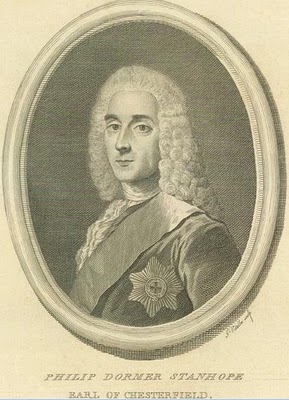
Influenced by his own neglect as a child, Lord Chesterfield began to write letters of advice to Philip, his illegitimate son by a Dutch governess, when the boy was only five years old. Regardless of what one might think of the information contained in these letters, they provide a fascinating insight into the manners and etiquette of the a gentleman in the 18th century:

I shall not therefore mention to you at present, your Greek or Latin, your study of the Law of Nature, or the Law of Nations, the Rights of People, or of Individuals; but rather discuss the subject of your Amusements and Pleasures; for to say the truth one must have some. May I be permitted to inquire of what nature yours are? Do they consist in little commercial play at cards in good company? are they little agreeable suppers at which cheerfulness and decency are united? or do you pay court to some fair one who requires such attentions as may be of use in contributing to polish you? Make me your confidant upon this subject; you shall not find a severe censor: on the contrary, I wish to obtain the employment of minister to your pleasures: I will point them out and even contribute to them. – Lord Chesterfield

Read Full Post »

This link to the BBC site will lead you to a video of a walk with Amanda Parr through Bath. You will need a Real Player.

Other posts about Bath on this site:

The Comforts of Bath: Thomas Rowlandson

The Viscount and the Toll Keeper’s Daughter: How Thomas Thynne Never Became the Marquess of  Bath

Saving Georgian Bath

Read Full Post »

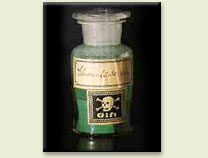
Bottle with emerald green pigment

Once upon a time green paint literally killed people. In 1814 in Schweinfurt, Germany, two men named Russ and Sattler tried to improve on Scheele’s green, a paint made with copper arsenite. The result was a highly toxic pigment called emerald green. Made with arsenic and verdigris, the bright green color became an instant favorite with painters, cloth makers, wall paper designers, and dyers. The first commercial British arsenic was produced at Perran-ar-Worthal in 1812, and at Bissoe in the Carnon Valley in 1834. Their product appealed to the Lancashire cotton industry which used the chemical in pigments and dyes. It was also used by other industries such as glass manufacture (as a decolouriser), in the production of lead-shot, leather tanning, soaps, lampshades, wallpaper manufacture (to create green and yellow print), pharmaceuticals, agriculture for sheep dips, children’s toys, candles, a highly effective rat poison, etc.*

“Manufacture of [emerald green] began in 1814 at the Wilhelm Dye and White Lead Company of Schweinfurt. It was more popular than Scheele’s green and was soon being used for printing on paper and cloth; it even coloured confectionary. –  The Elements of Murder: A History of Poison, John Emsley

Textured Georgian wallpaper

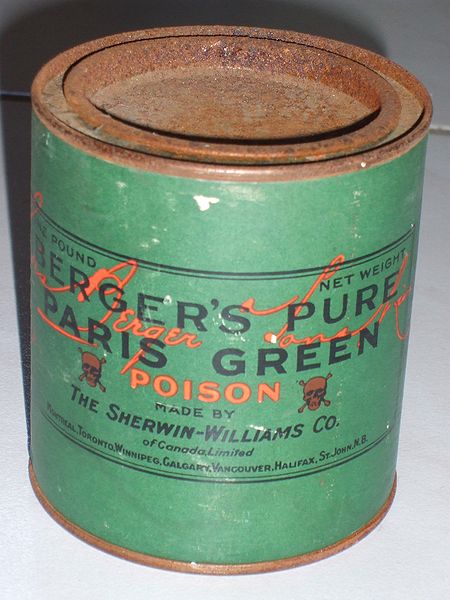
Emerald green was also called Schweinfurt green, Paris green, and Vienna green. The toxicity of dye made with emerald green was not initially recognized, until the recipe was published in 1822, and
“…its poisonous nature was revealed. Manufacturers then changed the recipe, adding other ingredients to lighten the colour, and changing its name accordingly in an effort to disguise its true nature.” – Murder, Emsley
Eventually, the use of this pigment was abandoned when it became generally known that people who wore clothes dyed with the substance tended to die early. To this day the French avoid making green theater costumes.** Emerald green was also used to color confectionary and cake cake decorations:
“The leaves of artificial flowers in particular were coloured with various arsenic greens and they were very popular in Victorian households. The industry making them employed hundreds of young girls, who suffered accordingly from chronic arsenic poisoning…at a banquet held by the Irish Regiment in London in the 1850’s the table decorations were sugar leaves coloured by them. Many of the diners took these home for their children to eat as sweets and several deaths ensued. At another dinner in 1860 a chef was eager to produce a spectacular green blancmange and sent to a local supplier for green dye. He was given Scheele’s green and three of the diners later died.” – Ibid
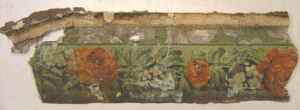
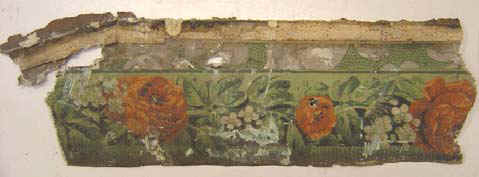
Floral border wallpaper, Ipswich, late 18th c.***

Wallpaper made with Scheele’s green was deadly, By 1830, wallpaper production had risen to 1 million rolls a year in the UK, and by 30 million in 1870. Tests later revealed that four out of five wallpapers contained arsenic. Leopold Gmelin (1788-1853), a famous German chemist, suspected as early as 1815 that wallpaper could poison the atmosphere. He noticed that the substance gave off a mouse-like odor when the paper was slightly damp. Gmelin warned people to strip their rooms of the paper and advocated banning Scheele’s green, but he was too far ahead of his time.
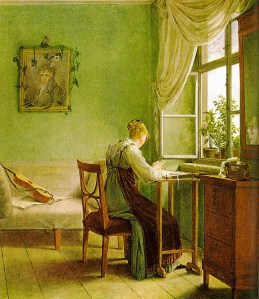
In 1861, Dr W. Fraser tested wallpaper that contained arsenic.The threat, he said, came from breathing the dust of the papers, especially flocked wallpaper. The warnings went unheeded, and by 1871, arsenic production had increased to the point that Britain had become its largest producer and consumer. An addition of a small amount of arsenic, for example, would neutralize iron in glass and give it a green tint. “Potassium chromate (K2CrO4) is yellow and this colour can be imparted to certain glasses. To produce emerald green glass in which a yellowish cast has to be avoided the addition of tin oxide and arsenic is necessary.” (Substances used in the making of colored glass.)

Soon arsenic was exported for the making of pesticides in the United States. Health considerations did not end the use of arsenic-laced wallpaper. By the 1870’s synthetic green dyes began to replace arsenic, and fewer people were placed in danger by its poisonous gases. Experiments at the end of the 19th century proved that arsenic pigments in damp or rotting wallpaper were lethal. The mold that grew on damp wallpaper emitted a toxic odor that smelled of garlic.

The French painter Cezanne had an affinity for using paris green, and it might have been no coincidence that he suffered from severe diabetes. The pigment had a tendency to turn black when exposed to heat and thus it did not become universally popular with artists. Even with scientific evidence of its highly toxic nature, production of emerald green paint was not banned until the 1960’s.

More on the topic

Read Full Post »
In 1751, Denis Diderot and Jean le Rond d’Alembert edited the 17-volume Encyclopedia: the Rational Dictionary of the Sciences, commonly known as the Encyclopédie. These heavily illustrated volumes were designed to teach people to think critically and objectively about all matters in the 18th century. Diderot said he wanted to “change the general way of thinking.” His ambition created quite a stir.

Diderot Couturiere

The Encyclopedie aroused opposition from the outset. Its first volume, published in 1751, dealt with topics such as atheism, the soul, and blind people (all words beginning with “a” in French. As a result, the government banned publication and the pope placed it on the Index of Forbidden books. He threatened to excommunicate all who bought or read it. The publisher of the work watered down later volumes without the consent of the writers in an attempt to stay out of trouble. The Encyclopedie exalted knowledge, questioned religion and immortality (Diderot was a proclaimed atheist), and criticized legal injustices and intolerance. Diderot championed the cause of women, writing that laws which limited the rights of women were counter to nature. The work was widely read and published in Switzerland, but was extremely popular in France. Copies reached America where it was read by Benjamin Franklin and Thomas Jefferson. It was completely banned in Spain as were other enlightenment works by order of church authorities.- The Enlightenment

Onsite Review discusses Diderot’s mid-18th century tailors, or tailleurs, and offers several corresponding images:

This survey of French crafts and trades just before the Revolution, includes such things as how a bodice is made, a riding jacket, gloves, hats – all the patterns laid out flat. Included are the workrooms for glovemakers, tailors, hatmakers – the spaces of craft and trade: where is the dress cut and stitched? where does the dressmaker or the tailor sit as they fell a seam? what is the space like in which the hat is sold?

In the Encyclopédie they are austere rooms flooded with light from tall many-paned sash windows. These rooms are never deep and usually have windows on two facing sides. Because these are crafts and trades, furniture is the work bench, a sturdy work table, open shelves and sometimes a cabinet. Accompanying the plates illustrating the garment, and the plates showing the spaces, are the plates of tools, the instruments of the craft: a catalogue of needles, of stretchers, of hat presses, of shears.

Gants, or glove patterns

The illustrated plates and their topics are discussed by John Morley, who wrote about the Encyclopédie in 1905:

Diderot, as has been justly said, himself the son of a cutler, might well bring handiwork into honour; assuredly he had inherited from his good father’s workshop sympathy and regard for skill and labour.The illustrative plates to which Diderot gave the most laborious attention for a period of almost thirty years, are not only remarkable for their copiousness, their clearness, their finish—and in all these respects they are truly admirable—but they strike us even more by the semi-poetic feeling that transforms the mere representation of a process into an animated scene of human life, stirring the sympathy and touching the imagination of the onlooker as by something dramatic. The bustle, the dexterity, the alert force of the iron foundry, the glass furnace, the gunpowder mill, the silk calendry are as skilfully reproduced as the more tranquil toil of the dairywoman, the embroiderer, the confectioner, the setter of types, the compounder of drugs, the chaser of metals. The drawings recall that eager and personal interest in his work, that nimble complacency, which is so charming a trait in the best French craftsman. The animation of these great folios of plates is prodigious. They affect one like looking down on the world of Paris from the heights of Montmartre. To turn over volume after volume is like watching a splendid panorama of all the busy life of the time. Minute care is as striking in them as their comprehensiveness. The smallest tool, the knot in a thread, the ply in a cord, the curve of wrist or finger, each has special and proper delineation. The reader smiles at a complete and elaborate set of tailor’s patterns.-DIDEROT AND THE ENCYCLOPÆDISTS, BY JOHN MORLEY, 1905

Illustration from Onsite Review

The above illustration from Onsite Review shows how the pattern for a riding outfit is laid out on the cloth. The width of the cloth varied. Wool cloth was wider than brocade, for instance. With Diderot’s publication of these plates, the knowledge of how to lay out these patterns became standardized. Onsite Review’s article, Diderot: Cutting Your Coat to Fit the Cloth, is fascinating to read.

Share/Bookmark// More about the Encyclopédie and Diderot:

Read Full Post »

« Newer Posts - Older Posts »