 Gentle readers,
The Lady Susan Soiree is going full tilt at Austenprose, where Laurel Ann and her band of readers are finishing up Jane Austen’s last published novel. Lady Susan is an epistolary novel, or one that is written in letter format. Last week I wrote a post about Upper Seymour Street, one of the prominent addresses in the novel, this week I will be writing about the postal service during the Georgian era. Not only did Jane Austen write a novel in letter format, she was a great letter writer herself. Sending a letter over two hundred years ago was much like sending an email today: the service was expensive and it depended upon the smooth running of a money making operation. But in London the service was different, for the Penny-Post had been introduced. This form of sending letters was both easy, affordable and practical, and explains how a lady with straitened finances like Lady Susan Vernon could afford to write so many letters in such a short space of time.
During the eighteenth century a letter from London to Bath could take three days to arrive, but by the 1820s, mail was delivered the morning after posting in towns more than 120 miles apart. In central London the postal service was so efficient, and there were such frequent deliveries, than an invitation issued in the morning could be acknowledged the same afternoon. – High Society, Venetia Murray, ISBN: 0670857580, p. 2.
Venetia Murray’s entry about the postal service was short and to the point, but it does not come close to telling the entire story. Because I uncovered so much information, I am dividing this post into three parts: 1) Letters and the Penny-Post, 2) Post Roads and Post Boys, and 3) John Palmer and the Royal Mail Coach.
Part One: Letters and the Penny-Post
In 1635 Charles I opened up his ‘royal mail’ for use by the public. Oliver Cromwell established the General Post Office in 1657 and after the Restoration, Charles II authorized the General Post Office to operate the ‘royal mail’, with the revenue from the postal service going to the Government.
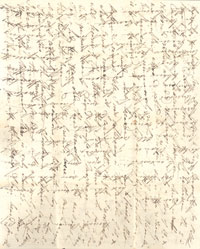
Small cross written letter
In those early days, postal rates were calculated according to the distances traveled and the number of sheets that comprised a letter. Because of their cost, only businesses and the wealthy could afford to send letters. Others simply had to entrust their missives to friends and family members, or ask people traveling to another town to serve as a messenger. Even the wealthy kept their sheets of paper small and wrote in a cross writing style to conserve space. (See the image at right and click here to read my post on Letter Writing in Jane Austen’s Time.) Envelopes would have been considered an additional sheet, so these very early letters did not include them. A letter was simply folded over and sealed with wax that was stamped by a signet ring or a seal. Recipients, not the sender, had to pay for the cost of a letter. This system caused hardship in cases where the recipient did not have the money, and as a result many letters languished on a post office shelf or were thrown away. Knowing these facts about the postal system of the period helps the reader to understand the following passage from Mansfield Park. Even though this scene occured in the early 19th century, the costs associated with sending letters from one city to another had not changed in over 100 years, for the postal system would not significantly improve until 1837, when Rowland Hill set out to reform it.
“But William will write to you, I dare say.” “Yes, he had promised he would, but he had told her to write first.” “And when shall you do it?” She hung her head and answered hesitatingly, “she did not know; she had not any paper.”
“If that be all your difficulty, I will furnish you with paper and every other material, and you may write your letter whenever you choose. Would it make you happy to write to William?”
“Yes, very.”
“Then let it be done now. Come with me into the breakfast room, we shall find every thing there, and be sure of having the room to ourselves.”
“But, cousin—will it go to the post?”
“Yes, depend upon me it shall; it shall go with the other letters; and, as your uncle will frank it, it will cost William nothing.”
“My uncle!” repeated Fanny, with a frightened look.
“Yes, when you have written the letter, I will take it to my father to frank.”
Fanny thought it a bold measure, but offered no farther resistance
Edmund also sits down to write “with his own hand his love to his cousin William, and sent him half a guinea under the seal.” This was a remarkable sum of money for the day, and demonstratedEdmund’s character like no words could. From this point on, William would have enough money to pay for Fanny’s letters as they came.
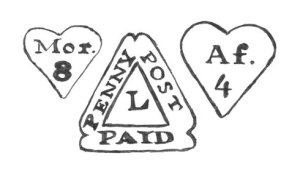
William Dockwra's postal markings
Interestingly, the Post Office did not handle letters sent from one London address to another. The city was a thriving metropolis and trading center, yet merchants had to employ private messengers to carry letters and packages across town, much like the poor in other parts of the country. In 1680, an enterprising merchant named William Dockwra introduced a local Penny-Post in London, which carried letters within a ten mile radius. His service also introduced the pre-payment of letters, a revolutionary idea. William’s advertisement in the Mercurius Civicus read:
“The Undertakers for the Incomparable and Advantageous Design for the Speedy and safe Conveyance of Letters and packquets under a pound weight, to all parts of the Cities of London and Westminster, and the suburbs thereof … [have] ordered their Messengers to call for all Letters at all Coffee-Houses in the High Roads and Streets following . . . And all persons, who leave their Letters at any of the places aforesaid, may be sure to have them speedily dispatched for ONE PENY”.
William’s method of operation was immediately successful, “particularly as letters left at any Penny-Post House were sent out “successively every hour of the Day, till Eight of the Clock at Night”. Furthermore, to ensure that correspondence was delivered as soon as possible, each letter was stamped with the hour of the day on which it was sent out. This way, people could work out whether the “delays that may happen be really in the Office, or their own Servants (or other) with whom their Letters were left in due time”. “– Potted History by Ben Locker
Dockwra used two main postmarks for each letter. One was a triangular stamp with “Penny-Post Paid” on the three sides and the initials of the sorting office in the centre. This indicated that the rate had been paid and there was no further charges necessary on receipt. The second postmark was a heart shaped stamp indicating the date and time of dispatch.
There was a great deal of opposition to Dockwra’s post from porters and messengers whose livelihood was affected by the service. The church, a powerful force at the time, also had strong opposition!
The most serious opposition to Dockwra’s system came from the General Post Office, which heavily resented the competition. As such, in 1682 legal action was taken against William Dockwra in the name of the Duke Of York (Later King James II.) who was responsible for overseeing the Post Office at the time. – William Dockwra
Unfortunately, the Duke of York held the monopoly on collecting revenue from the mail. He prosecuted Dockwra for £100 (Wikipedia says it was £2,000) in damages and forced the merchant to relinquish control of his enterprise. Four days after the judgement, the London Gazette announced that the Penny-Post would shortly be reopened as part of the General Post Office. For nine years Dockwra petitioned the Duke to save him and his “family of 9 children from Ruine.” Eventually in 1689, after James II’s death, Dockwra received a “seven-year pension of £500 “in consideration of his good service in inventing and setting up the business of the Penny-Post.” (Potted History by Ben Locker)

General Post Office in Lombard Street, London
“The Penny-Post was quickly adopted in other cities and towns, like Dublin, Edinburgh and Manchester. Revenues steadily increased, and by 1727 the London District Post was so well regarded that ‘Daniel Defoe praised it for not charging for “a single Piece of Paper, as in the General Post-Office, but [sending] any Packet under a Pound weight . . . at the same price.'” The employment of extra letter carriers increased the number of deliveries, so that the system became even more efficient. From the 1770s the numbering of houses began, and by 1805 this system became mandatory in London Streets, making it even easier for letter carriers to deliver mail (Potted History by Ben Locker). In contrast to the Penny-Post, letters that went out via the General Post Office still charged recipients for distance traveled and the number of sheets used, so that a letter sent from Steventon Rectory to Chawton would be quite expensive as compared to a letter sent from one London address to another, or one Manchester address to another.
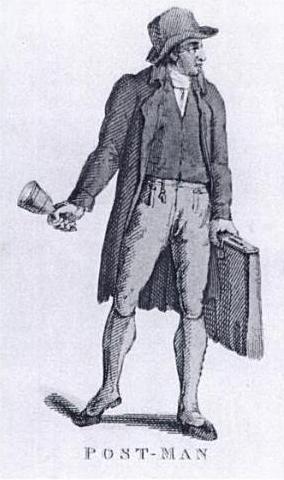
Letter carrier, 1800, with bell and satchel
For ordinary people the cost of receiving a letter was a significant part of the weekly wage. If you lived in London and your relatives had written to you from Edinburgh you would have to pay one shilling and one pence per page – more than the average worker earned in a day. Many letters were never delivered because their recipients could not afford them, losing the Post Office a great deal of money.” – Rowland Hill’s Postal Reforms
To help finance the war against Napoleon, the London Penny-Post was increased to tuppence in 1801; in 1805 the amount was raised to three pence. The beginning of uniform penny postage in 1840 made sending mail affordable to all for the first time. In 1837, English schoolmaster, Rowland Hill, wrote a pamphlet, Post Office Reform: its Importance and Practicability, which was privately circulated. In that year, he also invented the postage stamp, which necessitated the use of an envelope. “The Penny-Post system that began in 1840 used a lozenge-shaped sheet more akin to today’s aerogrammes, though in the same year George Wilson patented a system for printing several envelopes from one large sheet of paper, and in 1845 a steam-driven cutting and folding machine was invented.” History of the Humble Envelope
Hill’s famous pamphlet, Post Office Reform, was privately circulated in 1837. The report called for “low and uniform rates” according to weight, rather than distance. Hill’s study showed that most of the costs in the postal system were not for transport, but rather for laborious handling procedures at the origins and the destinations.
Costs could be reduced dramatically if postage were prepaid by the sender, the prepayment to be proven by the use of prepaid letter sheets or adhesive stamps (adhesive stamps had long been used to show payment of taxes – for example, on documents).
Letter sheets were to be used because envelopes were not yet common – they were not yet mass produced, and in an era when postage was calculated partly on the basis of the number of sheets of paper used, the same sheet of paper would be folded and serve for both the message and the address. In addition, Hill proposed to lower the postage rate to a penny per half ounce, without regard to distance. He presented his proposal to the Government in 1838.
Postal service rates were lowered almost immediately, to fourpence from the 5 December 1839, then to the penny rate on the 10 January 1840, even before stamps or letter sheets could be printed. The volume of paid internal correspondence increased dramatically, by 120%, between November, 1839 and February, 1840. – Rowland Hill
- Jane Austen’s Writing Desk or Writing Slope
- William Dockwra
- Statue of Rowland Hill
- 18th Century Letter Writing
- Post Boys & Mail Coaches, The British Postal Museum archive,
- Post Office Reform: its Importance and Practicability , Rowland Hill, 1837, Google book
- History of the Postal Service
- James Pollard and the Age of the Coach
- William Dockwra: A Disappointed and Unhappy Man in 18th C. London
- William Dockwra: Falmouth Packet Archives

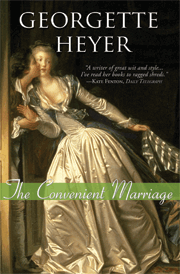 The plot of the Convenient Marriage is different in so many ways from the typical Georgette Heyer novel. One is the tenderness with which the Earl of Rule treats his very young and captivating bride, and the second is that the couple has already tasted the delights of the marital bed and found the results not displeasing. The earl was all set to marry the eldest Winwood sister in an arranged marriage when her youngest sister Horatia “sacrifices” herself on the altar of sibling loyalty. Horatia’s older sister, Lizzie, is the Beauty of the family and in love with an impoverished soldier. Needless to say her family insists that she drop her soldier and marry the earl to save the family fortune. To help her sister out of her misery, Horatia sneaks off to see Rule and reasons (quite logically) that if the earl isn’t in love with her sister he might just as well marry her. The legal contract between the two families would not be altered with the switch in brides and he will still be assured that the future mother of his heir will have the appropriate pedigree. Struck by the simplicity of her argument and charmed with her slight stutter and forthrightness, the earl agrees to wed Horatia instead. Up to this point the book resembles more a 1930’s drawing room comedy than the typical historical romance novel we have come to expect from Georgette Heyer. One of her earlier books (1936) and set in the Georgian Era, the writing does not yet possess her command of the genre as she shows in later years, yet her descriptive style was already fully developed. In this instance, Heyer describes Georgian clothing with as much expertise as her knowledge of Regency garb:







 Jane Austen's World