Feeds:
Posts
Comments

Archive for the ‘Jane Austen Novels’ Category

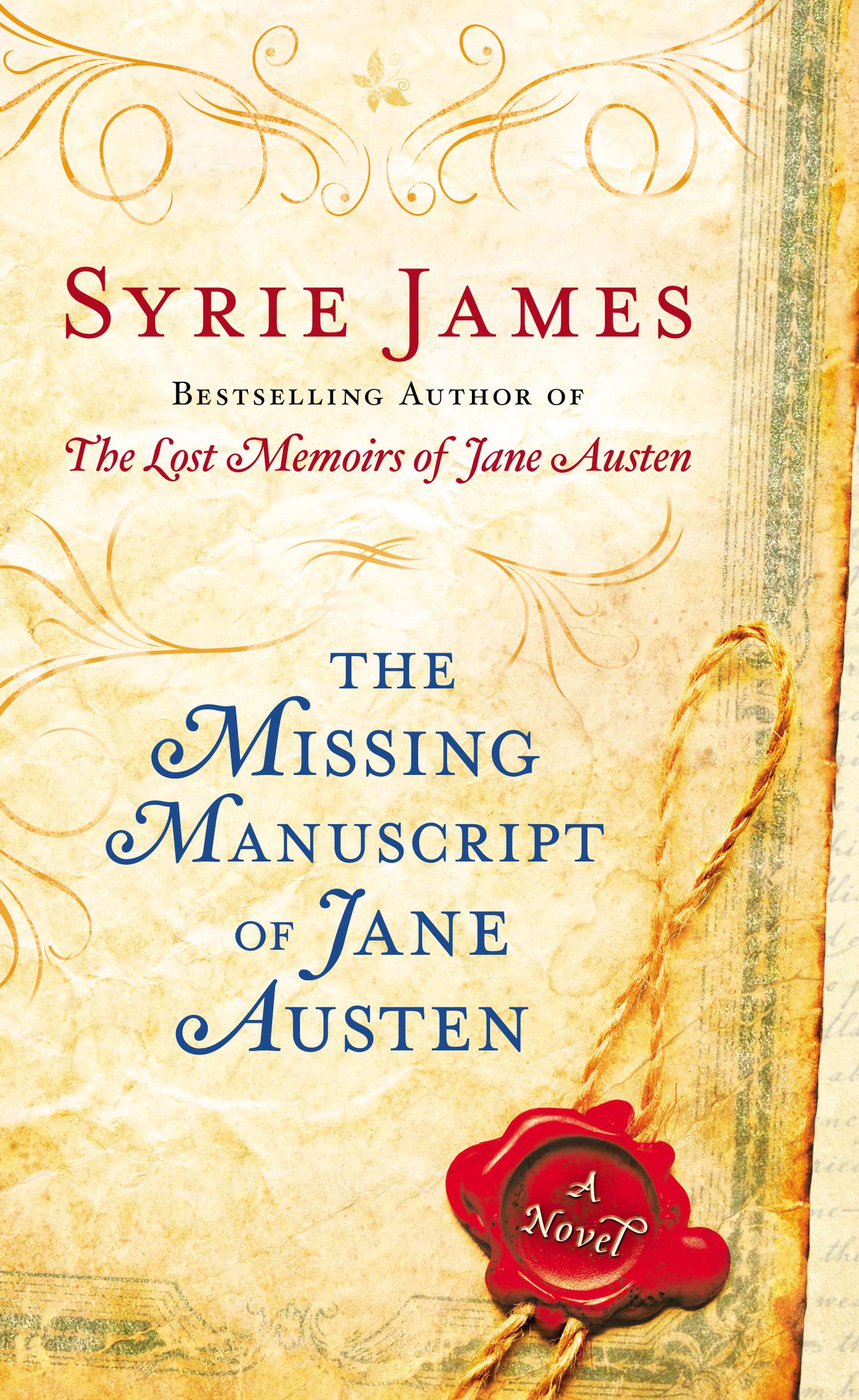
The Missing Manuscript of Jane Austen by Syrie JamesGentle readers, One lucky U.S. reader is eligible to win a copy of Syrie James’s latest book, The Missing Manuscript of Jane Austen! (See below) Contest Closed: The winner is – Lilyane Soltz. Congratulations!

The Missing Manuscript of Jane Austen, Syrie James

In the Missing Manuscript of Jane Austen, author Syrie James attempts a plot device that often trips up even the most experienced authors -a novel within a novel. Samantha McDonough, librarian and Jane Austen scholar, stumbles upon a clue in an old book of poetry she purchased while on a visit to England.

The minute I saw the letter, I knew it was hers. There was no mistaking it: the salutation, the tiny, precise handwriting, the date, the content itself, all confirmed its ancient status and authorship…

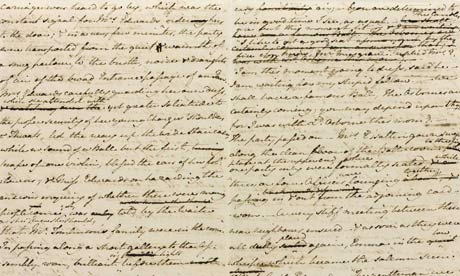
This letter leads her on a quest to find a missing manuscript by Jane Austen. Her journey lands her on the doorstep of handsome Anthony Whitaker, who has just inherited his estranged father’s rundown estate. By virtue of her charm, grit, and determination, Samantha persuades a skeptical Anthony to rummage around dusty rooms, cupboards, and closets and his attic until, voilà, they miraculously find a manuscript entitled The Stanhopes and that consists of 41 tiny hand-cut and bound booklets. (The Watsons, Jane’s unfinished manuscript, is made of 11 similarly bound booklets.)

A draft of Jane Austen's novel The Watsons, which was written in about 1804 . Image @The Guardian

A draft of Jane Austen’s novel The Watsons, which was written in about 1804 . Image @The Guardian

Anthony and Samantha immediately begin to read Jane’s long lost words, and, like Alice tumbling down the rabbit hole, the pair are instantly swept into the story of Rebecca Stanhope and her father, a rector with a propensity for mild gambling over a friendly game of cards. His vice sets off the plot, which is based on Jane’s hilarious Plan of a Novel. In short order, the rector loses a great deal of money with which he has been entrusted and then is forcibly retired from his living. Now destitute,  Mr. Stanhope and Rebecca (a sweet heroine  in the vein of a slightly feistier Jane Bennet or more mature Catherine Morland) must move from place to place — from the rectory to a married daughter’s cramped house, to an elegant abode in Bath, to a seedy inn, and so forth. Along the way, Rebecca receives three proposals, one that is almost as ridiculous as Mr. Collins’ proposal to Elizabeth, and two more serious ones from two suitors who are as different from each other in temperament and intent as, well, Henry Crawford and Edmund Bertram or Willoughby and Colonel Brandon. The road to a romantic union is rocky, and along the way both heroines (Rebecca and Samantha) must learn some harsh truths about themselves and others before they can be united with their heroes.

As the story develops, the reader will recognize a number of plot developments and characters based on those in Austen’s novels. Since the missing manuscript was written early (1802) and before Jane published her books and rewrote Sense and Sensibility and Pride and Prejudice for publication, one can assume that this manuscript is meant to be a foreshadowing of the mature novels.  Syrie James, a strong writer in her own right, is smart in setting Jane’s  lost manuscript so early in Jane’s writing career. Austen’s Juvinilia includes melodramatic twists and turns, evident in Northanger Abbey (when Catherine Morland is forced to leave the Abbey alone in the middle of the night) and in The Stanhopes, when Rebecca must find employment in the most unusual and creative way in order to feed herself and her father. The reader should also assume that the manuscript, having been lost before Jane could fully edit and revise it, was found in its  “raw” stage. This would explain any stylistic differences between the lost manuscript and Jane’s later works (and, more practically, between Syrie’s and Jane’s writing styles as well).

I won’t give too much of the plot away, except to say that I was more interested in the Stanhopes than the modern Samantha and Anthony story line. (I believe I had the same preference with Jane Odiwe’s Searching for Captain Wentworth, in which I liked the time travel to the past more than the contemporary narrative.) Syrie’s novel is filled with historically and geographically correct details, which I always appreciate in a novel set in a foreign country or in the past. As an interesting aside, one of Samantha’s friends in the modern world is Laurel Ann, a bookseller. Who could it be, I wonder? (Hint: Austenprose.)

Insights into Jane Austen’s World

Syrie, who I met at the Brooklyn AGM meeting and whose Regency costumes are varied and fabulous, graciously sent me some interesting details about one of Jane’s letters to Cassandra, and how one should handle an old manuscript:

 I don’t know if it’s strange or funny, but while re-reading Jane Austen’s letters to her sister Cassandra, I was fascinated to find the following mention of a “shut-up bed”:

Martha kindly made room for me in her bed, which was the shut-up one in the new nursery. Nurse and the child slept upon the floor, and there we all were in some confusion and great comfort. The bed did exceedingly well for us, both to lie awake in and talk till two o’clock, and to sleep in the rest of the night.

I take this to mean that a “shut-up bed” is what we now call a Murphy bed, or a bed that folds up and away by day into a piece of furniture. I happily put this information to use in The Stanhopes.

Here’s one fact that surprised me: I presumed that when my modern day characters found Jane Austen’s centuries-old manuscript, they’d have to wear latex gloves while handling it. (That was previous my experience when reviewing precious, old documents.) However, Christine Megowan, the Special Collections Librarian at Loyola Marymount University, explained that none of the conservators she knows wear gloves to handle old books and paper, because they don’t fit well and are clumsy. As long as your hands are clean and you work gently, she said, the oils on your fingers don’t do all that much damage to paper—you’d do far more mechanical damage by fumbling with latex gloves. I put that quote directly into the novel.

If you are interesting in reading similar  insights from Syrie, click on the links to her blog tour!

About Syrie James:

Syrie JamesAuthorPhoto2011 - Credit William James (1)Syrie James is the bestselling author of eight critically acclaimed novels, including The Missing Manuscript of Jane Austen, The Lost Memoirs of Jane Austen, The Secret Diaries of Charlotte Brontë, Dracula My Love, Nocturne, Forbidden, and The Harrison Duet: Songbird and Propositions. Her books have been translated into eighteen foreign languages. In addition to her work as a novelist, she is a screenwriter, a member of the Writers Guild of America, and a life member of the Jane Austen Society of North America. She lives with her family in Los Angeles, California. Connect with her on her website, Facebook, and Twitter.

Follow Syrie’s Blog tour in these links: 

About the book:

Amazon Prices

  • Kindle Edition $9.99
  • Paperback $10.20
  • Audible Audio Edition, Unabridged $23.95 or Free with Audible 30-day free trial
  • Reading level: Ages 18 and up
  • Paperback: 432 pages
  • Publisher: Berkley Trade; Reprint edition (December 31, 2012)
  • ISBN-10: 0425253368
  • ISBN-13: 978-0425253366

About the book giveaway for The Missing Manuscript of Jane Austen:  

For your chance to win a copy of Syrie’s latest book, let us know how you would feel and react if you stumbled across a long lost Jane Austen document! Contest open to U.S. readers only. Drawing by random number generator. Deadline, January 23rd, 2013, midnight EST. Contest Closed: The winner is – Lilyane Soltz. Congratulations!

Read Full Post »

Inquiring readers: This is the first of many posts I’ll be writing about “Pride and Prejudice” in honor of that novel’s 200 year anniversary in 2013. Enjoy.
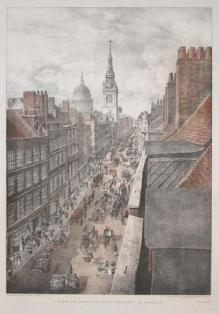
Cheapside in 1823. Engraved by T.M. Baynes from a drawing by W. Duryer.JPG

Cheapside in 1823. Engraved by T.M. Baynes from a drawing by W. Duryer. Image @Wikipedia

Some London streets seem determined never to distinguish themselves. No mediaeval scuffle has ever occurred in them; no celebrated church hoards its monuments; no City hall cherishes its relics there; no celebrated person has honoured it by birth or death. Gracechurch Street is one of these unambitious streets. It derived its name, says Stow, from the grass or herb market there kept in old time, and which gave its name to the parish church of St. Bennet. – British History Online,

It is a woeful fact that I most likely crossed Gracechurch Street on my first visit to London and never new it. We had just visited Tower Hill and were heading for St. Paul’s Cathedral on foot. My husband and I wandered here and there and got lost, no nearer to our destination. This part of London seemed a mismash of old and mostly modern buildings, with wide and narrow streets, some twisting and winding, others straight. It was nothing like the old London my 24-year-old self had expected to see, for at that time I did not fully realize the extent of the devastation that the great fire of 1666 had wrought. Those changes were compounded by the London Blitz during WWII and recent modernization.

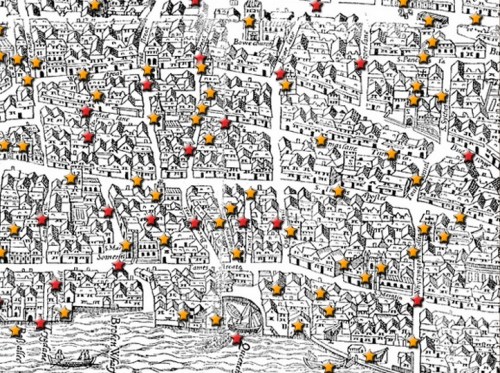
Early modern map of Cheapside. Image @The Map of Early Modern London

Early modern map of Cheapside. Image @The Map of Early Modern London One can see Bow Church at the top center.

We finally boarded a transit bus and missed noticing Gracechurch Street. Not that I would have searched for it. At that time I would not have recalled the few references in Pride and Prejudice to the street where Lizzy Bennet’s aunt and uncle Gardiner lived.

Mr. Gardiner was a sensible, gentlemanlike man, greatly superior to his sister, as well by nature as education. The Netherfield ladies would have had difficulty in believing that a man who lived by trade, and within view of his own warehouses, could have been so well bred and agreeable. Mrs. Gardiner, who was several years younger than Mrs. Bennet and Mrs. Philips, was an amiable, intelligent, elegant woman, and a great favourite with all her Longbourn nieces. Between the two eldest and herself especially, there subsisted a very particular regard. They had frequently been staying with her in town.

The first part of Mrs. Gardiner’s business on her arrival, was to distribute her presents and describe the newest fashions.

I love the Gardiners, two sane people in a novel filled with characters and oddballs. They provide ballast and sound advice to Elizabeth, who wisely turned to Mrs. Gardiner, not her mother, when mulling a problem about love and life. Mr. Gardiner was a merchant who lived close to his warehouse. Despite their middle class background, the Gardiners are more refined and sensible than many of their social betters. Elizabeth is proud to introduce them to Mr. Darcy when visiting his estate, knowing that their restrained behavior would not make him (or her) cringe.

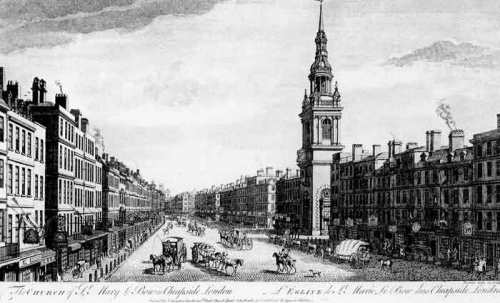
Cheapside in the mid 18th century. Image @Republic of Pemberley

Cheapside in the mid 18th century. Image @Republic of Pemberley

Caroline Bingley, whose snobbishness was evident when she paid Jane a hasty courtesy call at Gracechurch Street, demonstrated a decided lack of class when she all but wrinkled her nose at a neighborhood she had probably managed to avoid all her life, an interesting attitude considering her family’s wealth came from trade and she was but one generation away from the “stench” of the merchant class. Social calls, their timing and length – or lack thereof – could be used to extend a friendship or give the cut direct, which in this instance Miss Bingley chose to do to Jane. Her lack of civility and coolness before and during the visit finally opened Jane’s eyes to Caroline’s desire to end their friendship. This was an event that Mrs. Gardiner and Lizzy correctly predicted beforehand:
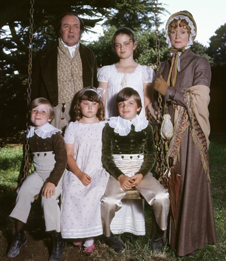
The Gardiners and their brood, Pride and Prejudice, 1995

The Gardiners and their brood, Pride and Prejudice, 1995

Chapter 25:  [Mrs. Gardiner] Poor Jane! I am sorry for her, because, with her disposition, she may not get over it [her failed love affair with Bingley] immediately. It had better have happened to you, Lizzy; you would have laughed yourself out of it sooner. But do you think she would be prevailed on to go back with us? Change of scene might be of service — and perhaps a little relief from home, may be as useful as anything.”

Elizabeth was exceedingly pleased with this proposal, and felt persuaded of her sister’s ready acquiescence.

“I hope,” added Mrs. Gardiner, “that no consideration with regard to this young man will influence her. We live in so different a part of town, all our connexions are so different, and, as you well know, we go out so little, that it is very improbable they should meet at all, unless he really comes to see her.”

“And that is quite impossible; for he is now in the custody of his friend, and Mr. Darcy would no more suffer him to call on Jane in such a part of London! My dear aunt, how could you think of it? Mr. Darcy may, perhaps, have heard of such a place as Gracechurch Street, but he would hardly think a month’s ablution enough to cleanse him from its impurities, were he once to enter it; and, depend upon it, Mr. Bingley never stirs without him.”

“So much the better. I hope they will not meet at all. But does not Jane correspond with the sister? She will not be able to help calling.”

“She will drop the acquaintance entirely.”

Dennis Severs house, a Georgian merchant's house. Image @photographsRoelof Bakker, www.rbakker.com

Dennis Severs house, a Georgian merchant’s house in Spitalsfield. Image @photographs
Roelof Bakker, http://www.rbakker.com

“…lessen their chance of marrying men of any consideration in the world.

With this phrase, Austen gives us a clue about the Bennet girls’ situation, but, as we know, the ending of Pride and Prejudice proves this forecast wrong (for Lizzy and Jane, at least).

Lizzy is right about Caroline Bingley, but not about Darcy. In the following scene her prejudice towards that proud man comes to the fore. She assumes that Mr. Darcy’s attitude towards Gracechurch Street will echo that of Caroline Bingley, for this bustling shopping district simply wasn’t an area that the upper crust tended to visit. Caroline, Darcy and Bingley made their observations about the Bennet family during their stay at Netherfield:

Darcy and Caroline at breakfast

Darcy and Caroline at breakfast

“I think I have heard you say that their uncle is an attorney in Meryton”

“Yes; and they have another, who lives somewhere near Cheapside.”

“That is capital,” added her sister, and they both laughed heartily.

“If they had uncles enough to fill all Cheapside,” cried Bingley, “it would not make them one jot less agreeable.”

“But it must very materially lessen their chance of marrying men of any consideration in the world,” replied Darcy.

Darcy, it turns out, is made of finer stuff than Caroline Bingley, for when he visits the Gardiners in his quest to find Wickham, his attitude is anything  but snobbish – stubborn, as Mrs. Gardiner later relates, but not snobbish. While arranging Wickham’s marriage to Lydia, he visits Gracechurch Street on several occasions and even dines with the Gardiners, leaving them with a very positive impression of his character:

Chapter 51 [Letter from Mrs. Gardiner to Lizzy after Lydia revealed Darcy’s part in her marriage to Wickham] He dined with us the next day, and was to leave town again on Wednesday or Thursday. Will you be very angry with me, my dear Lizzy, if I take this opportunity of saying (what I was never bold enough to say before) how much I like him. His behaviour to us has, in every respect, been as pleasing as when we were in Derbyshire. His understanding and opinions all please me; he wants nothing but a little more liveliness, and that, if he marry prudently, his wife may teach him. I thought him very sly;—he hardly ever mentioned your name. But slyness seems the fashion.

Mansion House, Cheapside. Image @Darvill's Rare Prints

Mansion House, Cheapside. Image @Darvill’s Rare Prints

At the time that Jane Austen wrote Pride and Prejudice, Cheapside was a very elegant thoroughfare with many sumptuous warehouses, convenient coffee houses, and  smart shops. In Real Life in London, Pierce Egan writes a passage in which Tom and Bob walk through this area filled with shopkeepers, bankers, merchants, shoppers, and “walking” billboards:

“Neither,” replied Dashall; “this is no other than the shop of a well-known dealer in stockings and nightcaps, who takes this ingenious mode of making himself popular, and informing the passengers that

“Here you may be served with all patterns and sizes,
From the foot to the head, at moderate prices;”
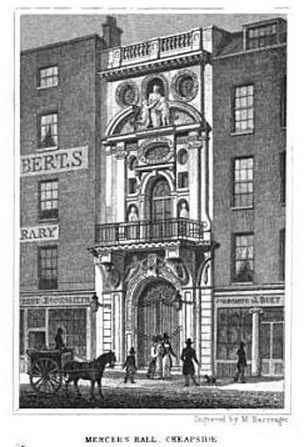
Mercer's Hall, Cheapside. Image @London and Its Environs

Mercer’s Hall, Cheapside. Image @London and Its Environs in the Nineteenth Century

with woolens for winter, and cottons for summer—Let us move on, for there generally is a crowd at the door, and there is little doubt but he profits by those who are induced to gaze, as most people do in London, if they can but entrap attention. Romanis is one of those gentlemen who has contrived to make some noise in the world by puffing advertisements, and the circulation of poetical handbills. He formerly kept a very small shop for the sale of hosiery nearly opposite the East-India House, where he supplied the Sailors after receiving their pay for a long voyage, as well as their Doxies, with the articles in which he deals, by obtaining permission to style himself “Hosier to the Rt. Hon. East India Company.” Since which, finding his trade increase and his purse extended, he has extended his patriotic views of clothing the whole population of London by opening shops in various parts, and has at almost all times two or three depositories for Romanis, the eccentric Hosier, generally places a loom near the door of his shops decorated with small busts; some of which being attached to the upper movements of the machinery, and grotesquely attired in patchwork and feathers, bend backwards and forwards with the motion of the works, apparently to salute the spectators, and present to the idea persons dancing; while every passing of the shuttle produces a noise which may be assimilated to that of the Rattlesnake, accompanied with sounds something like those of a dancing-master beating time to his scholars. his stock. (sic) At this moment, besides what we have just seen, there is one in Gracechurch Street, and another in Shoreditch, where the passengers are constantly assailed by a little boy, who stands at the door with some bills in his hand, vociferating—Cheap, cheap.”

“Then,” said Bob, “wherever he resides I suppose may really be called Cheapside?”

“With quite as much propriety,” continued Ton, “as the place we are now in; for, as the Irishman says in his song,

“At a place called Cheapside they sell every thing dear.”

During this conversation, Mortimer, Merrywell, and Harry were amusing themselves by occasionally addressing the numerous Ladies who were passing, and taking a peep at the shops—giggling with girls, or admiring the taste and elegance displayed in the sale of fashionable and useful articles—justled and impeded every now and then by the throng. Approaching Bow Church, they made a dead stop for a moment.

“What a beautiful steeple!” exclaimed Bob; “I should, though no architect, prefer this to any I have yet seen in London.” – Real Life in London, Egan
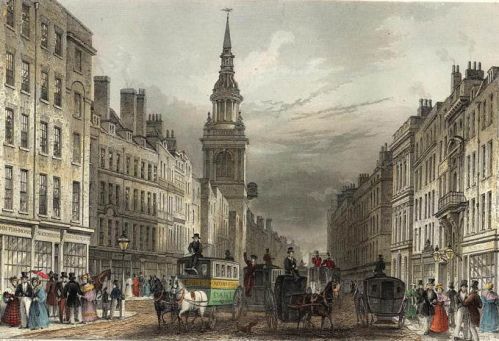
Cheapside and Bow Church engraved by W.Albutt after T.H.Shepherd publ 1837 edited. The pretty steeple is visible in this image. (wikipedia)

Cheapside and Bow Church engraved by W.Albutt after T.H.Shepherd publ 1837 edited. The pretty steeple is visible in this image. (wikipedia)

Once upon a time, Cheapside and Gracechurch Street were in the commercial heart of the city of London. It was the main shopping district in Jane Austen’s day. She describes the journey to Gracechurch street and Lizzy’s visit with the Gardiners in this lively scene:

Chapter 27: It was a journey of only twenty-four miles, and they began it so early as to be in Gracechurch Street by noon. As they drove to Mr. Gardiner’s door, Jane was at a drawing-room window watching their arrival; when they entered the passage she was there to welcome them, and Elizabeth, looking earnestly in her face, was pleased to see it healthful and lovely as ever. On the stairs were a troop of little boys and girls, whose eagerness for their cousin’s appearance would not allow them to wait in the drawing-room, and whose shyness, as they had not seen her for a twelvemonth, prevented their coming lower. All was joy and kindness. The day passed most pleasantly away: the morning in bustle and shopping, and the evening at one of the theatres.
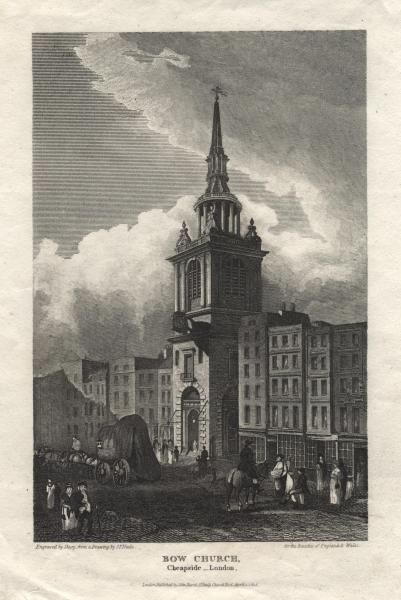
steel engraving of the Bow Church on Cheapside Street in London (the Bow Church is probably better known as Saint Mary's Le Bow and it is said that all true Cockneys were born within the sounds of this church's bells)

Steel engraving of the Bow Church on Cheapside Street in London (the Bow Church is probably better known as Saint Mary’s Le Bow and it is said that all true Cockneys were born within the sounds of this church’s bells) Image @bouletfermat.com

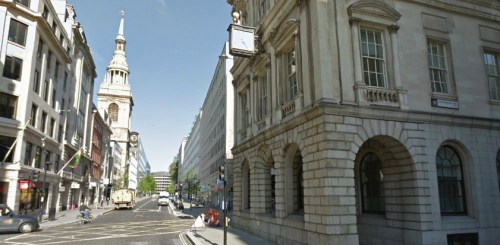
Gracechurch Street means grass-church and was thus named because of a hay market nearby (1680-1868). The distinctive steeple of  St Mary-le-Bow Church is the only structure remaining today that Jane Austen would have recognized. A church has stood on this ground since Saxon times. After the Fire of 1666, Christopher Wren designed a new structure, which was destroyed during a 1941 bombing was and carefully reconstructed during the 1950s. Today, Gracechurch Street largely resembles a modern office block.
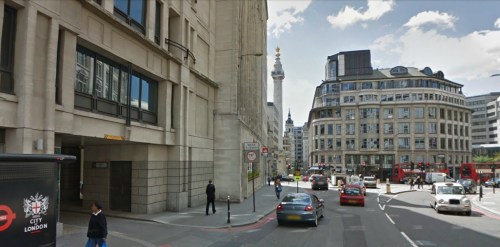
Gracechurch street today (Google maps)

Gracechurch street today (Google maps)

In the 17th century, coffeehouses arrived in the City and these soon became the place to pick up news. Some houses became the makeshift offices of the trades they served, giving birth to some of the world’s greatest financial institutions – the London Stock Exchange started in Jonathan’s Coffeehouse in Change Alley and Lloyds of London takes its name from Edward Lloyd, the proprietor of a coffeehouse in Tower Street. This, coupled with the founding by Royal Charter of the Bank of England in 1694, was the catalyst for the development of the City as a financial centre. – History of Cheapside

Cheapside was anything but cheap, the name “cheap” being the Saxon term for market. (Learn more about Cheapside Street here.) The names of the streets in that section of the City described the trades contained within this district: Wood Street, Milk Street, Bread Street, Honey Lane, Poultry and Friday Street for fish.

Today plans are afoot to revitalize this section of London and return it to its glory as a major shopping destination. History of Cheapside

More on the topic:

Read Full Post »
Inquiring readers: Tony Grant from London Calling has been a frequent contributor to this blog, sending posts and images. He lives in Wimbledon and acts as a tour guide, taking visitors on tours to Jane Austen country, the Lakes region, and points of interest all around London and the U.K. Recently, Tony sent in his thoughts about Jane Austen and his wish to delve deeper into other authors and their lives. As an active guide, he knows whereof he speaks. I asked Susannah Fullerton, author, president of JASA, and also a tour guide, to give her response (with Tony’s approval).  Here, then, is their very interesting conversation. I intend to weigh in. Does anyone else have an opinion? If so, please feel free to comment. Meanwhile, to all my U.S. readers, Happy Thanksgiving! Drive safely and have a wonderful time with kith and kin.

“Good-Bye to All That,” is an autobiography by Robert Graves. Graves said, “It was my bitter leave-taking of England where I had recently broken a good many conventions”.

I was reading a poem by Edward Thomas, (Philip Edward Thomas, 3rd March 1878 – 9th April 1917) recently, entitled, “The Brook.” In the poem Thomas is sitting by a stream and watching a child paddling in the brook. His senses are completely alert to the sights and sounds of insects, the sight of birds and the sounds of birds unseen, the play of sunlight, the rippling tinkling sounds of water and the memories of a past horseman and horse buried under a barrow on the heath nearby. The poem ends,

And then the child’s voice raised the dead.
“No one’s been here before,” is what she said.

It occurred to me that the child was right. Of course, probably, many people had been to that spot over years and decades. For each of us, however, when we go to a place for the first time that is pristine and natural and remains how it has always been we do experience something for the first time. It is as if nobody has been there or done that, or experienced that before us. We can experience things fresh and new for ourselves when we go somewhere like this, for the first time.

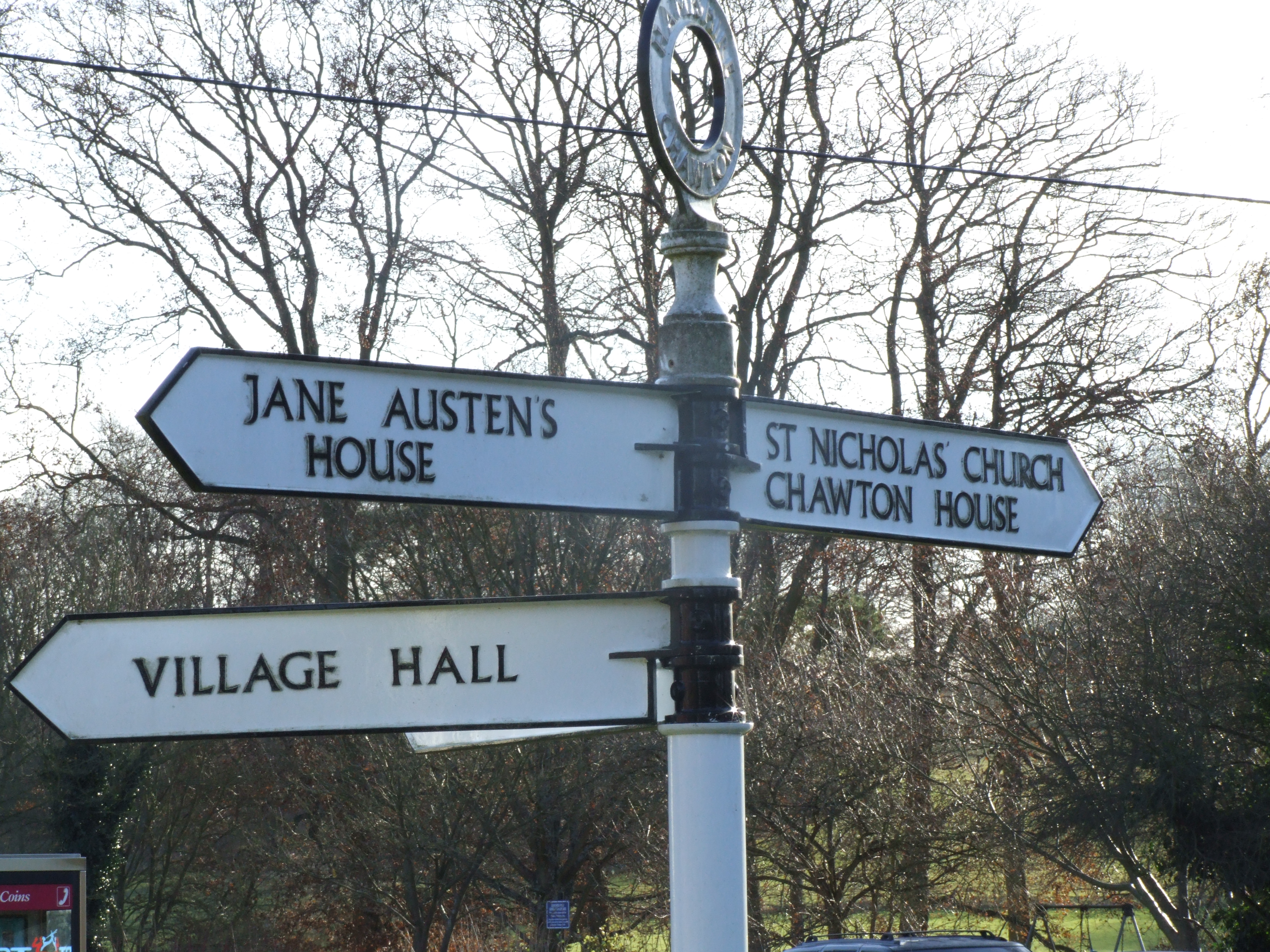
Signpost. Image @Tony Grant

Now lets take a visit to Chawton, Jane Austen’s last home before she died. I wonder if we can actually experience things fresh and new to us on a visit to Chawton and say,“No one’s been here before,” in the way the child in Edward Thomas’s poem did?

I remember standing at the crossroads in Chawton , years ago, for the first time. What I should have experienced, according to Jane Austen pilgrims to Chawton, is a sense of where she lived, a connection with Jane Austen – where she wrote, cooked, sewed, wrote letters, enjoyed the company of Cassandra, Martha, her mother and brothers and neighbours too. Indeed, Jane Austen (16 December 1775 – 18 July 1817) did all this over two hundred years ago. But can I or any of us get that feeling of, “No one’s been here before.” Do we really get an experience standing at Chawton crossroads next to that much photographed sign post put up in the 1930’s with pointers to the great house, the church and the cottage that it is the Chawton of Jane Austen? Do we really believe that we have a connection with Austen by being there? Isn’t it all in our imaginations because we want to believe?

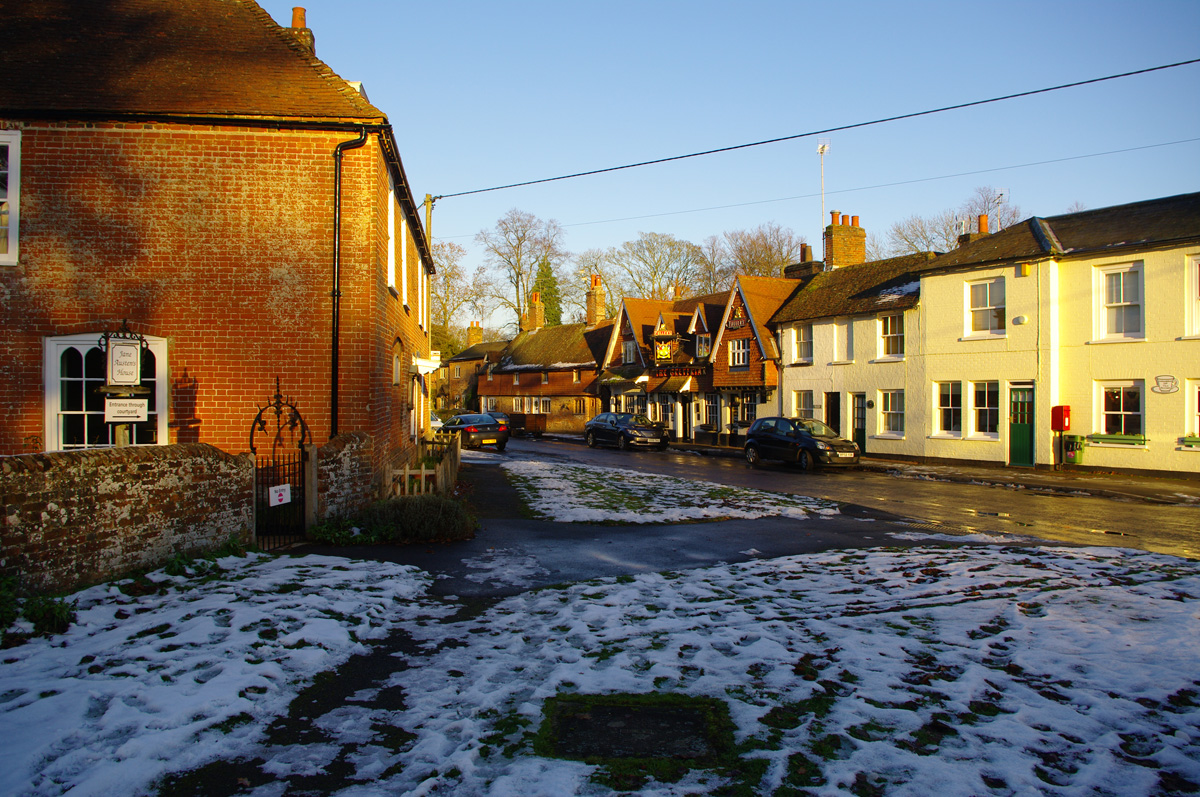
Chawton Village street. Image @Tony Grant

Chawton high street is full of parked cars with Japanese, French, German, Spanish and Scandinavian makers emblems on them. The road is metalled and covered in tarmac. It has a pavement edged by slate and granite curb stones from Dartmoor. It has concrete and tarmac pavements. Houses surrounding the cottage have a mesh of telecommunication wires leading to each one. People who live in Chawton are all connected to the World Wide Web with broadband like the rest of us. Modern street lights light the streets at night. In the small park opposite the cottage there is a children’s playground with steal clambering structures and swings. The pub opposite, The Greyfriar, is a Fullers pub. They hold a quiz night once a week for locals that probably doesn’t include questions about Jane Austen. Fullers, by the way, is a London brewery situated on the Great West Road, leading out towards Heathrow Airport, close to where Hogarth had his country retreat. These very locals travel to Winchester, Southampton or even commute to London for work every day. Chawton C of E Primary School, just along the road, on the way to The Great House, is an ordinary primary school that teaches the national curriculum. The children are like children anywhere and this is where they live. The Jane Austen connection to them is by the by, not really pertinent to their lives. Although, I am sure, as the school is in Chawton the children will know a lot about Jane Austen, but she will really be just somebody else on their list of famous people and writers to know about. Those children play computer games on their Ipads at home. Chawton is an ordinary place where people live and get on with their ordinary lives, where Jane doesn’t loom much in their minds when they are peeling the potatoes or hoovering their carpets or watching the TV.

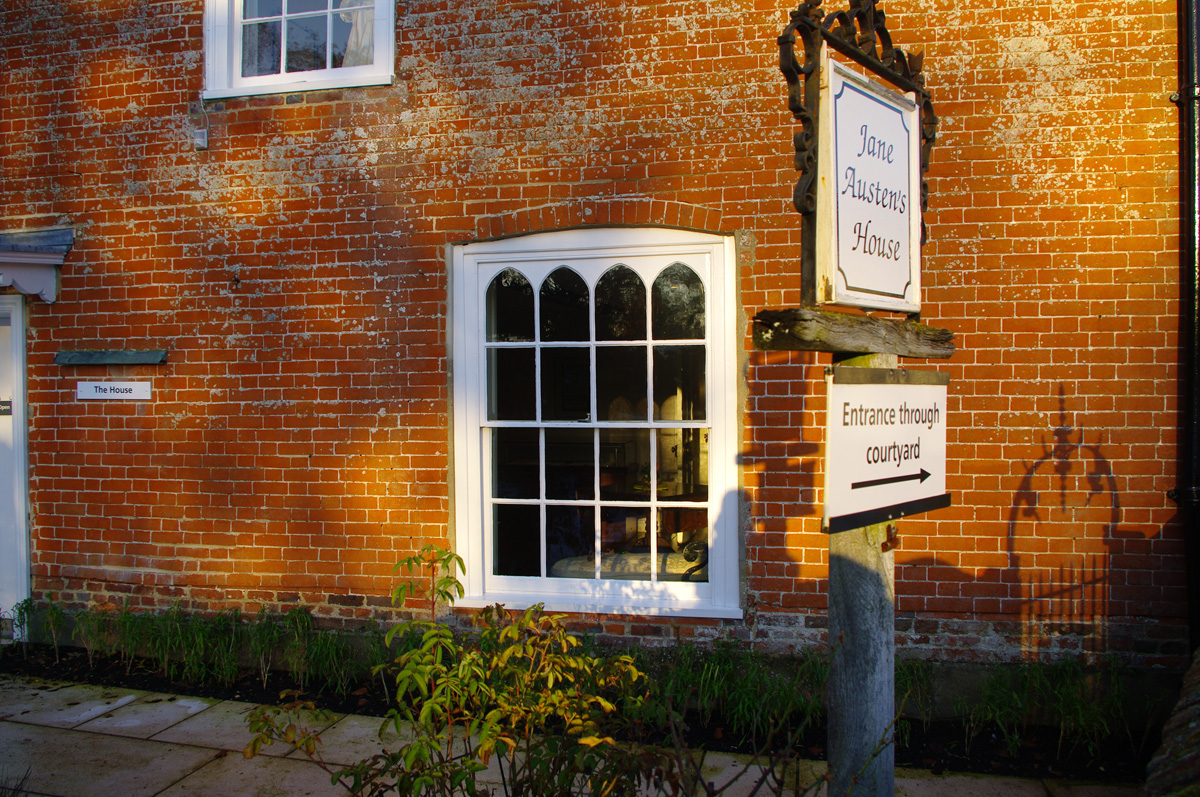
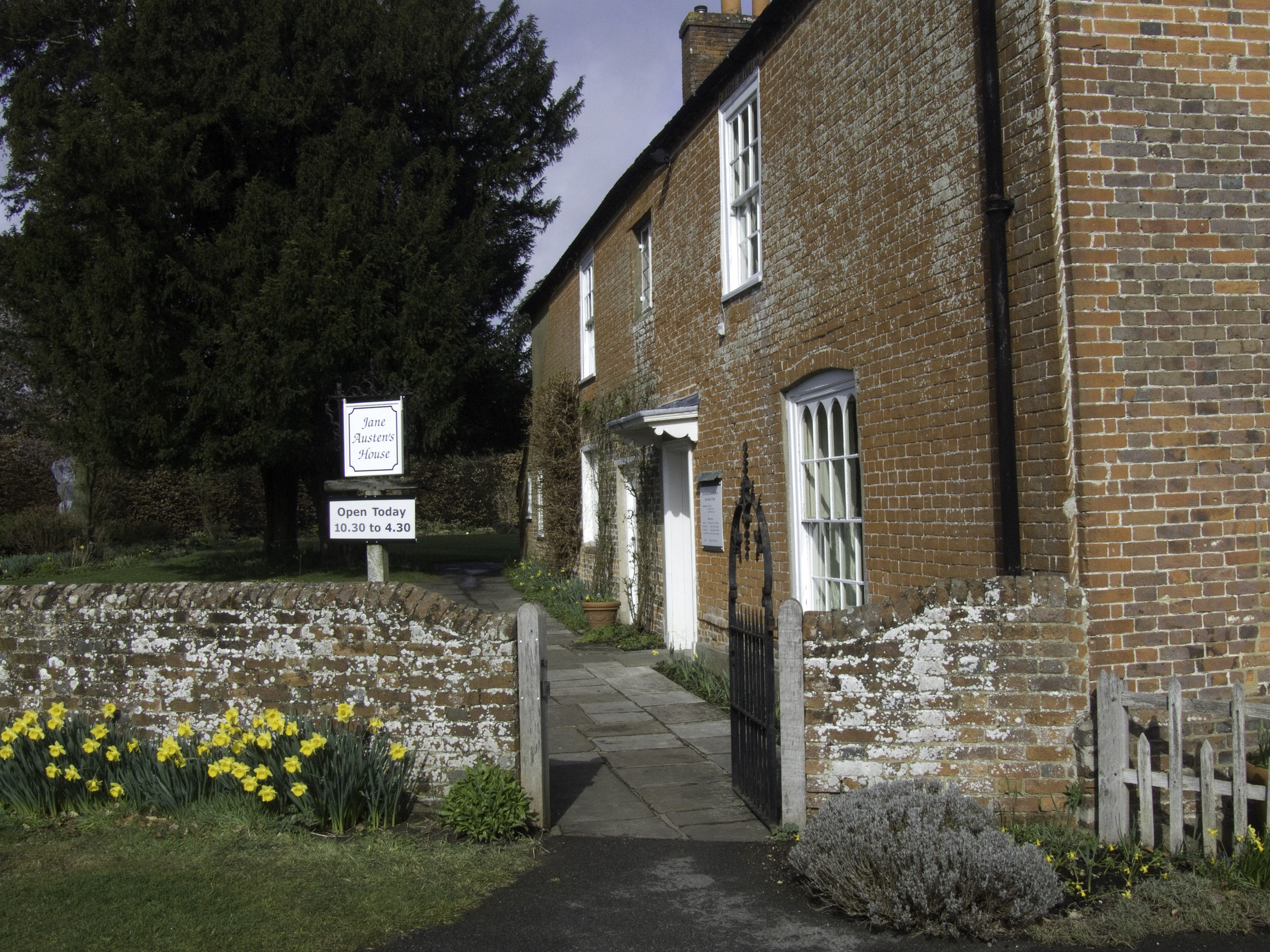
Chawton Cottage signs. Image @Tony Grant

Looking at the cottage from the outside, the Jane Austen societies have stuck large obtrusive signs on the walls facing the road. If you look at the structure of the building itself you begin to wonder what of it Jane would actually recognise if she were to come back today. Windows have obviously been bricked up. Was that a result of 18th century window taxes or because at one time the cottage was split into a group of smaller cottages? It has a variety of doors to enter by too which probably weren’t there or were in different locations in Jane’s day.

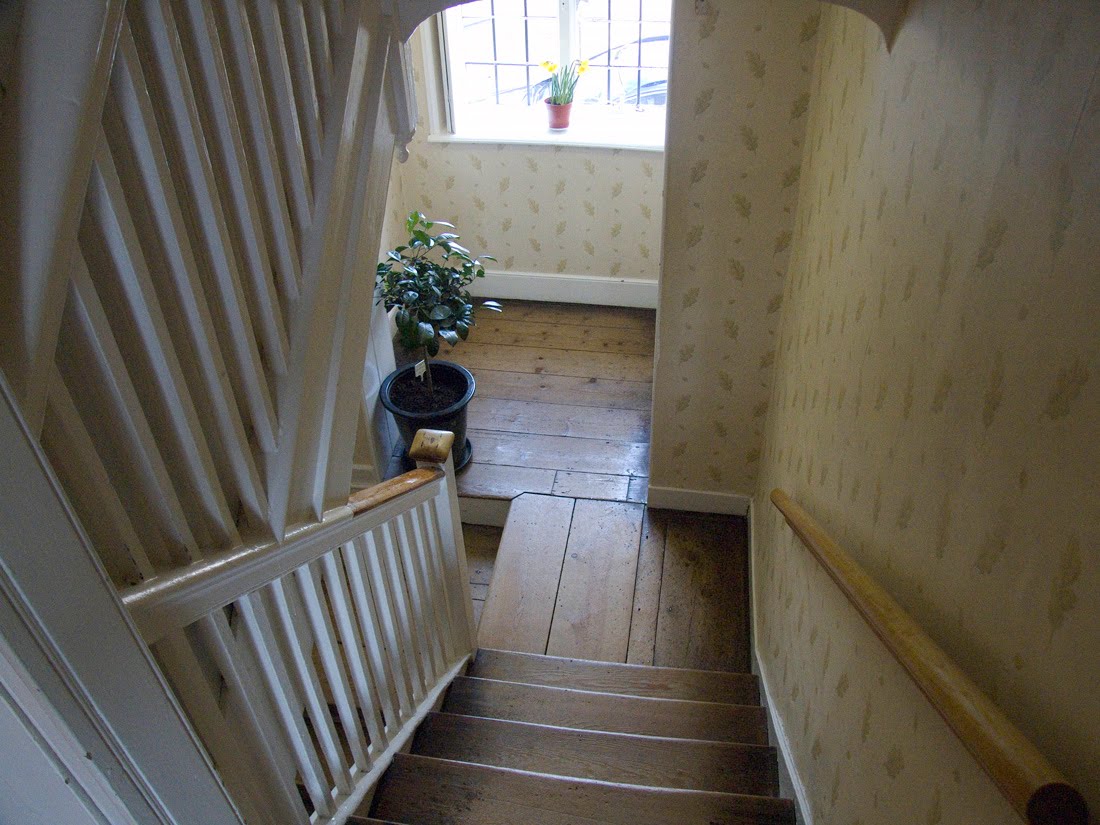
Staircase. Image @Tony Grant

When you go into the cottage you see modern radiators, electrical wiring, plug sockets and fire exit signs with the requisite fire extinguisher points. These are not subtly hidden or unobtrusive but are very prominent. Many of the display cases, especially upstairs, are bulky and obtrusive. They don’t look good. The staircase itself is not the staircase Jane Austen would have known in her time. The whole house has actually been restructured. The Austen’s might not recognise the place. It’s not really the place they knew.

The visitor’s entrance to Chawton Cottage. Image @Tony Grant

I always come back to the books and her letters. That is where to find Jane Austen. That is where we are going to get glimpses of the real person if we are attentive.
Now don’t get me wrong, I absolutely love reading Jane’s novels, her letters and the biographies written about her. However all these Jane Austen societies bother me. They worship and idolise her. They focus exclusively on her. They wring every bit of Janenness out of her. They make Chawton a false holy of holies. She was one writer for goodness sake. The world is a diverse and varied place full of great writers that we all need to read and not be partisan about. If I had my way I would get rid of all literary societies connected with all writers and say, just read. Reading develops us and helps us grow. Centering on one writer narrows us.

Penguin Classics

As a paraphrase of Robert Graves, this article “ (Is) my(not so) bitter leave-taking of (Austen) where I (have) recently broken a good many conventions”. We all need to stop squeezing the life out of Jane Austen and get on with real life and the rest of the real literary world. Returning to the essence of the Edward Thomas poem, I feel that my senses need to be open but to other writers without the weighty manufactured image of Jane Austen hovering over my shoulder.

Doesn’t anybody else feel that they would like to get out from underneath the weight of Austen and breath freely again?

Tony Grant

I am going to read all of Virginia Woolf’s novels after Christmas and post reviews. My mate Clive and I are going to do this in tandem. If you want an antidote to all things Jane, don’t stray!!!!!!! Clive and Tone are on their way.

Tony Grant, Wimbledon

Hi Tony,

I hope you are well. I enjoy reading your comments on Vic’s lovely website. Your photo of the Dolphin Hotel looks so nice in my new book, A Dance with Jane Austen. Thanks again for giving me permission to use it when we met.

I’m intrigued by your comments about Jane Austen societies, but don’t agree with you that they are in any way narrowing. My experience is quite the opposite. At JASA we’ve had talks on Jane Austen’s connections with / influence on many other writers – Kipling, Georgette Heyer, Byron, Radcliffe, the Brontes, etc. Such talks immediately send you hurrying off to get to know more about those other writers. We’ve had talks about Jane Austen and various historical figures, so you then want to learn more about them, and of course we’ve had talks and articles about the age in which she lived, so our members then explore music in her time, art and what paintings she knew, they learn about the church in that era, the navy and army, Georgian crime, fashion, food, travel, and the list goes on. I see JASA (and the other literary societies to which I belong) as a wonderful way of extending my reading and my knowledge, not limiting it.

And joining good literary societies is addictive. If you get great pleasure from learning more about one writer, you soon realise that you can do the same with another writer. It does not have to be exclusive – I’m extremely promiscuous indeed when it comes to joining literary groups! I’m part of an Anthony Trollope group (we have trouble knowing what to call our group – ‘The Trollopes’ has dubious connotations – I’d love to hear suggestions??) and we have been making our way through Trollope’s more than 40 novels with enormous pleasure. (Trollope, by the way, was a great admirer of Jane Austen). We have also read biographies of Trollope, biographies of his mother Frances, critical books about his writings, and books about the position of women in Victorian England. It’s a small group but we have all felt so enriched by it. Plus we have great fun, good food and wine, picnics (in places Trollope visited in Australia) and we have all made new friends.

And lastly a fabulous reason to join a literary society is for the social aspects. I have met some of my dearest friends through JASA and other Jane Austen connections. I can honestly say that joining JASA has totally changed my life – and all for the better – so there’s been nothing ‘narrowing’ about my passion for Jane Austen’s novels. Rather than ‘squeezing the life’ out of Jane Austen, my love of her writings has widened my knowledge, increased my appreciation of her books, life and historical era, has taken me around the world, given me new friends and given me intense happiness. The more I turn to her novels, the more I get from them; and the same goes for JASA – Jane Austen keeps giving and giving and I receive so very happily all she has to give in so many ways.

Am I waxing too lyrical??? I think you need to pay a visit to Australia, Tony, so that I can show you in person all you could get from a great literary society. Please come and visit any time!!!! JASA would love to welcome you to sunny Sydney.

Cheers,
Susannah

Read Full Post »

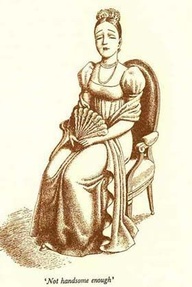
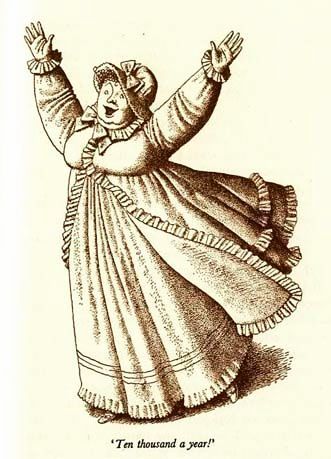
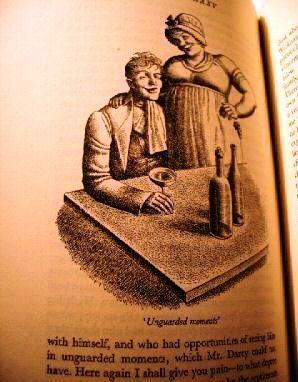
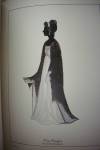
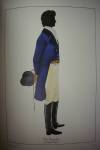
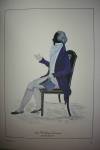
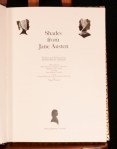
Shades from Jane Austen by Honoria Marsh was published in 1975-1976 in a series of limited editions. I saw this rare work at the silent auction table at the 2012 JASNA AGM meeting in NYC. There were many beautiful items, but this one was a standout with its colored illustrations, mostly silhouettes, and a few reproductions of Jane Austen’s writings. Bidding began at $50.00, but at the time I approached the table the price had gone up to $150.00, a bit beyond my price range but still less than the book attracts in online bookstores. The price reflects the book’s rarity, for only a few copies are available. I had seen a few illustrations before, but not the originals … until now.

The video shows a number of illustrations from the book not seen in this post. The portrayals of Jane Austen’s characters were painted by the author from life. Her sitters were either friends and acquaintances, or Jane Austen’s descendants or people associated with her! You can read their names below the title of the characters.

Part one of the book includes ‘Jane Austen’s Family in Silhouette’, a table showing Jane Austen’s Family and Chronology of Events During her Lifetime’ (written by Peggy Hickman), and Jane Austen’s family tree.

Part two includes an introduction and a discussion of Sense and Sensibility, Pride and Prejudice, Mansfield Park, Emma, Northanger Abbey and Persuasion.

Silhouette of Mrs. Gardiner

Alas, I do not know who successfully bid for the book in the silent auction or what it went for. Does anyone know?

Read Full Post »

Inquiring readers: While I am at JASNA’s meeting in NYC this weekend, I leave you with this delightful description of Catherine Morland as a very young girl. I have often wondered how much Jane Austen described her own character. After all, she lived with a house full of boys and must have played cricket with them and slid down the slope behind Steventon Rectory during the snow! Interestingly, Jane Austen wrote the description in one long paragraph, which my images break up. I love the tongue-in-cheek quality of her depiction of Catherine, yet she manages to describe exactly what a young lady’s accomplishments OUGHT to be.

**A family of ten children will be always called a fine family, where there are heads and arms and legs enough for the number. (Portait of Sir William Young and family, Johann Zoffany.) Walker Art Gallery

Description of Catherine Morland

A family of ten children will be always called a fine family, where there are heads and arms and legs enough for the number; but the Morlands had little other right to the word, for they were in general very plain, and Catherine, for many years of her life, as plain as any. She had a thin, awkward figure, a sallow skin without color, dark, lank hair, and strong features,— so much for her person. And not less unpropitious for heroism seemed her mind.

Embroidered 18th century handkerchief. “The ball once struck off, Away flies the boy, To the next destind post, And then home with joy.” *Image @CNN

She was fond of all boys’ plays, and greatly preferred cricket, not merely to dolls, but to the more heroic enjoyments of infancy, — nursing a dormouse, feeding a canary-bird, or watering a rose-bush. Indeed, she had no taste for a garden; and if she gathered flowers at all, it was chiefly for the pleasure of mischief, — at least so it was conjectured, from her always preferring those which she was forbidden to take. Such were her propensities. Her abilities were quite as extraordinary.

Girl sketching, by Henry Raeburn. c. 1811 Image @Sudley House

Catherine Morland’s Accomplishments

She never could learn or understand anything before she was taught; and sometimes not even then, for she was often inattentive and occasionally stupid. Her mother was three months in teaching her only to repeat the “Beggar’s Petition;” and after all, her next sister, Sally, could say it better than she did. Not that Catherine was always stupid,— by no means: she learnt the fable of “The Hare and many Friends” as quickly as any girl in England. Her mother wished her to learn music; and Catherine was sure she should like it, for she was very fond of tinkling the keys of the old forlorn spinnet; so, at eight years old, she began. She learnt a year, and could not bear it; and Mrs. Morland, who did not insist on her daughters being accomplished in spite of incapacity or distaste, allowed her to leave off. The day which dismissed the music-master was one of the happiest of Catherine’s life. Her taste for drawing was not superior; though whenever she could obtain the outside of a letter from her mother, or seize upon any other odd piece of paper, she did what she could in that way, by drawing houses and trees, hens and chickens, all very much like one another.

Dancing Masters Ball, 1794, Isaac Cruikshank. Childrens balls were arranged so that children could practice their dancing lessons. Image: Courtesy of Yale University, Lewis Walpole Digital Image Library Call Number 794.8.27.1

Writing and accounts she was taught by her father; French by her mother: her proficiency in either was not remarkable, and she shirked her lessons in both whenever she could. What a strange, unaccountable character!— for with all these symptoms of profligacy at ten years old, she had neither a bad heart nor a bad temper; was seldom stubborn, scarcely ever quarrelsome, and very kind to the little ones, with few interruptions of tyranny; she was moreover noisy and wild, hated confinement and cleanliness, and loved nothing so well in the world as rolling down the green slope at the back of the house.

Below: Catherine as I envision her when she meets Henry Tilney


Head of a girl
Louise Elisabeth Vigée Le Brun

Citations:
*Did baseball begin in 18th-century England?, By Simon Hooper, CNN, June 9, 2010 8:29 a.m. EDT

**A portrait of Sir William Young and his large family shows a picture of 18th century wealth in a fashionably bucolic setting. A “conversation piece”, this depiction was meant to tell a story. The artist, Johann Zoffany, helped develop this type of piece, positioning the sitters as if they are actors. The family is wearing a type of fancy dress, 17th century costumes inspired by century-old portraits by Sir Anthony Van Dyck . This type of nostalgia was extremely popular in Britain around 1770.  Michael Henry Adams, A Queen for Today! Huffington Post, April 22, 2009.

Read Full Post »

« Newer Posts - Older Posts »