Feeds:
Posts
Comments

Archive for the ‘Jane Austen Novels’ Category

Inquiring readers: While I am at JASNA’s meeting in NYC this weekend, I leave you with this delightful description of Catherine Morland as a very young girl. I have often wondered how much Jane Austen described her own character. After all, she lived with a house full of boys and must have played cricket with them and slid down the slope behind Steventon Rectory during the snow! Interestingly, Jane Austen wrote the description in one long paragraph, which my images break up. I love the tongue-in-cheek quality of her depiction of Catherine, yet she manages to describe exactly what a young lady’s accomplishments OUGHT to be.
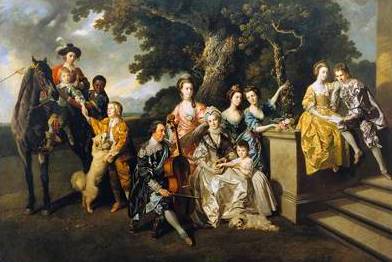
**A family of ten children will be always called a fine family, where there are heads and arms and legs enough for the number. (Portait of Sir William Young and family, Johann Zoffany.) Walker Art Gallery

Description of Catherine Morland

A family of ten children will be always called a fine family, where there are heads and arms and legs enough for the number; but the Morlands had little other right to the word, for they were in general very plain, and Catherine, for many years of her life, as plain as any. She had a thin, awkward figure, a sallow skin without color, dark, lank hair, and strong features,— so much for her person. And not less unpropitious for heroism seemed her mind.
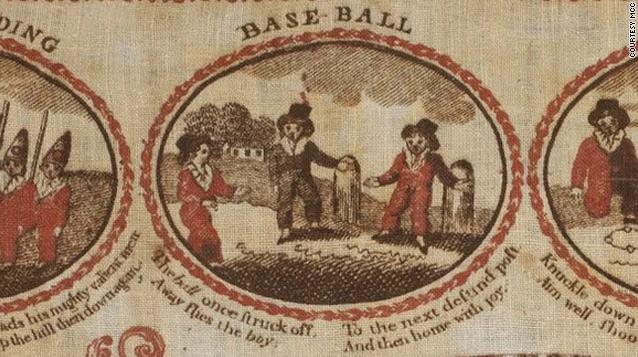
Embroidered 18th century handkerchief. “The ball once struck off, Away flies the boy, To the next destind post, And then home with joy.” *Image @CNN

She was fond of all boys’ plays, and greatly preferred cricket, not merely to dolls, but to the more heroic enjoyments of infancy, — nursing a dormouse, feeding a canary-bird, or watering a rose-bush. Indeed, she had no taste for a garden; and if she gathered flowers at all, it was chiefly for the pleasure of mischief, — at least so it was conjectured, from her always preferring those which she was forbidden to take. Such were her propensities. Her abilities were quite as extraordinary.
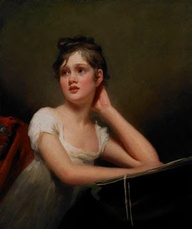
Girl sketching, by Henry Raeburn. c. 1811 Image @Sudley House

Catherine Morland’s Accomplishments

She never could learn or understand anything before she was taught; and sometimes not even then, for she was often inattentive and occasionally stupid. Her mother was three months in teaching her only to repeat the “Beggar’s Petition;” and after all, her next sister, Sally, could say it better than she did. Not that Catherine was always stupid,— by no means: she learnt the fable of “The Hare and many Friends” as quickly as any girl in England. Her mother wished her to learn music; and Catherine was sure she should like it, for she was very fond of tinkling the keys of the old forlorn spinnet; so, at eight years old, she began. She learnt a year, and could not bear it; and Mrs. Morland, who did not insist on her daughters being accomplished in spite of incapacity or distaste, allowed her to leave off. The day which dismissed the music-master was one of the happiest of Catherine’s life. Her taste for drawing was not superior; though whenever she could obtain the outside of a letter from her mother, or seize upon any other odd piece of paper, she did what she could in that way, by drawing houses and trees, hens and chickens, all very much like one another.

Dancing Masters Ball, 1794, Isaac Cruikshank. Childrens balls were arranged so that children could practice their dancing lessons. Image: Courtesy of Yale University, Lewis Walpole Digital Image Library Call Number 794.8.27.1

Writing and accounts she was taught by her father; French by her mother: her proficiency in either was not remarkable, and she shirked her lessons in both whenever she could. What a strange, unaccountable character!— for with all these symptoms of profligacy at ten years old, she had neither a bad heart nor a bad temper; was seldom stubborn, scarcely ever quarrelsome, and very kind to the little ones, with few interruptions of tyranny; she was moreover noisy and wild, hated confinement and cleanliness, and loved nothing so well in the world as rolling down the green slope at the back of the house.

Below: Catherine as I envision her when she meets Henry Tilney


Head of a girl
Louise Elisabeth Vigée Le Brun

Citations:
*Did baseball begin in 18th-century England?, By Simon Hooper, CNN, June 9, 2010 8:29 a.m. EDT

**A portrait of Sir William Young and his large family shows a picture of 18th century wealth in a fashionably bucolic setting. A “conversation piece”, this depiction was meant to tell a story. The artist, Johann Zoffany, helped develop this type of piece, positioning the sitters as if they are actors. The family is wearing a type of fancy dress, 17th century costumes inspired by century-old portraits by Sir Anthony Van Dyck . This type of nostalgia was extremely popular in Britain around 1770.  Michael Henry Adams, A Queen for Today! Huffington Post, April 22, 2009.

Read Full Post »

Inguiring readers, I literally SWOONED when I received a review copy of Emma: An Annotated Edition edited by Bharat Tandon. Readers of this blog know how much I have cherished this annotated series of Jane Austen’s novels by Harvard University Press. Click here for my review about the Annotated Pride and Prejudice and here for the Annotated Persuasion.

Lushly Illustrated Jane Austen Annotated Edition

Foremost, the books are lushly illustrated, beautifully produced, and well-researched by known Jane Austen scholars. Jane Austen Emma: An Annotated Edition is no exception. Considering the beautiful package, the book is very reasonably priced at $35 U.S., a perfect gift for the Janeite or historian in your family. Jane Austen Emma: Annotated Edition begins with a comprehensive introduction by Bharat Tandon, an academic, writer, and reviewer, who has lectured at the Universities of Cambridge and Oxford and specializes in teaching British literature after 1700 and American literature after 1900.

Emma is the only novel Jane Austen named after her heroine. Although she was fond of this eponymous character, she did not foresee Emma becoming a general favorite with the reading public, saying, ‘I am going to take a heroine whom no one but myself will much like.’ Truth be told, I’ve never quite warmed up to Emma Woodhouse, but in relation to 99% of the novels I’ve read my dislike is minor.

Annotated and Scholarly Insights on Emma

Her father, Mr. Woodhouse, on the other hand, has completely won me over with his odd, endearing hypochondriac ways, encouraging Mrs. Bates to eat a soft boiled egg and a very little bit of apple-tart, and a small half glass of wine put into a tumbler of water, for instance. Later in the novel, Mr. Woodhouse engages in a discussion with Frank Churchill about the room at the Crown, in which Frank tries to reassure the older man that the room reserved for the ball will be so large that there would be no occasion to open the windows and let in cold air upon heated bodies. Mr. Woodhouse nearly goes apoplectic at the thought, for both men are convinced that sweaty bodies should not be exposed to fresh air, a concept wonderfully explained by Tandon, who quotes The Code of Health and Longevity by John Sinclair (1807) as an explanation. Then there is this quote:

They were stopping, however, in the first place at Mrs. Bates’s; whose house was a little nearer Tandalls than Ford’s; and had all but knocked, when Emma caught their eye. – Immediately they crossed the road and came forward to her;”

I was delighted to discover that Jane Austen’s use of ‘catching an eye’ was one of the earliest citations of that particular use of that phrase in the OED, which cited Pride and Prejudice in the instance when Darcy catches Elizabeth’s eye and withdrew his own.

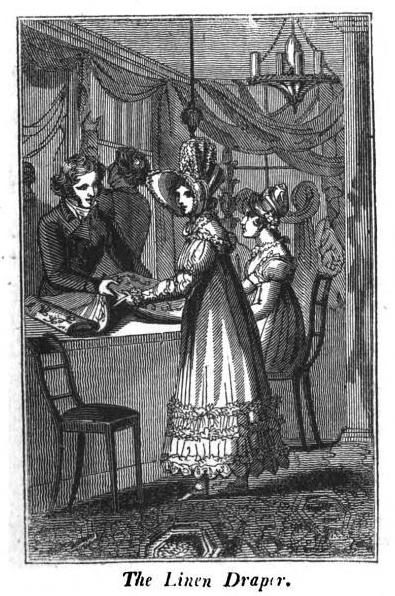
“The Linen Draper” from The Book of English Trades; and Library of the Useful Arts (London: Richard Phillips, 1818). (Image in the book)

Tandon discusses the meaning of making an entrance, the etiquette of dinner seating, square pianos, the plight of governesses, and so forth, and while I have seen some of the illustrations quite a few times before, such as the two that sit in this post, the author chose many that are new to me and add to my visual repertoire. Annotated books are such treasures for the serious reader of Jane Austen’s novels, explaining her words and old-fashioned idioms and making long dead customs come alive. This generously illustrated annotation from Harvard University Press both instructs and entertains with its running commentary along the margins, enhancing our enjoyment of one of Jane Austen’s most perfectly realized novels.

An Assembly Ball, plate 10 from the series “The Comforts of Bath”
1798, Colored aquatint. Image @Davis Museum and Cultural Center, Wesley College. (Image in the book)

Jane Austen Emma: An Annotated Edition is well worth the purchase.

I give this new addition to the Harvard University Press annotated Jane Austen novels five out of five regency teacups.

Purchase information: Harvard University Press

HARDCOVER

$35.00 • £24.95 • €31.50

ISBN 9780674048843

Read Full Post »

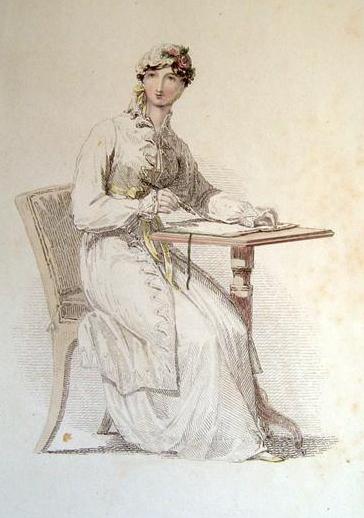
Lady writing at her desk, 1813, Ackermann fashion plate, morning dress.

It is a truth universally known that during her lifetime, Jane Austen published her novels as “a lady.”  While some in the family knew about her writing success – her brother Henry and sister Cassandra swiftly come to mind – many did not, including the cousins. When a genteel woman like Jane was described as being at “work”, the phrase meant needlework and sewing clothes for the poor basket. A lady simply did not sully her hands by toiling at a trade. Jane did not want it bandied about that she was the author of Pride and Prejudice or Sense and Sensibility, but her proud siblings, Henry in particular, couldn’t restrain themselves and bragged about their talented sister.  The word got out and the least well-kept secret was the name of the lady who wrote those delightful novels.

James Edward Austen, the son of Jane’s eldest brother James, and a favorite nephew of hers, discovered at school in 1813 that his favorite aunt was the author of two novels he had enjoyed immensely. The 11-12 year-old was so delighted with the news that he penned an enthusiastic poem about his discovery and sent it to her:

To Miss J. Austen

No words can express, my dear Aunt, my surprise
Or make you conceive how I opened my eyes,
Like a pig Butcher Pile has just struck with his knife,
When I heard for the very first time in my life
That I had the honour to have a relation
Whose works were dispersed throughout the whole of the nation.

I assure you, however, I’m terribly glad;
Oh dear! just to think (and the thought drives me mad)
That you made the Middletons, Dashwoods, and all,
And that you (not young Ferrars) found out that a ball
May be given in cottages never so small.
And though Mr. Collins, so grateful for all,
Will Lady de Bourgh his dear Patroness call,
‘Tis to your ingenuity he really owed
His living, his wife, and his humble abode.

James Edward Austen as a young man.

When Edward Austen-Leigh, as he became later known in life, was 72, he penned his now famous Memoirs of Jane Austen,  leaving a legacy of the memories that he and his cousins retained a half century after her death. Had Edward not embarked on this quest, his memories (he was 16 when Jane died), and those of Caroline Austen and Fanny Knatchbull, might not have been captured in print. While his book preserved those fading memories, they also “sanitized” his aunt Jane’s reputation, erasing much of her sharp tongue and wit and replacing it with sweetness of character:

The grave closed over my aunt fifty-two years ago; and during that long period no idea of writing her life had been entertained by any of her family. Her nearest relatives, far from making provision for such a purpose, had actually destroyed many of the letters and papers by which it might have been facilitated. They were influenced, I believe, partly by an extreme dislike to publishing private details, and partly by never having assumed that the world would take so strong and abiding an interest in her works as to claim her name as public property. It was therefore necessary for me to draw upon recollections rather than on written documents for my materials; while the subject itself supplied me with nothing striking or prominent with which to arrest the attention of the reader…

Edward Austen-Leigh at the time he wrote Memoirs of Jane Austen

The motive which at last induced me to make the attempt [to write this memoir] is exactly expressed in the passage prefixed to these pages. I thought that I saw something to be done: knew of no one who could do it but myself, and so was driven to the enterprise. I am glad that I have been able to finish my work. As a family record it can scarcely fail to be interesting to those relatives who must ever set a high value on their connection with Jane Austen, and to them I especially dedicate it; but as I have been asked to do so, I also submit it to the censure of the public, with all its faults both of deficiency and redundancy. I know that its value in their eyes must depend, not on any merits of its own, but on the degree of estimation in which my aunt’s works may still be held; and indeed I shall esteem it one of the strongest testimonies ever borne to her talents, if for her sake an interest can be taken in so poor a sketch as I have been able to draw.

Bray Vicarage:
Sept. 7, 1869.

Read Full Post »

A Dance with Jane Austen: How a Novelist and her Characters went to the Ball, Susannah Fullterton

“Ah”, I said, when I saw Susannah Fullerton’s book in my mail box. “Here’s just the book I need.” Some of the biggest gaps in my Austen reference library concern dance and music. Whenever I wanted to find out more about the social customs of balls and dancing, how ladies and gentleman conducted themselves, the food served at supper balls, the etiquette of a gentleman’s introduction to a lady before he could dance with her, precisely when the waltz became acceptable not only among the racy upper crust but with villagers in the hinterlands as well, and the difference between private balls and public balls, I had to consult a variety of books. This was time-consuming, and a bit frustrating, for there were variations in details that each source offered.

And now Susannah Fullerton has come to my rescue! Readers who have visited the Jane Austen Society of Australia (an excellent site) know that Ms. Fullerton is its president, and that she has written a previous book, Jane Austen and Crime. A Dance With Jane Austen is a compact illustrated book crammed with information, but written in a relaxed and accessible style. Topics include: Learning to dance, Dressing for the dance, Getting to and from a ball, Assembly balls, Private balls, Etiquette of the ballroom, Men in the ballroom, Dancing and music, ‘They sat down to supper’, Conversation and courtship, The shade of a departed ball, and Dance in Jane Austen films.

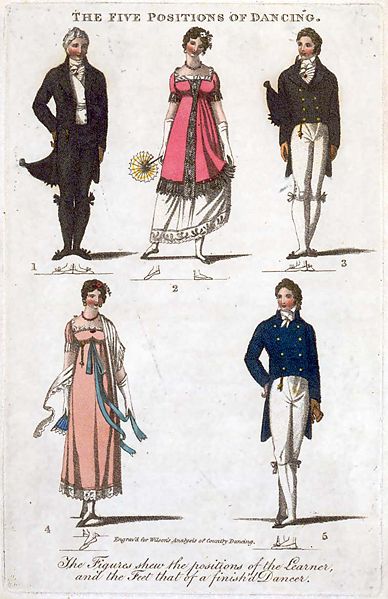
Ms. Fullerton culls information from Austen’s letters, novels, and historic texts, such as The Complete System of English Country Dancing, by Mr. Wilson, a dancing master of some renown and decided opinions. She also describes how Beau Nash, the influential master of ceremonies and taste maker in Bath, laid down a set of rules for Society to follow. Nash single-handedly changed a small, sleepy city into THE playground for the smart set with his dictums and innovations, which lasted well beyond his death.

The Five Positions of Dancing, Wilson, 1811

Jane Austen was no stranger to Bath’s public assemblies, or to dancing in private settings. She loved to dance and rarely said no when a man approached her for a set. Jane danced as often as she could, wryly observing to her sister when she was in her thirties and when partners became scarcer: “You will not expect to hear that I was asked to dance, but I was.”

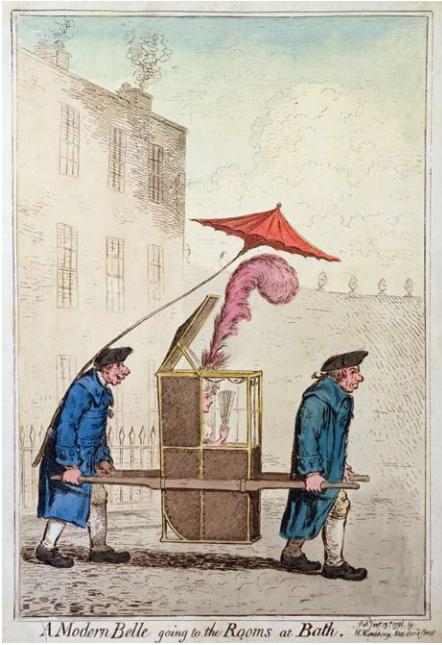
Getting to a ball might be problematic for those who had no means to keep horses or carriages. It made little sense to walk miles in fancy garb over dirt roads to a social event, and so arrangements needed to be made for those who were going to a dance to piggy-back with individuals who were willing to take them. This meant arriving and leaving a dance on someone else’s schedule. Catherine Morland did not walk to the Assembly Rooms, but took a sedan chair, for private carriages were seldom used within Bath proper. Her journey from “Great Pulteney Street to the Upper Rooms would have cost her between one shilling and six pence and two shillings (one way) – an expensive luxury at the time.”

A Modern Belle Going to the Rooms at Bath, Gillray caricature

The dancing ritual was one of courtship, and Jane Austen took full advantage of a ball to set the stage for character development. In each novel she takes a different approach. Lizzie and Darcy tense relationship began at the Meryton Assembly Ball, a situation that was not helped at the private ball at the Lucas’s house nor at the Netherfield Ball, where Lizzie’s family behaved abominably. The dances in Mansfield Park serve to show how selfish the characters are, and to point out Fanny’s isolation from the neighbors. Dancing masters taught children to dance properly, and they received further practice at children’s balls, but Fanny had few opportunities for practice, and she felt tense when she was prominently displayed at her birthday ball. Jane Austen masterfully used the dances in Emma to show how Emma never quite loses sight of Mr. Knightley even as she dances with Frank Churchill, and one gets a good sense of the frustration Catherine Morland feels at not being able to dance at her very first ball in Bath, for there was no one to introduce her and Mrs. Allen properly, or the utter irritation she feels when John Thorpe ruins her well-laid plans to dance with Mr. Tilney at a later assembly ball. Austen also uses balls to demonstrate how outrageous Marianne Dashwood’s behavior is towards Willoughby, breaking many rules of etiquette and decorum.

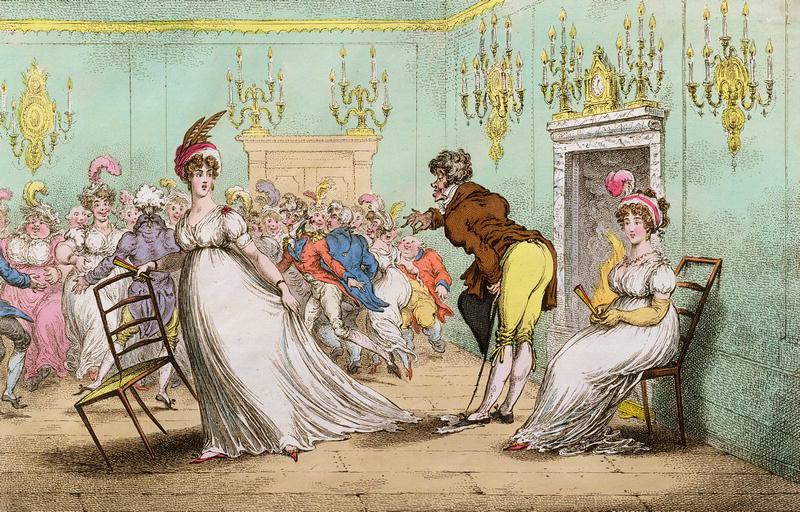
A Broad Hint of Not Meaning to Dance, James Gillray, published by Hannah Humphreys

Ms. Fullerton sets aside a few pages to discuss dances in films. These elaborately staged scenes are highly popular with film buffs. The costumes are beautiful, as is the music, and the settings are often quite lavish. But be aware that most of the dances and music are often inaccurate and chosen for cinematic effect. (As an aside, I was glad to note that Susannah’s take on Pride and Prejudice 1940 was similar to mine.)

Susannah Fullerton

Insights such as these make this book a sheer pleasure to read. A Dance with Jane Austen will be a valuable addition on the book shelves of any Regency author, Janeite, and history buff. As Susannah Fullterton says about her book:

Dances in the Regency era were almost the only opportunity young men and women had to be on their own without a chaperone right next to them, and dancing provided the exciting chance of physical touch. ..Dances were long – one often spent 30 minutes with the same partner – so there was plenty of opportunity for flirtation, amorous glances, and pressing of hands. After the dance was over, there was all the pleasure of gossip about everything that had happened.”

A Dance with Jane Austen will be available in October. Readers who are lucky enough to go to the Jane Austen Society Annual General Meeting in New York in a few weeks will have the opportunity to meet Ms. Fullerton! I give this book 5 out of 5 Regency tea cups.

Preorder the book at this Amazon.com link or at Frances Lincoln Publishers
Hardcover: 144 pages
Publisher: Frances Lincoln (October 16, 2012)
Language: English
ISBN-10: 0711232458
ISBN-13: 978-0711232457

Please note: The blue links are mine; other links are supplied by WordPress. I do not make money from my blog. I do, however, receive books from publishers to review.

Read Full Post »

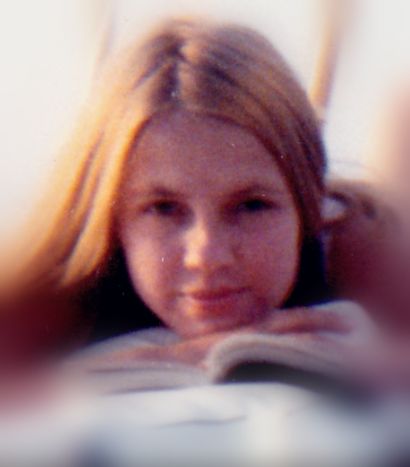
Vic at 22 on a sailboat, reading a Georgette Heyer novel. Look at those chubby Dutch cheeks!

I stumbled upon Georgette Heyer during a golden time of my life after college graduation when I had three precious free months before I began school again. Bursting with youthful energy, I didn’t know what to do with my time. And so I hit the books, but this time for pleasure. In those days, I could gobble up a book a day if I was so inclined, and I sped through Jane Eyre. Wuthering Heights. Tess of the d’Urbervilles. Rebecca. Father and Sons, by Ivan Turgenev, one of my favorite authors, and Pride and Prejudice (for the second time in my life). That last novel with its sparkling wit and clear view of village life seemed like a breath of fresh air after the heightened emotions of the Victorian authors.

To me, Mr. Bennet was the image of my father, whose wry statements always made me pause before I could figure out if he was making sport of me, himself, or some other unwitting target. Mrs. Bennet reminded me of my crazy Dutch grandmothers – both of whom were slightly hysterical and VERY demanding. I read Pride and Prejudice twice that summer (and began a tradition of reading it every summer for the next twenty years). Greedily I reached for more Jane Austen novels until there were none left. I railed against the illness that carried Jane off before she could produce enough novels to assuage my addiction. Where to turn?

The library, of course.

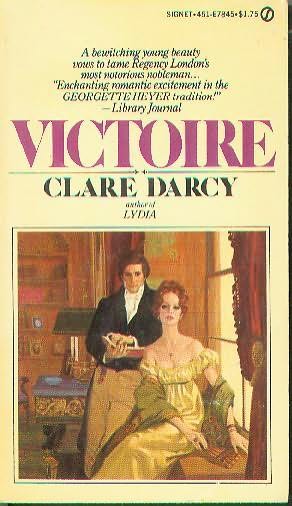
I looked up Regency novels and found … Clare Darcy. Ok, I thought. I’ll give her a try and picked up a copy of Victoire, a most logical choice given my given name, and read the book in one long sitting. How to state it nicely: Clare Darcy is to Jane Austen what a sputtering candle is to the sun at high noon.

My quest was not over.

My apartment roommie, also a Janeite, discovered the Flashman novels by George MacDonald Fraser. She LOVED them. But budding little feminist me wanted books written by humorous females, not a man with no interest in the goings on of small town families and their courtship rituals, and silly clergy, and strong heroines who were able to learn a thing or two. And so I continued my search.

One day I found a Barbara Cartland novel. Hahahahahahahaha! Tossing aside her cheesy book about a 16-year-old-heroine with a heart-shaped face, I wondered if I could charge her for wasting my precious life.

I continued my search.

And there it was. On the bottom shelf at the library. Arabella. It was a pathetic excuse of a book – dog-eared, blemished, and torn partially in the spine. I read the front cover – Arabella by Georgette Heyer – then sat on the floor and began to read. Witty words leapt from the pages. I laughed with delight. Before long I checked out the book and proceeded to read it in one long sitting. My roommie, who had started her new job two weeks after college, came home from work to find me engrossed. “I found a new author,” I said, telling her she could read the book when I was done. I gave it to her that night.

We were both instantly hooked on Georgette Heyer.

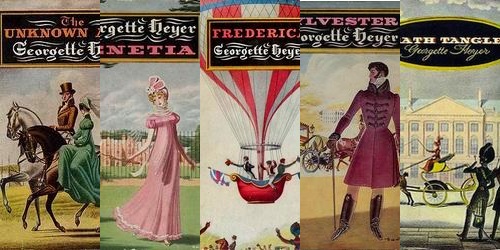
I returned to the library and checked out all the Georgette Heyers I could find. My roommie and I fell in love with Arabella, but we became die-hard fans when we encountered Venetia, The Grand Sophie, Sylvester, and Frederica. By summer’s end we had read ALL the GHs we could lay our hands on, even the mysteries and histories. (Thankfully, Georgette was prolific.)

My roommie and I were two young and hopeless romantics. We loved the glittering, detailed descriptions of the characters, the clothes they wore from expensive shops, and the houses, towns, and cities they inhabited. We learned about Regency London and the manners and mores of the Ton. Georgette Heyer characters spoke in cant, and thus we affected British accents and used cant-speech at every opportunity. Our boyfriends, while a bit mystified, played along, even debating which weapon was more effective in a fight – the epee or the sword.

Vintage GHs

But then life intruded and my intense love affair with Georgette Heyer had to take a back seat. I returned to school and began to read academic books again. I left my obsession behind, except for my yearly date with Pride and Prejudice.

Flash forward a number of decades when Sourcebooks began to republish Georgette Heyer novels. Once more I began to read them regularly, only this time I reviewed them as well.  I discovered that my tastes had changed and that I was more attracted to other novels like The Reluctant Widow and The Convenient Marriage. I never reread Arabella, for I did not want to revisit my first love only to discover that she had flaws.

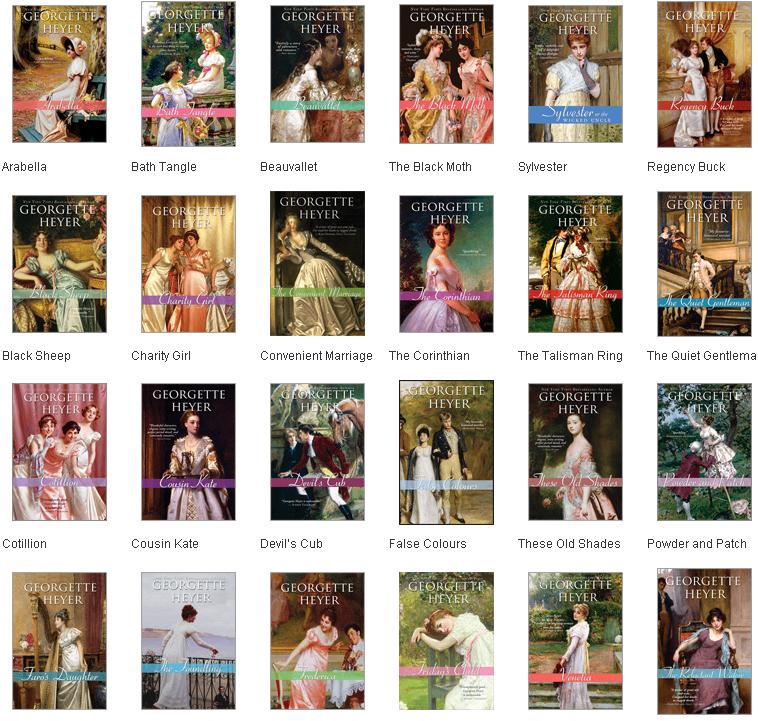
I savor my memory of first discovering Georgette Heyer and thank Sourcebooks for the opportunity to relive that Golden Summer. I keep about 10 GH books on my Nook and Kindle (yes, I have both) so I am not ever very far from one of my favorite authors. If you are intrigued, all of GH s novels are available at Sourcebook’s Discover a New Love Website at http://www.discoveranewlove.com.

WIN A FREE BOOK! Those who leave a comment, have an opportunity to win a Georgette Heyer novel! Just let me know why you love to read Regency romances and/or Jane Austen! Contest ends on August 16th, (Contest ended!)which is Georgette Heyer’s 110th Birthday! Happy Birthday, GH, and thanks for the memories. Congratulations winners, Jan and Ginger, chosen through Random Number Generator! Thank you all for making a comment!

More on the topic: 

Read Full Post »

« Newer Posts - Older Posts »