Feeds:
Posts
Comments

Archive for the ‘jane austen’ Category

brighton westallBrighton as It Is 1836 has been posted electronically online. A fascinating tour guide, it offers many peeks into a world that is long gone. Most interesting is this page that lists the fares for hiring a sedan chair, bathing machine, pleasure boats, and carriages. One may also find the subscription to the reading room and circulating library. The book is only 108 pages long and a must read for those who are fascinated with Brighton during this period.

Rates for hiring public conveyances

Rates for hiring public conveyances

Update: Compared to the prices of hiring a guide (sedan) chair in Bath in 1806, there was very little difference:

Bath guide chairs, John Feltham, 1806

Bath guide chairs, John Feltham, 1806

Letter of the learned W. Clarke, selected from Nichols’ Anecdotes (p. 6-7):

“July 22, 1736

“We are now sunning ourselves upon the beach at Brighthelmstone, and observing what a tempting figure this island must have made formerly in the eyes of those gentlemen who were pleased to civilize and subdue us. The place is really pleasant; I have seen nothing in its way that outdoes it: such a tract of sea, such regions of corn, and such an extent of fine carpet, that gives your eye command of it all. – But then the mischief is, that we have little conversation besides the clamor nauticus, which is here a sort of treble to the splashing of the waves against the cliffs. My morning business is, bathing in the sea, and then buying fish; the evening is, riding out for air, viewing the remains of old Saxon camps, and counting the ships in the road, and the boats that are trawling. Sometimes we give the imagination leave to expatiate a little-fancy that you are coming down, and that we intend to dine one day next week at Dieppe, in Normandy; the price is already fixed, and the wine lodging there tolerably good. But though we build these castles in the air, I assure you we live here almost under ground. I fancy the architects here usually take the altitude of the Inhabitants, and lose not an inch between the head and the ceiling, and then dropping a step or two below the surface, the second story, is finished something under twelve feet. I suppose this was a necessary precaution against storms, that a man should not be blown out of his bed into New England, Barbary, or God knows where. But as the lodgings are low, they are cheap: `we have two parlours, two bed chambers, pantry ‘ &c. for five shillings per week: and if you really will come down’ you need not fear a bed of proper dimensions. And then the coast is safe, the cannons all covered with rust and grass, the ships moored no enemy apprehended. Come and see…
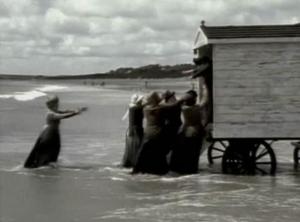
Bathing machine in Brighton, Vanity Fair

Bathing machine in Brighton, Vanity Fair

Also from the book (p. 8 )

Public attention was first directed to the spot by a treatise of Dr. Russell on the advantages of Sea-bathing, which he successfully recommended in scrophulous and glandular complaints. It was he, too, who caused the valuable chalybeate spring to the West of the town to be enclosed, prior to the erection of the present building. His successor, Dr. Rhellan, continued to add to the reputation of Brighton by publishing a Natural History of the town in 1761.

We now arrive at a period when the increasing popularity of the place was to receive a new stimulus from the presence of the Prince of Wales, afterwards George the Fourth. His first visit was in the summer of the year 1782, when the Prince resided with his Royal relatives, the late Duke and Duchess of Cumberland. He afterwards usually passed the summer and autumnal months at a mansion on the Steyne, then the property of the Lord of the Manor, which, after it had undergone several alterations, he finally purchased in 1814; and shortly after pulled it down to make room for the present Pavilion.

My other posts about Brighton, Transportation, and Seaside Resorts:

Read Full Post »

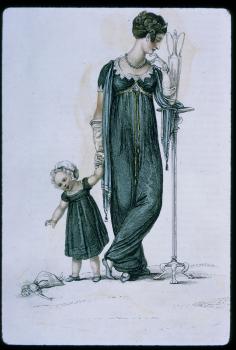
Belle Assemblee Morning Dress, 1818

Belle Assemblee Morning Dress, 1818

Outward manifestations of grief have changed in mourning rituals over the centuries. These days when we think of 19th century mourning, we tend to confuse elaborate Victorian rules of the 1860’s with the less rigid mourning etiquette of the earlier 19th century. Mourning fashions during the Regency Period are fully described in Dressing for Mourning in the Regency on the Jane Austen Centre’s website. Only the wealthy could afford the specially made fashionable mourning outfits shown in the fashion plates featured in Ackermann’s Repository or La Belle Assemblee, but the rising popularity of fashion magazines meant that the details of dress quickly spread through the provinces. Most people remade mourning clothes from an existing wardrobe, adding new linings to cloaks and pelisses, covering existing bonnets with a new piece of crape, and dyeing old dresses. Jane Austen wrote about her mother in 1808: “My Mother is preparing mourning for Mrs E. K. – she has picked her old silk pelisse to peices, & means to have it dyed black for a gown – a very interesting scheme.

One can imagine how an illustration like the one on the right would inspire women to add mourning details to their wardrobes, but such an expensive outfit would still be beyond most women’s means. The middle class was rising in numbers at a time when mourning clothes became more affordable through mass production of cloth. With these cheaper, more readily available clothes, the custom of wearing specially made mourning outfits (as opposed to remade) began to trickle down the social ladder. The very poor, who often did not own more than one outfit, could not afford to follow these wardrobe rules. They could not even afford the dark or black caps and bonnets that were worn with these ensembles. All they could manage at most was a touch of black, such as a ribbon or armband.

Ackermann, Mourning Dress,, 1819

Ackermann, Mourning Dress,, 1819

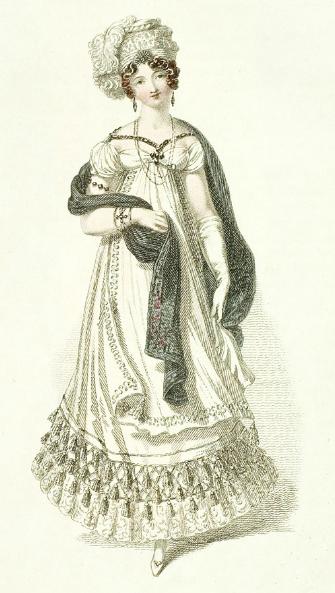
One feature that characterized custom made or manufactured mourning clothes of the era were broad or deep hems of at least three inches. Women dressed in crêpe, the fabric of choice, or wore black bombazine silk, which had a matte finish as opposed to the sheen of regular silk, and converted their narrow hems into broad hems. Black was the only acceptable color in the first stage of mourning, which for widows and widowers lasted one year and one day.  After the initial mourning period was over, the griever could choose wear subdued grays, purples, lilacs, and lavenders, as well as white, which had been the color of mourning during the medieval period.  There were reports of widows choosing to wear heavy widow’s weeds for the rest of their lives, but in the early 19th century these decisions were made from choice and were not dictated by the inflexible example set by Queen Victoria.

Shiny material was unacceptable during heavy mourning, when only flat matte colors would do. Two stages of mourning – full mourning and half mourning – were already being followed, as evidenced in the fashion plates between 1800 and 1820. The subdued colors of half mourning were supposed to help a person transition to the brighter colors of regular wear, but for some, death was so common in an extended family that it might take some individuals years before they could safely abandon their mourning garb.

Women largely took on the burdens of official grieving. A man might be expected to wear a dark jacket black cravat, black or white shirt, black bordered handkerchief or armband, or a black ornament on his hat, but his life was not turned upside down like a woman’s, for he often wore black clothes as a matter of course.

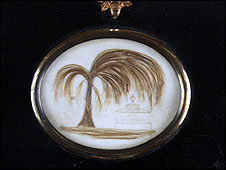
Locket with Jane Austen's hair (?)

Locket with Jane Austen's hair (?)

Early in the mourning process, only matte black jewelry made with jet or black amber could be worn. During the second phase of mourning, the wearer was given a wider choice of jewelry to wear. Jewelry made with the beloved’s hair, such as this brooch made (purportedly) with Jane Austen’s hair, was extremely popular and had a long tradition harking back to the 1600’s. In medieval times, giving a token of one’s hair was a gesture of love or courtship.  (Willoughby took a lock of Marianne’s hair, which gave her family the impression that they were engaged.) Hair symbolized life, and was long-lasting. It is remarkable how “fresh” some of the hair samples in centuries old jewelry still seems today.

Evening Dress, Full Mourning, 1817

Evening Dress, Full Mourning, 1817

Widows and widowers followed stricter rules of mourning and for them the mourning period was the most intense and lasted the longest. Friends, acquaintances and employees mourned officially to a lesser degree, depending on their relationship to the dead person. ” The degree of the loss depends on the person, an infant had practically no value to society but adolescents were recognized more. Grandparents were not a marked loss as their usefulness had passed, the longest period is that of a spouse.” – Death.

Author Georgette Heyer, who knew the Regency Period backwards and forwards, included a passage in A Civil Contract in which the bride’s new family contemplated introducing her (Jenny) to Society after her husband’s father had recently died. It was obvious that her new mother-in-law could not introduce her, for she was still wearing the veil and observing the first stages of mourning:

[Lady Oversley] perceived the intricacies of the situation at once, and gave the matter her profound consideration. “She must be presented,” she decided. “It would have a very strange appearance if she weren’t, because one always is, you know, on the occasion of one’s marriage. And there is nothing improper in going to a Drawing-Room when in mourning, though not, I think, in colour—except lavender, perhaps. Only, who is to present her? In general, one’s mother does so, but poor Jenny has no mother, and even if she had—dear me, yes! this is a trifle awkward, because I don’t think you could ask it of your own mother. Not while she is in such deep mourning, I mean! Well, it will have to be me, though I am strongly of the opinion that if we could but hit on a member of your own family it would create a better impression.”
“My Aunt Nassington?” suggested Adam.
“Would she?”
“I think she might.”

It was traditional for the nation to mourn the death of a royal. Princess Charlotte’s death from childbirth in 1817 resulted in an elaborate funeral that rivaled the one held more recently for Princess Diana, and inspired the populace to wear black. This nation wide mourning was a precursor to the elaborate ceremonies that would be planned for Prince Albert’s funeral almost half a decade later in 1861.

More links on the topic:

*A special thank you to Laurel Ann of Austenprose and my blog partner at Jane Austen Today for sending me most of the images for this post.

Half mourning evening dress, 1819

Half mourning evening dress, 1819

Read Full Post »

When Fanny Price first arrived at Mansfield Park, her cousins  found her ignorant on many things. “Dear mama, only think, my cousin cannot put the map of Europe together.”  The girls  were referring to dissected geography puzzles, now known as jigsaw puzzles, that had first made their appearance in Europe in the 18th century and were popularized and widely used in England and America in the 19th and 20th centuries. Mansfield Park makes one of the earliest references to this educational way of teaching of geography. While Fanny Price’s cousins teased her for not being familiar with these expensive new schoolroom toys, the truth was that her Portsmouth parents could not afford them.

At the turn of the 18th century,  British companies began to make toys that are still favorites today: toy soldiers, farmyards, wooden building blocks, steam engines, and kaleidoscopes. The toymaking industry began to boom, making mass-produced toys cheap enough to afford. By the start of the Regency Period,  people had become accustomed to purchasing them and they became educational in nature as well, such as puzzles. Many sources claim that John Spilsbury, a teacher in England, created the first jigsaw puzzle in  1767.  He glued a map of England and Wales  to a  flat thin piece of mahogany board and used a fine saw (fretsaw) to cut along the borders of the counties, which made up the separate pieces.  The “dissected map” became instantly successful.

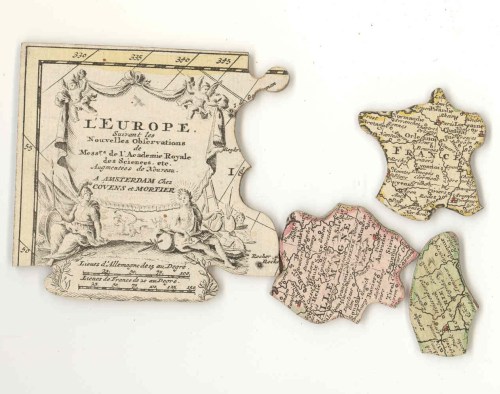
18th century Dutch dissected puzzle

18th century Dutch dissected puzzle

While it is popularly thought that Spilsbury created the first dissected puzzle, the Dutch dissected puzzle in this image was made ca. 1750 (Cartographic dept. Univ. Library of Amsterdam), predating Spilsbury’s invention by seventeen years. If you will notice, only the borders of this early map of Europe interlock but not the central parts. ( Theo de Boer.) The Dutch puzzle might well be one of the earliest jigsaw puzzles made in the world, but there is evidence that several countries in Europe, including France, were teaching geography in this “entertaining manner.” As an interesting aside, so many new geographical features were discovered during this period of scientific discovery and exploration, that maps quickly became outmoded as new ones were drawn.

Before long, pictorial puzzles became popular, teaching such subjects as history, alphabets, botany, biblical scenes, and zoology. Soon the puzzles began to be made for their entertainment value as well. Click here to view two fine examples of early puzzles, including an alphabet puzzle.

Colorful_british_pub_picturEarly puzzles did not come with an image that helped people to solve them, and a careless movement could ruin hours of painstaking work.The treadly saw, first used in 1880, could cut out more intricate shapes, and thus the jigsaw puzzle was born. The interlocking pieces held firmly together and the game took off in popularity. Paperboard began to replace wood and the pieces became more varied and intricate. The game was portable, became more affordable with the passing years, and could entertain families for hours at a time. By the early 19th century, America in particular experienced a puzzle craze that lasted for decades and still exists today.
Read Full Post »

Lady Maria Hamilton, 1802, by Thomas Lawrence.

Lady Maria Hamilton, 1802, by Thomas Lawrence.

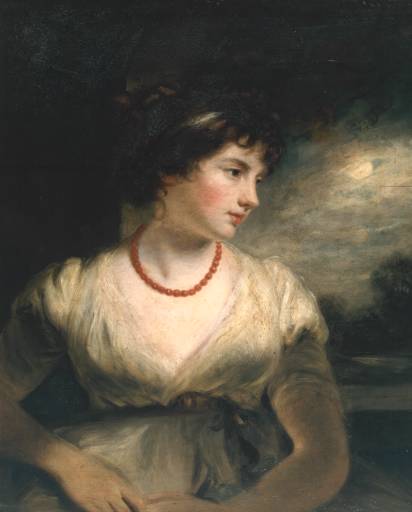
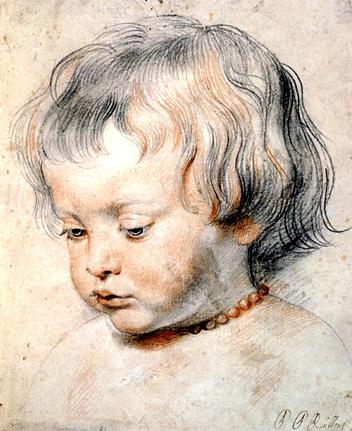
Inquiring Reader: You’ve probably seen the necklaces dozens of times without noticing them. I have. These beautiful single string coral necklaces worn by Regency ladies escaped my attention until my friend and blogging partner on Jane Austen Today, Laurel Ann of Austenprose, sent me some spectacular images, such as the one of Lady Maria Hamilton, who died in 1814 unmarried. Coral has enjoyed a long and ancient tradition, first worn as a talisman and later for its color and beauty. One of my favorite drawings by Peter Paul Rubens depicts his son with a coral necklace. At the time coral was thought to protect the wearer.

Nicolaas Rubens Wearing a Coral Necklace, Peter Paul Rubens, Red and black chalk heightened with white and some black ink on paper, c. 1619

Nicolaas Rubens Wearing a Coral Necklace, Peter Paul Rubens, Red and black chalk heightened with white and some black ink on paper, c. 1619

The tradition of giving children coral necklaces continued through the 19th century, as shown in this detail of a late 18th century John Hoppner painting of one of the Sackville girls. The gemstone was considered a guardian of sorts, protecting children from illnesses like stomachaches, fever, typhus, smallpox, and rickets. The mala beads were polished to a smooth sheen and matched in color. Bead sizes could be similar or gradated from small to larger stones that were strung in the center.

The Sackville Children, detail, John Hoppner, 1796

The Sackville Children, detail, John Hoppner, 1796

Handmade jewellery created during the late Georgian Era (1760-1837) is extremely hard to find today.  As styles changed, the pieces were remade rather than tossed out or sold. Until the latter part of the 18th century, coral was harvested from the sea largely by dredging. Fine quality red coral came from the Mediterranean – Algeria, France, Italy, Morocco, Spain, Tunisia and the islands of Corsica, Sardinia and Sicily, with some saying that the best corals came off the coasts of Algeria and Tunisia. Eighteenth century coral was a rich warm red and is unavailable today. In fact, original antique jewellery made with dark red coral is so difficult to find that it has become a highly prized collectible.

Jane Elizabeth, Countess of Oxford, John Hoppner, 1797

Jane Elizabeth, Countess of Oxford, John Hoppner, 1797

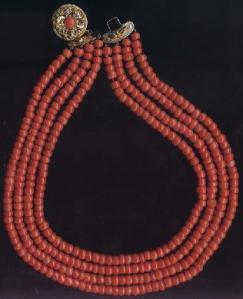
Early 19th century red coral necklace

Early 19th century red coral necklace

Simple round necklaces, like the one worn by the Countess of Oxford, were popular and complimented low necklines, but chokers were also fashionable, like the Georgian Cannetille Sardinian red coral four strand necklace on the left. Coral is made up of the skeletal material built up by small animals that live in slow growing colonies in the sea. Colors range from vivid orange, red, and white, to salmon and pale pink (called angelskin coral). In jewelry making coral is either carved into beads, cameos, and other forms, or is left in its natural branch-like form and simply polished. (My mother had such a necklace, which I played with as a child.) The most sought after color (and the rarest) is a deep red, as in the necklace at left.  Coral manufacturing during the Regency Period consisted primarily of filing beads of smoothed coral and stringing necklaces. Because coral consists of calcium carbonate, it is extremely sensitive to chemicals,  perfumes, and body acids. Like pearls, the necklaces must be washed with a damp cloth (no detergents) and restrung periodically.

Little boy placing a coral necklace on a dog's neck, Martin Drolling

Little boy placing a coral necklace on a dog's neck, Martin Drolling

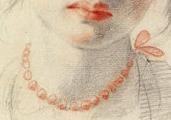
detail of Jacopo Vignali's Head of a Young Woman, 17th c

Many mystical and medicinal properties were attributed to coral, among them vitality, physical strength, stronger marital relationships, wealth, increased sensuality, and protection while out to sea. Coral was also used as a medicinal powder. Primitive physics believed that coral oxides mixed with honey made a person strong. Mix it with betel leaf and it made a potent cure for cough and heart disease. Coral powder is still a popular aphrodisiac in India today, which prompts avaricious collectors to dynamite coral reefs, putting fragile reefs in acute danger. In the detail of a 17th century drawing by Jacopo Vignali at right, one can easily see why this semi-precious stone was considered to have sensual qualities. The combination of the coral necklace and her full lips make the young woman look both fragile and seductive. Thank you, Laurel Ann, for introducing me to this fascinating topic! As you can see, I got a little carried away.

More information about corals can be found in these links:

Read Full Post »

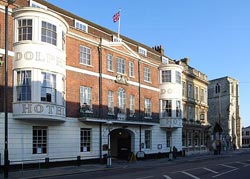
Dolphin Hotel in Southampton

Dolphin Hotel in Southampton

According to a recent newspaper report, The Dolphin, a 3-star hotel in Southampton, will close at the end of this month. Jane Austen danced in its ballroom between 1806 and 1809 after her father’s death and after she and her mother and sister moved from Bath. The building that houses the Dolphin was erected in 1250 and the hotel dates from 1550, a venerable history. Southampton is a medieval city. Its western walls were built in 1338 and remain one of the finest medieval town defenses in the UK.

The medieval town that Jane knew was, according to the diarist Mrs Powys, “one of the most neat and pleasant towns I ever saw … once walled round, many large stones of which are now remaining. There were four gates, only three now … one long fine street of a quarter mile in length … At the extremity a capital building was erected with two detached wings, and colonnades. The centre was an elegant tavern, with assembly, card room, etc., and at each wing hotels to accommodate the nobility and gentry. The tavern is taken down, but the wings converted into genteel houses” (Mitton 1917). – Hantsweb

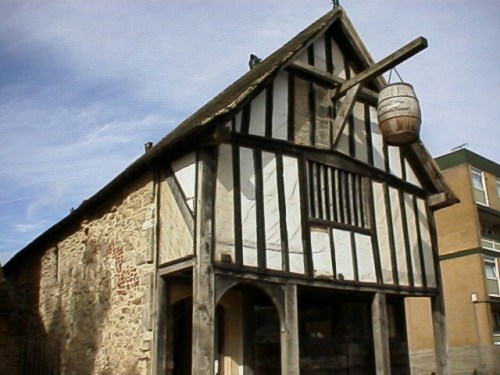
Medieval Merchant's House, Southampton

Medieval Merchant's House, Southampton

In one of her letters Jane mentioned a ball at the Assembly Rooms. These rooms, said a contemporary writer, were situated near the West Quay, and were very elegantly fitted up. “The Long Room, he says, was built in 1761, the Ball Room soon afterwards.”

Quadrille Plate from Le Bon Genre, 1805

Quadrille Plate from Le Bon Genre, 1805

“Our ball was rather more amusing than I expected,” Jane writes . . . . “The room was tolerably full, and there were, perhaps, thirty couple of dancers . . . . It was the same room in which we danced fifteen years ago. I thought it all over, and in spite of the shame of being so much older felt, with thankfulness, that I was quite as happy now as then . . . . you will not expect to hear that I was asked to dance, but I was – by the gentleman whom we met that Sunday with Captain D’Auvergne. We have always kept up a bowing acquaintance since, and being pleased with his black eyes, I spoke to him at the ball, which brought on me this civility; but I do not know his name, and he seems so little at home in the English language, that I believe his black eyes may be the best of him.”[1] Constance Hill, Jane Austen Southampton. – Constance Hill

Southampton Sea Walls

Southampton Sea Walls

During the 18th century Southampton was a popular Spa town, but this development did not last long. Although assembly rooms and baths were constructed, there were not enough features in the town to maintain it as a tourist attraction. Jane and her family could visit the theatre and there was a circulating library, but Southampton was more a working seaport than a resort. Unfortunately the building that Jane Austen lived in and its surrounding area have been demolished, but one can still see the medieval walls and ancient portions of the city.*  The Dolphin’s website describes the Assembly Rooms today:

Jane Austen Assembly Rooms – Jane Austen was a regular visitor to Southampton and famously attended a ball in the Assembly rooms here at the Dolphin on her 18th birthday. The main room divides into three creating: Jane Austen Assembly Room – One A large room, decorated in the Georgian style, featuring a quite stunning stone carved fireplace and one of two enormous bay windows, which are reputed to be the largest in the world, providing ample natural daylight. Jane Austen Assembly Room Two – The smallest of our meeting rooms is still a good size, with three sash windows, opening onto the royal balcony, which hangs over the high street. Jane Austen Assembly Room Three – A large room, decorated in the Georgian style, featuring a quite stunning stone carved fireplace on which one of our resident ghosts (Beau) is reputed to lean, whilst looking out of the bay window, which are reputed to be the largest in the world, providing ample natural daylight. Jane Austen Assembly Rooms Full Room – When the whole room is opened up, the symmetry of the architecture can be seen in its full glory, much as it would have been when Jane danced here. The two stone carved fireplaces, facing one another across the length of the room and the two bay windows together with the high ceilings reflect a style of architecture which has sadly passed. Jane Austen Music Room – The music room is also situated on the first floor, adjacent to Jane Austen Assembly Room One, was built slightly later than the main room in around 1780 and features a marble fireplace and five sash windows, overlooking the high street.

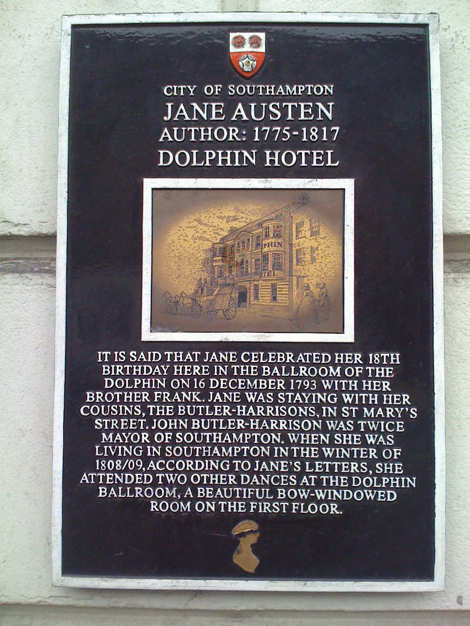
To mark the 200th anniversary of the year Jane took up residence in Southampton, a Jane Austen Trail was launched in July 2006. There are eight plaques each at a location associated with Jane and, available at Southampton Tourist Information Centre.

dolphin-hotel-jane-austen-trail

Find more on the topic in these links:

Read Full Post »

« Newer Posts - Older Posts »