Feeds:
Posts
Comments

Archive for the ‘jane austen’ Category

This carriage database discusses the history of the carriage and its uses over time. Included are links to specific makes of carriages, which lead to more detailed information or definition about that type, ie. landau, barouche, mail coach, phaeton, etc. In some instances, images accompany the pages. (Click on reference, then carriage). Update: Something seems to be wrong with the first link to the carriage database. I shall update this post as soon as I find the link again. This link to A Catalogue of Horse drawn vehicles 1896 catalogue of E. S. Annison, Coach Builder, of Hull, features drawings of his carriages and their latest design (late 19th century). Internet Archive provides a downloadable PDF book with images, Carriages and Coaches: their history and their evolution, fully illustrated with reproductions from old prints, contemporary drawings and photographs (1912). This entry in Carriages in Indopediais contemporary and provides links to definitions and information.

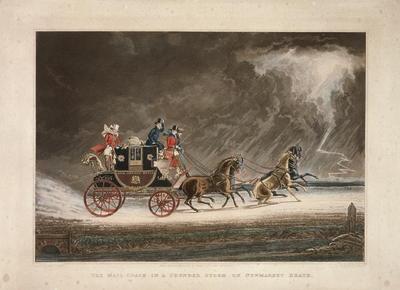
Mail Coach, 1827

The Georgian Index features an excellent page on Carriages and their Parts. Highways and Horses, Athol Maudslay, 1888 is an illustrated Google book that discusses carriages and transportation during the Victorian period in great detail. On the fronticepiece, Mr. Maudslay writes :

Share/Bookmark// More about the topic on this blog:

Read Full Post »

Inquiring Reader: David JC contacted me to let me know he would be blogging about his experiences reading Jane Austens six novels in six months in his new blog, Following Jane.  As he so eloquently wrote –

A complete social experiment. 31. Husband. Father. Friend. Reader.

Over the next 6 months, I’ll only read Jane Austen’s novels.

A solitary book club.

1 book a month between April and September of 2010.

Let’s see what insight I’ll find while following Jane.

I wrote David and asked him a few questions, which he promptly answered.

Why did you decide to concentrate on reading Jane Austen’s novels for six months?

I was driving home the other night and wanted to do something productive, but also something meaningful that would enrich my life. I thought of a list of influential people in life… directors, teachers, historical figures, actors, authors… and then Jane suddenly popped into my head. I wondered what it would be like for the male perspective to read all of her novels and then write about the experience and discoveries. I don’t think it has been done before, and it felt like an interesting challenged.

Sense and Sensibility, Richard Wilkinsons design for a book cover

Have you read any before? if so, what did you think of it/them?

I have read Pride and Prejudice before and was completely intrigued by the relationship between Darcy and Elizabeth (but then again, who isn’t?).

Have you seen the movie adaptations? Which are your favorite?

I have only watched bits and pieces of the Keira Knightley Pride and Prejudice version… never the entire thing, or any other film adaptations.

I cant wait for David to get started, and will keep you, dear reader, posted.

Read Full Post »

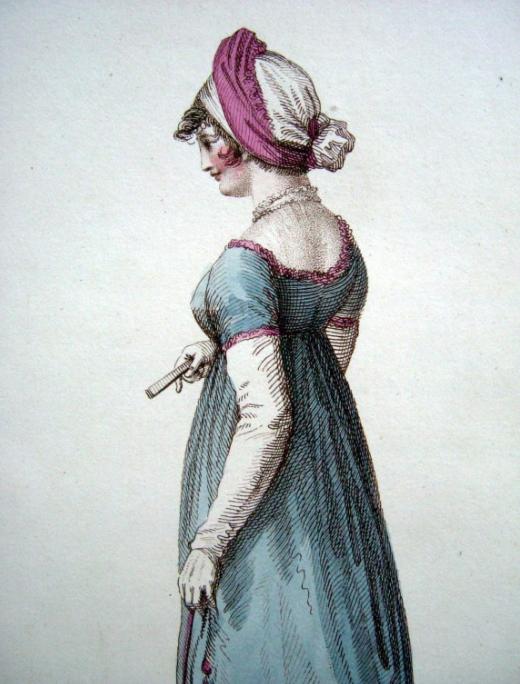
1803 Mirroir de la Mode Evening Dress

In 1803, a woman named Madame Lanchester of Bond Street, published  ‘Le Miroir de la Mode‘. By 1804, scarcely two years after it appeared, the magazine had vanished. (Although The Museum of London has at least one plate published by Madame Lanchester which is dated 1807).  Very little is known about the woman, who had designed for other publications, such as Richard Phillips Fashions of London and Paris.

La Miroir de la Mode was a short-lived, expensive, and large quarto-sized magazine published only from 1803 to 1804, clearly a failed attempt to follow in the footsteps of the defunct Gallery of Fashion, which was also quarto size. The publisher was the famous modiste, Madame Lanchester, who later wrote fashion descriptions and commentary for Ackermann’s Repository. – Word Wenches: Regency Ladies Magazines, Part 3

Ebay is a rich resource for people who are interested  in viewing Regency fashion plates, as this page by Cabrio4 attests. People can purchase their own fashion plates for a reasonable  price, with this particular seller enjoying a reputation of 100% satisfaction. The small image below of a Full Walking Dress  from  ‘Le Miroir de la Mode’, April 1803 (Measures approx: 10.5″ x 8.5″), is extremely rare (and has been sold).

Walking dress, 1803, Mirroir de la Mode

More about the topic

Early Georgian & Regency Fashion Prints to 1806 – Guide written by Cabrio4, eBay seller
Regency Ladies’ Magazines, Part One
Regency Ladies’ Magazines, Part Two
Regency Ladies’ Magazines, Part Three

Read Full Post »

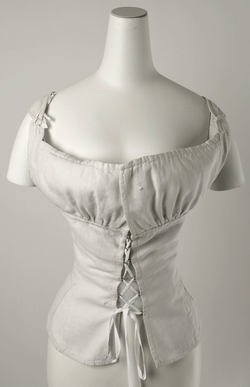
Share/Bookmark// Find examples of Regency dresses and unmentionables in this extensive database by Démodé. The clothes featured in this link are from 1800 through 1830. Examples include corsets, bodices, shifts, underdresses, petticoats, day dresses, spencers, robes, etc, from collections around the world. These images are representative of the Démodé Regency collection.

Corset, Metropolitan Museum, c. 1798-1810

1800 Muslin gown from the V & A Collection

Read Full Post »

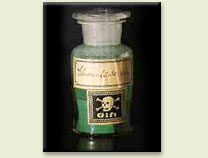
Bottle with emerald green pigment

Once upon a time green paint literally killed people. In 1814 in Schweinfurt, Germany, two men named Russ and Sattler tried to improve on Scheele’s green, a paint made with copper arsenite. The result was a highly toxic pigment called emerald green. Made with arsenic and verdigris, the bright green color became an instant favorite with painters, cloth makers, wall paper designers, and dyers. The first commercial British arsenic was produced at Perran-ar-Worthal in 1812, and at Bissoe in the Carnon Valley in 1834. Their product appealed to the Lancashire cotton industry which used the chemical in pigments and dyes. It was also used by other industries such as glass manufacture (as a decolouriser), in the production of lead-shot, leather tanning, soaps, lampshades, wallpaper manufacture (to create green and yellow print), pharmaceuticals, agriculture for sheep dips, children’s toys, candles, a highly effective rat poison, etc.*

“Manufacture of [emerald green] began in 1814 at the Wilhelm Dye and White Lead Company of Schweinfurt. It was more popular than Scheele’s green and was soon being used for printing on paper and cloth; it even coloured confectionary. –  The Elements of Murder: A History of Poison, John Emsley

Textured Georgian wallpaper

Emerald green was also called Schweinfurt green, Paris green, and Vienna green. The toxicity of dye made with emerald green was not initially recognized, until the recipe was published in 1822, and
“…its poisonous nature was revealed. Manufacturers then changed the recipe, adding other ingredients to lighten the colour, and changing its name accordingly in an effort to disguise its true nature.” – Murder, Emsley
Eventually, the use of this pigment was abandoned when it became generally known that people who wore clothes dyed with the substance tended to die early. To this day the French avoid making green theater costumes.** Emerald green was also used to color confectionary and cake cake decorations:
“The leaves of artificial flowers in particular were coloured with various arsenic greens and they were very popular in Victorian households. The industry making them employed hundreds of young girls, who suffered accordingly from chronic arsenic poisoning…at a banquet held by the Irish Regiment in London in the 1850’s the table decorations were sugar leaves coloured by them. Many of the diners took these home for their children to eat as sweets and several deaths ensued. At another dinner in 1860 a chef was eager to produce a spectacular green blancmange and sent to a local supplier for green dye. He was given Scheele’s green and three of the diners later died.” – Ibid
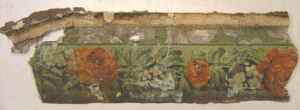
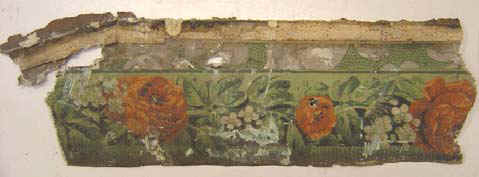
Floral border wallpaper, Ipswich, late 18th c.***

Wallpaper made with Scheele’s green was deadly, By 1830, wallpaper production had risen to 1 million rolls a year in the UK, and by 30 million in 1870. Tests later revealed that four out of five wallpapers contained arsenic. Leopold Gmelin (1788-1853), a famous German chemist, suspected as early as 1815 that wallpaper could poison the atmosphere. He noticed that the substance gave off a mouse-like odor when the paper was slightly damp. Gmelin warned people to strip their rooms of the paper and advocated banning Scheele’s green, but he was too far ahead of his time.
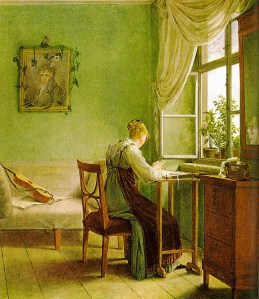
In 1861, Dr W. Fraser tested wallpaper that contained arsenic.The threat, he said, came from breathing the dust of the papers, especially flocked wallpaper. The warnings went unheeded, and by 1871, arsenic production had increased to the point that Britain had become its largest producer and consumer. An addition of a small amount of arsenic, for example, would neutralize iron in glass and give it a green tint. “Potassium chromate (K2CrO4) is yellow and this colour can be imparted to certain glasses. To produce emerald green glass in which a yellowish cast has to be avoided the addition of tin oxide and arsenic is necessary.” (Substances used in the making of colored glass.)

Soon arsenic was exported for the making of pesticides in the United States. Health considerations did not end the use of arsenic-laced wallpaper. By the 1870’s synthetic green dyes began to replace arsenic, and fewer people were placed in danger by its poisonous gases. Experiments at the end of the 19th century proved that arsenic pigments in damp or rotting wallpaper were lethal. The mold that grew on damp wallpaper emitted a toxic odor that smelled of garlic.

The French painter Cezanne had an affinity for using paris green, and it might have been no coincidence that he suffered from severe diabetes. The pigment had a tendency to turn black when exposed to heat and thus it did not become universally popular with artists. Even with scientific evidence of its highly toxic nature, production of emerald green paint was not banned until the 1960’s.
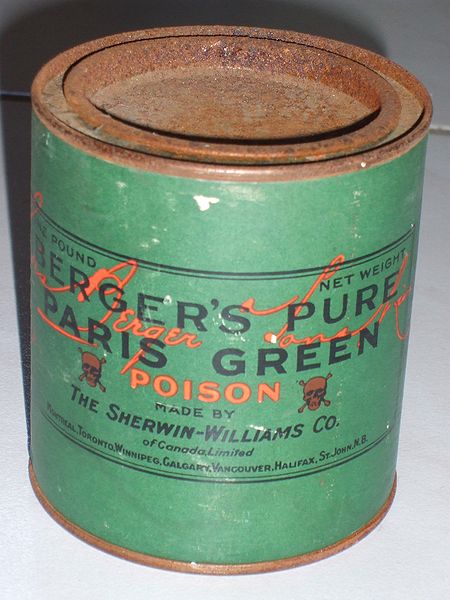

More on the topic

Read Full Post »
« Newer Posts - Older Posts »