Feeds:
Posts
Comments

Archive for the ‘Jane Austen’s enduring popularity’ Category

Inquiring readers: Covid-19 has meant making changes for us and our families, friends, and co-workers world wide. Rachel Dodge wrote this lovely article regarding stay-at-home activities in Jane Austen’s era that are still practiced. I think we can all relate!

As we practice social distancing and spend more time at home, I often think about what Jane would have done under similar circumstances. I can imagine she would miss making morning calls, traveling to visit family and friends, going to church on Sundays, and attending balls where she might dance “nine dances out of ten” (Jane Austen to Cassandra, November 1800).

With what we know of Austen’s home life in mind, I’ve compiled a list of activities that I hope will feed the minds, imaginations, and souls of my fellow Janeites:


Image of cover of Emma by Jane Austen, courtesy Rachel Dodge.

Image of cover of Emma by Jane Austen, courtesy of Rachel Dodge.

  • Read all the books

Books provided Austen with the intellectual stimulation and emotional escape her active mind required. (We can certainly relate!) She enjoyed a wide range of genres and didn’t limit herself to one category.

While libraries remain closed, we can follow our own literary pursuits to new places and take advantage of online resources, e-books (gasp!), and audiobooks. Better yet, we can go through our bookshelves and read the books we already own but haven’t read!

If you want to read the books Austen read, you can explore these resources:

Image of bookshelf courtesy of Rachel Dodge.

Image of bookshelf, courtesy of Rachel Dodge.


Use your creative gifts to connect with others

Austen enjoyed quiet moments by the fire and often found creative inspiration for her writing during those private reveries. Marianne Knight shares this memory: 

[Aunt Jane would sit quietly working beside the fire in the library, saying nothing for a good while, and then would suddenly burst out laughing, jump up and run across the room to a table where pens and paper were lying, write something down, and then come back to the fire and go on quietly working as before.” (Constance Hill, Jane Austen: Her Homes & Her Friends, 1901)

Later in the day, Austen would often share her creative work with her family, leading to hours of discussion and laughter. While sheltering in place, my friends and neighbors have taken turns sharing creative love offerings with one another—fresh flowers, special treats, recipes, wine, craft supplies, cards, and homemade bread. How can you share your gifts and talents with others during this time?

  • Play games

In the article “Spillikins,” The Jane Austen Centre (https://www.janeausten.co.uk/spillikins/) shares this: “Jane Austen was a very hands-on aunt, with numerous games and activities in her repertoire. Her nieces and nephews recall with fondness the many games, from paper ships to Battledore and Shuttlecock, that she would play with them by the hour.”

Spillikins was her particular favorite: “Our little visitor has just left us, & left us highly pleased with her… -Half her time here was spent at Spillikins; which I consider as a very valuable part of our Household furniture, & as not the least important Benefaction- from the family of Knight to that of Austen.” (Jane Austen to Cassandra, February 8, 1807)

If you have friends and family you’re missing right now, especially younger family members, try playing a game online or set up a Facetime game time. 

  • Enjoy walks and natural beauty

Austen (and many of her heroines) enjoyed a brisk walk. As we can see from her letters and novels, she liked the exercise and the beauty of her surroundings: 

We took a very charming walk from six to eight up Beacon Hill, and across some fields, to the village of Charlecombe, which is sweetly situated in a little green valley, as a village with such a name ought to be.” (Jane Austen to Cassandra, June 2, 1799)

My family likes to walk, bike, or go out on our deck when the weather is nice. We’ve paid closer attention to the beauty of a sunset, a mother duck with her ducklings, and the wildflowers blooming along our walking trail. If you can’t get outside, try an exercise program online. There’s something for everyone right now!

  • Pray with Jane
Image of Jane Austen's Prayers

Image courtesy of Rachel Dodge

The Austen family said morning and evening prayers together. You might take time to read through Austen’s prayers for a few days. She wrote three lovely prayers that cover many of the concerns of daily life. 

Austen herself was no stranger to distress and tribulation. She understood the dangerous realities of war, illness, childbearing, and sea travel during her lifetime. Some of the lines of her prayers are particularly fitting for times like these:

“Look with compassion upon the afflicted of every condition, assuage the pangs of disease, comfort the broken in spirit.” (Jane Austen, Prayers)

If you’d like to explore her prayers more fully, I created a 7-day Jane Austen prayer guide for COVID-19 here: https://www.racheldodge.com/7-days-prayer-jane-austen/

  • Write letters

Jane Austen wrote letters full of news and details. It was how she and her family and friends kept in close contact when they couldn’t be together in person. They shared everything – both the important and the mundane – in these missives!

I have now attained the true art of letter-writing, which we are always told is to express on paper exactly what one would say to the same person by word of mouth. I have been talking to you almost as fast as I could the whole of this letter.” (Jane Austen to Cassandra, January 3, 1801)

If you’re missing your friends and loved ones, why not write a letter? My daughter has been sending letters, stickers, and drawings back and forth in the mail with her best friend. They make their own envelopes and decorate them with colorful designs. 

  • Find comfort in familiar rhythms
Image of Tea with Jane Austen courtesy of Rachel Dodge

Image of Tea with Jane Austen by Kim Wilson, image courtesy of Rachel Dodge

In Caroline Austen’s book My Aunt Jane: A Memoir, she describes her aunt Jane’s morning habits: “Aunt Jane began her day with music . . . before breakfast—when she could have the room to herself—.” (Caroline Austen, My Aunt Jane: A Memoir, 1867)

Austen’s days had a certain cadence to them: She began the day with piano practice and letter writing. During the day, she wrote, sewed, visited with her family, and walked. In the evening, she and her family read out loud, played games, and talked. 

Keeping some of our routines as “normal” as possible (and finding new routines) helps give our days shape and definition. Perhaps you can host a weekly tea party or book discussion with your Jane Austen friends over Zoom!

Austen had an active imagination and would certainly have found many things with which to occupy her time. What else do you think Austen might have done? What routines do you find comforting in these turbulent times?

About the Author:

Rachel Dodge is a college English professor and the author of Praying with Jane: 31 Days Through the Prayers of Jane Austen. You can find her online at http://www.RachelDodge.com.
Read Full Post »

Happy 2020 everyone.  In the spirit of learning more about Jane Austen and the world she lived in, I am determined to finish reading the 12 books highlighted in this post. I purchased most of these books years ago and have used many for reference. Alas, I finished none completely. By the end of 2020, I will have read them all.

Like many of you, my rooms are filled with stacks of books on the floor, by my bedside, and in piles on tables. I purchase more than I can read.

What are your resolutions regarding your reading goals? Do you own any of the books listed below? Have I piqued your interested in purchasing a few? Inquiring minds want to know.

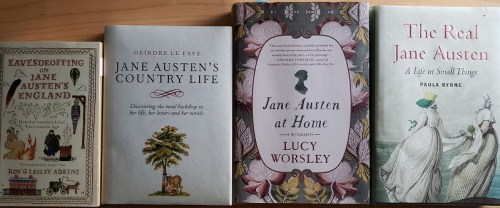
Book covers of Eavesdropping on Jane Austen's England; Jane Austen's Country Life; Jane Austen at Home; and The Real Jane Austen.

Four books that help readers understand the world Jane Austen lived in.

  • Eavesdropping on Jane Austen’s England: How Our Ancestors lived Two Centuries Ago, Roy and Leslie Adkins, Abacus, 2001, 422 pages, ISBN: 978-0-349-13860-2, Amazon. Product Information: A survey and guide to daily life in Jane Austen’s England.
  • Jane Austen’s Country Life: Uncovering the rural backdrop to her life, her letters and her novels, Deirdre Le Faye, Francis Lincoln Limited Publishers, London, 2014, 269 pages, ISBN: 978-0-7112-3158-0, Amazon. Product information: “Richly illustrated with contemporary depictions of country folk, landscapes and animals, Jane Austen’s Country Lifeconjures up a world which has vanished more than the familiar regency townscapes of Bath or London, but which is no less important to an understanding of this most treasured writer’s life and work.”
  • Jane Austen at Home: A Biography, Lucy Worsley, Martin’s Press, New York, 2017, 385 pages, ISBN: 978-1-250-13160-7, Amazon. Product Information: “…historian Lucy Worsley visits Austen’s childhood home, her schools, her holiday accommodations, the houses–both grand and small–of the relations upon whom she was dependent, and the home she shared with her mother and sister towards the end of her life.
  • The Real Jane Austen: A Life in Small Things, Paula Byrne, Harper Collins, New York, 2013, 380 pages, ISBN: 978-0-06-199909-3, Amazon. Product Information: “Just as letters and tokens in Jane Austen’s novels often signal key turning points in the narrative, Byrne explores the small things – a scrap of paper, a gold chain, an ivory miniature – that held significance in Austen’s personal and creative life.”

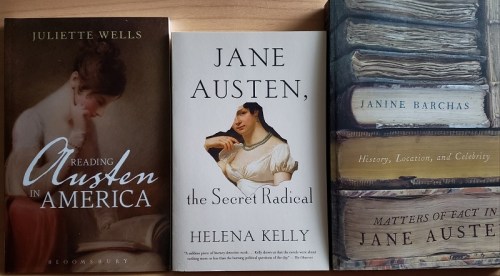
Book covers of Reading Austen in America; Jane Austen, the Secret Radical; and Matters of Fact in Jane Austen: History, Location, and Celebrity

The three books discuss the factors that influenced Jane Austen’s writing and understanding of her world, and how and why her fame spread.

  • Reading Austen in America, Juliette Wells, Bloomsbury Academic, 2017, 256 pages, ISBN-13: 978-1350012042, Amazon. Product Information: “Reading Austen in America presents a colorful, compelling account of how an appreciative audience for Austen’s novels originated and developed in America, and how American readers contributed to the rise of Austen’s international fame.”
  • Jane Austen, the Secret Radical, Helena Kelly, First Vintage Book Edition, Alfred A. Knopf, 2016, 318 pages, ISBN:978-0-525-43294-4, Amazon. Product Information: “Kelly illuminates the radical subjects–slavery, poverty, feminism, the Church, evolution, among them–considered treasonous at the time, that Austen deftly explored in the six novels that have come to embody an age. The author reveals just how in the novels we find the real Jane Austen: a clever, clear-sighted woman “of information,” fully aware of what was going on in the world and sure about what she thought of it.”
  • Matters of Fact in Jane Austen: History, Location, and Celebrity, Janine Barchas, The Johns Hopkins University Press, Baltimore, 2012, 336 pages, ISBN: 9781421411910, JHUPbooks. Product Information: “InMatters of Fact in Jane Austen: History, Location, and Celebrity, Janine Barchas makes the bold assertion that Jane Austen’s novels allude to actual high-profile politicians and contemporary celebrities as well as to famous historical figures and landed estates. Barchas is the first scholar to conduct extensive research into the names and locations in Austen’s fiction by taking full advantage of the explosion of archival materials now available onlin”

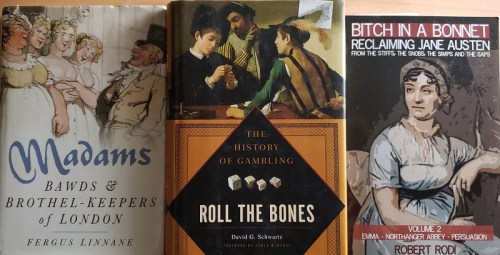
Three book covers of Madams: Bawds & Brothel-Keepers of London; Roll the Bones: The History of Gambling; Bitch in a Bonnet: Reclaiming Jane Austen from the stiff, the snobs, the simps and the saps.

The Regency era wasn’t all civility and manners. Georgian London boasted over 50,000 prostitutes and young heirs won and lost fortunes gambling. Austen’s wit, as evidenced in her letters, novels, and Juvenilia, could be biting, as Robert Rodi points out in his analysis of her novels.

  • Madams: Bawds & Brothel-Keepers of London, Fergus Linnane, The History Press, 2009, 256 pages, ISBN-13: 978-0750933070, Amazon. Product Information: “Fergus Linnane reveals the other side of London’s years of pomp and splendor, painting a vivid picture of the bawds, their girls, and their clients. Madamsis fresh and original, offering humor, insight, and a very candid view of the sexual behavior of Londoners through the ages.”
  • Roll the Bones: The History of Gambling, David G. Schwartz, Gotham Books, Penguin Group, New York, 2006, 570 pages, Amazon, ISBN 1-592-40208-9. Product Information: “Gambling is the second oldest profession. Dice were found in the tombs of the ancients. Roman soldiers cast lots for Jesus’ garments at the foot of the cross. Gambling, it seems, has had a role in virtually every civilization, from the earliest of times. It is sometimes important to be reminded of this reality. Roll the Bones: The History of Gamblingdoes just that.”-William R. Eadington, University of Nevada.
  • Bitch in a Bonnet: reclaiming Jane Austen from the stiffs, the snobs, the simps and the saps. (Volume 2: Emma, Northanger Abbey, Persuasion), Robert Rodi, Creative Space Independent Publishing Platform, 2014, 526 pages, ISBN-13: 978-1499133769, Amazon. Product Information: I bought this book because I loved, loved, loved Rodi’s bitingly sharp, often satiric male take on Jane Austen’s novels in Bitch in a Bonnet, (Volume 1), which covers Pride and Prejudice, Sense and Sensibility, and Mansfield Park. The reviews are mixed for Volume 2– some people think Rodi is off on Northanger Abbey, but even a Rodi book a little off its feed is better than 90% of critical essays about and analysis of Austen’s great novels. I can’t wait to read Volume 2. – Vic

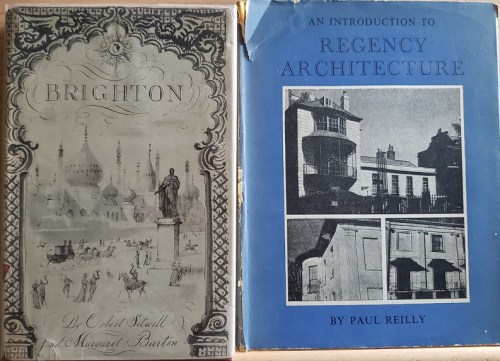
Covers of Brighton and An Introduction to Regency Architecture.

A day well spent is a day perusing used book sales and digging up fantastic finds, like these two early 20th century books, which are hard to find in their original editions. A Brighton edition sells online for $150 U.S., but ABE books offers a single second edition for $26.78. Shipping to the U.S. costs another $24.68, bringing the total cost over $50 U.S. My book was published in 1948 and contains a smattering of black and white photographs.

  • Brighton, Osbert Sitwell & Margaret Barton, 2nd edition, 1938, Published by Faber, London, 1959, 294 pages. Hardcover edition, very good, clean and tight. Jacket has loss to the rear. ABE books.


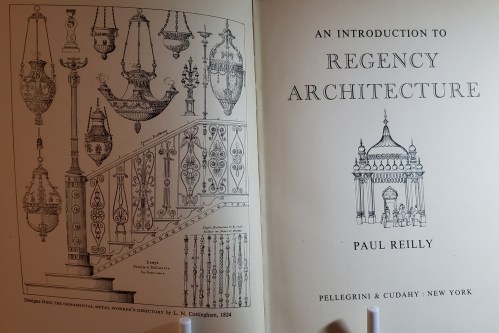
Paul Reilly’s Introduction to Regency Architecture has been republished by Forgotten Books, which offers a treasure trove of books now out of print as downloadable PDFs, ebooks, or print purchase, such as Georgian England, 1714-1820 by Susan Cunnington. My heavily illustrated hardcover book shows no date of publication, but according to the inside jacket it originally cost $2.50. Lucky me purchased it at a library sale for $1.50.

  • Introduction to Regency Architecture (Classic Preprint), Paul Reilly, Forgotten Books, 2018, 100 pages, ISBN-13: 978-13330278703. Product Information: With this book, author Paul Reilly had two ends in view. The first is to introduce the ever fewer examples of Regency buildings while they still exist. The second is to explain the historical role of Regency architecture, to show in what way it was a true descendant of the 18th century and in what way it broke new ground.”

Image of the title page of An Introduction to Regency Architecture

Treasures of old books can be found anywhere. I hope to uncover more during 2020.


Other sources for finding books:


Read Full Post »

“Cheap books make good authors canonical.” – Janine Barchas

lost book of jane austen barchasThe Lost Books of Jane Austen by Janine Barchas is a beautiful book – a bound hardcopy with almost one hundred color photographs of affordable, mass-produced novels that, outside of expensive hand pressed editions, contributed to Jane Austen’s ever-increasing fame. The detective work and scholarship that Dr. Barchas embarked on for a decade to find hundreds of inexpensive, disposable Jane Austen books to study their role in Austen’s rapidly growing popularity is awe inspiring.

Some readers may fear that such a well-researched, seemingly dry topic would be hard to follow. It is not. In fact,  Barchas’s tales about searching for unvalued books, many of which were tossed in a rubbish bin or shredded, and her forays in consulting census materials  and birth and marriage records to pursuit information about the books’ owners had me turning the pages.

After Jane Austen’s death in 1817, her popularity with the public lay fallow. In 1833, publisher Richard Bentley purchased the rights to her novels and introduced them at a lower price than the finer three-volume editions that were published during her time, when books cost as much as a week’s wages for ordinary people. The timing of these cheap publications coincided with the advent of train travel and innovations in the publishing business. Changes in printing, binding, paper making, and distribution led to inexpensive versions of Jane’s (and others’) novels.

During Austen’s life, print runs were large and costly, and not guaranteed to sell out. The new technology resulted in flat plates or stereotype plates that allowed for printing new orders as they were needed. Instead of publishing three volume novels, Bentley offered one book, which saved paper. By the 1840s, cheap paperback editions with advertisements printed inside targeted train travelers, bringing Austen’s work to the masses. (These days one can find paperback vending machines in public spaces abroad.)

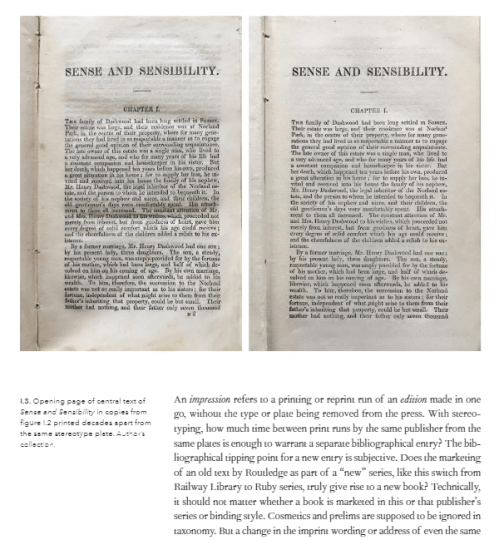
In 1866, Bentley sold his plates at auction for all his standard novels. Stereotype plates were used by different publishers, since plates lasted 50 years or more. Interestingly, although the stereotype plates used in new publications remained the same, publishers like Routlidge proudly boasted that these were new editions, when only the book cover and papers changed. The interior print with layouts and page numbers remained the same, as chronicled by Barchas in her book. (Click to view slide show of page samples.)

Sense and Sensibility comparison pages of books printed decades apart from the same stereotype plate

Image 1.5, p. 18 – Opening page of central text of Sense and Sensibility in copies from figure 1.2 printed decades apart from the same stereotype plate.

Not all the economical books were tossed aside. Miss Sybil Daniell kept her copy of Sense and Sensibility, given to her by her father. Barchas traced details of the Daniell family through census and birth and death records. She also traced the lives of Miss Emma Morris, who owned a copy of Emma, and Charlotte M. Mills, the proud possessor of a copy of Northanger Abbey-Persuasion. Virginia Woolf was inspired by Austen’s words. She returned frequently to her heavily stained, cheap Austen novel copies for rereading. These are some of the books that lasted in private collections for Barchas to study.

The Lost Books of Jane Austen is so rich in history and detail that I could write a book reviewing it.  I’ll end this critique using my own cheap paper back copies, which I have preserved through eight moves since my purchase. My thoughts are inspired by the last chapter, “Pinking Jane Austen.”

Book covers of Emma, 1964 Washington Square Press Book. Pride and Prejudice, 1962, Airmont Book Classic. Persuasion, 1966, An Airmont Classic.

Emma, 1964 Washington Square Press Book. Pride and Prejudice, 1962, Airmont Book Classic. Persuasion, 1966, An Airmont Classic. Vic’s personal paperbacks.

After graduating from college, I was surprised to learn that there were male Austen fans, for during my youth and up to this day, aggressive niche marketing of Jane Austen novels targeted female students and women in general. Gender signaling used pink to subtly attract the female sex to Austen’s books, which were often found in the romance sections at bookstores. I had no idea I was being manipulated, since I thought I was reading the works of a masterful author. I kept these three so-called disposable paperback novels for the hours of pleasure they gave me in my youth. As you can see, the covers reflect the 1960’s – the era in which they were published. One might say they are tasteless. Elizabeth Bennet, looking like a glammed up Brontë heroine, wears heavy eye makeup, dark pink lipstick, and pink bows. A Victorian Emma sports painted pink cheeks and bright pink lips. Anne Elliot is a vision in Edwardian pink. Our mousy heroine has been given a dramatic make over, with heavy eye liner and luscious pink lips that would make a Kardashian drool. Her body is too enviable for words.

Inside all three books, the paper has yellowed and I’m afraid to open them for fear of breaking their spines. Nevertheless, these books will stay with me forever, which I think is one reason why Janine Barchas was able to find enough cheap books to trace over time – like me, many individuals who possessed them cherished them, regardless of their tawdriness.

I’ll keep Barchas’s lovely, informative book on my shelves for years to come. It’s the season for gift giving. I can think of no more appropriate gift for the bibliophile in your life than The Lost Books of Jane Austen.

Purchase Information

The Lost Books of Jane Austen, Janine Barchas, Johns Hopkins University Press

304 Pages

978-1-4214-3159-8 $35.00

Also available as an e-book

Purchase Links: Johns Hopkins University Press | Amazon | Barnes & Noble

Image of author Janine BarchasAuthor Bio:

Janine Barchas is the Louann and Larry Temple Centennial Professor of English Literature at the University of Texas at Austin. She is the author of Matters of Fact in Jane Austen: History, Location, and Celebrity and Graphic Design, Print Culture, and the Eighteenth-Century Novel. She is also the creator behind What Jane Saw (www.whatjanesaw.org).

Author articles:

Other reviews:

Tour schedule:

Monday, December 9th: Lit and Life

Tuesday, December 10th: A Bookish Way of Life

Tuesday, December 10th: Broken Teepee

Wednesday, December 11th: The Sketchy Reader

Thursday, December 12th: No More Grumpy Bookseller

Thursday, December 12th: Laura’s Reviews

Friday, December 13th: View from the Birdhouse

Monday, December 16th: Savvy Verse & Wit

Monday, December 16th: Austenprose – A Jane Austen Blog

Tuesday, December 17th: Blunt Scissors Book Reviews

Thursday, December 19th: Jane Austen’s World

Friday, December 20th: My Jane Austen Book Club

Friday, December 20th: Diary of an Eccentric

Read Full Post »

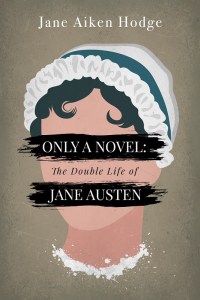
Image of the book cover Only a Novel: The Double Life of Jane Austen by Jane Aiken HodgeIt is only a novel… or, in short, only some work in which the greatest powers of the mind are displayed, in which the most thorough knowledge of human nature, the happiest delineation of its varieties, the liveliest effusions of wit and humour, are conveyed to the world in the best-chosen language” – Jane Austen, Northanger Abbey
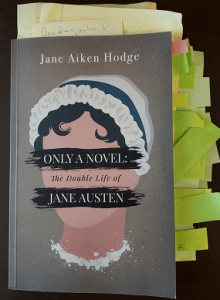
Jane Aiken Hodge’s (JAH) biography of Jane Austen is characterized by the biographer’s distinctive voice. It is as clear as spring water and as refreshing. She expertly braids a variety of sources consisting of biographies, articles, letters, and Austen’s own novels to tell us about the author’s life. JAH uses a straightforward yet descriptive writing style that takes us effortlessly through the stages of Austen’s personal journey, career, triumphs, and struggles.

Aiken Hodge’s descriptions paint a vivid word picture of a gifted author living the double life of a proper lady in a bygone era, who, unbeknownst to contemporary readers, chose career over marriage, a daring move in an age when genteel women were expected to marry, rule a household, and breed heirs and spares. JAH’s conclusions, although not footnoted like an academic, are laid out persuasively and supported by her choice of the source materials available to her in 1972, the year this biography was first published.

The book begins with a description of Steventon Rectory in the context of the rising middle class and rising costs of goods resulting from war, societal changes brought about by the industrial revolution, vast improvements in travel created by a network of canals and macademised roads, changes in fashion (barely mentioned by Austen), the advent of circulating libraries, and more.  Aiken Hodge describes a rural world where a stage coach clattering through a small village drowned out bird song or the voice of a farmer calling out to his cattle.

The elder Austens worked hard to put food on the table and clothes on their family’s backs. They performed double duty in almost all aspects of life. Rev. George Austen used his horse to plow his glebe land and perform the functions of his ministry. He was both a rector and the head of a small boarding school. Mrs. Austen oversaw the household, diary and chickens, and the children (including Rev. Austen’s male students) yet found the time to create recipes in rhymes.

Unlike many girls of their time, Jane and her older sister Cassandra were given free reign of Rev. Austen’s extensive library (books were extremely expensive in that era). Their hard-working and resourceful, parents still found time to join in the fun of riddles, charades, and plays and journey forth for family visits. Jane’s writings, actively encouraged by her family, are preserved in 3 volumes of her Juvenilia, which she painstakingly copied as an adult. The Austen family adored reading novels, hence the title of this book, Only a Novel. This was an age when reading novels over serious fiction and nonfiction was a habit akin to liking reality tv today over serious, well-researched documentaries. (I humbly confess to still watching ‘Survivor’.)

The difference between the Austen boys’ freedom and her own and Cassandra’s must have rankled Jane, whose independent career choice was curtailed by conventions. Sons could ride horses and carriages and venture forth at will. Their actions were unrestrained compared to the girls’ strict upbringing. JAH describes at great length how both Jane and Cassandra could not travel unescorted. In order to arrange for transportation, they had to wait for proper chaperonage, even if this meant delaying a return trip for weeks.

We know today that through her novels and letters Jane displayed a lively and irreverent sense of humor. In public, however, she presented herself as quiet and restrained, especially after she donned a spinster’s cap and had given up all pretense of seeking a husband. Before the publication of her first novel, friends and neighbors knew Jane to be friendly yet unobtrusive. (Her family knew an entirely different and much livelier Jane.) After Pride and Prejudice and subsequent novels were published, acquaintances and neighbors became more cautious around this keen, sometimes acerbic observer, thus the full title of this biography, Only a Novel: The Double Life of Jane Austen.

Aiken Hodge compares the rural settings of Steventon Rectory and Chawton Cottage to the city settings of Bath and London and the hectic, at times unpredictable, pace of her visits to family houses and friends. These events, including the shock of moving to Bath, Rev. Austen’s sudden death, and the Austen women’s peripatetic life for eight years, stood in the way of Jane’s creativity. Fortunately for posterity, her move to rural Chawton Cottage in 1809 spawned her productive period – her reworking of Pride and Prejudice, Sense and Sensibility, and Northanger Abbey, and creation of Emma, Mansfield Park, and Persuasion, all masterpieces. These days we can also enjoy her incomplete works (Lady Susan and Sanditon ) and her Juvenilia. While this period in Austen’s life was adequately covered by Jane Aiken Hodge, especially regarding Jane’s relationship with her publishers (through her male relatives) and quest for an independent living as a single woman, I longed for more details, but I quibble. Aiken Hodge’s description of Chawton Cottage, which sat so close to Winchester Road (and which ran through Chawton Village), allowed passersby to view the Austen women dining intimately in the dining room or conversing, was like a snapshot in time.

Jane Austen’s fatal disease, characterized more by fatigue than pain (and still studied by modern diagnosticians), took her family a long time to accept as dire. Aiken Hodge writes about the events leading to Jane’s death without over-emotional hand wringing. Her restrained description of Austen’s last days allowed my imagination to take hold. I cried once again at my and the world’s loss of this talented author at the height of her writing power. Almost as an afterthought, JAH mentioned that only four male mourners (brothers Edward, Henry, and Frank, and nephew James-Edward) were present at her funeral, whereas neither her mother nor sister could attend, as it was not the custom of females to accompany the funeral cortege.

JAH concludes her biography by describing Austen’s close relationships with her family (she and sister Cassandra were “everything to each other”), including her nieces and nephews. She had, through these associations, a special affinity with children. I was struck by this recollection from a nephew after her death:

He expected particular happiness in that house [Chawton] and found it there no longer. The laughter had died…”

JAH concluded that the laughter lives on through Austen’s novels and characters. Letters saved by her kin and memoirs published after her death preserved precious memories before all first-hand memories about her were lost.

Image of Only a Novel by Jane Aiken Hodge with reviewer notesCompared to Claire Tomalin’s biography Jane Austen: A Life (1999), which is filled with images and illustrations and attachments with postscripts, two appendices, page notes, bibliography, family tree, and index consisting of 73 pages, Aiken Hodge’s Only A Novel provides six pages of notes and bibliography. Instead, JAHs bibliography uses the memoirs, letters, histories, biographies, and papers available to her in the early 70’s.  I loved reading this biography. From the photo on the right, you can see by the sticky notes how much interesting information I found. Aiken Hodge’s lovely writing style suits me to a tee. I also own another JAH biography, the wonderfully illustrated The Private World of Georgette Heyer, published in 1984 and which I have kept all these years. Only A Novel: The Double Life of Jane Austen is worth every penny of its purchase and has become a grand addition to my Austen library.
________

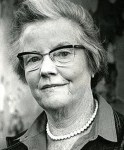
Image of author Jane Aiken Hodge

Jane Aiken Hodge

Jane Aiken Hodge was born in Massachusetts but moved with her family to East Sussex in Britain when she was three years old. After reading English in Somerville College, Oxford, she moved to the US to undertake a second degree at Radcliffe College. Whilst she was there, she spent time as a civil servant and worked for Time Magazine before returning to the UK to focus on her career as a novelist. In 1972 she became a British citizen. She is the daughter of the Pulitzer prize-winning poet, Conrad Aiken.

Aiken Hodge is known for her works of historical romance. In a career spanning nearly fifty years, she published over thirty novels, exploring contemporary settings and the detective genre in her later life. She died in 2009, aged ninety-two.

Purchase the book:

Product details:

  • Paperback: 290 pages
  • Publisher: Agora Books (April 25, 2019)
  • Language: English
  • ISBN-10: 1913099253
  • ISBN-13: 978-1913099251

Hashtag:  Please use the hashtag #OnlyANovel when posting or talking about Only a Novel on Twitter, Instagram or Facebook. Also, make sure you tag us – @AgoraBooksLDN on Twitter and Instagram!

Read Full Post »

Good news for Janeites who live within striking distance of Johns Hopkins University in Baltimore, MD! At 7:00 PM EST on April 29th, the Bird in Hand, a cafe/bookstore, will be offering the first in a series of workshops on the last Monday of each month in the public humanities. Sponsored by the Alexander Grass Humanities Institute at Johns Hopkins, Baltimore-based professors and students will share new work in the public humanities and oriented toward broader public audiences. The intimate setting is meant to encourage public feedback and critical dialogue. One guest lecturer will be Juliette Wells, author of ‘Reading Austen in America’ (see Project MUSE’s review of the book at this link and purchase the book at this link to Amazon prime.

Date: Monday, April 29, 2019 –
Time: 7:00pm,
Place: Bird in Hand, 11 E. 33rd Street, Baltimore, MD 21218

Excerpt from the advert from the Ivy Bookshop:

Just over a century after Jane Austen’s death in 1817, devoted readers sought out her letters and personal possessions, as well as first and rare editions of her novels. Alberta Hirshheimer Burke, Goucher College class of 1928, built the most extensive collection in the U.S. of Austen manuscripts, editions, translations, and ephemera–plus one famous relic, a lock of Jane Austen’s hair, which made international news when Mrs. Burke donated it to the Jane Austen House in Chawton, England. Second only to Mrs. Burke’s was the collection formed by Charles Beecher Hogan, Yale class of 1928, which included the topaz cross necklace owned by Austen. Drawing on new research in the two collectors’ personal archives, this presentation establishes the importance to Austen reception history of their pursuit of items that held great personal importance to them.

Event Topic (click on links):


Other posts on the topic of Jane Austen’s letters and personal possessions and Jane Austen scholars:

Read Full Post »

« Newer Posts - Older Posts »