Feeds:
Posts
Comments

Archive for the ‘Jane Austen’s enduring popularity’ Category

Inquiring readers: While I meant to write a post about muslin caps, my thoughts went in quite a different direction. My lovely mom just celebrated her 93rd birthday and she and Jane Austen have been much on my mind lately.
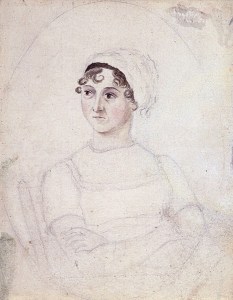
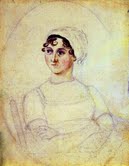
Jane Austen (16 December 1775 – 18 July 1817)

Jane Austen, painted by her sister Cassandra

Ladies during Jane Austen’s time were as thrifty and resourceful as my great aunts and great grandmother were in repurposing their clothes and fabrics. My mother, who endured first-hand the horrors of World War II, (one grandfather and two uncles died in a Japanese concentration camp), and subsequent years of poverty as an exile from her home country, is as thrifty as Jane’s mother, Cassandra, ever was – saving every button and piece of scrap, be it paper or cloth, recycling and repurposing clothes, darning woolen socks and stockings, knitting and sewing with scraps, and making ends meet until the fabric could be used only as a rag for cleaning. (Even then, that rag was used until its very useful end.)
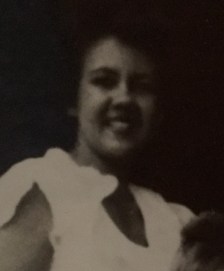
Mom

Mom in the early 50s.

I recall my single mom during my childhood in The Netherlands, tired after a day’s work, bent over her knitting and sewing in the evening, making sure that my brother and I were properly clothed. Oh, how I envied my cousin in California, who wore a variety of beautiful bespoke clothes! My sweaters were reworked from old yarn and I recall feeling self-conscious and, well, second-hand, compared to my dazzling relative.

These days I revere my mother for her fortitude in facing a multitude of challenges with an unwavering eye towards the future. Since those hard times, she has led a blessed life and bestowed on my brother and me the love and strength of family and a perfect father who adopted us and loved us as if we were his own. As a family, we’ve led the charmed life of successful immigrants in the U.S. and will always be grateful for the opportunity this country gave us.

Lately I have come to realize that I am an avid Jane Austen fan because of my mother’s example. One Christmas when I was 14, my mom gave me a copy of Pride and Prejudice and I fell instantly in love with Elizabeth Bennet and her creator. Not only did Mom introduce me to Jane Austen, but I was inspired by how my mother’s life’s struggles and sense of humor in so many ways echoed Jane’s.

Jane’s life as a spinster in an age when spinsterhood meant real hardship and worry for women of her class echoed Mom’s struggle as a divorcee in an age when divorce was unacceptable. Jane’s peripatetic wanderings after her dear father died reminds me of Mom’s constant search for a safe and affordable place to live. Mom moved us so much, across three continents every few years, that people mistook us for army brats. Jane’s constant worry over money and her courage in pursuing her craft and honing her talent remind me of my mother, who had the temerity to leave my biological father in favor of a better life and to pursue, single-mindedly, a goal that her friends and relatives felt was impossible for a single mother without a high school education to realize. They tried to dissuade her from what they considered an unreachable goal – one that we as a family surpassed beyond, as Mom states to this day, “our wildest dreams.”

Could Jane Austen have described her posthumous fame any better?

Ever the optimist, Mom bucked the system alone (afraid but with nothing to lose). She has a native intelligence and an eye for human nature – a gentle eye filled with humor. We always laughed – at the table, in the car, at and with others. Her second husband, my real father, had the dry sarcastic wit of Mr. Bennet, but Mom was/is raucously funny and insightful. People from all walks of life are attracted to her bright, sunny, and somewhat irreverent disposition. And, so, through her, I was introduced to the panoply of human kind – to the sort of characters who inhabit Jane Austen’s novels – to the many foibles Miss Austen understood and described in her novels and which I instantly recognized, even at 14. Dad was Mr. Bennet, but Mom was Jane Austen.

When my ex left our 26-year marriage, accusing me, among other things, of being “just like your mother,” he did not realize how honored I felt at hearing a comment that was meant to be a stinging barb. Frankly, I wish I were more like my mom. For now, I’ll just worship her and Jane Austen and count myself lucky for knowing both, one intimately and one at a distance.

One last comparison to Jane Austen I must mention is my mom’s faith, which imbues her life. While we know of at least 3 prayers Jane wrote, we also can divine, given she was a minister’s daughter and a woman of her time, that her faith was extremely important to her and quite personal in nature…just like my mother’s.

IMG_0154

Mom today surrounded by her grandchildren and great grandchildren.
Read Full Post »

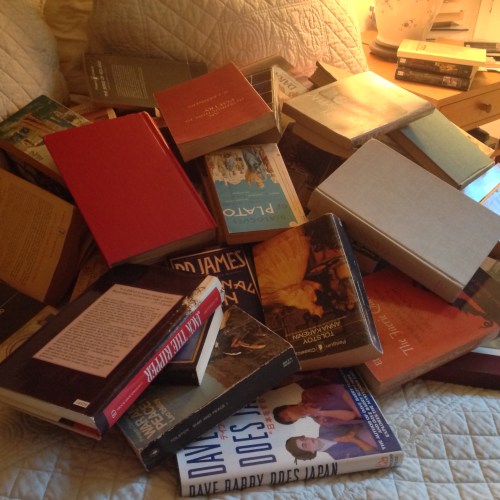
A local historical society will be hosting a book sale this weekend to raise funds. I am finally ready to part with a substantial number of some of my most beloved books (art, art history, English literature, nature books, etc).

IMG_2308

Waiting to be bagged and donated

The first three Jane Austen novels I purchased sat forgotten on the top shelf – all in paperback form. I had always thought that I first read Pride and Prejudice at 14, but the book’s publication date tells me that I was 13!

IMG_2315

I reread the tale of my beloved Mr. Darcy and his Lizzie Bennet so many times that my parents gave me this Modern Library edition of Jane Austen’s six great novels at Christmas, just before I turned 14. I have cherished it and still cherish it for all the good times I spent reading at night before turning off the light. (This book did not sit forgotten.)

I will keep this edition through all my future moves and until my last breath, since I only need a Jane Austen novel to keep me happy.

IMG_2313

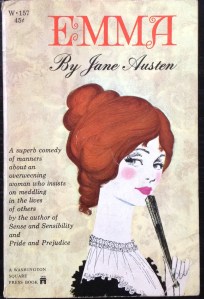
Interestingly, I was 15 when I read my second JA book, Emma, which I purchased to read on vacation. At that tender age, I found the book too talky and not nearly as romantic as P&P. Mr. Knightley seemed so OLD and staid compared to the dangerously handsome Mr. D, and bossy Emma was not the sort of girl I wanted to befriend, whereas Lizzie seemed she could fit right into my group. So, it took decades before my mature self tackled Emma again.

IMG_2317

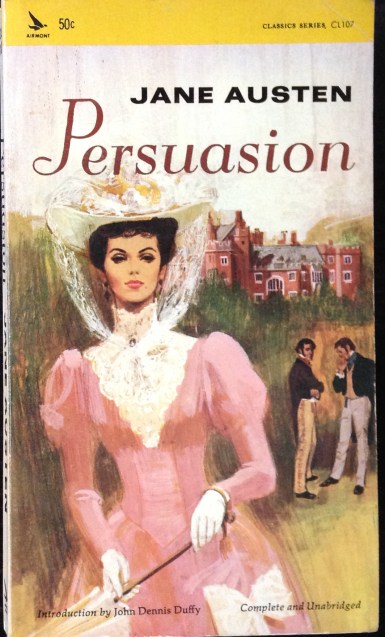
I read Persuasion at 17, too young to appreciate the fact that Anne Elliot’s bloom had faded from sadness or to truly understand the reason why she listened to Lady Russell’s advice. As a rebellious teen of the 60’s, how could I relate to her decision? I am now somewhat longer in the tooth (ahem) and am able to appreciate this gem of a novel fully, as Jane intended.

c201d9ce8c21c05acce03e14d356d677

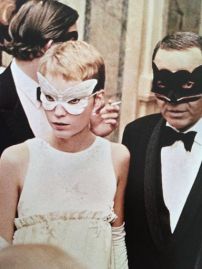
Mia Farrow and Frank Sinatra in the 60’s.

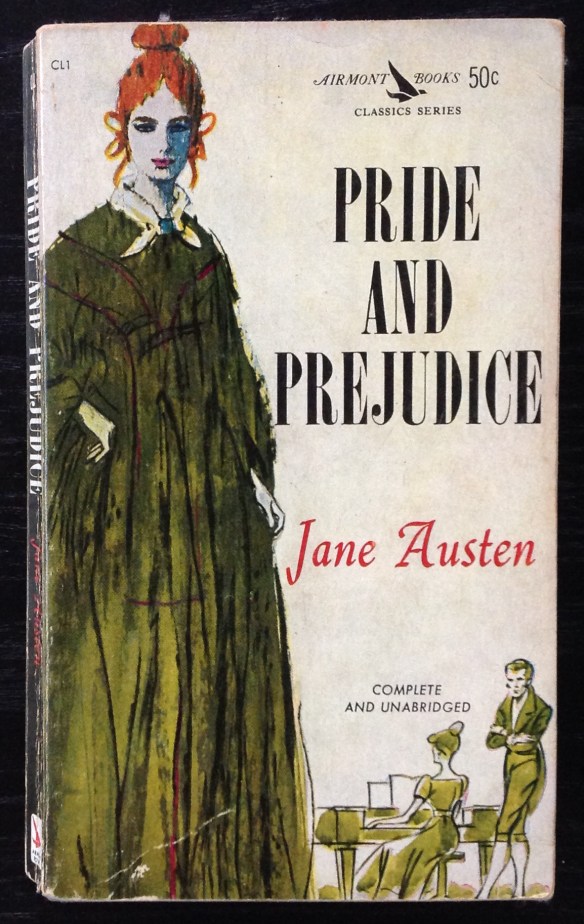
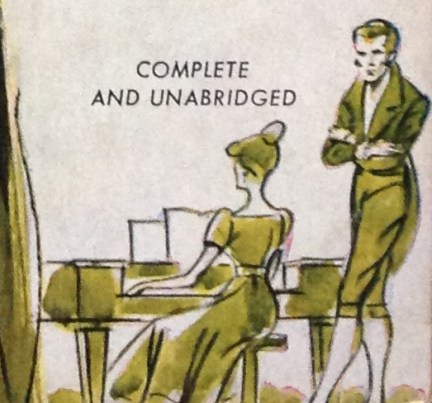
Now, let’s discuss the 60’s covers of these paperback editions. Mind you, this was an era when high-waisted empire dresses were popular (see Mia Farrow at right) but the cover artists generally ignored this fact. They preferred to see Lizzie in a dark and heavy Gothic gown, more suited to a Bronte novel than a Regency tale. Note that Emma has a decided Victorian look, as does Anne Elliot. At least the P&P cover included this fairly accurate regency scene of Mr. Darcy listening to Lizzie at the piano.

IMG_2315 copy

One of the reasons I like the Complete Novels is the cover art by Paul Galdone, a popular children’s author of the day. The scene reminds me just a bit of  the classic covers painted by Arthur Barbosa of Georgette Heyer novels in the 40’s and 50’s.

My old Jane Austen paperback covers represent a major characteristic of cover illustrations -they reflect the concept of female beauty of the era. Hence the 60’s birdwing eyebrows, eyeshadow, eye liner, and lipstick on Lizzie, Emma, and Anne. You’ll observe similar treatments of “historic” costumes and makeup in past times in cinema and other forms of popular entertainment throughout the decades. Recall the costumes and makeup of 1940’s Pride and Prejudice or the BBC’s versions of Jane Austen novels in the 1970’s. Ouch!

Regardless of the inaccuracies of their covers, I plan to keep these three books. For sentiment’s sake.


Read Full Post »

Part One of this four-part series left me salivating to meet Darcy’s aunt, for up to now we have experienced her only through Mr. Collins’s observations, which, the astute reader has come to surmise, MUST be suspect. After Lady Catherine de Bourgh’s daughter Anne stops by to visit Hunsford in her carriage, Charlotte announces to the group that they are invited to dine at Rosings. Even if Mrs. Collins hadn’t opened her mouth, Lizzy would have realized that something was up, what with an ecstatic Mr. Collins performing cartwheels and Irish jigs in the background and his chest puffed up with so much consequence and triumph that he nearly topples over from imbalance.

He cannot stop gloating about Lady CdeBs graciousness and affability, and pops up here and there like a Regency era whack-a-mole as the ladies and Sir William Lucas prepare for their walk to Rosings, constantly admonishing them with  – “Lady CdeB wants this” – ” Lady CdeB expects that” – ” Lady CdeB says” — until he has Sir William and his daughter Maria quaking in their boots and practically passed out from fear.

Only Lizzy remains unperturbed. Mere stateliness of money or rank do not overly impress her, and this is one of the many reasons why this heroine, conceived in the late 18th century, retains her appeal over two hundred years after her conception. Her attitude is so modern that we readily understand the motives of this educated, independent-minded woman, who, despite having some serious socio-economic cards stacked against her (she has no legal rights under British law and her dowry is but a mere pittance), refuses to buckle under pressure or kowtow to Society’s dictates. Unlike many fictional heroines of her day, she will chance fate and wait for a man she can respect AND love. You go girl!

Much to our chagrin, Jane Austen continues to delay that first meeting between Lizzy and Mr. Collins’s benefactress. Jane first takes us over hill and dale to enjoy the beautiful vistas and prospects and forces us to listen to more of Mr. Collins’s blathering until we readers begin to skim-read with impatience. Then Rosings comes into view and Jane swiftly takes us inside the manse’s impressive entrance hall and to the room where Lady CdeB receives her visitors (the Hunsford party and us). Our hostess rises to greet us with great condescension and for a second we wonder if she might not be all that Mr. Collins promised. Much to our delight, the lady is MORE than was advertised. (Thank you, thank you, Ms. Austen.). Lizzy calmly  takes in the scene and inspects Lady CdeB.

Lady Catherine was a tall, large woman, with strongly-marked features, which might once have been handsome. Her air was not conciliating, nor was her manner of receiving them such as  to make her visitors forget their inferior rank.”

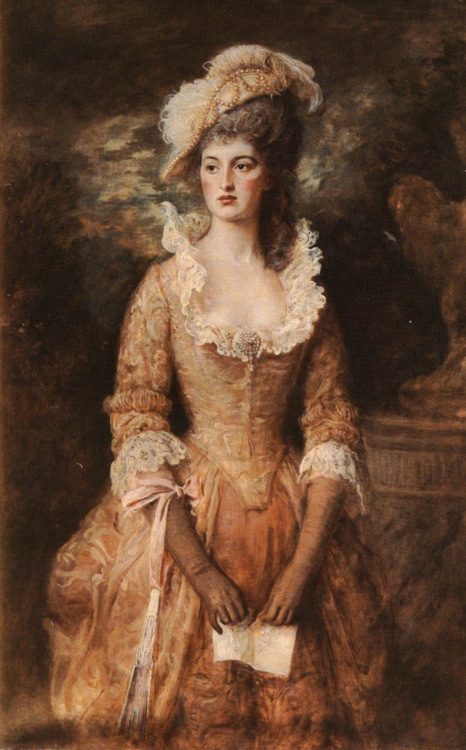
Lady CdeB much as I envision her in her younger years. Painting by Gainsborough.

Lady CdeB much as I envision her in her younger years: Haughty and Handsome. Painting by Gainsborough.

In fact, the lady’s demeanor brought everything Mr. Wickham had said about her to Lizzy’s mind. Undaunted, Lizzy turns her inquisitive gaze upon the daughter, in whose pale, sickly, Gollum-like features and timid presence she finds nothing remarkable. Her inner bad-girl is immensely satisfied that such a mousy specimen is destined to become Mr. Darcy’s bride.

While Lizzy scarcely bats an eye at the sight of Lady CdeB, Sir William  is unable to speak, his tongue cleaving  to the dry roof of his mouth, while Maria is seriously considering rolling over and playing dead. Lady CdeB is more than happy to show off her silver and fine plate and chef’s talents to this humble group, for “the dinner was exceedingly handsome. ” This is about as detailed a description of outer appearances as Jane Austen ever gives. We have no idea of what the guests wore, what dishes were served, and how many servants were in attendance. Such details are unimportant in the grand scheme of Jane’s masterful study of the human character.

Mr. Collins is completely in his element, scraping and bowing and prattling while carving the meat, an honor he finds so great that  it has eliminated any vestige of restraint. As he babbles nonstop, Sir William, having recovered his severe case of nerves, echoes the unfiltered stream of utterances. Lady CdeB laps up their compliments without a sense of irony.  No Mr. Bennet she!

Lizzy, meanwhile, sits unnoticed on the side and twiddles her thumbs, waiting for an opening in the conversation. This fails to come, for Lady CdeB is too busy relating the opinions of “Me, Myself, and I”, an overpowering and determined trio intent on delivering their viewpoint on every subject.

In the drawing room Lady CdeB continues her one-sided discussions, giving Charlotte advice on all matters pertaining to  household management, including the care of her poultry and cows, of all things. Then, just before poor Lizzy falls asleep from boredom, the Lady zeroes in on our heroine, firing off a series of questions.

  • How many sisters do you have?
  • Are they younger or older?
  • Are they handsome?
  • Any chance of them marrying soon?
  • Are they educated as a young lady ought to be?
  • What is your mother’s maiden name?
  • What year and make is your father’s carriage?

Lizzy hides her outrage but feels all the impertinence of this inquiry. Lady CdeB attempts to rattle her again. “Your father’s estate is entailed on Mr. Collins,” she drops, before abruptly switching the topic. Seasoned interrogators use this technique to catch their subjects off guard, but our Lizzy remains unflappable:

“Do you play and sing, Miss Bennet?”

“A little.”

“Do your sisters play and sing?”

“One of them does.” (Mary. Hah!)

Undeterred, Lady CdeB keeps  the chandeliers spotlighted over Lizzy’s head and continues her inquisition:

You ought all to have learned, the Miss Webbs all play.”

Still trying to rattle Lizzy’s chain, she resorts to insulting Mrs. Bennet’s mothering skills. The reader guffaws from the irony of it all.

“What, you don’t draw? Strange, but your mother should have taken you to town for the benefit of masters.”

“No Governess! How is that possible. You must have been neglected.”

And on and on she goes. Elizabeth plasters a polite smile on her face and refuses to cower. I recall reading this passage with the speed of a Ferrari on an open road  racing to the finish. I so enjoyed the heady ride Jane Austen was taking us on that I had to read how it ended as swiftly as possible! (In fact, I finished my first reading of P&P in one sitting, then reread it a short time later, slowly savoring each word.)

Lady CdeB asks one more question —

Are any of your younger sisters OUT, Miss Bennet?”

“Yes, ma’am, ALL.”

“ALL?!!” You could have thrown the feathers on top of Lady CdeB’s aristocratic head for a loop when Lizzy calmly explains the fairness of her mother’s decision.  “You give your opinion decidedly for so young a person, ” she sniffs, but the reader already knows the score:

Miss Elizabeth Bennet of Longbourn, One

Lady Catherine de Bourgh of Rosings, Zilch

GO TEAM LIZZY!”

After this scene one can only conclude that Lost in Austen got it right when the series transported Elizabeth Bennet to the future and had her land on her feet,  embracing smart phones, automated teller machines, and iPads as if to the Internet born. In this time travel fantasy series the viewer can readily imagine Jane’s prototype of a modern heroine wanting to free herself from the restraints of her era. In my estimation, Lost in Austen lost its way when it followed the story line of boring Amanda Price discovering life in the past in favor of Lizzy’s more interesting journey into the future.

As for Lady CdeB, I will next examine her as a Proficient. Read Part One of the Lady CdeB series here.

Read Full Post »

Gilbert Gottfried Reads Jane Austengilbert-gottfried-300x249

Ever heard of The Irrelevant Show? I wouldn’t have until I noticed that Gilbert Gottfried, the original voice of the Aflack duck, read Sense and Sensibility using his *ahem* unique comic’s voice.

Imagine Gilbert living 200 years ago and reading by candlelight at night with that voice. It does not bear to think about. Here’s the link to the CBC player. Gilbert’s reading starts after the introduction. Thankfully, his reading is blissfully short.

julie ann cooperFried and Prejudice

On a more serious note, story teller Julie Ann Cooper will stage a retelling of Pride and Prejudice on Friday, June 14th at 7 PM at Theatre Absolute, a converted chip shop in Coventry. This event is part of the Literally Coventry Book Festival, which runs from June 10 to 15 this year. Click here to learn more.


Read Full Post »

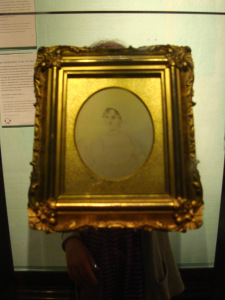
Gentle readers, this year marks the 200th anniversary of Pride and Prejudice. This blog will feature a variety of posts about the novel and on its author, Jane Austen. Frequent contributor, Tony Grant (London Calling) recently visited the National Portrait Gallery in London and viewed the small watercolour portrait of her painted by Cassandra Austen. In this tribute, Tony demonstrates her star status among other literary superstars.

jane1

Click on this link to see the portrait’s location within the National Portrait Gallery

If you enter the National Portrait Gallery as you walk into the main atrium go up the tall escalator on the left and you come to a foyer area at the top off which there are entrances into two main galleries. On the right is the wonderful gallery displaying the powerfully evocative Tudor monarchs and their statesmen.

On the left are the 18th and 19th century galleries portraying the politicians, monarchs, reformers and writers of that period. It is here , many of you will know, is the tiny portrait of Jane Austen attributed to her sister Cassandra and drawn in 1810 using pencil and watercolours. It is an unprepossessing little picture. It’s great worth is in who it is. But, if you stand back from the plinth with the perspex box on its summit containing Jane and view the whole vista you will notice that Jane is surrounded by a halo of super star writers. She is the centre of the group.

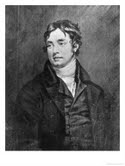
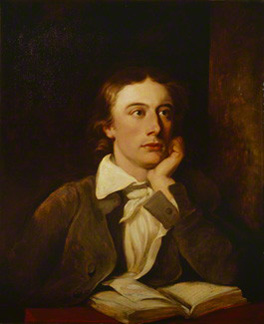
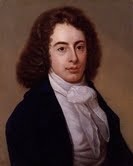
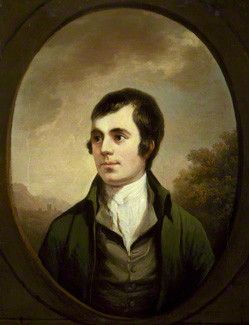
Bottom left is Sir Walter Scott. Moving clockwise next comes Samuel Taylor Coleridge, at the top is John Keats and then as you move down right of Jane, Robert Southey follows and last, bottom right, is Robert Burns. Quite a group, and there she is in the middle, our Jane. If you think I am imagining the halo metaphor, walk behind the plinth with Jane displayed and you will notice that there is nothing on the wall, there is a space. The halo metaphor works. The only thing behind Jane is a handwritten catalogue number on the back of the portrait itself. It reads; “NPG 360, Jane Austen.” It’s written in pencil in a reasonably legible hand. A scrawled note such as somebody might write as a memo to themselves on a post it and stick on their fridge door.

All of these writers were geniuses and there is Jane right at their centre. The men were all Romantics. Jane perhaps ridiculed some aspects of Romanticism in Northanger Abbey but she wrote about romance and its vicissitudes. The men wrote about their emotional response to the world. Jane did not portray her own emotions, just the emotions of her characters.

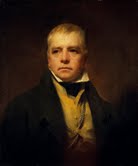
walter scottSir Walter Scott (1771-1832) painted by Sir Edwin Landseer.

Chivalry!—why, maiden, she is the nurse of pure and high affection—the stay of the oppressed, the redresser of grievances, the curb of the power of the tyrant —Nobility were but an empty name without her, and liberty finds the best protection in her lance and her sword.” Ivanhoe

Many of Scott’s novels harked back to a supposed ideal period , the Middle Ages, when chivalry was the moral high ground for men and women fitted into the system as perfect idols worshipped by men. However this was for the aristocracy. Serfdom was really slavery. Serfs were possessions. Scott wrote in Ivanhoe and Quentin Durward and novels such as those about this ideal dreamlike world. It was the ultimate escapism.
coleridgeSamuel Taylor Coleridge (1772-1834) painted by Peter Van Dyke.

The western wave was all a-flame.
The day was well nigh done !
Almost upon the western wave
Rested the broad bright Sun;
When that strange shape drove suddenly
Betwixt us and the Sun.
It seemeth him but the skeleton of a ship.”

Samuel Taylor Coleridge was a friend of William Wordsworth and his sister Dorothy. They promoted Romanticism together which added a more emotional and personal response to the world in addition to the ways of thinking the Age of Enlightenment promoted.

NPG 194; John Keats by William Hilton, after  Joseph SevernJohn Keats (1795 – 1821) painted by Joseph Severn

A thing of beauty is a joy for ever:
Its loveliness increases; it will never
Pass into nothingness; but still will keep
A bower quiet for us, and a sleep
Full of sweet dreams, and health, and quiet breathing.”

John Keats died of tuberculosis in Rome in February 1821. Joseph Severn, the portrait artist was his best friend and was with him in Rome when he died. Keats was another Romantic poet. When he first started publishing his poetry he was heavily criticised in Blackwood’s Magazine. Those with invested interests in the status quo and couldn’t think imaginatively beyond what they knew, seemed hell-bent on preventing the human race from progressing. It was ever thus.

robert southeyRobert Southey(1774 -1843) painted by Peter Van Dyke.

We pursued our way
To the house of mirth, and with that idle talk
That passes o’er the mind and is forgot,
We wore away the time. But it was eve
When homewardly I went, and in the air
Was that cool freshness, that discolouring shade
That makes the eye turn inward.”

Robert Southey was another of the Romantic poets. He lived in the lakes with Wordsworth and Coleridge and is generally known as one of the Lakeland poets. He is now considered a lesser poet than either Wordsworth or Coleridge. In 1813 he became the poet laureate and Byron lambasted him for this.

NPG 46; Robert Burns by Alexander NasmythRobert Burns (1759 – 1796) painted by Alexander Nasmyth

We’ll gae down by Cluden side,
Thro’ the hazels spreading wide,
O’er the waves that sweetly glide
To the moon sae clearly.
Yonder Cluden’s silent towers,
Where at moonshine midnight hours,
O’er the dewy-bending flowers,
Fairies dance sae cheery.”

Robert Burns is a Scottish national hero. Websites dedicated to him use his name, his picture and his poems in an unashamedly mercenary way. He is probably the most marketed writer in this group and a real money spinner for the Scottish economy. He was actually a great poet it is sometimes worth stopping and remembering. What can be difficult for many readers is the Scottish dialect and use of colloquial phrases in his poems. His poetry is worth spending time with. They require deep emotional investment. They are rich with feelings and emotions. He was a romantic poet more by inclination than belief. It was just him, the way he was.

jane austenJane Austen (1775 – 1817) painted by Cassandra Austen

The first line of Pride and Prejudice goes such:

It is a truth universally acknowledged that a single man in possession of a good fortune , must be in want of a wife.”

However, the last lines of the penultimate chapter of Pride and Prejudice are also worth considering and shed light on Elizabeth and Fitzwilliam Darcy in particular.

…….she looked forward with delight to the time they should be removed from society so little pleasing to either, to all the comfort and elegance of their family party at Pemberley.”

Read Full Post »

« Newer Posts - Older Posts »