Feeds:
Posts
Comments

Archive for the ‘Jane Austen’s letters’ Category

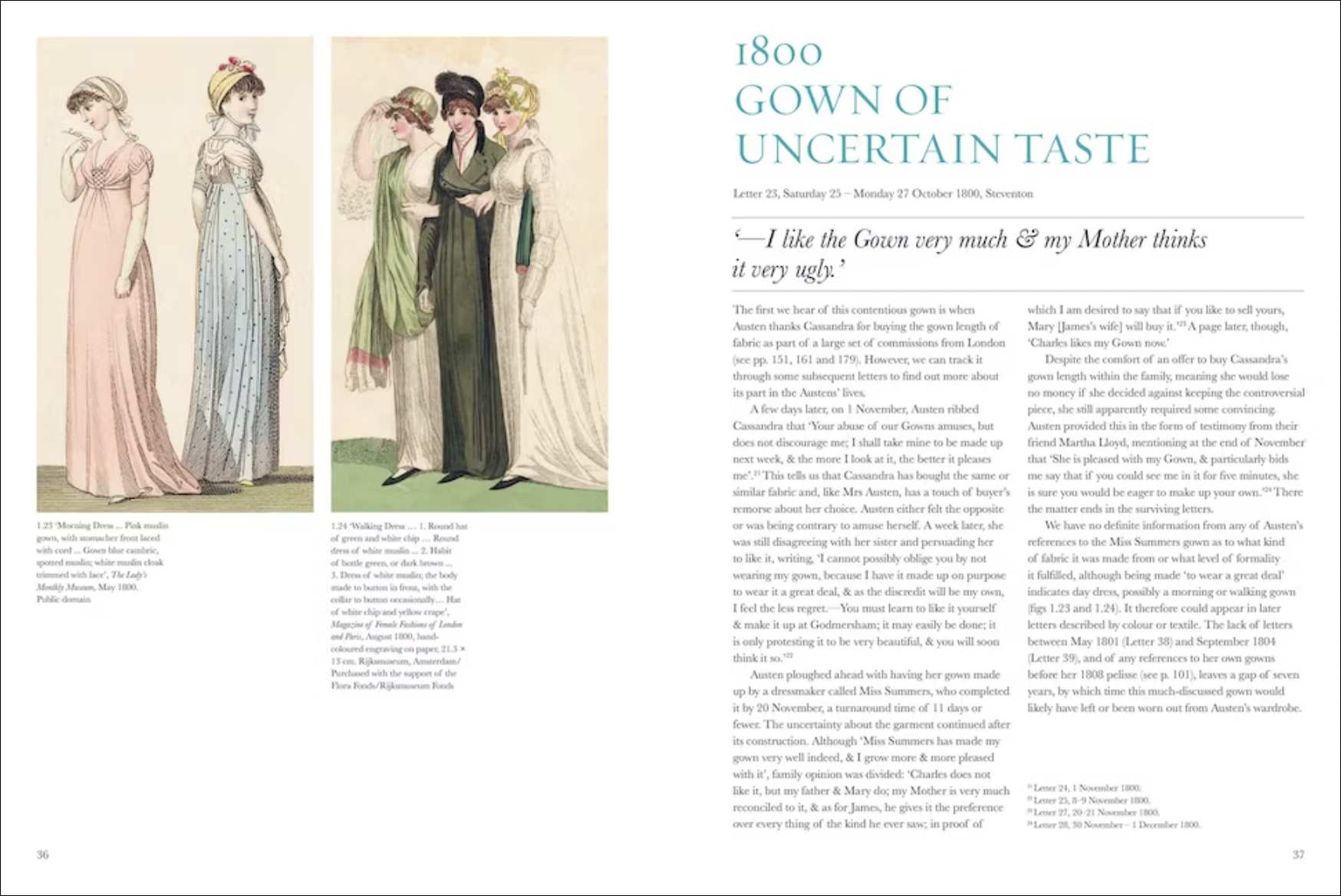
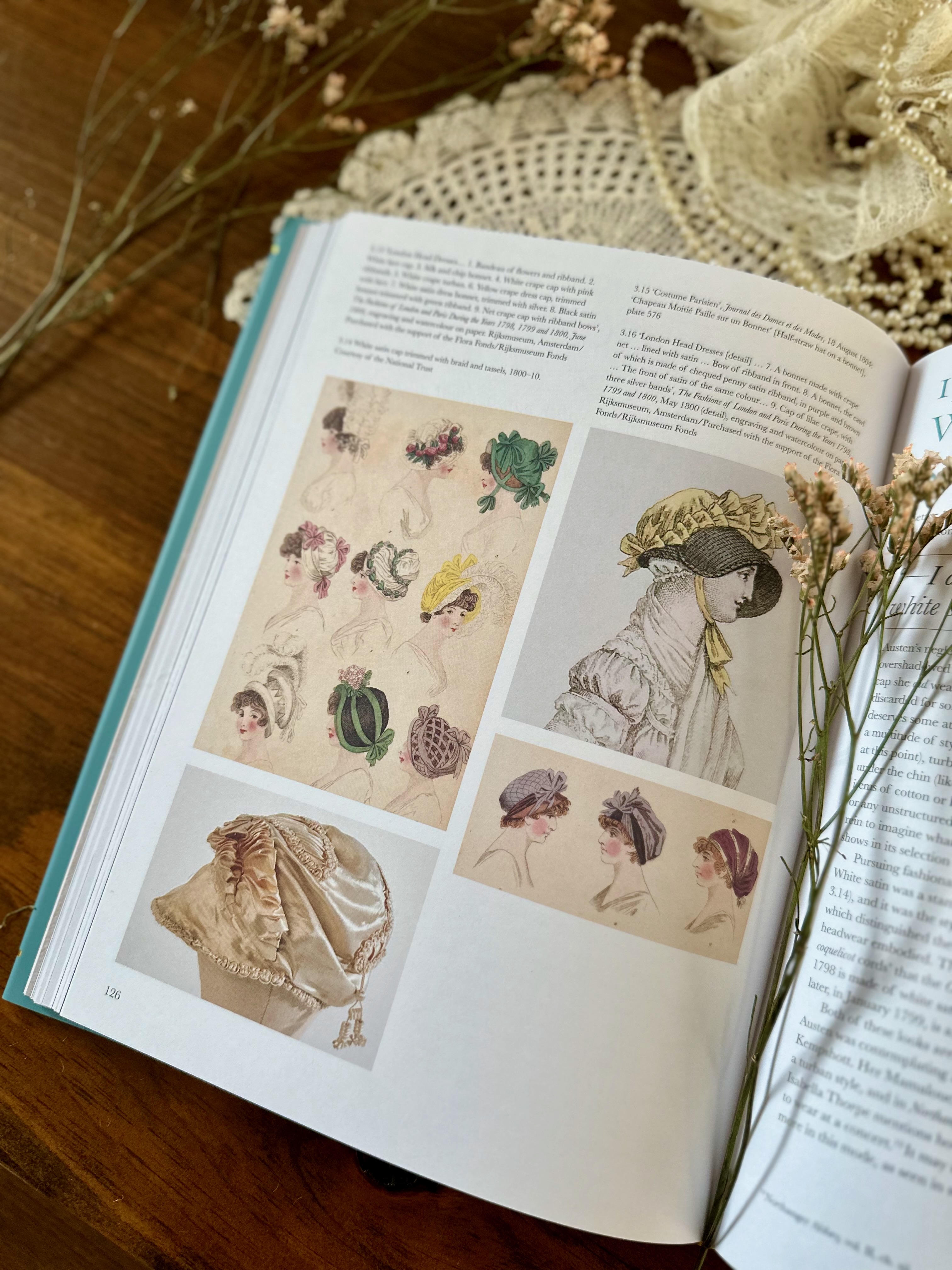
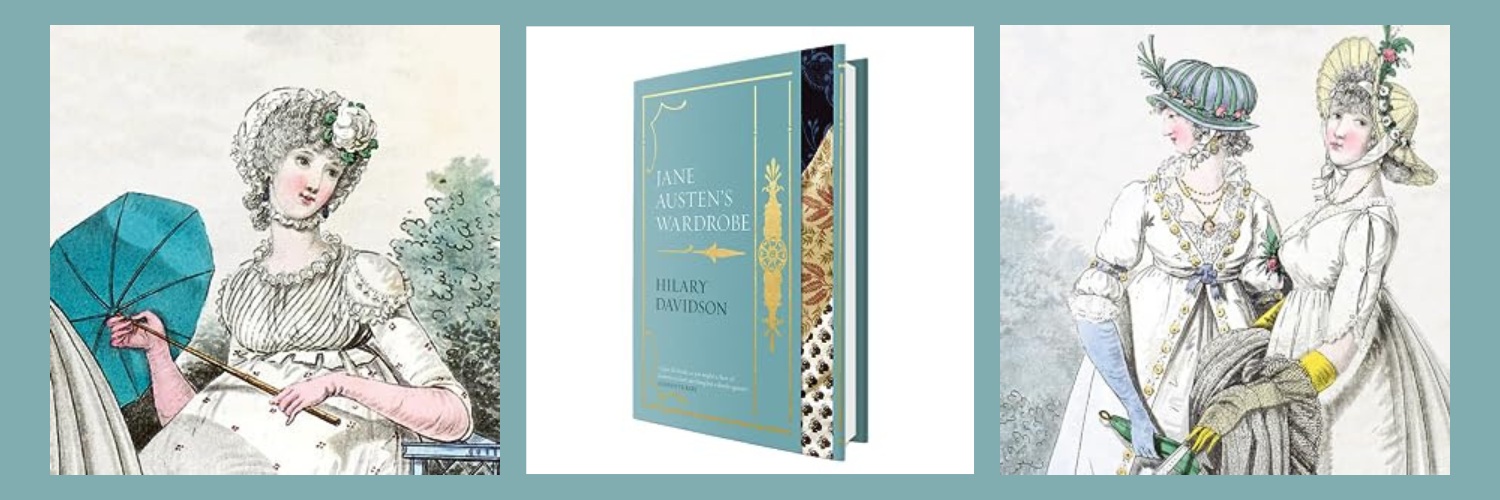
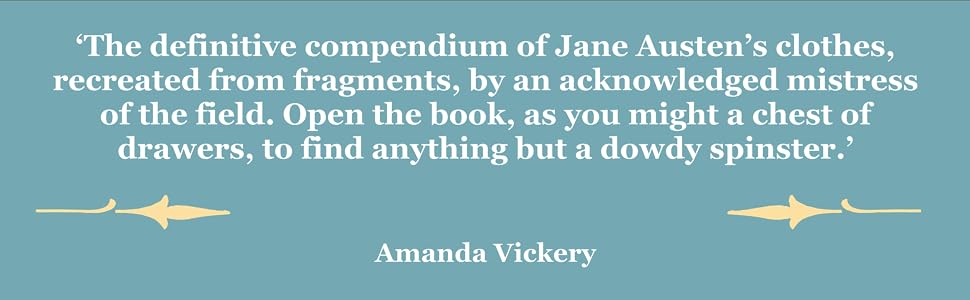
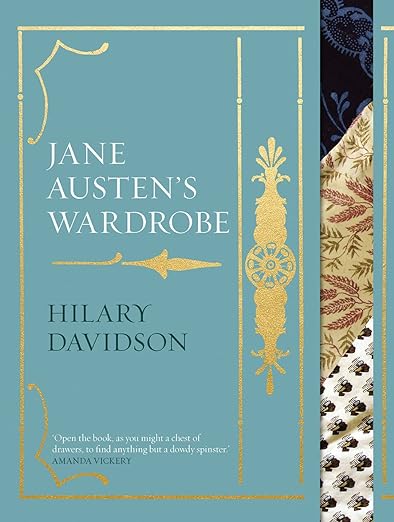
Dear readers, I have an exquisite new book to share with you today: Jane Austen’s Wardrobe by Hilary Davidson!

Filled with incredible photos and written information, it’s one of the most detailed books I’ve seen in a long time on this topic. Not only is it beautiful, it is filled with fascinating information on one of my most favorite topics.

This is my new favorite book on Jane Austen’s Regency Fashion. I know I’ll continue to pour over it for years to come!

Austen’s Wardrobe by Category

Within the pages of this lovely book, Davidson works her way through Austen’s personal wardrobe chronologically, from head to toe. Davidson’s system for cataloging Austen’s wardrobe is fascinating! For those of us who delight in a linear and/or chronological order to a wide and varied topic, Davidson definitely checks all the boxes.

First, she breaks all of Austen’s clothing down into the following categories:

  • Clothes Press: Gowns
  • Closet: Spencers, Pelisses and Outer Garments
  • Band Box: Hats, Caps and Bonnets
  • Shelves: Shawls, Tippets, Cloaks and Shoes
  • Dressing Table: Gloves, Fans, Flowers, Trims and Handkerchiefs
  • Jewelery Box: Necklaces, Rings and Bracelets
  • Drawers: Undergarments and Nightwear

Davidson even includes several pages of sketches, descriptions, and explanations for Jane’s “Portrait Gown” – which I found completely engrossing.

Austen’s Letters Quoted

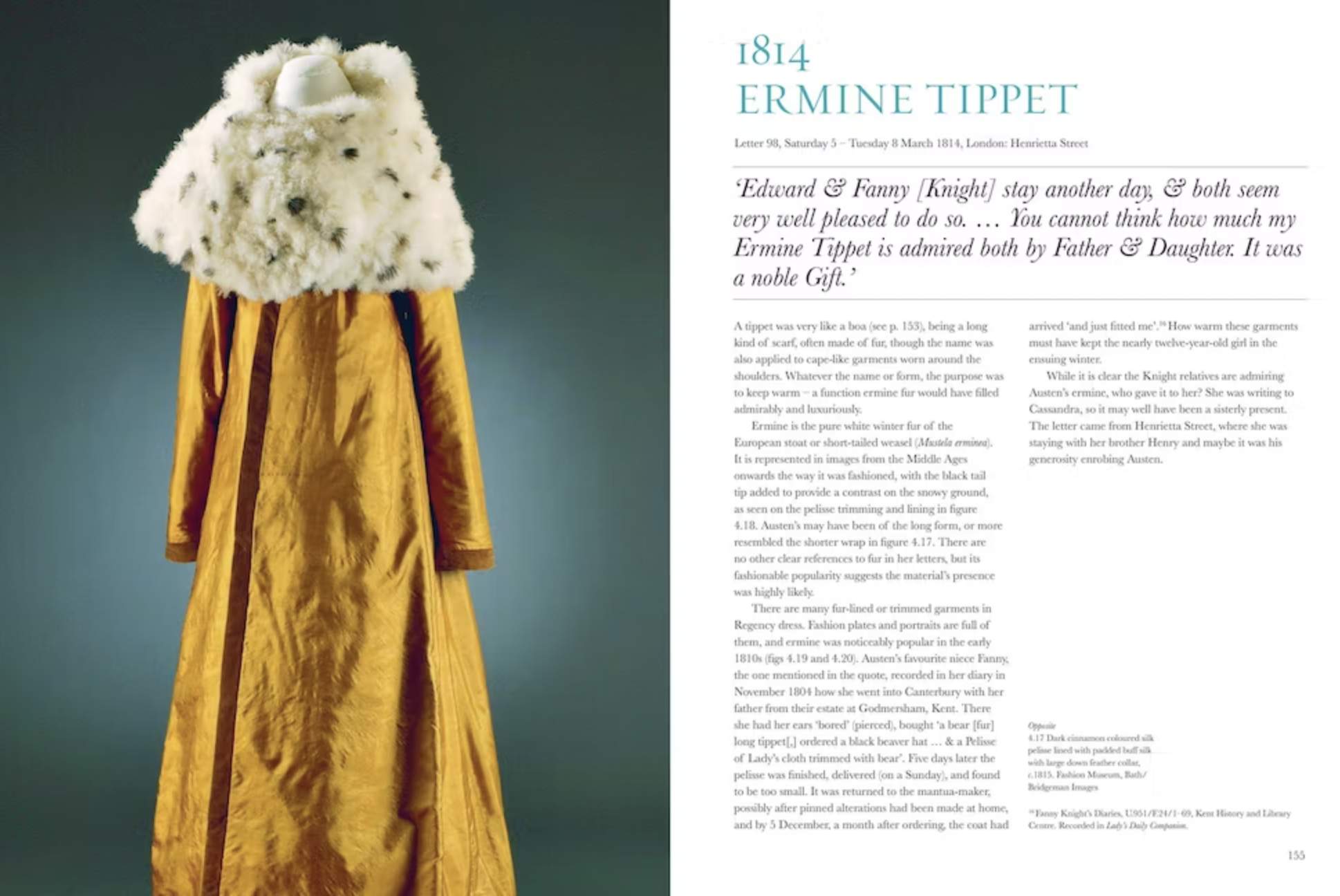
Next, Davidson utilizes Austen’s personal letters to explore every inch of Austen’s wardrobe, working her way through each category in chronological order. To do this, she shares one quote at time, citing portions of letters that mention Austen’s clothing. Then, for each article of clothing, every hat, and every piece of jewelry, she explains that quote in great detail and provides photos to aid our understanding.

For instance, Austen writes this in Letter 65:

“I can easily suppose that your six weeks here will be fully occupied, were it only in lengthening the waists of your gowns. I have pretty well arranged my spring & summer plans of that kind, & mean to wear out my spotted Muslin before I go. –You will exclaim at this–but mine has signs of feebleness, which with a little care may come to something.”

Tuesday 17 – Wednesday 18 January, 1809, Castle Square

Davidson provides photos of spotted muslin fabric swatches and a photo of a dress made of spotted muslin, dated 1805-10. Then she explains the muslin fabric, provides quotes from Austen’s novels about muslin dresses, and explains Austen’s quote. She goes over the dress styles, what was involved in “lengthening the waist” of a gown, the meaning of “worked” fabric, and the ins and outs of fragile fabrics of that time period, including how women used belts to cover holes in the fabric when a waist was lengthened.

I found this incredibly interesting because I’ve always been curious about Austen’s extensive quotes about her dresses and hats in her letters. The result is a delightful (and sometimes hilarious) tour through Jane Austen’s closet in her own words, with pictures and explanations to match!

Here are several more examples, provided by Yale University Press:

Informative and Beautiful

Like many of Austen’s heroines, this book is both intelligent and beautiful. Inside and out, this book is absolutely stunning. The photos provide a detailed look into Jane Austen’s clothing that is hard to find, especially all in one place. This book feels like a worldwide museum tour of all the most exquisite clothing artifacts from Austen’s time.

This is the perfect addition to any Jane Austen library – and it will look gorgeous on your coffee table!

Book Description

Hilary Davidson delves into the clothing of one of the world’s great authors, providing unique and intimate insight into her everyday life and material world.
 
Acclaimed dress historian and Austen expert Hilary Davidson reveals, for the first time, the wardrobe of one of the world’s most celebrated authors. Despite her acknowledged brilliance on the page, Jane Austen has all too often been accused of dowdiness in her appearance. Drawing on Austen’s 161 known letters, as well as her own surviving garments and accessories, this book assembles examples of the variety of clothes she would have possessed—from gowns and coats to shoes and undergarments—to tell a very different story.

The Jane Austen Hilary Davidson discovers is alert to fashion trends but thrifty and eager to reuse and repurpose clothing. Her renowned irony and wit peppers her letters, describing clothes, shopping, and taste. Jane Austen’s Wardrobe offers the rare pleasure of a glimpse inside the closet of a stylish dresser and perpetually fascinating writer.

About the Author

Hilary Davidson is a dress, textile and fashion historian and curator. Her work encompasses making and knowing, things and theory, with an extraordinary understanding of how historic clothing objects come to be and how they function in culture.

Hilary is equally skilled in analysing historical and archaeological material culture artefacts; presenting engaging, fascinating talks to diverse audiences; and producing influential academic research.

Her extensive experience includes:

  • Scholarly research
  • Lecturing, teaching and public talks
  • Broadcasting and journalism
  • Historic dressmaking

Hilary trained as a bespoke shoemaker in her native Australia before completing a Masters in the History of Textiles and Dress at Winchester School of Art (University of Southampton) in 2004. Since graduating, Hilary’s practice has concerned the relationship between theoretical and highly material approaches to dress history, especially in the early modern and medieval periods.

As a skilled and meticulous handsewer, she has created replica clothing projects for a number of museums, including a ground-breaking replication of Jane Austen’s pelisse. At the same time she lectured extensively on fashion history, theory and culture, on semiotics, and cultural mythologies, especially red shoes.

In 2007 Hilary became curator of fashion and decorative arts at the Museum of London. She contributed to the £20 million permanent gallery redevelopment opening in 2010, and curated an exhibition on pirates, while continuing to publish, teach and lecture in the UK and internationally. In collaboration with Museum of London Archaeology, Hilary began analysing archaeological textiles and continues to cross disciplines by consulting in this area in England and Australia. She also worked on the AHRC 5-star rated Early Modern Dress and Textiles Network (2007-2009) and from 2011 has appeared as an expert on a number of BBC historical television programmes, and as a frequent radio guest speaker in London and Sydney.

From 2012 Hilary worked between Sydney and London as a freelance curator, historian, broadcaster, teacher, lecturer, consultant and designer, while working on a PhD in Archaeology at La Trobe University, Melbourne. In addition to historical studies she has been a jewellery designer, graphic designer, photographer, gallerist, and worked in retail fashion and vintage clothing. In 2022 she moved to New York City to take up the role of Associate Professor and Chair of the MA Fashion and Textile Studies: History, Theory, Museum Practice at the Fashion Institute of Technology.

Hilary has taught and lectured extensively, including at the University of Southampton, Central St Martins, the University of Cambridge, the University of Glasgow, New York University London, The American University Paris, Fashion Design Studio TAFE Sydney and the National Institute of Dramatic Art (NIDA), Sydney. She speaks regularly at academic conferences and to the public. Her first monograph book was Dress in the Age of Jane Austen (2019) followed by Jane Austen’s Wardrobe in 2023. Her extensive publications can be found on Academia and ResearchGate.

To Order the Book:

You can order the book by clicking HERE
or by clicking the image below:

Recommended Book Gift

I hope you’ve enjoyed this short tour of this stunning new book by Hilary Davidson. If you’re looking for a gift for a fellow Jane Austen fan, or if your friends or family members need an idea for a gift for you this holiday season, I highly recommend this one!


RACHEL DODGE teaches college English classes, gives talks at libraries, teas, and book clubs, and writes for Jane Austen’s World blog. She is the bestselling author of The Little Women DevotionalThe Anne of Green Gables Devotional and Praying with Jane: 31 Days Through the Prayers of Jane Austen. Now Available: The Secret Garden Devotional! You can visit Rachel online at www.RachelDodge.com.

Read Full Post »

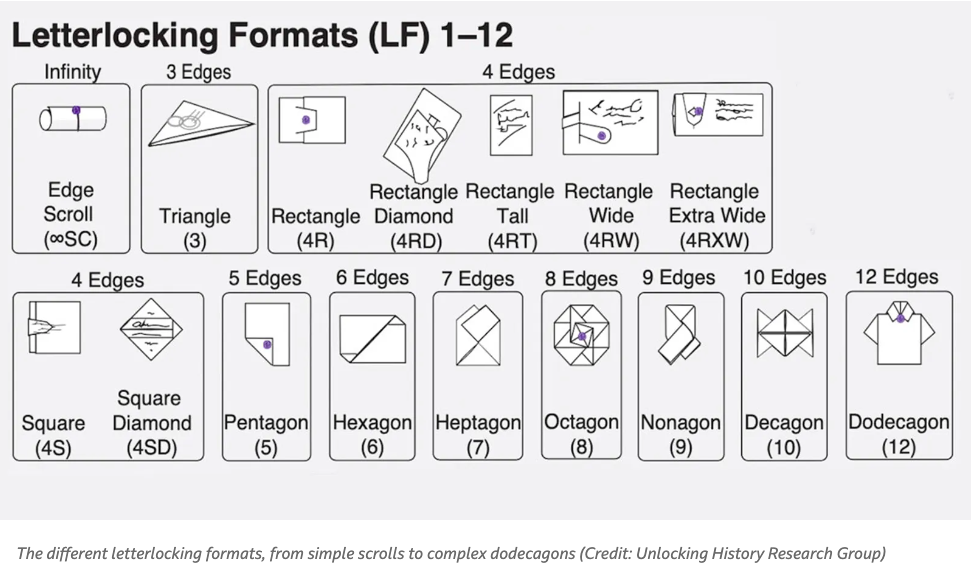
Letterlocking was a method used by European societies between the 15th – 18th centuries to keep messages private.  Ancient human societies found other techniques to protect their messages through the use of seals, or, as in the case of Ancient Mesopotamia, cylinder seals that were unique to each owner. These were eventually replaced with stamp seals, some of which are still used today in the form of signet rings.

Today I seek other ways to keep my public affairs private. Passwords for my online correspondence and purchases are changed frequently, and I make sure to have a secure two-step process for accessing the information along with a back up plan.

During Jane Austen’s lifetime, envelopes were not yet used. The extra weight made the expense of sending or receiving letters more expensive. Therefore, the paper was carefully folded. Often the lines were crossed, as shown in an article from this blog.  Images of Austen’s surviving letters demonstrate the method by which she folded them, as described by Jane Austen’s House .

The letter was written across the first three pages and the top and bottom thirds of the fourth page, leaving its middle third blank. With the first page uppermost, the bottom third of the letter was then folded upwards and the top third folded down so that the edges met in the middle. Then, holding the letter lengthways, the left-hand and right-hand sides were tucked inside each other. The packet was sealed with wax and the address written on the blank reverse. –  Room 5: How to Write and Fold a Letter, Jane Austen’s House

One method of letterlocking is shown in the YouTube video below.

Letterlocking is the art of using specific folds and cuts in flexible paper to seal it shut for document security. Because paper was not always as common as it is today, it was much more expensive, which led to minimizing the use of paper as much as possible. At this point in history, envelopes would have been seen as excess cost, an issue that was quickly solved with letterlocking.” — Securing Ancient Secrets: The Fascinating History of Letterlocking, Ancient Origins

In a BBC article (see link below), Richard Fisher described the historic research that uncovered the secrets to letterlocking in the early 2000’s. Conservator Jana Dambrogio was the first woman allowed to work in the Vatican Secret Archives when she found a cache of documents and noticed cuts, creases and folds in the paper. Thinking they were evidence of letterlocking, she scientifically described what she observed.

Screen Shot 2023-10-17 at 1.06.18 PM

She and a colleague, Starza Smith, searched for more letterlocking samples, which they often found in old archives and museum collections. Recently they discovered a trunk containing 2,600 letters from 17th-Century Europe, of which 577 were unopened. This trove provided details of European life during the 1600s.

As a final act before her execution, Mary Queen of Scots sealed a letter she wrote to her brother-in-law with a spiral lock. He would have known her message had been intercepted if that seal arrived broken. The irony would not have been lost on a juvenile Austen, whose “History of England” included a memorable passage about the doomed queen.

Read Full Post »

When Jane Austen wrote letters to her sister or brothers, she had the choice of sending them two ways: One was to assume her siblings would pay to receive her letters. The other was that Jane would pay to send the letter. As we know, Jane lived on a budget of a mere £50 per year, as did Cassandra, and so their letters were crossed to save money on weight and pages.

Letter to Godmersham

In the following passage from Mansfield Park, Jane writes about 10 year old Fanny Price’s dilemma: She wants to write to her brother William, the sibling she loves the most, but she has no paper on which to write him, and even if she had the paper, she has no funds to send the letter. Her cousin Edmund offers a solution. 

“My dear little cousin,” said he, with all the gentleness of an excellent nature, “what can be the matter?” And sitting down by her, he was at great pains to overcome her shame in being so surprised, and persuade her to speak openly. Was she ill? or was anybody angry with her? or had she quarrelled with Maria and Julia? or was she puzzled about anything in her lesson that he could explain? Did she, in short, want anything he could possibly get her, or do for her? For a long while no answer could be obtained beyond a “no, no—not at all—no, thank you”; but he still persevered; and no sooner had he begun to revert to her own home, than her increased sobs explained to him where the grievance lay. He tried to console her.

“You are sorry to leave Mama, my dear little Fanny,” said he, “which shows you to be a very good girl; but you must remember that you are with relations and friends, who all love you, and wish to make you happy. Let us walk out in the park, and you shall tell me all about your brothers and sisters.”

On pursuing the subject, he found that, dear as all these brothers and sisters generally were, there was one among them who ran more in her thoughts than the rest. It was William whom she talked of most, and wanted most to see. William, the eldest, a year older than herself, her constant companion and friend; her advocate with her mother (of whom he was the darling) in every distress. “William did not like she should come away; he had told her he should miss her very much indeed.” “But William will write to you, I dare say.” “Yes, he had promised he would, but he had told her to write first.” “And when shall you do it?” She hung her head and answered hesitatingly, “she did not know; she had not any paper.”

“If that be all your difficulty, I will furnish you with paper and every other material, and you may write your letter whenever you choose. Would it make you happy to write to William?”

“Yes, very.”

“Then let it be done now. Come with me into the breakfast-room, we shall find everything there, and be sure of having the room to ourselves.”

“But, cousin, will it go to the post?”

“Yes, depend upon me it shall: it shall go with the other letters; and, as your uncle will frank it, it will cost William nothing.”

“My uncle!” repeated Fanny, with a frightened look.

“Yes, when you have written the letter, I will take it to my father to frank.”

Screen Shot 2023-07-28 at 5.40.45 PM

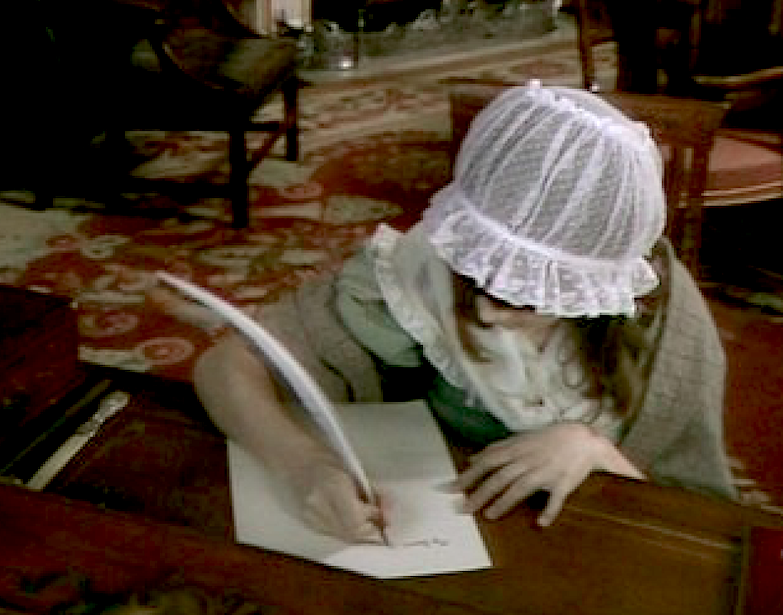
Fanny writes William a letter. (Mansfield Park, 1983)

Fanny thought it a bold measure, but offered no further resistance; and they went together into the breakfast-room, where Edmund prepared her paper, and ruled her lines with all the goodwill that her brother could himself have felt, and probably with somewhat more exactness. He continued with her the whole time of her writing, to assist her with his penknife or his orthography, as either were wanted; and added to these attentions, which she felt very much, a kindness to her brother which delighted her beyond all the rest. He wrote with his own hand his love to his cousin William, and sent him half a guinea under the seal. Fanny’s feelings on the occasion were such as she believed herself incapable of expressing; but her countenance and a few artless words fully conveyed all their gratitude and delight, and her cousin began to find her an interesting object. He talked to her more, and, from all that she said, was convinced of her having an affectionate heart, and a strong desire of doing right; and he could perceive her to be farther entitled to attention by great sensibility of her situation, and great timidity. He had never knowingly given her pain, but he now felt that she required more positive kindness; and with that view endeavoured, in the first place, to lessen her fears of them all, and gave her especially a great deal of good advice as to playing with Maria and Julia, and being as merry as possible.

From this day Fanny grew more comfortable. She felt that she had a friend, and the kindness of her cousin Edmund gave her better spirits with everybody else. The place became less strange, and the people less formidable; and if there were some amongst them whom she could not cease to fear, she began at least to know their ways, and to catch the best manner of conforming to them.”

Edmund’s solution was a third option not available to Jane or her family. Franking privileges were available to all peers and sirs, like his father, Sir Thomas Bertram, a baronet. He who would write his name diagonally across the sealed letter. This act automatically paid for the postage. — Regency Trivia: Franking Privileges, Ella Quinn

This scene sets the stage for the special relationship between the lonely, bewildered Fanny and her kind cousin, who has made her feel welcome and at home at a time when she felt adrift. Their connection would stand the test of time.

More on the Topic:

The Regency Post — A Pity We’ve Lost Letters, Shannon Donnely’s Fresh Ink

Jane Austen — Quills and Correspondence

Read Full Post »

On January 9, 1773, Jane Austen’s older sister Cassandra Austen was born – 250 years ago – and we Austen fans are celebrating her life worldwide!

The two Austen sisters were nearly inseparable, from the time Jane was born until she passed away. She was the yin to Austen’s yang . . . or to put it in Regency terms, she was the darning needle to Jane’s stockings, the saucer to her tea cup. If you love Jane, then you would have undoubtedly loved Cassandra!

A Friend and Companion

When Jane was born, her father famously wrote: “We have now another girl, a present plaything for her sister Cassy, and a future companion.”

Reverend Austen was right on both counts. When the girls were young, Jane was extremely attached to Cassandra. So much so that when Cassandra went away to school, Jane was allowed to go as well. Not because she was necessarily ready for school, but because, as their mother said, “if Cassandra’s head had been going to be cut off, Jane would have hers cut off too.”

As they grew up, the sisters became the closest of companions and the dearest of friends. Of particular note, Cassandra is known for her sketches and watercolor paintings, particularly those believed to be of Jane and those that accompany Jane’s History of England.

Excerpt from the History of England by Jane Austen, illustrated by Cassandra Austen, the British Library.

Cassandra and Jane

Much of what we know about Austen’s personal life is largely due to the letters Jane wrote to her sister. Though Cassandra destroyed many of Jane’s letters after her death, there is still much we can find out about the two sisters through reading Jane Austen’s letters. Cassandra’s own letters about Jane’s illness and death provide a tender glimpse into the love and closeness of the Austen sisters.

I have lost a treasure, such a sister, such a friend as never can have been surpassed. She was the sun of my life, the gilder of every pleasure, the soother of every sorrow; I had not a thought concealed from her, and it is as if I had lost a part of myself… I thank God that I was enabled to attend her to the last…

Cassandra Austen to Fanny Knight, July 18, 1817
Jane Austen by Cassandra

A Year of Cassandra

To honor Cassandra’s life and legacy, Jane Austen’s House Museum launched its “Year of Cassandra,” during which the museum will feature special events and exhibitions to celebrate her life.

If you’re like me and you want to be part of this special celebration but don’t live close enough to participate in person, the Museum is planning a “Cassandra-themed” Virtual Tour of the museum in March. The tour description is as follows: “Find out about Cassandra’s life at Chawton Cottage and discover objects related to her on a lively, fact-filled tour that you can enjoy from the comfort of your own home.” You can find the details HERE.

Cassandra’s Orchard

Of special note is the commemorative orchard being planted in Cassandra Austen’s honor, which has been named “Cassandra’s Orchard.” The name itself certainly makes me want to visit Chawton Cottage again one day soon, but the descriptions are even more intriguing:

Jane’s letters to her are filled with references to plants, flowers and fruits from the orchard, now sadly lost from the grounds of the House.

We will recreate this lost orchard, using dwarf varieties suitable for growing in containers. There will be a tree for every novel, and donors’ names will be recorded on plaques for each tree. The orchard will provide blossom in the spring, delicious shade in the summer, and fruits in the autumn. We will underplant the trees with plants for pollinators, turning this empty space into a haven for people and wildlife alike.

Jane Austen’s House Museum
Cassandra’s Orchard, Photo courtesy of Jane Austen’s House Museum.

More About Cassandra

I’ve been following along with the progress of the Cassandra’s Orchard project, and I was delighted when the museum announced in December (on Jane’s birthday) that it had reached its fundraising goal. I can just imagine what a wonderful addition this little orchard will make to Jane Austen’s house.

I’m thankful for Cassandra Austen because I know that having someone who believes in you, supports you, and challenges you intellectually is important in every person’s life – but especially in the lives of writers, artists, and creatives. The very fact that she was so loved by Jane means that Cassandra must have been quite a remarkable person.

If you’d like to know more about Cassandra Austen’s life, Vic here at Jane Austen’s World has built quite the catalog of articles over the years. You can access those articles HERE. Of particular note is the article entitled, “Cassandra Austen: Jane’s confidante, supporter and helpmate” that is well worth your time.

More links about this topic:


RACHEL DODGE teaches college English classes, gives talks at libraries, teas, and book clubs, and writes for Jane Austen’s World blog. She is the bestselling author of The Little Women DevotionalThe Anne of Green Gables Devotional and Praying with Jane: 31 Days Through the Prayers of Jane Austen. Her newest release is The Secret Garden Devotional! You can visit Rachel online at www.RachelDodge.com.

Read Full Post »

“We are to have a tiny party here tonight; I hate tiny parties–they force one into constant exertion.” — Jane Austen to Cassandra, May 21, 1801,  while visiting her Aunt Jane and Uncle James Leigh-Perrot in Bath
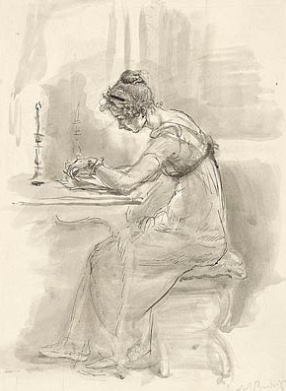
Drawing of a Regency woman writing a letter

Image by Isabelle Bishop, from the Morgan Library Exhibit of Life, Work, and Legacy of Jane Austen.

Inquiring readers, 

Tomorrow it will be December, a time for parties, celebrations, family gatherings, and Christmas activities, mostly  in Christian regions. During Austen’s time, people associated this period with the religious calendar, as well as with pagan traditions observed since ancient times. Celebrations during Austen’s life began on Dec 6th, St. Nicholas Day, and lasted until January 6th, or 12th night — the Feast of the Epiphany. 

Since 2009, this blog has posted many articles about British Christmas and New Year’s traditions, with food, dress, and customs during the Regency era and before. Austen described holiday festivities in her novels, and balls, such as the one at Netherfield Park, but none of her personal descriptions are as detailed as those mentioned in this letter to Cassandra, which tells of a large musical party that her brother Henry and sister-in-law, Eliza, held in their house in London ( 64 Sloane Street) on 25th April, 1811.
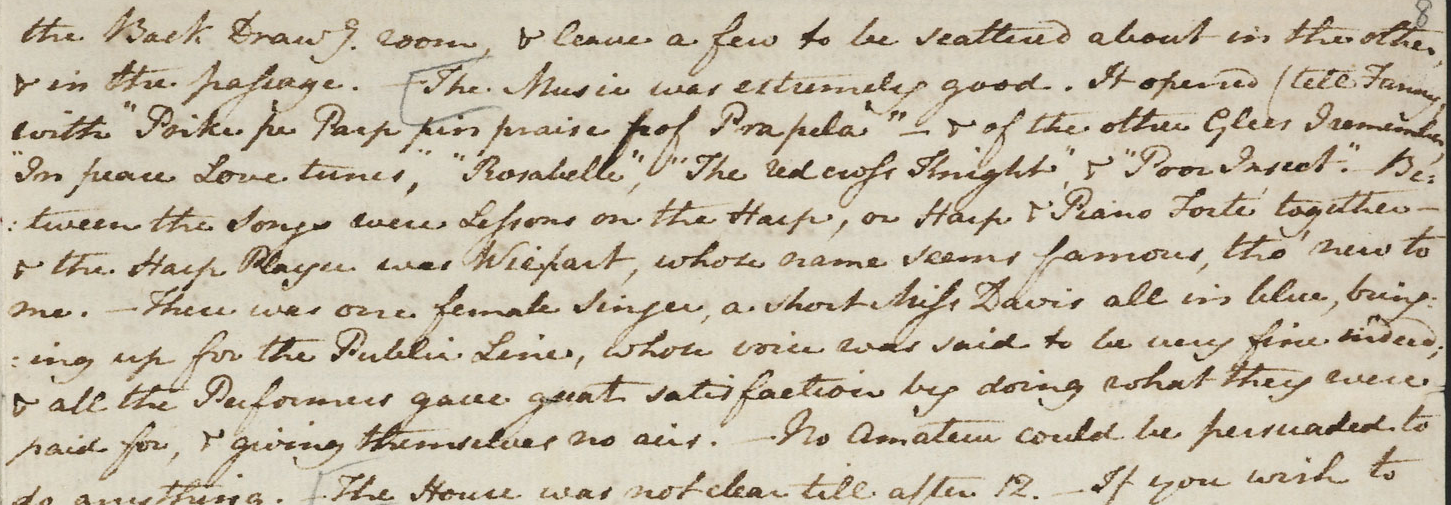
snip of the letter

Detail of Austen’s letter to Cassandra. Image: British Library Online.

The reason for Austen’s visit was to work on proofs for Sense and Sensibility, her first published novel. I chose this letter because musical parties and get-togethers were given frequently, regardless of the time of year. The songs, decorations, and fashions might have changed with the seasons, but Austen’s description of this large party, the musicians, and the guests must have seemed quite familiar to her contemporaries, despite her spare details.

NOTE: I’ve related only the details of the party in the letter. Read the full transcript at this link to The British Library.

The Letter 

  1. To Cassandra Austen (# From Deirdre Le Faye’s Fourth Edition of Jane Austen’s Letters)

Thursday, 25, April 1811

Sloane St Thursday April 25

Before the party:

My dearest Cassandra

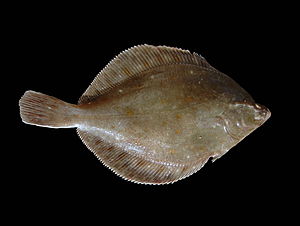
… Our party went off extremely well. There were many solicitudes, alarms, and vexations, beforehand, of course, but at last everything was quite right. The rooms were dressed up with flowers, &c., and looked very pretty. A glass for the mantlepiece was lent by the man who is making their own. Mr. Egerton and Mr. Walter came at half-past five, and the festivities began with a pair of very fine soals. 

(Soals is an obsolete spelling for sole, a flat fish. Hannah Glasse described a recipe for Fricasee of Soles made with lemon soles or a larger, thicker plaice fish, which fed more people.)

In this passage, Jane described the usual hustle and bustle before a grand party that we all have felt in our own lives. In this letter, she provided more details for her sister than in her novels for her readers.)

Mr Egerton is the publisher who brought out Jane’s first novel, “Sense and Sensibility”.)

Events leading up to the party:

Yes, Mr. Walter — for he postponed his leaving London on purpose — which did not give much pleasure at the time, any more than the circumstance from which it rose — his calling on Sunday and being asked by Henry to take the family dinner on that day, which he did; but it is all smoothed over now, and she likes him very well.”

(This sentence is somewhat enigmatic. Why would his postponement not give him much pleasure? How was the situation smoothed over? Mollands.net says this about Mr. Walter: [He] must have been related to Jane through her grandmother (Rebecca Hampson), who married first, Dr. Walter; secondly, William Austen. Mr. Ronald Dunning wrote a post about  Rebecca Hampson for this blog just a week ago. 

As the festivities began:

At half-past seven arrived the musicians in two hackney coaches, and by eight the lordly company began to appear. Among the earliest were George and Mary Cooke*, and I spent the greater part of the evening very pleasantly with them. The drawing-room being soon hotter than we liked, we placed ourselves in the connecting passage, which was comparatively cool, and gave us all the advantage of the music at a pleasant distance, as well as that of the first view of every new comer.”
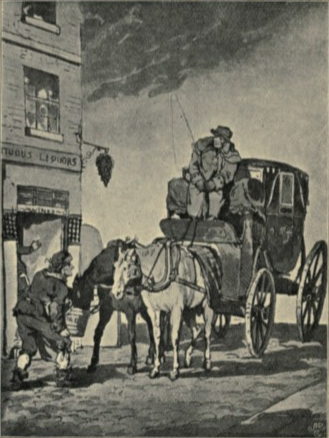
Black and white drawing of a Hackney Coach drawn by two horses

Hackney Coach, ca 1800

(Two hackney coaches carried 6 people per coach, so we may surmise that at least 12 musicians arrived with their  instruments. 

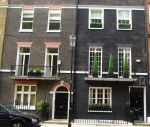
Houses in town were listed as 1st, 2nd, 3rd & 4th rate, fourth being the largest and first being the smallest. Henry’s house, located on 64 Sloane Street, is today unrecognizable from its Georgian size and façade. At the time he and Eliza rented the house, it was a 3rd rate house (3 windows wide), worth between £ 350 and £ 850 with from 500 – 900 square feet of floor space.) Because Henry was a successful banker during this time and Eliza had considerable means of her own, we can surmise that the house they rented was most likely on the larger side of 500 – 900 square feet of floor space.

Austen comments on a few acquaintances:

I was quite surrounded by acquaintances, especially gentlemen; and what with Mr. Hampson, Mr.Seymour, Mr. W. Knatchbull, Mr. Guillemarde, Mr. Cure, a Captain Simpson, brother to the Captain Simpson, besides Mr. Walter and Mr. Egerton, in addition to the Cookes, and Miss Beckford, and Miss Middleton, I had quite as much upon my hands as I could do. Poor Miss B. has been suffering again from her old complaint, and looks thinner than ever. She certainly goes to Cheltenham the beginning of June. We were all delight and cordiality of course. Miss M. seems very happy, but has not beauty enough to figure in London.”

This slideshow requires JavaScript.

(Fashion: While Austen did not describe the clothes worn by guests, Cassandra would have easily envisioned what people wore. Jane had a limited yearly budget for personal items. At a party held on Christmas, 1811, she would have refurbished a previously worn evening gown, from 1810 or before. The 1811 evening dresses had narrower skirts, mostly without trains, and hems cut at or above ankle length. Eliza de Fuillide, a woman of rank and fortune, would have worn the latest fashion. Henry Austen was quite prosperous when he rented the house at 64 Sloane Street and therefore was able to spare no expense in hosting this party.

Although Jane hated tiny parties because they required constant exertion, this musical party seemed to require as much of her attention as the former. Her wit was on full display in this letter.  Miss M., sadly, has not sufficient funds nor the looks to attract a possible husband, unlike Jane Bennet in “Pride and Prejudice” or Cassandra Austen, as described by Lucy Worsley in “Jane Austen at Home.”

Many of the people mentioned by Jane are identified by Deidre Le Faye. Find their descriptions at the end of this article.**

Cheltenham, whose famous mineral waters were founded in 1716,  was prominent during the Georgian era. (Christy Somers noted a short article by Carolyn S. Greet, in Jane Austen Reports for 2003, “Jane and Cassandra in Cheltenham. Diana Birchall wrote: 

“In the spring of 1816 Jane and Cassandra paid a visit to Cheltenham, primarily for the sake of Jane’s health. Other members of the family had previously visited the little town, including James and his wife Mary, as Jane had mentioned in a letter of 1813. Cheltenham was then in its fashionable heyday, with its attractions being both therapeutic and social. It was still small and rustic compared with Bath, and all the buildings were still grouped along the single mile-long High Street. It was not lit with gas until 1818, and had a single set of Assembly Rooms, theatre, libraries, shops, and lodging houses. There is a description of the saline wells, which people drank from in the morning, for a laxative effect.- Reveries Under the sign of Austen

Numbers Attending the Party:

Including everybody we were sixty-six — which was considerably more than Eliza had expected, and quite enough to fill the back drawing-room and leave a few to be scattered about in the other and in the passage.”

Jane had mentioned standing in the connecting passage, which was cooler than the two drawing rooms. The image below might be a facsimile of Henry’s and Eliza’s first floor, which typically consisted of two rooms for entertaining guests. One was larger than the other. A passageway connected the stairs to the two rooms. 

The first floor:

“It was held on the first floor in the octagonal rear salon and the front drawing room. Jane told Cassandra that she spent most of the time talking to friends in ‘…the connecting Passage, which was comparatively cool, & gave us all the advantage of the Music at a pleasant distance, as well as that of the first view of every new comer.’ There were glee singers, a harpist and floral decorations” – Walking Jane Austen’s London. Louise Allen, Bloomsbury Publishing10 Jul 2013 .

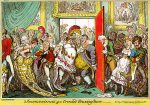
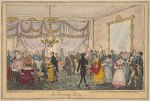
None of the above images showed fashions even close to those worn in 1811. Formal menswear had not changed much, however, and the illustrations do give us an idea of how these parties were held.

Sixty-six people in a Regency London townhouse would have presented quite a squeeze. Even on a cold day in December, the rooms, with candles burning in chandeliers and candelabras, and heat rising from the kitchen in the basement, would have already been hot. In April, when this letter was written, the heat would have been substantial. The large group of guests would have intensified the heat even more. We do not know if the 66 guests included the musicians and singer. As Cruikshank’s images showed, card tables were set up, a common practice that Jane does not mention. One wonders if they were set up on the ground floor, near the dining room, and the floor just above the kitchen. This level would also have been easier for older people to reach. One can only conjecture about these arrangements.

Deirdre Le Faye mentions Winnifred Watson’s description of the interior of 64 Sloane Street, but the few remaining copies of her small out of print booklet, “Jane Austen in London,” are above my budget (one was listed at over $260) and so I could not read it. London townhouses built after the great London fire followed strict guidelines in both design and materials. Henry and Eliza at this juncture in their lives could probably afford a 3rd rate house with a larger square footage of floor space, perhaps even 900 sq. feet. 

Using Jane’s description, and Deirdre Le Faye’s mention of this house, I found this image and quickly drew the other one very badly.

The Music:

The music was extremely good. It opened (tell Fanny) with “Poike de Parp pirs praise pof Prapela”; and of the other glees I remember, “In peace love tunes,” “Rosabelle,” “The Red Cross Knight,” and “Poor Insect.” Between the songs were lessons on the harp, or harp and pianoforte together; and the harp-player was Wiepart, whose name seems famous, though new to me. There was one female singer, a short Miss Davis, all in blue, bringing up for the public line, whose voice was said to be very fine indeed; and all the performers gave great satisfaction by doing what they were paid for, and giving themselves no airs. No amateur could be persuaded to do anything. “

This image of Regency guests listening to musicians sits on the Alamy website. Since I have not purchased it, please click on the  link to view it: https://www.alamy.com/thomas-rowlandson-a-little-evening-music-georgian-cartoon-of-a-fashionable-image9616736.html 

(Interestingly, the phrase “Poike de Parp pirs praise pof Prapela” was a special language that Jane used with her niece Fanny by placing a ‘p’ in front of every word. The only one I could decipher was Harp for Parp. https://bit.ly/3o8Nb97, Jane Austen, Her Contemporaries and Herself: An Essay in Criticism, By Walter Herries Pollock, 1899, Google Books.

Mollands.net adds:  Jane and her niece Fanny seem to have invented a language of their own–the chief point of which was to use a ‘p’ wherever possible. Thus the piece of music alluded to was ‘Strike the harp in praise of Bragela.’)

Miss Davis was a professional singer in London. Jane mentions that no amateur stepped up to play after listening to these fine players and singer.

About musicians during this time: 

“Amateur orchestras in city taverns or in gentlemen’s clubs competed with the professional concerts that began to sprout up in public places. (- The Rage for Music, Simon McVeigh) Local musicians would be hired for assembly balls in small towns. Musicians with a more professional background would be enlisted to play at more stylish events, like the Netherfield Ball. The lady asked to lead a set would choose the music and the steps, and relay her request to the Master of Ceremonies. “  https://janeaustensworld.com/2010/07/12/jane-austen-and-music/

Cities like London or Bath provided steady incomes for musicians. In order to make ends meet, those living in rural areas traveled from town to town to the different public assemblies or parties.

Glees

Glees were quite popular at this time. Jane mentioned glee songs in Mansfield Park. “Fanny Price was the only one of Austen’s heroines who never receives any musical training at all.” Fanny was unsuccessful in enticing Edmund to go outside to look at the stars. As soon as he hears singing, he says to her, “We will stay till this is finished, Fanny.” She was mortified.

Austen also mentioned glees in this letter to Cassandra, which during her time were songs for men’s voices in three or more parts, usually unaccompanied, popular especially c. 1750–1830. These songs, by the way, were nothing like the productions created for the TV series, Glee, which ran from 2009-2015. I found one glee recording on YouTube: Reginald Spofforth- 18th Century Glee Club: L’ape E La Serpe, from Vanguard Classics. 

In Peace Love Tunes the Shepherds Reed, the glee was meant for three voices, with words supplied by Walter Scott. Instrumentals were accompaniments for Piano Forte & Harp, or two performers on one Piano Forte. This glee was written by J. Atwood

This Rosabella score by John Wall Calcotte (1766-1821) in this link is for a cappella (originally). Piano accompaniment was added later by William Horsley. The lyrics were by Walter Scott.

The Red Cross Knight was written by Callcott, 1797. Also written by Callcott is the Poor Insect, a refrain from “The May Fly.”
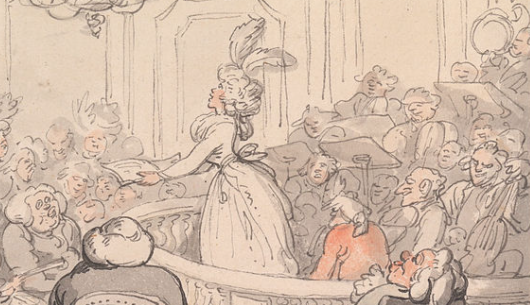
Comforts of Bath-The Concert-Rowlandson-Google Art Project-Wikimedia Commons

Detail: The Concert, The Comforts of Bath, Thomas Rowlandson, 1798. Wikimedia Commons

At Party’s End:

The house was not clear till after twelve.” 

This party lasted a little over four hours. London had street lights that guided guests back to their lodgings and houses. In country houses, parties, which were scheduled under the light of the full moon, often lasted until the wee early hours. After a party at a country house, Jane would often spend the night as a guest at a friend’s house, at times with her dear friend Martha Lloyd if she could manage it. 

The following day:

Her party is mentioned in this morning’s paper.”  

“…in the Morning Post of 25 April, which must have been very gratifying, even if the newspaper spelled her name wrong: ‘Mrs H Austin had a musical party at her house in Sloane-street.” – http://what-when-how.com/Tutorial/topic-673689/London-A-Tour-Guide-for-Modern-Traveller-10.html  “Travel Reference In-Depth Information, Walk 1: Sloane Street to Kensington, A Tour Guide for the Modern Traveler.”

The guests:

* Cooke family of Great Bookham. Rev. George Cooke and his unmarried sister Mary. Their father, Rev. Samuel Cooke was Jane’s godfather. 

**

  • Mr. George Hampson was a baronet who chose not to use his title. He is one of Jane’s cousins through her relationship to her grandmother, Rebecca Hampson, whose second husband was William Austen.
  • Mr. William Seymour, Henry Austen’s friend and a lawyer, who, it was speculated, might have considered proposing to Jane, but he didn’t.
  • M. Wyndham Knatchbull, merchant in London, or Reverend Doctor Wyndham Knatchbull, the eldest son of Sir Edward Knatchbull, 8th Baronet. 
  • Mr. Guillemarde is probably John Lewis Guillemarde, who lived in London
  • Mr. Capel Cure, who lived in London. His father, George, had first married Elizabeth Hampson, daughter of Sir George Hampson, but she died childless. Capel is the son of George Cure’s second wife.
  • Captain John Simpson, brother of Captain Robert Simpson. 
  • Mr. Thomas Egerton, Austen’s first publisher. He brought out S&S, P&P, and the first edition of Mansfield Park. His presence at the party, and Jane’s purpose for visiting Henry and Eliza to complete work on Sense & Sensibility connects his attendance at the party in a marvelous way.
  • Miss Maria Beckford, unmarried, lived with the Middleton family as hostess for her brother-in-law, John Middleton. When in London for the season Miss Beckford lived at 17 Welbeck Street. (Le Faye, p 495)
  • Miss Middleford. No explanation by Ms. Le Faye.)

Additional sources:

Characteristics of the Georgian Townhouse , June 3, 2009 , Jane Austen’s World, Vic

Jane Austen’s Letters, 4th Edition, Deirdre Le Faye, 2011, Oxford University Press. 

Jane Austen’s visit to Sloane Street , Kleurijk Jane Austen, 9-2014

Jane Austen, Her Contemporaries and Herself: Walter Herries Pollock · 1899 – Explanation of “Poike de Parp pirs praise pof Prapela”

Georgian Terrace Houses, April 27, 2021, Random Bits of Fascination.com, Georgian Townhomes

Thank you, Tony Grant, for contributing the 3 current photographs of Hans Place (2) and of 64 Sloane Street (1).

Read Full Post »
« Newer Posts - Older Posts »