Feeds:
Posts
Comments

Archive for the ‘Jane Austen’s World’ Category

Emma, Lady Hamilton is best known by the casual history fan for her love affair with Lord Nelson. Born in poverty, she first plied her alluring wares in a brothel before becoming Sir Harry Fetherstonhaugh’s mistress. When she became pregnant, he unceremoniously dumped her. But Emma was too stunningly beautiful to live a life of squalor, and the Honorable Charles Greville next picked her to become his mistress. It was through Greville’s connections that she met painter, George Romney, whose obsession with her beauty resulted in a score of memorable paintings. (He continued to paint her portrait even after she left England.)
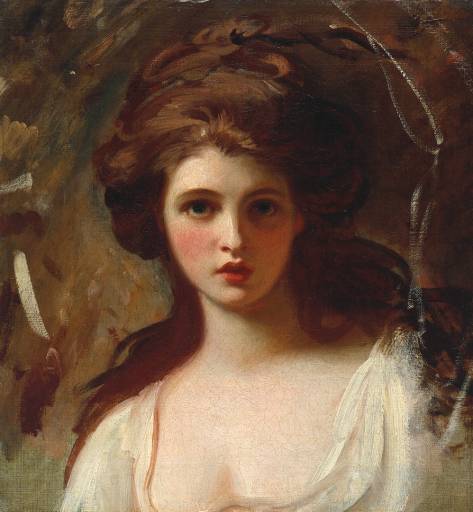
Emma as Circe, George Romney

Emma loved Charles, but he needed money, so when he met a woman of means in 1786,  he trundled Emma off to his widowed uncle in Naples, Italy, and thus Emma’s association with Sir William Hamilton began. Sir William was a diplomat and an avid art collector of classical statuary, urns and vases, which filled his villa in Portici overlooking the Bay of Naples. A connoisseur, he deeply appreciated Emma’s beauty, intelligence and special talents, not the least among which were her acting skills, hostessing abilities, and aptitude for learning new languages.
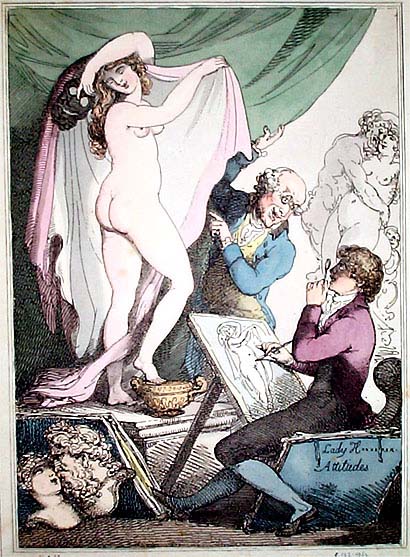
Caricature of Emma Hamilton as an artist’s model posing in an “Attitude”, Thomas Rowlandson
Sir William Hamilton

Emma’s stint as Romney’s model had given her experience posing in various classical guises. She’d also had the dubious distinction earlier in her career in London, of having worked as a scantily clad model and dancer – or “Goddess of Health” –  at Dr. Graham’s Temple of Health and Hymen, which claimed to cure the reproductive and sexual problems of couples. Emma  used her “theatrical” experiences to develop her “Attitudes”.  In helping Emma design her act, Sir William, whose knowledge of the imagery on classical vases was authoritative, used ancient Roman pantomimes as a model. The result of their collaboration was a silent performance that combined poses, classical dance and acting with Emma’s special allure. Emma gave her first showing in spring of 1787 to a group of European guests. Sir William held the lights and introduced his wife, as he would do for all her theatrics.
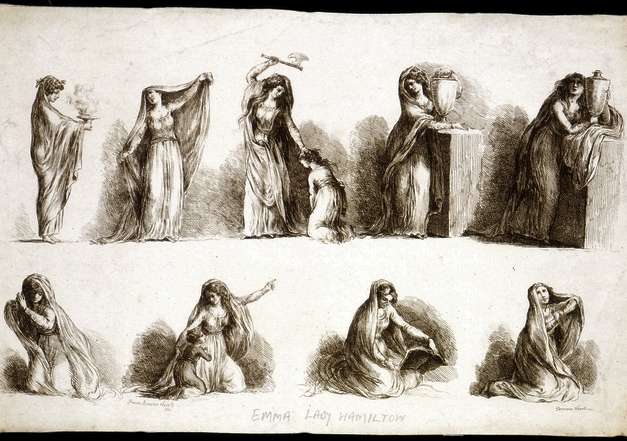
The Attitudes of Lady Hamilton, 1791, Novelli

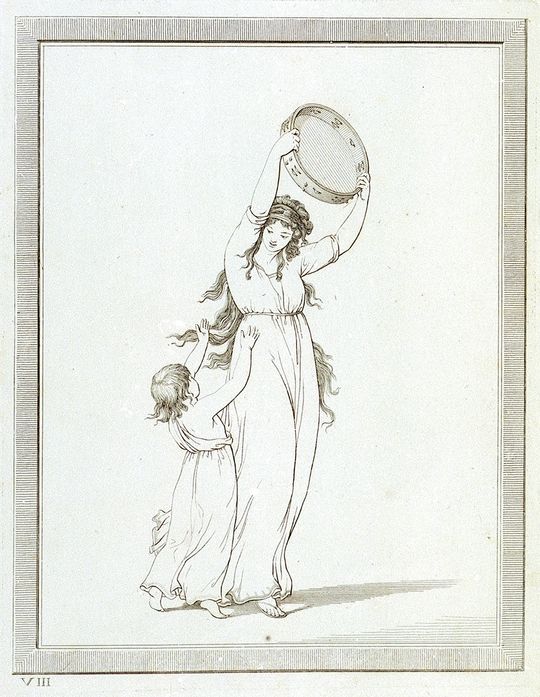
The poses were an immediate hit. Emma moved through her routine within a tall black box surrounded by a gold picture frame, using only a shawl or urn for a prop. (Although she must have occasionally used a child, as included in these images.) For her “Attitudes”, Emma  wore simple white-draped garments that fitted loosely and allowed her long hair to flow free. Her dresses were modeled on those worn by peasant women in the Bay of Naples. Sitting, standing, leaning, or kneeling, or posing as Medea or Cleopatra, she seemed to step right off the antique vases that her husband collected.
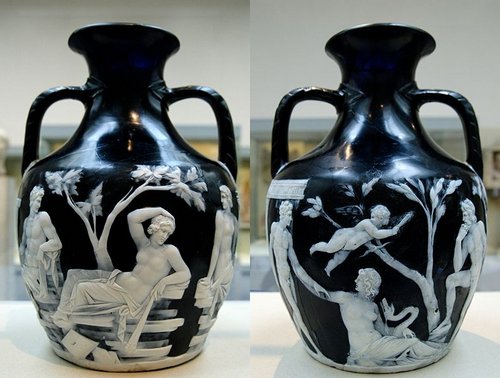
Portland Vase, British Museum, once owned by Sir William Hamilton

Emma’s repertoire was large and made up of at least 200 poses. During a performance she moved from one silent tableau to the other with great rapidity, delicacy. and deliberateness in what one writer termed ‘bursts of stillness.’ The private and select audiences would attempt to guess the names of the classical characters and scenes from stage and literature that she pantomimed, and stare in awe at Emma’s ability to transform her moods and the scene in an instant. Out of necessity, earlier viewings remained private, for Sir William and Emma were not married.
The couple did eventually marry  in London in 1791 at St. George’s Church in Hanover Square. Sir William was 61 and his wife was 26. After their wedding, the Hamiltons returned to their home in Italy. They continued to perform the “Attitudes, but now they could publicly and conspicuously invite a much larger and more diverse audience. Johann Wolfgang von Goethe, the German poet, had been invited to watch a performance during a visit to Naples. Impressed, he wrote:

The Chevalier Hamilton so long resident here as English Ambassador, so long too connoisseur and student of Art and Nature, has found their counterpart and acme with exquisite delight in a lovely girl, English, and some twenty years of age. She is exceedingly beautiful and finely built. She wears a Greek garb becoming her to perfection. She then merely loosens her locks takes a pair of shawls, and effects changes of postures, moods, gestures, mien, and appearance that make one really feel as if one were in some dream. Here is visible complete and bodied forth in movements of surprising variety, all that so many artists have sought in vain to fix and render. Successively standing, kneeling, seated, reclining, grave, sad, sportive, teasing, abandoned, penitent, alluring, threatening, agonised. One follows the other and grows out of it. She knows how to choose and shift the simple folds of her single kerchief for every expression, and to adjust it into a hundred kinds of headgear. Her elderly knight holds the torches for her performance, and is absorbed in his soul’s desire.
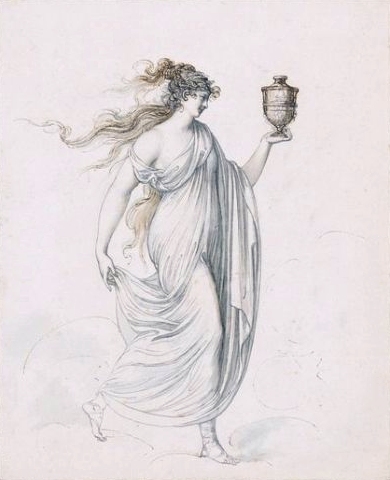
Lady Emma Hamilton as the Goddess of Health, 1790, Cosway

There must have been something titillating and erotic about Emma’s act, for her poses, although inspired by classical motifs, also drew upon her earlier experiences as a “Goddess of Health” in London and her erotic performances dancing naked for Sir Harry Fetherstonhaugh’s friends on his dining table. Her fame spread far and wide, and Emma, Lady Hamilton’s “Attitudes” became a big draw on Europe’s Grand Tour. Painters and writers sought out her performances, which charmed aristocrats and royals as much as artists and the literary set.  Élisabeth-Louise Vigée-Le Brun observed:

“Nothing was more curious than the faculty that Lady Hamilton had acquired of suddenly imparting to all her features the expression of sorrow or joy, and of posing in a wonderful manner in order to represent different characters. Her eyes alight with animation, her hair strewn about her, she displayed to you a delicious bacchanale, then all at once her face expressed sadness, and you saw an admirable repentant Magdalene.” – Elizabeth Vigee-Lebrun
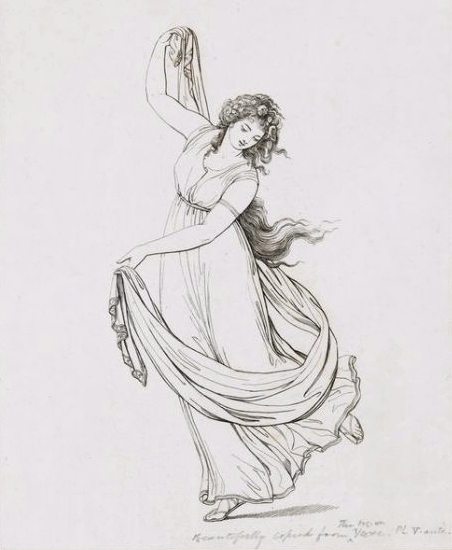
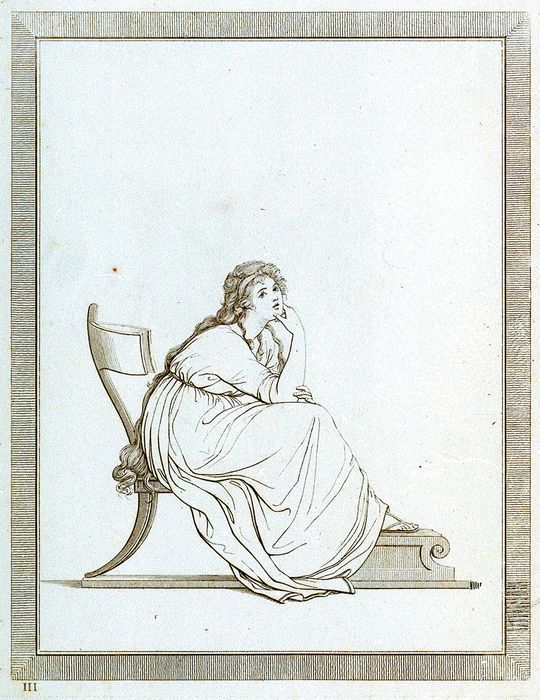
Lady Emma Hamilton, 1794, Rehberg

The black and white Rehberg illustrations featured in this post and commisioned by Sir William,  are drawn with simple, graceful and classical lines and freeze a particular “Attitude”. Their idealistic poses are among the few visual reminders that remain of Emma, Lady Hamilton as a performance artist. As the images show, Emma was a voluptuous, well-formed and beautiful woman. Her love for food and drink was no secret, and she would gain a substantial amount of weight over time, until at 47 she was described as being fat. But for a number of magical years, art, performance and beauty combined to create a series of tableaus that are still remembered today for their freshness and originality.
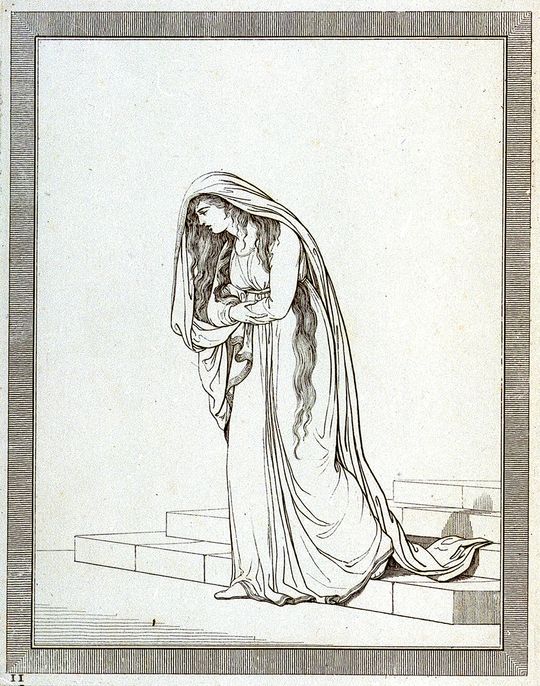
Emma Hamilton, 1794, Friedrich Rehberg, engraver and Tommaso Piroli, illustrator

Read about Lady Hamilton’s later years and sad death in this link.

To learn more about Emma’s fascinating skills, watch a lecture by John Wilton-Ely. His talk is on the ” performances by Lady Emma Hamilton, one of the most celebrated beauties of her era and a remarkable pioneer in developing performance art.”  Click here to watch the lecture. (A little over an hour long but well worth the time.)

More on the topic:

Add to DeliciousAdd to DiggAdd to FaceBookAdd to Google BookmarkAdd to RedditAdd to StumbleUponAdd to TechnoratiAdd to Twitter

Read Full Post »

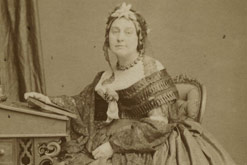
Caroline Norton 1833

Until the mid 1800s, married women in England had no legal rights. By law a husband could prevent his wife from seeing their children. He also had control over all her income, including any earnings she might make. Caroline Norton (1808-1877), who was married to an abusive man and who had been barred from seeing her three sons after they divorced, successfully challenged these laws.

Caroline was the granddaughter of a playwright Richard Brinsley Sheridan and the daughter of novelist Caroline Henrietta Sheridan. Caroline’s father died when she was eight years old, which left the family in financial straits. When Caroline had turned 16, George Norton, a Tory member of parliament for Guildford,  spotted her and asked for her hand in marriage. But she was too young to marry. Though a renowned beauty, Caroline had no dowry. Still, she hesitated to marry George Norton, but her mother eventually supported the match and thus she wed him at 19.

George Norton turned out to be a violent and unfaithful husband. He beat Caroline repeatedly, even in her third trimester of pregnancy. The marriage, though a failure, lasted long enough for Caroline to bear three sons. There were repeated estrangements and reunions, but the marriage finally ended in 1836. Caroline’s travails had just begun. Her reputation was in tatters as a divorced woman, and she was not allowed to see her sons. She was to write:

What I suffered on my children’s account, none will ever know or measure. “The heart knoweth its own bitterness,” and God knew mine! The days and nights of tears and anguish, that grew into the struggle of yearsit is even now a pain to me to look back upon; even now, the hot agony of resentment and grief rises in my mind, when I think of the needless tyranny I endured in this respect. Mr Norton held my children as hostages; he felt that while he had them, he still had a power over me that nothing could control. Baffled in the matter of the trial and damages, he still had the power to do more than punishto torturethe wife who had been so anxious to part from him – Caroline Norton, English Laws for Women in the 19th Century

Caroline’s story is more convoluted and complicated than presented here, and well worth reading. Suffice it to say that Caroline challenged the law that favored men over women, and her writing was instrumental in having The Child Custody Act of 1839 passed. Sadly for Caroline, her husband still denied her access to her children. Her youngest boy fell from a horse and died, and only after this tragedy were her two other boys allowed to live with her.

His cruel carelessness was afterwards proved, on a most miserable occasion. My youngest child, then a boy of eight years old, left without care or overlooking, rode out with a brother but little older than himself, was thrown, carried to the house of a country neighbor, and died there of lock jaw, consequent on the accident. Mr Norton allowed the child to lie ill for a week,–indeed to be at death’s door,–before he sent to inform me. Sir Fitzroy and Lady Kelly were staying with Mr Norton in the country. Lady Kelly (who was an utter stranger to me) met me at the railway station. I said–”I am here,–is my boy better?” “No,” she said–”he is not better,–he is dead.” And I found, instead of my child, a corpse already coffined.
Mr Norton asked my forgiveness then, as he had asked it often before; he sent his elder child to plead for him,–for well he knew what my children were to me; he humbled himself, and grieved for an hour, till he changed into pity the horror and repugnance I had expressed at the idea of seeing him;–and then he buried our child, and forgot both his sorrow and his penitence.

Caroline Norton

When George Norton caught wind that Caroline had been left a small legacy by her friend, Lord Melbourne and a small sum that her mother had left her, he stopped support payments for her and the children. Caroline fought him in court but lost. She campaigned to have the laws changed, and her victory resulted in the Matrimonial Act of 1857. Caroline remarried just months before her death in 1877, but not before two more crucial laws were passed that protected the rights of women and children, the Infant Custody Acts of 1873 (and 1886) and The Married Women’s Property Acts of 1870 (and 1882).

More on the topic:

Read Full Post »

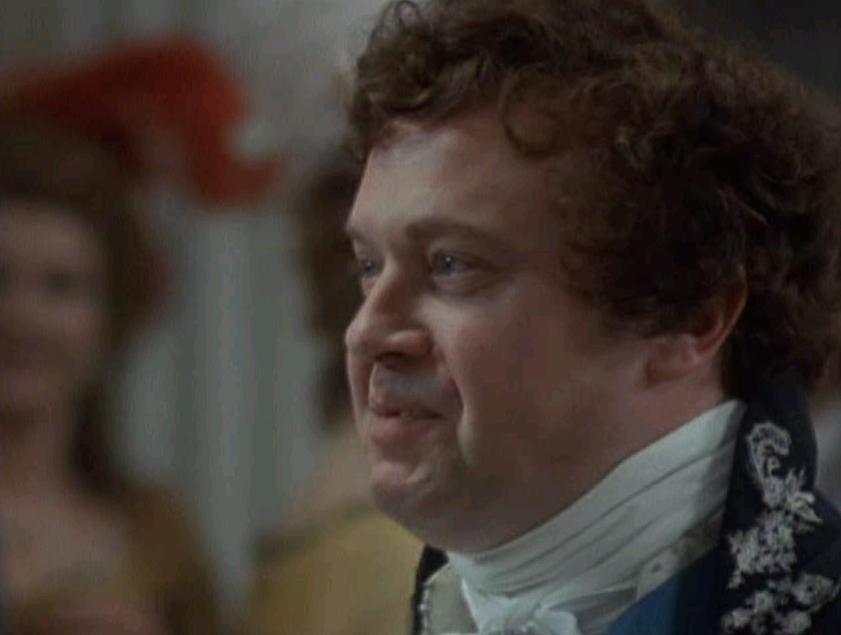
Gentle Reader, Those of us who have read The Scarlet Pimpernel by Baroness Emmuska Orczy know that Sir Percy Blakeney pretends to be an effete dandy. Unbeknownst to his wife, who cannot conceal her disappointment in her foppish husband, he smuggles people out of  France during the French Revolution and away from danger. Sir Percy, despite his heroics, is a bit of a clothes horse. Here, then, is his opinion of cravats after he accidentally on purpose spills wine on Monsieur Chauvelin, for whom the public admiration for the Scarlet Pimpernel was a source of bitter hatred.

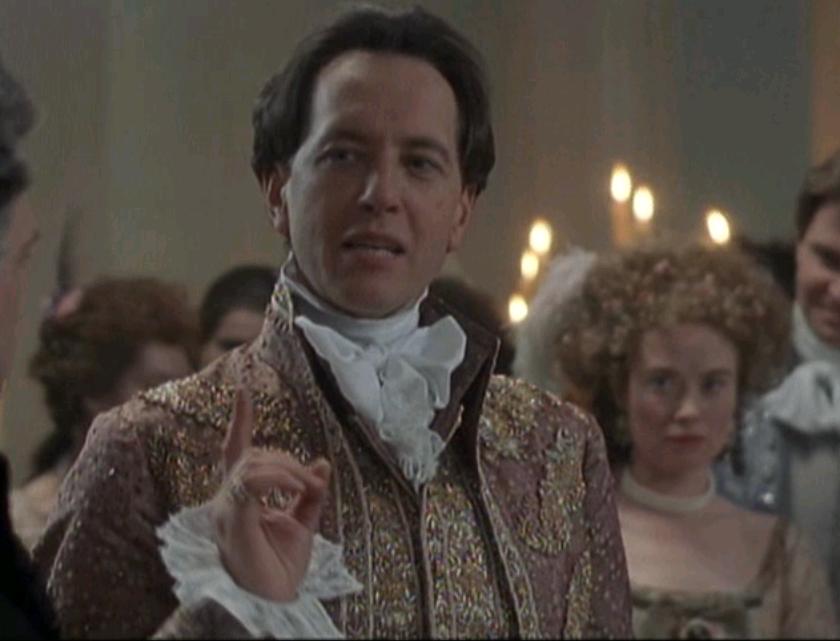
Sir Percy Blakeney, Richard E. Grant as the Scarlet Pimpernel

Sir Percy Blakeney to Monsieur Chauvelin: “Sir, my most abject and humble apologies. I’ve completely drowned your cravat! How can I possibley make amends for such clumsiness?”

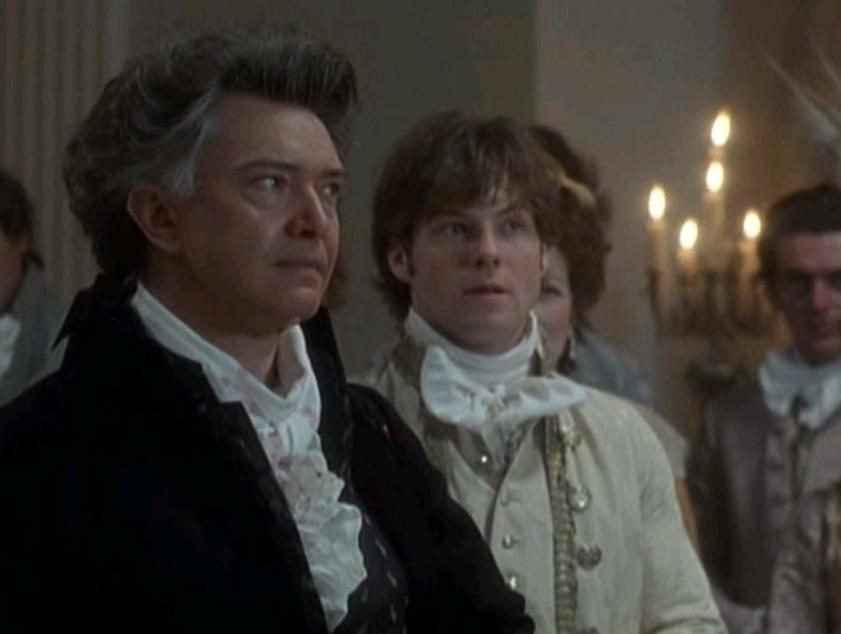
Martin Shaw as Monsieur Chauvelin

Monsieur Chauvelin, Ministry of Justice: “It’s of no consequence. It’s only a cravat.”

Richard E. Grant as Sir Percy aka The Scarlet Pimpernel

Sir Percy: “Only a cravat! Oh, my dear sir! A cravat is the apotheosis of all neckwear! A cravat distinguishes a man of refinement from the merely ordinary. It sneers at the severity of the stock. It is the only item of dress that expresses true individuality. And whether it be made of lace or silk or the finest lawn it thrives on ingenuity, on originality, and above all, on personality down to the last skilled twist of bow or knot.”

Jonathan Coy as the Prince of Wales

Prince Regent: “Bravo, Percy! Bravo!”

Bravo, indeed! More on the topic

Read Full Post »

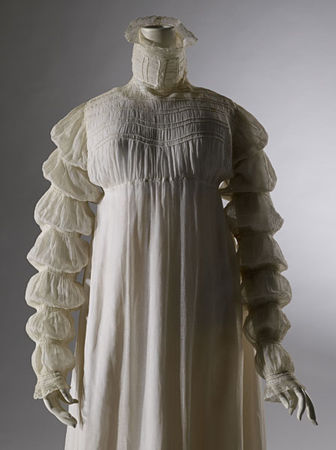
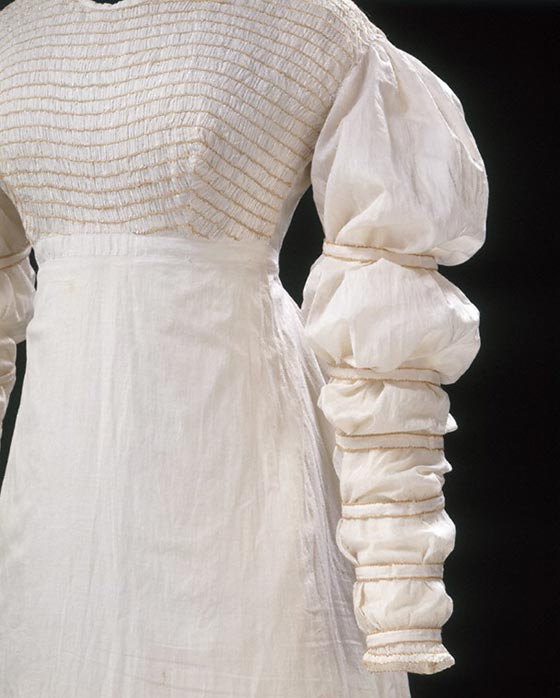
I love puffed and gathered sleeves on regency gowns. The Probert Encyclopedia defines a mamaluke sleeve as “a long full sleeve partitioned into five sections, each section being drawn and seamed to fit around the arm.” Romantic Fashion Plates defines Marie Sleeves as full to the wrist but tied at intervals. Which source accurately names the sleeves on these gowns?  The three dresses shown in this post show sleeves with more than the five sections. Could the number of sections determine what the sleeve is called?

Muslin dress with mamaluke sleeves

The first dress (1816) was featured in the Jane Austen Fashion Exhibit last fall in Melbourne. Note that in the second dress (1819-1820) the waist is beginning to creep down. The skirt during this time is conical in shape and stiffened at the bottom, whereas the earlier dress has a columnar-shaped skirt that drapes in soft folds from the high waist.

The dress below is described as having Marie sleeves. Adding another wrinkle to identifying these sleeves is this description found in a glossary from Nineteenth Century Fashions: A Compendium: “sleeve with multitude of puffs top to bottom” (romance).  I’m not sure how these differ from Marie sleeves.” In a description for Marie Sleeves, the site states:

“long gauzy sleeves gathered at intervals to make a series of puffs down the arm. I think I have also heard these referred to as “Juliet sleeves”; may also be synonymous with Gabrielle sleeves, the point being, I think, that they were perceived as vaguely Latinate and Renaissancy in origin.”

So, now we have these sleeves described as Mameluke, Marie, Juliet, or Gabrielle.

1820 dress with marie sleeves, V&A museum

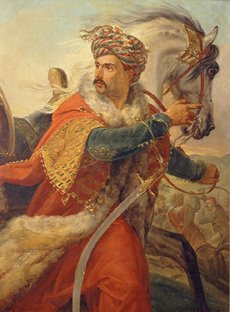
I’ve scoured images of Mamelukes, none of which feature these segmented sleeves. Mamelukes are members of a former military caste originally composed of slaves from Turkey, that held the Egyptian throne from the mid thirteenth century to the early 1500s. They remained strong until 1811. Regency fashion took inspiration from Mameluke clothing, so it wouldn’t be surprising if the sleeves were also inspired by this group of warriors – if only I could find a painting of a Mameluke wearing a shirt with partitioned puffy sleeves.

Mameluke, early 19th c.

Read Full Post »

Whilst Mansfield Park is overrun by mummies and Fanny Price is being seduced by a princely corpse who was embalmed and buried 2,000 years ago, we join a select party playing whist at the Assembly Rooms in Bath. Sir Walter Elliot, Mrs. Elton, Mrs. Bennet and Mrs. Jennings are in deep discussion about the ghoulish goings on in Britain, for their Society has been decimated in the span of a few short years. Except for the demise of great swaths of the populace, Sir Walter would normally never have found himself spending two hours with people of such low connections. Not one to give up an opportunity to show off his fine gaming skills, Sir Walter graciously agreed to make up a fourth at cards.

Of the group, he had only made a tentative acquaintance with Mrs. Jenkins, an unrefined woman whose fortune was her only saving grace. The others were all unknown to him, which was not surprising. Mrs. Elton, although handsome of form and face, was even more vulgar than Mrs. Jennings, if such a thing were possible, for she also had the misfortune of being a mere clergyman’s wife. Mrs. Bennet’s behavior was beyond the pale. Although she could boast of some connections and had once possessed a beauty that would have attracted his connoisseur’s eye, he could only compare her mind to that of a simpleton’s. How Mr. Bennet could put up with her ceaseless and inane prattle was beyond his comprehension. Sir Walter’s only satisfaction at present lay in the fact that he was winning every rubber and that he looked resplendent in his new jacket and waistcoat.

He turned to Mrs. Jennings and asked politely, “How are the Miss Dashwoods and Mrs. Dashwood getting on?”

“Not well, my dear, Sir Walter, not well at all. A most unfortunate INFESTATION of deadly sea creatures and crustaceans has RUINED our ponds and waters, especially those around Barton Cottage. The ladies Dashwood must be ever vigilant against deadly tentacles wrapping themselves around an innocent limb, lest they be pulled into the waters and DROWNED. They must also guard their virtues from the murderous Colonel Brandon, whose face is designed to disgust. He is not what he appeared to be at first, I assure you.”

“WE do not have such slithery goings on in Highbury or Plymouth,” said Mrs. Elton primly. “In my opinion, these outbreaks must be in some way connected to LICENTIOUS behavior.”

Mrs. Bennet’s nostrils flared at this pronouncement. “Well, if it were not for my dear girls, whose fighting skills are legendary, Meryton must have succumbed to the undead plague long ago. T’is quite uncomfortable to be living in a region where corpses come to life and seek out one’s brain for sustenance.” Shivering delicately, she pulled her Norwich shawl around her. “I recall a dreadful ball at Netherfield Park where the cooks preparing dinner BECAME dinner. My poor Lizzie’s ball gown was torn to shreds as she lopped off the heads and limbs of those horrid creatures in order to save the rest of the assembly.”

“Nay, never!” Mrs. Elton could not contain her excitement. Gossip was her strong suit, and the sharing of it her vocation. Besides, she adored tales filled with blood and gore.

Sir Walter, concentrating on his cards, wished the conversation had not taken this deplorable turn. He was, however, a gentleman first and foremost, and thus he kept silent. If he played his cards right and allowed his opponents to continue to prattle, he would win this hand. If only Mrs. Bennet, his partner, would pay some attention to his discards.

Mrs. Jennings, who was in possession of a scrumptious scrap of knowledge that served no purpose until it was spread far and wide, crowed. “Indeed, t’is true. I understand from a dear old acquaintance, Mrs Norris, that mummies have overtaken Mansfield Park. It seems that her sister, Lady Bertram, evoked some ancient Egyptian INCANTATION and brought them to life.”

Thinking of her two remaining unmarried girls, Mrs. Bennet inquired a tad too eagerly, “Pray tell. what are the mummies’ backgrounds? How far do their families go back?”

“Thousands of years, my dear Mrs. Bennet. The pedigree of these creatures would put Sir Walter’s lineage to shame.”

Sir Walter bristled. No one’s lineage could touch the noble ancestry of the Elliots of Kellynch Hall.

“What of their lands? Their fortunes?” Mrs. Elton asked.

“I believe, said Mrs. Jennings, a closet Blue Stocking, “that their entire fortunes are entombed with them.”

“That is most regrettable,” Sir Walter said, thinking of his eldest unmarried, Elizabeth, whose good looks were withering and dessicating with every moment that passed beyond her prime. He despaired of her ever finding a husband who would suit the Elliots’ exacting standards.

Mrs. Jennings eyes gleamed with the cheap shine of a newly minted shilling. “I understand that the creatures have recently begun to stir again.” She reached for her reticule and retrieved a letter from Mrs. Norris, an odd woman whose acquaintance she had made in Lyme: ‘T’is the strangest phenomenon, my dear Mrs. Jennings,” she read aloud. “For whilst these creatures at first looked quite ungainly and ragged, and lumbered about the countryside walking into trees and emerging from the bushes like so many cavemen, they are starting to look better and better with each passing day. Whilst the mummies are coming to life, our servants have not fared half so well, some disappearing for hours and experiencing lapses in memory that puzzle us exceedingly. I find the Pharaoh startlingly handsome despite the unfortunate fact that his skin is as swarthy as, well, an Egyptian’s! His Eminence is apparently unmarried and looking for a CONSORT.”

The card players stopped playing. Silence lay as heavy in the room as the stone lid of a sarcophagus.

Sir Walter mentally began to formulate a plan that would place his Elizabeth in the path of this lofty, though foreign personage. Handsome, rich, and well connected were the only qualities he sought for a son-in-law. Who cared if his skin was tanned and leathery?

Mrs. Bennet’s shrill voice cut through the tomb-like atmosphere, “T’is a wonder that there are any eligible men left in England at all. My two middle girls are still unmarried, but those detestable zombies have eaten practically all the heads off every young male within three counties. Mr. Bennet and I have considered moving to the Colonies in order to provide for them, matrimonially speaking, of course.” Her thoughts automatically turned to Mr. Collins and that cheap golddigging Charlottte Lucas, whose behavior and manner of speech had become exceedingly strange of late.

Mrs. Elton’s silence did not go unnoticed by herself. She was accustomed to insinuating her opinion into every discussion, but neither Highbury nor Plymouth had been the destinations of choice for the ghouls, demons, and crustaceans that had overrun every nook and cranny of her beloved England! It went against her grain to be mum on any subject, and thus she spoke, “I and the Sucklings are Egyptologists of sorts. Mummy wrappings should be made of the most sturdy linen, for the cloth must survive untold generations of burial. I suggest, Sir Walter, that you meet with your tailor to discuss where you can obtain a cloth of a similar…”

A shriek pierced the assembly hall dance rooms. Above the din, Isabella Thorpe’s voice could be heard crying, “John, oh, John! What have they DONE to your head!? Where are your brains?”

Mrs. Bennet leaped up, scattering the cards on the table, which disconcerted Sir Walter to no end, for he was about to win the rubber …. “I must fetch Lizzie immediately! The zombies have arrived in Bath and we shall require her warrior skills!”

“But I protest!,” cried Mrs. Jennings. “We were speaking of MUMMIES!! T’is not fair that the zombies are taking center stage again! Why is it that they receive ALL the attention, whilst the mummies are getting none?”

Mrs. Elton turned to Mrs. Jennings, “According to Mrs. Norris, they are starting to GAIN GROUND. T’will be up to you, dear madam, to spread the word about Mansfield Park and Mummies as successfully as those Quirk Book upstarts, who have promoted the UNDEAD virally via Web 2.0. Perhaps you should solicit the aid of Vera Nazarian and that vulgar creature, Vic, who oversees that tasteless blog, Jane Austen’s World.”

“Well, if I must,” replied Mrs. Jennings, unhappy with the thought of having to exert herself on anyone’s behalf , especially after her experience with Marianne Dashwood, a most disastrous guest and watering pot. “One would think that people would be as intrigued with Mummies as with Zombies. It’s six of one or a half dozen of the other, if you ask me.”

Sir Walter scraped his chair back and bid his adieu. He would hie home to collect his Elizabeth, and whilst the assembly was preoccupied with staving off the zombies, he would take his daughter to Mansfield Park and place her in the Pharaoh’s way in a most COMPROMISING situation.

Gentle Reader: I have just finished reading Mansfield Park and Mummies and must admit that, much to my surprise, I kept turning the pages and reading the book. Goodness, but I enjoyed this fun romp. While I know that these kinds of books are not for everyone, I feel comfortable recommending Mansfield Park and Mummies to those who would like to take the PLUNGE and read their first Jane Austen mash-up. For those who have not read my interview with Vera Nazarian, please click here. She even made writing the novel sound like fun.

Add to DeliciousAdd to DiggAdd to FaceBookAdd to Google BookmarkAdd to MySpaceAdd to NewsvineAdd to RedditAdd to StumbleUponAdd to TechnoratiAdd to Twitter

Read Full Post »

« Newer Posts - Older Posts »