Feeds:
Posts
Comments

Archive for the ‘Jane Austen’s World’ Category

Grand SophyThe Grand Sophy, the latest Georgette Heyer release by SourceBooks, is a page turner that will keep the reader guessing and wondering when and how the heroine will top her previous outrageous acts. Sir Horace Stanton-Lacy, a rich widower who has recently returned from the Continent, convinces his sister, Lady Ombersley, that his sweet, motherless daughter ought to stay with her while he returns abroad. Several weeks after their discussion, Miss Sophy Stanton-Lacy makes a grand entrance:

Lady Ombersley, meanwhile, standing as though rooted to her own doorstep, was realizing with strong indignation, that the light in which a gentleman of great height and large proportions regarded his daughter had been misleading. Sir Horace’s little Sophy stood five feet nine inches in her stockinged feet, and was built on generous lines, a long-legged, deep-bosomed creature, with a merry face, and a quantity of glossy brown ringlets under one of the most dashing hats her cousins had ever seen.

Sophy could not exactly be called a beauty, but no one who had met her could ever quite forget her. Not ten minutes after her dramatic arrival, Lady Ombersley wonders: “What kind of niece was this, who set up her stable, made her own arrangements, and called her father Sir Horace?” The entire family, nay all of London, would soon find out.

Georgette Heyer wrote about two types of heroines. The Mark II heroine, who was a biddable and quiet young girl, and the Mark I heroine whose independent habits and dominant character invariably clashed with the hero’s personality. Sophy is the quintessential Mark I Heyer heroine: a tall, bossy, outrageously rich and independent, problem-solving, smart and capable young lady who will let nothing, not even Mr. Charles Rivenhall’s censure and outrage stand in her way. Arriving at the Ombersley’s house wearing a sable stole and carrying a sable muff, she alights from a coach and four with an entourage that includes several liveried footmen, a doyenne, an Italian greyhound, a monkey named Jacko, and a parrot in a birdcage. Even as Lady Ombersley struggles to hide her dismay, Sophy’s cousins are delighted, except for Charles. Everything about Sophy sets him on edge, especially when she won’t give way to even his slightest wishes.

High Perch Phaeton

As heroes go, Charles is a bit of a prig. He cannot help himself, for his father, Lord Ombersley is an inveterate gambler. Charles unexpectedly came into an inheritance from a rich relative who had made his fortune in India and he uses his wealth to pay off his father’s debts. In doing so, Charles becomes the de facto head of the family. A sensible man, he proposes to a patronizing young lady of impeccable character, Miss Eugenia Wraxton, and leads a bland existence … until Sophy turns his well-ordered life upside down. The reader learns one thing about Charles that others don’t seem to appreciate – children, dogs, monkeys, and parrots turn instinctively to him, and although he might seem harsh on the surface, he has a soft heart and is an easy touch. However, his dictatorial ways intimidate two of his siblings, Cecilia and Hubert, to the point where Sophy feels she needs to help out. This causes Charles to gnash his teeth at her presumption. At the core of this book are the crackling scenes between Sophy and Charles, and thankfully they are numerous.

The Grand Sophy is one of Georgette Heyer’s “larger than life” books. Everything – from the characters to Sophy’s antics to the settings – is bigger and grander than in most of her other novels, and the side characters are unforgettable. Augustus Fawnhope is a beautiful but a gloriously silly poet whom Cecilia loves. Cecilia, Charles’s lovestruck sister, is a sweet Mark II heroine with backbone and pluck, who sees the error of her ways, but can do little to rectify the situation. Enter Sophy to the rescue. Sancia, Sir Horace’s Spanish fiancee, is singularly lazy and unforgettable in her ability to drop off to sleep in front of guests, but Sophy knows she can solicit her support whenever it is needed. Lord Bromford, a terminally boring hypochondriac and Mamma’s boy, woos Sophy with the tenacity of a bulldog, much to the glee of her younger cousins, who watch with awe as their older cousin deftly skirts his advances.

Charles’s fiancee, the horse-faced and prudish Eugenia Wraxton, is Sophy’s perfect foil. On the outside, Miss Wraxton is all that is proper, but on the inside she is small and mean of spirit. Sophy sees right through her and is determined to open Charles’s eyes before he is leg-shackled to her through marriage. Where Miss Wraxton merely pays lip service to being a lady, Sophy is warmhearted and generous to a fault. Her rarified social status allows her to behave outrageously with impunity, a fact that the jealous Miss Wraxton never quite realizes. Miss Wraxton constantly lectures Sophy or, worse, tattles on her, as the following scene between Sophy and Charles suggests. In it they are discussing her purchase of her high perch phaeton, to which Charles has strenuously objected:

“I have no control over your actions, cousin,” he said coldly. No doubt if it seems good to you to make a spectacle of yourself in the Park, you will do so. But you will not, if you please, take any of my sisters up beside you!”

“But it does please me,” she said. “I have already taken Cecilia for a turn round the Drive. You have very antiquated notions, have you not? I saw several excessively smart sporting carriages being driven by ladies of the highest ton!”

“I have no particular objection to a phaeton and pair,” he said, still more coldly, “though a perch model is quite unsuited to a lady. You will forgive me if I tell you that there is something more than a little fast in such a style of carriage.”

“Now, who in the world can have been spiteful enough to have put that idea into your head?” wondered Sophy.

He flushed, but did not answer.

Although this book provides us with a fun romp through Regency London, it does possess one flawed scene. The scene is pivotal and demonstrates Sophy’s fearlessness in helping Charles’s brother Hubert out of an impossible situation, but Georgette Heyer is a product of her snobbish upbringing and time. Her description of a stereotypical Jewish lender, the villainous Mr. Goldhanger, is old-fashioned and ruffles our modern sensibilities. For many readers, this scene is a deal-breaker (see comments in link). Some stop reading the book at this point, others feel that the book loses some of its lustre, and others like myself manage to move on, realizing that authors cannot help but be influenced by the age in which they live. A friend of mine observed that Huckleberry Finn is full of racial slurs, but these statements did not prevent it from becoming a classic. Having said that, Georgette’s description of the Jewish lender did give me pause, but after a few pages, I was once again absorbed by Sophy’s antics and rooting for the characters I had come to love. When I turned the last page, I could only wish them all the happiest of ever afters.

3 regency fansI give The Grand Sophy three out of three regency fans. Order the book at this link.

Read this blog’s other Georgette Heyer reviews here.

Gentle readers: The Grand Sophy will be released today. A reissue from SourceBooks, this 1950 novel was one of Georgette Heyer’s best. Look for a month-long kick off of this highly entertaining book on Jane Austen Today, Austenprose and this blog.

Also:

Regency Manners and The Grand Sophy
Read the review on Austenprose at this link.

Read Full Post »

“Invite him to dinner, Emma, and help him to the best of the fish and the chicken, but leave him to choose his own wife.” – Jane Austen, Emma

By the time breakfast was served in a regency household, the family had been up for a while. After rising, people would engage in tasks such as letter writing, practicing the piano, taking a walk or riding. In larger households, the cook and maids would busy themselves heating the stove and boiling water. In more modest establishments, such as the Austen household at Chawton, Jane would help with preparing breakfast. A simple repast of toast, rolls, cheese, tea, coffee, chocolate, or ale would be served between nine and ten. The more elaborate breakfast would not be featured until Victorian times.*

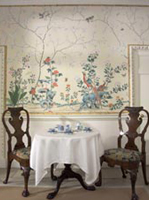
chinoiserieIndividuals would rise early, at around 6:00 in the morning. Within the next half-hour or so, people would start work. Breakfast would be taken later, at around 9:00 and afterwards. The morning’s work would finish with ‘dinner’–probably taken between 12:30 and 14:00. Work continued until late. For some, there was tea in the late afternoon, between 17:00 and 18:00. It would be common not to leave one’s work before 19:00. After the evening meal, people would go to bed at around 22:00 – Time and Work in England 1750- 1830, Hans-Joachim Voth
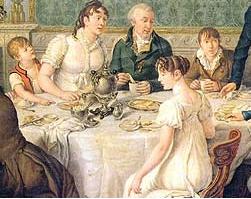
Nuncheon or luncheon was a midday meal served at an inn. For several centuries this meal was simply a snack. Dr. Johnson’s 1755 Dictionary defined luncheon as “as much food as one’s hand can hold.” In the Regency home, such meals had no official name and often consisted of only a cold snack and drink to provide sustenance until the evening meal.*

Morning

food

After breakfast with the children, the first job of the lady of the house would be to talk to the housekeeper. It would be important for them to communicate about the other servants, making sure they were doing their jobs properly and behaving correctly above and below stairs.

They would also discuss the evening meal. If visitors were expected, the lady would choose meals that were lavish and unusual. (They loved showing off) When these matters were dealt with the wife would then check through the household accounts. Bills for meat, candles and flour would usually be paid weekly. When the early morning activities were finished, the social whirl would begin! High society ladies would either receive calls or visit others. Tea would be drunk and snacks eaten.- The Regency Townhouse

During the medieval period dinner was eaten at midday, but this meal was slowly moved up to 3 in the afternoon, then pushed up to five. These meals became elaborate affairs of at least two or three courses, which Louis Simond, a French/American traveler to London, described in wondrous detail in his travel diary. During Jane Austen’s time tea would be served an hour or so after the meal, or from 3-6 o’clock, depending on when dinner was served. Suppers became light snacks, except in the case of a grand ball, where elaborate buffets might be served.

In 1798 Jane Austen writes of half past three being the customary dinner hour at Steventon, but by 1808 they are dining at five o’clock in Southampton. There are many mentions of the timing of dinner in the novels, but none is so explicit as in the fragment The Watsons. Tom Musgrave knows perfectly well that the unpretentious Watson family dine at three, and times his visit to embarrass them, arriving just as their servant is bringing in the tray of cutlery. Tom compounds his rudeness by boasting that he dines at eight: the latest dinner hour of any character. At Mansfield Parsonage they dine at half past four and at Northanger Abbey at five. The effect of London fashion can be seen in the difference between the half past four dinner at Longbourn and that at half past six at Netherfield. – Jane Austen in Context, Janet Todd, p. 264

  • *Jane Austen’s World, Maggie Lane

Read Full Post »

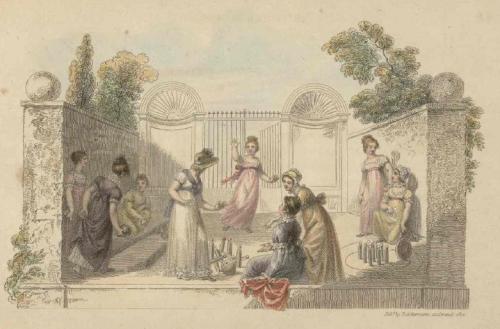
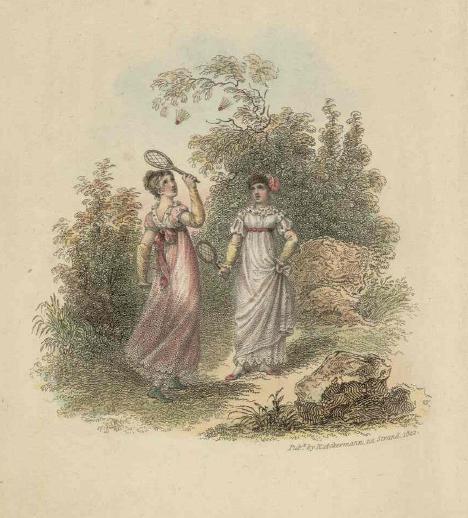
Healthful Sports for Young Ladies was written by Mlle St. Sernin, a French governess, and delightfully illustrated by Jean Demosthene Dugourc (1749-1825). The book, which described exercises that were appropriate for young ladies, was printed in London in 1822 by W. Clowes  for R. Ackermann. The book can be viewed in the digital collection at the Library of Congress

Bowls and nine pins, 1822

Bowls and nine pins, 1822

A regency lady was not expected to unduly exert herself while exercising, but there were forms of physical motion that were acceptable. Swinging, playing hoops, see sawing, archery, and bowls and nine pins were sports that were not unduly frowned upon. Bowling became popular in Britain in the 14th Century and became a favorite pastime of King Edward III’s soldiers.  During the 1400s, the game was brought indoors. Later, bowling became a favorite bar game, with many pubs sporting their own bowling greens.  Heavy balls were rolled on a lawn at a smaller ball called the Jack. During the 18th century the game was called “nine pins” because of the number of pins used. The game was banned in Colonial America due to its association with drinking and gambling. On page 70 of her charming book, Mlle St. Sernin discusses a complicated scoring system:

nine pins

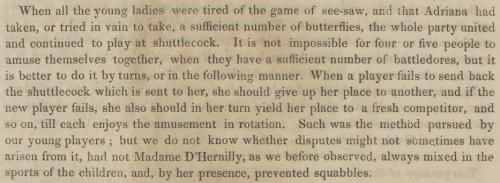
The game of shuttlecock was fairly simple to play. There were no official rules and the sole object was to keep the shuttlecock in the air for as long as possible  by hitting it up. When two people played the game, the idea was to keep the shuttlecock up in the air for as long as possible. A point was lost by the player who let the shuttle fall. A single person playing the game would tally the number of hits for as long as she kept the shuttlecock in play. Below is a description of the game for 4-5 people.

Shuttlecock, 1822

Shuttlecock, 1822

After the introduction of a net, the game, also known as badminton, became more regulated and competitive. Below is a charming explanation of how 4-5  people can play shuttlecock:

shuttlecock

Read Full Post »

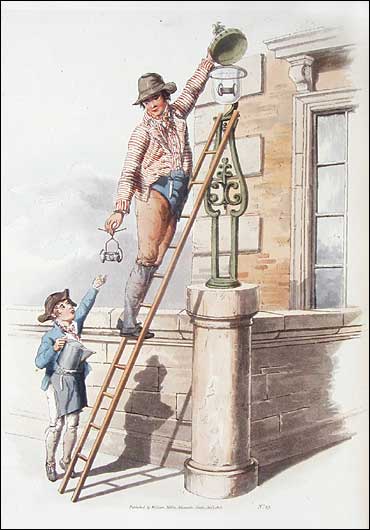
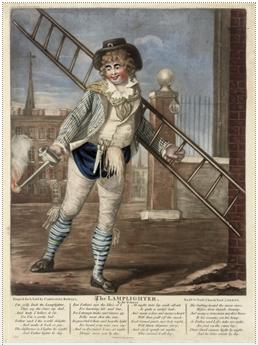
Lamplighter, Pyne, 1808

Lamplighter, Pyne, 1808

In Oxford Road alone there are more lamps than in all the city of Paris. Even the great roads, for seven or eight miles round, are crowded with them, which makes the effect exceedingly grand. – Archenholtz, 1780s

The Lamplighter, 1790's

The Lamplighter, 1790's

Urban development in London grew at a rapid rate during the 18th century, especially in London’s West End, where the great squares were laid out. The population of London surpassed one million in 1815 and an increasing number of bridges were built between 1750 and 1819, boosting development south of the river. In 1750, a system of street lighting with oil lamps was introduced, changing the nature of city life. The lights were supplied with reflectors, a big improvement. Previous to 1736, the lights were lit until midnight, but after that year they stayed on until sunrise, making the streets safer. As the quote suggests, foreign visitors were impressed, for at that time no other city could boast of so much lighting. Before 1750, people who traveled at night hired link boys to light their way. Their torches emitted poor lighting, however, and the streets were dangerous and dark outside their small circles of light.

With the new system of lights, walking the streets at night became relatively safe. The new lights contributed to London’s nightlife and the sense that life in the City was unnatural and not subject to traditional constraints.* The pleasure gardens of London, such as Ranelagh and Vauxhall, offered illuminated entertainment, and fashionable people could travel to theatres, assembly rooms, and each others’ houses, which extended social interaction. Shops lighted window displays and stayed open later,  profiting from the extended hours. The benefit of  better lighting worked both ways, for:

The shop-keepers of London are of infinite service to the rest of the inhabitants by their liberal use of the Patent Lamp, to shew their commodities during the long evenings of winter. Anecdotes of the Manners and Customs of London During the Eighteenth Century, James Peller Malcolm, 1810,  P 383,

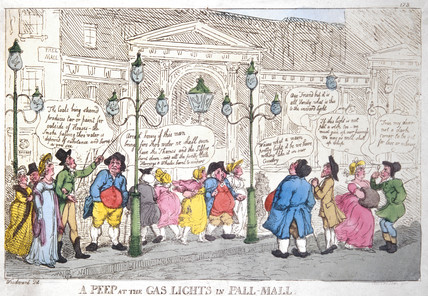
The first gas lights were introduced in Pall Mall on January 28th, 1807. Samuel Clegg had by then set up the London and Westminser Gas Lighting and Coke Company. On December 31, 1813, the Westminster Bridge was also lit by gas, and by 1823, 40,000 lamps covered 215 miles of London’s streets. Today, one can still see the gas lights in Green Park and the exterior of Buckingham Palace.

A peep at the gas lights in Pall Mall, Rowlandson

A peep at the gas lights in Pall Mall, Rowlandson

More on the topic:

Read Full Post »

Old Bailey Trial

Old Bailey Trial

Many websites and blogs dealing with the Regency and Georgian eras link to the Proceedings of The Old Bailey, which features transcripts from courts between 1674 and 1913. Or as one man put it, “the best accounts we shall ever have of what transpired in ordinary English criminal courts before the later eighteenth century.” These transcripts make the past come alive in the citizens’ own words, evoking the era. Trial transcripts selected for inclusion into the Proceedings worked much along the same lines as inclusion of articles in popular magazines today:

Old Bailey 1808

Old Bailey 1808

Early editions of the Proceedings did not report every trial held at the Old Bailey, and considerations of marketability meant that the most fully reported trials were those which involved sex or violence, or were thought to be entertaining or amusing.” The accounts, which were sold to the public, were held to be accurate, for the  Old Bailey Courthouse was a public place and the reputation of the Proceedings would have quickly suffered if the accounts had been unreliable. The proceedings required the approval of the Lord Mayor of London and by the eighteenth century began to be treated as a legal record of the trials heard at the Old Bailey. They formed the basis of the reports by the City Recorder to the King on prisoners convicted of capital offences so that they could be considered for a pardon. Even when coverage became more systematic (the length of the Proceedings was extended in 1729 to twenty-four pages and later increased further), however, the Proceedings only provided partial transcripts of what was said in court. To have published complete transcripts would have rendered the Proceedings considerably longer and uneconomic to publish*

Sample transcript from the Proceedings, in which ELIZABETH CHARLESWORTH and ANN PRITCHARD were indicted for feloniously stealing on the 5th of August [1799], a duck, value 2d. a hen, value 2d. and four chickens, value 9d. the property of Thomas Miller:

I live at Bowesfarm, near Southgate ; I farm a little land, and my wife keeps a shop. On the 5th of August, I had seen the property mentioned in the indictment running about the yard; I saw them again about three o’clock in the day; I was sent for, and told that two women had been stopped with them; I went to Mr. King’s a farmer, about half a mile from me; I saw the duck, four chickens, and the hen; I had had the hen these five years, the hen I am very sure of, the duck and the chickens I cannot be sure of; the hen was dead when I found it, but quite warm; the duck and the chickens were alive, they were taken to the Magistrate’s, and from there I took them home; the two prisoners had been employed about me as hay-makers; the weather had been bad, and I believe they were very much distrest; they lodged in a rick-yard close by me.- Read the rest of the transcript here – reference #t17990911-48

Pritchard’s defence: We were coming to London between twelve and one in the night, and a man sold them to us for three-pence half-penny; Mrs. Charlesworth gave him the money. The prisoner, Charlesworth, called two witnesses, who gave her an excellent character. The women were found Not Guilty.

*Text from About the Proceedings, Old Bailey Online

Read Full Post »

« Newer Posts - Older Posts »